
6 Mean Variance Moments and Characteristic Functions For
- Slides: 50
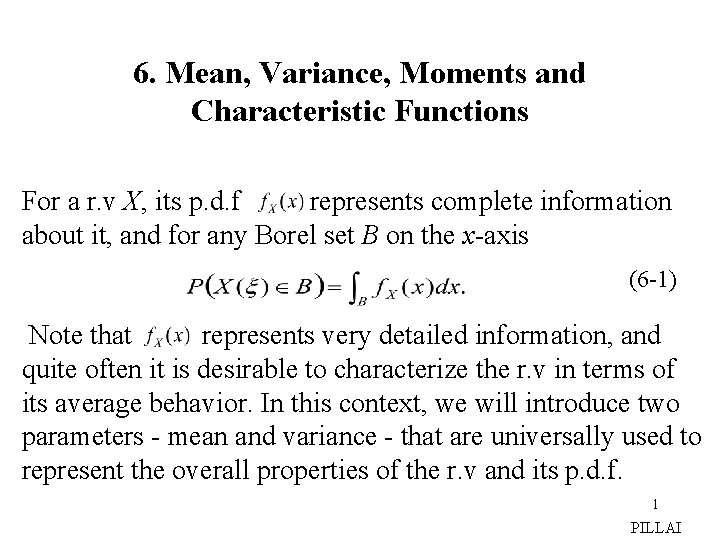
6. Mean, Variance, Moments and Characteristic Functions For a r. v X, its p. d. f represents complete information about it, and for any Borel set B on the x-axis (6 -1) Note that represents very detailed information, and quite often it is desirable to characterize the r. v in terms of its average behavior. In this context, we will introduce two parameters - mean and variance - that are universally used to represent the overall properties of the r. v and its p. d. f. 1 PILLAI
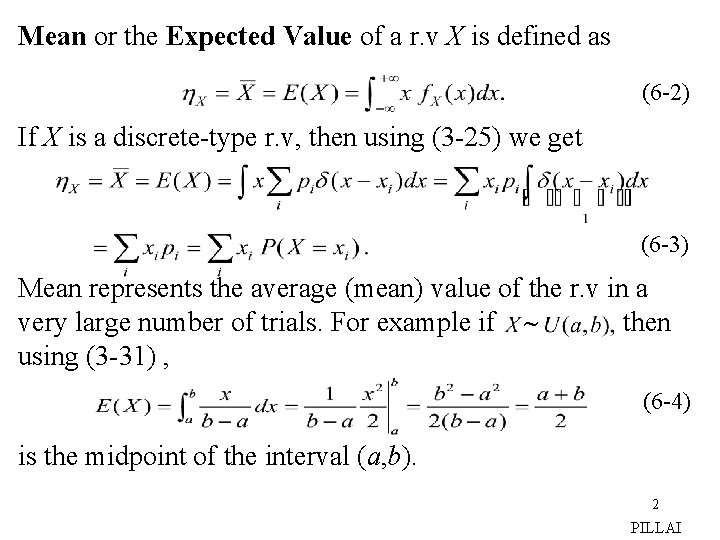
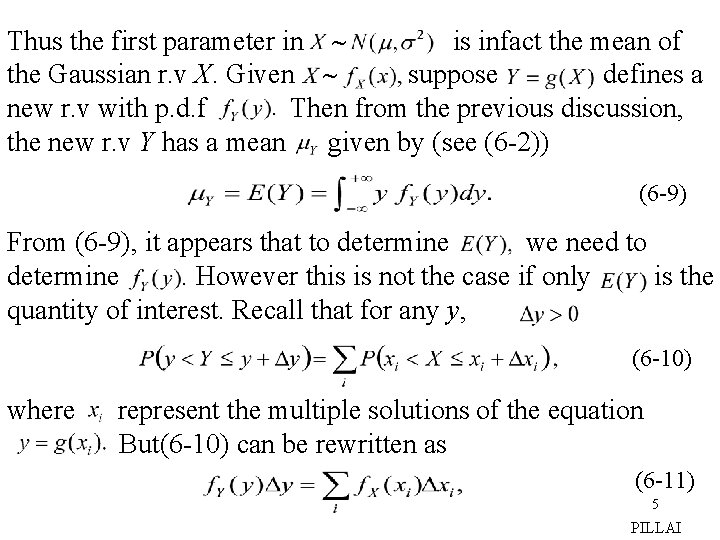
Mean or the Expected Value of a r. v X is defined as (6 -2) If X is a discrete-type r. v, then using (3 -25) we get (6 -3) Mean represents the average (mean) value of the r. v in a very large number of trials. For example if then using (3 -31) , (6 -4) is the midpoint of the interval (a, b). 2 PILLAI
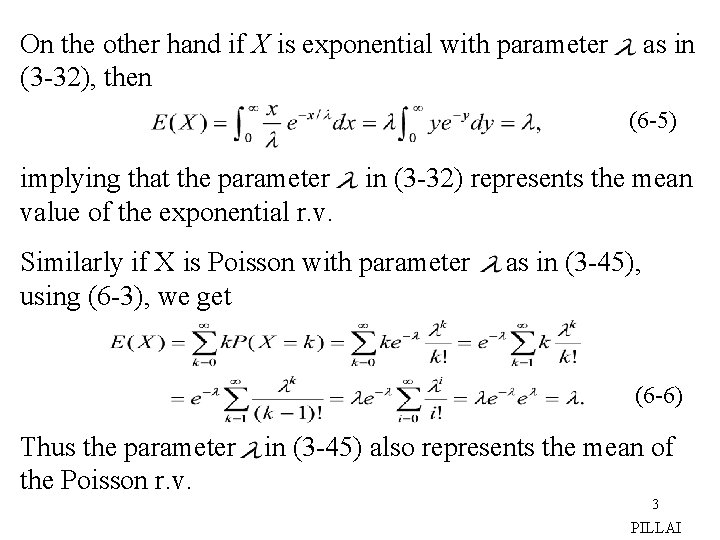
On the other hand if X is exponential with parameter (3 -32), then as in (6 -5) implying that the parameter value of the exponential r. v. in (3 -32) represents the mean Similarly if X is Poisson with parameter using (6 -3), we get as in (3 -45), (6 -6) Thus the parameter the Poisson r. v. in (3 -45) also represents the mean of 3 PILLAI
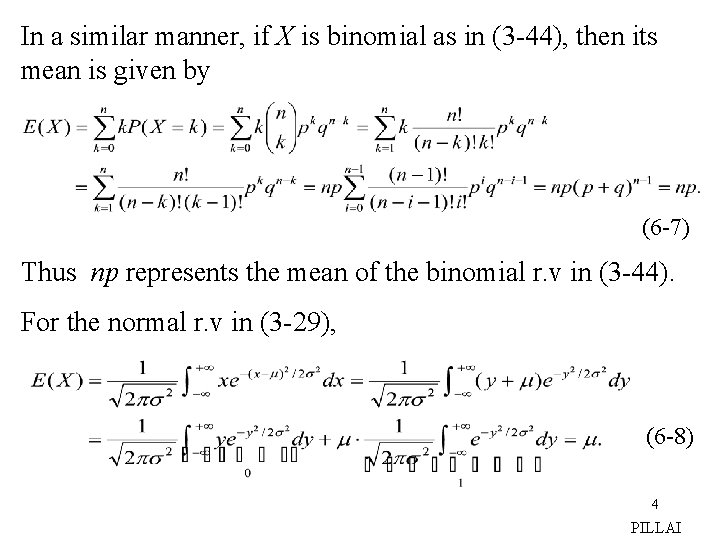
In a similar manner, if X is binomial as in (3 -44), then its mean is given by (6 -7) Thus np represents the mean of the binomial r. v in (3 -44). For the normal r. v in (3 -29), (6 -8) 4 PILLAI
Thus the first parameter in is infact the mean of the Gaussian r. v X. Given suppose defines a new r. v with p. d. f Then from the previous discussion, the new r. v Y has a mean given by (see (6 -2)) (6 -9) From (6 -9), it appears that to determine we need to determine However this is not the case if only is the quantity of interest. Recall that for any y, (6 -10) where represent the multiple solutions of the equation But(6 -10) can be rewritten as (6 -11) 5 PILLAI
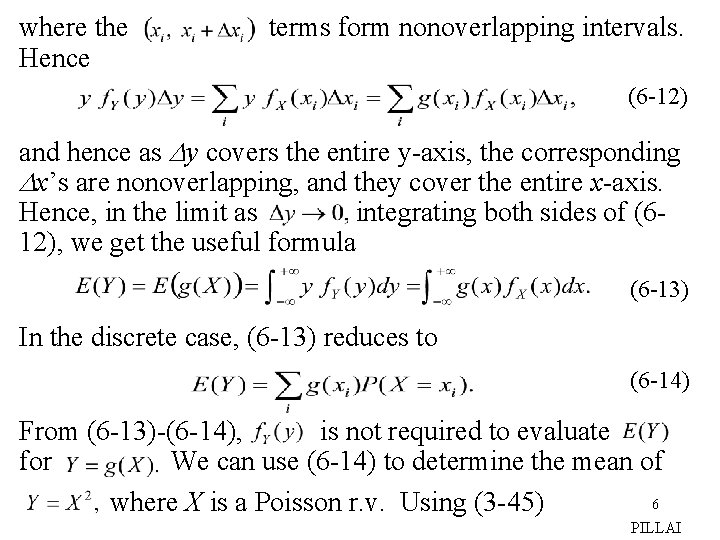
where the Hence terms form nonoverlapping intervals. (6 -12) and hence as y covers the entire y-axis, the corresponding x’s are nonoverlapping, and they cover the entire x-axis. Hence, in the limit as integrating both sides of (612), we get the useful formula (6 -13) In the discrete case, (6 -13) reduces to (6 -14) From (6 -13)-(6 -14), is not required to evaluate for We can use (6 -14) to determine the mean of 6 where X is a Poisson r. v. Using (3 -45) PILLAI
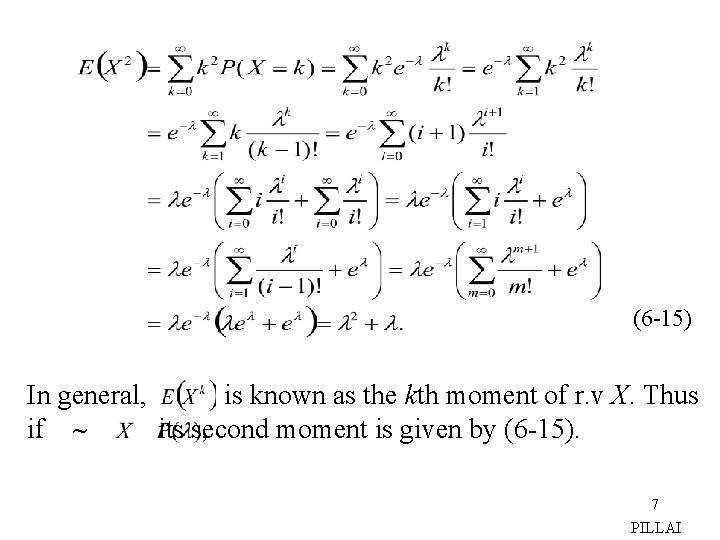
(6 -15) In general, is known as the kth moment of r. v X. Thus if its second moment is given by (6 -15). 7 PILLAI
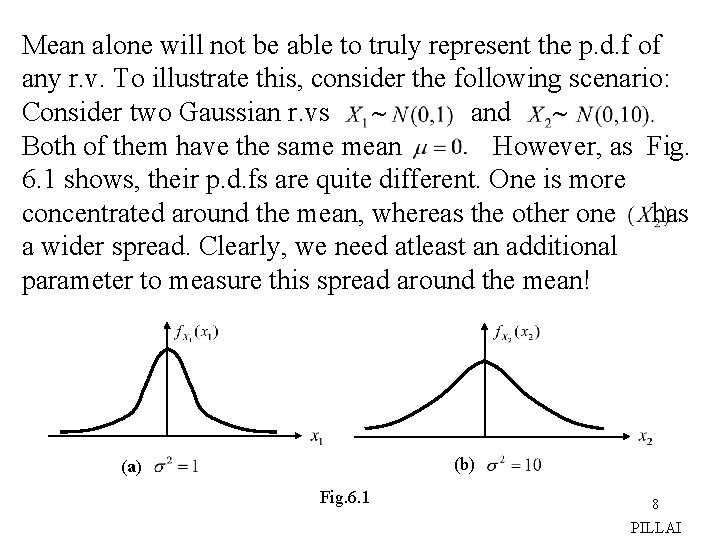
Mean alone will not be able to truly represent the p. d. f of any r. v. To illustrate this, consider the following scenario: Consider two Gaussian r. vs and Both of them have the same mean However, as Fig. 6. 1 shows, their p. d. fs are quite different. One is more concentrated around the mean, whereas the other one has a wider spread. Clearly, we need atleast an additional parameter to measure this spread around the mean! (b) (a) Fig. 6. 1 8 PILLAI
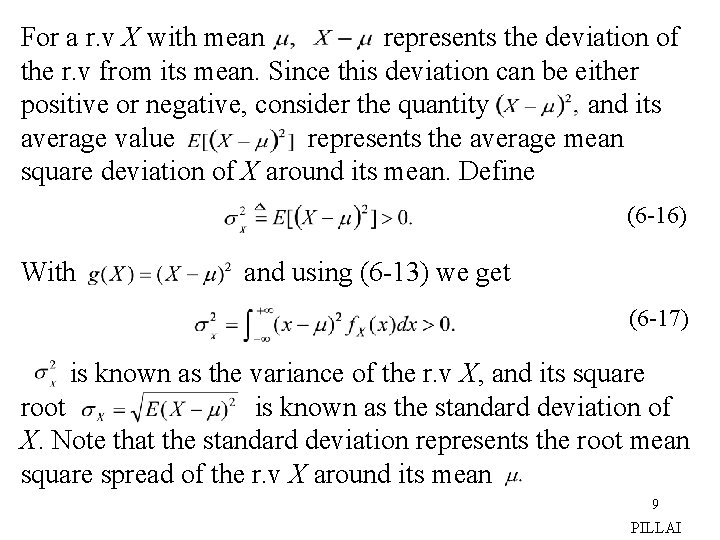
For a r. v X with mean represents the deviation of the r. v from its mean. Since this deviation can be either positive or negative, consider the quantity and its average value represents the average mean square deviation of X around its mean. Define (6 -16) With and using (6 -13) we get (6 -17) is known as the variance of the r. v X, and its square root is known as the standard deviation of X. Note that the standard deviation represents the root mean square spread of the r. v X around its mean 9 PILLAI
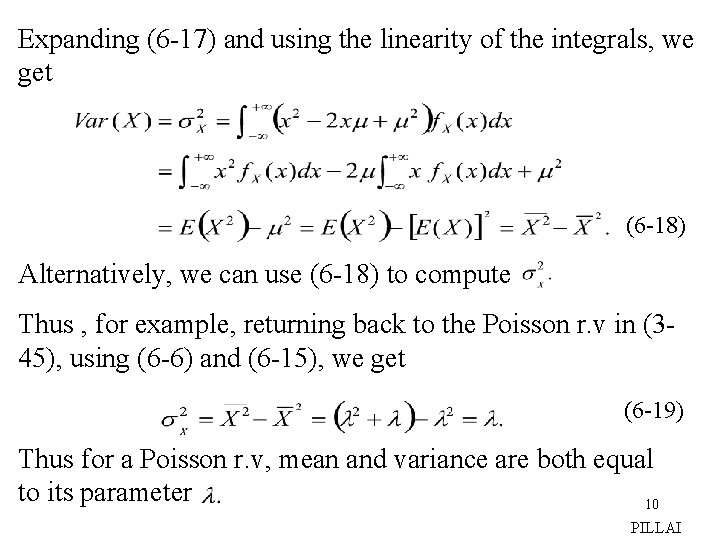
Expanding (6 -17) and using the linearity of the integrals, we get (6 -18) Alternatively, we can use (6 -18) to compute Thus , for example, returning back to the Poisson r. v in (345), using (6 -6) and (6 -15), we get (6 -19) Thus for a Poisson r. v, mean and variance are both equal to its parameter 10 PILLAI
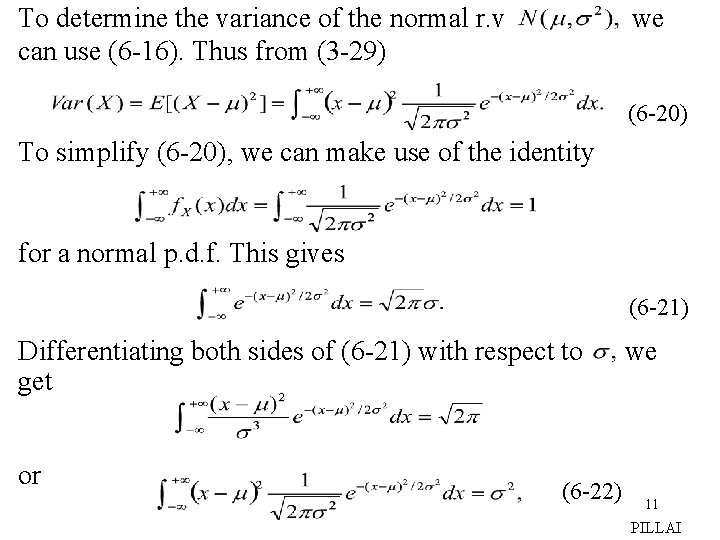
To determine the variance of the normal r. v can use (6 -16). Thus from (3 -29) we (6 -20) To simplify (6 -20), we can make use of the identity for a normal p. d. f. This gives (6 -21) Differentiating both sides of (6 -21) with respect to get or (6 -22) we 11 PILLAI
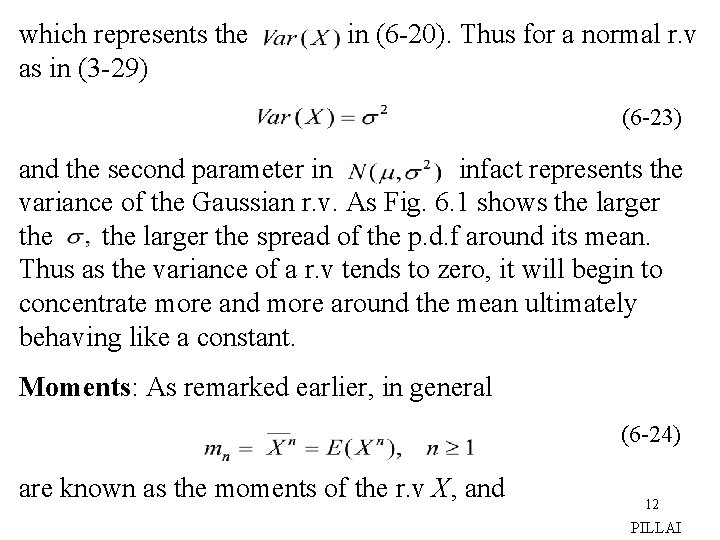
which represents the as in (3 -29) in (6 -20). Thus for a normal r. v (6 -23) and the second parameter in infact represents the variance of the Gaussian r. v. As Fig. 6. 1 shows the larger the spread of the p. d. f around its mean. Thus as the variance of a r. v tends to zero, it will begin to concentrate more and more around the mean ultimately behaving like a constant. Moments: As remarked earlier, in general (6 -24) are known as the moments of the r. v X, and 12 PILLAI
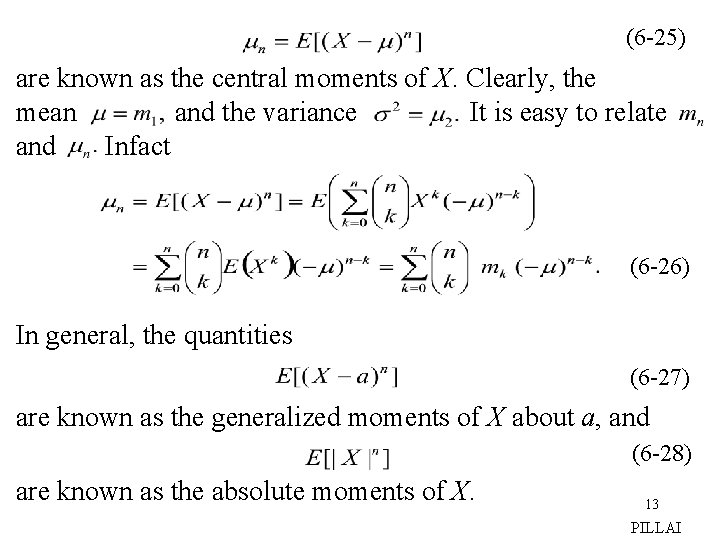
(6 -25) are known as the central moments of X. Clearly, the mean and the variance It is easy to relate and Infact (6 -26) In general, the quantities (6 -27) are known as the generalized moments of X about a, and (6 -28) are known as the absolute moments of X. 13 PILLAI
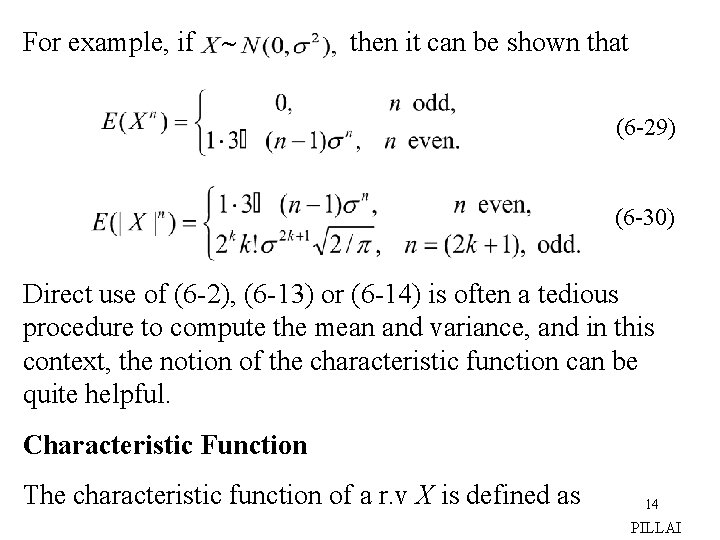
For example, if then it can be shown that (6 -29) (6 -30) Direct use of (6 -2), (6 -13) or (6 -14) is often a tedious procedure to compute the mean and variance, and in this context, the notion of the characteristic function can be quite helpful. Characteristic Function The characteristic function of a r. v X is defined as 14 PILLAI
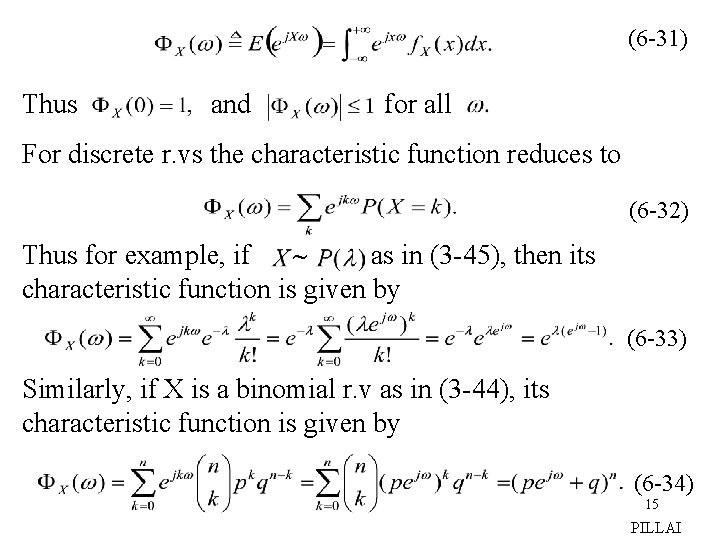
(6 -31) Thus and for all For discrete r. vs the characteristic function reduces to (6 -32) Thus for example, if as in (3 -45), then its characteristic function is given by (6 -33) Similarly, if X is a binomial r. v as in (3 -44), its characteristic function is given by (6 -34) 15 PILLAI
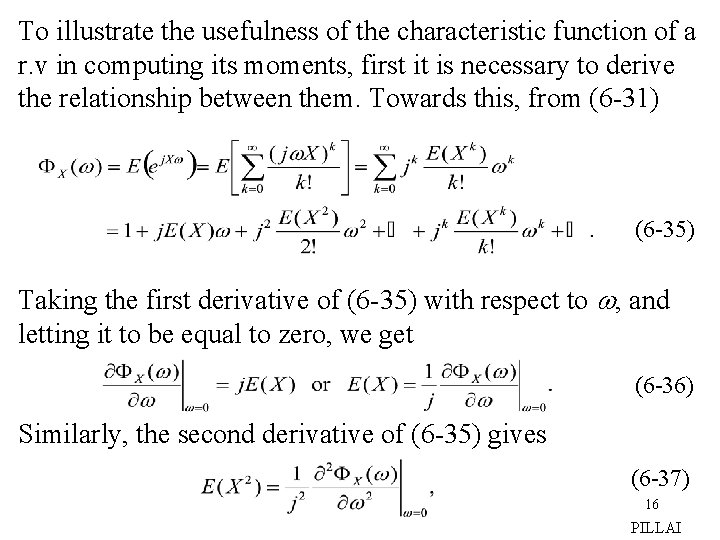
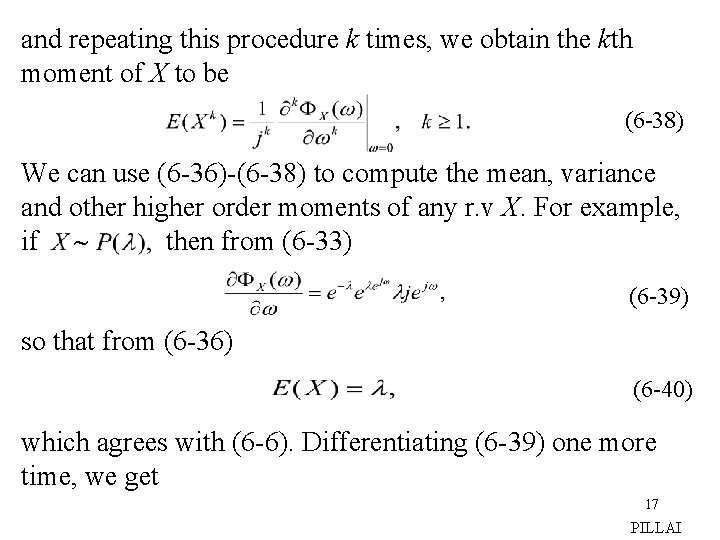
To illustrate the usefulness of the characteristic function of a r. v in computing its moments, first it is necessary to derive the relationship between them. Towards this, from (6 -31) (6 -35) Taking the first derivative of (6 -35) with respect to , and letting it to be equal to zero, we get (6 -36) Similarly, the second derivative of (6 -35) gives (6 -37) 16 PILLAI
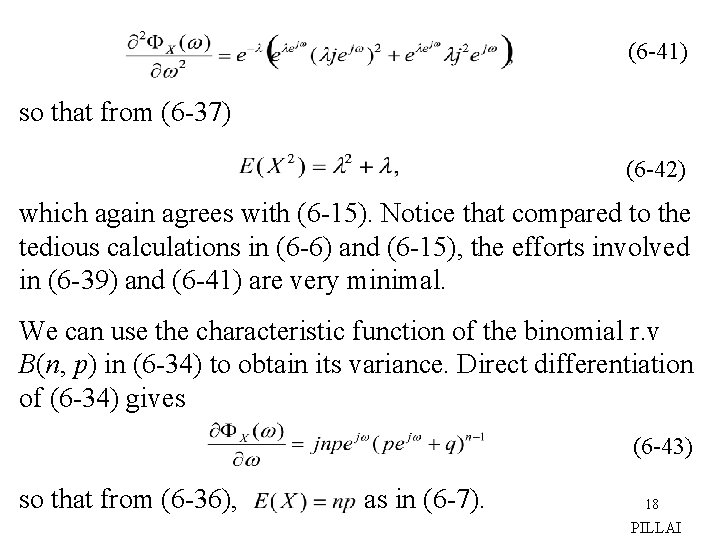
and repeating this procedure k times, we obtain the kth moment of X to be (6 -38) We can use (6 -36)-(6 -38) to compute the mean, variance and other higher order moments of any r. v X. For example, if then from (6 -33) (6 -39) so that from (6 -36) (6 -40) which agrees with (6 -6). Differentiating (6 -39) one more time, we get 17 PILLAI
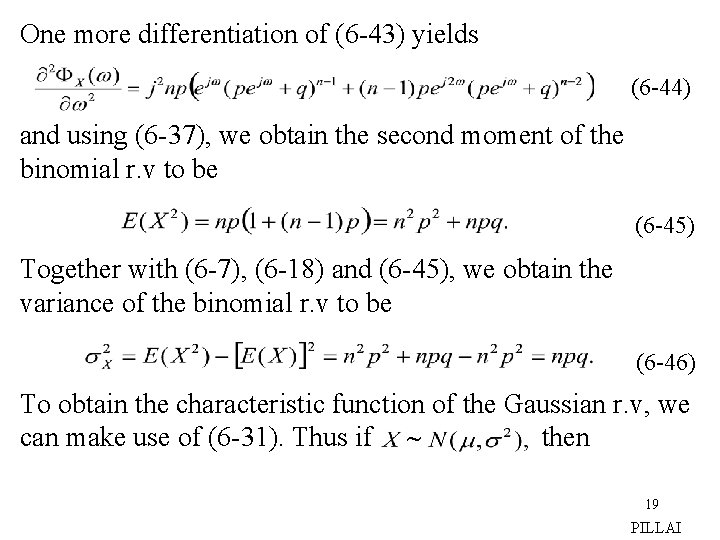
(6 -41) so that from (6 -37) (6 -42) which again agrees with (6 -15). Notice that compared to the tedious calculations in (6 -6) and (6 -15), the efforts involved in (6 -39) and (6 -41) are very minimal. We can use the characteristic function of the binomial r. v B(n, p) in (6 -34) to obtain its variance. Direct differentiation of (6 -34) gives (6 -43) so that from (6 -36), as in (6 -7). 18 PILLAI
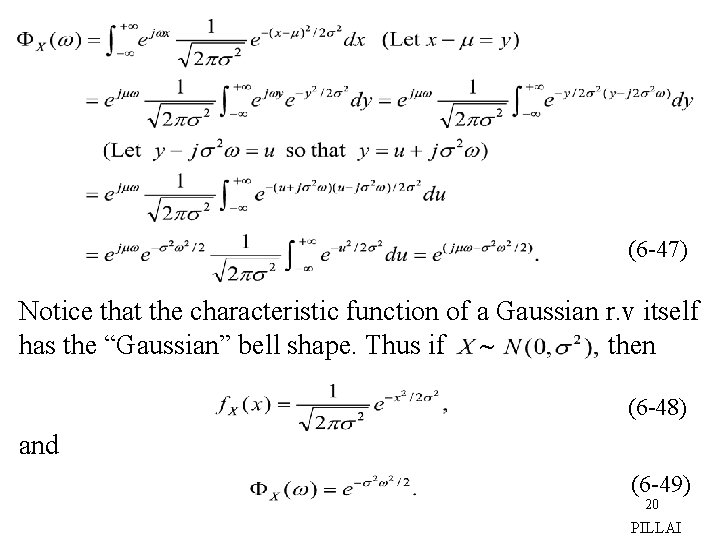
One more differentiation of (6 -43) yields (6 -44) and using (6 -37), we obtain the second moment of the binomial r. v to be (6 -45) Together with (6 -7), (6 -18) and (6 -45), we obtain the variance of the binomial r. v to be (6 -46) To obtain the characteristic function of the Gaussian r. v, we can make use of (6 -31). Thus if then 19 PILLAI
(6 -47) Notice that the characteristic function of a Gaussian r. v itself has the “Gaussian” bell shape. Thus if then (6 -48) and (6 -49) 20 PILLAI
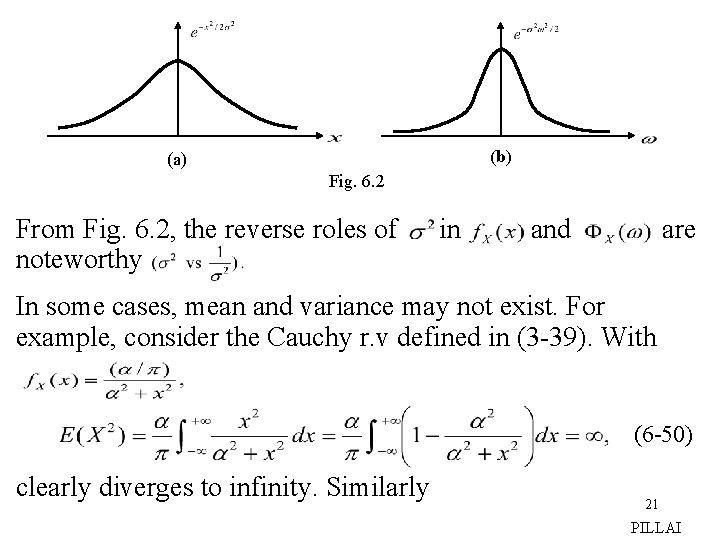
(b) (a) Fig. 6. 2 From Fig. 6. 2, the reverse roles of noteworthy in and are In some cases, mean and variance may not exist. For example, consider the Cauchy r. v defined in (3 -39). With (6 -50) clearly diverges to infinity. Similarly 21 PILLAI
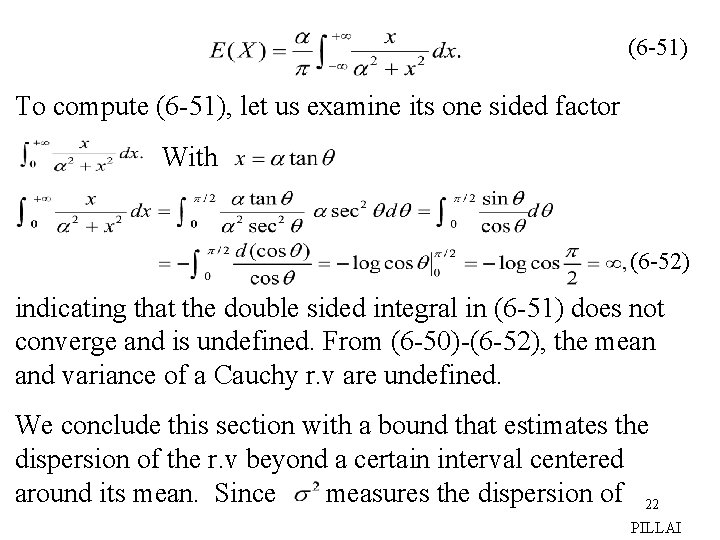
(6 -51) To compute (6 -51), let us examine its one sided factor With (6 -52) indicating that the double sided integral in (6 -51) does not converge and is undefined. From (6 -50)-(6 -52), the mean and variance of a Cauchy r. v are undefined. We conclude this section with a bound that estimates the dispersion of the r. v beyond a certain interval centered around its mean. Since measures the dispersion of 22 PILLAI
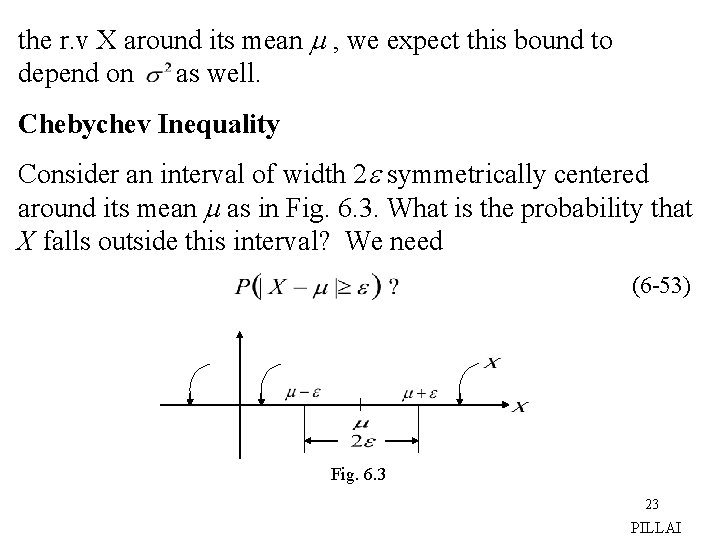
the r. v X around its mean , we expect this bound to depend on as well. Chebychev Inequality Consider an interval of width 2 symmetrically centered around its mean as in Fig. 6. 3. What is the probability that X falls outside this interval? We need (6 -53) Fig. 6. 3 23 PILLAI
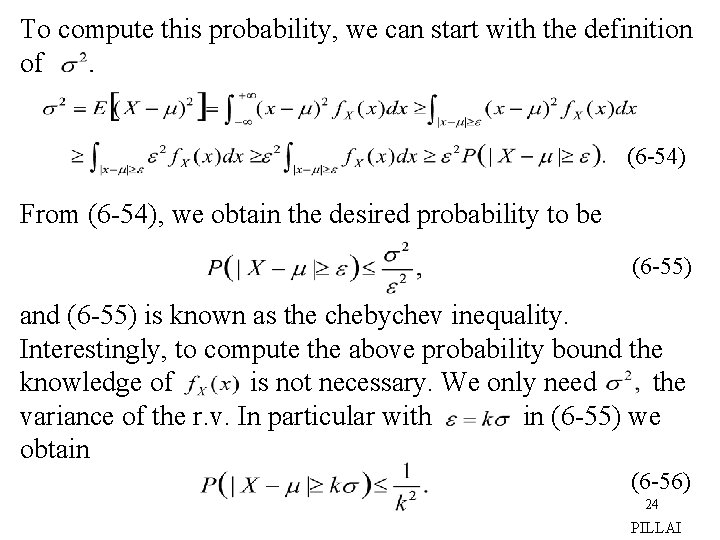
To compute this probability, we can start with the definition of (6 -54) From (6 -54), we obtain the desired probability to be (6 -55) and (6 -55) is known as the chebychev inequality. Interestingly, to compute the above probability bound the knowledge of is not necessary. We only need the variance of the r. v. In particular with in (6 -55) we obtain (6 -56) 24 PILLAI
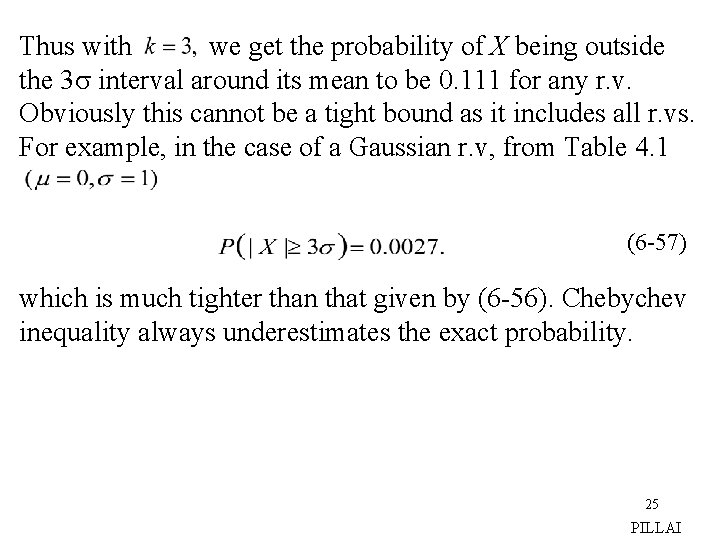
Thus with we get the probability of X being outside the 3 interval around its mean to be 0. 111 for any r. v. Obviously this cannot be a tight bound as it includes all r. vs. For example, in the case of a Gaussian r. v, from Table 4. 1 (6 -57) which is much tighter than that given by (6 -56). Chebychev inequality always underestimates the exact probability. 25 PILLAI
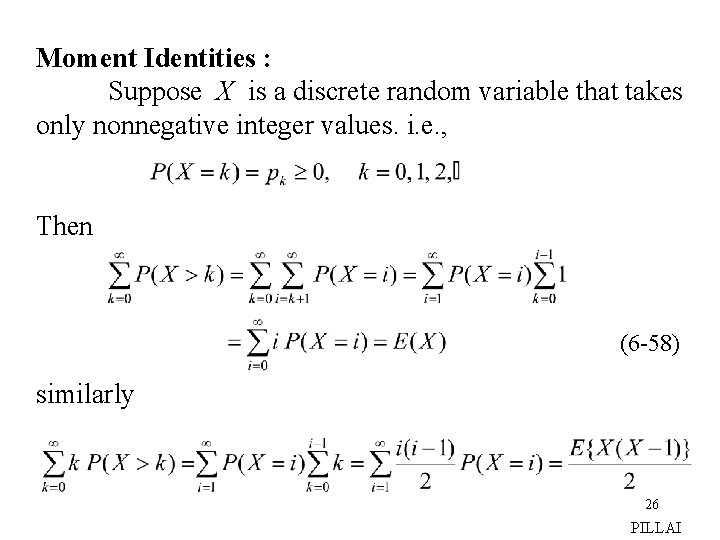
Moment Identities : Suppose X is a discrete random variable that takes only nonnegative integer values. i. e. , Then (6 -58) similarly 26 PILLAI
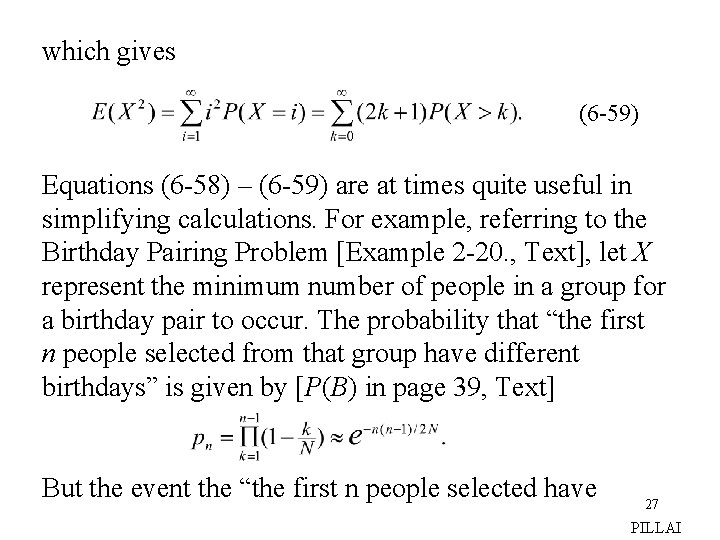
which gives (6 -59) Equations (6 -58) – (6 -59) are at times quite useful in simplifying calculations. For example, referring to the Birthday Pairing Problem [Example 2 -20. , Text], let X represent the minimum number of people in a group for a birthday pair to occur. The probability that “the first n people selected from that group have different birthdays” is given by [P(B) in page 39, Text] But the event the “the first n people selected have 27 PILLAI
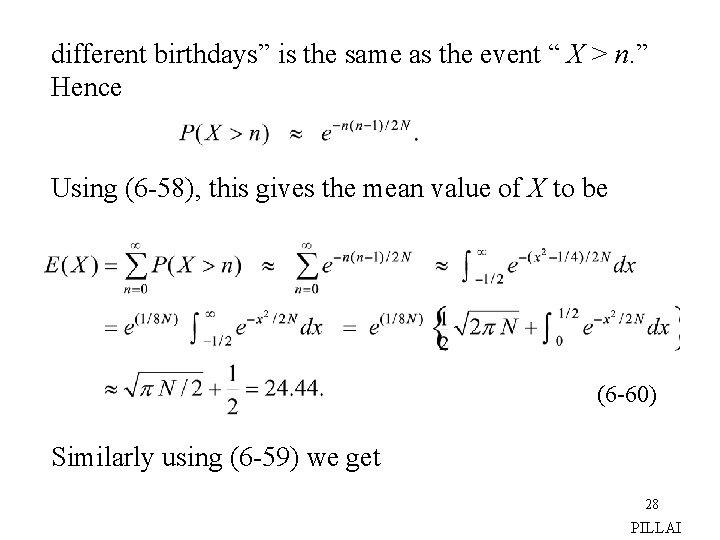
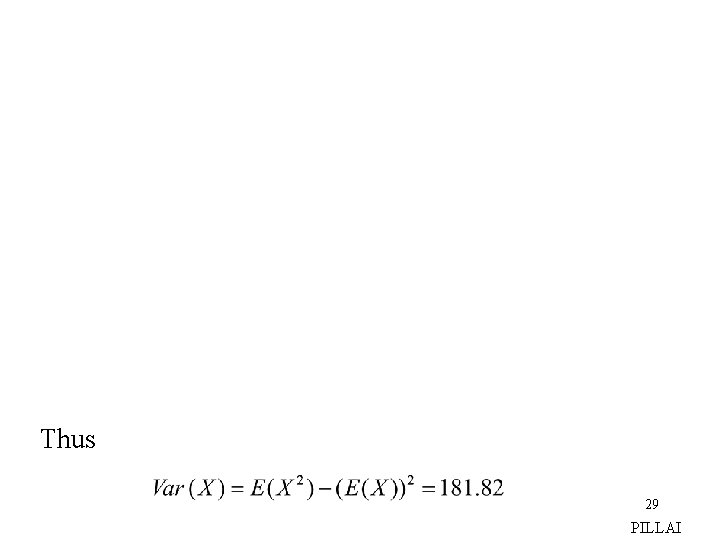
different birthdays” is the same as the event “ X > n. ” Hence Using (6 -58), this gives the mean value of X to be (6 -60) Similarly using (6 -59) we get 28 PILLAI
Thus 29 PILLAI
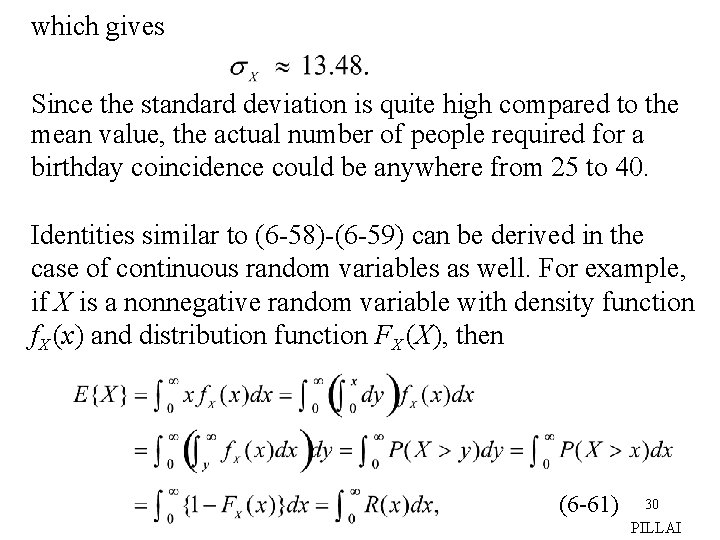
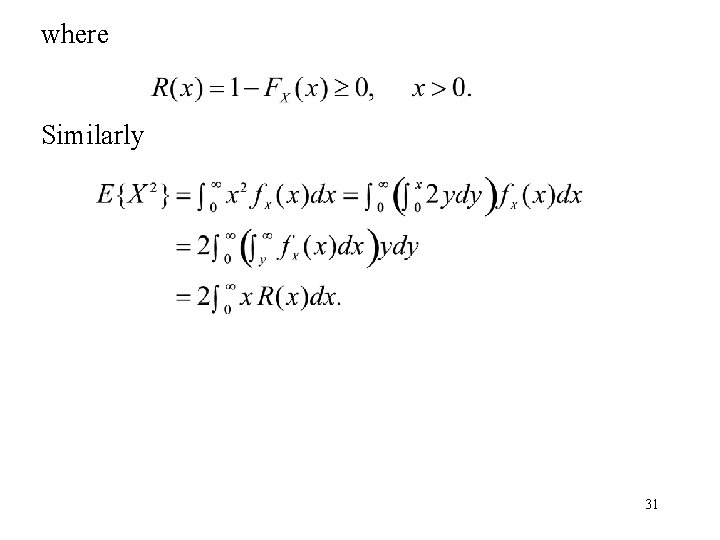
which gives Since the standard deviation is quite high compared to the mean value, the actual number of people required for a birthday coincidence could be anywhere from 25 to 40. Identities similar to (6 -58)-(6 -59) can be derived in the case of continuous random variables as well. For example, if X is a nonnegative random variable with density function f. X (x) and distribution function FX (X), then (6 -61) 30 PILLAI
where Similarly 31
A Baseball Trivia (Pete Rose and Dimaggio): In 1978 Pete Rose set a national league record by hitting a string of 44 games during a 162 game baseball season. How unusual was that event? As we shall see, that indeed was a rare event. In that context, we will answer the following question: What is the probability that someone in major league baseball will repeat that performance and possibly set a new record in the next 50 year period? The answer will put Pete Rose’s accomplishment in the proper perspective. Solution: As example 5 -32 (Text) shows consecutive successes in n trials correspond to a run of length r in n 32 PILLAI
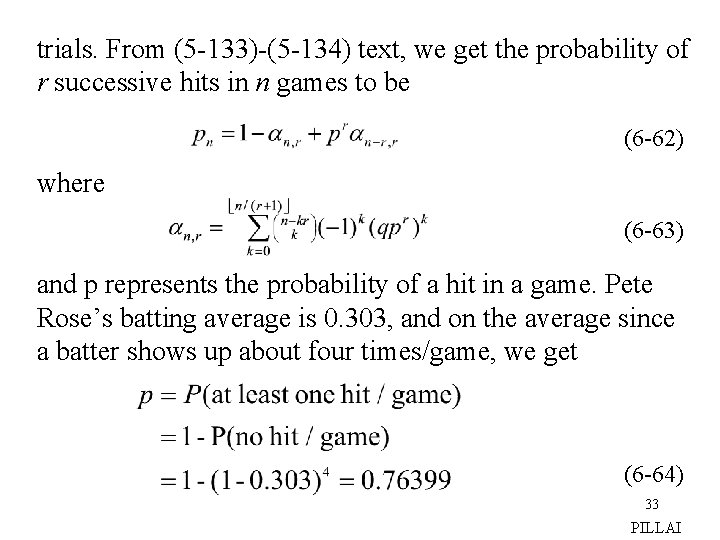
trials. From (5 -133)-(5 -134) text, we get the probability of r successive hits in n games to be (6 -62) where (6 -63) and p represents the probability of a hit in a game. Pete Rose’s batting average is 0. 303, and on the average since a batter shows up about four times/game, we get (6 -64) 33 PILLAI
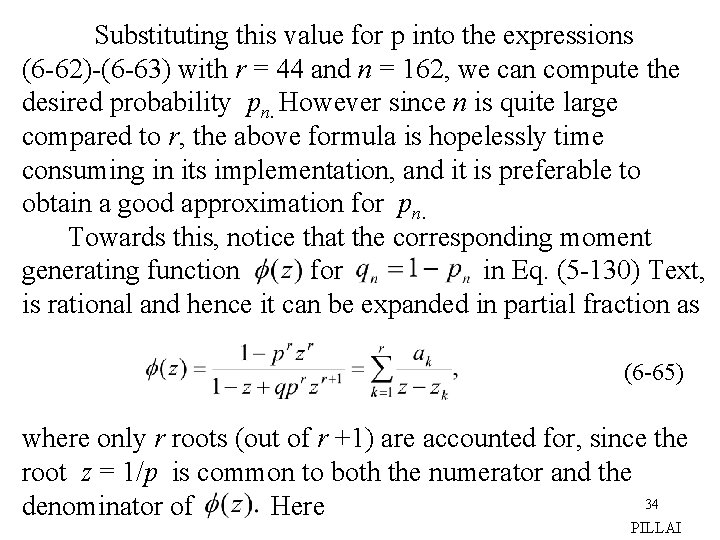
Substituting this value for p into the expressions (6 -62)-(6 -63) with r = 44 and n = 162, we can compute the desired probability pn. However since n is quite large compared to r, the above formula is hopelessly time consuming in its implementation, and it is preferable to obtain a good approximation for pn. Towards this, notice that the corresponding moment generating function for in Eq. (5 -130) Text, is rational and hence it can be expanded in partial fraction as (6 -65) where only r roots (out of r +1) are accounted for, since the root z = 1/p is common to both the numerator and the 34 denominator of Here PILLAI
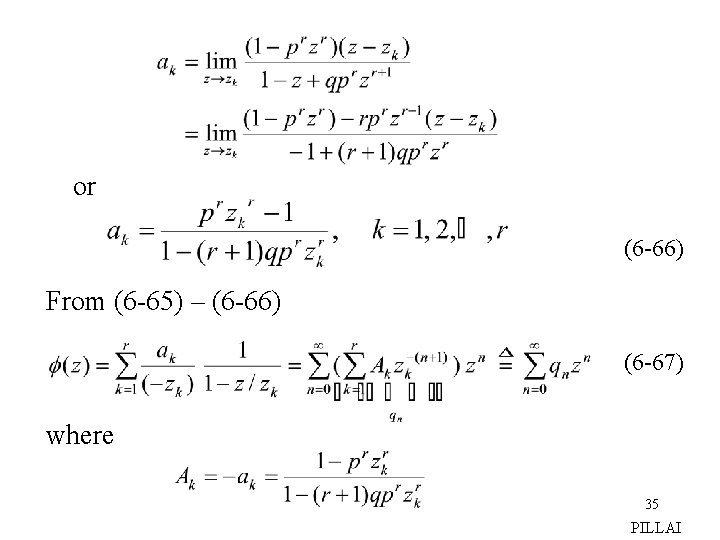
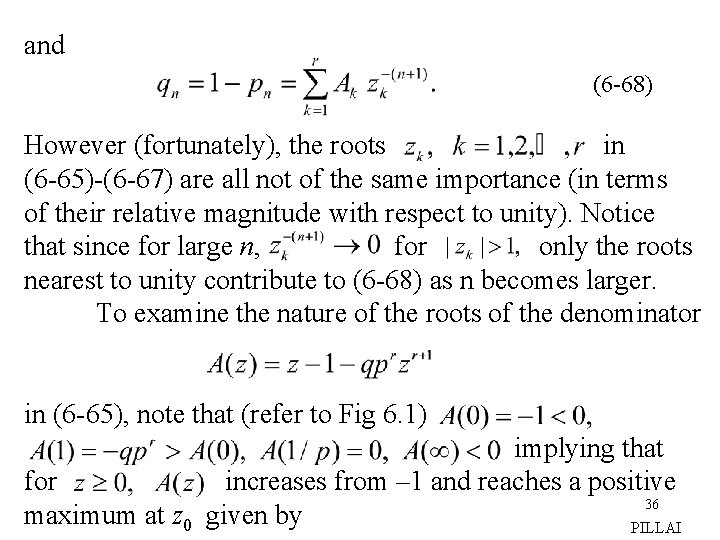
or (6 -66) From (6 -65) – (6 -66) (6 -67) where 35 PILLAI
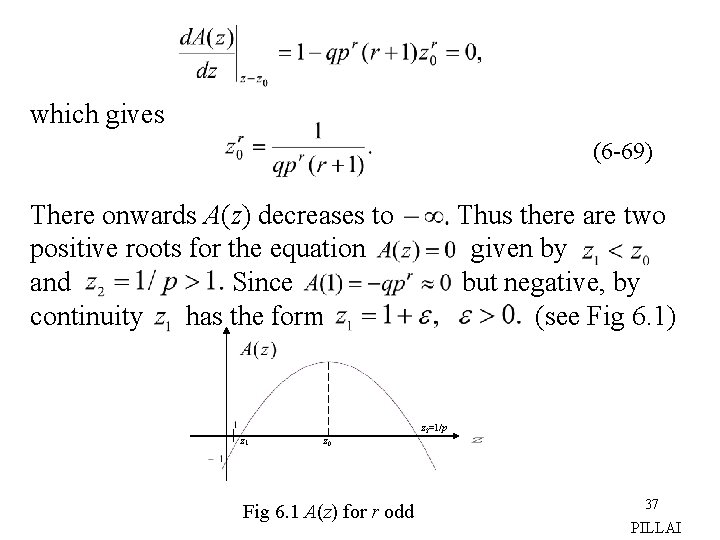
and (6 -68) However (fortunately), the roots in (6 -65)-(6 -67) are all not of the same importance (in terms of their relative magnitude with respect to unity). Notice that since for large n, for only the roots nearest to unity contribute to (6 -68) as n becomes larger. To examine the nature of the roots of the denominator in (6 -65), note that (refer to Fig 6. 1) implying that for increases from – 1 and reaches a positive 36 maximum at z 0 given by PILLAI
which gives (6 -69) There onwards A(z) decreases to positive roots for the equation and Since continuity has the form Thus there are two given by but negative, by (see Fig 6. 1) z 2=1/p z 1 z 0 Fig 6. 1 A(z) for r odd 37 PILLAI
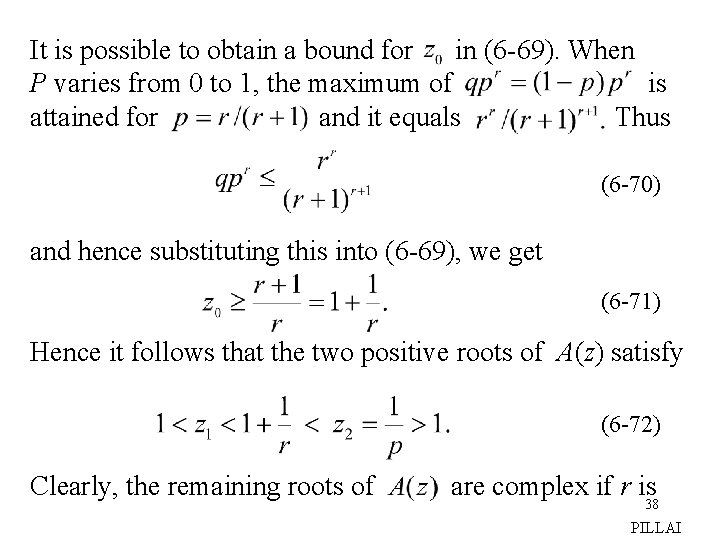
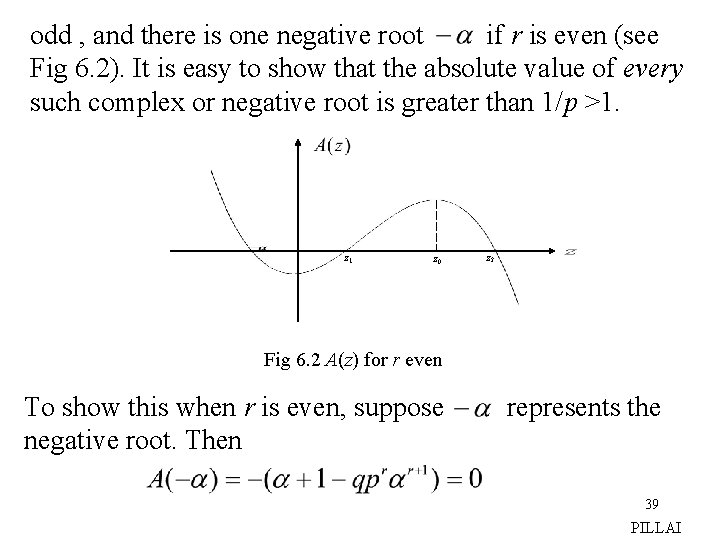
It is possible to obtain a bound for in (6 -69). When P varies from 0 to 1, the maximum of is attained for and it equals Thus (6 -70) and hence substituting this into (6 -69), we get (6 -71) Hence it follows that the two positive roots of A(z) satisfy (6 -72) Clearly, the remaining roots of are complex if r is 38 PILLAI
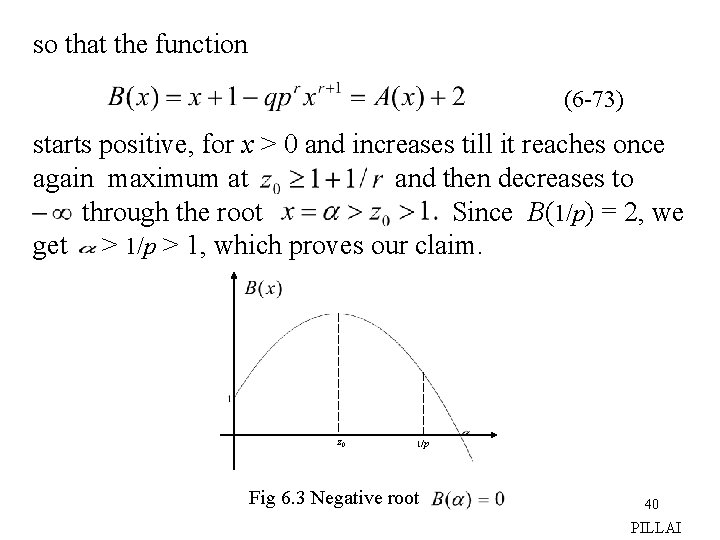
odd , and there is one negative root if r is even (see Fig 6. 2). It is easy to show that the absolute value of every such complex or negative root is greater than 1/p >1. z 1 z 0 z 2 Fig 6. 2 A(z) for r even To show this when r is even, suppose negative root. Then represents the 39 PILLAI
so that the function (6 -73) starts positive, for x > 0 and increases till it reaches once again maximum at and then decreases to through the root Since B(1/p) = 2, we get > 1/p > 1, which proves our claim. z 0 1/p Fig 6. 3 Negative root 40 PILLAI
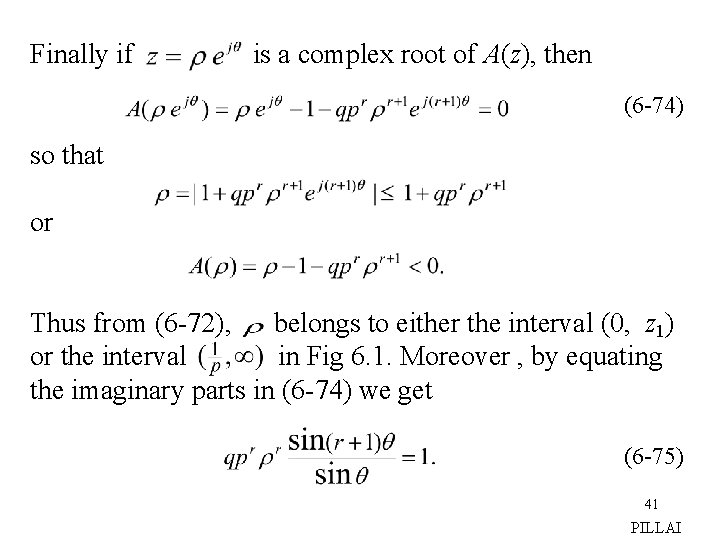
Finally if is a complex root of A(z), then (6 -74) so that or Thus from (6 -72), belongs to either the interval (0, z 1) or the interval in Fig 6. 1. Moreover , by equating the imaginary parts in (6 -74) we get (6 -75) 41 PILLAI
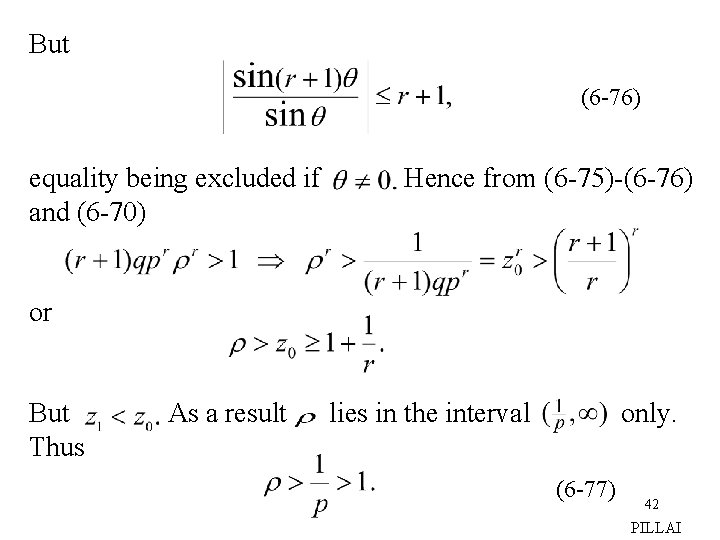
But (6 -76) equality being excluded if and (6 -70) Hence from (6 -75)-(6 -76) or But Thus As a result lies in the interval only. (6 -77) 42 PILLAI
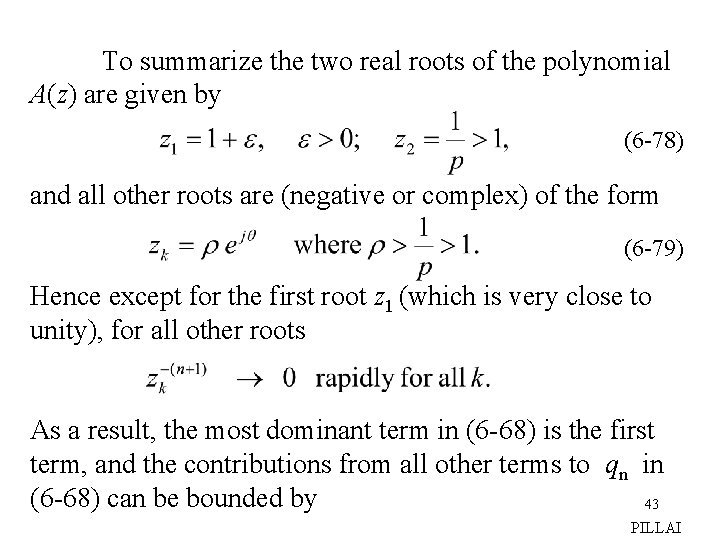
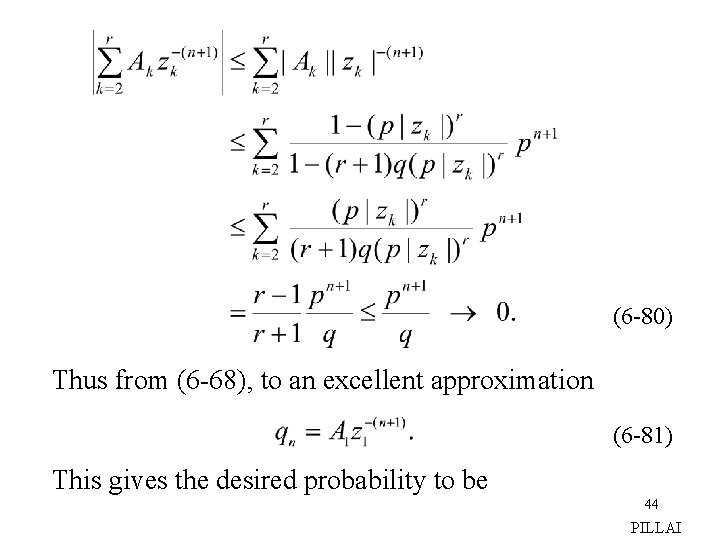
To summarize the two real roots of the polynomial A(z) are given by (6 -78) and all other roots are (negative or complex) of the form (6 -79) Hence except for the first root z 1 (which is very close to unity), for all other roots As a result, the most dominant term in (6 -68) is the first term, and the contributions from all other terms to qn in (6 -68) can be bounded by 43 PILLAI
(6 -80) Thus from (6 -68), to an excellent approximation (6 -81) This gives the desired probability to be 44 PILLAI
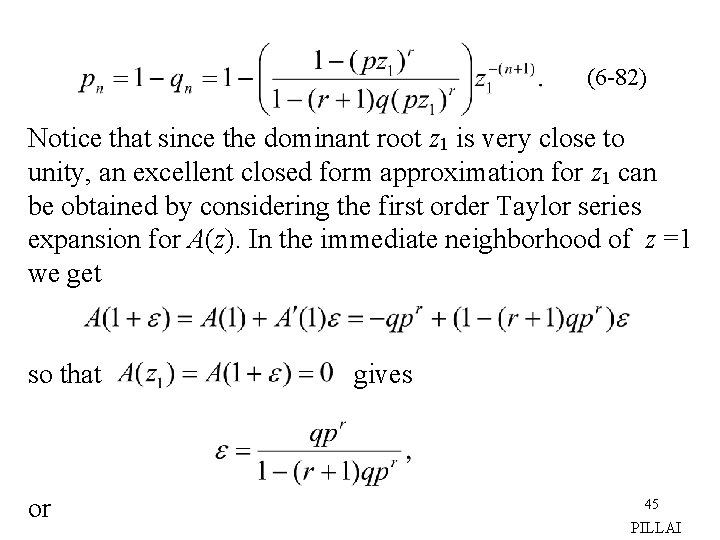
(6 -82) Notice that since the dominant root z 1 is very close to unity, an excellent closed form approximation for z 1 can be obtained by considering the first order Taylor series expansion for A(z). In the immediate neighborhood of z =1 we get so that or gives 45 PILLAI
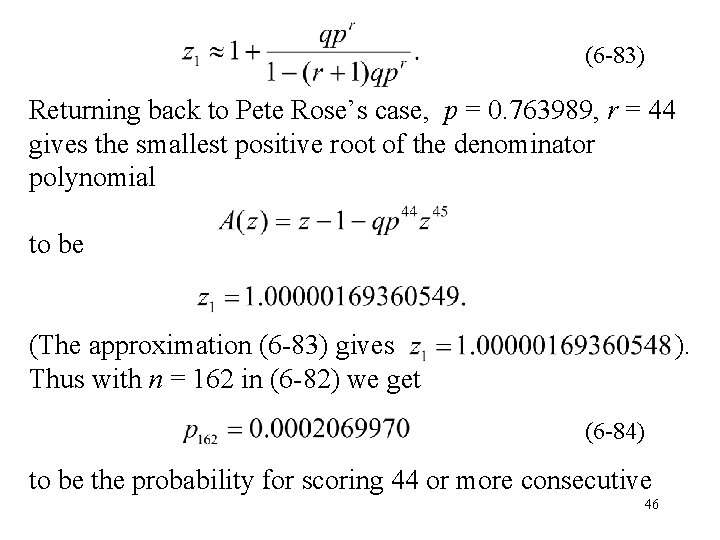
(6 -83) Returning back to Pete Rose’s case, p = 0. 763989, r = 44 gives the smallest positive root of the denominator polynomial to be (The approximation (6 -83) gives Thus with n = 162 in (6 -82) we get ). (6 -84) to be the probability for scoring 44 or more consecutive 46
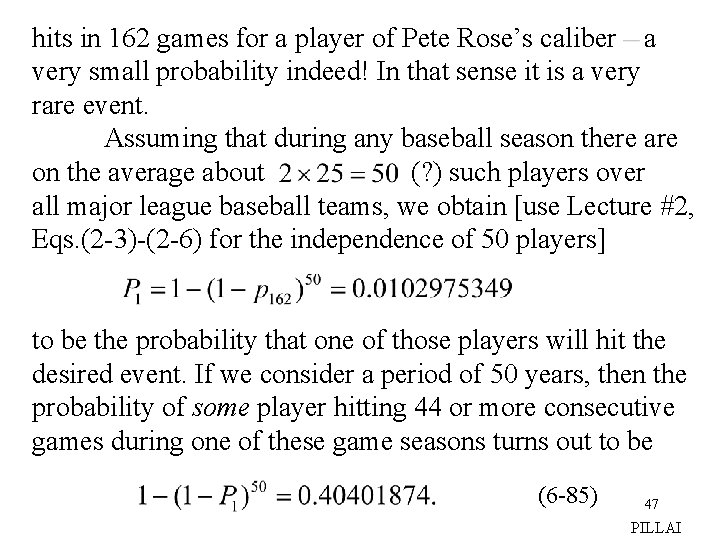
hits in 162 games for a player of Pete Rose’s caliber a very small probability indeed! In that sense it is a very rare event. Assuming that during any baseball season there are on the average about (? ) such players over all major league baseball teams, we obtain [use Lecture #2, Eqs. (2 -3)-(2 -6) for the independence of 50 players] to be the probability that one of those players will hit the desired event. If we consider a period of 50 years, then the probability of some player hitting 44 or more consecutive games during one of these game seasons turns out to be (6 -85) 47 PILLAI
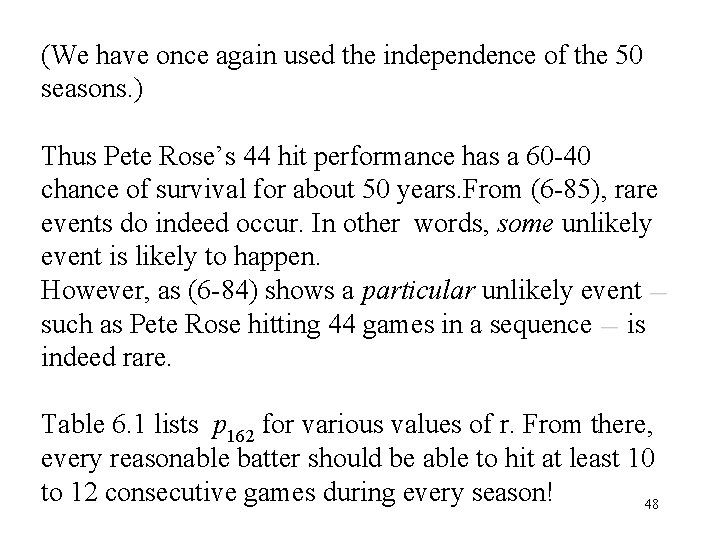
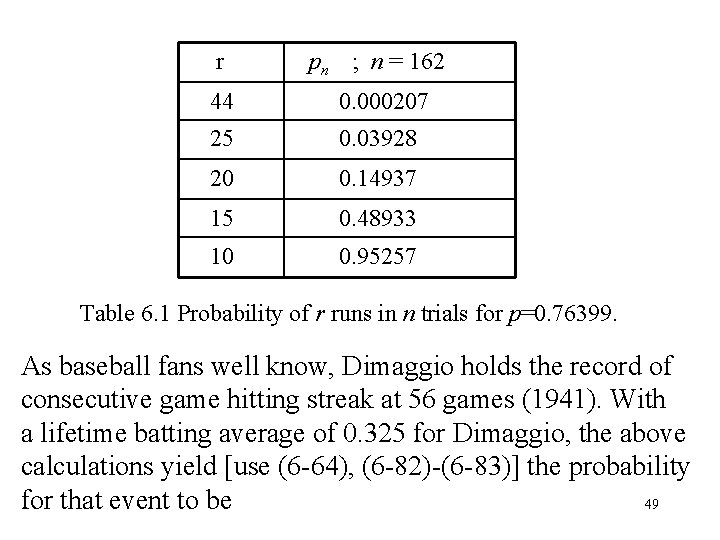
(We have once again used the independence of the 50 seasons. ) Thus Pete Rose’s 44 hit performance has a 60 -40 chance of survival for about 50 years. From (6 -85), rare events do indeed occur. In other words, some unlikely event is likely to happen. However, as (6 -84) shows a particular unlikely event such as Pete Rose hitting 44 games in a sequence is indeed rare. Table 6. 1 lists p 162 for various values of r. From there, every reasonable batter should be able to hit at least 10 to 12 consecutive games during every season! 48
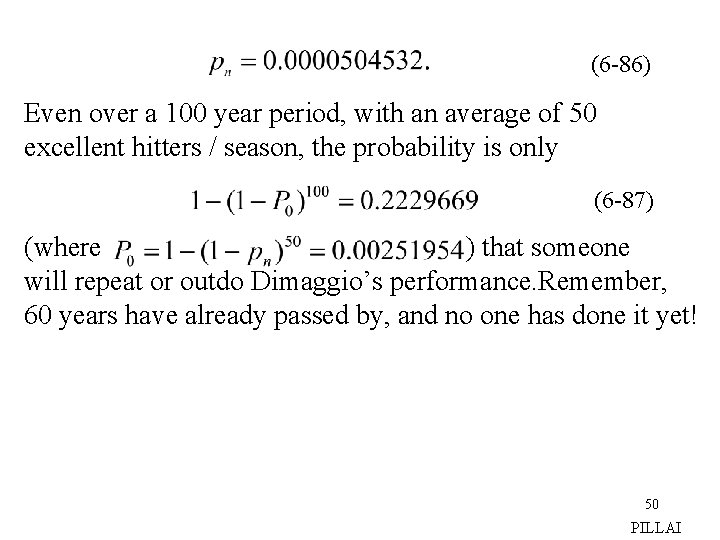
r pn ; n = 162 44 0. 000207 25 0. 03928 20 0. 14937 15 0. 48933 10 0. 95257 Table 6. 1 Probability of r runs in n trials for p=0. 76399. As baseball fans well know, Dimaggio holds the record of consecutive game hitting streak at 56 games (1941). With a lifetime batting average of 0. 325 for Dimaggio, the above calculations yield [use (6 -64), (6 -82)-(6 -83)] the probability for that event to be 49
(6 -86) Even over a 100 year period, with an average of 50 excellent hitters / season, the probability is only (6 -87) (where ) that someone will repeat or outdo Dimaggio’s performance. Remember, 60 years have already passed by, and no one has done it yet! 50 PILLAI