
6 Major Ecosystems of the World Overview of







- Slides: 44
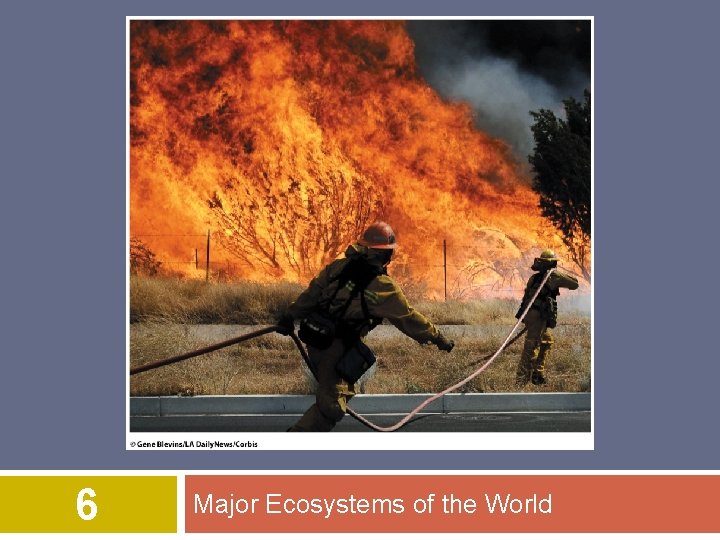
6 Major Ecosystems of the World
Overview of Chapter 6 Earth’s Major Biomes Aquatic Ecosystems � Freshwater ecosystems � Estuaries Marine Ecosystems Interaction of Life Zones and Humans © 2012 John Wiley & Sons, Inc. All rights reserved.
Earth’s Major Biomes Biome �A large, relatively distinct terrestrial region with a similar climate soil, plants, and animals, regardless of where it occurs in the world � Nine major biomes Location of each biome is primarily determined by: � Temperature elevation) � Precipitation (varies with both latitude and © 2012 John Wiley & Sons, Inc. All rights reserved.
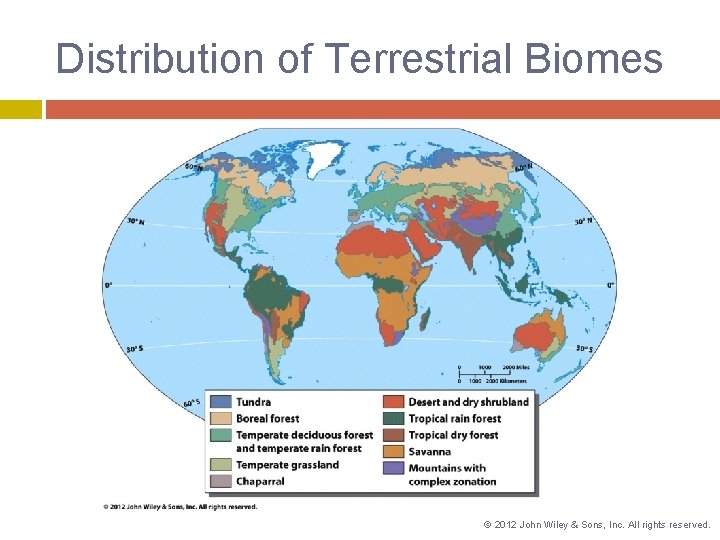
Distribution of Terrestrial Biomes © 2012 John Wiley & Sons, Inc. All rights reserved.
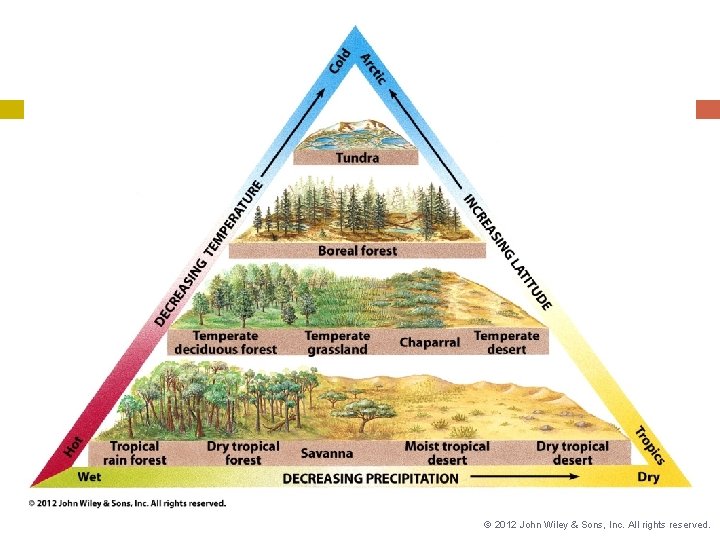
© 2012 John Wiley & Sons, Inc. All rights reserved.
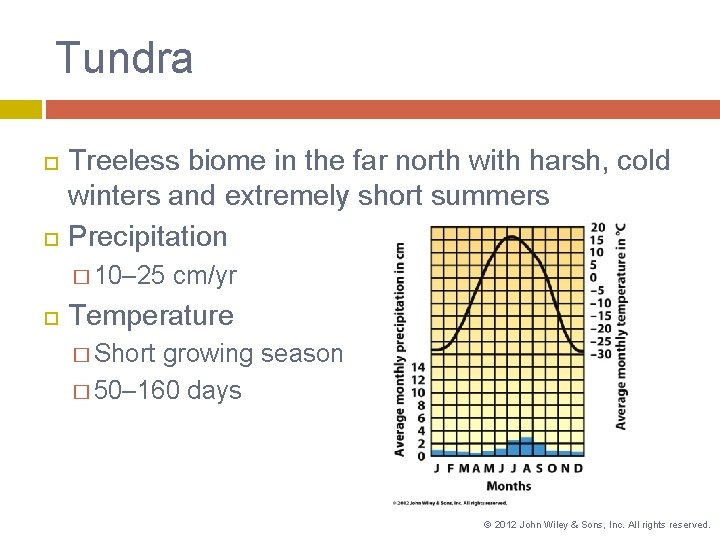
Tundra Treeless biome in the far north with harsh, cold winters and extremely short summers Precipitation � 10– 25 cm/yr Temperature � Short growing season � 50– 160 days © 2012 John Wiley & Sons, Inc. All rights reserved.
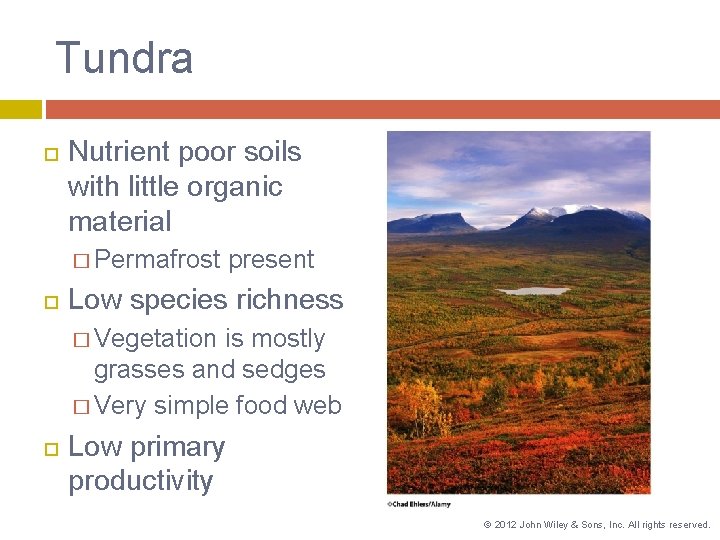
Tundra Nutrient poor soils with little organic material � Permafrost present Low species richness � Vegetation is mostly grasses and sedges � Very simple food web Low primary productivity © 2012 John Wiley & Sons, Inc. All rights reserved.
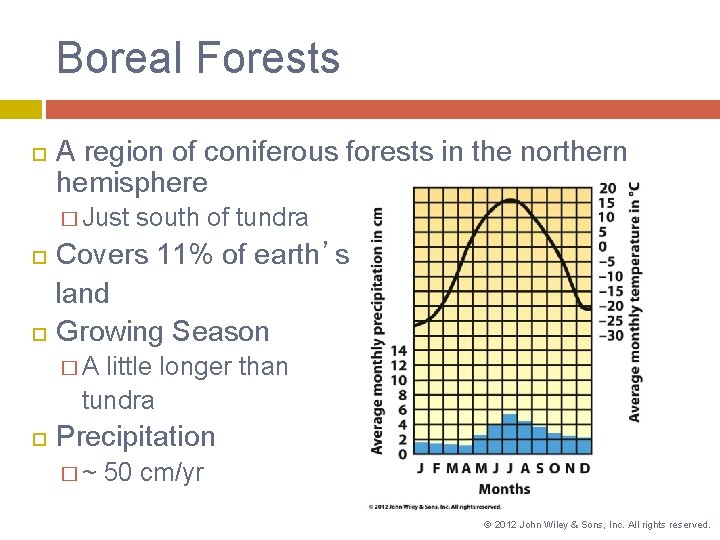
Boreal Forests A region of coniferous forests in the northern hemisphere � Just south of tundra Covers 11% of earth’s land Growing Season �A little longer than tundra Precipitation �~ 50 cm/yr © 2012 John Wiley & Sons, Inc. All rights reserved.
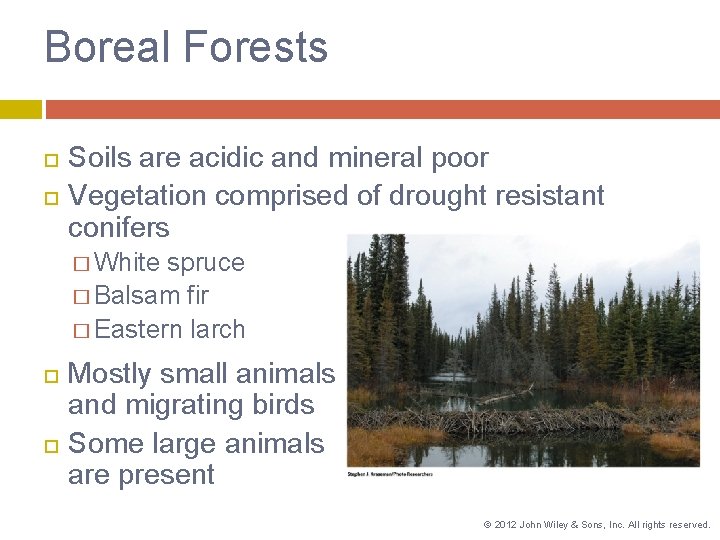
Boreal Forests Soils are acidic and mineral poor Vegetation comprised of drought resistant conifers � White spruce � Balsam fir � Eastern larch Mostly small animals and migrating birds Some large animals are present © 2012 John Wiley & Sons, Inc. All rights reserved.
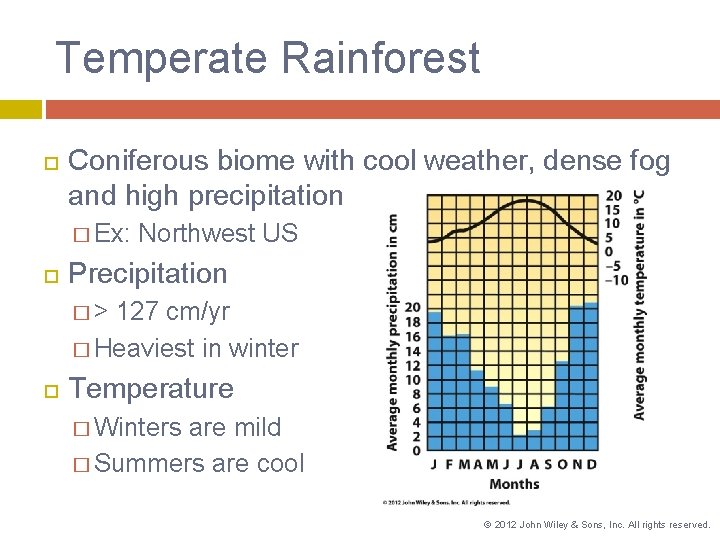
Temperate Rainforest Coniferous biome with cool weather, dense fog and high precipitation � Ex: Northwest US Precipitation �> 127 cm/yr � Heaviest in winter Temperature � Winters are mild � Summers are cool © 2012 John Wiley & Sons, Inc. All rights reserved.
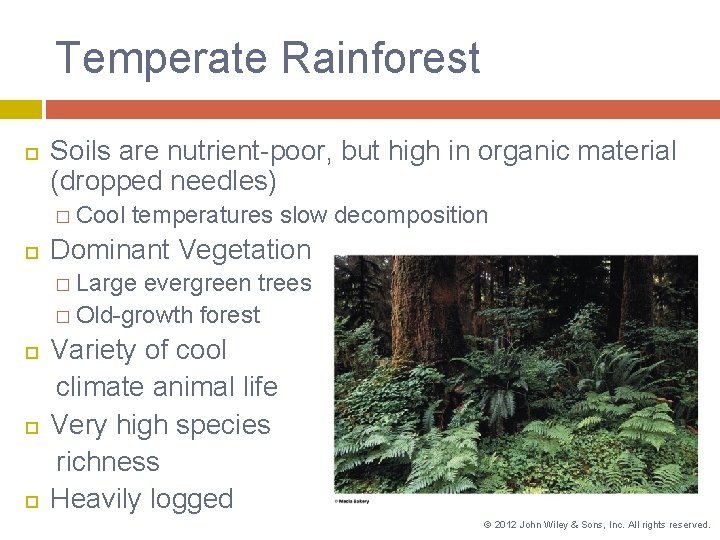
Temperate Rainforest Soils are nutrient-poor, but high in organic material (dropped needles) � Cool temperatures slow decomposition Dominant Vegetation � Large evergreen trees � Old-growth forest Variety of cool climate animal life Very high species richness Heavily logged © 2012 John Wiley & Sons, Inc. All rights reserved.
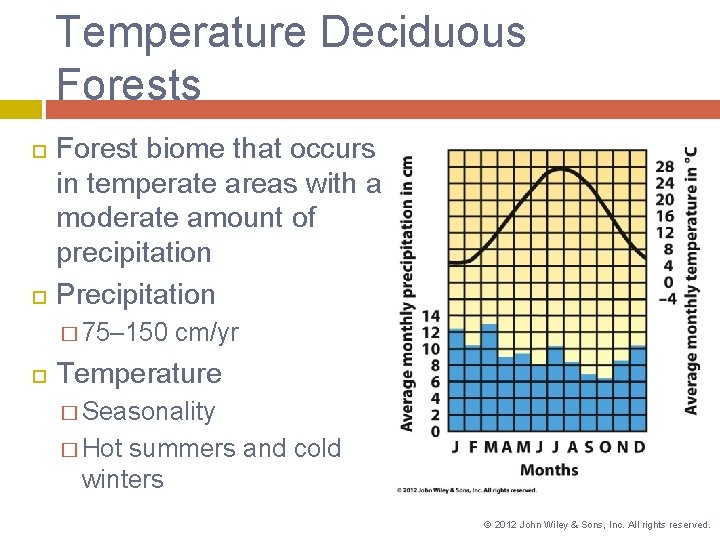
Temperature Deciduous Forests Forest biome that occurs in temperate areas with a moderate amount of precipitation Precipitation � 75– 150 cm/yr Temperature � Seasonality � Hot summers and cold winters © 2012 John Wiley & Sons, Inc. All rights reserved.
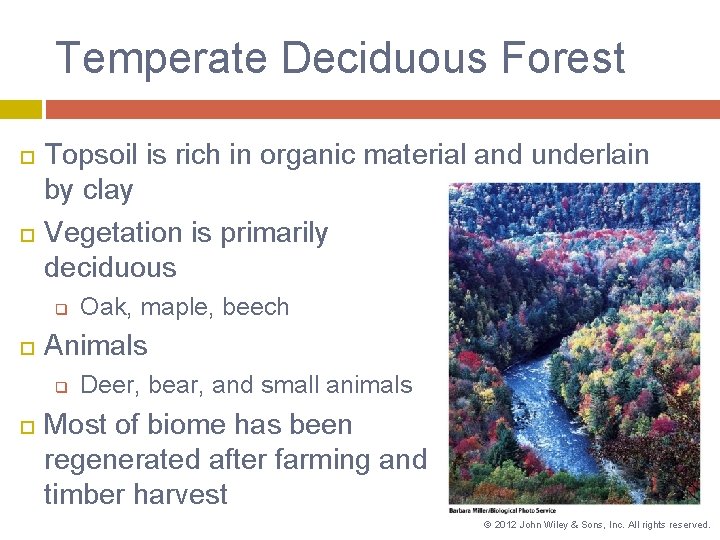
Temperate Deciduous Forest Topsoil is rich in organic material and underlain by clay Vegetation is primarily deciduous q Animals q Oak, maple, beech Deer, bear, and small animals Most of biome has been regenerated after farming and timber harvest © 2012 John Wiley & Sons, Inc. All rights reserved.
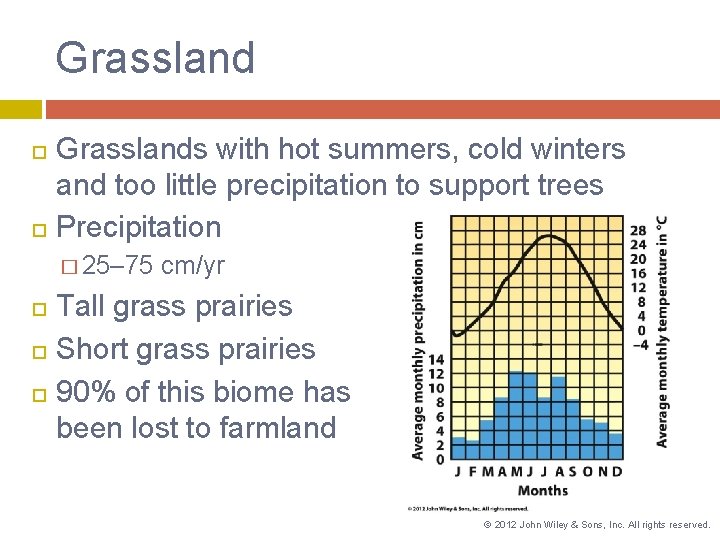
Grasslands with hot summers, cold winters and too little precipitation to support trees Precipitation � 25– 75 cm/yr Tall grass prairies Short grass prairies 90% of this biome has been lost to farmland © 2012 John Wiley & Sons, Inc. All rights reserved.
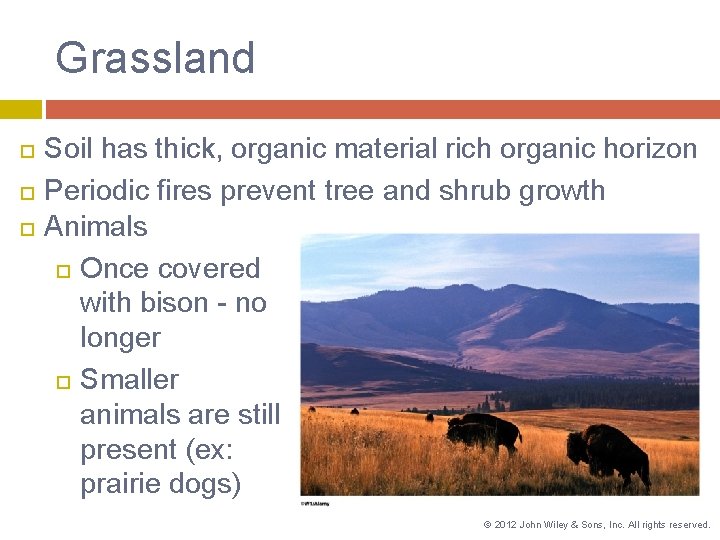
Grassland Soil has thick, organic material rich organic horizon Periodic fires prevent tree and shrub growth Animals Once covered with bison - no longer Smaller animals are still present (ex: prairie dogs) © 2012 John Wiley & Sons, Inc. All rights reserved.
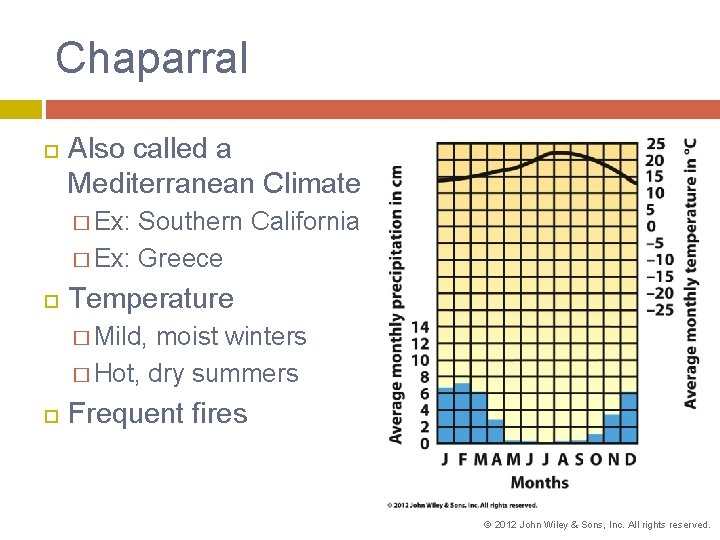
Chaparral Also called a Mediterranean Climate � Ex: Southern California � Ex: Greece Temperature � Mild, moist winters � Hot, dry summers Frequent fires © 2012 John Wiley & Sons, Inc. All rights reserved.
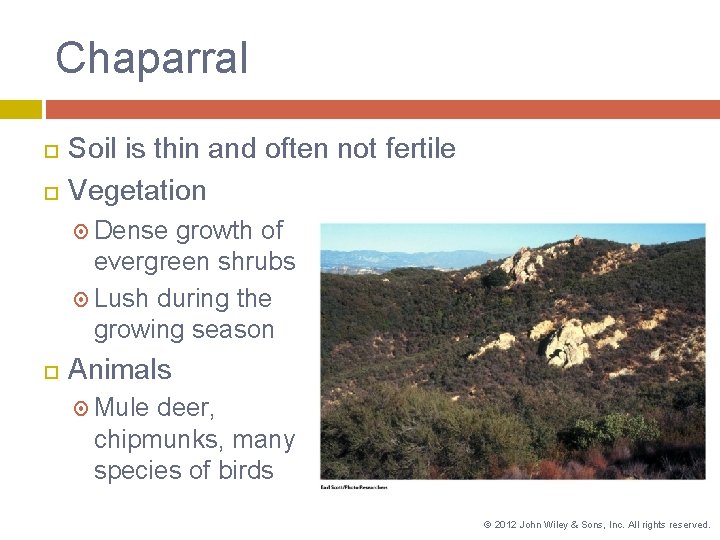
Chaparral Soil is thin and often not fertile Vegetation Dense growth of evergreen shrubs Lush during the growing season Animals Mule deer, chipmunks, many species of birds © 2012 John Wiley & Sons, Inc. All rights reserved.
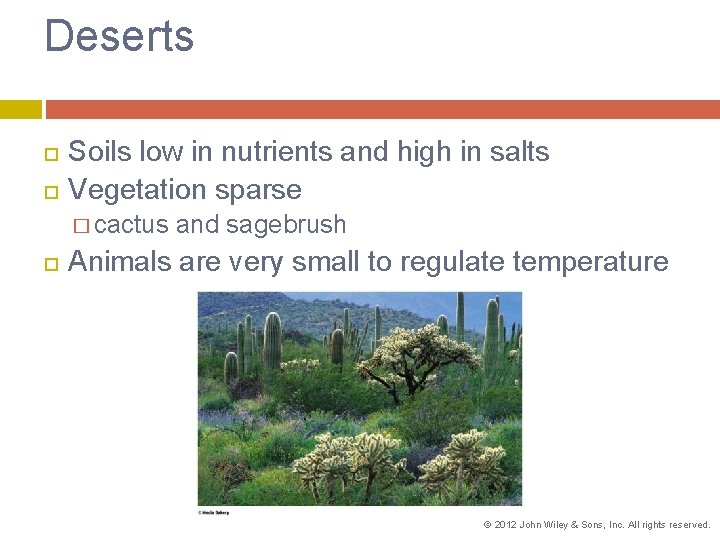
Deserts Biome where lack of precipitation limits plant growth Temperature � Can very greatly in 24 hr period, as well as yearly (based on location) Precipitation �< 25 cm/yr © 2012 John Wiley & Sons, Inc. All rights reserved.
Deserts Soils low in nutrients and high in salts Vegetation sparse � cactus and sagebrush Animals are very small to regulate temperature © 2012 John Wiley & Sons, Inc. All rights reserved.
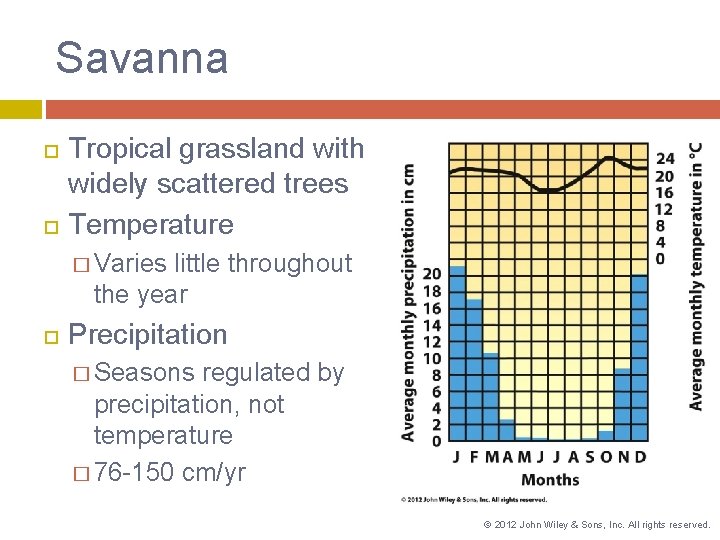
Savanna Tropical grassland with widely scattered trees Temperature � Varies little throughout the year Precipitation � Seasons regulated by precipitation, not temperature � 76 -150 cm/yr © 2012 John Wiley & Sons, Inc. All rights reserved.
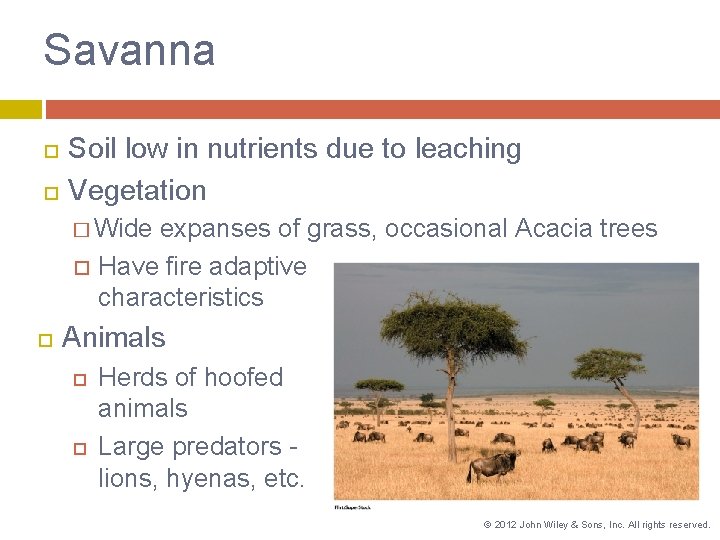
Savanna Soil low in nutrients due to leaching Vegetation � Wide expanses of grass, occasional Acacia trees Have fire adaptive characteristics Animals Herds of hoofed animals Large predators lions, hyenas, etc. © 2012 John Wiley & Sons, Inc. All rights reserved.
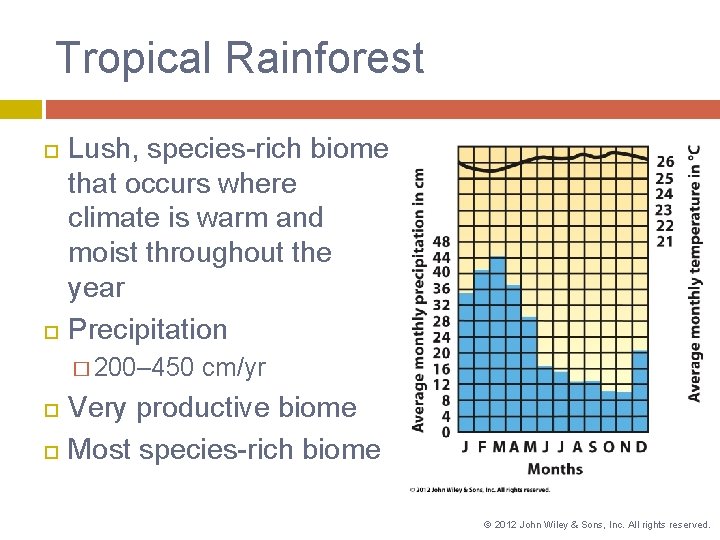
Tropical Rainforest Lush, species-rich biome that occurs where climate is warm and moist throughout the year Precipitation � 200– 450 cm/yr Very productive biome Most species-rich biome © 2012 John Wiley & Sons, Inc. All rights reserved.
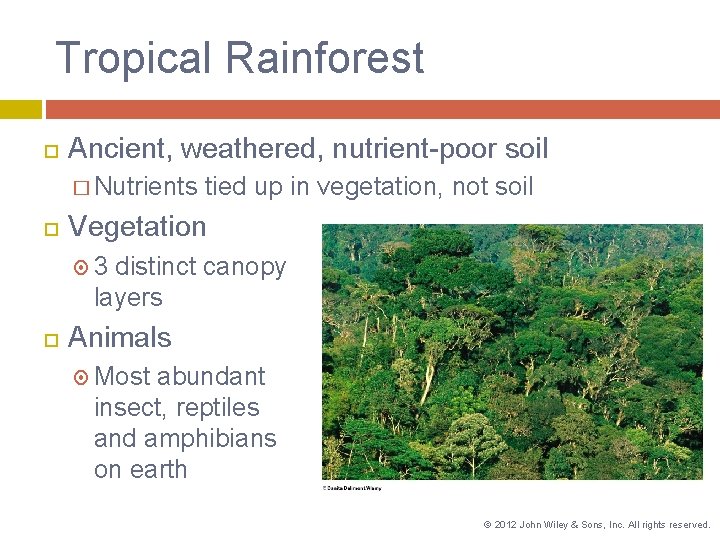
Tropical Rainforest Ancient, weathered, nutrient-poor soil � Nutrients tied up in vegetation, not soil Vegetation 3 distinct canopy layers Animals Most abundant insect, reptiles and amphibians on earth © 2012 John Wiley & Sons, Inc. All rights reserved.
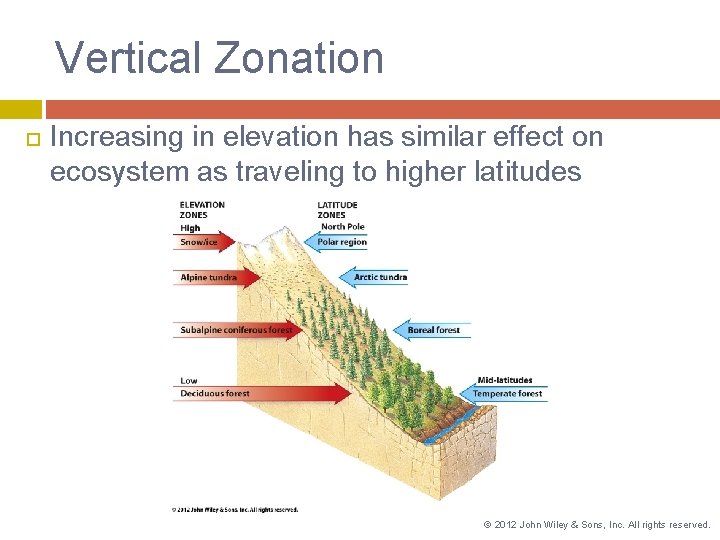
Vertical Zonation Increasing in elevation has similar effect on ecosystem as traveling to higher latitudes © 2012 John Wiley & Sons, Inc. All rights reserved.
Aquatic Ecosystem Fundamental Division � Freshwater � Saltwater Aquatic Ecosystems also affected by � Dissolved oxygen level, light penetration, p. H, presence/absence of currents Three main ecological categories of organisms � Plankton- free floating � Nekton - strong swimming � Benthos - bottom dwelling © 2012 John Wiley & Sons, Inc. All rights reserved.
Freshwater Ecosystems Includes: � Rivers and streams � Lakes and ponds � Marshes and swamps Represent 2% of earth’s surface Assist in recycling water back to the oceans © 2012 John Wiley & Sons, Inc. All rights reserved.
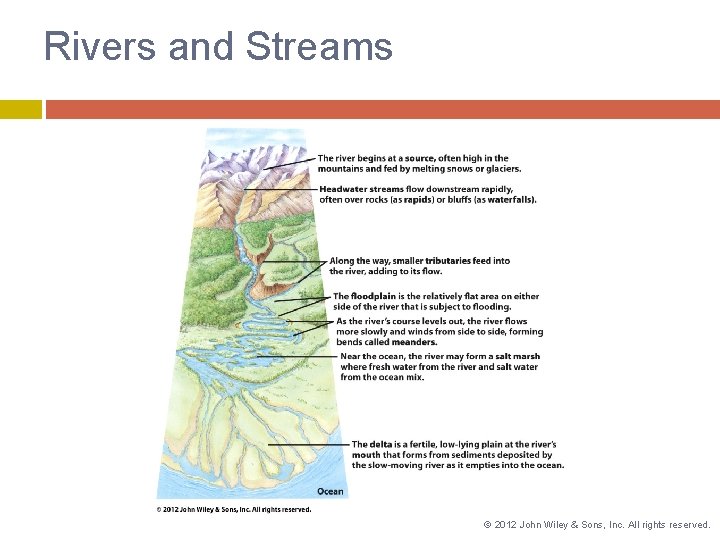
Rivers and Streams © 2012 John Wiley & Sons, Inc. All rights reserved.
Lakes and Ponds Body of freshwater that does not flow Three zones � Littoral � Limnetic � Profundal Experience thermal stratification (depending on depth) © 2012 John Wiley & Sons, Inc. All rights reserved.
Lakes and Ponds Littoral Zone - shallow water area along the shore Limnetic Zone - open water beyond the littoral zone Profundal Zone - beneath the limnetic zone of deep lakes © 2012 John Wiley & Sons, Inc. All rights reserved.
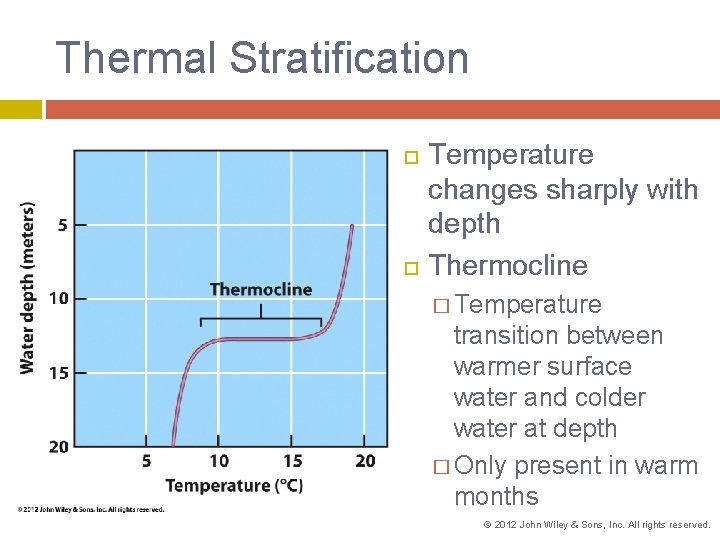
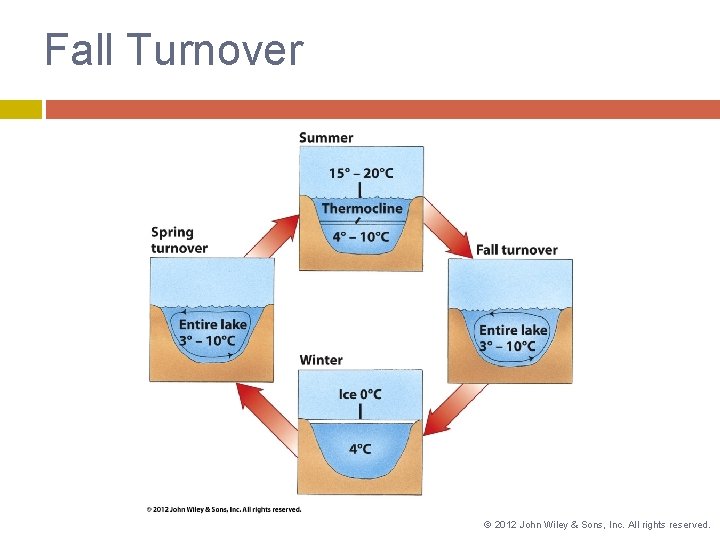
Thermal Stratification Temperature changes sharply with depth Thermocline � Temperature transition between warmer surface water and colder water at depth � Only present in warm months © 2012 John Wiley & Sons, Inc. All rights reserved.
Fall Turnover © 2012 John Wiley & Sons, Inc. All rights reserved.
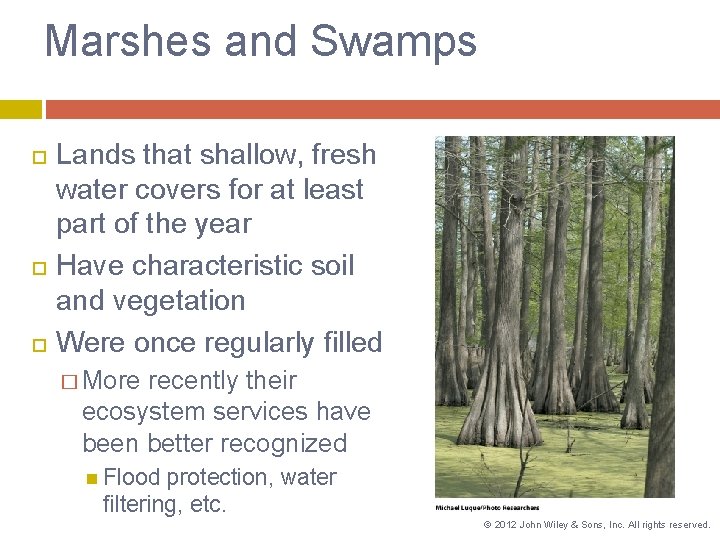
Marshes and Swamps Lands that shallow, fresh water covers for at least part of the year Have characteristic soil and vegetation Were once regularly filled � More recently their ecosystem services have been better recognized Flood protection, water filtering, etc. © 2012 John Wiley & Sons, Inc. All rights reserved.
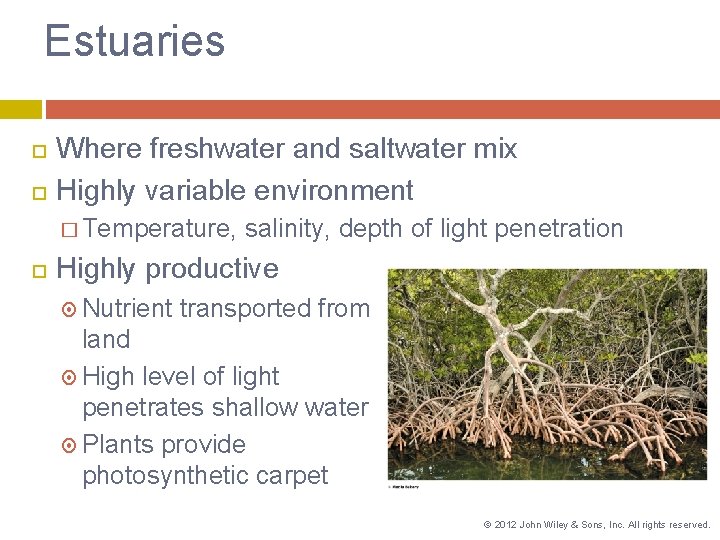
Estuaries Where freshwater and saltwater mix Highly variable environment � Temperature, salinity, depth of light penetration Highly productive Nutrient transported from land High level of light penetrates shallow water Plants provide photosynthetic carpet © 2012 John Wiley & Sons, Inc. All rights reserved.
Marine Ecosystems Subdivided into life zones � Intertidal zone � Benthic zone � Pelagic environment Neritic Province Oceanic Province © 2012 John Wiley & Sons, Inc. All rights reserved.
Marine Ecosystems © 2012 John Wiley & Sons, Inc. All rights reserved.
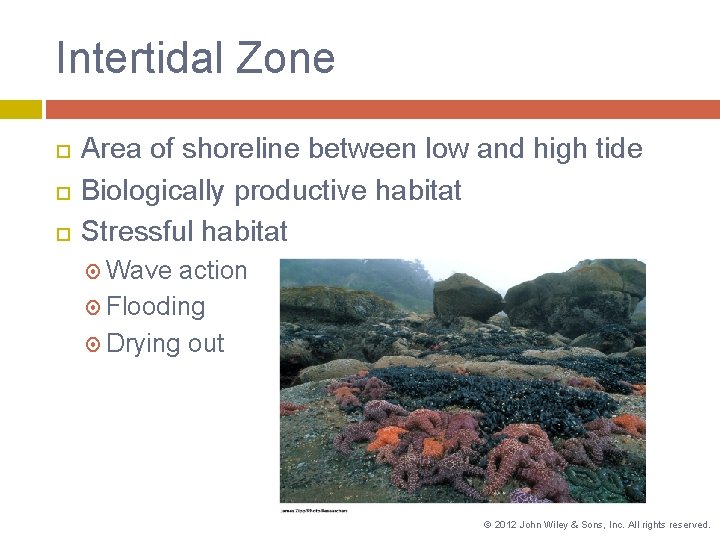
Intertidal Zone Area of shoreline between low and high tide Biologically productive habitat Stressful habitat Wave action Flooding Drying out © 2012 John Wiley & Sons, Inc. All rights reserved.
Benthic Zone Ocean floor, extending from tidal zone to deep sea trenches Sediment is mostly mud � Burrowing worms and clams Three zone � Bathyal: 200 m – 4000 m deep � Abyssal: 4000 m – 6000 m deep � Hadal: 6000 m – bottom of deep sea trenches © 2012 John Wiley & Sons, Inc. All rights reserved.
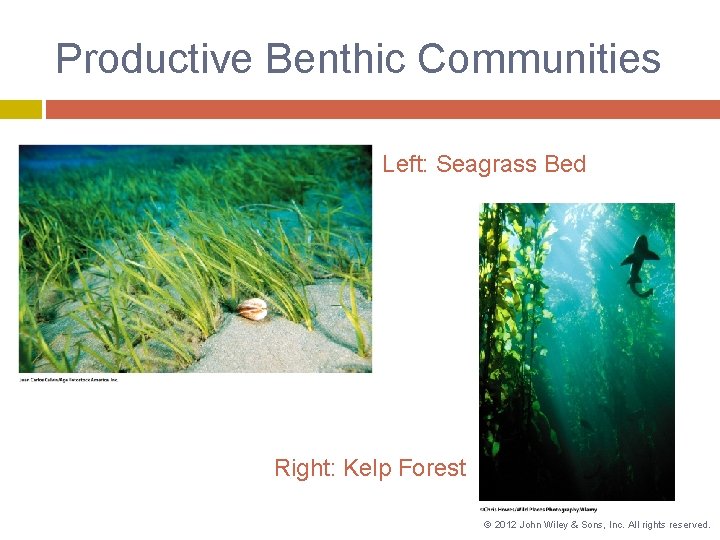
Productive Benthic Communities Seagrass Beds � Present to depth of 10 m � Provide food and habitat to ecosystem Kelp Forest � 60 -m long brown algae found off rocky shores � Large Biodiversity Coral Reefs � Built from accumulated layers of Ca. CO 3 Colonies of millions of tiny coral animals � Found in shallow warm water � Most diverse of all marine environments © 2012 John Wiley & Sons, Inc. All rights reserved.
Productive Benthic Communities Left: Seagrass Bed Right: Kelp Forest © 2012 John Wiley & Sons, Inc. All rights reserved.
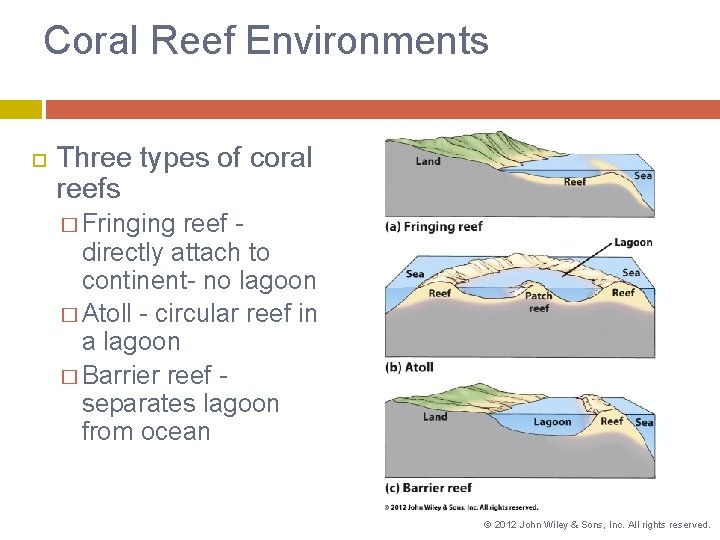
Coral Reef Environments Three types of coral reefs � Fringing reef directly attach to continent- no lagoon � Atoll - circular reef in a lagoon � Barrier reef separates lagoon from ocean © 2012 John Wiley & Sons, Inc. All rights reserved.
Human Impact on Coral Reefs Sedimentation � From clear-cutting upstream Overfishing Coral bleaching Mining of corals as building materials Runoff pollution © 2012 John Wiley & Sons, Inc. All rights reserved.
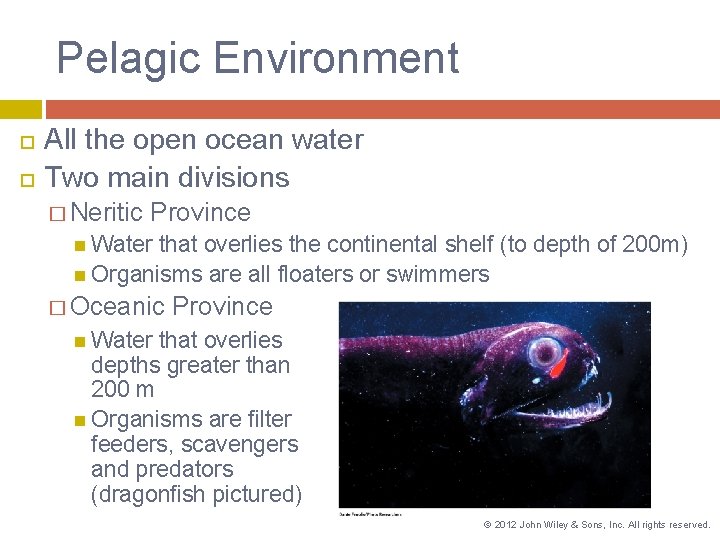
Pelagic Environment All the open ocean water Two main divisions � Neritic Province Water that overlies the continental shelf (to depth of 200 m) Organisms are all floaters or swimmers � Oceanic Province Water that overlies depths greater than 200 m Organisms are filter feeders, scavengers and predators (dragonfish pictured) © 2012 John Wiley & Sons, Inc. All rights reserved.
National Marine Sanctuaries © 2012 John Wiley & Sons, Inc. All rights reserved.
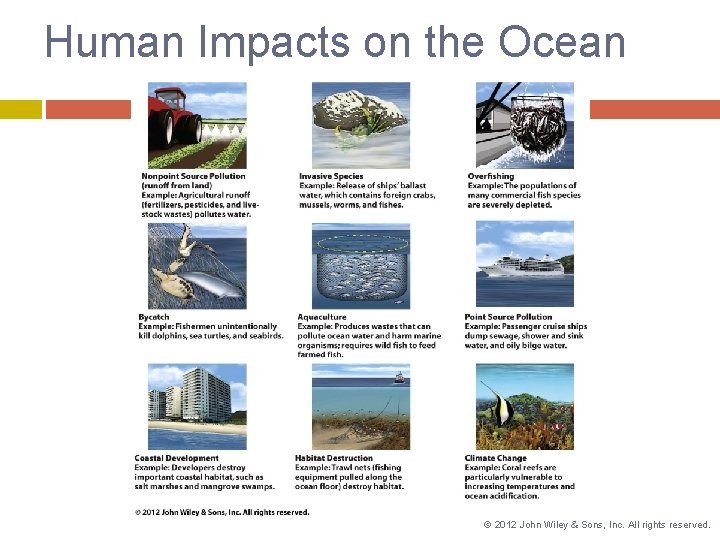
Human Impacts on the Ocean © 2012 John Wiley & Sons, Inc. All rights reserved.