
6 Introduction to Ergonomics TI 2111 Work System
- Slides: 16
6. Introduction to Ergonomics TI 2111 Work System Design and Ergonomics
Definition n n Branch of science that applies what is known about human behavior, mental processes, and anatomy and physiology to the design, development, and evaluation of work methods, environments, technologies, and systems Discipline that studies human capabilities and performance capacities and applies this information in designing consumer products, tools, and equipment TI 2111 Work System Design and Ergonomics
Common Definitions “Ergonomics is essentially fitting the workplace to the worker. The better the fit, the higher the level of safety and worker efficiency. ” Fitting the n Task to the Human ~ Grandjean 1990 “ Ergonomics removes barriers to quality, productivity and human performance by fitting products, tasks, and environments to people. ” Ergo. Web. com TI 2111 Work System Design and Ergonomics
Ergonomics n Greek words: q q n In the literature: q q n “Ergon” : work “Nomos” : principle or laws Ergonomics = The Science of Work in 1840 s by Wojciech Jastrzebowski (a Polish educator and scientist) In 1949 by K. F. H. Murrel (a British scientist) Other terms: q Human Factors, Human Engineering, Engineering Psychology TI 2111 Work System Design and Ergonomics
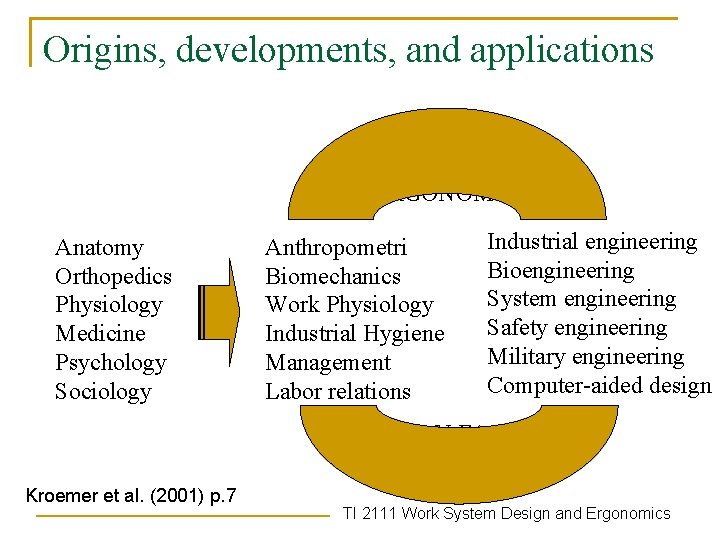
Origins, developments, and applications ERGONOMICS Anatomy Orthopedics Physiology Medicine Psychology Sociology Anthropometri Biomechanics Work Physiology Industrial Hygiene Management Labor relations Industrial engineering Bioengineering System engineering Safety engineering Military engineering Computer-aided design HUMAN FACTORS Kroemer et al. (2001) p. 7 TI 2111 Work System Design and Ergonomics
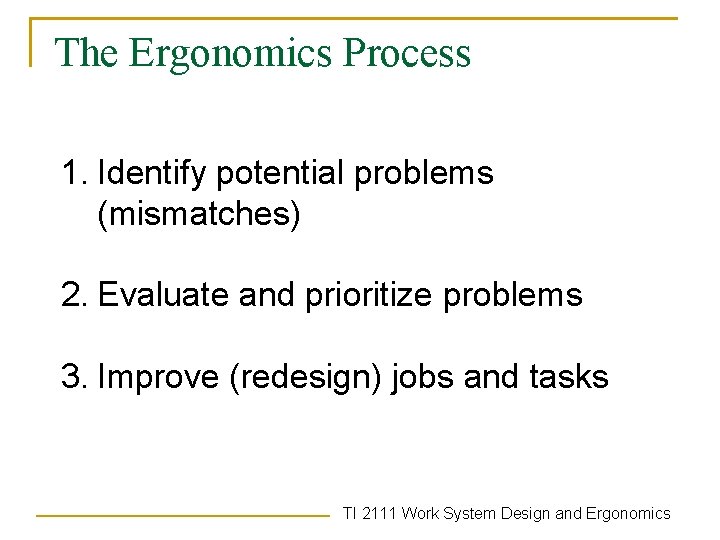
The Ergonomics Process 1. Identify potential problems (mismatches) 2. Evaluate and prioritize problems 3. Improve (redesign) jobs and tasks TI 2111 Work System Design and Ergonomics
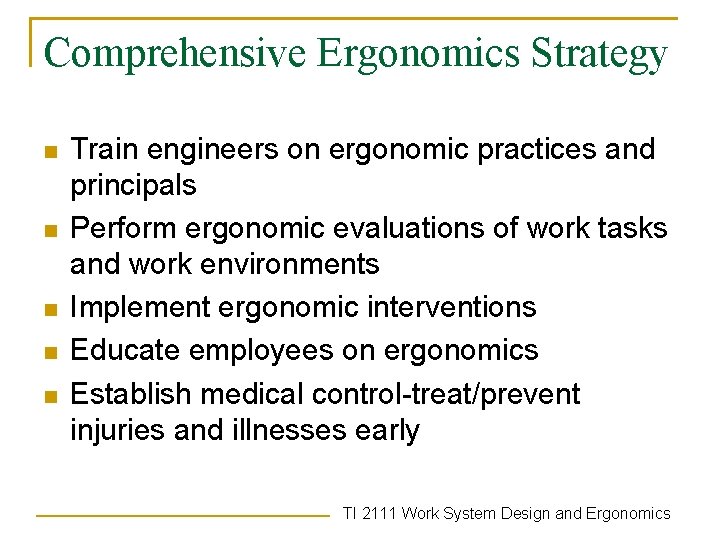
Comprehensive Ergonomics Strategy n n n Train engineers on ergonomic practices and principals Perform ergonomic evaluations of work tasks and work environments Implement ergonomic interventions Educate employees on ergonomics Establish medical control-treat/prevent injuries and illnesses early TI 2111 Work System Design and Ergonomics
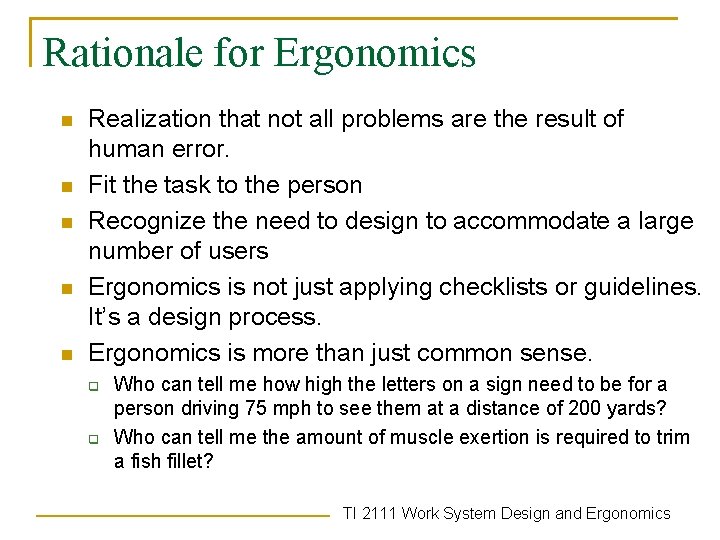
Rationale for Ergonomics n n n Realization that not all problems are the result of human error. Fit the task to the person Recognize the need to design to accommodate a large number of users Ergonomics is not just applying checklists or guidelines. It’s a design process. Ergonomics is more than just common sense. q q Who can tell me how high the letters on a sign need to be for a person driving 75 mph to see them at a distance of 200 yards? Who can tell me the amount of muscle exertion is required to trim a fish fillet? TI 2111 Work System Design and Ergonomics
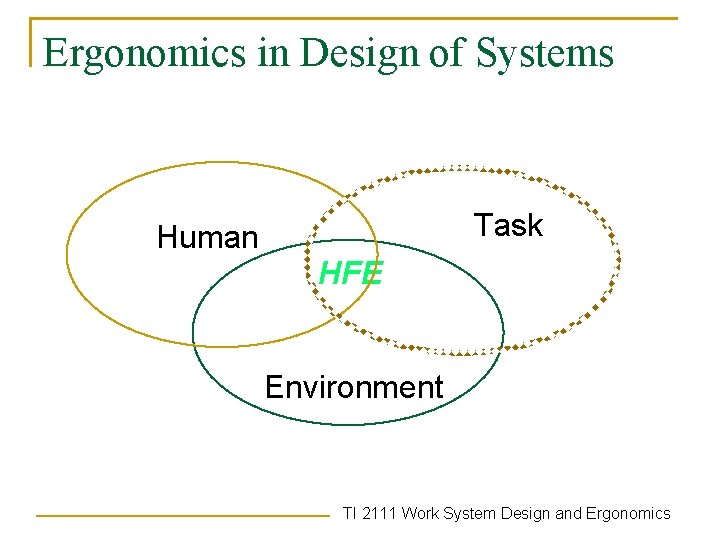
Ergonomics in Design of Systems Task Human HFE Environment TI 2111 Work System Design and Ergonomics
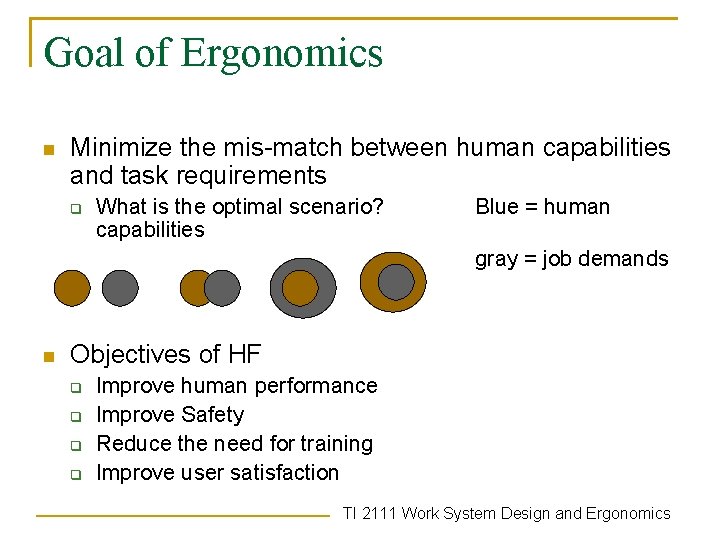
Goal of Ergonomics n Minimize the mis-match between human capabilities and task requirements q What is the optimal scenario? capabilities Blue = human gray = job demands n Objectives of HF q q Improve human performance Improve Safety Reduce the need for training Improve user satisfaction TI 2111 Work System Design and Ergonomics
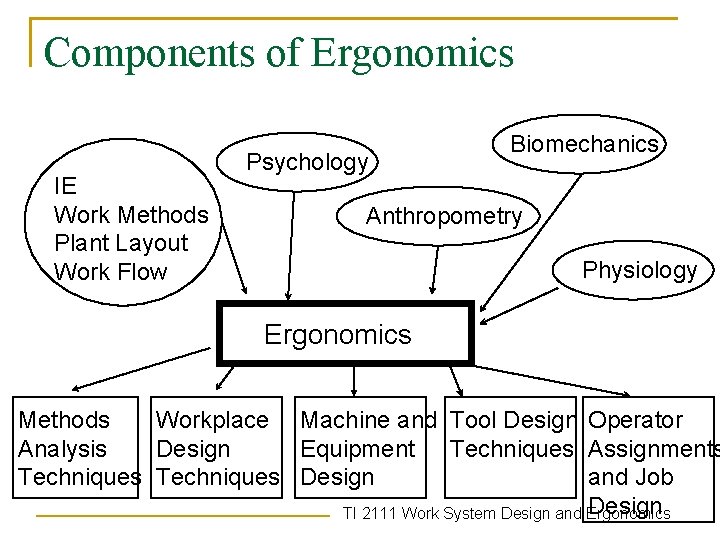
Components of Ergonomics IE Work Methods Plant Layout Work Flow Psychology Biomechanics Anthropometry Physiology Ergonomics Methods Workplace Machine and Tool Design Operator Analysis Design Equipment Techniques Assignments Techniques Design and Job Design TI 2111 Work System Design and Ergonomics
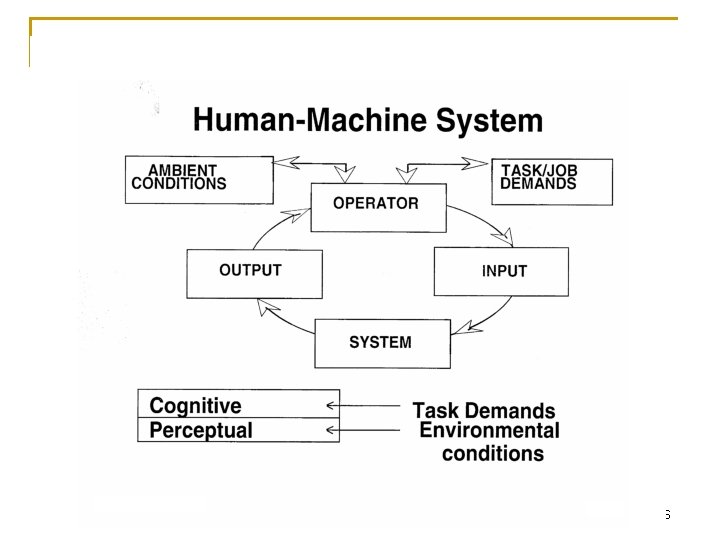
TI 2111 Work System Design and Ergonomics
Division of the Discipline n Physical Ergonomics (work place layout and design) n Cognitive Ergonomics (cognitive and psychological issues) TI 2111 Work System Design and Ergonomics
History n n n n Can be traced back to the late 1800 s/early 1900 s and Frank and Lillian Gilbreth—motion and time studies, investigated performance, fatigue, workstation design, tool design Formal birth in WWII: significant number of pilot accidents due to human error 1950 s— regulations began to be developed in USA 1957—first professional society was created (HFES) Number of tragedies in semi-recent years: 3 -mile Island, Chernobyl, dramatic increase in the number of reported occupational injuries illnesses, and deaths OSHA is developed Computer age TI 2111 Work System Design and Ergonomics
Why Ergonomics? n Increased Productivity q q q n improved work methods increased efficiency better tools less stress and fatigue fewer errors Quality of Work Life q q q n Money q q decreased medical costs increased productivity decreased workman’s compensation costs fewer lost work day cases (light duty days) fewer injuries less fatigue and stress improved employee morale TI 2111 Work System Design and Ergonomics
Current Topics n Occupational Injuries and Illnesses q n n n n CTDs, slips/trips/falls, deaths, … Sources of Operator Discomfort/Fatigue Design for Special Populations HCI Individual Differences User-centered Design Production Ergonomics Human Error Others TI 2111 Work System Design and Ergonomics