
6 Heamodynamics By Prof Sherif W Mansour Physiology

6 - Heamodynamics By Prof. Sherif W. Mansour Physiology dpt. , Mutah school of Medicine.
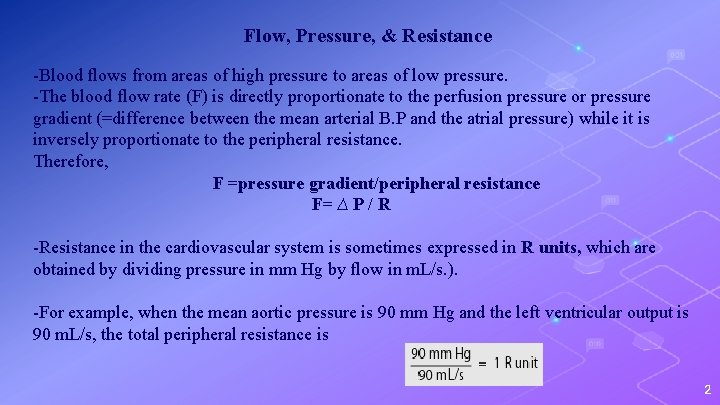
Flow, Pressure, & Resistance -Blood flows from areas of high pressure to areas of low pressure. -The blood flow rate (F) is directly proportionate to the perfusion pressure or pressure gradient (=difference between the mean arterial B. P and the atrial pressure) while it is inversely proportionate to the peripheral resistance. Therefore, F =pressure gradient/peripheral resistance F= ∆ P / R -Resistance in the cardiovascular system is sometimes expressed in R units, which are obtained by dividing pressure in mm Hg by flow in m. L/s. ). -For example, when the mean aortic pressure is 90 mm Hg and the left ventricular output is 90 m. L/s, the total peripheral resistance is 2
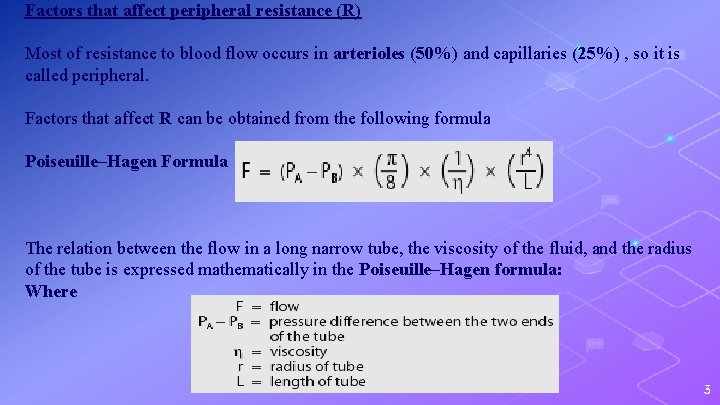
Factors that affect peripheral resistance (R) Most of resistance to blood flow occurs in arterioles (50%) and capillaries (25%) , so it is called peripheral. Factors that affect R can be obtained from the following formula Poiseuille–Hagen Formula The relation between the flow in a long narrow tube, the viscosity of the fluid, and the radius of the tube is expressed mathematically in the Poiseuille–Hagen formula: Where 3
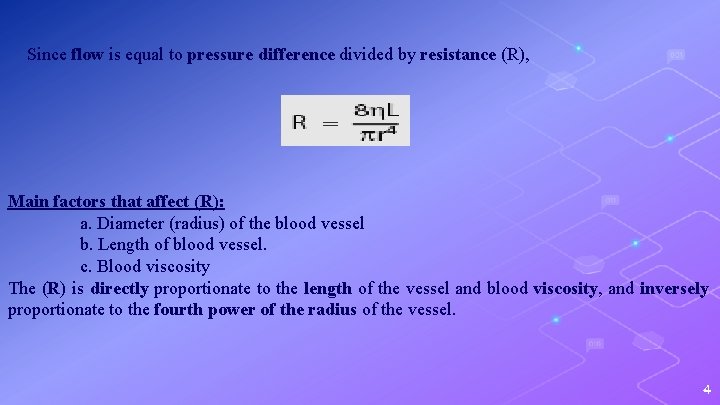
Since flow is equal to pressure difference divided by resistance (R), Main factors that affect (R): a. Diameter (radius) of the blood vessel b. Length of blood vessel. c. Blood viscosity The (R) is directly proportionate to the length of the vessel and blood viscosity, and inversely proportionate to the fourth power of the radius of the vessel. 4
Factors that affect the blood viscosity 1. Haematocrit value (Ht): the percentage of the volume of blood occupied by red blood cells In severe polycythemia, the increase in resistance does increase the work of the heart. Conversely, in anemia, peripheral resistance is decreased, in part because of the decline in viscosity. Of course, the decrease in hemoglobin decreases the O 2 -carrying ability of the blood, but the improved blood flow due to the decrease in viscosity partially compensates for this. 2. Composition of the plasma: Plasma has relative viscosity 1. 8 times as that of water, mainly due to presence of proteins (fibrinogen and some globulins) so, viscosity is increased in marked elevation of plasma proteins (hyper-gamma-globuinemia) 3. Blood temperature: Viscosity increases by cooling and vice versa. 4. Diamter of blood vessel: Viscosity is low in vessels having small diameters and vice versa. 5. Velocity of blood flow: Viscosity increases at low velocity flow rates and vice versa. 5
Velocity of blood flow The blood velocity at any point in the circulatory system is inversely proportionate to the total crosssectional area at that point, and is calculated by dividing the blood flow rate (ml per second)/crosssectional area (cm 2). Types of blood flow: 1. Laminar blood flow: This is the normal smooth (streamline) flow of blood in straight blood vessels, it is silent (producing no sounds) and laminar i. e. the blood flows in several layers of laminae. The outermost layer of blood in contact with vessel wall is almost completely static (not moving) while the other layers move by velocities that increase gradually from out- inwards till becoming maximal in the central layer of the stream. The mean velocity is the average of velocities in all blood layers, and beyond a certain critical velocity, turbulence occurs. 6
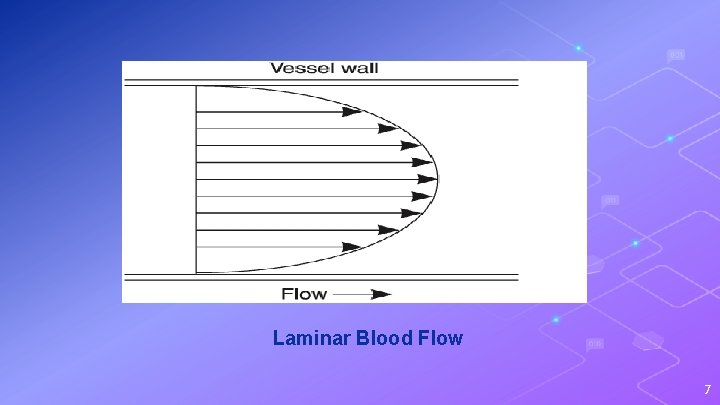
Laminar Blood Flow 7
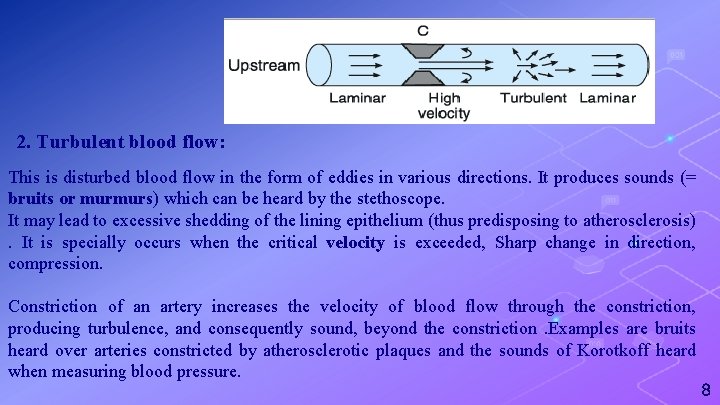
2. Turbulent blood flow: This is disturbed blood flow in the form of eddies in various directions. It produces sounds (= bruits or murmurs) which can be heard by the stethoscope. It may lead to excessive shedding of the lining epithelium (thus predisposing to atherosclerosis). It is specially occurs when the critical velocity is exceeded, Sharp change in direction, compression. Constriction of an artery increases the velocity of blood flow through the constriction, producing turbulence, and consequently sound, beyond the constriction. Examples are bruits heard over arteries constricted by atherosclerotic plaques and the sounds of Korotkoff heard when measuring blood pressure. 8
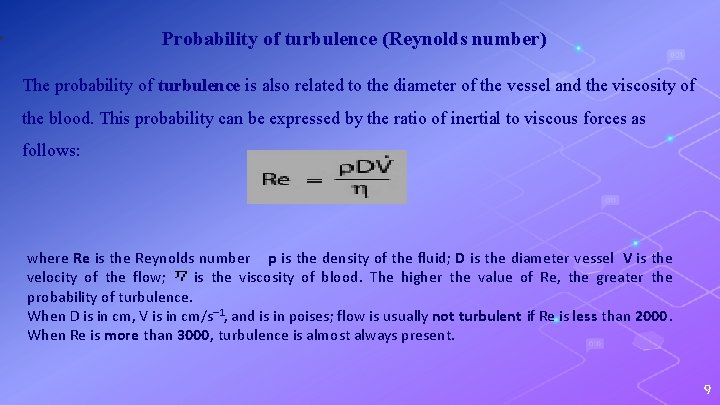
Probability of turbulence (Reynolds number) The probability of turbulence is also related to the diameter of the vessel and the viscosity of the blood. This probability can be expressed by the ratio of inertial to viscous forces as follows: where Re is the Reynolds number p is the density of the fluid; D is the diameter vessel V is the velocity of the flow; is the viscosity of blood. The higher the value of Re, the greater the probability of turbulence. When D is in cm, V is in cm/s– 1, and is in poises; flow is usually not turbulent if Re is less than 2000. When Re is more than 3000, turbulence is almost always present. 9
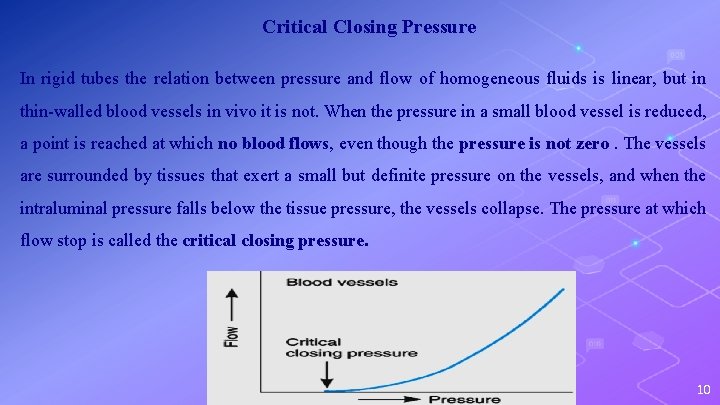
Critical Closing Pressure In rigid tubes the relation between pressure and flow of homogeneous fluids is linear, but in thin-walled blood vessels in vivo it is not. When the pressure in a small blood vessel is reduced, a point is reached at which no blood flows, even though the pressure is not zero. The vessels are surrounded by tissues that exert a small but definite pressure on the vessels, and when the intraluminal pressure falls below the tissue pressure, the vessels collapse. The pressure at which flow stop is called the critical closing pressure. 10
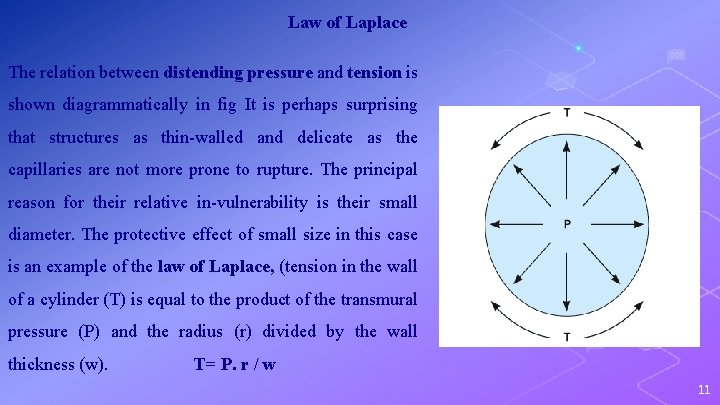
Law of Laplace The relation between distending pressure and tension is shown diagrammatically in fig It is perhaps surprising that structures as thin-walled and delicate as the capillaries are not more prone to rupture. The principal reason for their relative in-vulnerability is their small diameter. The protective effect of small size in this case is an example of the law of Laplace, (tension in the wall of a cylinder (T) is equal to the product of the transmural pressure (P) and the radius (r) divided by the wall thickness (w). T= P. r / w 11

Thank You
- Slides: 12