
6 GEO 4 Unit 4 Cold Environments What
- Slides: 23
6 GEO 4 Unit 4 Cold Environments
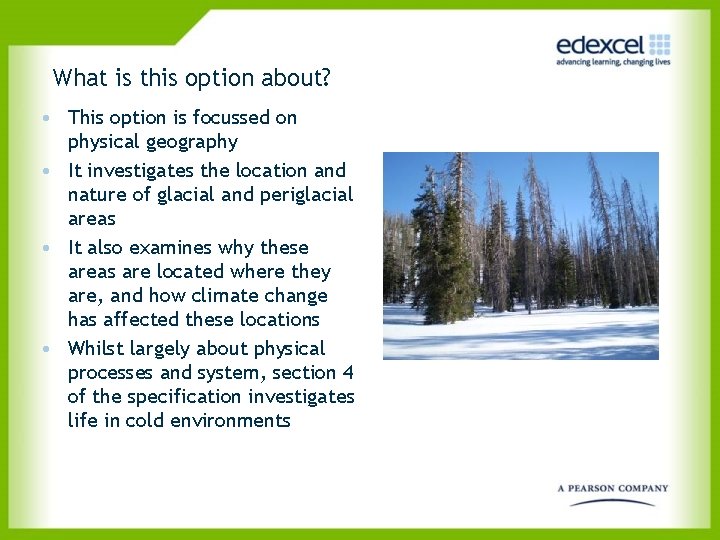
What is this option about? • This option is focussed on physical geography • It investigates the location and nature of glacial and periglacial areas • It also examines why these areas are located where they are, and how climate change has affected these locations • Whilst largely about physical processes and system, section 4 of the specification investigates life in cold environments
CONTENTS 1. Defining and locating cold environments 2. Climatic processes and their causes 3. Distinctive landforms and landscapes 4. Challenges and opportunities Click on the information icon Click on the home button to jump to that section. to return to this contents page
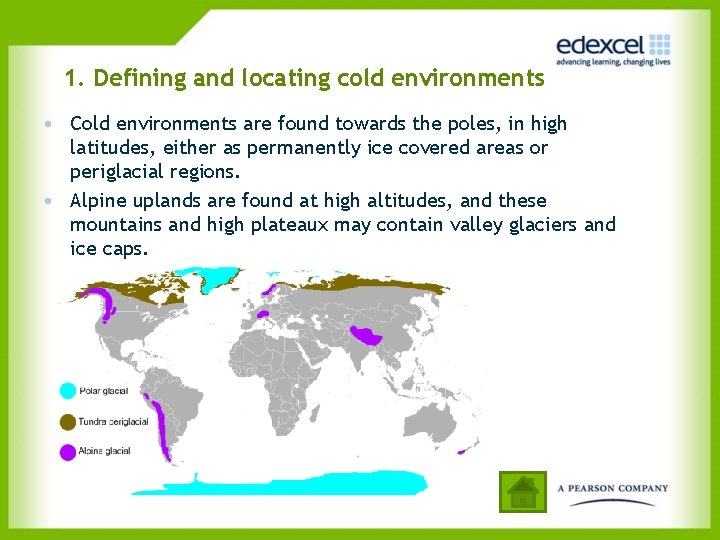
1. Defining and locating cold environments • Cold environments are found towards the poles, in high latitudes, either as permanently ice covered areas or periglacial regions. • Alpine uplands are found at high altitudes, and these mountains and high plateaux may contain valley glaciers and ice caps.
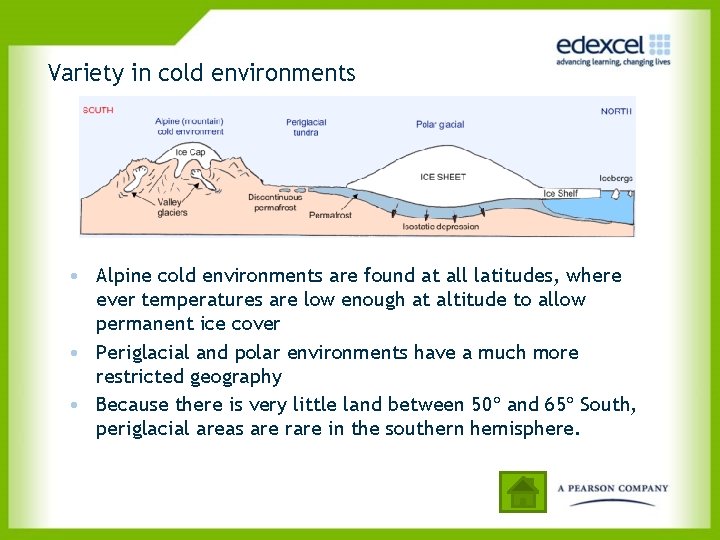
Variety in cold environments • Alpine cold environments are found at all latitudes, where ever temperatures are low enough at altitude to allow permanent ice cover • Periglacial and polar environments have a much more restricted geography • Because there is very little land between 50 and 65 South, periglacial areas are rare in the southern hemisphere.
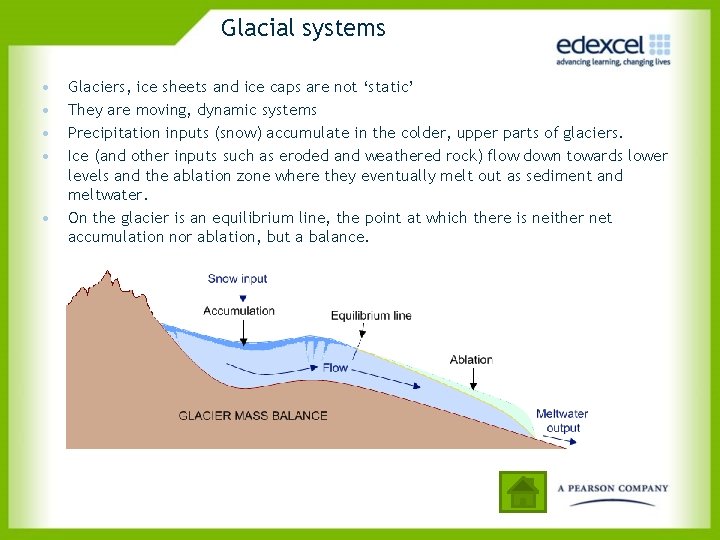
Glacial systems • • • Glaciers, ice sheets and ice caps are not ‘static’ They are moving, dynamic systems Precipitation inputs (snow) accumulate in the colder, upper parts of glaciers. Ice (and other inputs such as eroded and weathered rock) flow down towards lower levels and the ablation zone where they eventually melt out as sediment and meltwater. On the glacier is an equilibrium line, the point at which there is neither net accumulation nor ablation, but a balance.
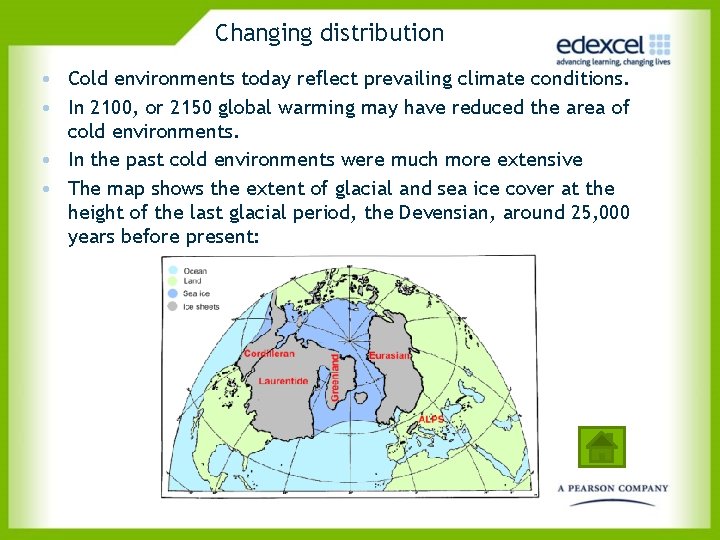
Changing distribution • Cold environments today reflect prevailing climate conditions. • In 2100, or 2150 global warming may have reduced the area of cold environments. • In the past cold environments were much more extensive • The map shows the extent of glacial and sea ice cover at the height of the last glacial period, the Devensian, around 25, 000 years before present:
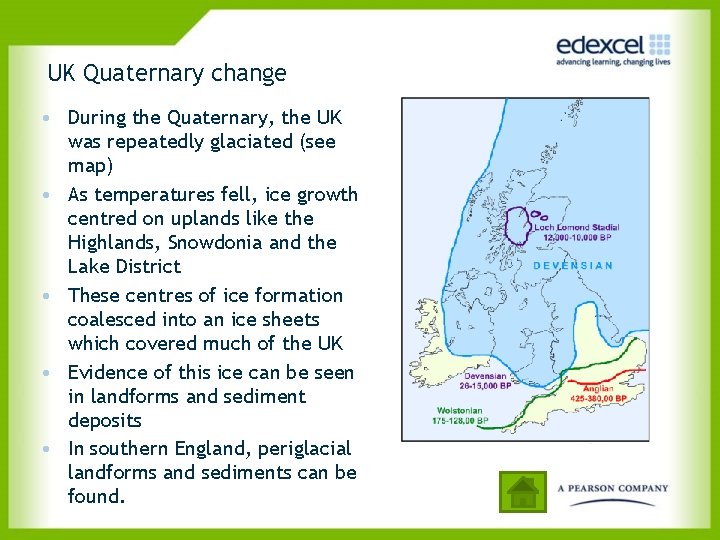
UK Quaternary change • During the Quaternary, the UK was repeatedly glaciated (see map) • As temperatures fell, ice growth centred on uplands like the Highlands, Snowdonia and the Lake District • These centres of ice formation coalesced into an ice sheets which covered much of the UK • Evidence of this ice can be seen in landforms and sediment deposits • In southern England, periglacial landforms and sediments can be found.
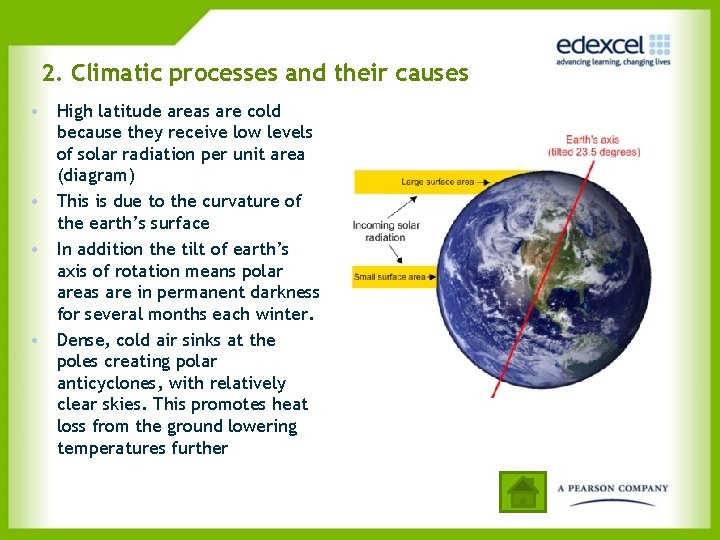
2. Climatic processes and their causes • High latitude areas are cold because they receive low levels of solar radiation per unit area (diagram) • This is due to the curvature of the earth’s surface • In addition the tilt of earth’s axis of rotation means polar areas are in permanent darkness for several months each winter. • Dense, cold air sinks at the poles creating polar anticyclones, with relatively clear skies. This promotes heat loss from the ground lowering temperatures further
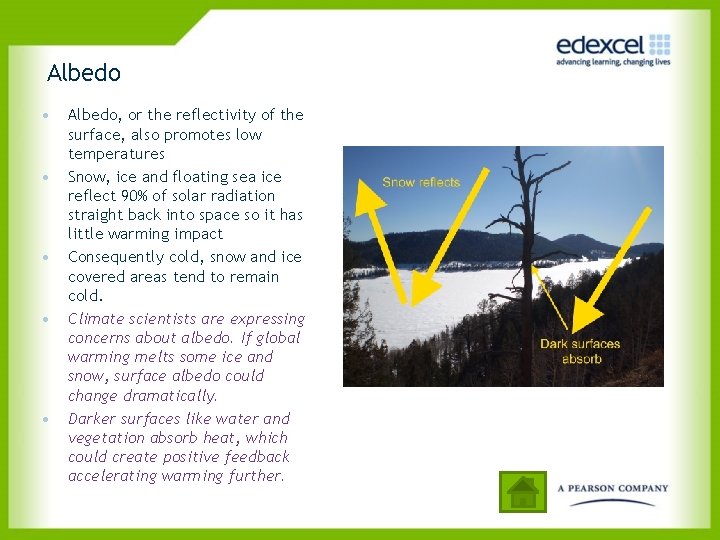
Albedo • • • Albedo, or the reflectivity of the surface, also promotes low temperatures Snow, ice and floating sea ice reflect 90% of solar radiation straight back into space so it has little warming impact Consequently cold, snow and ice covered areas tend to remain cold. Climate scientists are expressing concerns about albedo. If global warming melts some ice and snow, surface albedo could change dramatically. Darker surfaces like water and vegetation absorb heat, which could create positive feedback accelerating warming further.
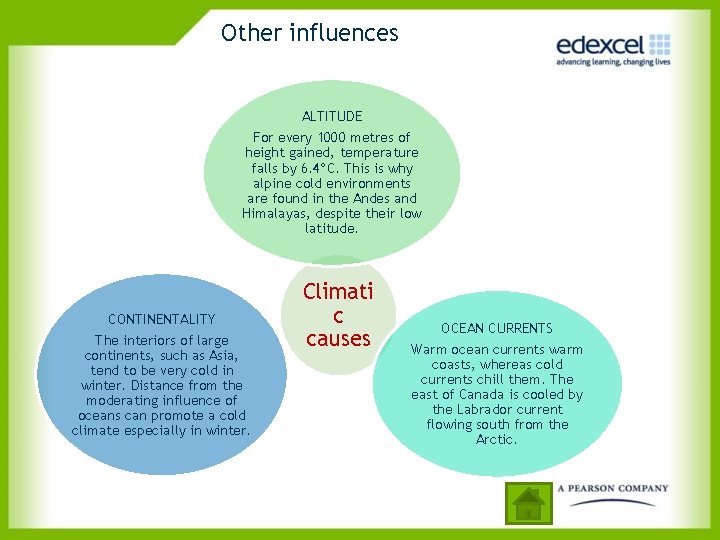
Other influences ALTITUDE For every 1000 metres of height gained, temperature falls by 6. 4 C. This is why alpine cold environments are found in the Andes and Himalayas, despite their low latitude. CONTINENTALITY The interiors of large continents, such as Asia, tend to be very cold in winter. Distance from the moderating influence of oceans can promote a cold climate especially in winter. Climati c causes OCEAN CURRENTS Warm ocean currents warm coasts, whereas cold currents chill them. The east of Canada is cooled by the Labrador current flowing south from the Arctic.
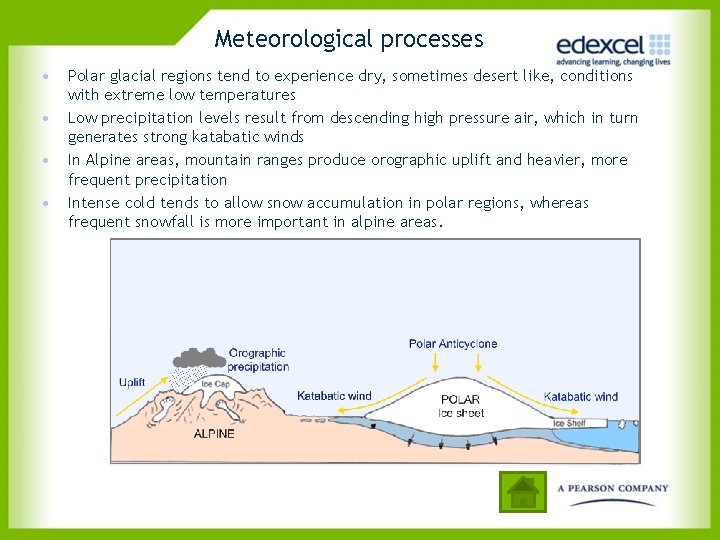
Meteorological processes • • Polar glacial regions tend to experience dry, sometimes desert like, conditions with extreme low temperatures Low precipitation levels result from descending high pressure air, which in turn generates strong katabatic winds In Alpine areas, mountain ranges produce orographic uplift and heavier, more frequent precipitation Intense cold tends to allow snow accumulation in polar regions, whereas frequent snowfall is more important in alpine areas.
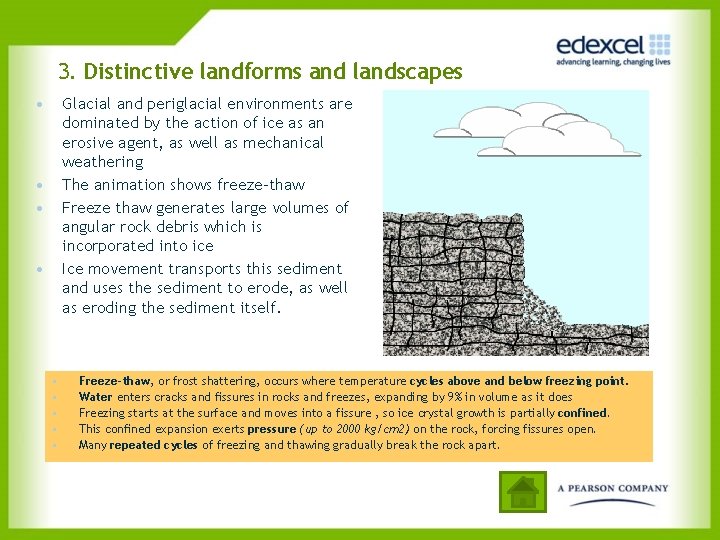
3. Distinctive landforms and landscapes • Glacial and periglacial environments are dominated by the action of ice as an erosive agent, as well as mechanical weathering The animation shows freeze-thaw Freeze thaw generates large volumes of angular rock debris which is incorporated into ice Ice movement transports this sediment and uses the sediment to erode, as well as eroding the sediment itself. • • Click here for animation Freeze-thaw, or frost shattering, occurs where temperature cycles above and below freezing point. Water enters cracks and fissures in rocks and freezes, expanding by 9% in volume as it does Freezing starts at the surface and moves into a fissure , so ice crystal growth is partially confined. This confined expansion exerts pressure (up to 2000 kg/cm 2) on the rock, forcing fissures open. Many repeated cycles of freezing and thawing gradually break the rock apart.
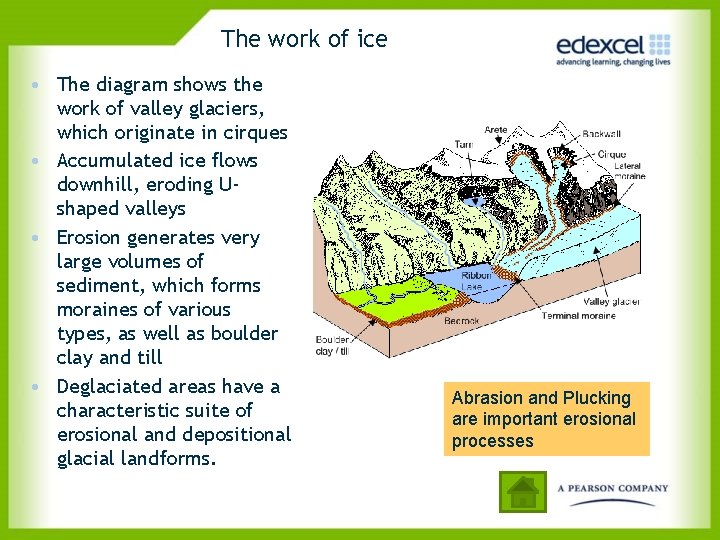
The work of ice • The diagram shows the work of valley glaciers, which originate in cirques • Accumulated ice flows downhill, eroding Ushaped valleys • Erosion generates very large volumes of sediment, which forms moraines of various types, as well as boulder clay and till • Deglaciated areas have a characteristic suite of erosional and depositional glacial landforms. Abrasion and Plucking are important erosional processes
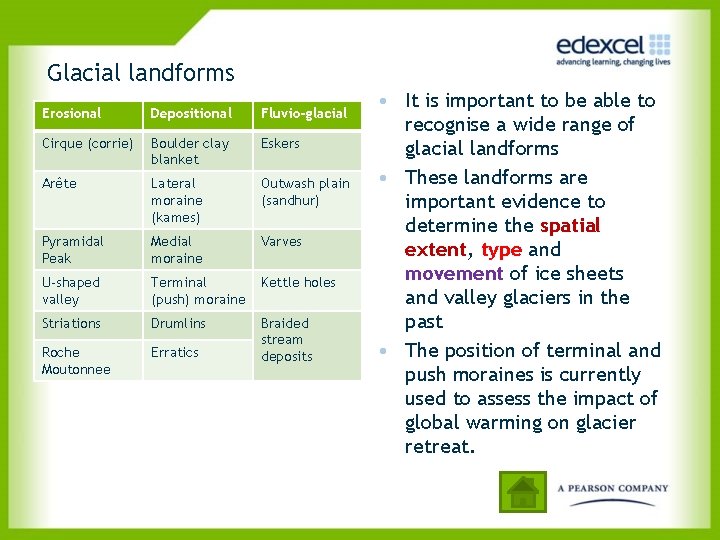
Glacial landforms Erosional Depositional Fluvio-glacial Cirque (corrie) Boulder clay blanket Eskers Arête Lateral moraine (kames) Outwash plain (sandhur) Pyramidal Peak Medial moraine Varves U-shaped valley Terminal (push) moraine Kettle holes Striations Drumlins Roche Moutonnee Erratics Braided stream deposits • It is important to be able to recognise a wide range of glacial landforms • These landforms are important evidence to determine the spatial extent, type and movement of ice sheets and valley glaciers in the past • The position of terminal and push moraines is currently used to assess the impact of global warming on glacier retreat.
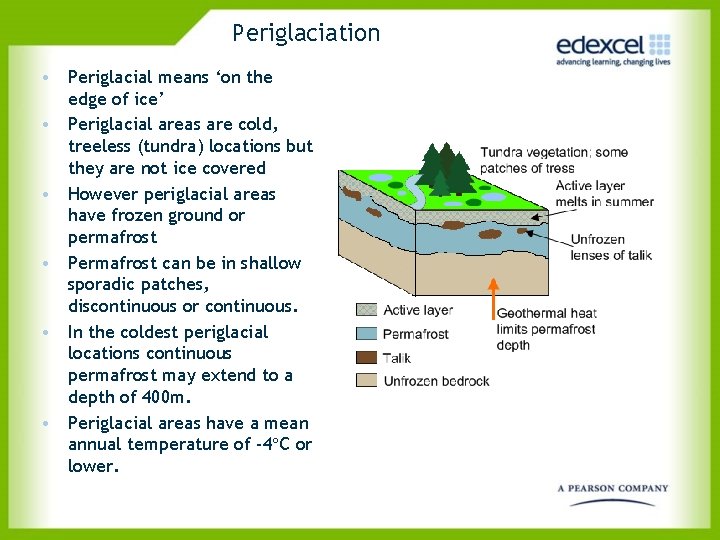
Periglaciation • Periglacial means ‘on the edge of ice’ • Periglacial areas are cold, treeless (tundra) locations but they are not ice covered • However periglacial areas have frozen ground or permafrost • Permafrost can be in shallow sporadic patches, discontinuous or continuous. • In the coldest periglacial locations continuous permafrost may extend to a depth of 400 m. • Periglacial areas have a mean annual temperature of -4 C or lower.
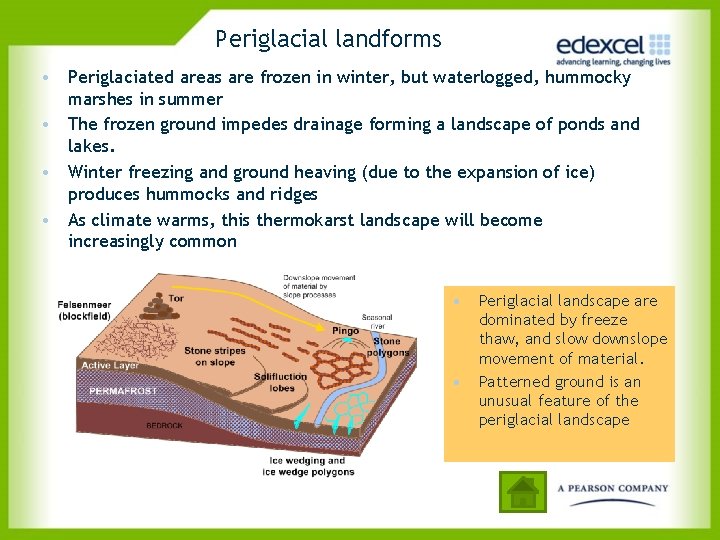
Periglacial landforms • Periglaciated areas are frozen in winter, but waterlogged, hummocky marshes in summer • The frozen ground impedes drainage forming a landscape of ponds and lakes. • Winter freezing and ground heaving (due to the expansion of ice) produces hummocks and ridges • As climate warms, this thermokarst landscape will become increasingly common • • Periglacial landscape are dominated by freeze thaw, and slow downslope movement of material. Patterned ground is an unusual feature of the periglacial landscape
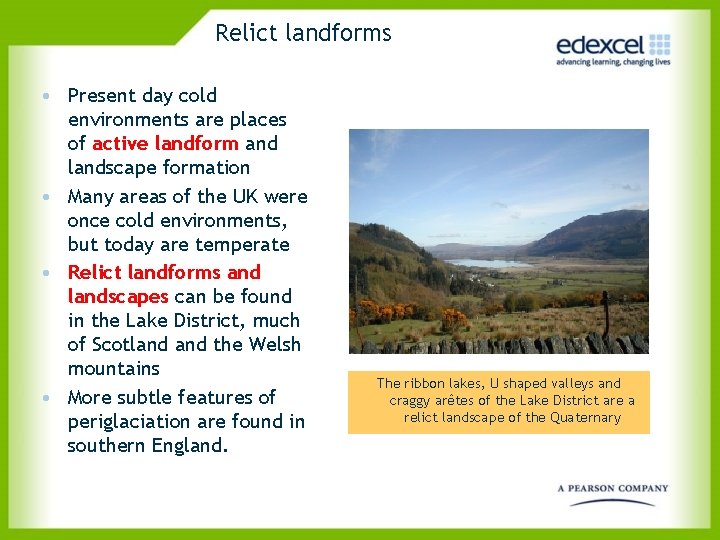
Relict landforms • Present day cold environments are places of active landform and landscape formation • Many areas of the UK were once cold environments, but today are temperate • Relict landforms and landscapes can be found in the Lake District, much of Scotland the Welsh mountains • More subtle features of periglaciation are found in southern England. The ribbon lakes, U shaped valleys and craggy arêtes of the Lake District are a relict landscape of the Quaternary
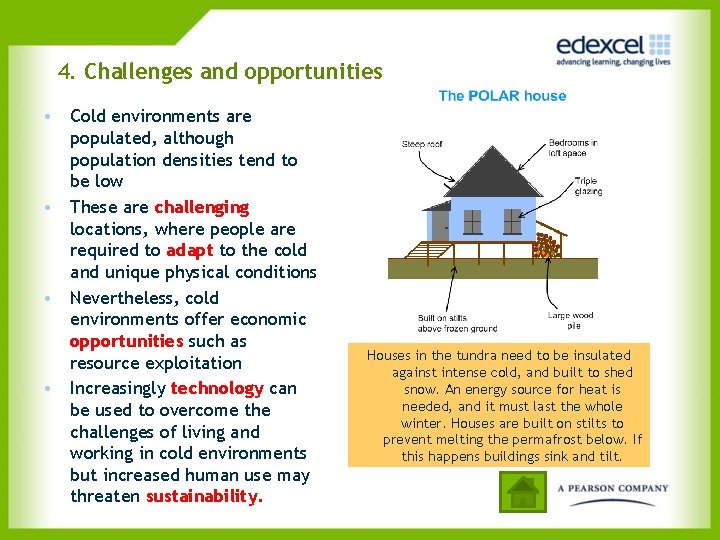
4. Challenges and opportunities • Cold environments are populated, although population densities tend to be low • These are challenging locations, where people are required to adapt to the cold and unique physical conditions • Nevertheless, cold environments offer economic opportunities such as resource exploitation • Increasingly technology can be used to overcome the challenges of living and working in cold environments but increased human use may threaten sustainability. Houses in the tundra need to be insulated against intense cold, and built to shed snow. An energy source for heat is needed, and it must last the whole winter. Houses are built on stilts to prevent melting the permafrost below. If this happens buildings sink and tilt.
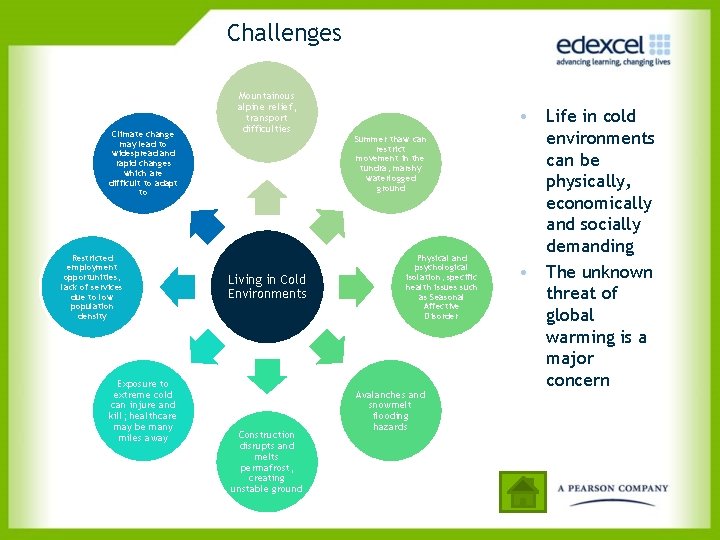
Challenges Climate change may lead to widespread and rapid changes which are difficult to adapt to Restricted employment opportunities; lack of services due to low population density Exposure to extreme cold can injure and kill; healthcare may be many miles away Mountainous alpine relief, transport difficulties Living in Cold Environments Construction disrupts and melts permafrost, creating unstable ground Summer thaw can restrict movement in the tundra; marshy waterlogged ground Physical and psychological isolation; specific health issues such as Seasonal Affective Disorder Avalanches and snowmelt flooding hazards • Life in cold environments can be physically, economically and socially demanding • The unknown threat of global warming is a major concern
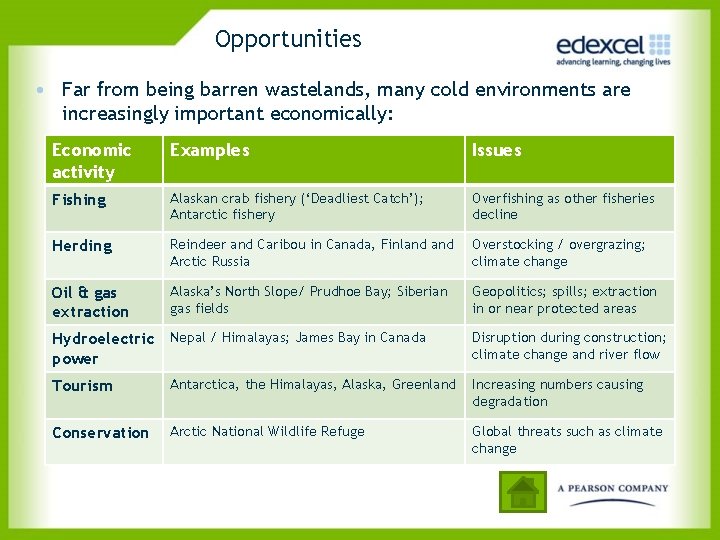
Opportunities • Far from being barren wastelands, many cold environments are increasingly important economically: Economic activity Examples Issues Fishing Alaskan crab fishery (‘Deadliest Catch’); Antarctic fishery Overfishing as other fisheries decline Herding Reindeer and Caribou in Canada, Finland Arctic Russia Overstocking / overgrazing; climate change Oil & gas extraction Alaska’s North Slope/ Prudhoe Bay; Siberian gas fields Geopolitics; spills; extraction in or near protected areas Hydroelectric power Nepal / Himalayas; James Bay in Canada Disruption during construction; climate change and river flow Tourism Antarctica, the Himalayas, Alaska, Greenland Increasing numbers causing degradation Conservation Arctic National Wildlife Refuge Global threats such as climate change
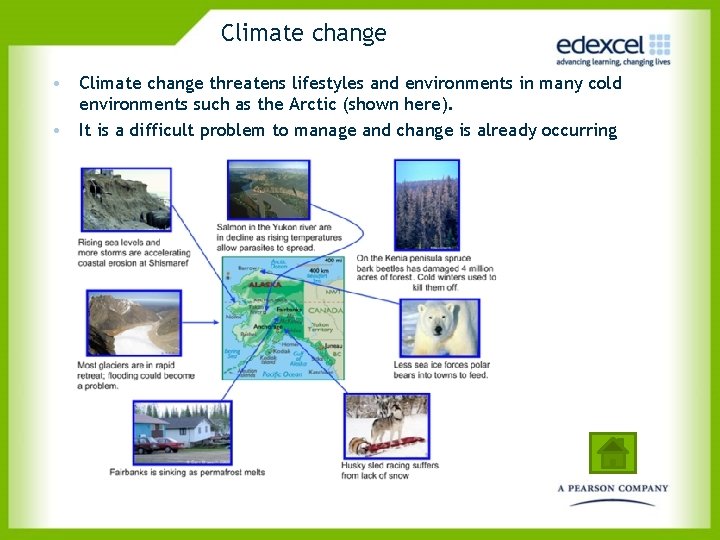
Climate change • Climate change threatens lifestyles and environments in many cold environments such as the Arctic (shown here). • It is a difficult problem to manage and change is already occurring
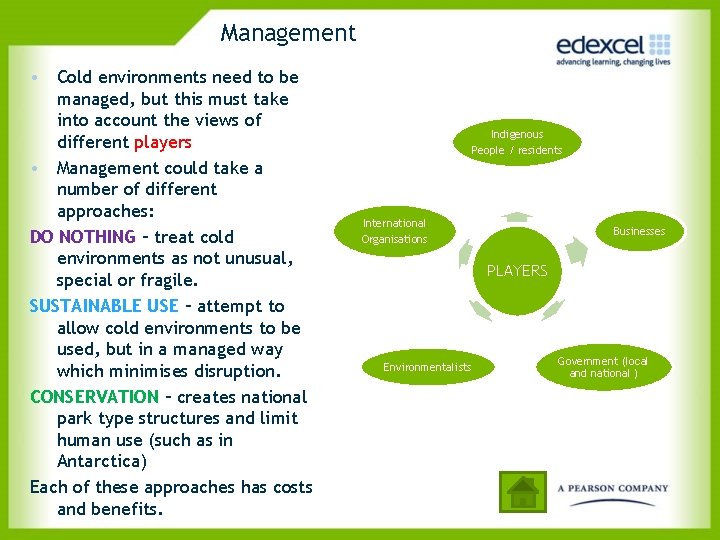
Management • Cold environments need to be managed, but this must take into account the views of different players • Management could take a number of different approaches: DO NOTHING – treat cold environments as not unusual, special or fragile. SUSTAINABLE USE – attempt to allow cold environments to be used, but in a managed way which minimises disruption. CONSERVATION – creates national park type structures and limit human use (such as in Antarctica) Each of these approaches has costs and benefits. Indigenous People / residents International Organisations Businesses PLAYERS Environmentalists Government (local and national )