
6 Crystal structure The particles atoms ions or



- Slides: 13
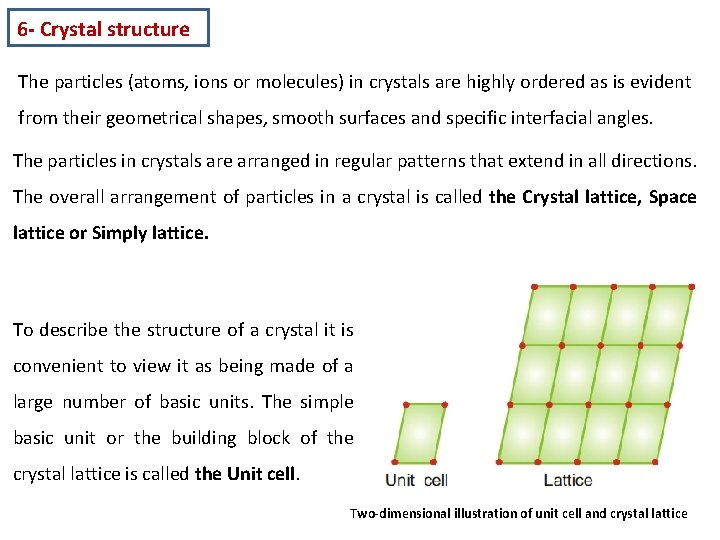
6 - Crystal structure The particles (atoms, ions or molecules) in crystals are highly ordered as is evident from their geometrical shapes, smooth surfaces and specific interfacial angles. The particles in crystals are arranged in regular patterns that extend in all directions. The overall arrangement of particles in a crystal is called the Crystal lattice, Space lattice or Simply lattice. To describe the structure of a crystal it is convenient to view it as being made of a large number of basic units. The simple basic unit or the building block of the crystal lattice is called the Unit cell. Two-dimensional illustration of unit cell and crystal lattice
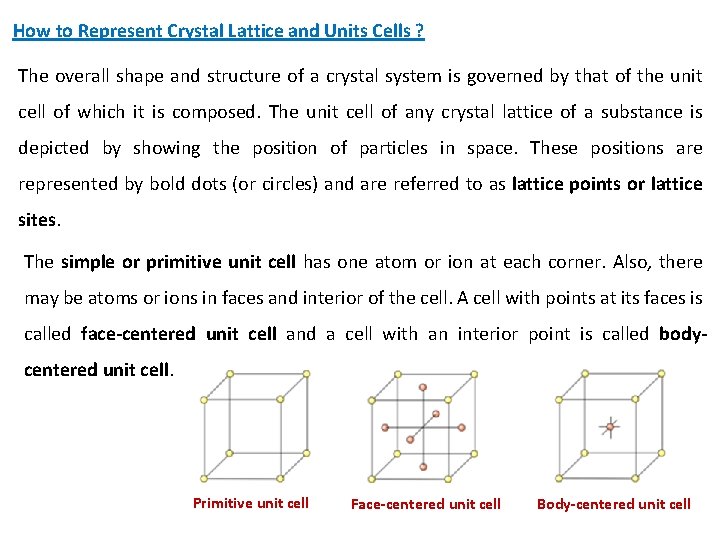
How to Represent Crystal Lattice and Units Cells ? The overall shape and structure of a crystal system is governed by that of the unit cell of which it is composed. The unit cell of any crystal lattice of a substance is depicted by showing the position of particles in space. These positions are represented by bold dots (or circles) and are referred to as lattice points or lattice sites. The simple or primitive unit cell has one atom or ion at each corner. Also, there may be atoms or ions in faces and interior of the cell. A cell with points at its faces is called face-centered unit cell and a cell with an interior point is called bodycentered unit cell. Primitive unit cell Face-centered unit cell Body-centered unit cell
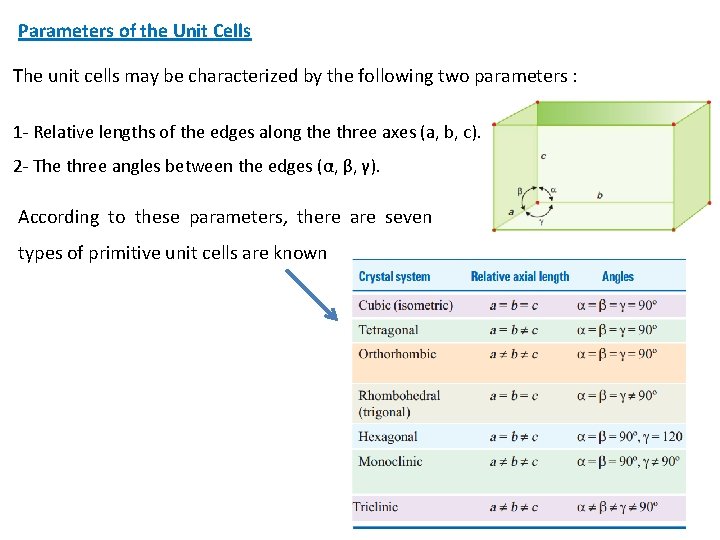
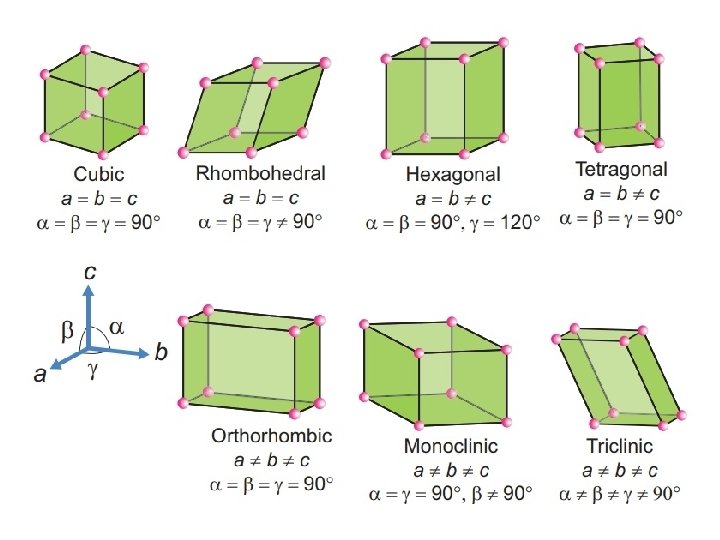
Parameters of the Unit Cells The unit cells may be characterized by the following two parameters : 1 - Relative lengths of the edges along the three axes (a, b, c). 2 - The three angles between the edges (α, β, γ). According to these parameters, there are seven types of primitive unit cells are known
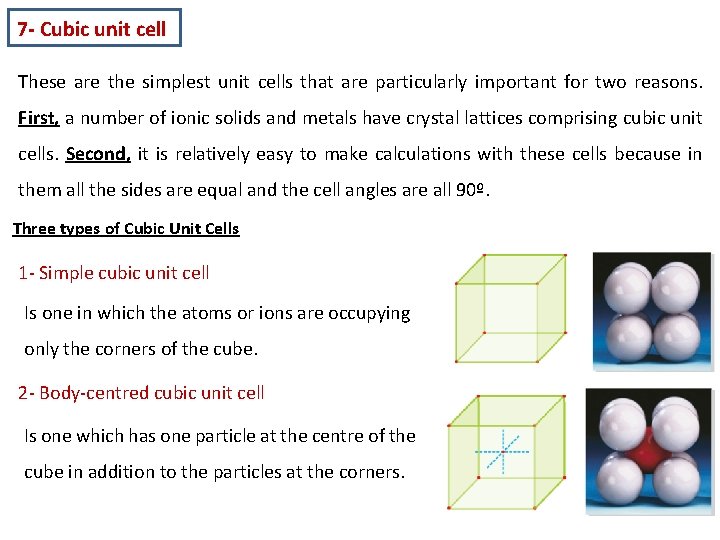
7 - Cubic unit cell These are the simplest unit cells that are particularly important for two reasons. First, a number of ionic solids and metals have crystal lattices comprising cubic unit cells. Second, it is relatively easy to make calculations with these cells because in them all the sides are equal and the cell angles are all 90º. Three types of Cubic Unit Cells 1 - Simple cubic unit cell Is one in which the atoms or ions are occupying only the corners of the cube. 2 - Body-centred cubic unit cell Is one which has one particle at the centre of the cube in addition to the particles at the corners.
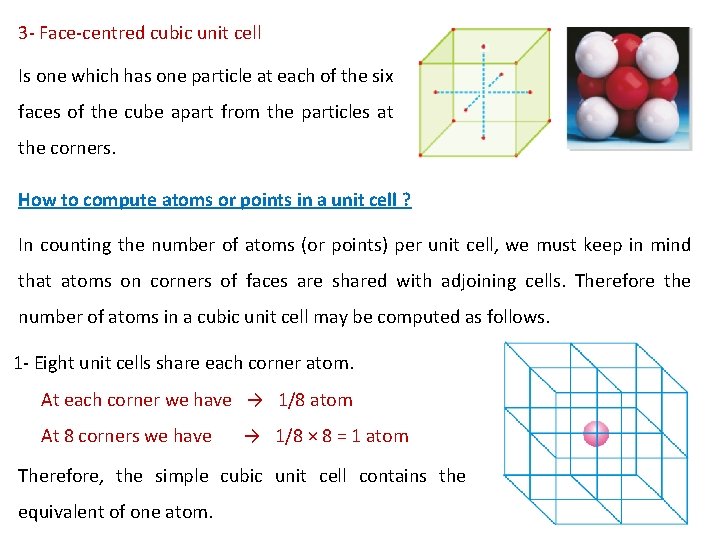
3 - Face-centred cubic unit cell Is one which has one particle at each of the six faces of the cube apart from the particles at the corners. How to compute atoms or points in a unit cell ? In counting the number of atoms (or points) per unit cell, we must keep in mind that atoms on corners of faces are shared with adjoining cells. Therefore the number of atoms in a cubic unit cell may be computed as follows. 1 - Eight unit cells share each corner atom. At each corner we have → 1/8 atom At 8 corners we have → 1/8 × 8 = 1 atom Therefore, the simple cubic unit cell contains the equivalent of one atom.
2 - Each face-centred atom is shared by two unit cells. 8 corners = 1 atom 6 face-centred sites = 6 x 1/2 = 3 atoms Total equivalent atoms = 1 + 3 = 4 Therefore, the face-centred unit cell contains the equivalent of four atoms. 3 - Each body centred unit cell contains a central unshared atom 8 corners = 1 atom central unshared atom 1 x 1 = 1 atom Total equivalent atoms = 1 + 1 = 2 Therefore, A body centred unit cell contains the equivalent of two atoms.
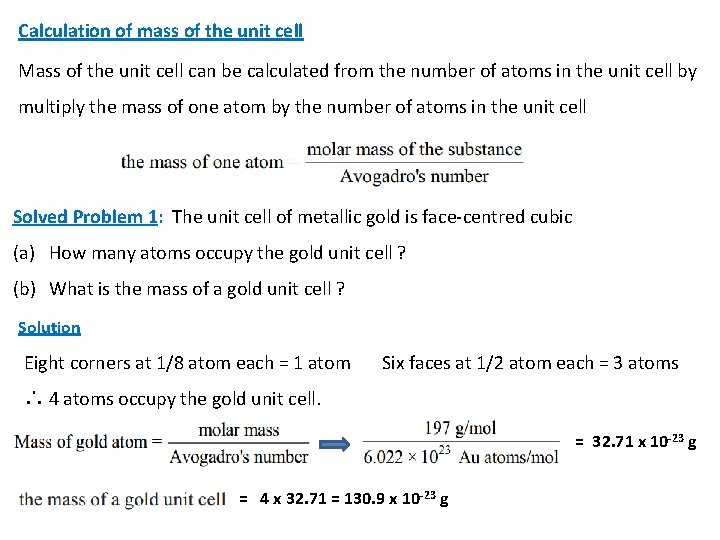
Calculation of mass of the unit cell Mass of the unit cell can be calculated from the number of atoms in the unit cell by multiply the mass of one atom by the number of atoms in the unit cell Solved Problem 1: The unit cell of metallic gold is face-centred cubic (a) How many atoms occupy the gold unit cell ? (b) What is the mass of a gold unit cell ? Solution Eight corners at 1/8 atom each = 1 atom Six faces at 1/2 atom each = 3 atoms ∴ 4 atoms occupy the gold unit cell. = 32. 71 x 10 -23 g = 4 x 32. 71 = 130. 9 x 10 -23 g
8 - Classification of crystals on the basis of bonds Crystals can also be classified on the basis of the bonds that hold the ions, molecules or atoms together in the crystal lattice. So that, there are four type of crystals: A- Ionic crystals B-Molecular crystals C- Network covalent crystals D-Metallic crystals
9 - Ionic crystals In an ionic crystal the lattice is made of positive and negative ions held together by ionic bonds. The positive and negative ions attract one another and pack together in an arrangement so that the attractive forces maximize. Each ion is surrounded by neighbors of opposite charge and there are no separate molecules. Since the ions are fixed in their lattice sites, typical ionic solids are hard and rigid with high melting points. Sodium chloride is an example of ionic solids Even though the ionic solids are hard, they are brittle. They shatter easily by hammering. By hammering, a layer of ions slips away from their oppositely charged neighbors to be closer to ions of the same charge which increases the electrostatic repulsions along the displaced plane causes the crystal to break.
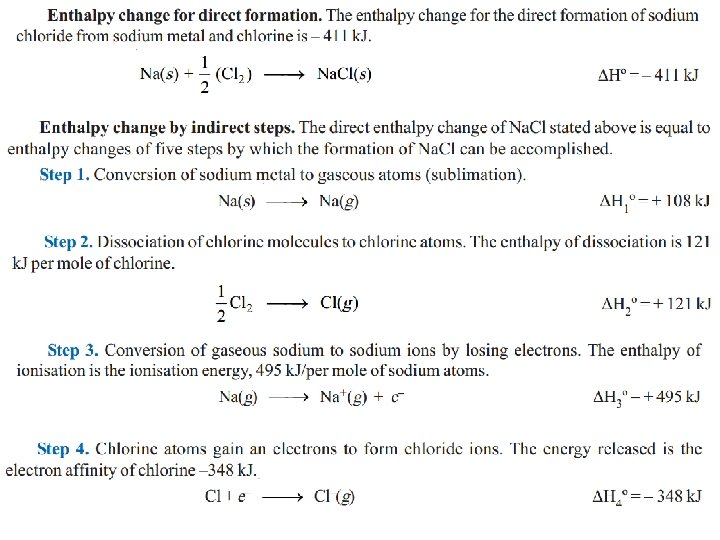
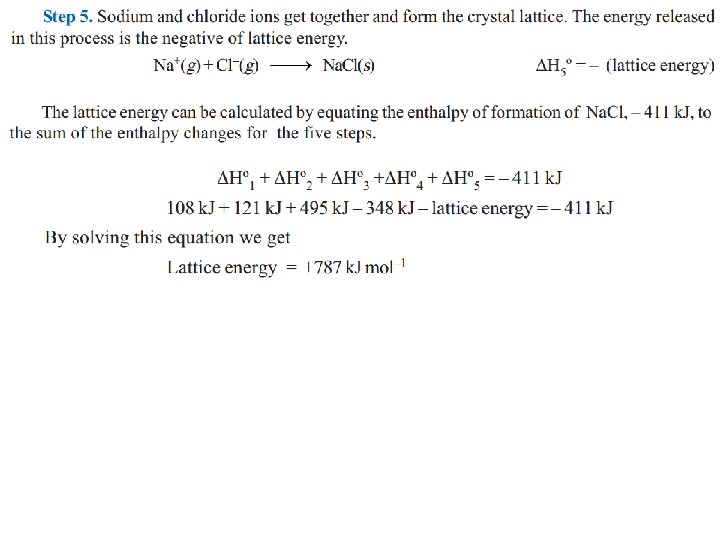
Lattice energy of an Ionic crystal The positive and negative ions in the ionic crystal are held together by electrostatic forces. The bond energy is expressed in terms of the lattice energy which may be defined as : The change in enthalpy (heat change) when 1 mole of a solid crystalline substance is formed from its gaseous ions. Determination of lattice energy The lattice energy of an ionic crystal can be found by applying Hess’s law. The formation of an ionic solid from its elements can expressed as occurring directly in one step or indirectly as the sum of the series of steps. Let us illustrate by taking example of Na. Cl.