
6 Control and Implementation of State Space Search





![General recursive rules • X, Y [path(X, Y) ← Z [move(X, Z) path(Z, Y)]]](https://slidetodoc.com/presentation_image/5920cbe08096bd630ec5925de25639b4/image-13.jpg "General recursive rules • X, Y [path(X, Y) ← Z [move(X, Z) path(Z, Y)]]")




- Slides: 28
6 Control and Implementation of State Space Search 6. 0 Introduction 6. 1 Recursion-Based Search Pattern-directed Search 6. 2 6. 3 The Blackboard Architecture for Problem Solving 6. 4 Epilogue and References 6. 5 Exercises Production Systems 1
Chapter Objectives • Compare the recursive and iterative implementations of the depth-first search algorithm • Learn about pattern-directed search as a basis for production systems • Learn the basics of production systems • The agent model: Has a problem, searches for a solution, has different ways to model the search 2
Summary of previous chapters • Representation of a problem solution as a path from a start state to a goal • Systematic search of alternative paths • Backtracking from failures • Explicit records of states under consideration · open list: untried states · closed lists: to implement loop detection • open list is a stack for DFS, a queue for BFS 3
Function depthsearch algorithm 4
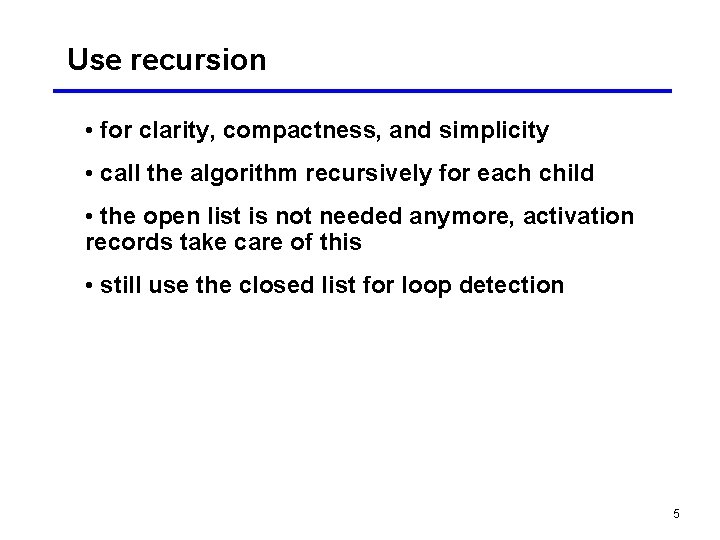
Use recursion • for clarity, compactness, and simplicity • call the algorithm recursively for each child • the open list is not needed anymore, activation records take care of this • still use the closed list for loop detection 5
Function depthsearch (current_state) algorithm 6
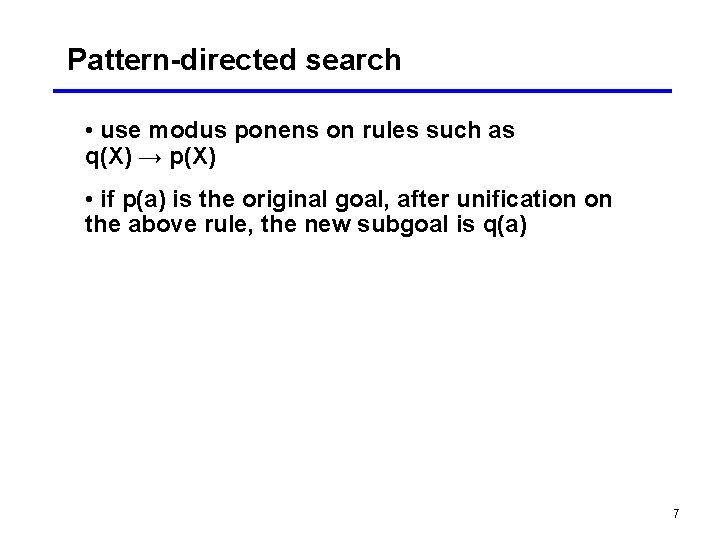
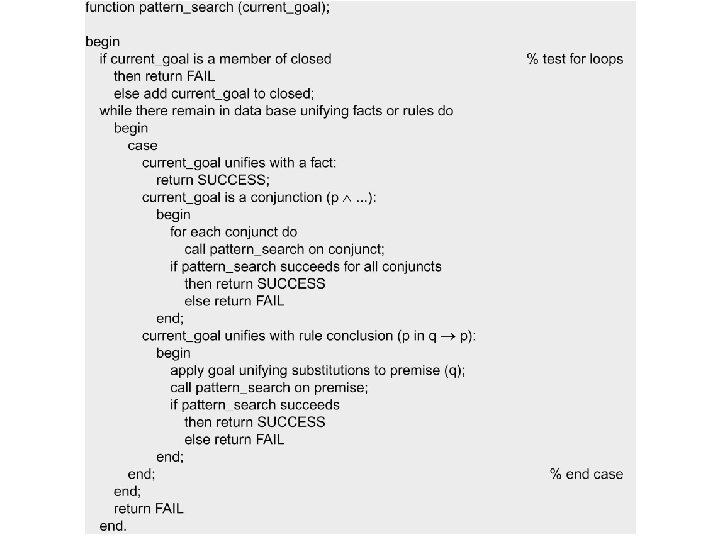
Pattern-directed search • use modus ponens on rules such as q(X) → p(X) • if p(a) is the original goal, after unification on the above rule, the new subgoal is q(a) 7
A chess knight’s tour problem Legal moves of a knight Move rules 9
Examples • Is there a move from 1 to 8? Pattern_search(move(1, 8)) success • Where can the knight move from 2? Pattern_search(move(2, X)) {7/X}, {9/X} • Can the knight move from 2 to 3? Pattern_search(move(2, 3)) fail • Where can the knight move from 5? Pattern_search(move(5, X)) fail 10
2 step moves • X, Y [path 2(X, Y) ← Z [move(X, Z) move(Z, Y)]] • path 2(1, 3)? • path 2(2, Y)? 11
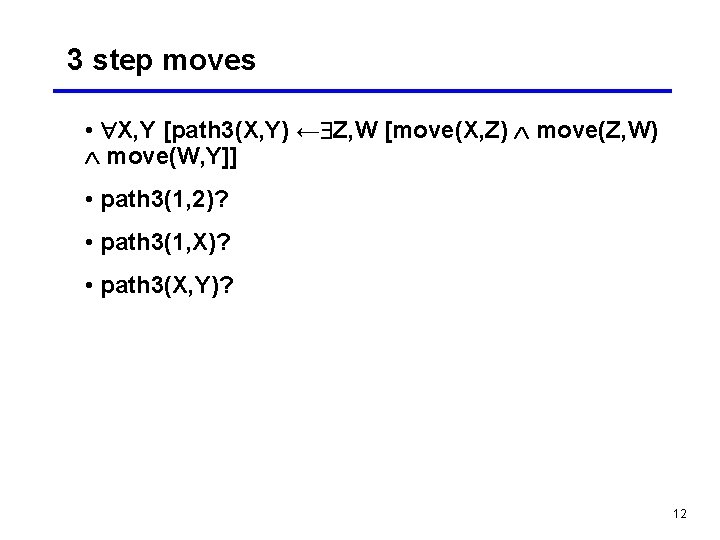
3 step moves • X, Y [path 3(X, Y) ← Z, W [move(X, Z) move(Z, W) move(W, Y]] • path 3(1, 2)? • path 3(1, X)? • path 3(X, Y)? 12
General recursive rules • X, Y [path(X, Y) ← Z [move(X, Z) path(Z, Y)]] • X path(X, X) 13
Generalized pattern_search • if the current goal is negated call pattern_search with the goal and return success if the call returns failure • if the current goal is a conjunction call pattern_search for all the conjuncts • if the current goal is a disjunction call pattern_search for all the disjuncts until one returns success 14
A production system is defined by: • A set of production rules (aka productions): condition-action pairs. • Working memory: the current state of the world • The recognize-act cycle: the control structure for a production system Initialize working memory Match patterns to get the conflict set (enabled rules) Select a rule from the conflict set (conflict resolution) Fire the rule 15
A production system 16
Trace of a simple production system 17
The 8 -puzzle as a production system 18
Production system search with loop detection & depth bound 5 (Nilsson, 1971) 19
A production system solution to the 3 3 knight’s tour problem 20
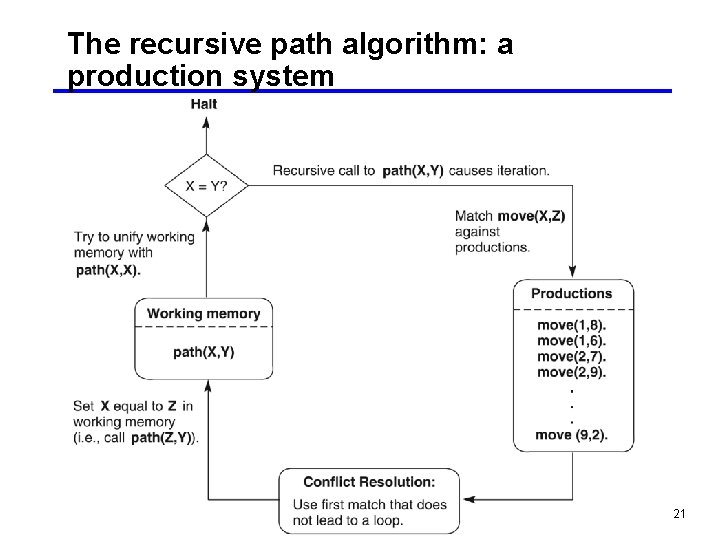
The recursive path algorithm: a production system 21
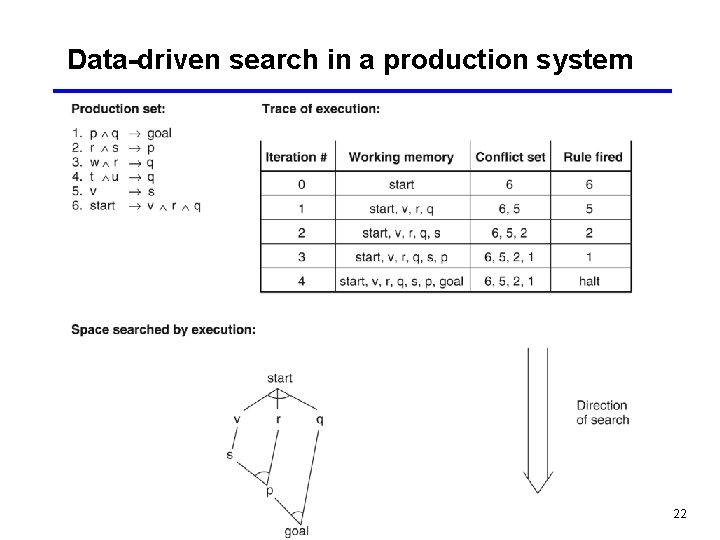
Data-driven search in a production system 22
Goal-driven search in a production system 23
Bidirectional search misses in both directions: excessive search 24
Bidirectional search meets in the middle 25
Advantages of production systems Separation of knowledge and control A natural mapping onto state space search Modularity of production rules Pattern-directed control Opportunities for heuristic control of search Tracing and explanation Language independence A plausible model of human problem solving 26
Comparing search models Given a start state and a goal state • State space search keeps the “current state” in a “node”. Children of a node are all the possible ways an operator can be applied to a node • Pattern-directed search keeps the all the states (start, goal, and current) as logic expressions. Children of a node are all the possible ways of using modus ponens. • Production systems keep the “current state” in “working memory. ” Children of the current state are the results of all applicable productions. 27
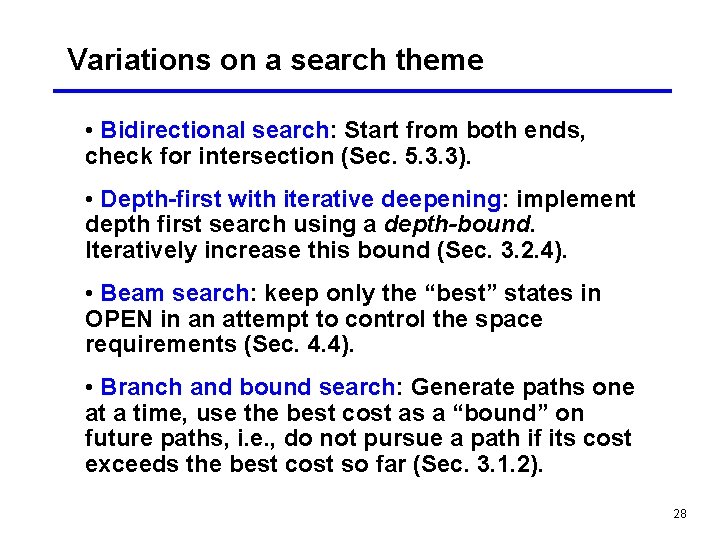
Variations on a search theme • Bidirectional search: Start from both ends, check for intersection (Sec. 5. 3. 3). • Depth-first with iterative deepening: implement depth first search using a depth-bound. Iteratively increase this bound (Sec. 3. 2. 4). • Beam search: keep only the “best” states in OPEN in an attempt to control the space requirements (Sec. 4. 4). • Branch and bound search: Generate paths one at a time, use the best cost as a “bound” on future paths, i. e. , do not pursue a path if its cost exceeds the best cost so far (Sec. 3. 1. 2). 28