
6 CommunityBased Disaster Risk Management What is community
6. Community-Based Disaster Risk Management • What is community? • Why Community participation? • What is the community based disaster management (CBDM) approach? • Community: people living in the same area with common interests • Why community participation? top down approach becomes unsuccessful in addressing the needs of vulnerable communities • Community participation can help to address real interests of the people. • Disaster mitigation using government and institutional interventions alone is insufficient because they pay little attention to addressing the community dynamics, perceptions or priorities. • As a result many feel it is important to adopt a new strategy, which directly involves vulnerable people themselves in planning and implementation of disaster risk reduction measures.
5. 1. Community-Based DRM …. . cont’d • This bottom up approach has received wide acceptance because considered communities are the best judges of their own vulnerability and can make the best decisions regarding their well being. • Community based DM: a system developed, managed and maintained by the community itself. In this process the empowering of the people will be in the center. The role of supporting organizations will be to facilitate active and meaningful participation of all community members. • Ultimately the DM will be owned by the community. • Normally, the term “People-centered” and the “Community-based” are used as synonyms words. • The aim of CBDM is to reduce vulnerabilities and strengthen people’s capacity to cope with hazards. • CBDM can be seen as risk reduction program designed primarily by and for the people in certain disaster prone areas.
• It is important to adapt a new strategy which directly participates the vulnerable people themselves in planning and implementation of mitigation measures. • A thorough assessment of a community’s exposure to hazards and an analysis of their specific vulnerabilities and capacities is the basis for activities, projects and programs that can reduce disaster risks. • Because a community is involved in the whole process, their felt and real needs as well as inherent resources are considered. • This will contribute, to a progression towards safer conditions, security of livelihood & sustainable development. • This underlines the point that the community is not only the primary actor but also the beneficiary of the risk reduction and development process. • Implementation of CBDM points to the following essential features: v The community has a central role in long term and short term disaster management. v The focus of attention in disaster management must be the local community.
Main Characteristics of Community Based Disaster Management (CBDM) v Disaster risk or vulnerability reduction is the foundation of CBDM. v The primary content of disaster management activities revolves around reducing vulnerable conditions and the root causes of vulnerability. v The primary strategy of vulnerability reduction is by increasing a community’s capacities, their resources and coping strategies. • CBDM should lead to a general improvement of the quality of life of the vast majority of the poor people and of the natural environment. • CBDM contributes to people’s empowerment – to possess physical safety; to have more access and control of resources; to participate in decision making which affects their lives; to enjoy the benefits of a healthy environment. • Community as a key resource in disaster risk reduction- the community key actor and the primary beneficiary of disaster risk reduction
• Within the community, priority attention is given to the conditions of the most vulnerable as well as to their mobilization in the disaster risk reduction. • Application of multi sectoral and multi disciplinary approaches. • CBDM brings together the multitude of community stakeholders for disaster risk reduction to Integrating Poverty Reduction Programs with Disaster Management Sector expand its resource base. • The local community level links up with the intermediate and national and even up to the international level to address the complexity of vulnerability issues. A wide range of approaches to disaster risk reduction is employed.
6. 2. Community-based Early Warning Systems • The term ‘early warning’ is used in many fields to describe the provision of information on an emerging dangerous circumstance where that information can enable action in advance to reduce the risks involved. Early warning systems exist for natural geophysical and biological hazards, complex sociopolitical emergencies, industrial hazards, personal health risks and many other related hazards. • Early warning system is the set of capacities needed to generate and disseminate timely and meaningful warning information to enable individuals, communities and organizations threatened by hazards to take necessary preparedness measures and act appropriately in sufficient time to reduce the possibility of harms or losses. • Early warning systems contribute with other DRR interventions to protect and support sustainable economic development and early detection of undesirable situations. The society benefits from early warning systems in place.
• Many governments have failed to take early warning into account while formulating their development and disaster risk reduction policies which results in heavy losses to human lives and economic entities when disasters strike. • The significance of an effective early warning system lies in the recognition of its benefits by the members of the general public. • A people-centered early warning system necessarily comprises four key elements: I) knowledge of the risks; II) monitoring, analysis and forecasting of the hazards; III) communication or dissemination of alerts and warnings; and IV) local capacities to respond to the warnings received. • A weakness or failure in any one part could result in failure of the whole system. • The expression "end-to-end warning system” emphasizes that early warning systems need to span all steps from hazard detection to community response.
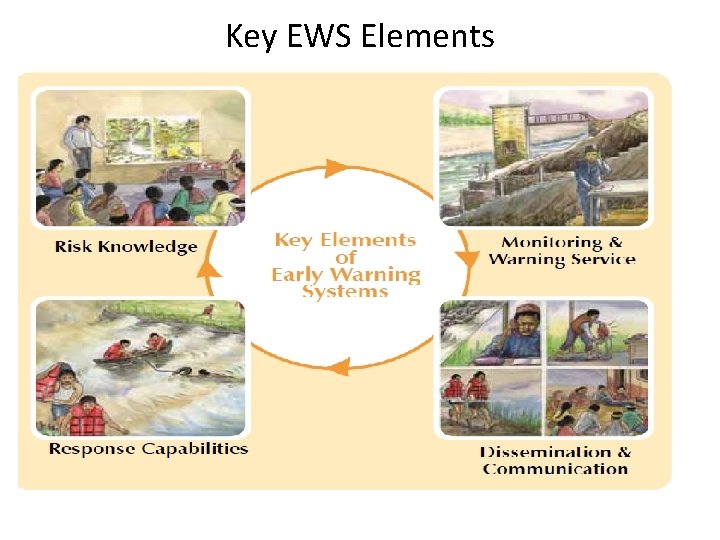
Key EWS Elements
• Risk Knowledge • A detailed assessment of the risks will be required through systematic collection and analysis of data and should consider the dynamic nature of hazards and vulnerabilities arising from land-use change, environmental degradation, and climate change. • Risk assessments and maps help to understand the situation, motivate people, prioritize needs for developing early warning systems and guide preparations of disaster prevention and response measures. • Monitoring and Warning • Warning services lie at the core of the system. • There must be a sound basis for predicting and forecasting hazards as well as reliable forecasting and warning system operating 24/7. • Continuous monitoring of hazard parameters and contributing factors is essential to generate accurate and timely warnings. • Warning services should be coordinated with stakeholders and relevant agencies to gain benefits of shared institutional, procedural and communication networks.
Dissemination and Communication • Warnings must reach all those at risk including all vulnerable members. • Clear messages containing simple, useful, and understandable information are crucial to enable proper understanding of warnings and responses in order to safeguard lives and livelihoods. • It should be taken into account that some community members might not be able to hear or see the information or to follow the instructions by themselves and appropriate measures and actions should be taken accordingly. • Community and district level communication systems must be preidentified and appropriate authoritative mandates be established. The use of multiple communication channels can be necessary to ensure that many people receive warning message. • Response Capabilities • It is essential that communities understand their risks, respect and follow the warning and know how to react.
§Education and preparedness interventions play a key role in increasing knowledge. It is also essential that contingency and disaster management plans be in place, that roles and responsibilities are clearly stated among community members, that resources including human resources are allocated and that standard procedures are well practiced and tested §All community members should be well informed regarding warning messages, when and how to react to the messages, steps to take to prepare themselves and their family, options for safe behavior, available escape/evacuation routes, and best ways to avoid damage and loss of properties. Establishing Community-based early Warning Systems • Community Based Early Warning System: is a system designed, operated and maintained by the communities themselves. • While establishing the system the community will explore external support from different individuals, communities, organizations and institutions. • It is essential that the community develops and maintains close coordination and links with these stakeholders. • The community will lead all steps of establishment of the early warning system.
• The ‘people-centered’ elements require many systematic approaches and diverse activities spanning the four elements of early warning systems described above, such as: v identifying target population, especially the vulnerable and disadvantaged and interacting with them to determine needs and capacities; v conducting community meetings and involving communities in exploring and mapping their risks and planning their responses; v fostering the development by communities of monitoring and warning systems for local hazards; v generating public information tailored to target groups; v developing formal mechanisms for community representatives to monitor and oversee warning system design; v providing training for observers, authorities and communicators who operate the warning system; and v providing exercises and simulations to enable people to experience and practice warning interpretation and responses.
Community Based Early Warning System • Community-Based Early Warning Systems (CBEWS) are anchored in the communities and managed by the communities. • It provides communities, practitioners and organizations involved in disaster risk management with advance information of risks that can be readily translated into prevention, preparedness and response actions. • CBEWS helps to reduce economic losses by allowing people to better protect their assets and livelihood. • The true essence and significance of CBEWS is community empowerment. • CBEWS suggests that people of a community can be capable and it empowers them to protect and prepare themselves and make them resilient against the disastrous effects. • The communities are in the best position to undertake preparedness measures against disasters. • The basic requirements of CBEWS are that individuals and institutions have knowledge about what is threatening them, that people are able to communicate a change in threats, and that they are in a position to respond.
6. 3. Essential features of Community-Based Early Warning Systems • All community members especially the vulnerable groups should be involved at all stages of the CBEWS from designing to operating the systems, receiving the warning messages and responding to the warning. • Measures taken should be based on the needs of the community including the most vulnerable segments of the community. • The community members should own the process and system. • CBEWS measures will enhance the capacity of the community members to deal with their situation. • Meaningful participation in the decision-making process of EWS. Flood Early Warning • A flood early warning system is an integrated system of tools and plans that guide detection of and coordinates response to flood emergencies. • A properly designed and implemented system can save lives and reduce property damage by increasing the time to prepare and respond to the threat of flood and time available to take protective measures prior to the occurrence of flood.
6. 4. Importance of Flood Early Warning Systems • Get advance notice of flood occurrence. • Early Warning Systems can help to reduce casualties and damages. • Vulnerable people in flood-prone areas are warned in time so that they can: v leave the danger zone and go to a safer place to avoid casualties. v transfer moveable items to safer grounds. • EWS contribute in protecting and supporting sustainable social and economic development. • The society benefits from an early warning system. • However, these benefits only work under certain circumstances: § The lead time (time between the warning and the actual arrival of the flood) must be sufficient to make the necessary arrangements. § Safe places must be identified prior to the event and must be within reach of all people of the community. § Evacuation routes must be identified prior to the event, marked and accessible for all segments of the community.
The EWS must be fully operational and reliable, all procedures and equipment must be regularly tested and updated. • All community members including the most vulnerable segments of the community must be aware of and agree on the EWS procedures and warning methods and must be willing to follow information and advice given to them. • Early Warning Practices and Systems • Effective Early warning systems require appropriate and easy to use technical knowhow and good knowledge of the risks. • The systems must have efficient and effective dissemination, information and communication systems that will reach all those at risk including the most vulnerable segments of the communities. • It must be practiced and have well understood response mechanisms and procedures. • The general public, risk managers, community leaders, members of disaster risk reduction and early warning committees, and security personnel should be well familiar with the mechanisms and procedures. Public awareness and education are crucial for ensuring effective and efficient early warning system. • Close collaboration among the many sectors involved in the systems is essential to produce synergic efforts and make the system more viable.
Traditional framework of EW systems is composed of three phases: i) Monitoring of Risk (Measurement of Precursors) ii) Forecast indicates sudden disaster event (catastrophic) iii) Notification of a warning or alert, should an event of probable disaster/event take place • An improved four-step framework being promoted by the different agencies includes a 4 th phase: preparedness and response for an emergency situation. • The purpose of this fourth element is to recognize the fact that there needs to be a response to the warning. The response will be the responsibility of the community.
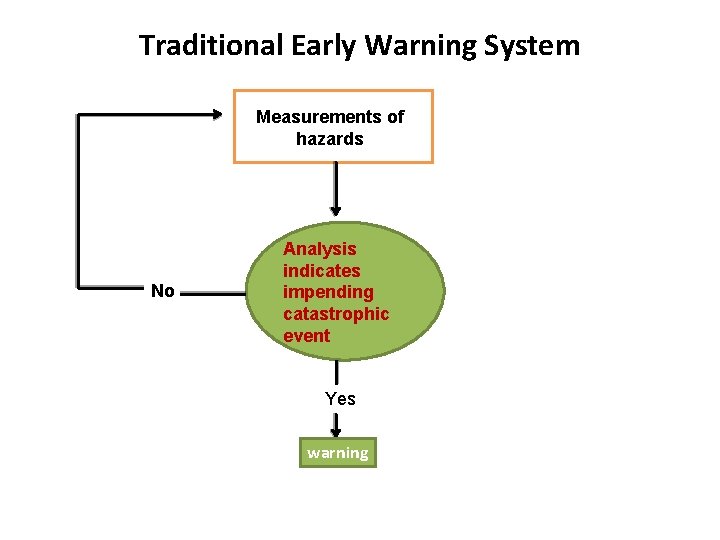
Traditional Early Warning System Measurements of hazards No Analysis indicates impending catastrophic event Yes warning
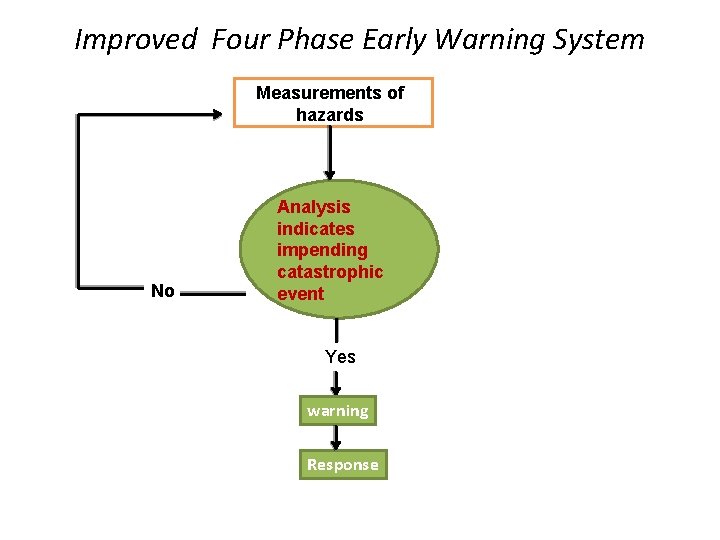
Improved Four Phase Early Warning System Measurements of hazards No Analysis indicates impending catastrophic event Yes warning Response
• It helps to develop ownership and contributes to the sustainability of the systems. • The following five steps should be considered while establishing a community based early warning System: v. Step I: Preparation v. Step II: Participatory Situational Analysis Step v. Step III: Observation & Monitoring v. Step IV: Communication and Dissemination v. Step V: Preparation for Response v. VI: Follow-up, Review & Sustainability
Step 1: Preparation • This step includes activities to identify whether the establishment of an early warning system will be the right intervention to mitigate the problems that the community is facing. • The basic information should be collected in consultation with key persons in the community. • The following information can be collected: v. Frequency and severity of past hazards v. Vulnerable households and groups. v. Spatial characteristics v. Existing social groups v. Indigenous early warning practices v. Capacity of the community
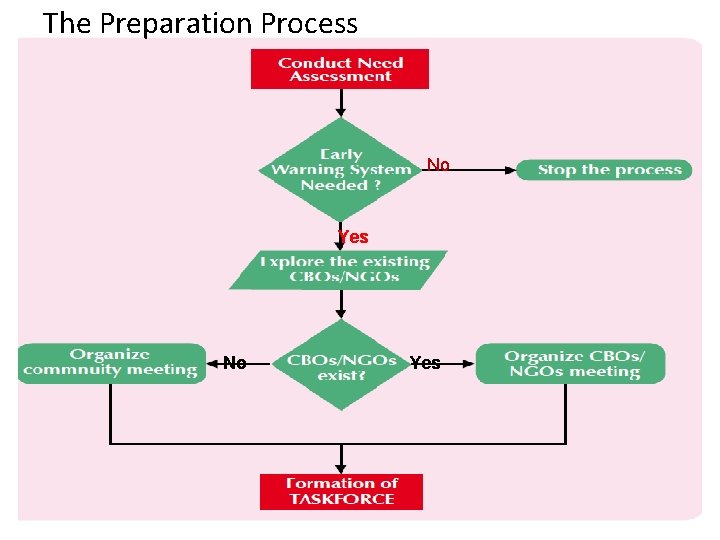
The Preparation Process No Yes
• The information will be analyzed with community representatives and the outcomes will advice whether establishment of an early warning system will be effective in reducing the vulnerabilities of the community. • The major criteria for identification of the relevance of establishing early warning systems are: v frequency of hazard vseverity of hazards vavailability of sufficient lead time v. Step II: Participatory Situational Analysis • The community will be the key actors and decision makers in the participatory situational analysis to ensure successful outcome of the mapping, analysis and effectiveness of the early warning system. • This participatory process assumes the people as experts and the ones to know the reality of their community.
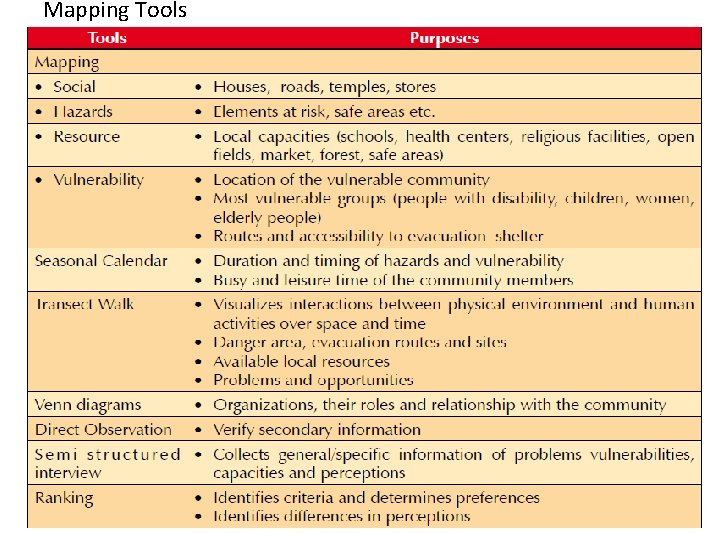
Mapping Tools
• Formation of Early Warning Management Committee • After completion of the Participatory Situational Analysis, the taskforce will have in depth information and knowledge of the community and will facilitate in the formation of early warning management committee. • In the establishment of an early warning system, this committee will develop links with different stakeholders for technical, managerial and financial support. • The members of the management committee will be oriented about their rights, roles, responsibilities and tasks. • Step III: Observation and Monitoring of Hazard for Early Warning • After analyzing the collected data, an observation and monitoring system should be developed with the active participation of the community. • The hydrology and meteorology services should establish daily observation and recording of rainfall and water level stations in many places.
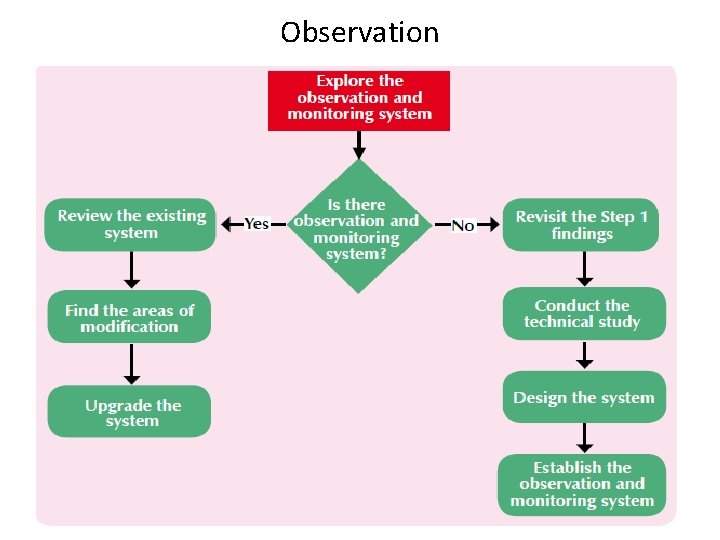
• A joint assessment team with representatives from the community, EWS taskforce, project staff, and government staff will assess the stations to determine whether they can provide relevant information for an early warning system. • The assessment team will identify the relationship between the observer stations and downstream communities. • The team will look into quantity and quality of the monitoring devices, human resources available, need for capacity building, and possibilities for communication, additional equipment and necessary maintenance. • Exploring the existing Observation and Monitoring Systems: • First of all, existing observation and monitoring systems should be explored (indigenous, traditional or modern). Upgrading of Existing Systems • If systems exist, the community will review it and find out the areas of modification. Once the areas are identified, the community will develop their system for observation and monitoring of flood hazards.
Observation
The following checklist can be used to review the existing systems: How effectively are they functioning? Do they provide timely and reliable information? How are they managed? How are resources for the systems mobilized? Does the community have capacity and resources (Human and financial resources, tools and equipment) to operate the system? • What are the lessons learned from the existing system? • Are there any needs for modification of the system? • The review will identify whether the system can effectively serve the community’s needs for a EWS. It will be relevant to explore available external technical support from the government and nongovernmental organizations. • • •
Step IV: Communication and Dissemination Plan • This step will focus on transferring the information gathered during observation and monitoring of hazard to the residents of the hazard prone areas and disaster risk reduction stakeholders. • A reliable and well-organized dissemination system should be in place for on time information dissemination. • It is therefore essential to develop and agree on a flow of information which needs to be well understood by all stakeholders. • The system should be effective and efficient to reach all end users. • The communication and dissemination system should offer alternative methods in case of failures of one or more communication channels.
§ The following steps can be followed to develop a communication and dissemination system: a. Identify existing communication and dissemination systems b. Identify the mechanism and medium for communication and dissemination based on the information and level of risk c. Develop communication and dissemination plan with technical support from the concerned organizations. Identify roles and responsibilities of each stakeholder. Take into account the special need of all community members (including hearing, visual and mentally impaired persons). d. Supply and install the communication and dissemination tools and equipment. • Prepare operation and management plan for these tools and. Equipment. e) Share agreed communication and dissemination plan to all community members and stakeholders. • Tools and Equipment • The following tools and equipment can be used for communication and dissemination of early warning information: Telephones, Wireless radios, Sirens (hand operated), Colored flags/light, Hand mikes, and Radio and television stations
• An effective communication and dissemination system in principle consists of three levels: • 1. Upstream (or gauging station) to Community • The primary and very important communication is made from the upstream gauging station to the flood prone communities and other entry points in accordance with the agreed communication channels. • The upstream observer will provide the downstream community’s real time information about the rainfall and river level and to what extent the rain and flood is likely to continue. 2. Within Communities • The community will agree on and set up a system for disseminating early warning information. Each community member will be responsible for disseminating information to ensure that everyone has heard or seen the information. • Once the flood prone community receives information, they will immediately impart information to other member of the community. • The community members will use sirens, hand mikes, colored flags, traditional horns, drums, and telephones by following "Community Communication Network" as agreed in their plan for dissemination of information.
3. Community to Community • It is equally important to disseminate early warning information to other communities in the same river system especially the downstream communities. • Downstream communities can benefit from the information in order to prepare and respond on time. • Recognizing and Understanding Warning Messages • Emergency situations do not allow for lengthy conversations. • The information therefore should be short, clear and easily understandable. Common understanding of the EWS system, warning level and communication channels will ensure effective communication.
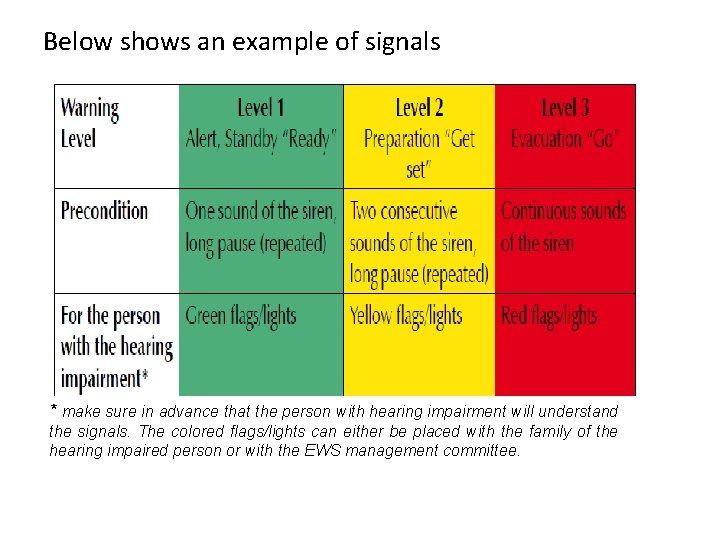
Below shows an example of signals * make sure in advance that the person with hearing impairment will understand the signals. The colored flags/lights can either be placed with the family of the hearing impaired person or with the EWS management committee.
Step V: Preparation for Response • Preparation for response is the fourth step in establishment of community based early warning system. This step totally relies on the previous steps and will only be effective when they are fully functional. • This step will empower the community to be well prepared and respond effectively to disasters. Hence, response is the most crucial component of early warning system. • Early warning systems will only make sense if all involved stakeholders have the relevant knowledge, capability and are ready to respond when a disaster occurs. • The previous steps will ensure that the communities have relevant knowledge of hazards, their vulnerability, and capacities, observation, monitoring of hazards and how to communicate and disseminate warning. However, the community will still need a concrete plan to be prepared and to respond to disasters.
• The effectiveness of response depends on the following critical components: v Availability of lead time v Clear understanding of the warning information and the actual risk v Trust in warning information v Knowledge on how to prepare and respond v Past experience of hazards, disasters and warnings v Well structured contingency action plans v Trainings, awareness campaigns and simulation/drills v Step VI: Follow-up, Review and Sustainability • This final and fifth step will focus on initiatives for follow-up, review and sustainability of the systems. • It will be necessary with a fine tuning of the system combined with real time experience and changes of the situation and environment. • It might seem easy to establish an EWS, but sustaining and carrying the systems forward can be challenging and will require specific initiatives.
• Follow-up and review is important for the sustainability of the systems. Sustainability is defined as the ability to maintain an activity, a process and a system over a longer period of time. • In simple words it means that the community itself will be able to continue and maintain the EWS either by own means or means generated from other sources. • The community will take the full operational and financial ownership of the system. • Early warning should be seen as an integral part of DRR interventions and development initiatives and of the daily life of the communities to ensure the sustainability. • The system should further be built on existing structures and with sound technical support. • The success of the early warning systems and their sustainability will require the community to develop a culture of preparedness and resilience. • Sustainability of the EWS can be divided into organizational and technical sustainability. Organizational sustainability implies that the community is the owner of the system after its establishment.
• It further requires plans and responsibilities to be reviewed, tested and updated. Human resources should be available and trained. • Technical sustainability refers to the community's ability to maintain and update the technical component of the systems. • These two parts are equally important to sustain the EWS and the failure of anyone of these will reduce the effectiveness of the system. • The two parts can be compared with the two wheels of a bicycle; the bicycle cannot run with only one wheel. • Essentials of EWS • Community based early warning systems must be built on four essential aspects: Effectiveness, Efficiency, Equity and Legitimacy • Effectiveness: While designing EWS, the following questions should carefully be considered to ensure effectiveness of the system: v. Does the system ensure that the early warning messages reach the last and most vulnerable person of the community? v. Does the early warning message help reduce disaster risks? v. Is early warning message beneficial for saving human, physical and financial capital of the community?
v Is the system well managed and are the resources used in the most appropriate way? • Efficiency: Any established Community Based Early Warning Systems (CBEWS) should function properly which means it should be managed efficiently and be effective in protecting life and property during the time of the flood. • Efficiency of any CBEWS can be assessed by following: v Are there prompt and effective decision making policies and systems in place to achieve its objectives? v Will people have a positive perception on the immediate danger and is the level of understanding about hazard type appropriate? v Can the EW messages be issued on time? v Are early warning facilities appropriate and are decisions taken by those at risk timely? • Equity: CBEWS must address the need of all community members. Special needs of the most vulnerable groups of the community (women, people with disabilities, elderly people, and children) should be considered. • The Equity of any CBEWS can be assessed by following:
• Does the system address human justice? • Are the voices of the most vulnerable people in the community heard? • Are the special needs of the women, elderly people, people with disabilities and children considered and addressed? • Legitimacy: The community should take the early warning message authentic and interpret properly to cope with the situation and make responses. The early warning message should not be considered like a Nepali Folk Story mentioned in the manual. EWS could be adopted and developed as common practice and culture of the community. • Legitimacy of any CBEWS can be assessed by following: v Are the early warning messages accepted by the community or end users? v Are there any possibilities of issuing the wrong early warning messages? v Does the community respond to the early warnings? v Are the local knowledge/traditional early warning practice accepted by the systems?
6. 5. Contingency Planning 6. 5. 1. What is contingency planning? • Contingency means something preparation for an event that might occur in the future, especially a problem, emergency, or expense that might arise unexpectedly. • Planning is the process of deciding what to do, where to do, and how to do some activities for the future with changes and uncertainties, because it is not possible to know how changes in demographics, economics, technologies or consumer preferences occur. • In planning we have to ensure that disaster risk and related options for reducing vulnerability are to be adequately and systematically examined. • It is a field involved with the assessment, evaluation, design and preparing disaster risk reduction projects. • Planning requires, area/location, activities; resources (financial and human), equipment and materials needed as well as time to
• It also requires prioritization of problems to efficiently allocate scarce resources at many different levels. • Contingency plan or response plan is an important part of early warning system and disaster risk reduction initiatives. • This is the ultimate indicator of the effectiveness of successful community based early warning system. • Contingency Planning is a management process that analyses specific potential events or emerging situations that might affect people or the environment and establishes arrangements in advance to enable timely, effective and appropriate responses to such events and situations. • It relates to events, which may or may not occur, in which objectives and scenarios are agreed; managerial and technical actions defined; and potential responses put in place to prevent, or respond to an emergency situation. § This plan should be developed, tested and disseminated before the onset of disaster.
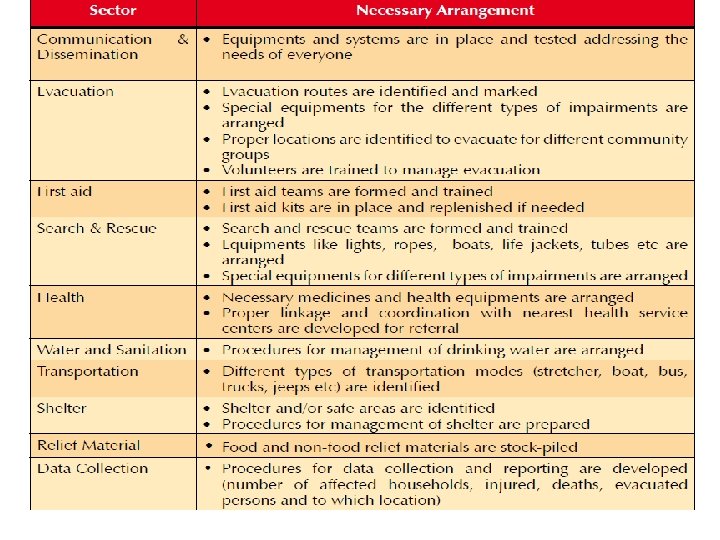
• An effective and efficient contingency plan will include and should address the following sectors: v. Communication and dissemination v. Evacuation v. Search and rescue (early response) v. First Aid v. Health v. Transportation v. Shelter and shelter management v. Water and sanitation v. Provision of relief (food and non-food) v. Data collection
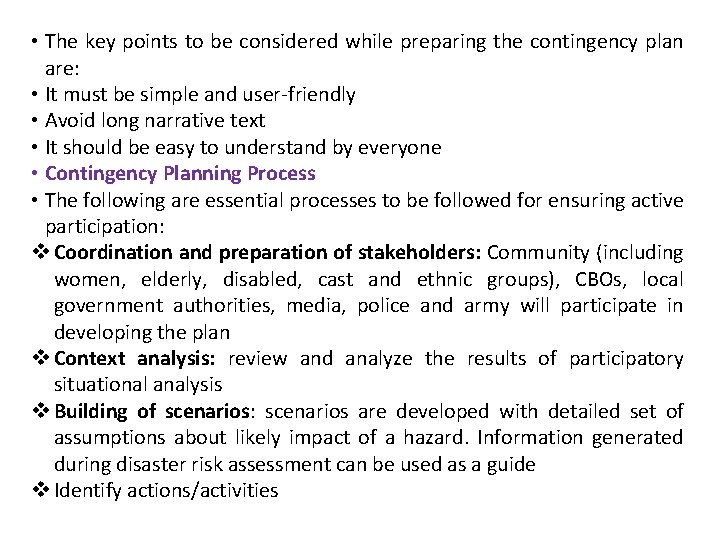
• The key points to be considered while preparing the contingency plan are: • It must be simple and user-friendly • Avoid long narrative text • It should be easy to understand by everyone • Contingency Planning Process • The following are essential processes to be followed for ensuring active participation: v Coordination and preparation of stakeholders: Community (including women, elderly, disabled, cast and ethnic groups), CBOs, local government authorities, media, police and army will participate in developing the plan v Context analysis: review and analyze the results of participatory situational analysis v Building of scenarios: scenarios are developed with detailed set of assumptions about likely impact of a hazard. Information generated during disaster risk assessment can be used as a guide v Identify actions/activities
v Identify resources needed to implement the plan (i. e. human and financial resources, tools and equipment) v Identify committees/teams needed to facilitate the actions and their roles and responsibilities v Compilation of the Contingency plan; detailing key intervention areas with clear objectives, targets, activities, resources required, responsibilities for implementation and time when their implementation is appropriate guided by EWS v Revise the contingency plan based on lessons learnt after implementation or updating it regularly to reflect the changes taking place in the context.
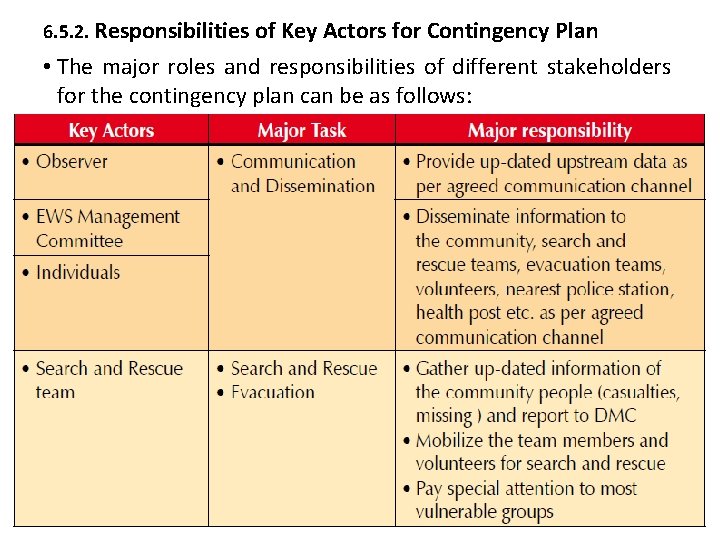
6. 5. 2. Responsibilities of Key Actors for Contingency Plan • The major roles and responsibilities of different stakeholders for the contingency plan can be as follows:
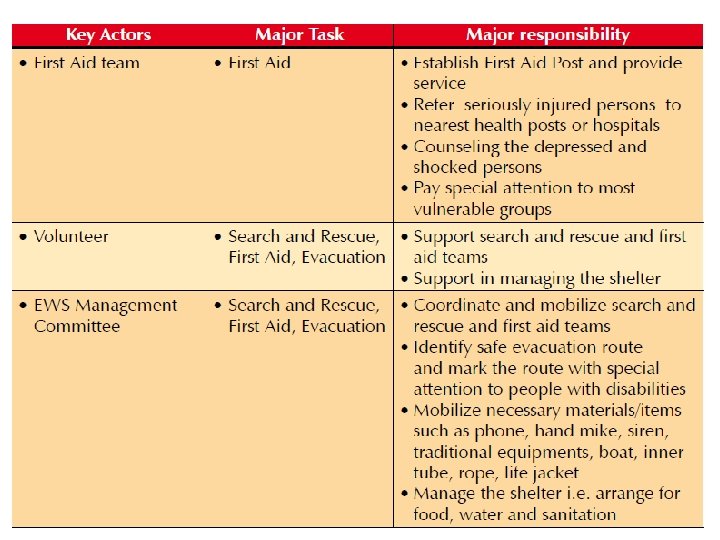
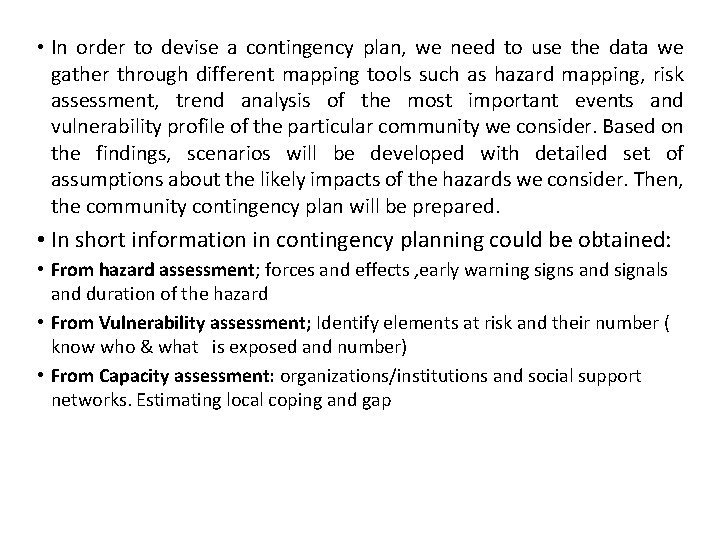
• In order to devise a contingency plan, we need to use the data we gather through different mapping tools such as hazard mapping, risk assessment, trend analysis of the most important events and vulnerability profile of the particular community we consider. Based on the findings, scenarios will be developed with detailed set of assumptions about the likely impacts of the hazards we consider. Then, the community contingency plan will be prepared. • In short information in contingency planning could be obtained: • From hazard assessment; forces and effects , early warning signs and signals and duration of the hazard • From Vulnerability assessment; Identify elements at risk and their number ( know who & what is exposed and number) • From Capacity assessment: organizations/institutions and social support networks. Estimating local coping and gap
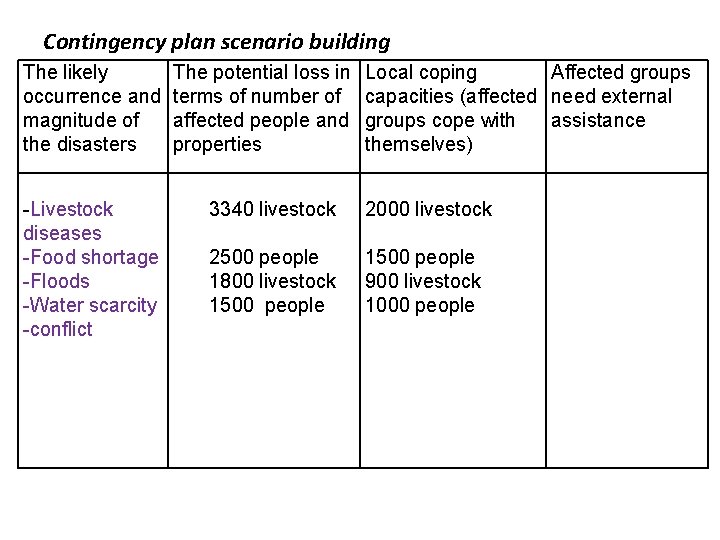
Contingency plan scenario building The likely occurrence and magnitude of the disasters -Livestock diseases -Food shortage -Floods -Water scarcity -conflict The potential loss in terms of number of affected people and properties Local coping Affected groups capacities (affected need external groups cope with assistance themselves) 3340 livestock 2000 livestock 2500 people 1800 livestock 1500 people 900 livestock 1000 people
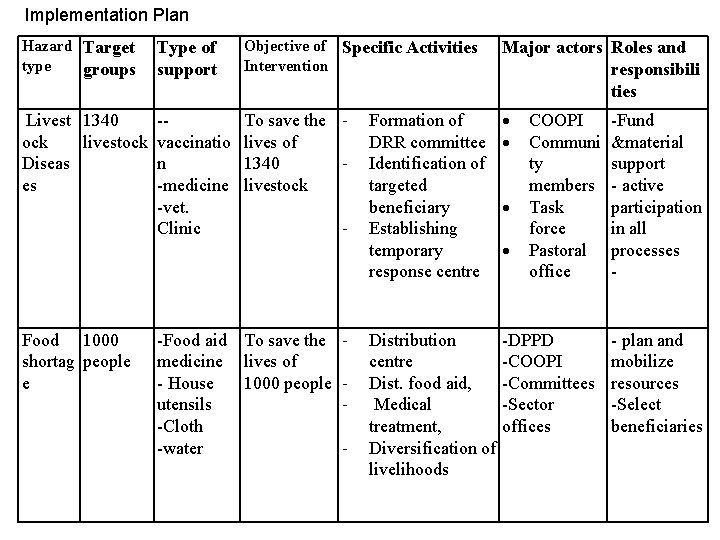
Implementation Plan Hazard Target type groups Type of support Objective of Specific Activities Intervention Major actors Roles and responsibili ties Livest 1340 ock livestock Diseas es -vaccinatio n -medicine -vet. Clinic To save the lives of 1340 livestock Formation of DRR committee Identification of targeted beneficiary Establishing temporary response centre Distribution centre Dist. food aid, Medical treatment, Diversification of livelihoods -DPPD -COOPI -Committees -Sector offices Food 1000 shortag people e -Food aid To save the medicine lives of - House 1000 people utensils -Cloth -water - - COOPI Communi ty members Task force Pastoral office -Fund &material support - active participation in all processes - - plan and mobilize resources -Select beneficiaries
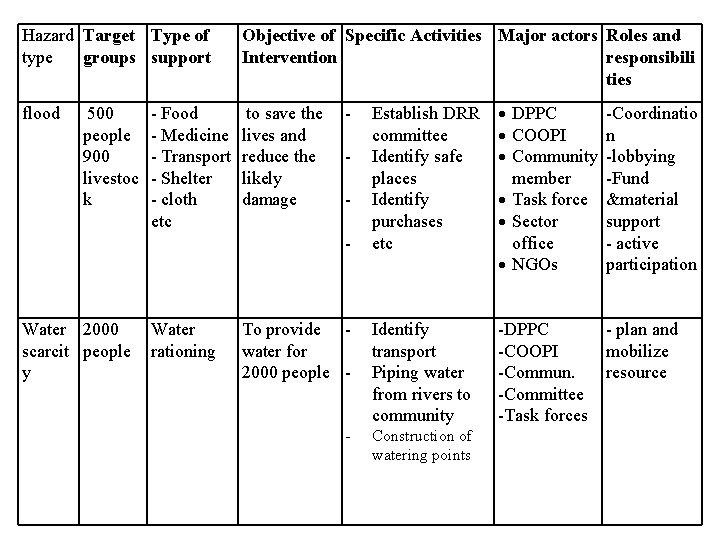
Hazard Target Type of type groups support Objective of Specific Activities Major actors Roles and Intervention responsibili ties flood to save the lives and reduce the likely damage 500 people 900 livestoc k - Food - Medicine - Transport - Shelter - cloth etc Establish DRR committee Identify safe places Identify purchases etc DPPC COOPI Community member Task force Sector office NGOs -Coordinatio n -lobbying -Fund &material support - active participation To provide water for 2000 people - Identify transport Piping water from rivers to community -DPPC -COOPI -Commun. -Committee -Task forces - plan and mobilize resource - Construction of watering points - Water 2000 scarcit people y Water rationing
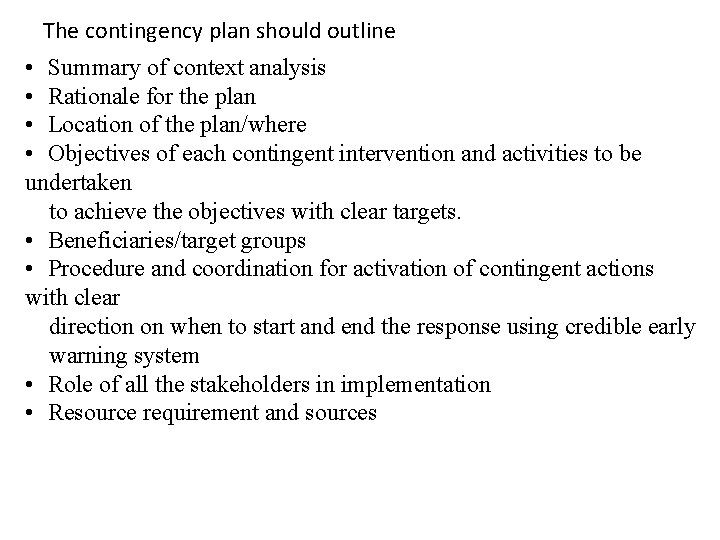
The contingency plan should outline • Summary of context analysis • Rationale for the plan • Location of the plan/where • Objectives of each contingent intervention and activities to be undertaken to achieve the objectives with clear targets. • Beneficiaries/target groups • Procedure and coordination for activation of contingent actions with clear direction on when to start and end the response using credible early warning system • Role of all the stakeholders in implementation • Resource requirement and sources
- Slides: 52