
6 CO 2 12 H 2 O Light
![The spatial organization of chemiosmosis Differs in chloroplasts and mitochondria Key Higher [H+]](https://slidetodoc.com/presentation_image_h2/4d1fd0f762a72ce9ef6260409bec56e4/image-14.jpg "The spatial organization of chemiosmosis Differs in chloroplasts and mitochondria Key Higher [H+]")
- Slides: 22
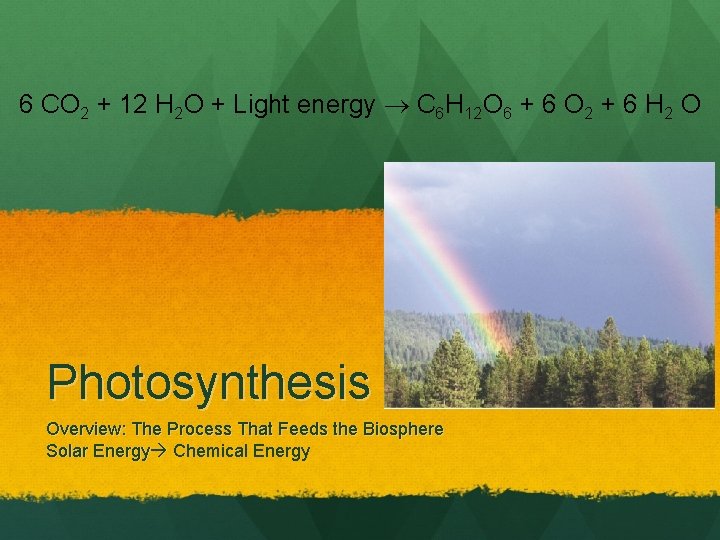
6 CO 2 + 12 H 2 O + Light energy C 6 H 12 O 6 + 6 O 2 + 6 H 2 O Photosynthesis Overview: The Process That Feeds the Biosphere Solar Energy Chemical Energy
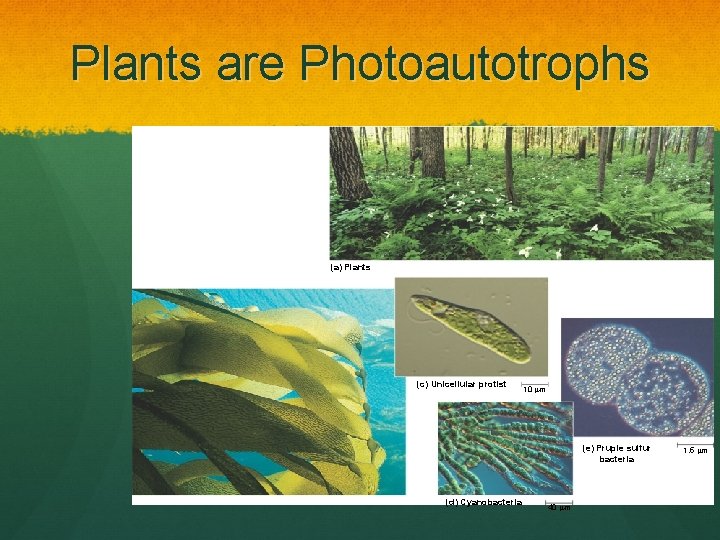
Plants are Photoautotrophs (a) Plants (c) Unicellular protist 10 m (e) Pruple sulfur bacteria (d) Cyanobacteria 40 m 1. 5 m
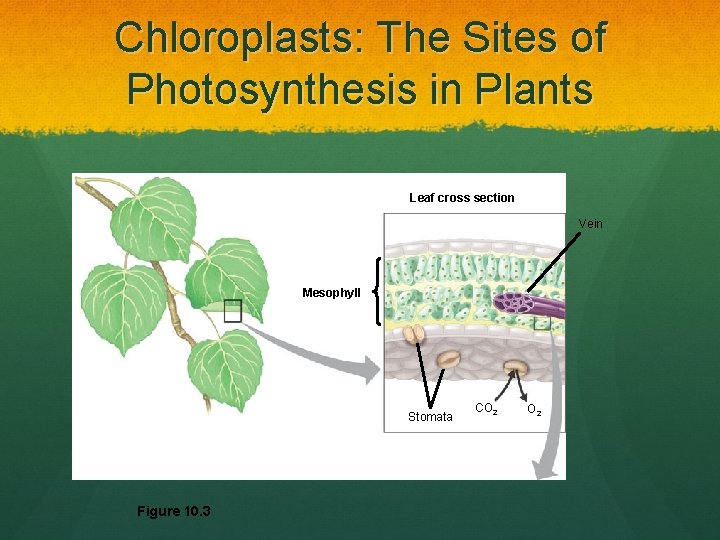
Chloroplasts: The Sites of Photosynthesis in Plants Leaf cross section Vein Mesophyll Stomata Figure 10. 3 CO 2
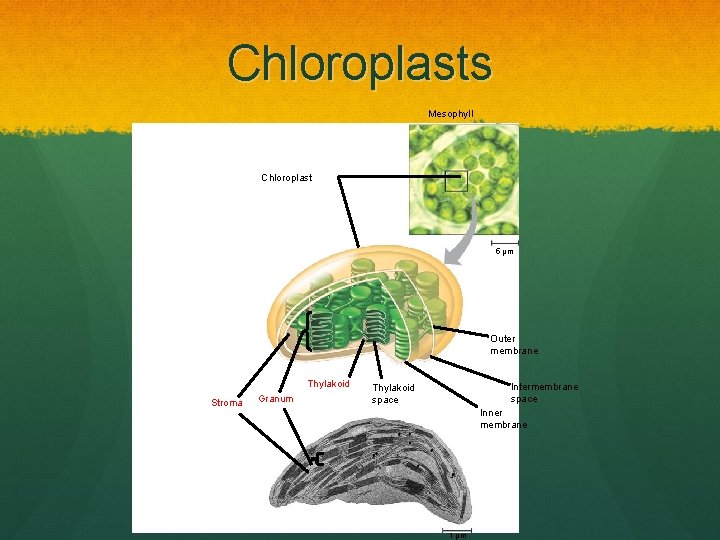
Chloroplasts Mesophyll Chloroplast 5 µm Outer membrane Thylakoid Stroma Granum Intermembrane space Thylakoid space Inner membrane 1 µm
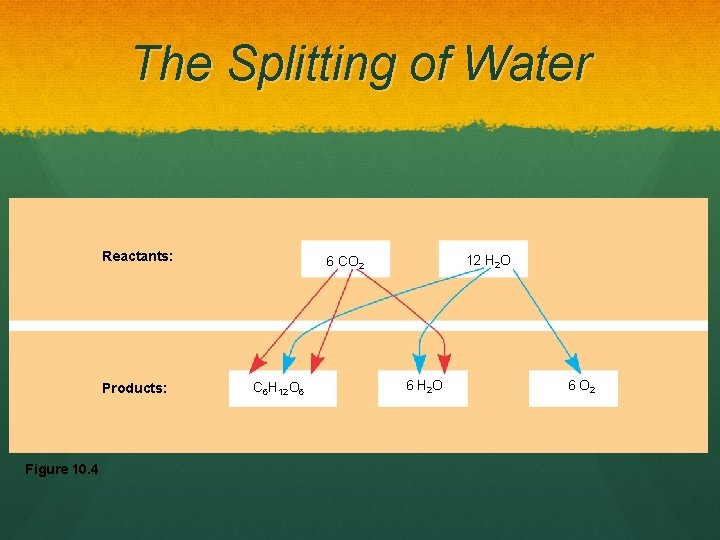
The Splitting of Water Reactants: Products: Figure 10. 4 12 H 2 O 6 CO 2 C 6 H 12 O 6 6 H 2 O 6 O 2
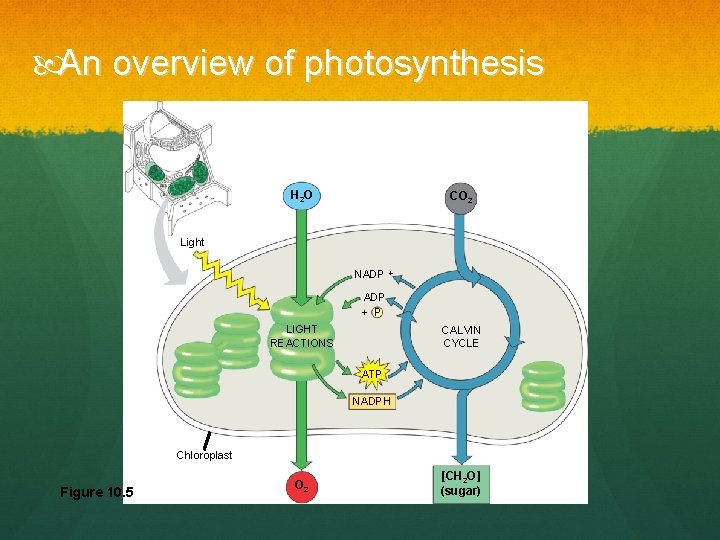
An overview of photosynthesis H 2 O CO 2 Light NADP + P LIGHT REACTIONS CALVIN CYCLE ATP NADPH Chloroplast Figure 10. 5 O 2 [CH 2 O] (sugar)
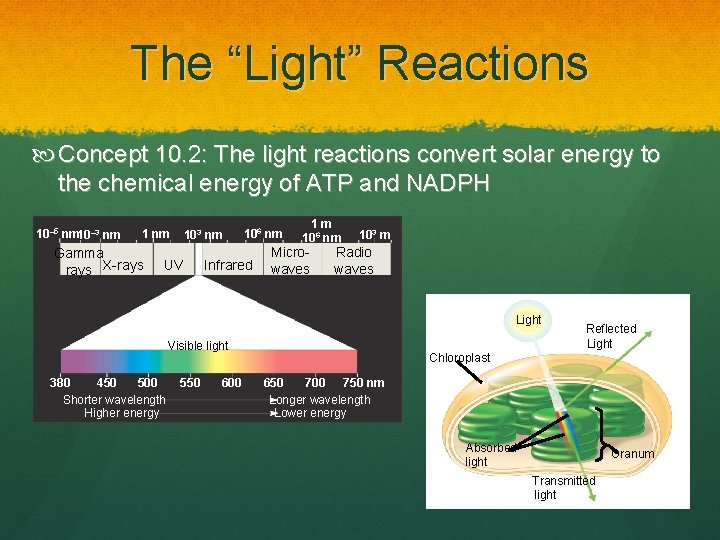
The “Light” Reactions Concept 10. 2: The light reactions convert solar energy to the chemical energy of ATP and NADPH 10– 5 nm 10– 3 nm 1 nm Gamma rays X-rays 103 nm UV 106 nm Infrared 1 m 106 nm Microwaves 103 m Radio waves Light Visible light 380 450 500 Shorter wavelength Higher energy 550 600 Reflected Light Chloroplast 650 700 750 nm Longer wavelength Lower energy Absorbed light Granum Transmitted light
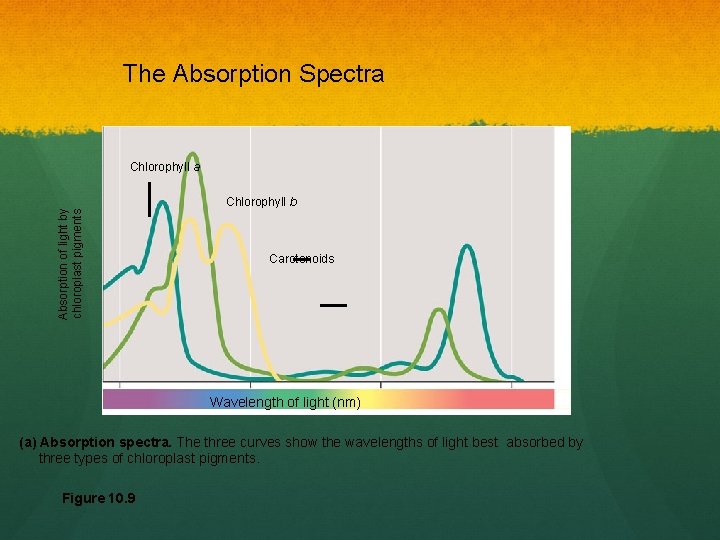
The Absorption Spectra Absorption of light by chloroplast pigments Chlorophyll a Chlorophyll b Carotenoids Wavelength of light (nm) (a) Absorption spectra. The three curves show the wavelengths of light best absorbed by three types of chloroplast pigments. Figure 10. 9
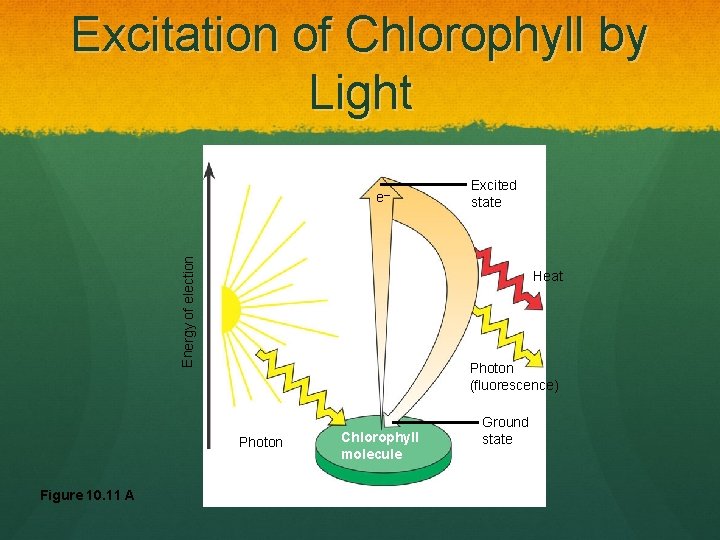
Excitation of Chlorophyll by Light Energy of election e– Heat Photon (fluorescence) Photon Figure 10. 11 A Excited state Chlorophyll molecule Ground state
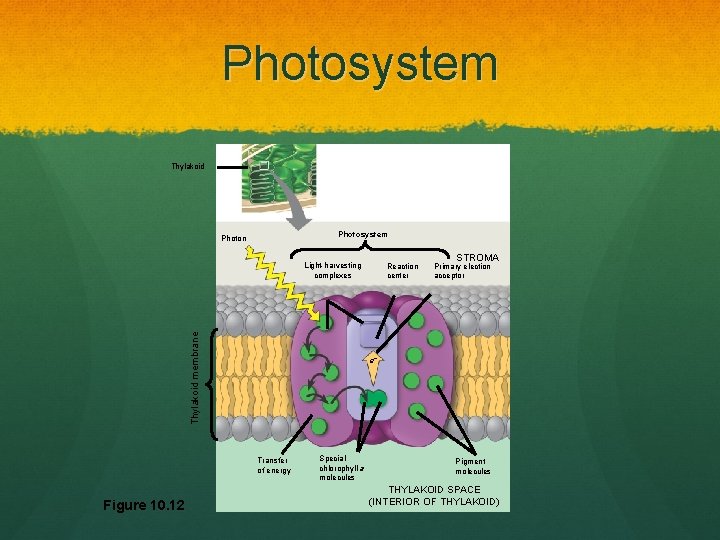
Photosystem Thylakoid Photosystem Photon Thylakoid membrane Light-harvesting complexes STROMA Primary election acceptor e– Transfer of energy Figure 10. 12 Reaction center Special chlorophyll a molecules Pigment molecules THYLAKOID SPACE (INTERIOR OF THYLAKOID)
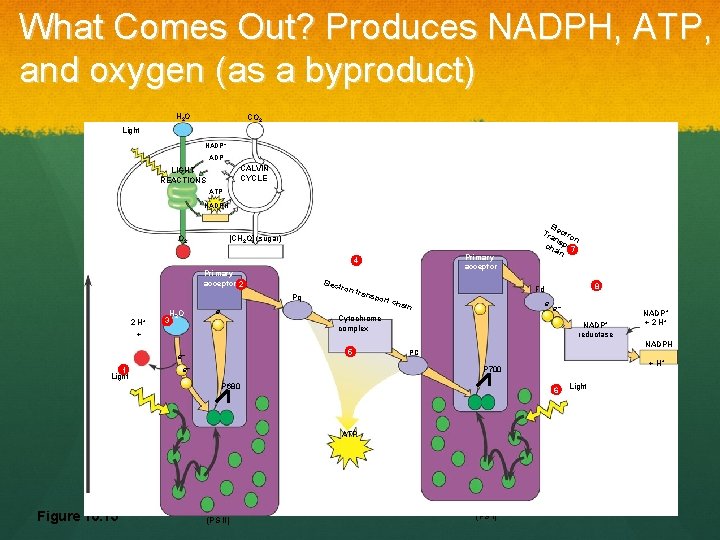
What Comes Out? Produces NADPH, ATP, and oxygen (as a byproduct) H 2 O CO 2 Light NADP+ ADP CALVIN CYCLE LIGHT REACTIONS ATP NADPH O 2 [CH 2 O] (sugar) Primary acceptor 4 Primary acceptor 2 Elec Pq 2 H+ 3 e H 2 O tran s port 5 e– chai n e e– NADP+ reductase + H+ P 700 e– 6 ATP Photosystem II (PS II) NADP+ + 2 H+ NADPH PC P 680 Figure 10. 13 8 Fd Cytochrome complex + O 2 1 Light tron El Tra ectro ns n ch por ain 7 t Photosystem-I (PS I) Light
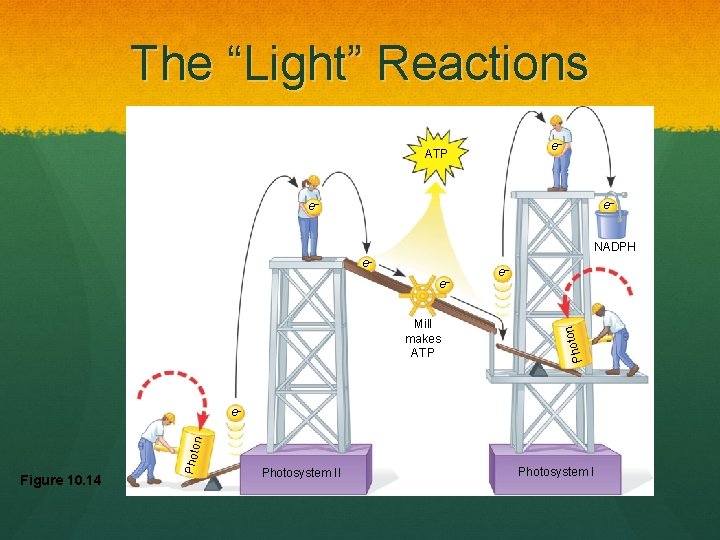
The “Light” Reactions e– ATP e– e– NADPH e– Mill makes ATP e– on Phot e– Figure 10. 14 Photo n e– Photosystem II Photosystem I
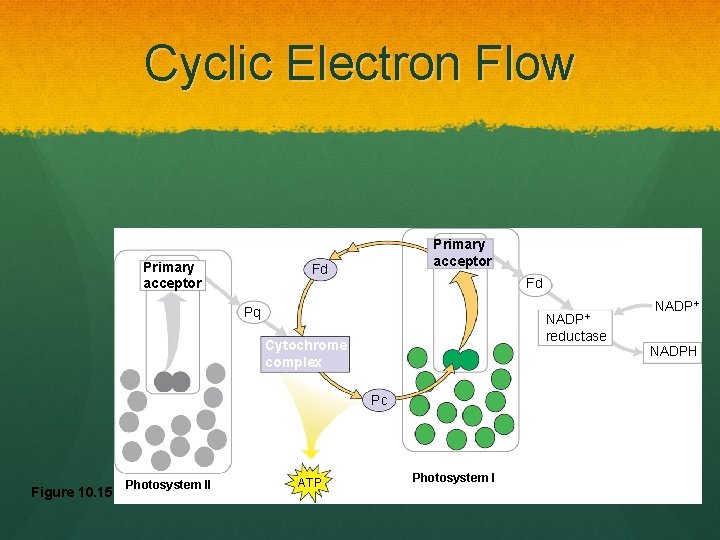
Cyclic Electron Flow Primary acceptor Fd Fd Pq NADP+ reductase Cytochrome complex Pc Figure 10. 15 Photosystem II ATP Photosystem I NADP+ NADPH
The spatial organization of chemiosmosis Differs in chloroplasts and mitochondria Key Higher [H+] Lower [H+] Chloroplast Mitochondrion CHLOROPLAST STRUCTURE MITOCHONDRION STRUCTURE Intermembrance space Membrance Matrix Figure 10. 16 H+ Diffusion Electron transport chain ATP Synthase ADP+ Thylakoid space Stroma P H+ ATP
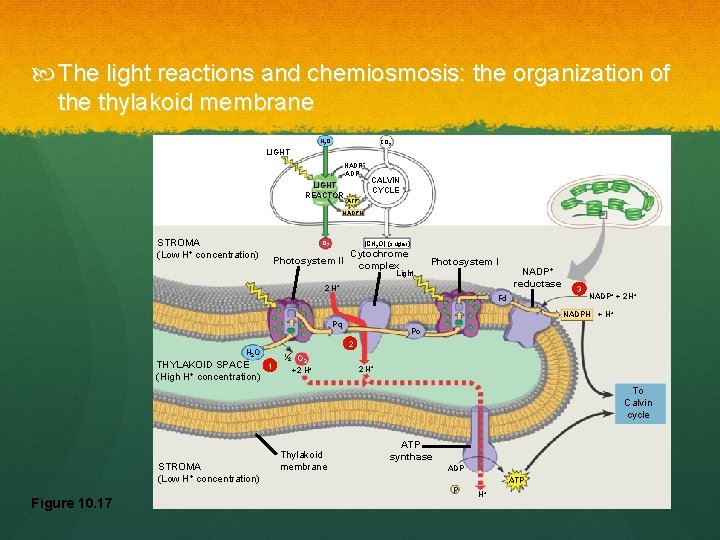
The light reactions and chemiosmosis: the organization of the thylakoid membrane H 2 O CO 2 LIGHT NADP+ ADP LIGHT REACTOR CALVIN CYCLE ATP NADPH STROMA (Low H+ concentration) O 2 [CH 2 O] (sugar) Cytochrome Photosystem II complex Photosystem I Light 2 H+ NADP+ reductase Fd 3 NADP+ + 2 H+ NADPH + H+ Pq H 2 O THYLAKOID SPACE (High H+ concentration) Pc 2 1⁄ 1 2 O 2 +2 H+ To Calvin cycle STROMA (Low H+ concentration) Thylakoid membrane ATP synthase ADP ATP P Figure 10. 17 H+
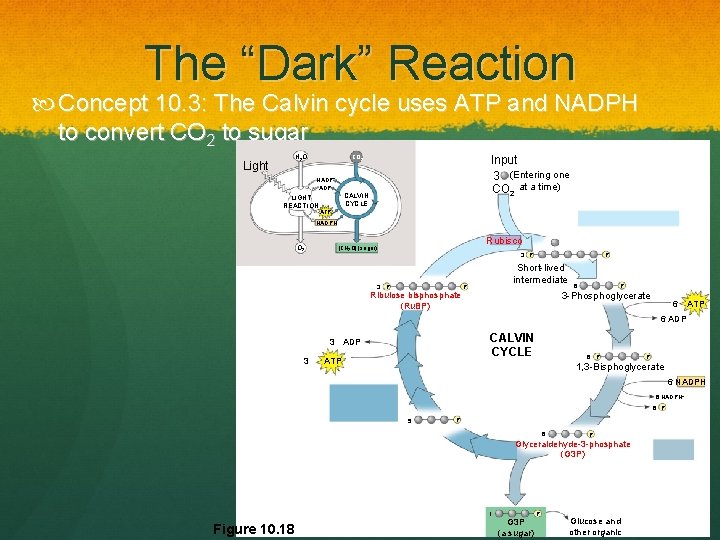
The “Dark” Reaction Concept 10. 3: The Calvin cycle uses ATP and NADPH to convert CO 2 to sugar Light H 2 O Input 3 (Entering one CO 2 at a time) CO 2 NADP+ ADP LIGHT REACTION CALVIN CYCLE ATP NADPH O 2 Rubisco [CH 2 O] (sugar) 3 P Ribulose bisphosphate (Ru. BP) P Short-lived intermediate P P 6 3 -Phosphoglycerate 6 ATP 6 ADP CALVIN CYCLE 3 ADP 3 ATP 6 P P 1, 3 -Bisphoglycerate 6 NADPH+ 6 P P 5 (G 3 P) 6 P Glyceraldehyde-3 -phosphate (G 3 P) 1 Figure 10. 18 G 3 P (a sugar) P Glucose and other organic
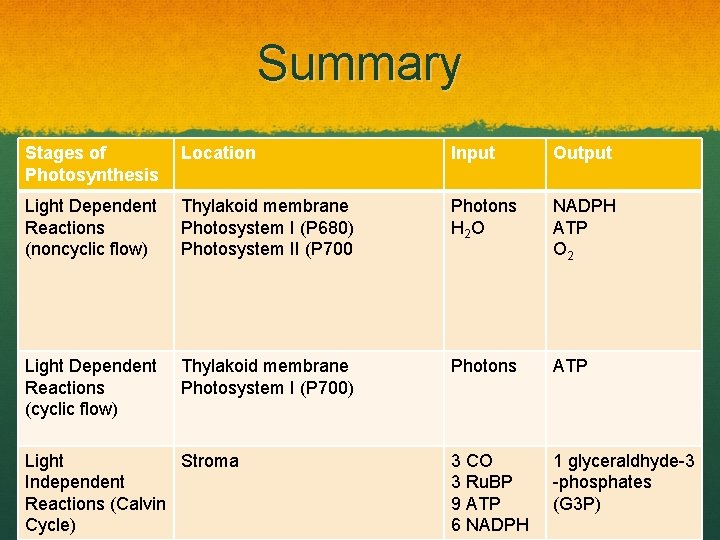
Summary Stages of Photosynthesis Location Input Output Light Dependent Reactions (noncyclic flow) Thylakoid membrane Photosystem I (P 680) Photosystem II (P 700 Photons H 2 O NADPH ATP O 2 Light Dependent Reactions (cyclic flow) Thylakoid membrane Photosystem I (P 700) Photons ATP 3 CO 3 Ru. BP 9 ATP 6 NADPH 1 glyceraldhyde-3 -phosphates (G 3 P) Light Stroma Independent Reactions (Calvin Cycle)
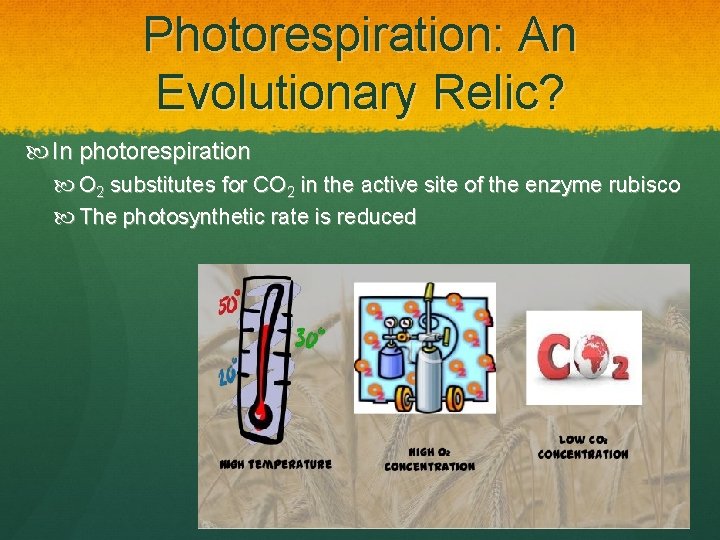
Photorespiration: An Evolutionary Relic? In photorespiration O 2 substitutes for CO 2 in the active site of the enzyme rubisco The photosynthetic rate is reduced
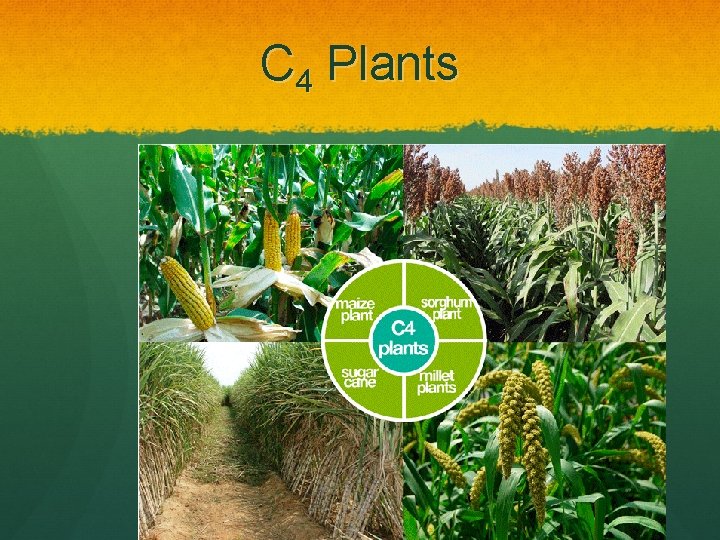
C 4 Plants
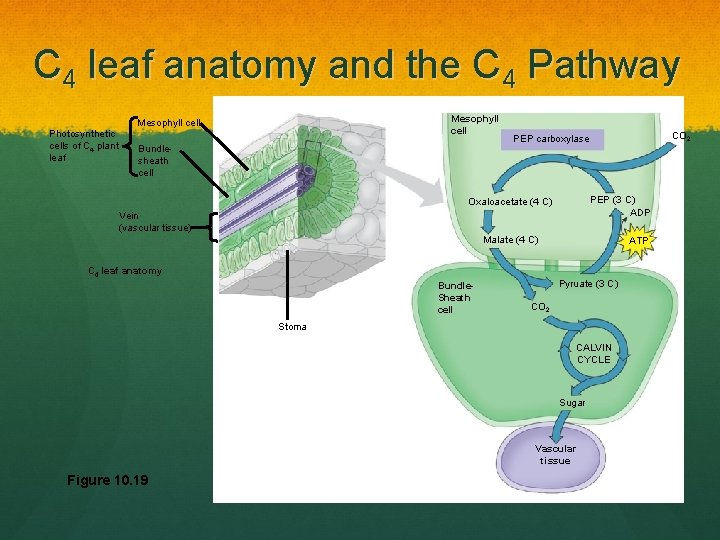
C 4 leaf anatomy and the C 4 Pathway Mesophyll cell Photosynthetic cells of C 4 plant leaf Bundlesheath cell CO CO 2 2 PEP carboxylase PEP (3 C) ADP Oxaloacetate (4 C) Vein (vascular tissue) Malate (4 C) C 4 leaf anatomy Bundle. Sheath cell ATP Pyruate (3 C) CO 2 Stoma CALVIN CYCLE Sugar Vascular tissue Figure 10. 19
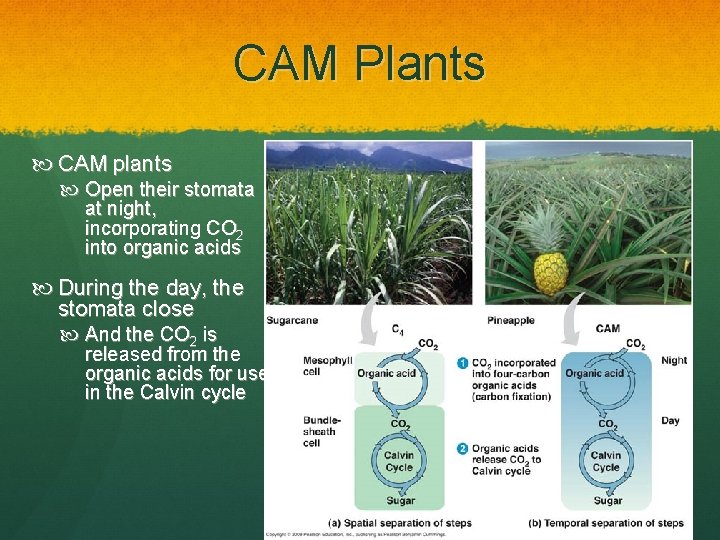
CAM Plants CAM plants Open their stomata at night, incorporating CO 2 into organic acids During the day, the stomata close And the CO 2 is released from the organic acids for use in the Calvin cycle
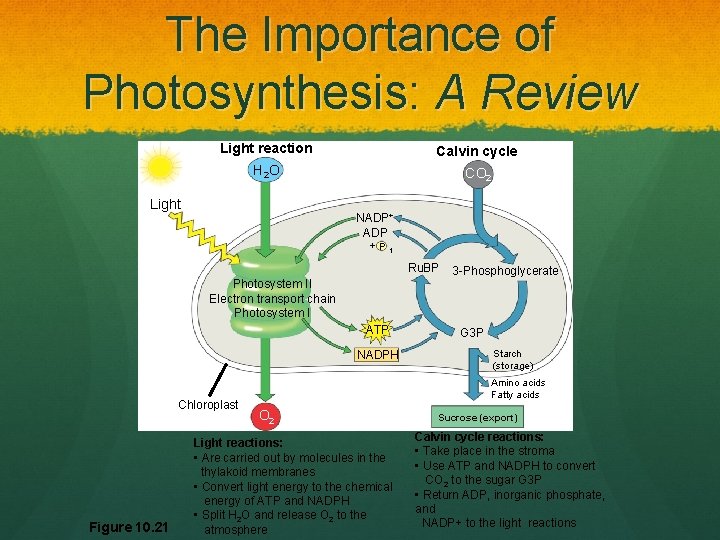
The Importance of Photosynthesis: A Review Light reaction Calvin cycle H 2 O CO 2 Light NADP+ ADP +P 1 Ru. BP Photosystem II Electron transport chain Photosystem I ATP NADPH Chloroplast Figure 10. 21 3 -Phosphoglycerate G 3 P Starch (storage) Amino acids Fatty acids O 2 Light reactions: • Are carried out by molecules in the thylakoid membranes • Convert light energy to the chemical energy of ATP and NADPH • Split H 2 O and release O 2 to the atmosphere Sucrose (export) Calvin cycle reactions: • Take place in the stroma • Use ATP and NADPH to convert CO 2 to the sugar G 3 P • Return ADP, inorganic phosphate, and NADP+ to the light reactions