
6 Ciliates Acknowledgements n n n n Addisa
- Slides: 18
6. Ciliates
Acknowledgements n n n n Addisa Ababa University Jimma University Hawassa University Haramaya University of Gondar American Society for Clinical Pathology Center for Disease Control and Prevention-Ethiopia
Learning Objectives Upon completion of this unit , you should be able to: § Discuss the general features ciliates ¨ Explain transmission and Illustrate the life cycle of Balantidium coli ¨ Discuss the clinical feature of Balantidium coli prevention and control of Balantidium coli infection ¨ Distinguish trophozoite and cyst forms of Balantidium coli
Out line § General features of Ciliates § Blantidium coli § Epidemiology, habitat , morphology, transmission and life cycle, clinical features , laboratory diagnosis , treatment , prevention and control
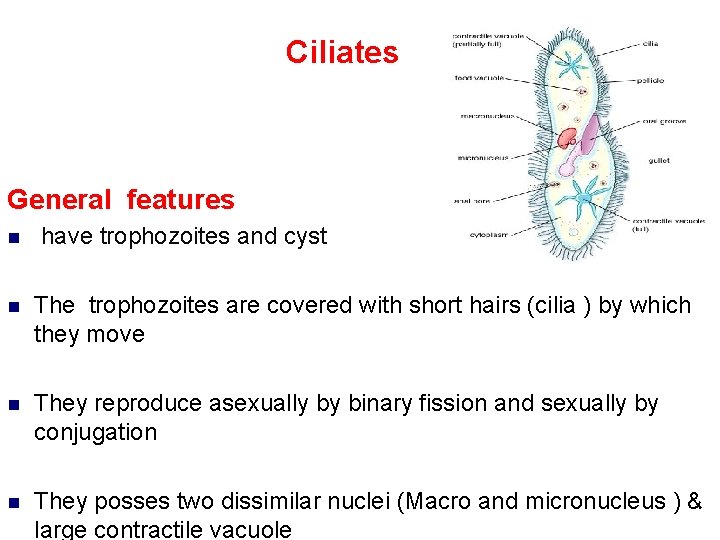
Ciliates General features n have trophozoites and cyst n The trophozoites are covered with short hairs (cilia ) by which they move n They reproduce asexually by binary fission and sexually by conjugation n They posses two dissimilar nuclei (Macro and micronucleus ) & large contractile vacuole
Balantidium coli n The largest protozoan parasite of man Epidemiology n n World wide being more commonly found amongst those who keep pigs, and uses pig faeces as fertilizer especially in warmer climates In Ethiopia it was reported from Debre Brerahn
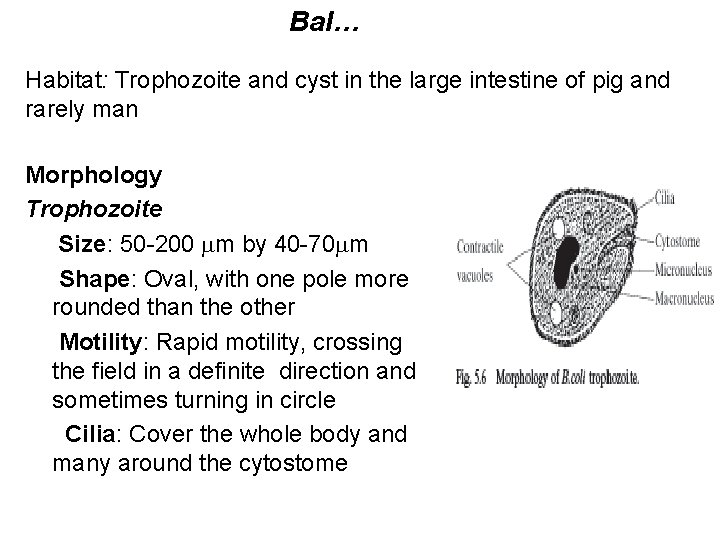
Bal… Habitat: Trophozoite and cyst in the large intestine of pig and rarely man Morphology Trophozoite Size: 50 -200 m by 40 -70 m Shape: Oval, with one pole more rounded than the other Motility: Rapid motility, crossing the field in a definite direction and sometimes turning in circle Cilia: Cover the whole body and many around the cytostome
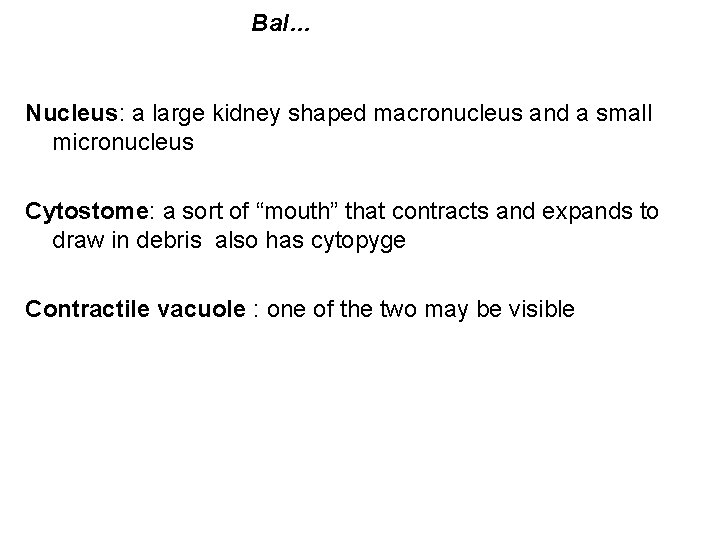
Bal… Nucleus: a large kidney shaped macronucleus and a small micronucleus Cytostome: a sort of “mouth” that contracts and expands to draw in debris also has cytopyge Contractile vacuole : one of the two may be visible
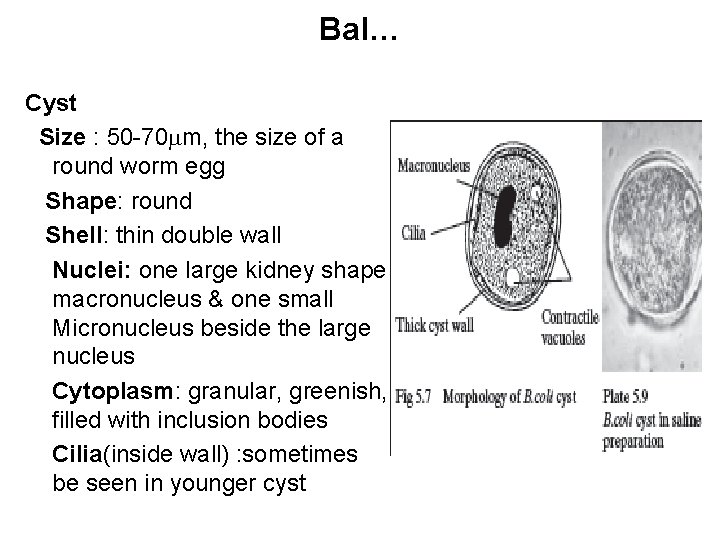
Bal… Cyst Size : 50 -70 m, the size of a round worm egg Shape: round Shell: thin double wall Nuclei: one large kidney shape macronucleus & one small Micronucleus beside the large nucleus Cytoplasm: granular, greenish, filled with inclusion bodies Cilia(inside wall) : sometimes be seen in younger cyst
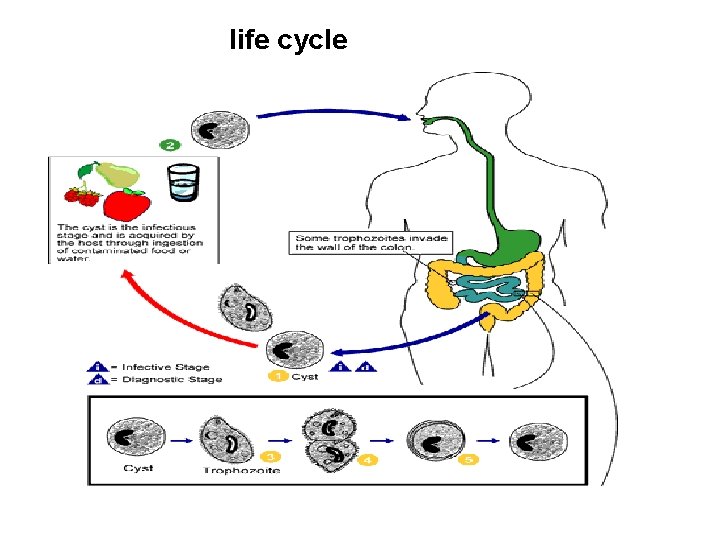
Bal… Transmission and life cycle Ø Human acquires through ingestion of contaminated food or water or hands contaminated with pig faeces containing cyst
life cycle
Bal… n Following ingestion, excystation occurs in the small intestine n The trophozoites reside in the lumen of the large intestine of humans and animals, where they replicate n Some trophozoites invade the wall of the colon& multiply n Some return to lumen and disintegrate n Trophozoites undergo encystation to produce infective cysts n Mature cysts are passed with feces
Bal… Clinical feature ¨ Infection with B. coli can be without symptoms unless the ciliates invade the intestinal wall ¨ Invasion cause inflammation and ulceration, leading to dysentery with blood and mucus being passed with faeces
Bal… Laboratory Diagnosis ¨ Finding the tropozoites in dysenteric faecal specimens and the cysts in formed or semi formed faeces ¨ In dysenteric specimens the ciliates usually contain ingested red cell Treatment ¨ Tetracycline, metronidazole
Bal… Prevention and Control 1. Avoid contamination of food or drink 2. Improving personal hygiene especially those who keep pigs. 3. Treatment and health information dissemination
summary n n Ciliates have trophozoite and cyst stage Balantidium coli ¨ The largest protozoan parasite of man which is pathogenic to human being ¨ Human acquires through ingestion of contaminated food or water or hands contaminated with pig faeces containing cyst ¨ Cause balantidial dysentery ¨ Diagnosis by the finding balatidium coli tropozoites and cysts satge
Review questions 1. What are unique features of B. coli among other intestinal protozoa? 2. What is the diagnostic and infective stage of the B. coli? 3. What is the prevention and control method of B. coli?
References 1. Awole M. , Cheneke W. Medical Parasitology for Medical laboratory Technology students. Upgraded lecture Notes Series. 2006. 2. Cheesbrough M. District laboratory practice in tropical countries United Kingdom, Cambridge university press, 2000, part I