
6 Characteristics of Living Things 1 Living Things
- Slides: 22
6 Characteristics of Living Things
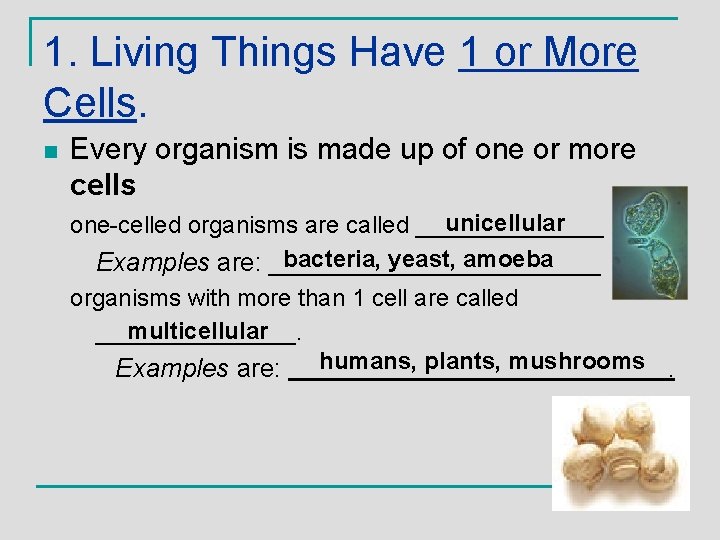
1. Living Things Have 1 or More Cells. n Every organism is made up of one or more cells unicellular one-celled organisms are called _______ bacteria, yeast, amoeba Examples are: ____________ organisms with more than 1 cell are called multicellular ________. humans, plants, mushrooms Examples are: ________________.
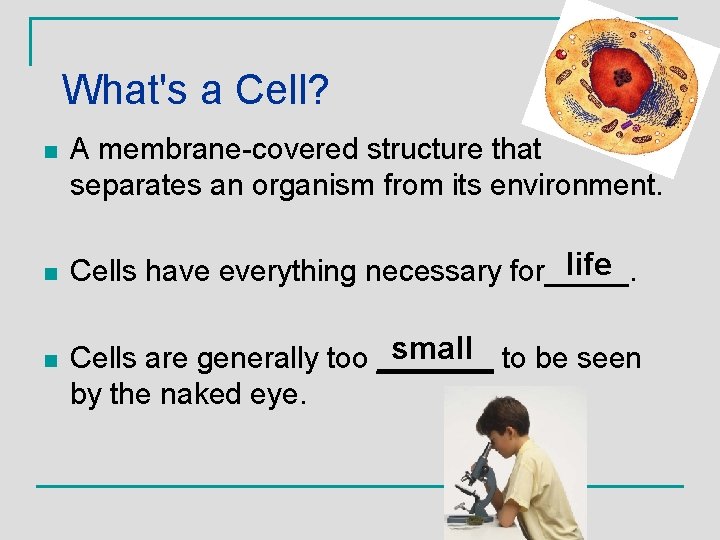
What's a Cell? n A membrane-covered structure that separates an organism from its environment. n life Cells have everything necessary for_____. n small to be seen Cells are generally too _______ by the naked eye.
2. Living Things Respond to Stimuli n A stimulus is a change in an organism’s n environment that affects the activity of the organism. All organisms sense stimuli in their environment and respond. n Examples: light, odors, sounds, weather ______________________ n What do you do when the fire alarm sounds? n stimulus The bell is a _____ response is the_____. and leaving the building
n n Organisms also respond to changes in their internal environment. Maintaining a stable homeostasis internal environment is called ______. It is necessary because most chemical reactions in the body require balanced environments. Example: Your body maintains a temperature of about 37°C (98. 6°F). When you’re hot you sweat; when you’re cold you shiver; this is your body trying to return things to normal.
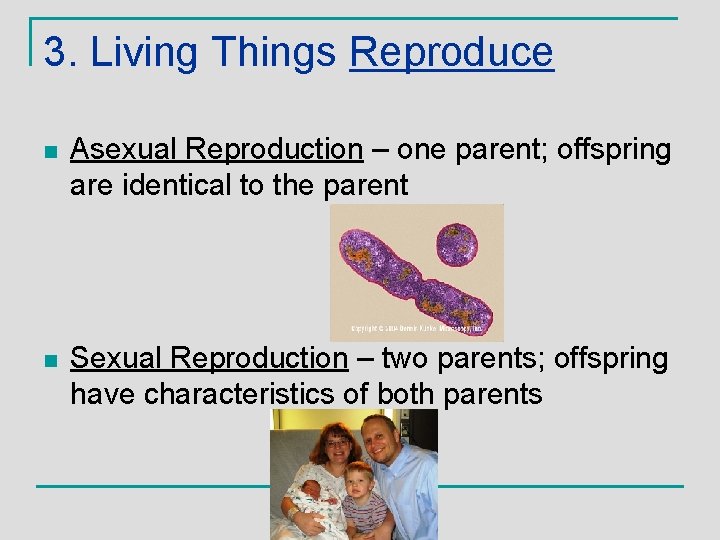
3. Living Things Reproduce n Asexual Reproduction – one parent; offspring are identical to the parent n Sexual Reproduction – two parents; offspring have characteristics of both parents
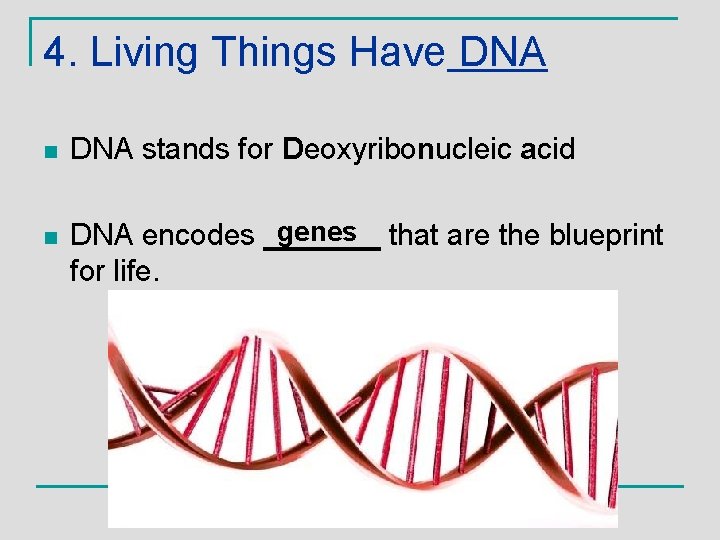
4. Living Things Have DNA n n DNA stands for Deoxyribonucleic acid genes that are the blueprint DNA encodes _______ for life.
5. Living Things Use Energy n Energy is required to carry out all day-to-day activities. q Examples of activities that require energy: walking, thinking, digesting food ___________________
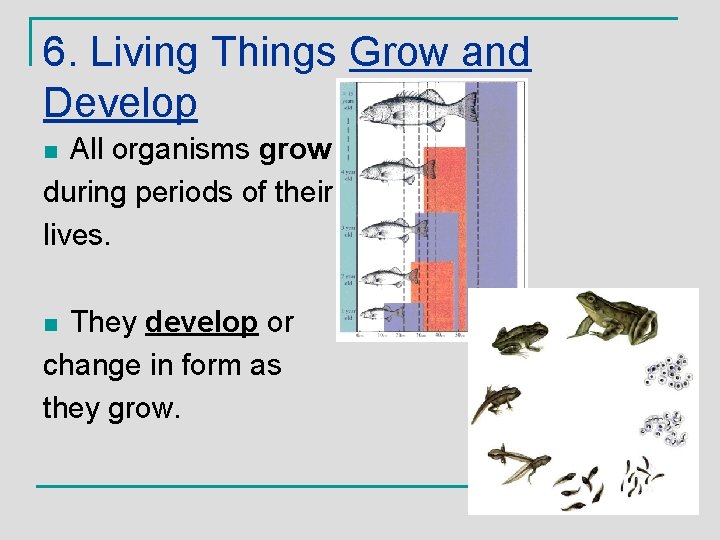
6. Living Things Grow and Develop All organisms grow during periods of their lives. n They develop or change in form as they grow. n
Necessities of Life
1. Food n All living things need food because it gives them _______to carry out day-to-day energy activities. q producers – make their own food. ______ q consumers – eat other organisms to get food. ______ q decomposers ______ – break down nutrients in dead organisms or animal waste.
2. Water n Probably the single most important compound on Earth. q q 70 % of the content of ~_____ cells is water Used in all chemical reactions in the cell
3. Air n n oxygen – needed by most animals and _____ plants; used in the chemical process called cellular respiration that releases energy from food. carbon dioxide ________– needed by plants, algae and some bacteria; used to convert the energy of sunlight into food in a process photosynthesis called _________.
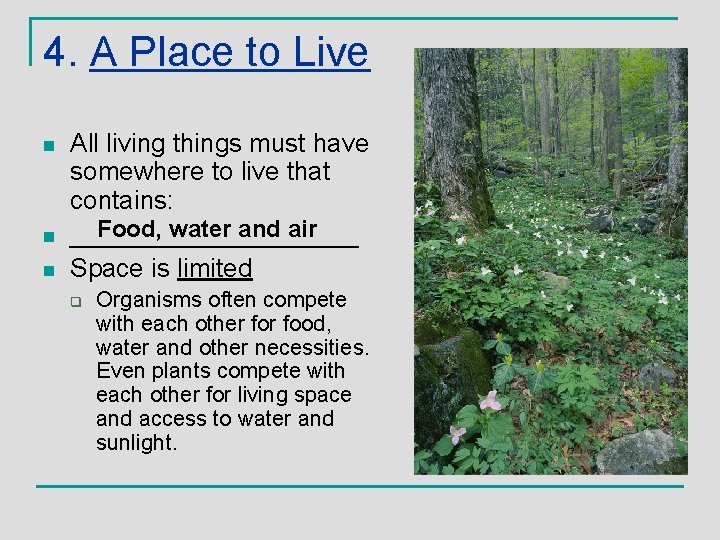
4. A Place to Live n n n All living things must have somewhere to live that contains: Food, water and air __________ Space is limited q Organisms often compete with each other food, water and other necessities. Even plants compete with each other for living space and access to water and sunlight.
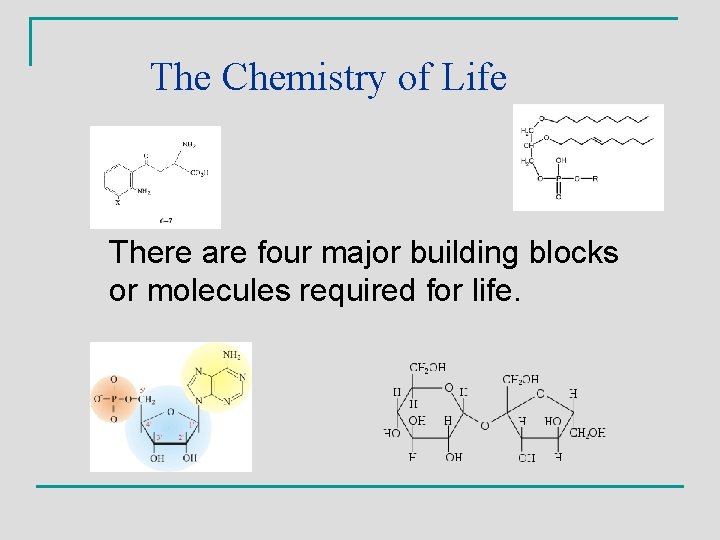
The Chemistry of Life There are four major building blocks or molecules required for life.
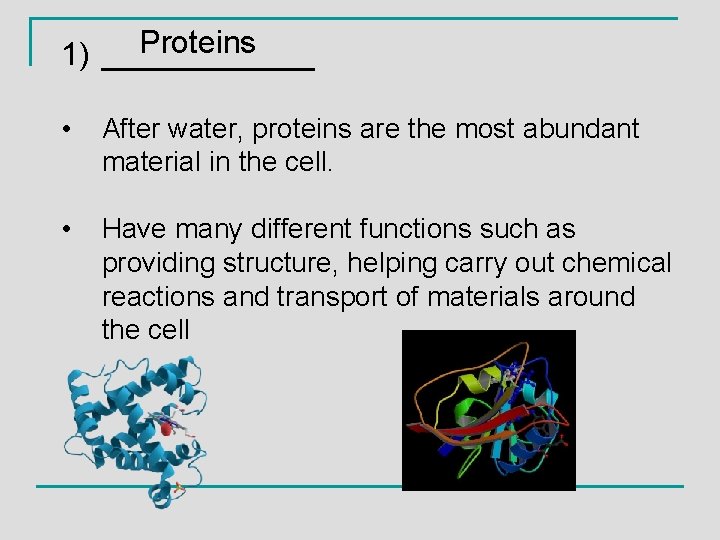
Proteins 1) ______ • After water, proteins are the most abundant material in the cell. • Have many different functions such as providing structure, helping carry out chemical reactions and transport of materials around the cell
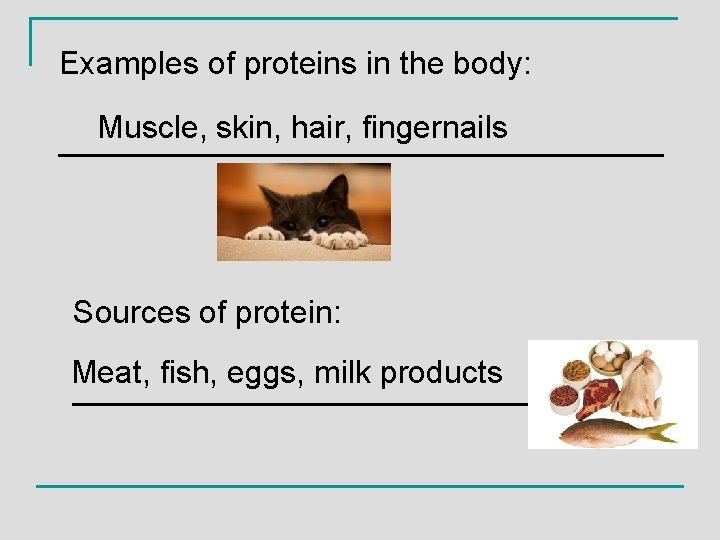
Examples of proteins in the body: Muscle, skin, hair, fingernails _________________ Sources of protein: Meat, fish, eggs, milk products _________________
carbohydrates 2) ______ • Major source of energy for the body • Made up of sugars
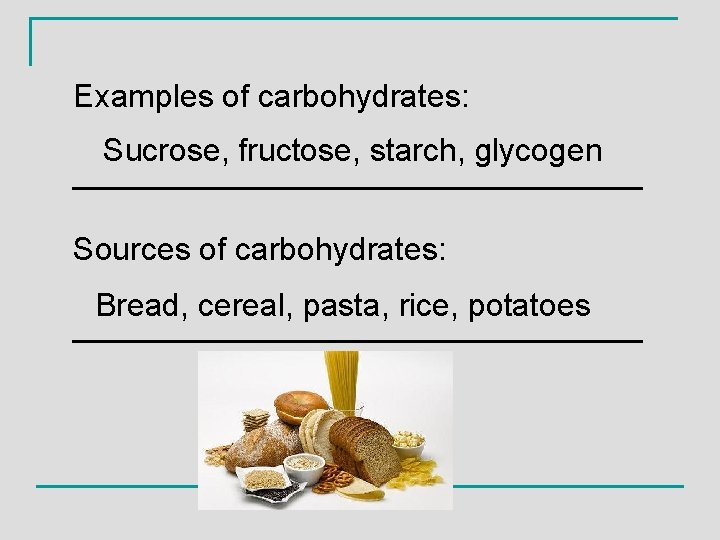
Examples of carbohydrates: Sucrose, fructose, starch, glycogen ________________ Sources of carbohydrates: Bread, cereal, pasta, rice, potatoes ________________
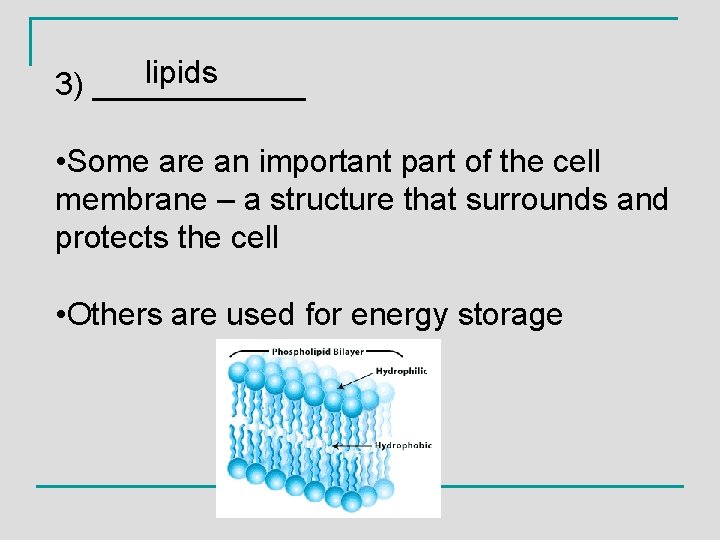
lipids 3) ______ • Some are an important part of the cell membrane – a structure that surrounds and protects the cell • Others are used for energy storage
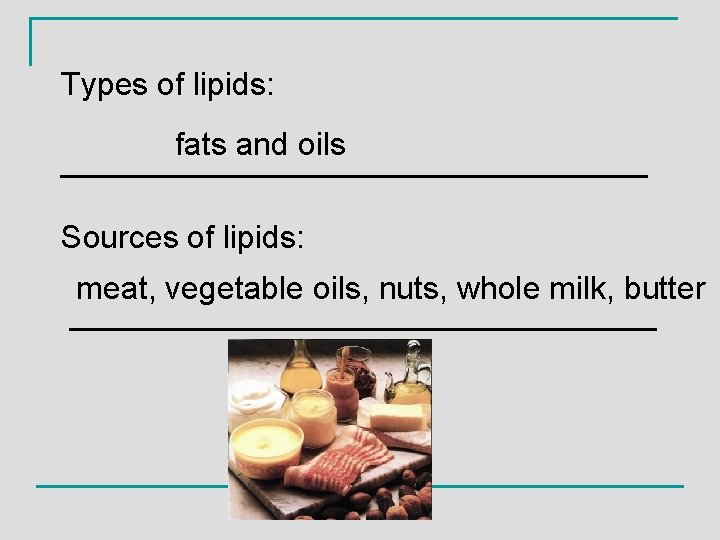
Types of lipids: fats and oils _________________ Sources of lipids: meat, vegetable oils, nuts, whole milk, butter _________________
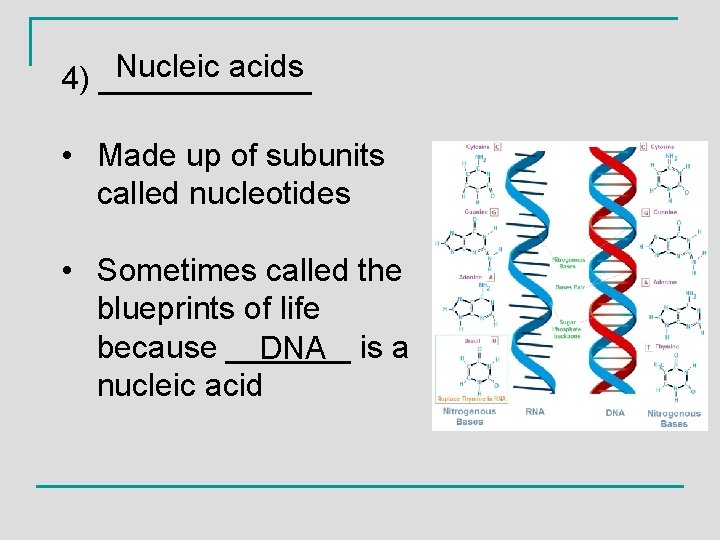
Nucleic acids 4) ______ • Made up of subunits called nucleotides • Sometimes called the blueprints of life because _______ DNA is a nucleic acid