
6 chapter Forms of Business Ownership Better Business
6 chapter Forms of Business Ownership Better Business 2 nd Edition Solomon (Contributing Editor) · Poatsy · Martin © 2012 Pearson Education, Inc. Publishing as Prentice Hall 6 -1
All rights reserved. No part of this publication may be reproduced, stored in a retrieval system, or transmitted, in any form or by any means, electronic, mechanical, photocopying, recording, or otherwise, without the prior written permission of the publisher. Printed in the United States of America. © 2012 Pearson Education, Inc. Publishing as Prentice Hall 6 -2
Learning Objectives 1. What are the strengths and weaknesses of a sole proprietorship? 2. What are the advantages and disadvantages of a partnership and a partnership agreement? 3. How is a corporation formed, and how does it compare with sole proprietorships and partnerships? 4. What are the major differences between a C corporation, an S corporation, and an ? 5. What are the characteristics of not-for-profit corporations and cooperatives? 6. What are the different types of mergers and acquisitions and why do they occur? © 2012 Pearson Education, Inc. Publishing as Prentice Hall 6 -3

Businesses by Type of Ownership © 2012 Pearson Education, Inc. Publishing as Prentice Hall 6 -4
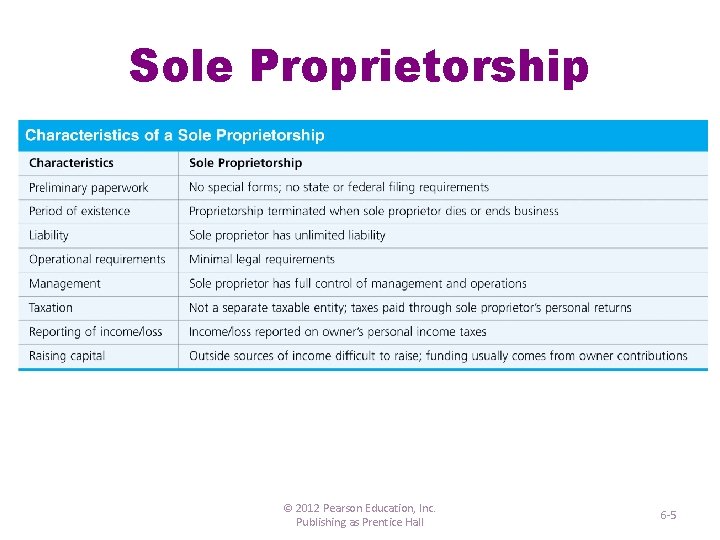
Sole Proprietorship © 2012 Pearson Education, Inc. Publishing as Prentice Hall 6 -5
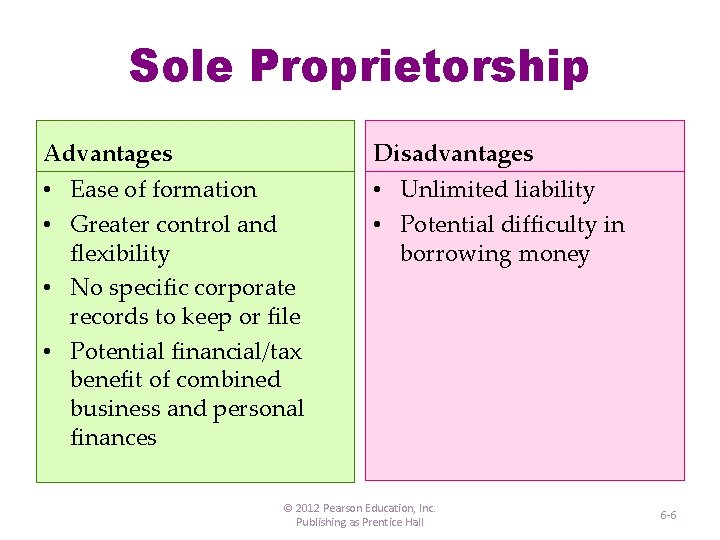
Sole Proprietorship Advantages Disadvantages • Ease of formation • Greater control and flexibility • No specific corporate records to keep or file • Potential financial/tax benefit of combined business and personal finances • Unlimited liability • Potential difficulty in borrowing money © 2012 Pearson Education, Inc. Publishing as Prentice Hall 6 -6
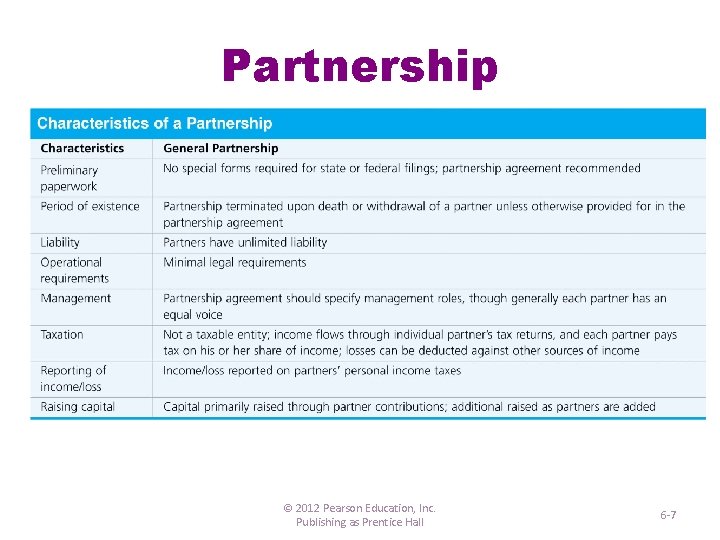
Partnership © 2012 Pearson Education, Inc. Publishing as Prentice Hall 6 -7
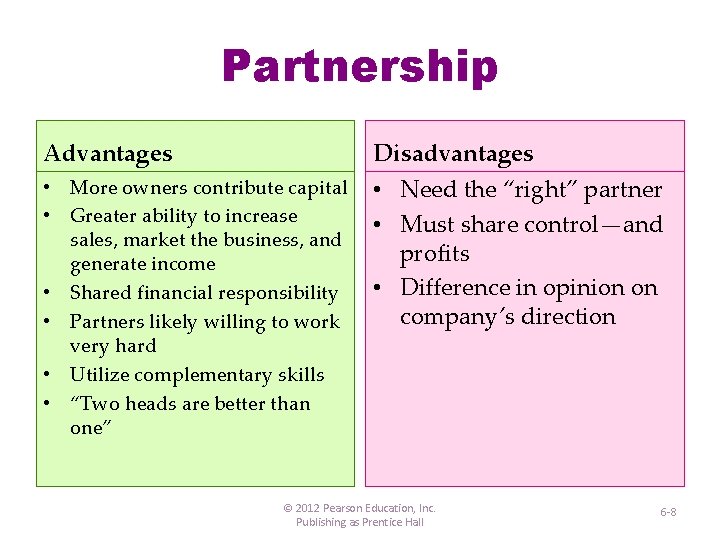
Partnership Advantages Disadvantages • More owners contribute capital • Greater ability to increase sales, market the business, and generate income • Shared financial responsibility • Partners likely willing to work very hard • Utilize complementary skills • “Two heads are better than one” • Need the “right” partner • Must share control—and profits • Difference in opinion on company’s direction © 2012 Pearson Education, Inc. Publishing as Prentice Hall 6 -8

Sole Proprietorship vs. Partnership • • • Similarities Inexpensive to set up Unlimited liability Financials flow through individual’s tax returns No tax benefits Legally dissolves upon change or death of owner or partner Profits increase owner’s personal taxes Differences • Number of people contributing resources • Sharing of profits and liabilities • Ability to get financing © 2012 Pearson Education, Inc. Publishing as Prentice Hall 6 -9
Partnership Agreement • • • Capital contributions Responsibilities of each partner Decision-making process Shares of profits or losses Departure of partners Addition of partners © 2012 Pearson Education, Inc. Publishing as Prentice Hall 6 -10

Types of Partnerships • General partnerships - Default arrangement - Simplest to form • Limited partnership - General partners - Limited partners © 2012 Pearson Education, Inc. Publishing as Prentice Hall 6 -11
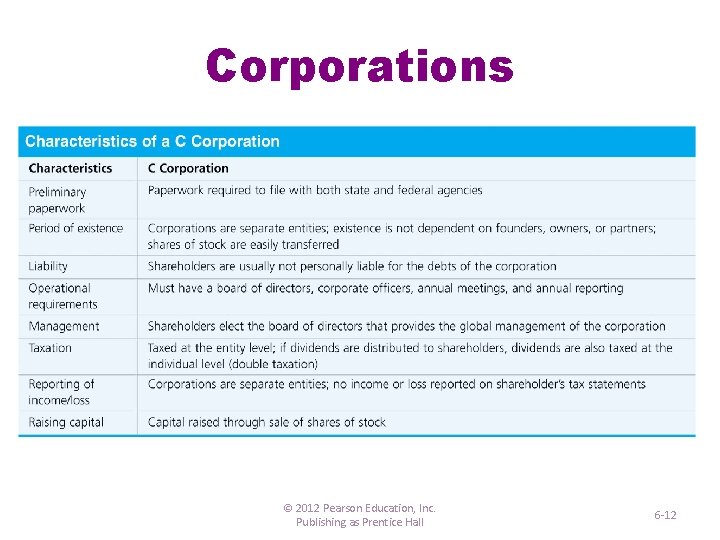
Corporations © 2012 Pearson Education, Inc. Publishing as Prentice Hall 6 -12
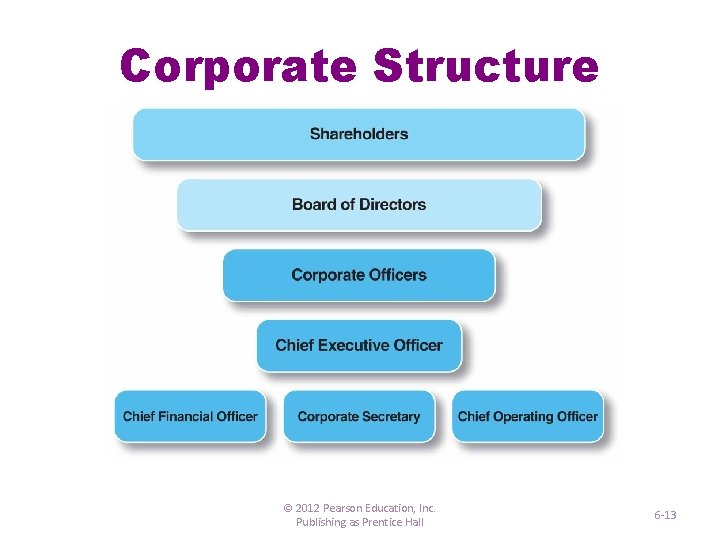
Corporate Structure © 2012 Pearson Education, Inc. Publishing as Prentice Hall 6 -13
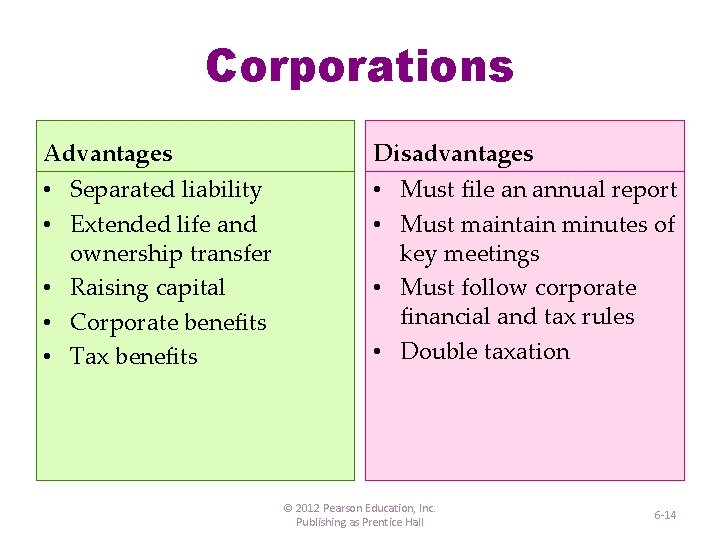
Corporations Advantages Disadvantages • Separated liability • Extended life and ownership transfer • Raising capital • Corporate benefits • Tax benefits • Must file an annual report • Must maintain minutes of key meetings • Must follow corporate financial and tax rules • Double taxation © 2012 Pearson Education, Inc. Publishing as Prentice Hall 6 -14
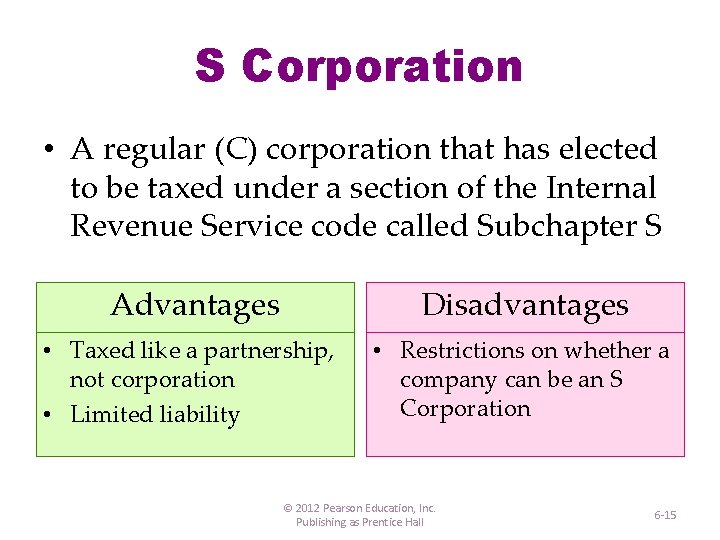
S Corporation • A regular (C) corporation that has elected to be taxed under a section of the Internal Revenue Service code called Subchapter S Advantages Disadvantages • Taxed like a partnership, not corporation • Limited liability • Restrictions on whether a company can be an S Corporation © 2012 Pearson Education, Inc. Publishing as Prentice Hall 6 -15
Limited Liability Company (LLC) • An LLC combines corporate limited liability with partnership tax advantages with fewer administrative requirements than S or C corporations • Often used by professional corporations formed by accountants, attorneys, and doctors © 2012 Pearson Education, Inc. Publishing as Prentice Hall 6 -16

Comparing C and S Corporations and LLCs Common (C) Subchapter S (S) Limited-Liability Company (LLC) Ownership unrestricted Subsidiaries allowed Not allowed Perpetual life yes no Stock transferable yes With approval none On compensation only On all profits At the discretion of the board of directors Proportional to shareholder’s investment As owners decide May offer benefits and stock options Limited in benefits can offer; no stock benefits Self-employment taxes Profit and loss distribution Owner and employee benefits © 2012 Pearson Education, Inc. Publishing as Prentice Hall 6 -17
Not-for-Profit Corporations • An incorporated business that does not seek a net profit • Utilizes revenue available after normal operating expenses for the corporation’s declared social or educational goals - Revenues come primarily from fundraising and donations • Tax-exempt with 501(c)(3) status © 2012 Pearson Education, Inc. Publishing as Prentice Hall 6 -18
Cooperative • A business that is owned and governed by members who use its products or services • Provides services to people with common interests • Members can be individuals or businesses • Members set policy and elect directors • Biggest advantage is group power © 2012 Pearson Education, Inc. Publishing as Prentice Hall 6 -19
Mergers and Acquisitions • Merger - Two companies join to form one company - Friendly and mutually agreed upon • Acquisition - One company takes over another company - Unfriendly acquisition • Hostile takeover • Tender offer • Proxy fight © 2012 Pearson Education, Inc. Publishing as Prentice Hall 6 -20
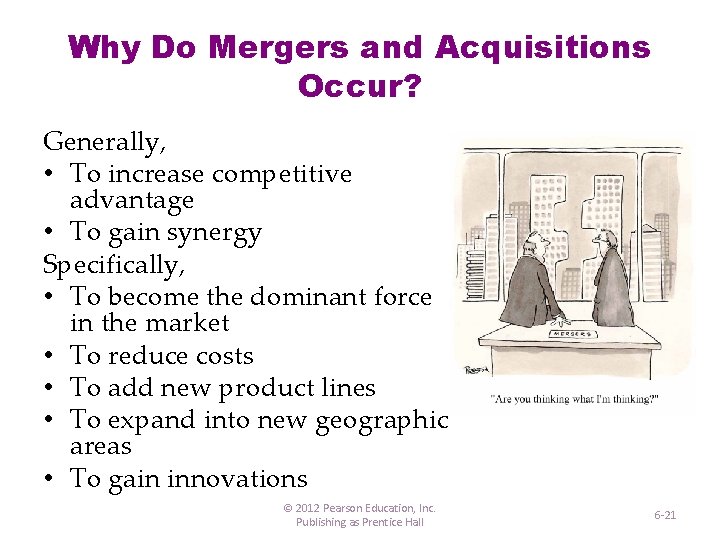
Why Do Mergers and Acquisitions Occur? Generally, • To increase competitive advantage • To gain synergy Specifically, • To become the dominant force in the market • To reduce costs • To add new product lines • To expand into new geographic areas • To gain innovations © 2012 Pearson Education, Inc. Publishing as Prentice Hall 6 -21
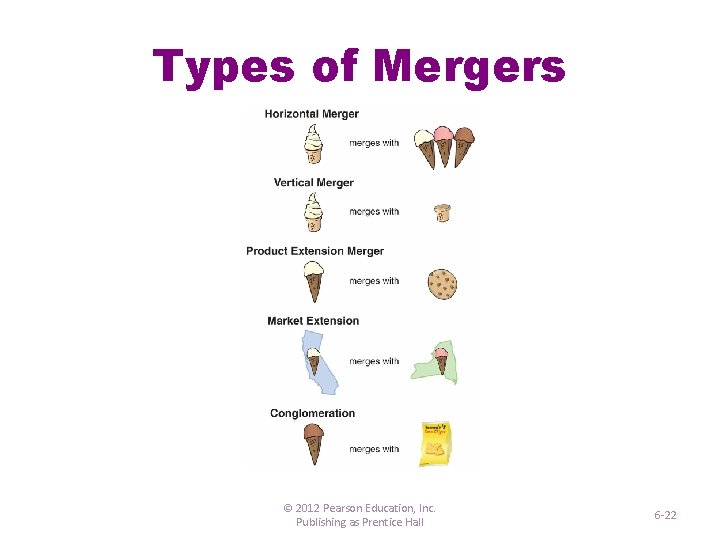
Types of Mergers © 2012 Pearson Education, Inc. Publishing as Prentice Hall 6 -22
Disadvantages of Mergers • Nearly two-thirds don’t achieve greater market value • Revenues and profits suffer because day-to-day activities are neglected while the companies are combined • Corporate cultures may clash • Communications may break down • New division of responsibilities can be vague • Divided loyalties, hidden agendas, or power struggles within new management team may lead to conflict • Employees may be nervous as jobs are usually eliminated • Employees whose jobs aren’t threatened may still leave © 2012 Pearson Education, Inc. Publishing as Prentice Hall 6 -23

Chapter Summary 1. What are the strengths and weaknesses of a sole proprietorship? 2. What are the advantages and disadvantages of a partnership and a partnership agreement? 3. How is a corporation formed, and how does it compare with sole proprietorships and partnerships? 4. What are the major differences between a C corporation, an S corporation, and an LLC? 5. What are the characteristics of not-for-profit corporations and cooperatives? 6. What are the different types of mergers and acquisitions and why do they occur? © 2012 Pearson Education, Inc. Publishing as Prentice Hall 6 -24
Beyond the Book © 2012 Pearson Education, Inc. Publishing as Prentice Hall 6 -25
Board of Directors Responsibilities • The board is responsible for the corporation - Directors must be truly independent - New requirements for audit, nomination, and compensation committees • At least one audit committee member must be a financial expert - Loans to executives and directors banned • SEC has more power to bar a director • Possible criminal charges for fraud and negligence • Requirements created or strengthened by Sarbanes. Oxley Act of 2002 © 2012 Pearson Education, Inc. Publishing as Prentice Hall 6 -26
Why Be on a Board of Directors? • Even with the added scrutiny of boards today, being a director is still enticing for: - Financial rewards Perks Professional development Networking Recognition © 2012 Pearson Education, Inc. Publishing as Prentice Hall 6 -27
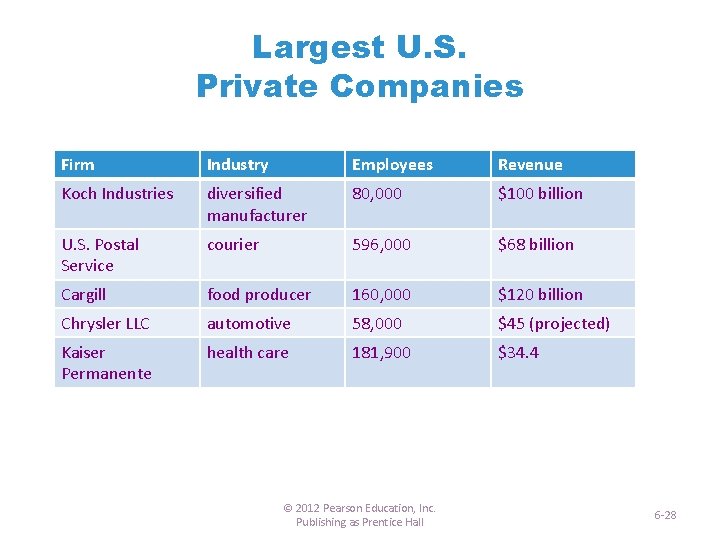
Largest U. S. Private Companies Firm Industry Employees Revenue Koch Industries diversified manufacturer 80, 000 $100 billion U. S. Postal Service courier 596, 000 $68 billion Cargill food producer 160, 000 $120 billion Chrysler LLC automotive 58, 000 $45 (projected) Kaiser Permanente health care 181, 900 $34. 4 © 2012 Pearson Education, Inc. Publishing as Prentice Hall 6 -28
How Ethical Is Your Nonprofit Organization? • The nonprofit world has a guiding principle: No one individual is to profit from the organization • Nonprofit ethics: - Honesty - Openness and transparency - Conflicts of interest - Privacy - Fundraising issues - Treating employees, volunteers, and clients with respect • Examples of non-profits that have had ethical issues - Nature Conservancy - Red Cross © 2012 Pearson Education, Inc. Publishing as Prentice Hall 6 -29
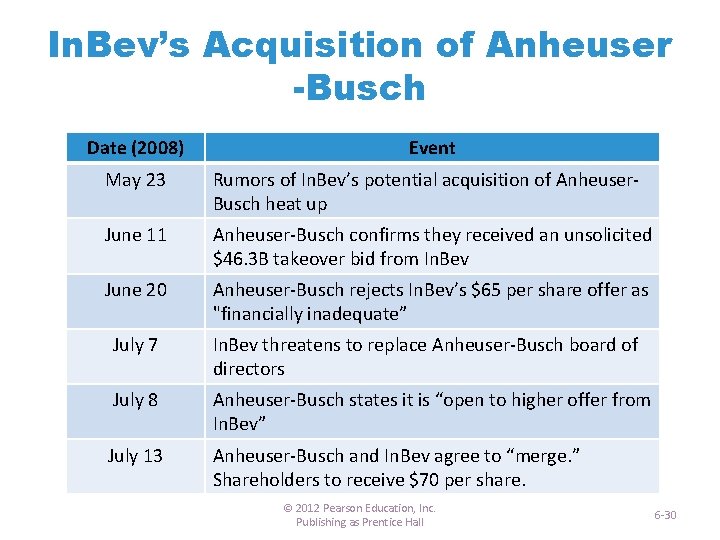
In. Bev’s Acquisition of Anheuser -Busch Date (2008) Event May 23 Rumors of In. Bev’s potential acquisition of Anheuser. Busch heat up June 11 Anheuser-Busch confirms they received an unsolicited $46. 3 B takeover bid from In. Bev June 20 Anheuser-Busch rejects In. Bev’s $65 per share offer as "financially inadequate” July 7 In. Bev threatens to replace Anheuser-Busch board of directors July 8 Anheuser-Busch states it is “open to higher offer from In. Bev” July 13 Anheuser-Busch and In. Bev agree to “merge. ” Shareholders to receive $70 per share. © 2012 Pearson Education, Inc. Publishing as Prentice Hall 6 -30
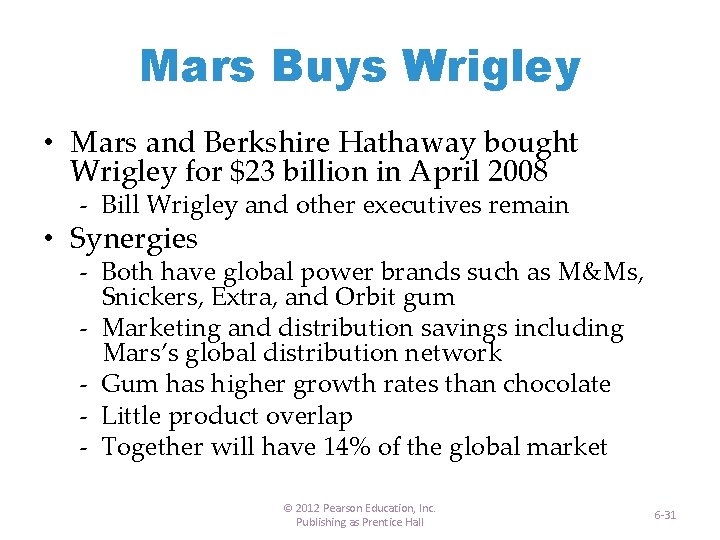
Mars Buys Wrigley • Mars and Berkshire Hathaway bought Wrigley for $23 billion in April 2008 - Bill Wrigley and other executives remain • Synergies - Both have global power brands such as M&Ms, Snickers, Extra, and Orbit gum - Marketing and distribution savings including Mars’s global distribution network - Gum has higher growth rates than chocolate - Little product overlap - Together will have 14% of the global market © 2012 Pearson Education, Inc. Publishing as Prentice Hall 6 -31
- Slides: 31