
6 CHAPTER 6 THE PURCHASE METHOD POSTACQUISITION PERIODS

- Slides: 32
6 CHAPTER 6 THE PURCHASE METHOD: POSTACQUISITION PERIODS AND PARTIAL OWNERSHIPS Slide 6 -1
6 FOCUS OF CHAPTER 6 l Consolidation Worksheets: 100% Ownerships --Postacquisition Periods l The Purchase Method: Partial Ownerships n Conceptual issues n Analyzing cost l Consolidation Worksheets: Partial Ownerships n At the Acquisition Date n Postacquisition Periods Slide 6 -2
6 Postacquisition Subsidiary Earnings: The Only Reportable Earnings Under The Purchase Method l ONLY the subsidiary’s postacquisition earnings are reported in the consolidated financial statements. l The subsidiary’s preacquisition earnings (included in its retained earnings account) are ALWAYS eliminated against the parent’s Investment account in consolidation. Slide 6 -3
6 Parent’s Amortization of Cost in Excess of Book Value: How Handled? l Non-Push-Down Accounting: G/L Method: s Recorded in parent’s general ledger. s Maintains built-in checking features. n Cost Method: W/S s Recorded on consolidation worksheets. n Equity l Push-Down Accounting: n Parent Slide 6 -4 has no amortization--sub records it.
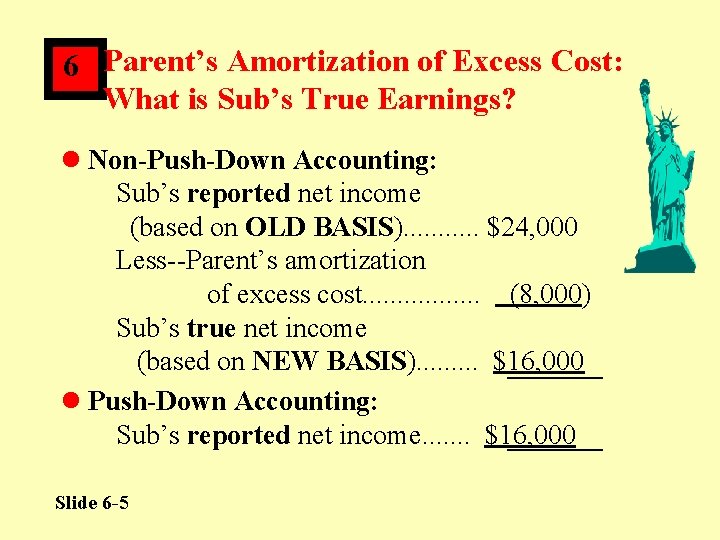
6 Parent’s Amortization of Excess Cost: What is Sub’s True Earnings? l Non-Push-Down Accounting: Sub’s reported net income (based on OLD BASIS). . . $24, 000 Less--Parent’s amortization of excess cost. . . . (8, 000) Sub’s true net income (based on NEW BASIS). . $16, 000 l Push-Down Accounting: Sub’s reported net income. . . . $16, 000 Slide 6 -5
6 Liquidating Dividends: A Special Situation l Because an acquired subsidiary usually has a retained earnings balance at the acquisition date, a unique issue arises for acquired subsidiaries: HOW TO REPORT DIVIDENDS THAT ARE IN EXCESS OF THE SUBSIDIARY’S POSTACQUISITION EARNINGS? n Such dividends are called liquidating dividends. Slide 6 -6
6 Liquidating Dividends: They Differ From “Regular” Dividends l Dividends in excess of postacquisition earnings are a return of the parent’s original investment. l Parent’s Accounting Treatment: n CREDIT to the Investment account under: s Equity method (the usual treatment). s Cost method (the usual treatment is to credit Dividend Income). Slide 6 -7
6 Liquidating Dividends: Acquired vs. Created Subsidiaries created l Can a subsidiary declare a liquidating dividend? NO l No such thing exists for a created subsidiary. Slide 6 -8
6 Liquidating Dividends: What Is their Significance for Tax? l A central issue in taxation is whether a distribution to a shareholder is a dividend or a return of capital. l The concept of “EARNINGS & PROFITS” (E & P) exists in the Internal Revenue Code for making this determination. Code Slide 6 -9
6 Goodwill: It Must be Assigned to a “Reporting Unit” l A reporting unit is (1) an “operating segment” (as defined in FAS 131) or (2) one level below an operating segment. l The reporting unit could be: n The acquired business alone (the subsidiary or division). n The acquired business and the parent combined. n The acquired business and one or more of the parent’s other subsidiaries or divisions. Slide 6 -10
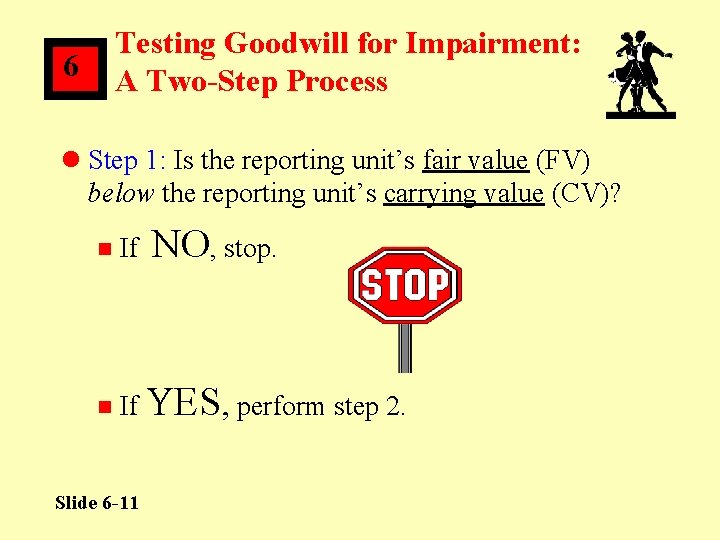
Testing Goodwill for Impairment: A Two-Step Process 6 l Step 1: Is the reporting unit’s fair value (FV) below the reporting unit’s carrying value (CV)? NO, stop. n If YES, perform step 2. Slide 6 -11
Testing Goodwill for Impairment: A Two-Step Process 6 l Step 2: Calculate the “implied value” of goodwill as follows: On a memo basis, allocate the reporting unit’s FV to its assets and liabilities in a “purchase price allocation fashion. ” n Excess of reporting unit’s FV over FV of assets/liabilities (as allocated) is “implied goodwill” of the reporting unit. [Thus implied GW is residually determined. ] n Slide 6 -12
6 Testing Goodwill for Impairment: A Two-Step Process l Step 2 (cont. ) n If the implied FV of GW is less than the carrying value of GW, the excess carrying value is the GW impairment loss to be reported. n Report any GW impairment loss in earnings— as a separate line item, if material. Slide 6 -13
Testing Goodwill for Impairment: A Two-Step Process 6 l Goodwill Impairment Test--How Often? annually. n At least n At interim periods when certain “triggering events” occur that indicate that goodwill of a reporting unit may be impaired. Slide 6 -14
6 Testing Goodwill for Impairment: A Two-Step Process l The Annual GW Impairment Test--It does not require a formal FV determination each year if: n Components of the reporting unit have not changed significantly. n Previous FV of the reporting unit exceeded its CV by a substantial margin. n The likelihood that the reporting unit’s FV is less than its CV is remote. Slide 6 -15
6 Goodwill: Determining the “Reporting Unit’s” Fair Value l The following items are included in determining the reporting unit’s fair value: n Tangible net assets. n Recognized intangible assets. n Unrecognized intangible assets. Slide 6 -16
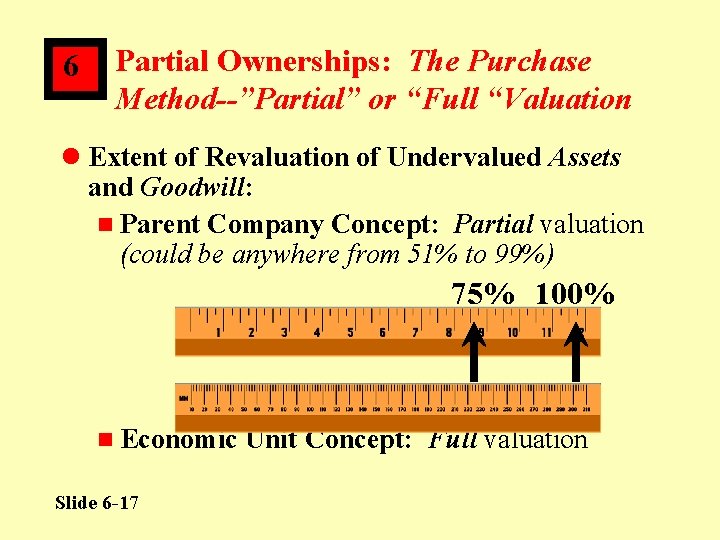
6 Partial Ownerships: The Purchase Method--”Partial” or “Full “Valuation l Extent of Revaluation of Undervalued Assets and Goodwill: n Parent Company Concept: Partial valuation (could be anywhere from 51% to 99%) 75% 100% n Economic Slide 6 -17 Unit Concept: Full valuation
6 Partial Ownerships: The Purchase Method--Undervalued Assets l Extent of Revaluation of Subsidiary’s Undervalued Assets: company concept. . . < 100% of CV s Revalued only to the extent of the parent’s OWNERSHIP INTEREST. n Economic unit concept. . . . 100% of CV s The offsetting credit for the additional valuation increases the NCI in the consolidated B/S. n Parent Slide 6 -18
6 Partial Ownerships: The Purchase Method--Goodwill l Extent of Valuation of Goodwill: company concept. . . . < 100% s Valued only to the extent it is bought and paid for by the parent. n Economic unit concept. . . . . 100% s The offsetting credit for the additional valuation increases the NCI in the consolidated B/S. n Parent Slide 6 -19
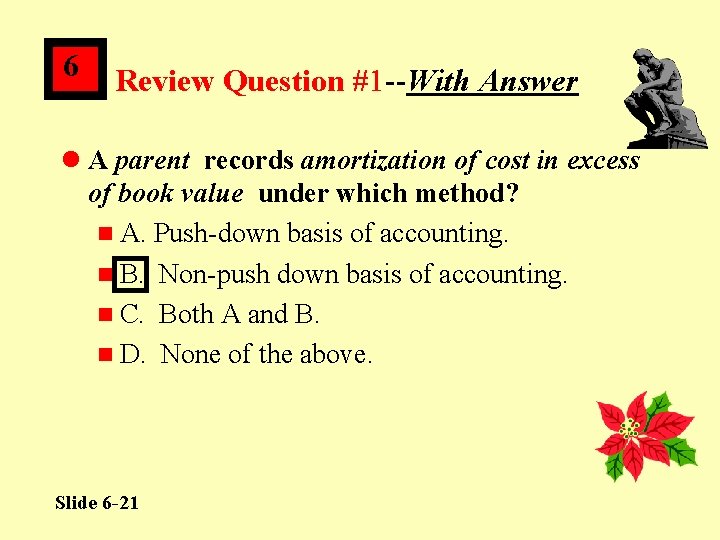
6 Review Question #1 l A parent records amortization of cost in excess of book value under which method? n A. Push-down basis of accounting. n B. Non-push down basis of accounting. n C. Both A and B. n D. None of the above. Slide 6 -20
6 Review Question #1 --With Answer l A parent records amortization of cost in excess of book value under which method? n A. Push-down basis of accounting. n B. Non-push down basis of accounting. n C. Both A and B. n D. None of the above. Slide 6 -21
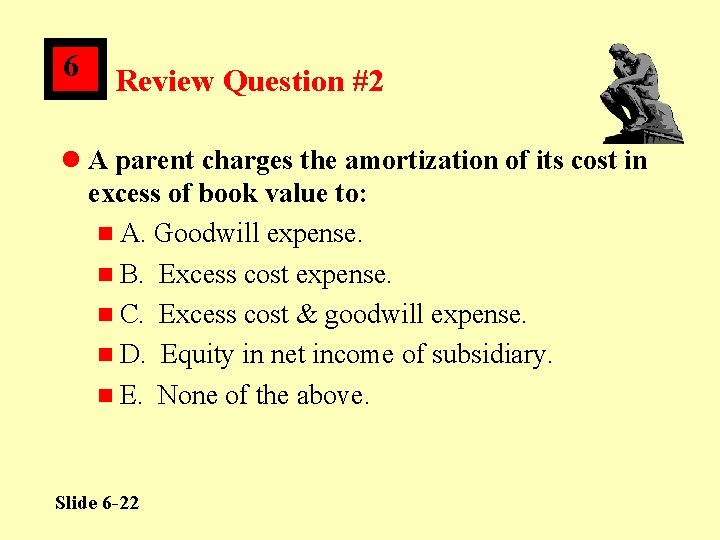
6 Review Question #2 l A parent charges the amortization of its cost in excess of book value to: n A. Goodwill expense. n B. Excess cost expense. n C. Excess cost & goodwill expense. n D. Equity in net income of subsidiary. n E. None of the above. Slide 6 -22
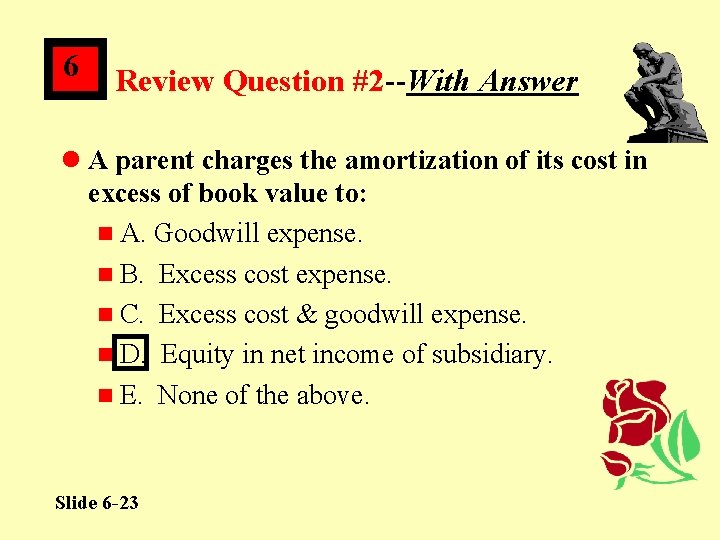
6 Review Question #2 --With Answer l A parent charges the amortization of its cost in excess of book value to: n A. Goodwill expense. n B. Excess cost expense. n C. Excess cost & goodwill expense. n D. Equity in net income of subsidiary. n E. None of the above. Slide 6 -23
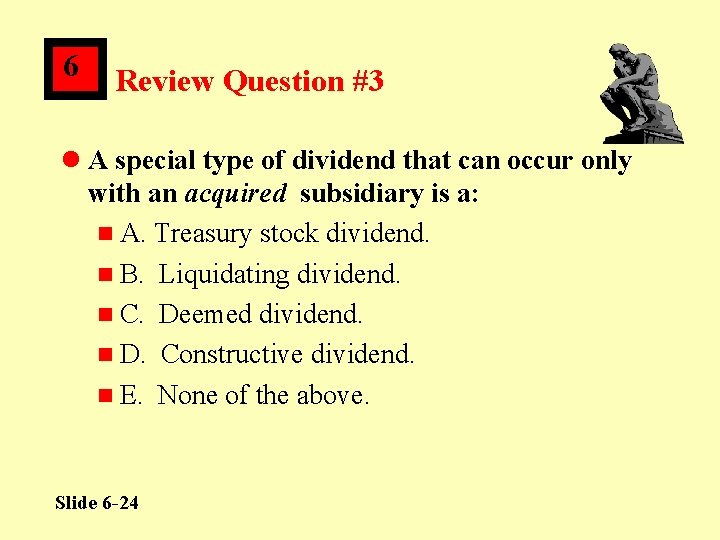
6 Review Question #3 l A special type of dividend that can occur only with an acquired subsidiary is a: n A. Treasury stock dividend. n B. Liquidating dividend. n C. Deemed dividend. n D. Constructive dividend. n E. None of the above. Slide 6 -24
6 Review Question #3 --With Answer l A special type of dividend that can occur only with an acquired subsidiary is a: n A. Treasury stock dividend. n B. Liquidating dividend. n C. Deemed dividend. n D. Constructive dividend. n E. None of the above. Slide 6 -25
6 Review Question #4 l When a liquidating dividend occurs, the parent credits which account? n A. Retained earnings. n B. Dividend income. n C. Investment in subsidiary n D. Liquidating dividend income. n D. None of the above. Slide 6 -26
6 Review Question #4 --With Answer l When a liquidating dividend occurs, the parent credits which account? n A. Retained earnings. n B. Dividend income. n C. Investment in subsidiary n D. Liquidating dividend income. n D. None of the above. Slide 6 -27
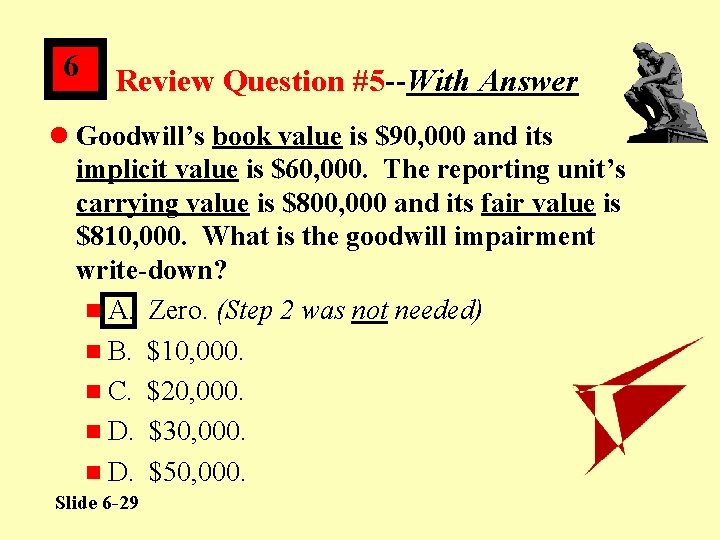
6 Review Question #5 l Goodwill’s book value is $90, 000 and its implicit value is $60, 000. The reporting unit’s carrying value is $800, 000 and its fair value is $810, 000. What is the goodwill impairment write-down? n A. Zero. n B. $10, 000. n C. $20, 000. n D. $30, 000. n D. $50, 000. Slide 6 -28
6 Review Question #5 --With Answer l Goodwill’s book value is $90, 000 and its implicit value is $60, 000. The reporting unit’s carrying value is $800, 000 and its fair value is $810, 000. What is the goodwill impairment write-down? n A. Zero. (Step 2 was not needed) n B. $10, 000. n C. $20, 000. n D. $30, 000. n D. $50, 000. Slide 6 -29
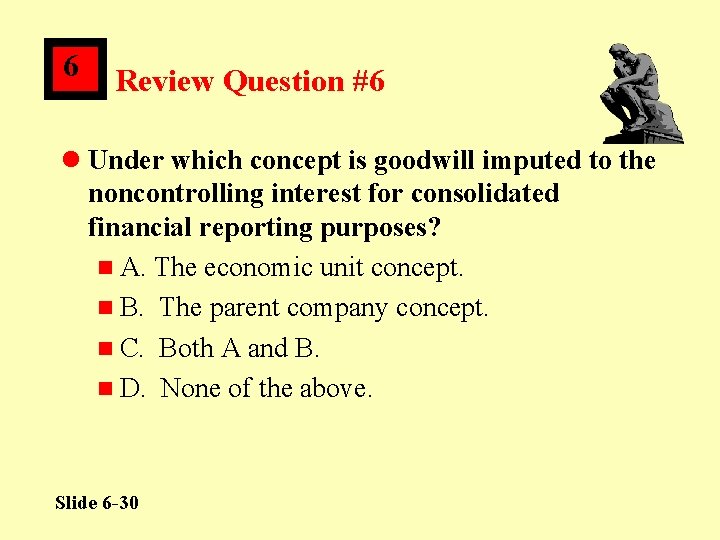
6 Review Question #6 l Under which concept is goodwill imputed to the noncontrolling interest for consolidated financial reporting purposes? n A. The economic unit concept. n B. The parent company concept. n C. Both A and B. n D. None of the above. Slide 6 -30
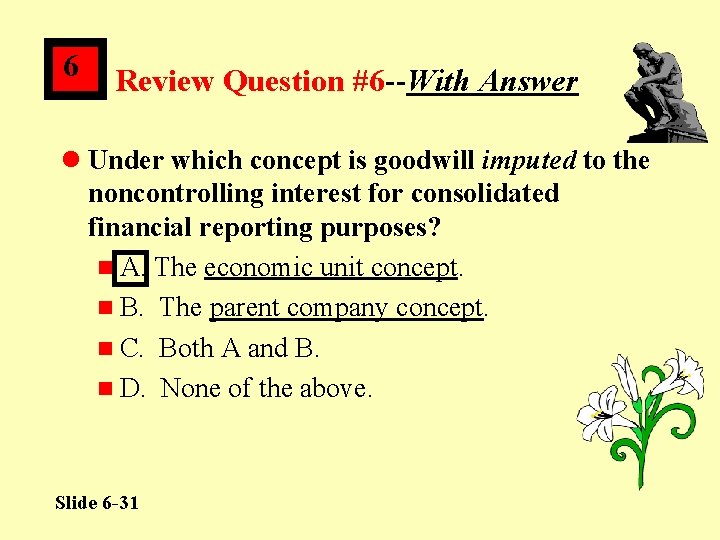
6 Review Question #6 --With Answer l Under which concept is goodwill imputed to the noncontrolling interest for consolidated financial reporting purposes? n A. The economic unit concept. n B. The parent company concept. n C. Both A and B. n D. None of the above. Slide 6 -31
6 End of Chapter 6 l. Time to Clear Things Up-Any Questions? Slide 6 -32