
6 Applications of Integration Copyright Cengage Learning All

![Volumes by Cylindrical Shells If the rectangle with base [x i – 1, xi]](https://slidetodoc.com/presentation_image/34fb37ec433ee9ee487dee3db70787bf/image-8.jpg "Volumes by Cylindrical Shells If the rectangle with base [x i – 1, xi]")
- Slides: 16
6 Applications of Integration Copyright © Cengage Learning. All rights reserved.
6. 3 Volumes by Cylindrical Shells Copyright © Cengage Learning. All rights reserved.
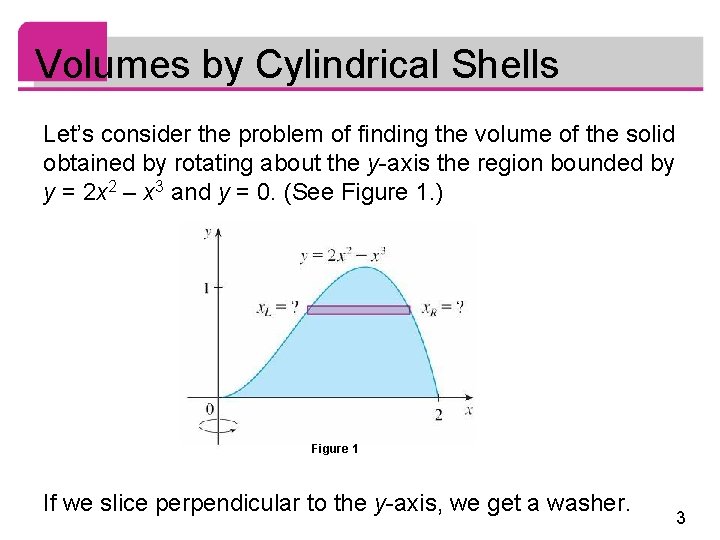
Volumes by Cylindrical Shells Let’s consider the problem of finding the volume of the solid obtained by rotating about the y-axis the region bounded by y = 2 x 2 – x 3 and y = 0. (See Figure 1. ) Figure 1 If we slice perpendicular to the y-axis, we get a washer. 3
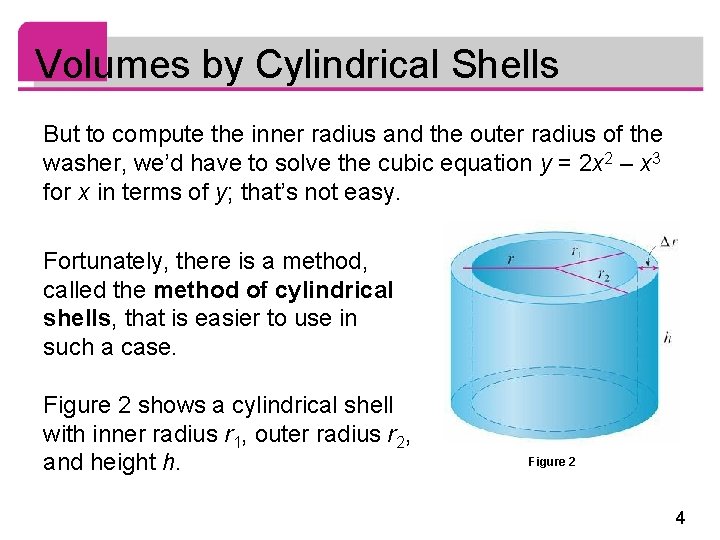
Volumes by Cylindrical Shells But to compute the inner radius and the outer radius of the washer, we’d have to solve the cubic equation y = 2 x 2 – x 3 for x in terms of y; that’s not easy. Fortunately, there is a method, called the method of cylindrical shells, that is easier to use in such a case. Figure 2 shows a cylindrical shell with inner radius r 1, outer radius r 2, and height h. Figure 2 4
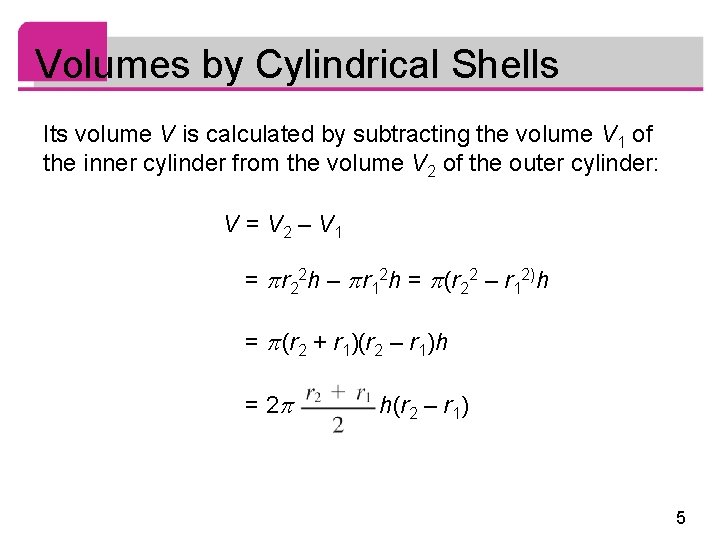
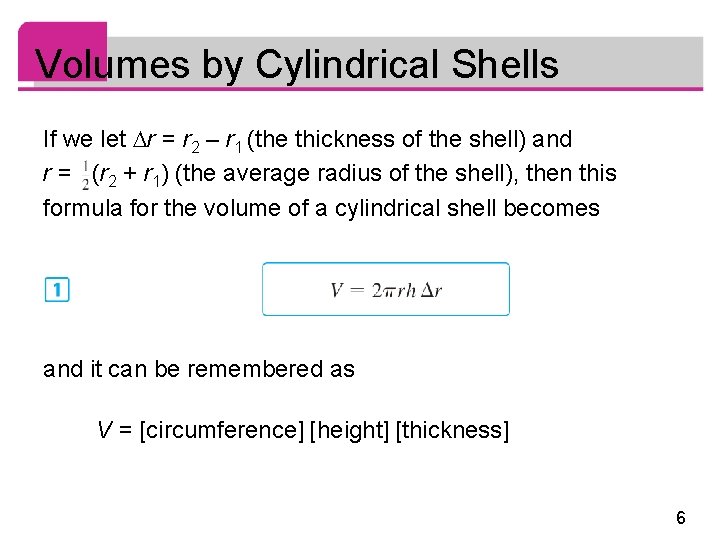
Volumes by Cylindrical Shells Its volume V is calculated by subtracting the volume V 1 of the inner cylinder from the volume V 2 of the outer cylinder: V = V 2 – V 1 = r 22 h – r 12 h = (r 22 – r 12)h = (r 2 + r 1)(r 2 – r 1)h = 2 h(r 2 – r 1) 5
Volumes by Cylindrical Shells If we let r = r 2 – r 1 (the thickness of the shell) and r = (r 2 + r 1) (the average radius of the shell), then this formula for the volume of a cylindrical shell becomes and it can be remembered as V = [circumference] [height] [thickness] 6
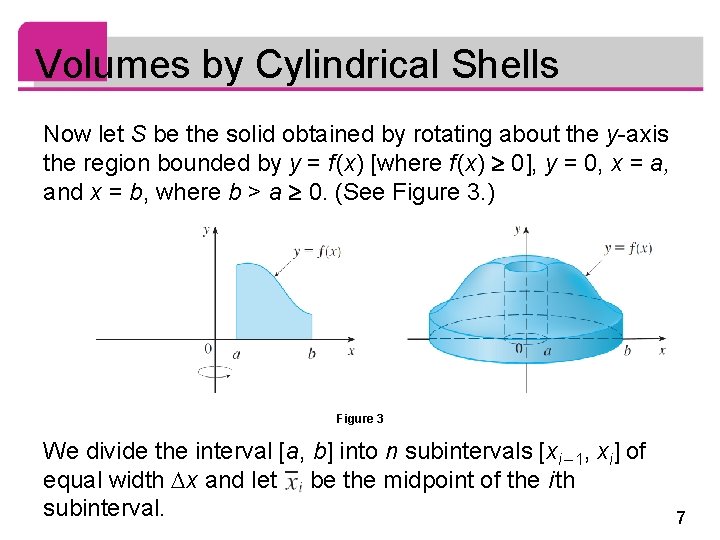
Volumes by Cylindrical Shells Now let S be the solid obtained by rotating about the y-axis the region bounded by y = f (x) [where f (x) 0], y = 0, x = a, and x = b, where b > a 0. (See Figure 3. ) Figure 3 We divide the interval [a, b] into n subintervals [xi – 1, xi] of equal width x and let be the midpoint of the i th subinterval. 7
Volumes by Cylindrical Shells If the rectangle with base [x i – 1, xi] and height is rotated about the y-axis, then the result is a cylindrical shell with average radius , height , and thickness x (see Figure 4), so by Formula 1 its volume is Figure 4 8
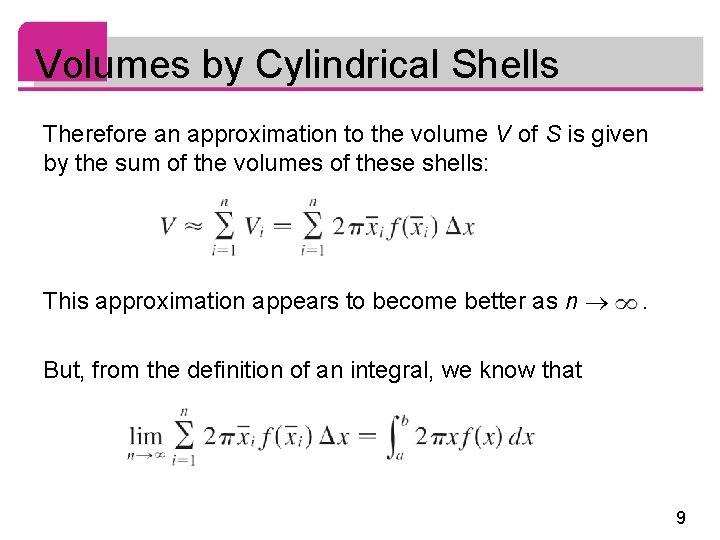
Volumes by Cylindrical Shells Therefore an approximation to the volume V of S is given by the sum of the volumes of these shells: This approximation appears to become better as n . But, from the definition of an integral, we know that 9
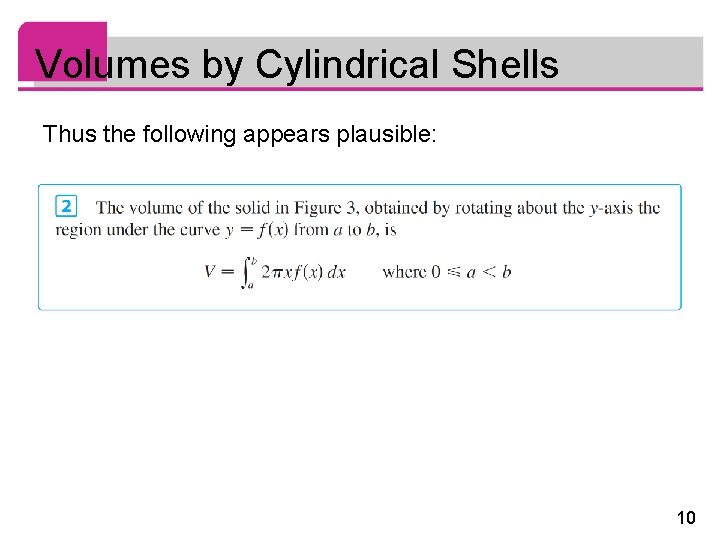
Volumes by Cylindrical Shells Thus the following appears plausible: 10
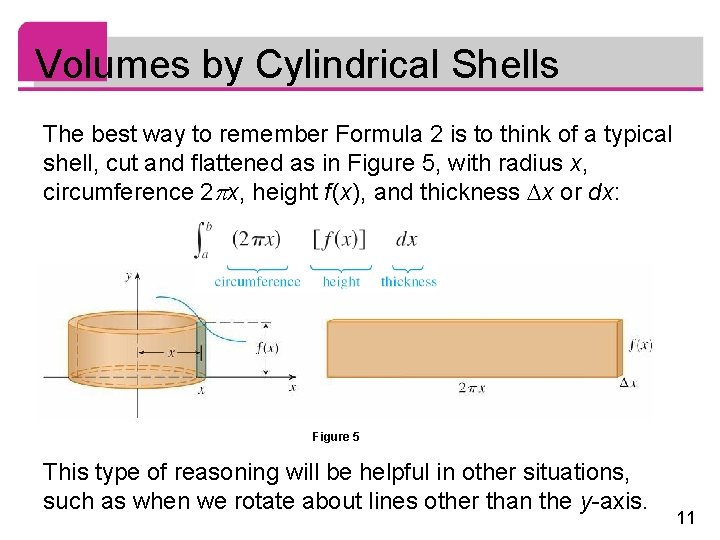
Volumes by Cylindrical Shells The best way to remember Formula 2 is to think of a typical shell, cut and flattened as in Figure 5, with radius x, circumference 2 x, height f (x), and thickness x or dx: Figure 5 This type of reasoning will be helpful in other situations, such as when we rotate about lines other than the y-axis. 11
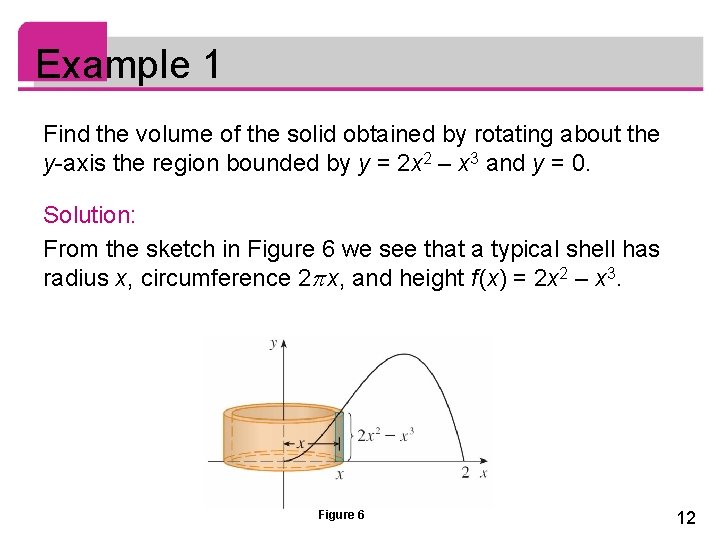
Example 1 Find the volume of the solid obtained by rotating about the y-axis the region bounded by y = 2 x 2 – x 3 and y = 0. Solution: From the sketch in Figure 6 we see that a typical shell has radius x, circumference 2 x, and height f (x) = 2 x 2 – x 3. Figure 6 12
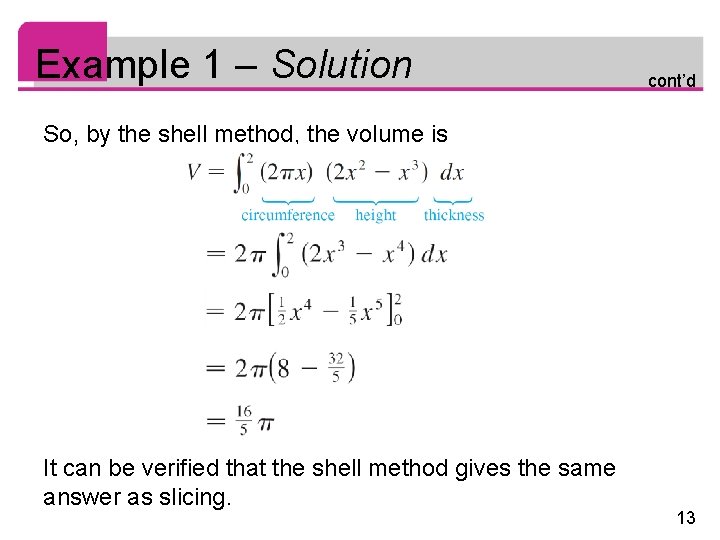
Example 1 – Solution cont’d So, by the shell method, the volume is It can be verified that the shell method gives the same answer as slicing. 13
Disks and Washers versus Cylindrical Shells 14
Disks and Washers versus Cylindrical Shells When computing the volume of a solid of revolution, how do we know whether to use disks (or washers) or cylindrical shells? There are several considerations to take into account: Is the region more easily described by top and bottom boundary curves of the form y = f (x) or by left and right boundaries x = g (y)? Which choice is easier to work with? Are the limits of integration easier to find for one variable versus the other? Does the region require two separate integrals when using x as the variable but only one integral in y? Are we able to evaluate the integral we set up with our choice of variable? 15
Disks and Washers versus Cylindrical Shells If we decide that one variable is easier to work with than the other, then this dictates which method to use. Draw a sample rectangle in the region, corresponding to a crosssection of the solid. The thickness of the rectangle, either x or y, corresponds to the integration variable. If you imagine the rectangle revolving, it becomes either a disk (washer) or a shell. 16