
6 Analyzing qualitative data Qualitative Research Methods in

- Slides: 11
6. Analyzing qualitative data Qualitative Research Methods in Nationalism and Ethnic Studies 2019 Central European University Nationalism Studies Margit Feischmidt
Topics and readings Topics Organizing qualitative data Grounded theory Coding and memo-ing Using software for qualitative data analysis Readings: Hammersley, Martyn and Paul Atkinson (1983): The Process of Analysis. In: Ibid: Ethnography: Principles and Practice. London: Routledge 23 -53. Atlas. ti – Quick tour http: //atlasti. com/manuals-docs/
Analysis in qualitative research Not a distinct stage of the research Starts – when? In formulation and clarification of research problems Continues – how? Through the process of data gathering Takes shape – where? In analytic notes Grounded theory (Glazer and Strauss) – mezo-level theories emerge from data analysis Dialectical relation between data collection and data analysis Problems with data analysis in qualitative research Hard to check particular interpretations and typologies Why? (1) naturalism – capturing the social world in description, “tell it like it is” (2) great deal of data is collected but little time left on interpreting the relations, meanings, implications (3) Data processing is time consuming
Types of theory Micro and macro theory – ethnography: more often research on micro theory, but: it can play an important role in developing and testing macro theories as well Substantive and formal theory (Glazer and Strauss) – concerns the generality of the categories under which cases are subsumed Given the two dimensions, four types of theories can be identified, give examples macro-formal (Radcliffe-Brown), macro-substantive (Malinowski), micro-formal (local forms of social org, Goffman), micro-substantive (research on particular type of org or situation)
Progressive focusing Funnel structure or progressive focusing in qualitative research (including transformations of the research problem) Gradual shift from description towards developing and testing explanations on a more general and theoritical level Different reasons and research designs 1. Rather descriptive works Advantages, disadvantages ? Descriptions are broader, cover many different aspects of the phenomena 2. More analytic, explanatory projects Theories through typologies of social orientation, discursive practice, interactional strategy institutional forms Involves a narrowing of focus and a process of abstraction Advantages, disadvantages ?
Development of analytic categories Ethnography: unstructured data, different sources (fieldnotes, interview transcripts etc) Analysis starts with the development of a set of analytic categories Generating concepts Find analytical concepts – make sense of what is going on, what is documented by data Mysterious process? No: emergence, developing and testing analytical ideas In relation to previous knowledge of the same issues Used as resources to make sense of the data collected – but not forced interpretations
Validation of concepts The development of typology is not only a conceptual work – must be linked to the material What is said or done must be interpreted in relation to the social context in which is done or said (in public, in private) Data recorded at different time need to be examined in light of their place within temporal patterns, that structure the lives of those being studied Respondent validation: Who is doing or saying something is an important consideration, two kind of effects ? Comparison of data related to the same phenomenon but deriving from different people, or phases of fieldwork etc.
Steps in process of analysis 0. preparing the qualitative data corpus in a systematic way 1. careful reading (probably several readings) of the corpus – “use the data to think with” One looks – for what while reading the material ? whether any interesting patterns, regularities can be identified whether anything stands out as surprising or puzzling how the data relate to what one have expected based on commonsense knowledge, official accounts or previous theory whethere any apparent inconsistencies or contradictions among the views of different groups and individuals
Steps in the process of analysis (2) 2. check analytic memos - some of the features and patterns may have been noted already there The aim: to compare and relate what happens or what was said at different places and times – identify stable features that transcend local contexts The source of analytical concepts ? used by participants themselves observer-identified adapting existing concepts from the literature The concepts used to start are often mundane, later more analytical The ultimate aim – a stable set of categories – that can be used for systematic coding 3. Working with analytic categories to organize the data: Coding
Developing typologies The reasons of categories emerged from the analysis: (1) descriptions or (2) more systematic typologies: various strategies which actors could adopt to deal with a problem Follow the question: why particular strategies are adopted by particular sorts of people in these particular circumstances? Lazarsfeld and Barton – systematic development of typologies initial set of categories differentiating a particular range of phenomena developed into a systematic typology
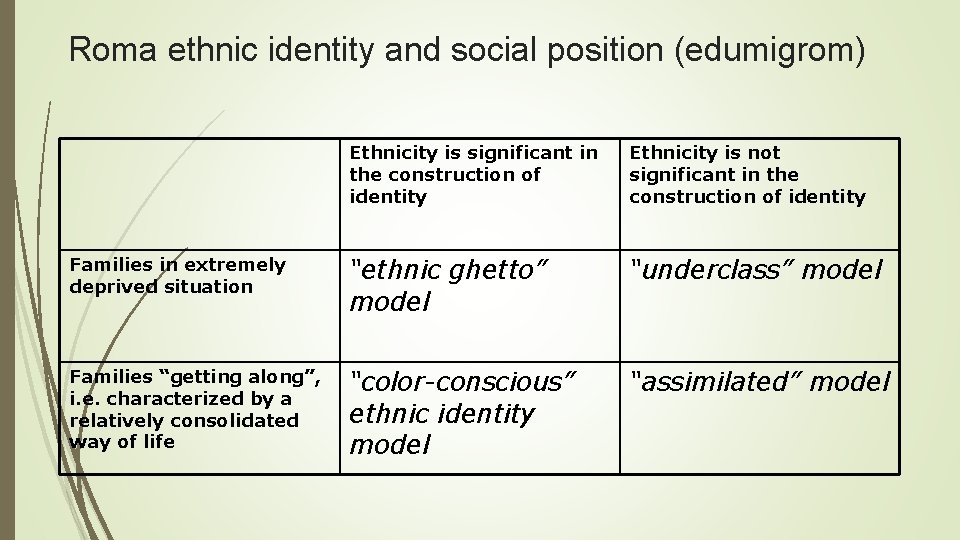
Roma ethnic identity and social position (edumigrom) Ethnicity is significant in the construction of identity Ethnicity is not significant in the construction of identity Families in extremely deprived situation “ethnic ghetto” model “underclass” model Families “getting along”, i. e. characterized by a relatively consolidated way of life “color-conscious” ethnic identity model “assimilated” model