
6 852 Distributed Algorithms Spring 2008 Class 5
6. 852: Distributed Algorithms Spring, 2008 Class 5
Today’s plan • Finish EIG algorithm for Byzantine agreement. • Number-of-processors lower bound for Byzantine agreement. • Connectivity bounds. • Weak Byzantine agreement. • Time lower bounds for stopping agreement and Byzantine agreement. • Reading: Sections 6. 3 -6. 7, [Aguilera, Toueg], [Keidar. Rajsbaum] • Next: Chapter 7 (skim 7. 2)

Byzantine agreement • Recall correctness conditions: – Agreement: No two nonfaulty processes decide on different values. – Validity: If all nonfaulty processes start with the same v, then v is the only allowable decision for nonfaulty processes. – Termination: All nonfaulty processes eventually decide. • Present EIG algorithm for Byzantine agreement, using: – Exponential communication (in f) – f+1 rounds – n > 3 f
EIG algorithm for Byzantine agreement • Use EIG tree. • Relay messages for f+1 rounds. • Decorate the EIG tree with values from V, replacing any garbage messages with default value v 0. • Call the decorations val(x), where x is any node label. • Decision rule: – Redecorate the tree, defining newval(x). • Proceed bottom-up. • Leaf: newval(x) = val(x) • Non-leaf: newval(x) = – newval of strict majority of children in the tree, if majority exists, – v 0 otherwise. – Final decision: newval( ) (newval at root)

Example: n = 4, f = 1 • T 4, 1: • Consider a possible execution in which p 3 is faulty. • Initial values 1 1 0 0 • Round 1 • Round 2 1 2 3 12 13 14 21 23 24 4 31 32 34 41 42 43 Lies 1 1 0 0 1 1 0 1 0 1 1 0 0 0 1 1 1 1 0 0 0 Process 1 Process 2 0 1 1 1 1 0 0 1 (Process 3) Process 4
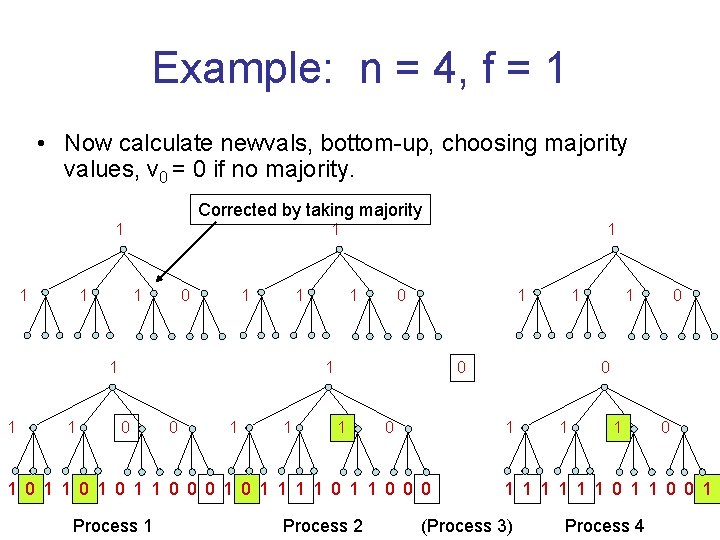
Example: n = 4, f = 1 • Now calculate newvals, bottom-up, choosing majority values, v 0 = 0 if no majority. Corrected by taking majority 1 1 1 1 1 0 0 1 1 0 Process 2 1 0 0 1 1 0 0 0 1 1 1 1 0 0 0 Process 1 1 1 1 0 0 1 (Process 3) Process 4
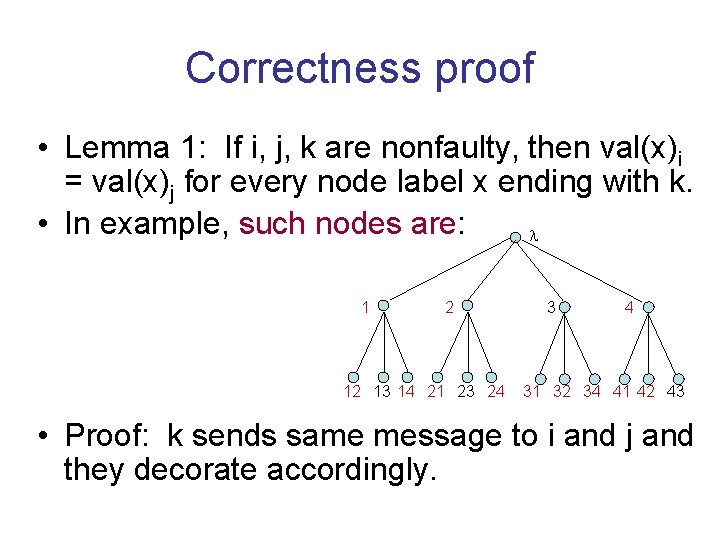
Correctness proof • Lemma 1: If i, j, k are nonfaulty, then val(x)i = val(x)j for every node label x ending with k. • In example, such nodes are: 1 2 12 13 14 21 23 24 3 4 31 32 34 41 42 43 • Proof: k sends same message to i and j and they decorate accordingly.
Proof, cont’d • Lemma 2: If x ends with nonfaulty process index then v V such that val(x)i = newval(x)i = v for every nonfaulty i. • Proof: Induction on lengths of labels, bottom up. – Basis: Leaf. • Lemma 1 implies that all nonfaulty processes have same val(x). • newval = val for each leaf. – Inductive step: |x| = r f (|x| = f+1 at leaves) • Lemma 1 implies that all nonfaulty processes have same val(x), say v. • We need newval(x) = v everywhere also. • Every nonfaulty process j broadcasts same v for x at round r+1, so val(xj)i = v for every nonfaulty j and i. • By inductive hypothesis, also newval(xj)I = v for every nonfaulty j and i. • A majority of labels of x’s children end with nonfaulty process indices: – Number of children of node x is n – f > 3 f – f = 2 f. – At most f are faulty. • So, majority rule applied by i leads to newval(x)i = v, for all nonfaulty i.
Main correctness conditions • Validity: – If all nonfaulty processes begin with v, then all nonfaulty processes broadcast v at round 1, so val(j)i = v for all nonfaulty i, j. – By Lemma 2, also newval(j)i = v for all nonfaulty i, j. – Majority rule implies newval( )i = v for all nonfaulty i. – So all nonfaulty i decide v. • Termination: – Obvious. • Agreement:
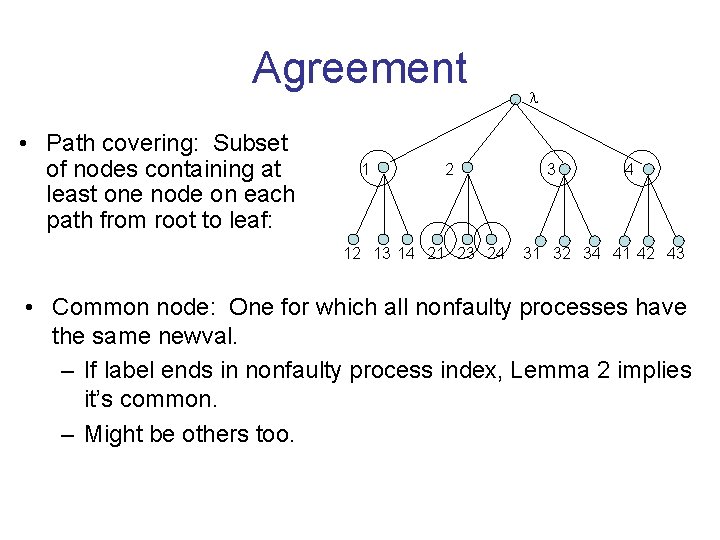
Agreement • Path covering: Subset of nodes containing at least one node on each path from root to leaf: 1 2 12 13 14 21 23 24 3 4 31 32 34 41 42 43 • Common node: One for which all nonfaulty processes have the same newval. – If label ends in nonfaulty process index, Lemma 2 implies it’s common. – Might be others too.
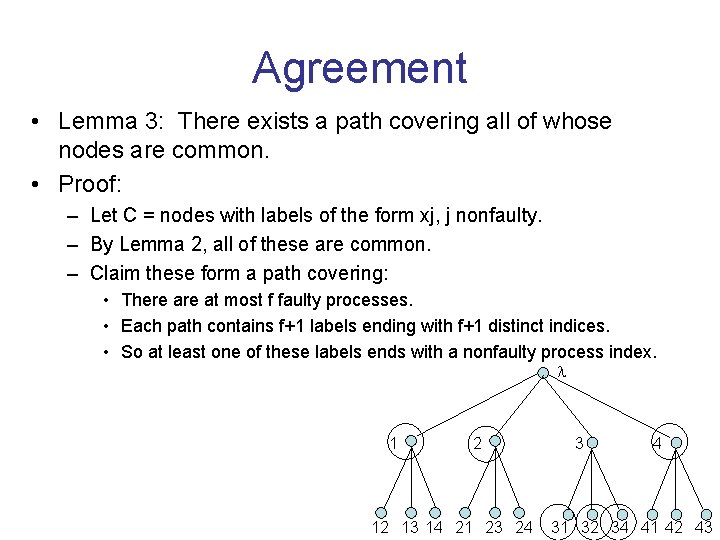
Agreement • Lemma 3: There exists a path covering all of whose nodes are common. • Proof: – Let C = nodes with labels of the form xj, j nonfaulty. – By Lemma 2, all of these are common. – Claim these form a path covering: • There at most f faulty processes. • Each path contains f+1 labels ending with f+1 distinct indices. • So at least one of these labels ends with a nonfaulty process index. 1 2 12 13 14 21 23 24 3 4 31 32 34 41 42 43
Agreement • Lemma 4: If there’s a common path covering of the subtree rooted at any node x, then x is common • Proof: – By induction, from the leaves up. – “Common-ness” propagates upward. • Lemmas 3 and 4 together imply that the root is common. • So all nonfaulty processes get the same newval( ). • Yields Agreement.
Complexity bounds • As for EIG for stopping agreement: – Time: f+1 – Communication: O(nf+1) • But now, also requires n > 3 f processors
Number of processors for Byzantine agreement • n > 3 f is necessary! – Holds for any n-node (undirected) graph. – For graphs with low connectivity, may need even more processors. – Number of failures that can be tolerated for Byzantine agreement in an undirected graph G has been completely characterized, in terms of number of nodes and connectivity. • Theorem 1: 3 processes cannot solve BA with 1 possible failure.
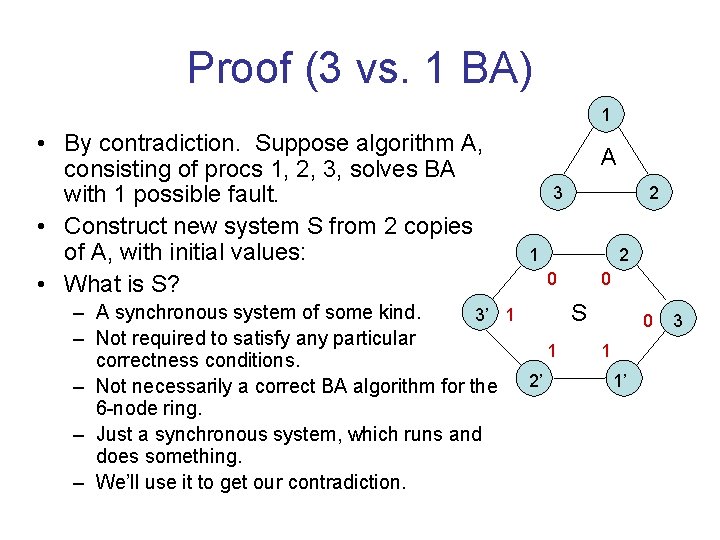
Proof (3 vs. 1 BA) 1 • By contradiction. Suppose algorithm A, consisting of procs 1, 2, 3, solves BA with 1 possible fault. • Construct new system S from 2 copies of A, with initial values: • What is S? A 3 2 1 2 0 0 – A synchronous system of some kind. 3’ 1 S 0 3 – Not required to satisfy any particular 1 1 correctness conditions. 2’ 1’ – Not necessarily a correct BA algorithm for the 6 -node ring. – Just a synchronous system, which runs and does something. – We’ll use it to get our contradiction.
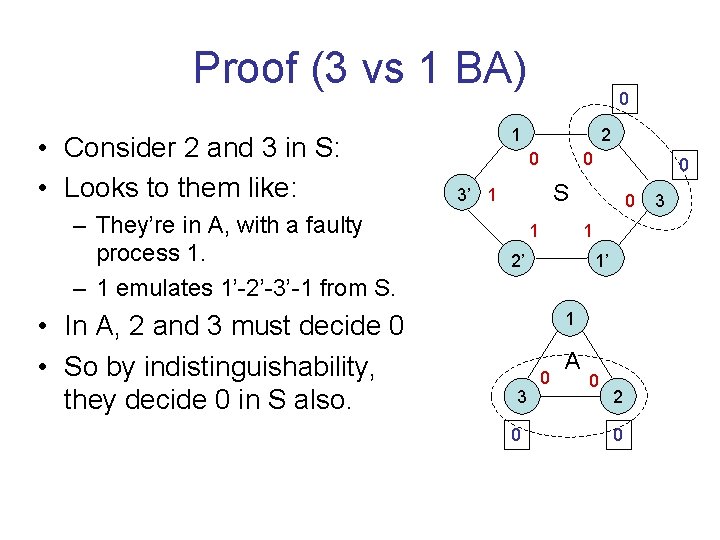
Proof (3 vs 1 BA) • Consider 2 and 3 in S: • Looks to them like: – They’re in A, with a faulty process 1. – 1 emulates 1’-2’-3’-1 from S. • In A, 2 and 3 must decide 0 • So by indistinguishability, they decide 0 in S also. 0 1 2 0 0 0 S 3’ 1 1 0 1 2’ 1’ 1 3 0 0 A 0 2 0 3
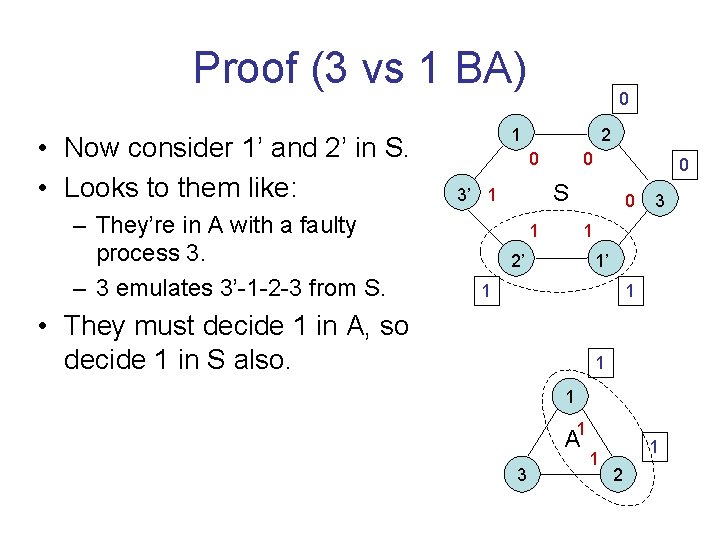
Proof (3 vs 1 BA) • Now consider 1’ and 2’ in S. • Looks to them like: – They’re in A with a faulty process 3. – 3 emulates 3’-1 -2 -3 from S. 0 1 2 0 0 0 S 3’ 1 0 1 3 1 2’ 1’ 1 1 • They must decide 1 in A, so decide 1 in S also. 1 1 1 A 3 1 1 2
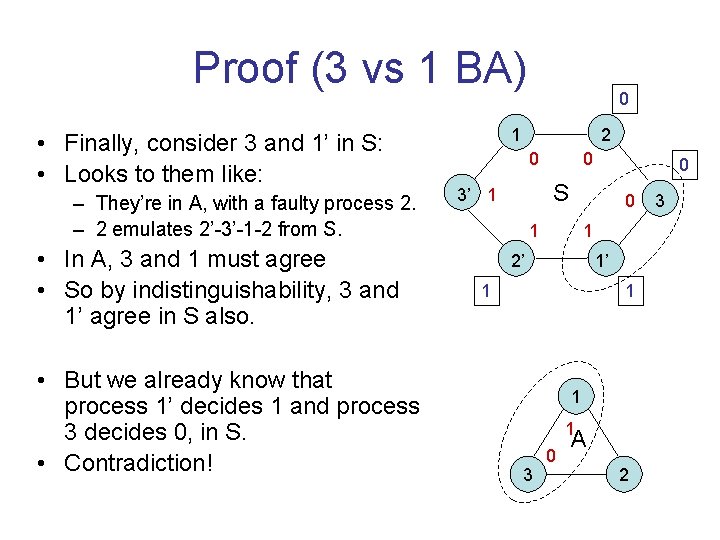
Proof (3 vs 1 BA) • Finally, consider 3 and 1’ in S: • Looks to them like: – They’re in A, with a faulty process 2. – 2 emulates 2’-3’-1 -2 from S. • In A, 3 and 1 must agree • So by indistinguishability, 3 and 1’ agree in S also. • But we already know that process 1’ decides 1 and process 3 decides 0, in S. • Contradiction! 0 1 2 0 0 0 S 3’ 1 0 1 1 2’ 1’ 1 1 3 0 A 2 3
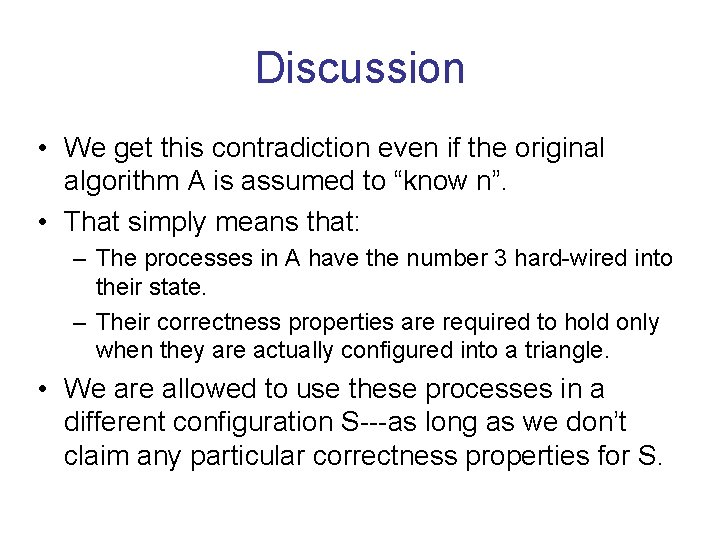
Discussion • We get this contradiction even if the original algorithm A is assumed to “know n”. • That simply means that: – The processes in A have the number 3 hard-wired into their state. – Their correctness properties are required to hold only when they are actually configured into a triangle. • We are allowed to use these processes in a different configuration S---as long as we don’t claim any particular correctness properties for S.
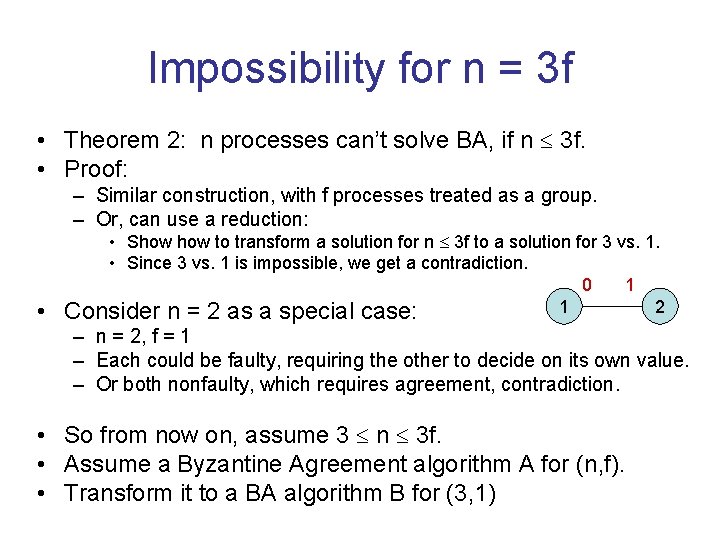
Impossibility for n = 3 f • Theorem 2: n processes can’t solve BA, if n 3 f. • Proof: – Similar construction, with f processes treated as a group. – Or, can use a reduction: • • Show to transform a solution for n 3 f to a solution for 3 vs. 1. • Since 3 vs. 1 is impossible, we get a contradiction. 0 1 1 2 Consider n = 2 as a special case: – n = 2, f = 1 – Each could be faulty, requiring the other to decide on its own value. – Or both nonfaulty, which requires agreement, contradiction. • So from now on, assume 3 n 3 f. • Assume a Byzantine Agreement algorithm A for (n, f). • Transform it to a BA algorithm B for (3, 1)
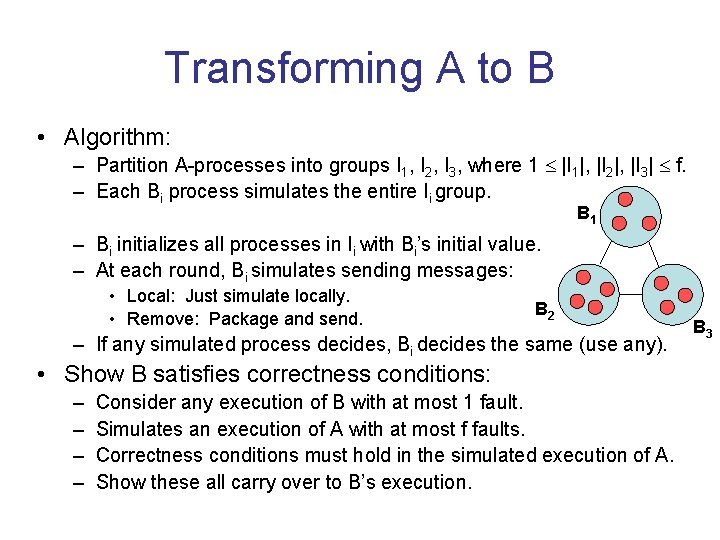
Transforming A to B • Algorithm: – Partition A-processes into groups I 1, I 2, I 3, where 1 |I 1|, |I 2|, |I 3| f. – Each Bi process simulates the entire Ii group. B 1 – Bi initializes all processes in Ii with Bi’s initial value. – At each round, Bi simulates sending messages: • Local: Just simulate locally. • Remove: Package and send. B 2 – If any simulated process decides, Bi decides the same (use any). • Show B satisfies correctness conditions: – – Consider any execution of B with at most 1 fault. Simulates an execution of A with at most f faults. Correctness conditions must hold in the simulated execution of A. Show these all carry over to B’s execution. B 3
B’s correctness • Termination: – If Bi is nonfaulty in B, then it simulates only nonfaulty processes of A (at least one). – Those terminate, so Bi does also. • Agreement: – If Bi, Bj are nonfaulty processes of B, they simulate only nonfaulty processes of A. – Agreement in A implies all these agree. – So Bi, Bj agree. • Validity: – If all nonfaulty processes of B start with v, then so do all nonfaulty processes of A. – Then validity of A implies that all nonfaulty A processes decide v, so the same holds for B.
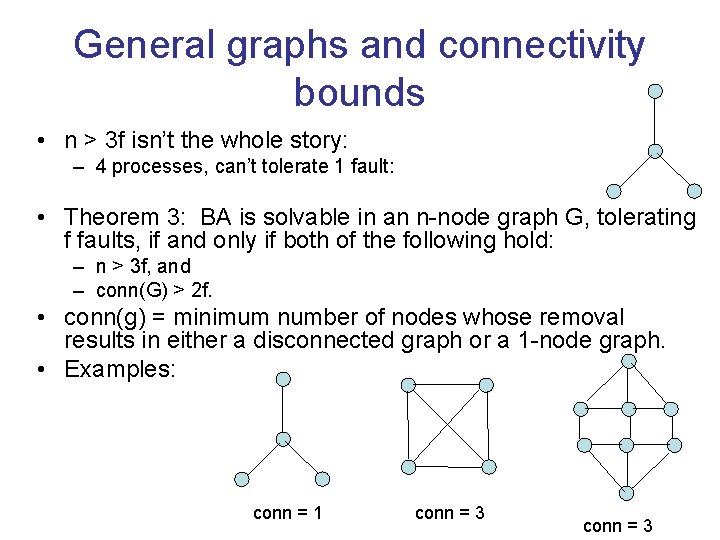
General graphs and connectivity bounds • n > 3 f isn’t the whole story: – 4 processes, can’t tolerate 1 fault: • Theorem 3: BA is solvable in an n-node graph G, tolerating f faults, if and only if both of the following hold: – n > 3 f, and – conn(G) > 2 f. • conn(g) = minimum number of nodes whose removal results in either a disconnected graph or a 1 -node graph. • Examples: conn = 1 conn = 3
Proof: “If” direction • Theorem 3: BA is solvable in an n-node graph G, tolerating f faults, if and only if n > 3 f and conn(G) > 2 f. • Proof (“if”): – Suppose both hold. – Then we can simulate a total-connectivity algorithm. – Key is to emulate reliable communication from any node i to any other node j. – Rely on Menger’s Theorem, which says that a graph is c-connected (that is, has conn c) if and only if each pair of nodes is connected by c node-disjoint paths. – Since conn(G) 2 f + 1, we have 2 f + 1 node-disjoint paths between i and j. – To send message, send on all these paths (assumes graph is known). – Majority must be correct, so take majority message.
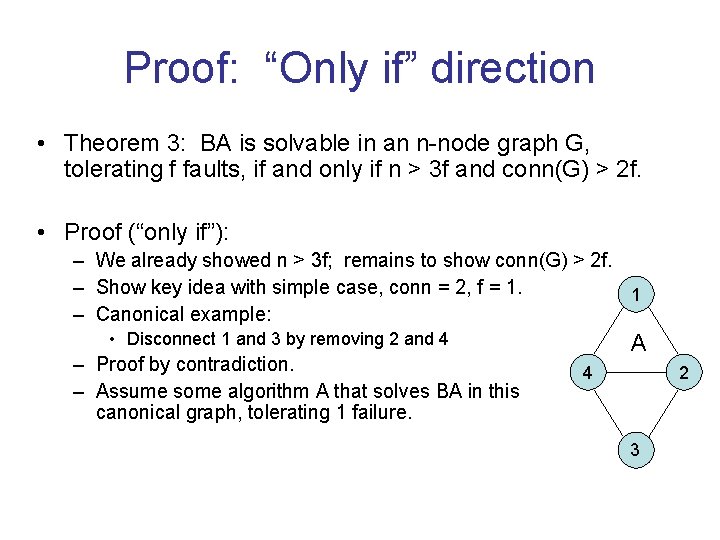
Proof: “Only if” direction • Theorem 3: BA is solvable in an n-node graph G, tolerating f faults, if and only if n > 3 f and conn(G) > 2 f. • Proof (“only if”): – We already showed n > 3 f; remains to show conn(G) > 2 f. – Show key idea with simple case, conn = 2, f = 1. 1 – Canonical example: • Disconnect 1 and 3 by removing 2 and 4 – Proof by contradiction. – Assume some algorithm A that solves BA in this canonical graph, tolerating 1 failure. A 4 2 3
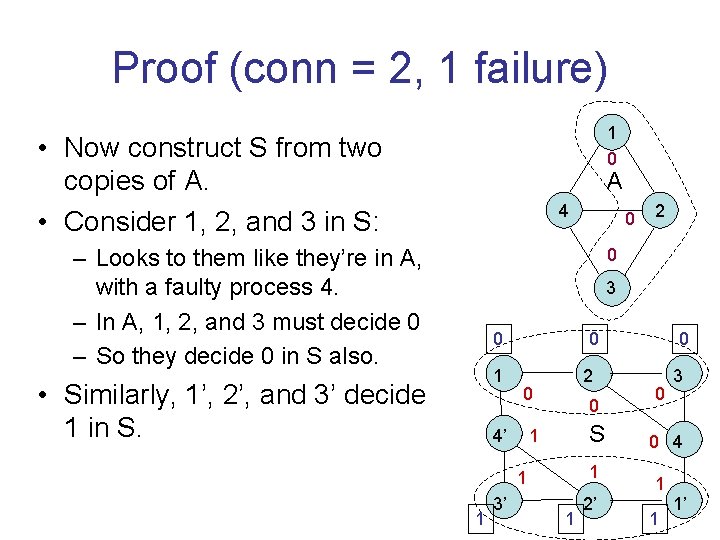
Proof (conn = 2, 1 failure) 1 0 • Now construct S from two copies of A. • Consider 1, 2, and 3 in S: A 4 – Looks to them like they’re in A, with a faulty process 4. – In A, 1, 2, and 3 must decide 0 – So they decide 0 in S also. 0 2 0 3 0 1 • Similarly, 1’, 2’, and 3’ decide 1 in S. 0 2 0 4’ 0 S 1 1 3’ 1 2’ 0 0 3 0 4 1 1 1’
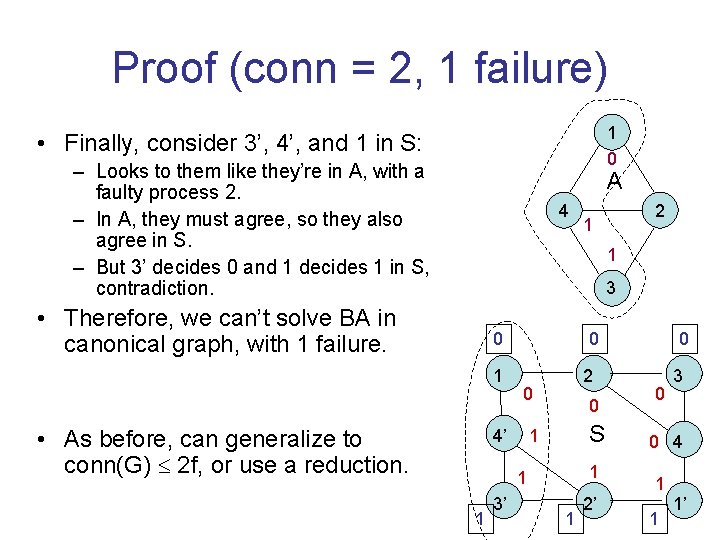
Proof (conn = 2, 1 failure) 1 0 • Finally, consider 3’, 4’, and 1 in S: – Looks to them like they’re in A, with a faulty process 2. – In A, they must agree, so they also agree in S. – But 3’ decides 0 and 1 decides 1 in S, contradiction. A 4 2 1 1 3 • Therefore, we can’t solve BA in canonical graph, with 1 failure. 0 1 • As before, can generalize to conn(G) 2 f, or use a reduction. 0 2 0 4’ 0 S 1 1 3’ 1 2’ 0 0 3 0 4 1 1 1’
Byzantine processor bounds • The bounds n > 3 f and conn > 2 f are fundamental for consensus-style problems with Byzantine failures. • Same bounds hold, in synchronous settings with f Byzantine faulty processes, for: – Byzantine Firing Squad synchronization problem – Weak Byzantine Agreement – Approximate agreement • Also, in timed (partially synchronous settings), for maintaining clock synchronization. • Proofs used similar methods.
![Weak Byzantine Agreement [Lamport] • Correctness conditions for BA: – Agreement: No two nonfaulty](http://slidetodoc.com/presentation_image_h2/614eadcfad55b8c6476fc1d6da78aaad/image-29.jpg "Weak Byzantine Agreement [Lamport] • Correctness conditions for BA: – Agreement: No two nonfaulty")
Weak Byzantine Agreement [Lamport] • Correctness conditions for BA: – Agreement: No two nonfaulty processes decide on different values. – Validity: If all nonfaulty processes start with the same v, then v is the only allowable decision for nonfaulty processes. – Termination: All nonfaulty processes eventually decide. • Correctness conditions for Weak BA: – Agreement: Same as for BA. – Validity: If there are no faulty processes and all processes start with the same v, then v is the only allowed decision value. – Termination: Same as for BA. • Limits the situations where the decision is forced to go a certain way. • Similar to validity condition for 2 -Generals problem
WBA Processor Bounds • Theorem 4: Weak BA is solvable in an nnode graph G, tolerating f faults, if and only if n > 3 f and conn(G) > 2 f. • Same bounds. • Proof: – “If”: Follows from results for ordinary BA. – “Only if”: • By constructions like those for ordinary BA, but slightly more complicated. • Show 3 vs. 1 here, rest LTTR.
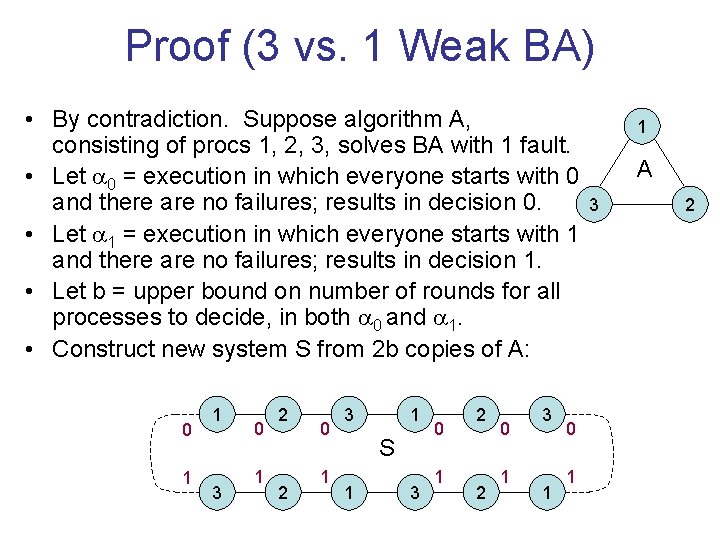
Proof (3 vs. 1 Weak BA) • By contradiction. Suppose algorithm A, consisting of procs 1, 2, 3, solves BA with 1 fault. • Let 0 = execution in which everyone starts with 0 and there are no failures; results in decision 0. • Let 1 = execution in which everyone starts with 1 and there are no failures; results in decision 1. • Let b = upper bound on number of rounds for all processes to decide, in both 0 and 1. • Construct new system S from 2 b copies of A: 0 1 1 3 0 1 2 2 0 1 1 3 S 1 3 0 1 2 2 0 1 3 1 0 1 1 A 3 2
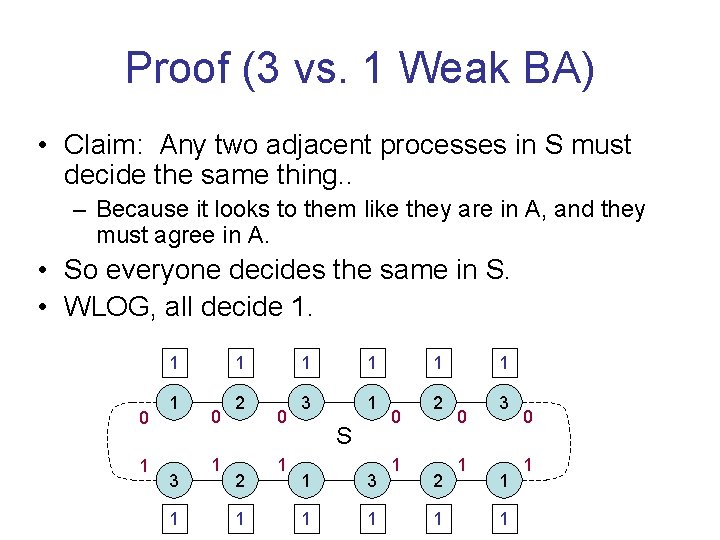
Proof (3 vs. 1 Weak BA) • Claim: Any two adjacent processes in S must decide the same thing. . – Because it looks to them like they are in A, and they must agree in A. • So everyone decides the same in S. • WLOG, all decide 1. 1 0 1 1 3 1 1 0 1 2 2 1 0 1 1 1 3 1 S 1 3 1 1 1 0 1 2 2 1 1 0 1 3 1 1 0 1
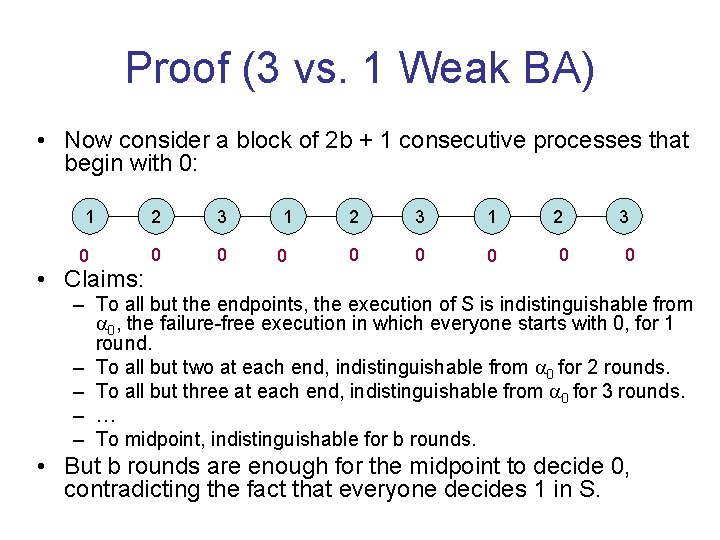
Proof (3 vs. 1 Weak BA) • Now consider a block of 2 b + 1 consecutive processes that begin with 0: 1 0 • Claims: 2 3 0 0 1 0 2 3 1 0 0 0 2 0 3 0 – To all but the endpoints, the execution of S is indistinguishable from 0, the failure-free execution in which everyone starts with 0, for 1 round. – To all but two at each end, indistinguishable from 0 for 2 rounds. – To all but three at each end, indistinguishable from 0 for 3 rounds. – … – To midpoint, indistinguishable for b rounds. • But b rounds are enough for the midpoint to decide 0, contradicting the fact that everyone decides 1 in S.
Lower bound on number of rounds • Note f+1 rounds are used in all the agreement algorithms we’ve seen so far---both stopping and Byzantine. • That’s inherent: f+1 rounds are needed in the worst-case, even for simple stopping failures. • Assume an f-round algorithm A tolerating f faults, and get a contradiction. • Restrictions on A (WLOG): – – n-node complete graph. Decisions at end of round f. V = {0, 1} All-to-all communication at every round f.
Special case: f = 1 • Theorem 5: Suppose n 3. There is no n-process 1 -fault stopping agreement algorithm, in which nonfaulty processes always decide at the end of round 1. • Proof: Suppose A exists. – Construct a chain of executions, each with at most one failure, such that: • First has (unique) decision value 0. • Last has decision value 1. • Any two consecutive executions in the chain are indistinguishable to some process i that is nonfaulty in both. So i must decide the same in both executions, and the two must have the same decision values. – So, decision values in first and last executions are the same, contradiction.
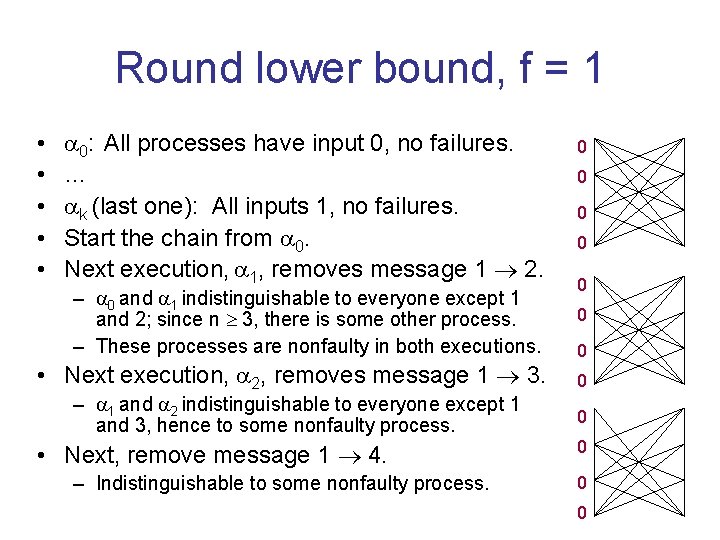
Round lower bound, f = 1 • • • 0: All processes have input 0, no failures. … k (last one): All inputs 1, no failures. Start the chain from 0. Next execution, 1, removes message 1 2. – 0 and 1 indistinguishable to everyone except 1 and 2; since n 3, there is some other process. – These processes are nonfaulty in both executions. • Next execution, 2, removes message 1 3. – 1 and 2 indistinguishable to everyone except 1 and 3, hence to some nonfaulty process. • Next, remove message 1 4. – Indistinguishable to some nonfaulty process. 0 0 0
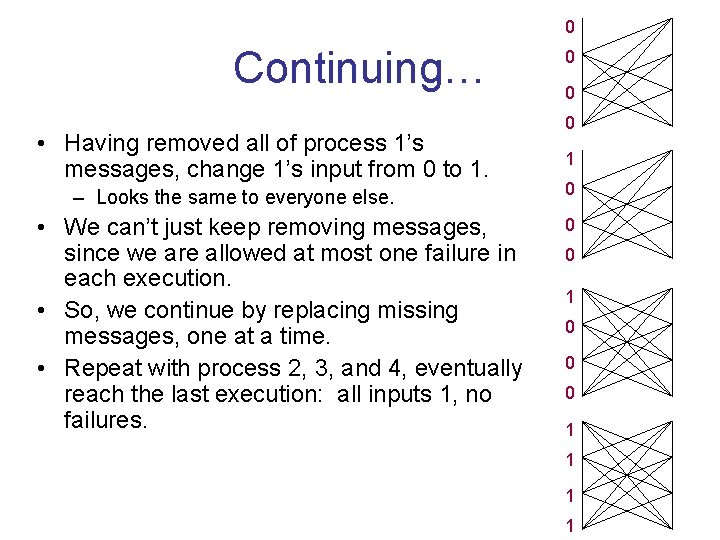
0 Continuing… • Having removed all of process 1’s messages, change 1’s input from 0 to 1. – Looks the same to everyone else. • We can’t just keep removing messages, since we are allowed at most one failure in each execution. • So, we continue by replacing missing messages, one at a time. • Repeat with process 2, 3, and 4, eventually reach the last execution: all inputs 1, no failures. 0 0 0 1 1
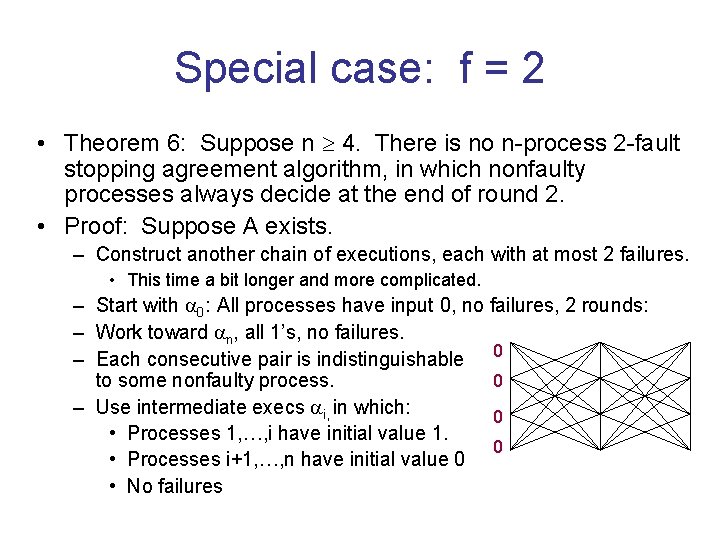
Special case: f = 2 • Theorem 6: Suppose n 4. There is no n-process 2 -fault stopping agreement algorithm, in which nonfaulty processes always decide at the end of round 2. • Proof: Suppose A exists. – Construct another chain of executions, each with at most 2 failures. • This time a bit longer and more complicated. – Start with 0: All processes have input 0, no failures, 2 rounds: – Work toward n, all 1’s, no failures. – Each consecutive pair is indistinguishable 0 to some nonfaulty process. 0 – Use intermediate execs i, in which: 0 • Processes 1, …, i have initial value 1. 0 • Processes i+1, …, n have initial value 0 • No failures
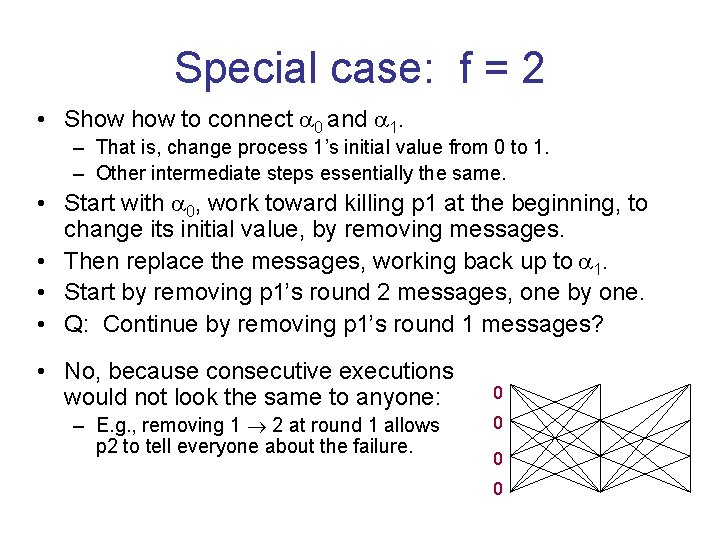
Special case: f = 2 • Show to connect 0 and 1. – That is, change process 1’s initial value from 0 to 1. – Other intermediate steps essentially the same. • Start with 0, work toward killing p 1 at the beginning, to change its initial value, by removing messages. • Then replace the messages, working back up to 1. • Start by removing p 1’s round 2 messages, one by one. • Q: Continue by removing p 1’s round 1 messages? • No, because consecutive executions would not look the same to anyone: – E. g. , removing 1 2 at round 1 allows p 2 to tell everyone about the failure. 0 0
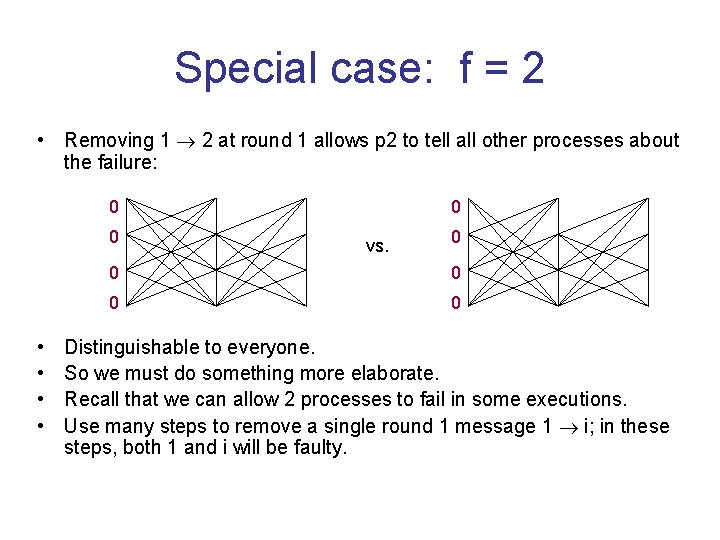
Special case: f = 2 • Removing 1 2 at round 1 allows p 2 to tell all other processes about the failure: 0 0 • • 0 vs. 0 0 0 Distinguishable to everyone. So we must do something more elaborate. Recall that we can allow 2 processes to fail in some executions. Use many steps to remove a single round 1 message 1 i; in these steps, both 1 and i will be faulty.
Removing p 1’s round 1 messages • Start with execution where p 1 sends to everyone at round 1, and only p 1 is faulty. • Remove round 1 message 1 2: – p 2 starts out nonfaulty, so sends all its round 2 messages. – Now make p 2 faulty. – Remove p 2’s round 2 messages, one by one, until we reach an execution where 1 2 at round 1, but p 2 sends no round 2 messages. – Now remove the round 1 message 1 2. • Executions look the same to all but 1 and 2 (and they’re nonfaulty). – Replace all the round 2 messages from p 2, one by one, until p 2 is no longer faulty. • Repeat to remove p 1’s round 1 messages to p 3, p 4, … • After removing all of p 1’s round 1 messages, change p 1’s initial value from 0 to 1, as needed.
General case: Any f • Theorem 7: Suppose n f + 2. There is no n-process ffault stopping agreement algorithm, in which nonfaulty processes always decide at the end of round f. • Proof: Suppose A exists. – Same ideas, longer chain. – Must fail f processes in some executions in the chain, in order to remove all the required messages, at all rounds. – Construction in book, LTTR. • Newer proof [Aguilera, Toueg]: – Uses ideas from [FLP] impossibility of consensus. – They assume strong validity, but works for our weaker validity condition also.
![Lower bound on rounds, [Aguilera, Toueg] • Proof: – By contradiction. Assume A solves](http://slidetodoc.com/presentation_image_h2/614eadcfad55b8c6476fc1d6da78aaad/image-43.jpg "Lower bound on rounds, [Aguilera, Toueg] • Proof: – By contradiction. Assume A solves")
Lower bound on rounds, [Aguilera, Toueg] • Proof: – By contradiction. Assume A solves stopping agreement for f failures and everyone decides after exactly f rounds. – Restrict attention to executions in which at most one process fails during each round. – Recall failure at a round allows process to miss sending an arbitrary subset of the messages, or to send all but halt before changing state. – Consider vector of initial values as a 0 -round execution. – Defs (adapted from [Fischer, Lynch, Paterson]): , an execution that completes some finite number (possibly 0) of rounds, is: • 0 -valent, if 0 is the only decision that can occur in any execution (of the kind we consider) that extends . • 1 -valent, if 1 is… • Univalent, if is either 0 -valent or 1 -valent (essentially decided). • Bivalent, if both decisions occur in some extensions (undecided).
Initial bivalence • Lemma 1: There is some 0 -round execution (vector of initial values) that is bivalent. • Proof (adapted from [FLP]): – Assume for contradiction that all 0 -round executions are univalent. – 000… 0 is 0 -valent – 111… 1 is 1 -valent – So there must be two 0 -round executions that differ in the value of just one process, say i, such that one is 0 valent and the other is 1 -valent. – But this is impossible, because if process i fails at the start, no one else can distinguish the two 0 -round executions.
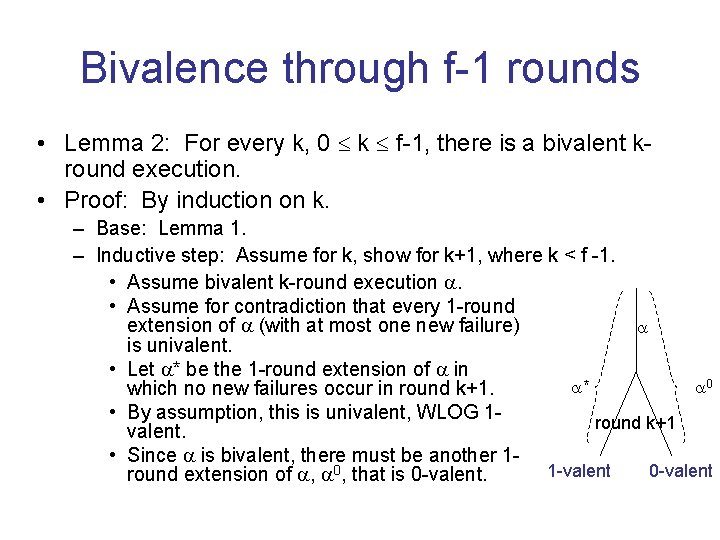
Bivalence through f-1 rounds • Lemma 2: For every k, 0 k f-1, there is a bivalent kround execution. • Proof: By induction on k. – Base: Lemma 1. – Inductive step: Assume for k, show for k+1, where k < f -1. • Assume bivalent k-round execution . • Assume for contradiction that every 1 -round extension of (with at most one new failure) is univalent. • Let * be the 1 -round extension of in * 0 which no new failures occur in round k+1. • By assumption, this is univalent, WLOG 1 round k+1 valent. • Since is bivalent, there must be another 11 -valent 0 -valent round extension of , 0, that is 0 -valent.
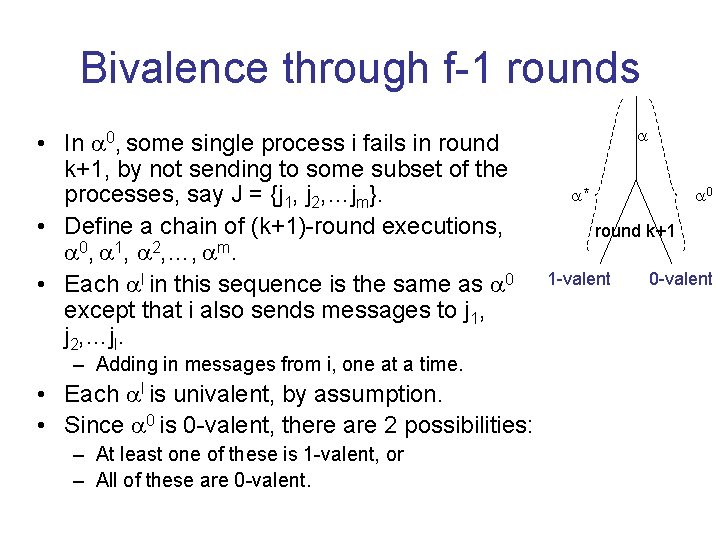
Bivalence through f-1 rounds • In 0, some single process i fails in round k+1, by not sending to some subset of the processes, say J = {j 1, j 2, …jm}. • Define a chain of (k+1)-round executions, 0, 1, 2, …, m. • Each l in this sequence is the same as 0 except that i also sends messages to j 1, j 2, …jl. – Adding in messages from i, one at a time. • Each l is univalent, by assumption. • Since 0 is 0 -valent, there are 2 possibilities: – At least one of these is 1 -valent, or – All of these are 0 -valent. * 0 round k+1 1 -valent 0 -valent
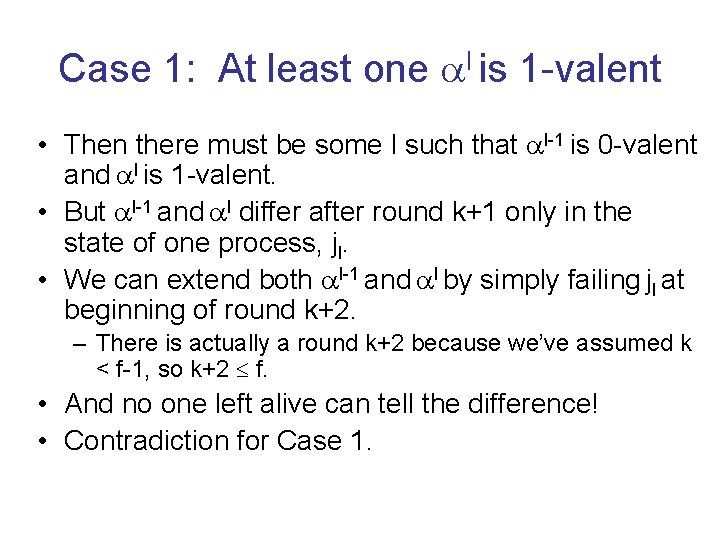
Case 1: At least one l is 1 -valent • Then there must be some l such that l-1 is 0 -valent and l is 1 -valent. • But l-1 and l differ after round k+1 only in the state of one process, jl. • We can extend both l-1 and l by simply failing jl at beginning of round k+2. – There is actually a round k+2 because we’ve assumed k < f-1, so k+2 f. • And no one left alive can tell the difference! • Contradiction for Case 1.
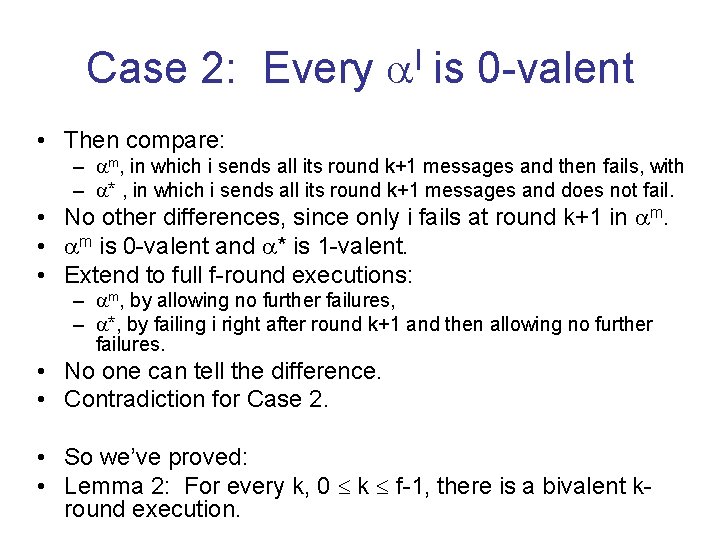
Case 2: Every l is 0 -valent • Then compare: – m, in which i sends all its round k+1 messages and then fails, with – * , in which i sends all its round k+1 messages and does not fail. • No other differences, since only i fails at round k+1 in m. • m is 0 -valent and * is 1 -valent. • Extend to full f-round executions: – m, by allowing no further failures, – *, by failing i right after round k+1 and then allowing no further failures. • No one can tell the difference. • Contradiction for Case 2. • So we’ve proved: • Lemma 2: For every k, 0 k f-1, there is a bivalent kround execution.
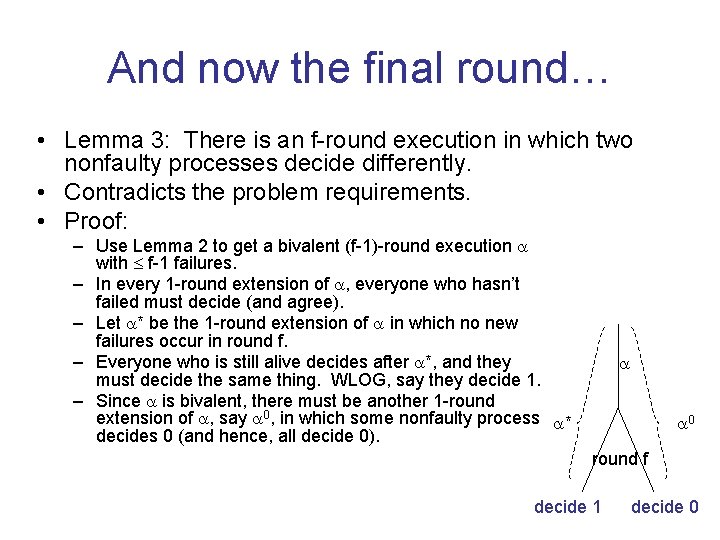
And now the final round… • Lemma 3: There is an f-round execution in which two nonfaulty processes decide differently. • Contradicts the problem requirements. • Proof: – Use Lemma 2 to get a bivalent (f-1)-round execution with f-1 failures. – In every 1 -round extension of , everyone who hasn’t failed must decide (and agree). – Let * be the 1 -round extension of in which no new failures occur in round f. – Everyone who is still alive decides after *, and they must decide the same thing. WLOG, say they decide 1. – Since is bivalent, there must be another 1 -round extension of , say 0, in which some nonfaulty process * decides 0 (and hence, all decide 0). 0 round f decide 1 decide 0
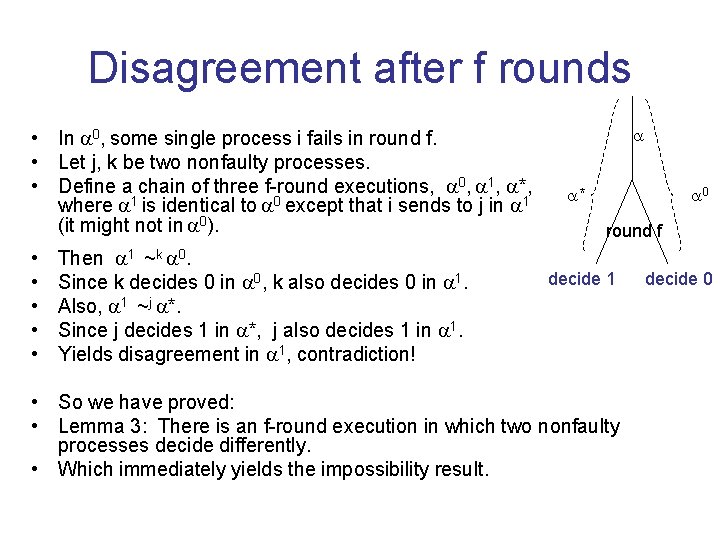
Disagreement after f rounds • In 0, some single process i fails in round f. • Let j, k be two nonfaulty processes. • Define a chain of three f-round executions, 0, 1, *, where 1 is identical to 0 except that i sends to j in 1 (it might not in 0). • • • Then 1 ~k 0. Since k decides 0 in 0, k also decides 0 in 1. Also, 1 ~j *. Since j decides 1 in *, j also decides 1 in 1. Yields disagreement in 1, contradiction! * 0 round f decide 1 • So we have proved: • Lemma 3: There is an f-round execution in which two nonfaulty processes decide differently. • Which immediately yields the impossibility result. decide 0
Early-stopping agreement algorithms • Tolerate f failures in general, but in executions with f < f failures, terminate faster. • [Dolev, Reischuk, Strong 90] Stopping agreement algorithm in which all nonfaulty processes terminate in min(f + 2, f+1) rounds. – If f + 2 f, decide “early”, within f + 2 rounds; in any case decide within f+1 rounds. • [Keidar, Rajsbaum 02] Lower bound of f + 2 for earlystopping agreement. – Not just f + 1. Early stopping requires an extra round. • Theorem 8: Assume 0 f f – 2 and f < n. Every earlystopping agreement algorithm tolerating f failures has an execution with f failures in which some nonfaulty process doesn’t decide by the end of round f + 1.
Special case: f = 0 • Theorem 9: Assume 2 f < n. Every early-stopping agreement algorithm tolerating f failures has a failure-free execution in which some nonfaulty process does not decide by the end of round 1. • Definition: Let be an execution that completes some finite number (possibly 0) of rounds. Then val( ) is the unique decision value in the extension of with no new failures. – Different from bivalence defs---now consider value in just one extension. • Proof: – Again, assume executions in which at most one process fails per round. – Identify 0 -round executions with vectors of initial values. – Assume, for contradiction, that everyone decides by round 1, in all failurefree executions. – val(000… 0) = 0, val(111… 1) = 1. – So there must be two 0 -round executions 0 and 1, that differ in the value of just one process i, such that val( 0) = 0 and val( 1) = 1.
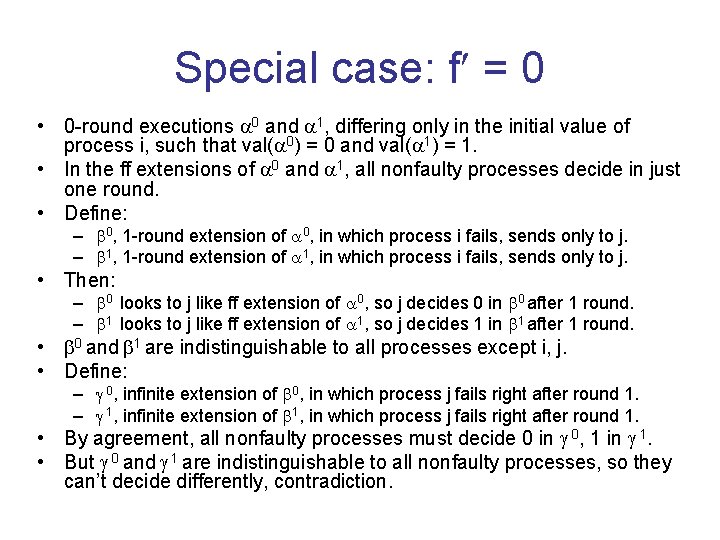
Special case: f = 0 • 0 -round executions 0 and 1, differing only in the initial value of process i, such that val( 0) = 0 and val( 1) = 1. • In the ff extensions of 0 and 1, all nonfaulty processes decide in just one round. • Define: – 0, 1 -round extension of 0, in which process i fails, sends only to j. – 1, 1 -round extension of 1, in which process i fails, sends only to j. • Then: – 0 looks to j like ff extension of 0, so j decides 0 in 0 after 1 round. – 1 looks to j like ff extension of 1, so j decides 1 in 1 after 1 round. • 0 and 1 are indistinguishable to all processes except i, j. • Define: – 0, infinite extension of 0, in which process j fails right after round 1. – 1, infinite extension of 1, in which process j fails right after round 1. • By agreement, all nonfaulty processes must decide 0 in 0, 1 in 1. • But 0 and 1 are indistinguishable to all nonfaulty processes, so they can’t decide differently, contradiction.
Next time… • Other kinds of consensus problems: – k-agreement – Approximate agreement (skim) – Distributed commit • Reading: Chapter 7
- Slides: 54