
6 830 Lecture 3 Relational Algebra and Normalization
6. 830 Lecture 3 Relational Algebra and Normalization 2. 24. 21
Today • Recap relational algebra • Discuss logical data independence • Schema normalization and normal forms
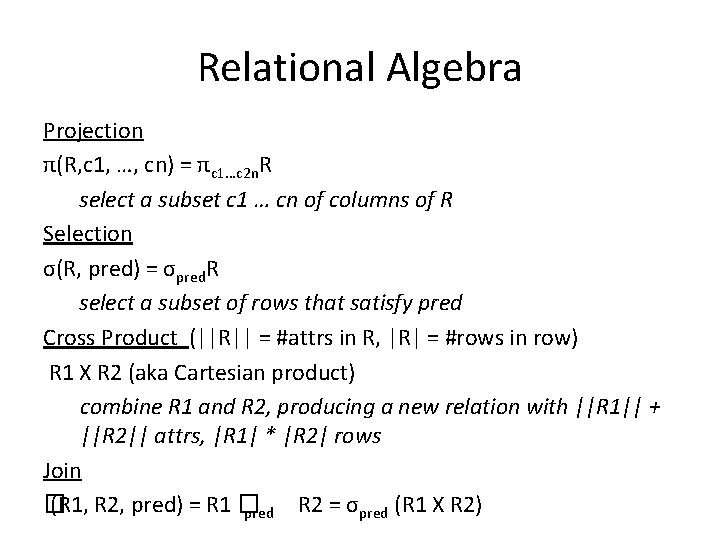
Relational Algebra Projection π(R, c 1, …, cn) = πc 1…c 2 n. R select a subset c 1 … cn of columns of R Selection σ(R, pred) = σpred. R select a subset of rows that satisfy pred Cross Product (||R|| = #attrs in R, |R| = #rows in row) R 1 X R 2 (aka Cartesian product) combine R 1 and R 2, producing a new relation with ||R 1|| + ||R 2|| attrs, |R 1| * |R 2| rows Join � (R 1, R 2, pred) = R 1 � R 2 = σpred (R 1 X R 2) pred
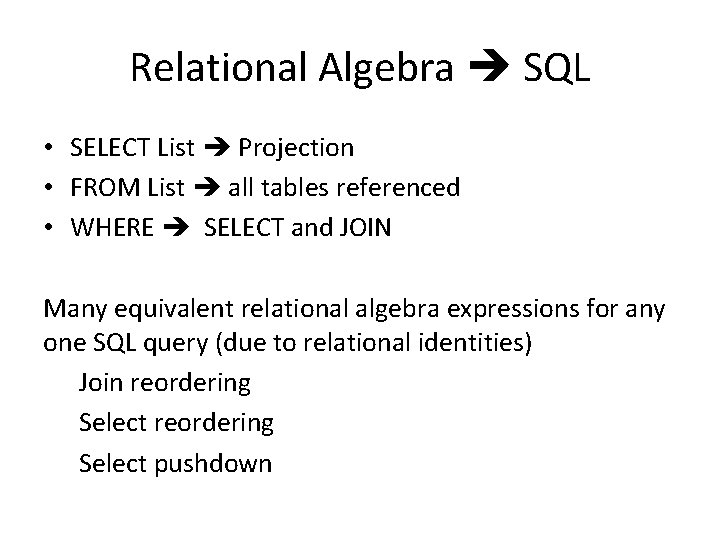
Relational Algebra SQL • SELECT List Projection • FROM List all tables referenced • WHERE SELECT and JOIN Many equivalent relational algebra expressions for any one SQL query (due to relational identities) Join reordering Select pushdown

IMS v CODASYL v Relational IMS CODASYL Relational Many to many relationships without redundancy � ✓ ✓ Declarative, non “navigational” programming � � ✓ Physical data independence � � ✓ ✓ Logical data independence

Logical Data Independence • What if I want to change the schema without changing the code? • Views allow us to map old schema to new schema, so old programs work
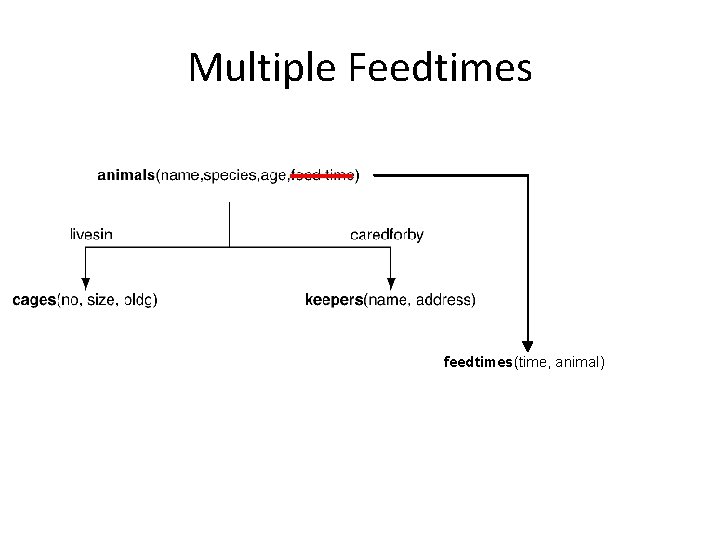
Multiple Feedtimes feedtimes(time, animal)
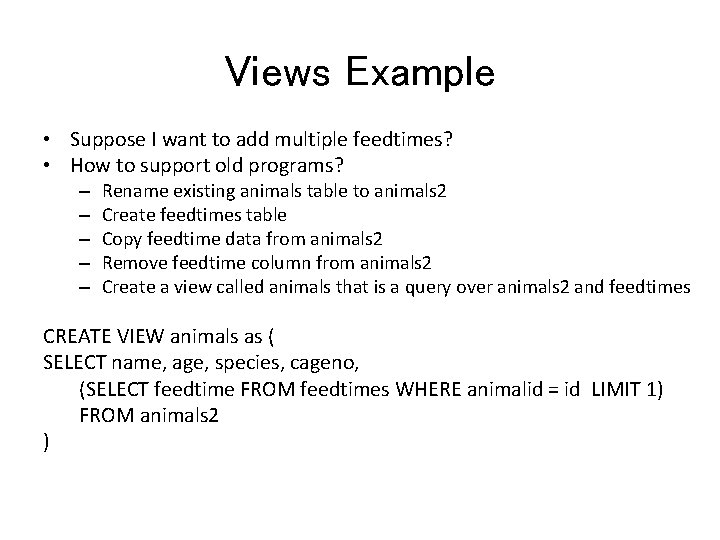
Views Example • Suppose I want to add multiple feedtimes? • How to support old programs? – – – Rename existing animals table to animals 2 Create feedtimes table Copy feedtime data from animals 2 Remove feedtime column from animals 2 Create a view called animals that is a query over animals 2 and feedtimes CREATE VIEW animals as ( SELECT name, age, species, cageno, (SELECT feedtime FROM feedtimes WHERE animalid = id LIMIT 1) FROM animals 2 )
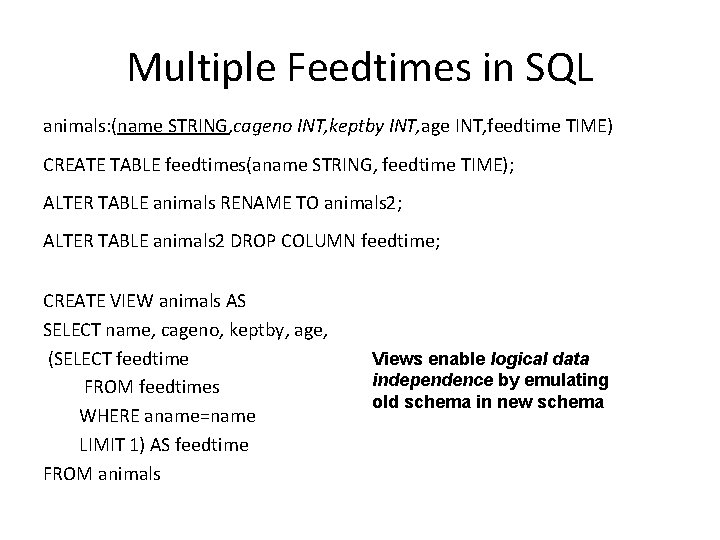
Multiple Feedtimes in SQL animals: (name STRING, cageno INT, keptby INT, age INT, feedtime TIME) CREATE TABLE feedtimes(aname STRING, feedtime TIME); ALTER TABLE animals RENAME TO animals 2; ALTER TABLE animals 2 DROP COLUMN feedtime; CREATE VIEW animals AS SELECT name, cageno, keptby, age, (SELECT feedtime FROM feedtimes WHERE aname=name LIMIT 1) AS feedtime FROM animals Views enable logical data independence by emulating old schema in new schema
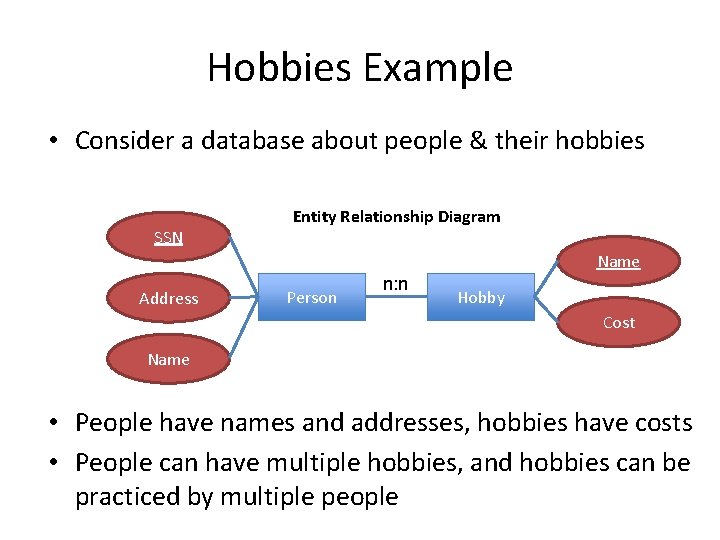
Hobbies Example • Consider a database about people & their hobbies SSN Entity Relationship Diagram Name Address Person n: n Hobby Cost Name • People have names and addresses, hobbies have costs • People can have multiple hobbies, and hobbies can be practiced by multiple people
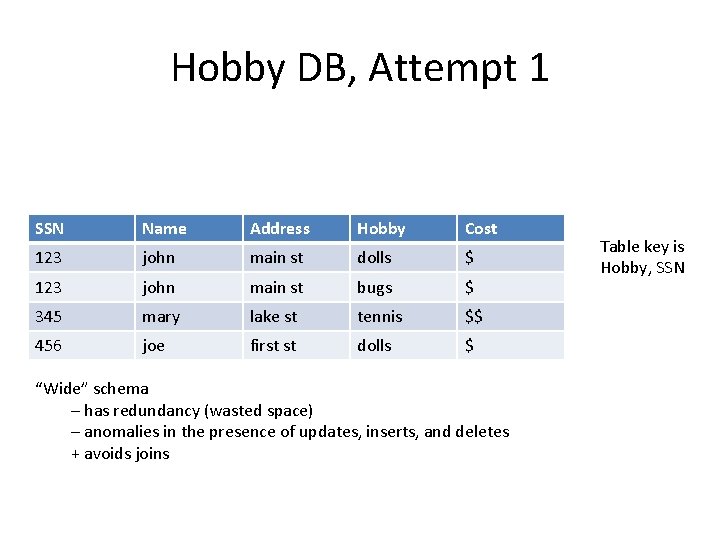
Hobby DB, Attempt 1 SSN Name Address Hobby Cost 123 john main st dolls $ 123 john main st bugs $ 345 mary lake st tennis $$ 456 joe first st dolls $ “Wide” schema – has redundancy (wasted space) – anomalies in the presence of updates, inserts, and deletes + avoids joins Table key is Hobby, SSN
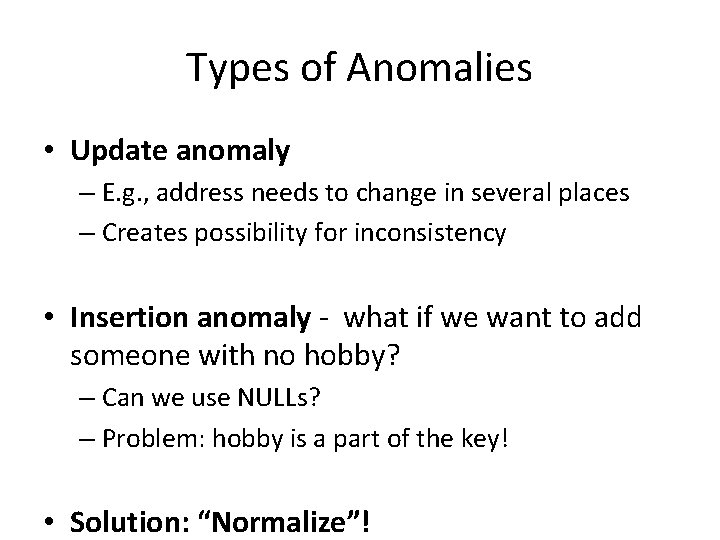
Types of Anomalies • Update anomaly – E. g. , address needs to change in several places – Creates possibility for inconsistency • Insertion anomaly - what if we want to add someone with no hobby? – Can we use NULLs? – Problem: hobby is a part of the key! • Solution: “Normalize”!
Normalization • Normalized: a schema that is redundancy free – As much as possible • Several methods: – ER Diagrams – Use functional dependencies and normal forms
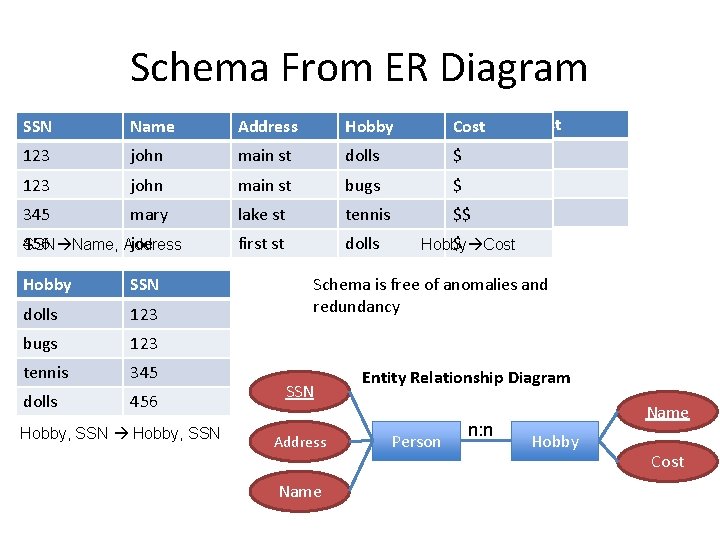
Schema From ER Diagram SSN Name Address Hobby Cost 123 john main st dolls$ $ 345 123 mary john lake stst main bugs$ $ 456 345 joe mary first st lake tennis $$ $$ first st dolls $ Hobby Cost 456 joe SSN Name, Address Hobby SSN dolls 123 bugs 123 tennis 345 dolls 456 Hobby, SSN Schema is free of anomalies and redundancy SSN Address Name Entity Relationship Diagram Person n: n Name Hobby Cost
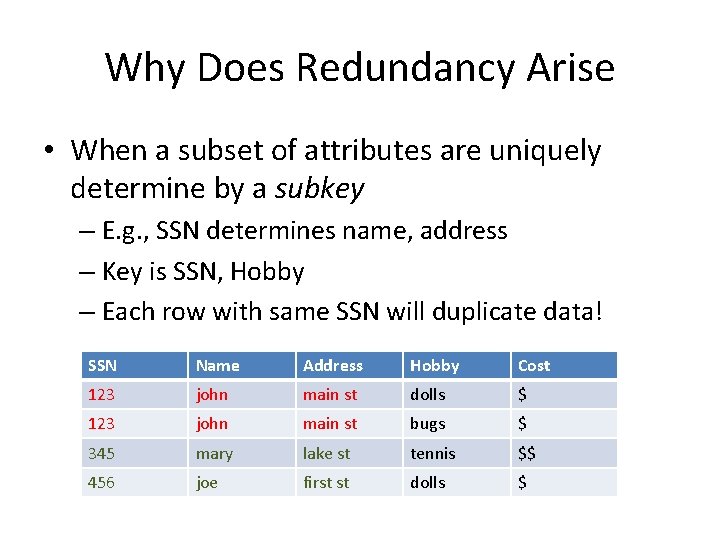
Why Does Redundancy Arise • When a subset of attributes are uniquely determine by a subkey – E. g. , SSN determines name, address – Key is SSN, Hobby – Each row with same SSN will duplicate data! SSN Name Address Hobby Cost 123 john main st dolls $ 123 john main st bugs $ 345 mary lake st tennis $$ 456 joe first st dolls $
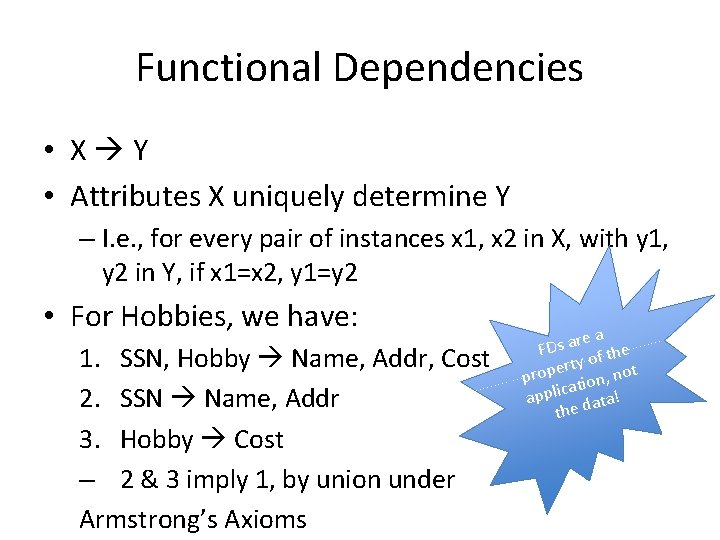
Functional Dependencies • X Y • Attributes X uniquely determine Y – I. e. , for every pair of instances x 1, x 2 in X, with y 1, y 2 in Y, if x 1=x 2, y 1=y 2 • For Hobbies, we have: 1. SSN, Hobby Name, Addr, Cost 2. SSN Name, Addr 3. Hobby Cost – 2 & 3 imply 1, by union under Armstrong’s Axioms re a a s D F f the o y t r prope tion, not ca appli data! the
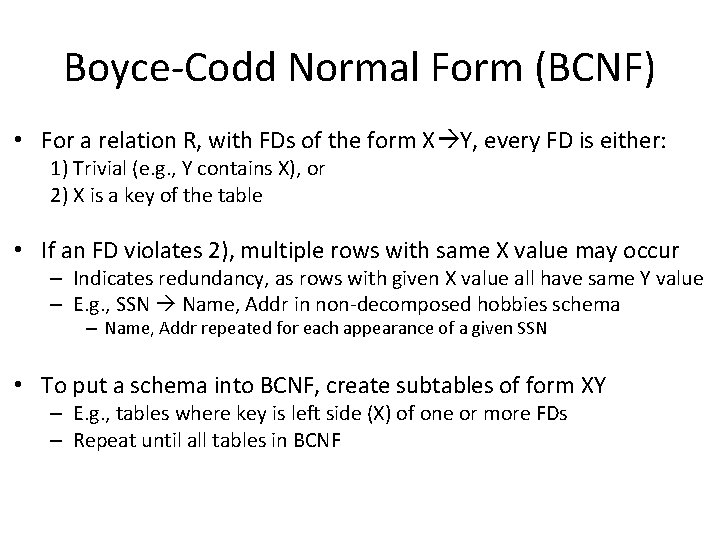
Boyce-Codd Normal Form (BCNF) • For a relation R, with FDs of the form X Y, every FD is either: 1) Trivial (e. g. , Y contains X), or 2) X is a key of the table • If an FD violates 2), multiple rows with same X value may occur – Indicates redundancy, as rows with given X value all have same Y value – E. g. , SSN Name, Addr in non-decomposed hobbies schema – Name, Addr repeated for each appearance of a given SSN • To put a schema into BCNF, create subtables of form XY – E. g. , tables where key is left side (X) of one or more FDs – Repeat until all tables in BCNF
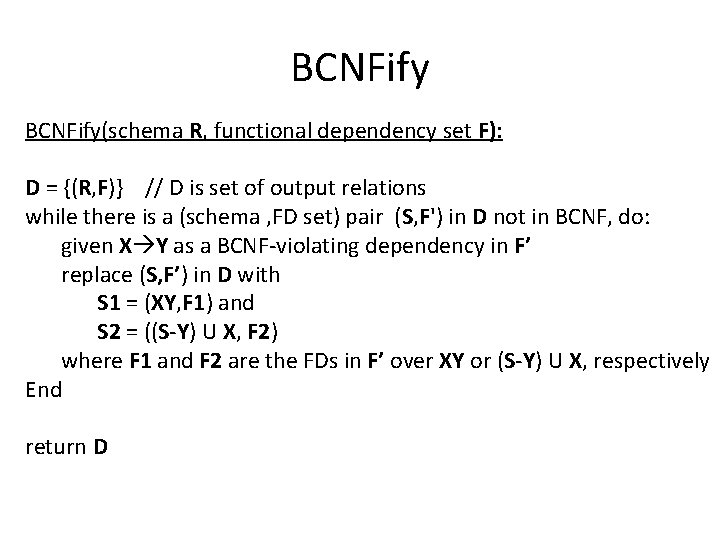
BCNFify(schema R, functional dependency set F): D = {(R, F)} // D is set of output relations while there is a (schema , FD set) pair (S, F') in D not in BCNF, do: given X Y as a BCNF-violating dependency in F’ replace (S, F’) in D with S 1 = (XY, F 1) and S 2 = ((S-Y) U X, F 2) where F 1 and F 2 are the FDs in F’ over XY or (S-Y) U X, respectively End return D
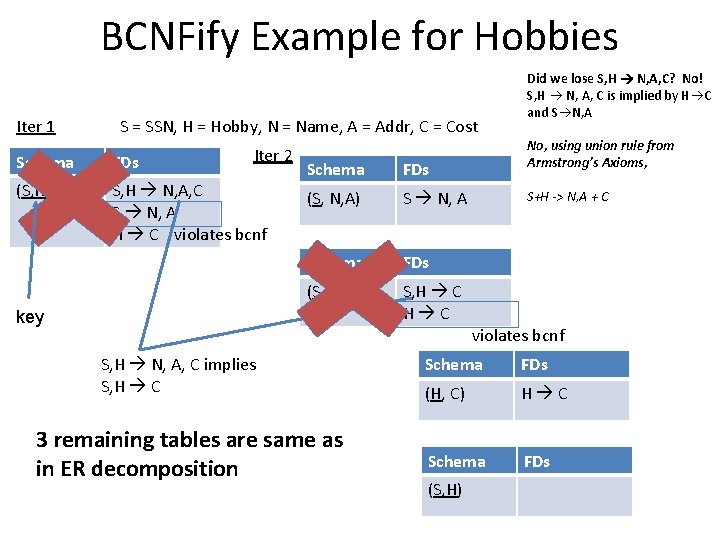
BCNFify Example for Hobbies Iter 1 Schema S = SSN, H = Hobby, N = Name, A = Addr, C = Cost FDs Iter 2 (S, H, N, A, C) S, H N, A, C S N, A H C violates bcnf Schema FDs (S, N, A) S N, A Schema FDs (S, H, C) S, H C H C key Did we lose S, H N, A, C? No! S, H N, A, C is implied by H C and S N, A No, using union rule from Armstrong’s Axioms, S+H -> N, A + C violates bcnf S, H N, A, C implies S, H C 3 remaining tables are same as in ER decomposition Schema FDs (H, C) H C Schema FDs (S, H)
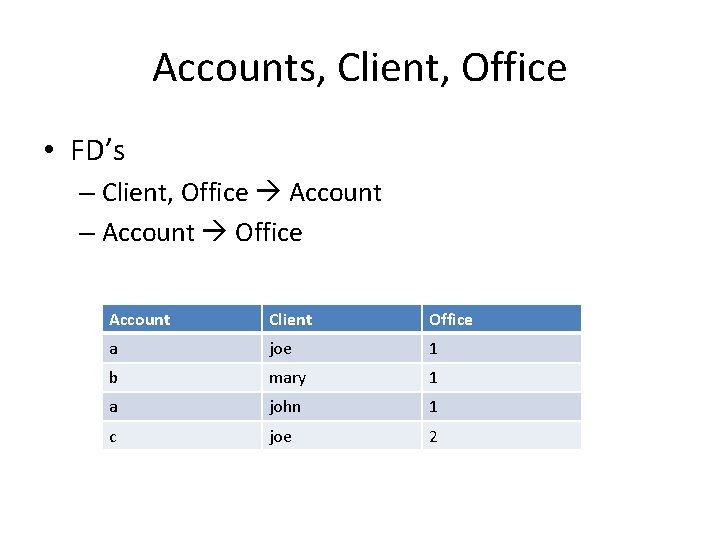
Accounts, Client, Office • FD’s – Client, Office Account – Account Office Account Client Office a joe 1 b mary 1 a john 1 c joe 2
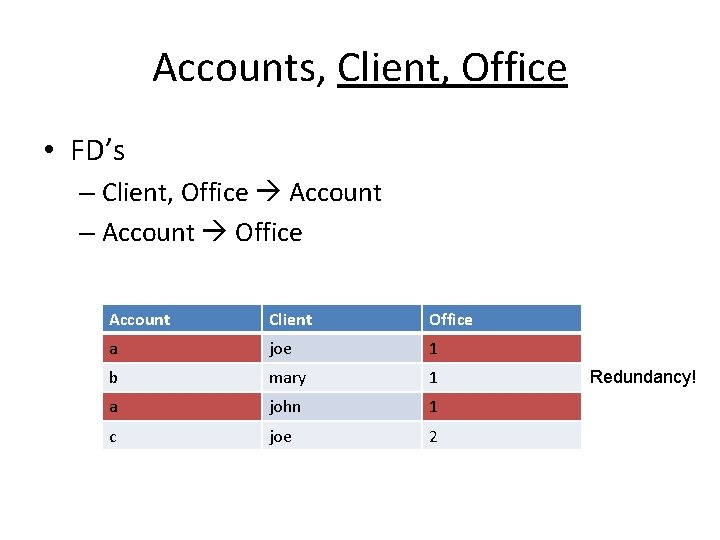
Accounts, Client, Office • FD’s – Client, Office Account – Account Office Account Client Office a joe 1 b mary 1 a john 1 c joe 2 Redundancy!
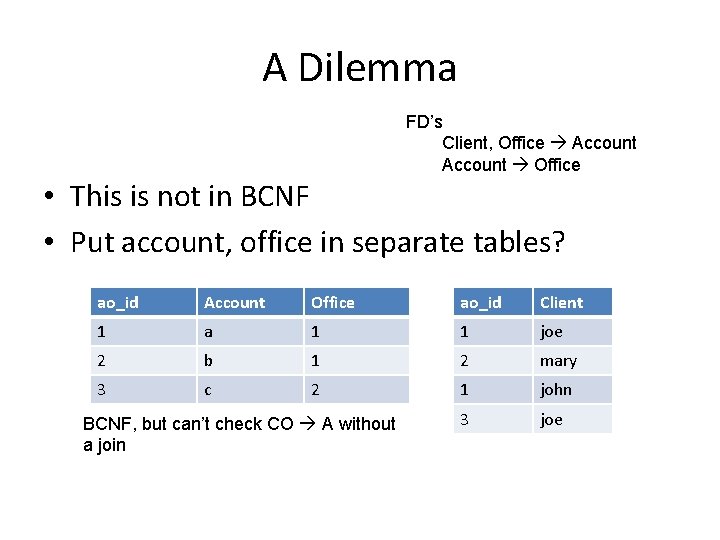
A Dilemma FD’s Client, Office Account Office • This is not in BCNF • Put account, office in separate tables? ao_id Account Office ao_id Client 1 a 1 1 joe 2 b 1 2 mary 3 c 2 1 john 3 joe BCNF, but can’t check CO A without a join
BCNF vs 3 NF • BCNF decomposition is not “dependency preserving” • 3 rd Normal Form (3 NF) eliminates as much redundancy as possible while preserving all dependencies – We will skip the details • Neither form is “better” – You can choose either dependency preservation (3 NF) or redundancy-free (BCNF)
Study Break • • Patient database Want to represent patients at hospitals with doctors Patients have names, birthdates Doctors have names, specialties Hospitals have names, addresses One doctor can treat multiple patients, each patient has one doctor Each patient in one hospital, hospitals have many patients 1) Draw an ER diagram 2) What are the functional dependencies 3) What is the normalized schema? Is it redundancy free?
Recap • Properly normalized schemas avoid redundancy and preserve dependencies • Functional dependencies and normal forms (e. g. , BCNF) give us a formal way to reason about these concepts • In practice, people use ER modeling to derive a schema in BCNF rather than the BCNFify algorithm
- Slides: 25