
6 7 Using the Fundamental Theorem of Algebra

6. 7 Using the Fundamental Theorem of Algebra
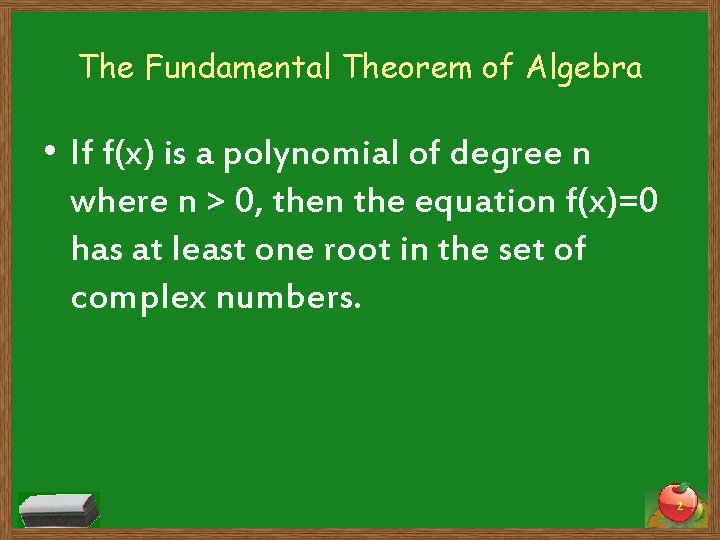
The Fundamental Theorem of Algebra • If f(x) is a polynomial of degree n where n > 0, then the equation f(x)=0 has at least one root in the set of complex numbers. 2

Finding the Number of Solutions or Zeros • State the number of solutions and tell what they are. 1) x 2 – 14 x + 49 = 0 2) x 4 + 3 x 3 – 8 x 2 – 22 x – 24 = 0 3) x 3 – 3 x + 52 = 0 3

Finding all the zeros of the polynomial function • Find all the zeros. 1) f(x) = x 3 + x 2 – x + 15 2) f(x) = x 3 + 5 x 2 – 6 3) f(x) = x 3 – x 2 + 4 x – 4 4
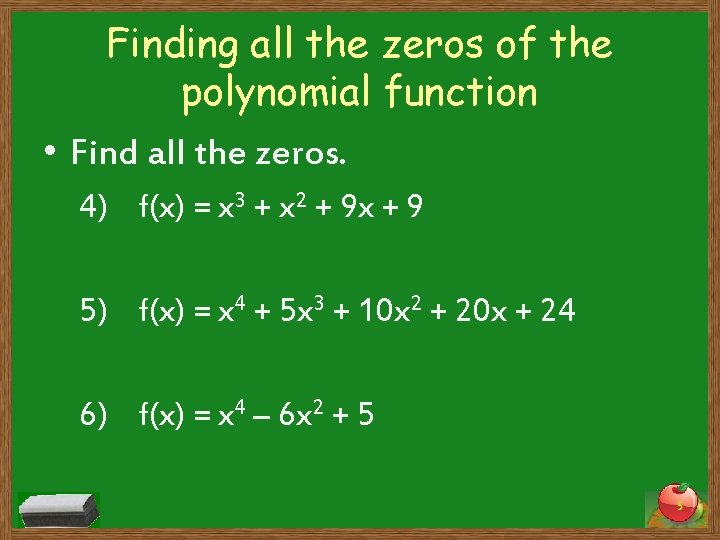
Finding all the zeros of the polynomial function • Find all the zeros. 4) f(x) = x 3 + x 2 + 9 x + 9 5) f(x) = x 4 + 5 x 3 + 10 x 2 + 20 x + 24 6) f(x) = x 4 – 6 x 2 + 5 5
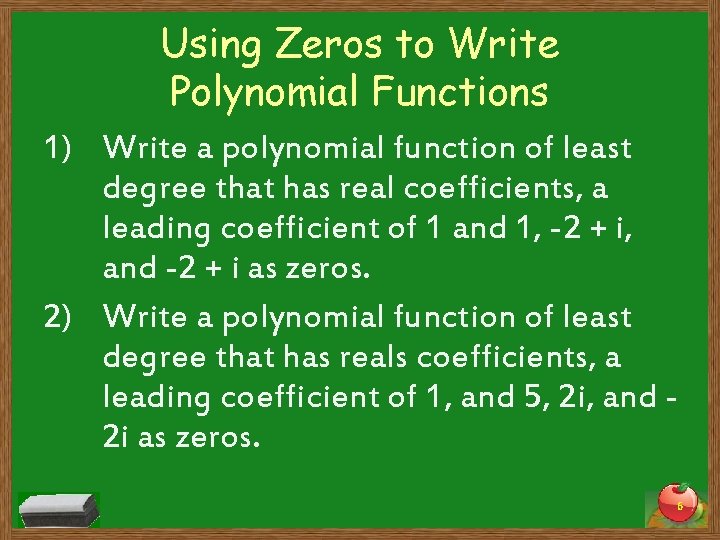
Using Zeros to Write Polynomial Functions 1) Write a polynomial function of least degree that has real coefficients, a leading coefficient of 1 and 1, -2 + i, and -2 + i as zeros. 2) Write a polynomial function of least degree that has reals coefficients, a leading coefficient of 1, and 5, 2 i, and 2 i as zeros. 6
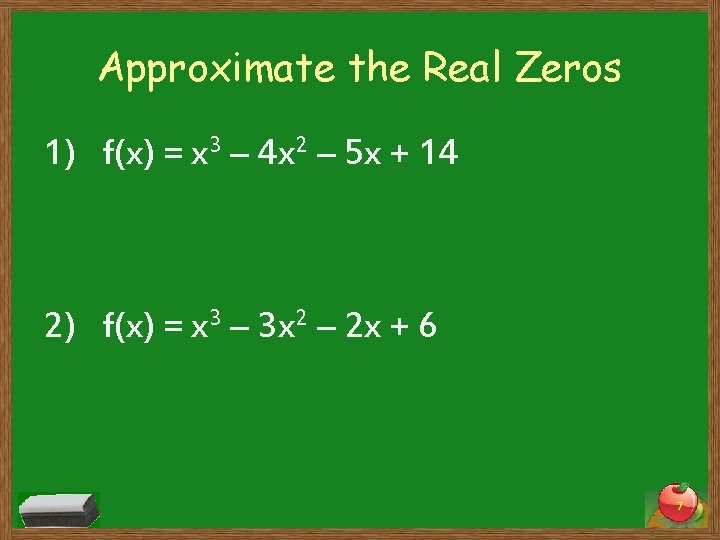
Approximate the Real Zeros 1) f(x) = x 3 – 4 x 2 – 5 x + 14 2) f(x) = x 3 – 3 x 2 – 2 x + 6 7
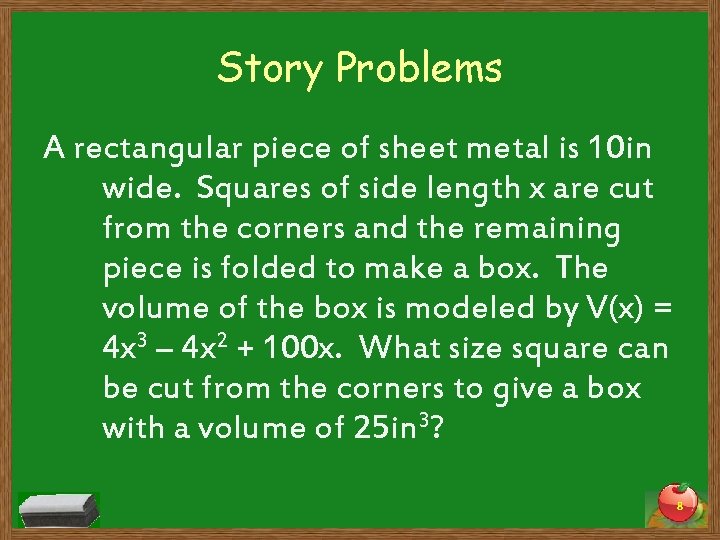
Story Problems A rectangular piece of sheet metal is 10 in wide. Squares of side length x are cut from the corners and the remaining piece is folded to make a box. The volume of the box is modeled by V(x) = 4 x 3 – 4 x 2 + 100 x. What size square can be cut from the corners to give a box with a volume of 25 in 3? 8
- Slides: 8