
6 7 NOTES Naming Ionic Compounds Steps for

- Slides: 8
6. 7 – NOTES Naming Ionic Compounds
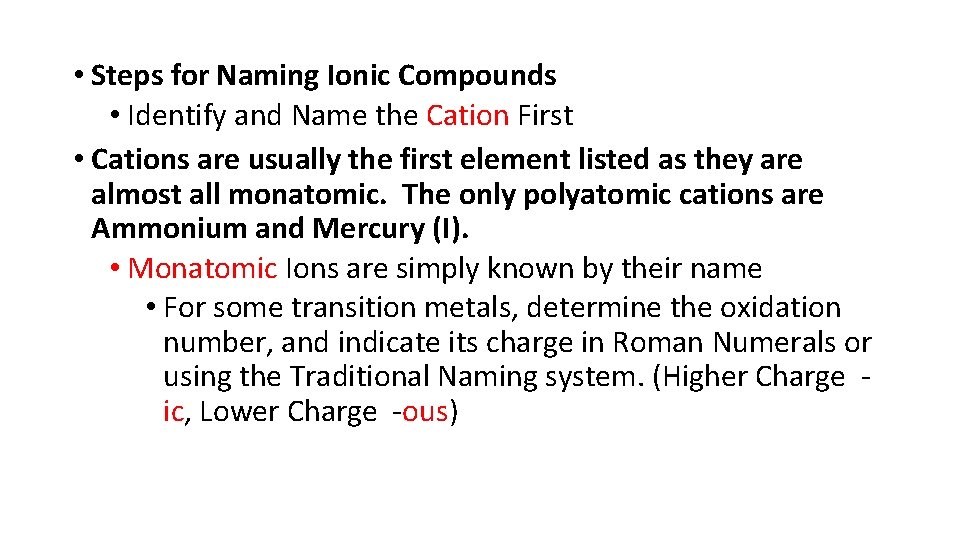
• Steps for Naming Ionic Compounds • Identify and Name the Cation First • Cations are usually the first element listed as they are almost all monatomic. The only polyatomic cations are Ammonium and Mercury (I). • Monatomic Ions are simply known by their name • For some transition metals, determine the oxidation number, and indicate its charge in Roman Numerals or using the Traditional Naming system. (Higher Charge ic, Lower Charge -ous)
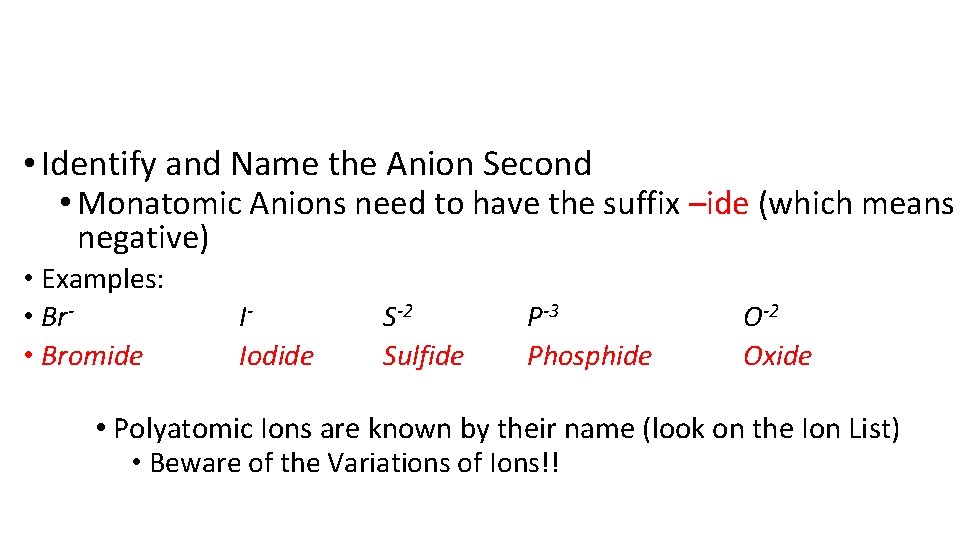
• Identify and Name the Anion Second • Monatomic Anions need to have the suffix –ide (which means negative) • Examples: • Bromide IIodide S-2 Sulfide P-3 Phosphide O-2 Oxide • Polyatomic Ions are known by their name (look on the Ion List) • Beware of the Variations of Ions!!
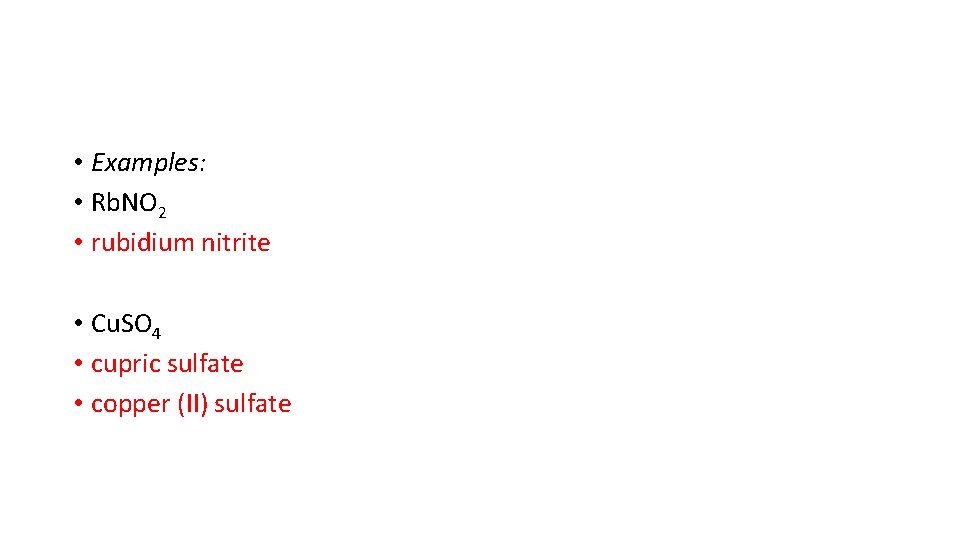
• Examples: • Rb. NO 2 • rubidium nitrite • Cu. SO 4 • cupric sulfate • copper (II) sulfate
• Fe(HSO 4)2 • ferrous bisulfate • iron (II) bisulfate • (NH 4)3 PO 4 • ammonium phosphate
• Al 2(SO 3)3 • aluminum sulfite • Pb(CO 3)2 • lead (IV) carbonate • Plumbic carbonate
• Fe. Cl 3 • ferric chloride • iron (III) chloride • Sn. I 4 • stannic iodide • tin (IV) iodide
• Rb 3 BO 2 • Rubidium Borite • • Ni 3(PO 2)2 Nickel Hypophosphite Ba. O 2 Barium Peroxide • Co(Br. O 3)3 • Cobalt (III) Bromate