
6 7 Line Graphs Warm Up Problem of
6 -7 Line. Graphs Warm Up Problem of the Day Lesson Presentation Course 11
6 -7 Line Graphs Warm Up Describe how to graph each point on a coordinate grid. 1. (4, 5) right 4, up 5 2. (0, 2) up 2 3. (3, 0) right 3 Course 1
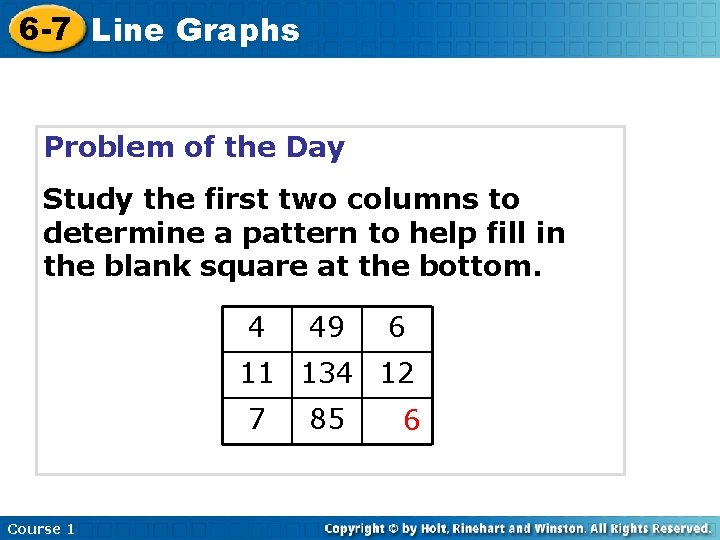
6 -7 Line Graphs Problem of the Day Study the first two columns to determine a pattern to help fill in the blank square at the bottom. 4 49 6 11 134 12 7 Course 1 85 6
6 -7 Line Graphs Learn to display and analyze data in line graphs. Course 1
6 -7 Line Graphs Vocabulary line graph double-line graph Course 1
6 -7 Line Graphs Data that shows change over time is best displayed in a line graph. A line graph displays a set of data using line segments. Course 1
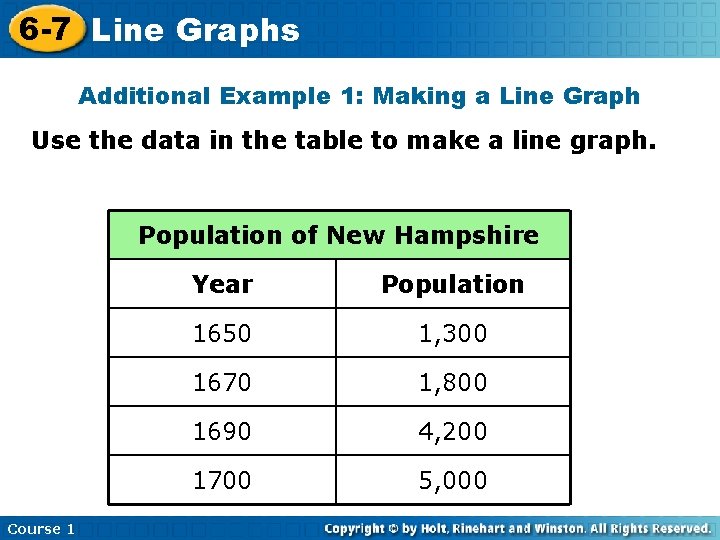
6 -7 Line Graphs Additional Example 1: Making a Line Graph Use the data in the table to make a line graph. Population of New Hampshire Course 1 Year Population 1650 1, 300 1670 1, 800 1690 4, 200 1700 5, 000
6 -7 Line Graphs Caution! Because time passes whether or not the population changes, time is independent of population. Always put the independent quantity on the horizontal axis. Course 1
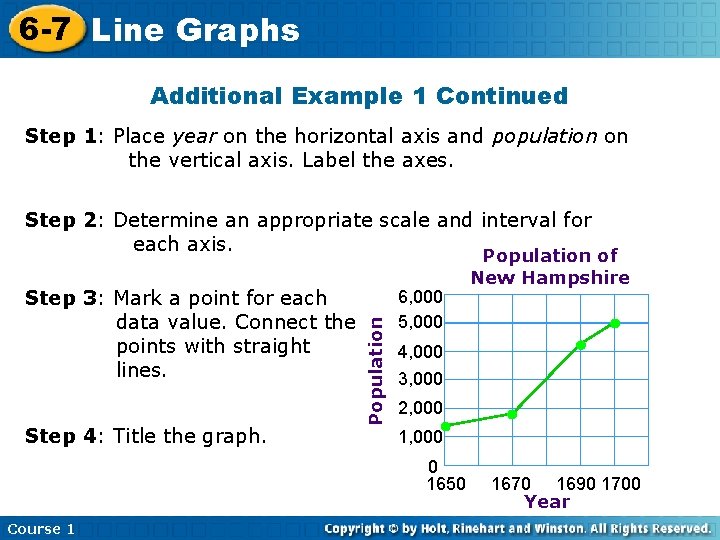
6 -7 Line Graphs Additional Example 1 Continued Step 1: Place year on the horizontal axis and population on the vertical axis. Label the axes. Step 3: Mark a point for each data value. Connect the points with straight lines. Step 4: Title the graph. Population Step 2: Determine an appropriate scale and interval for each axis. 6, 000 5, 000 4, 000 3, 000 2, 000 1, 000 0 1650 Course 1 Population of New Hampshire 1670 1690 1700 Year
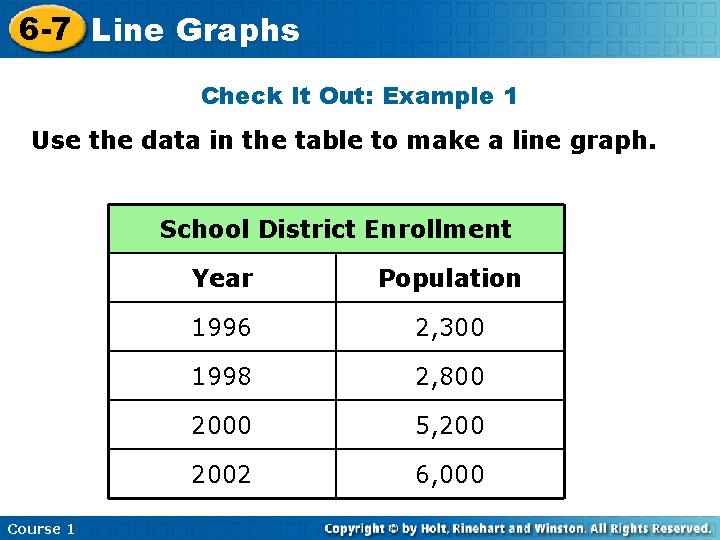
6 -7 Line Graphs Check It Out: Example 1 Use the data in the table to make a line graph. School District Enrollment Course 1 Year Population 1996 2, 300 1998 2, 800 2000 5, 2002 6, 000
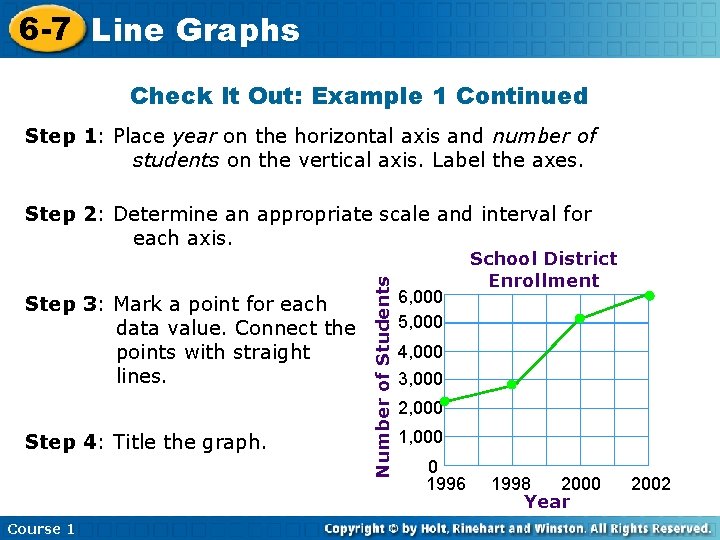
6 -7 Line Graphs Check It Out: Example 1 Continued Step 1: Place year on the horizontal axis and number of students on the vertical axis. Label the axes. Step 3: Mark a point for each data value. Connect the points with straight lines. Step 4: Title the graph. Course 1 Number of Students Step 2: Determine an appropriate scale and interval for each axis. 6, 000 5, 000 School District Enrollment 4, 000 3, 000 2, 000 1, 000 0 1996 1998 2000 Year 2002
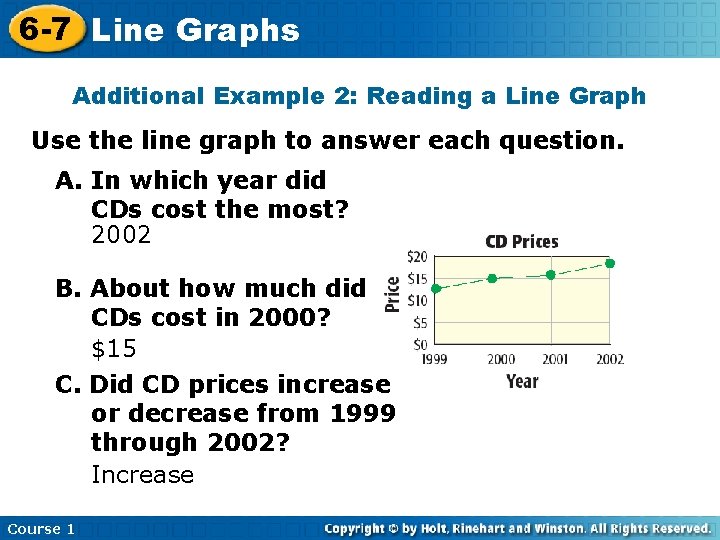
6 -7 Line Graphs Additional Example 2: Reading a Line Graph Use the line graph to answer each question. A. In which year did CDs cost the most? 2002 B. About how much did CDs cost in 2000? $15 C. Did CD prices increase or decrease from 1999 through 2002? Increase Course 1
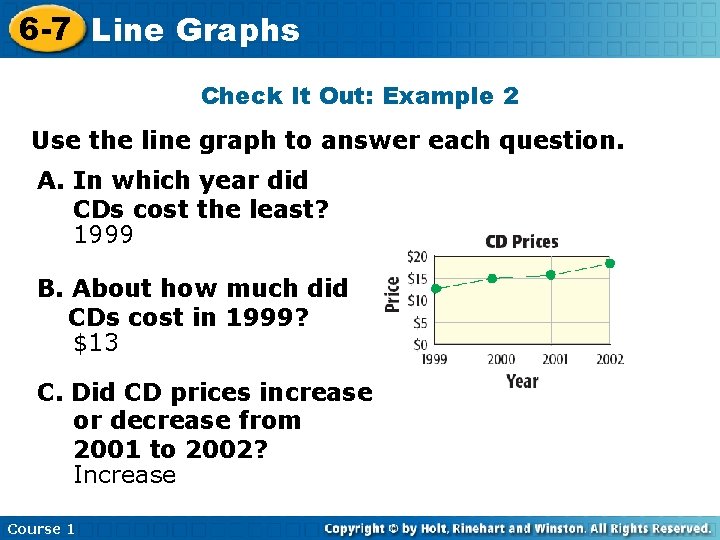
6 -7 Line Graphs Check It Out: Example 2 Use the line graph to answer each question. A. In which year did CDs cost the least? 1999 B. About how much did CDs cost in 1999? $13 C. Did CD prices increase or decrease from 2001 to 2002? Increase Course 1
6 -7 Line Graphs Line graphs that display two sets of data are called double-line graphs. Course 1
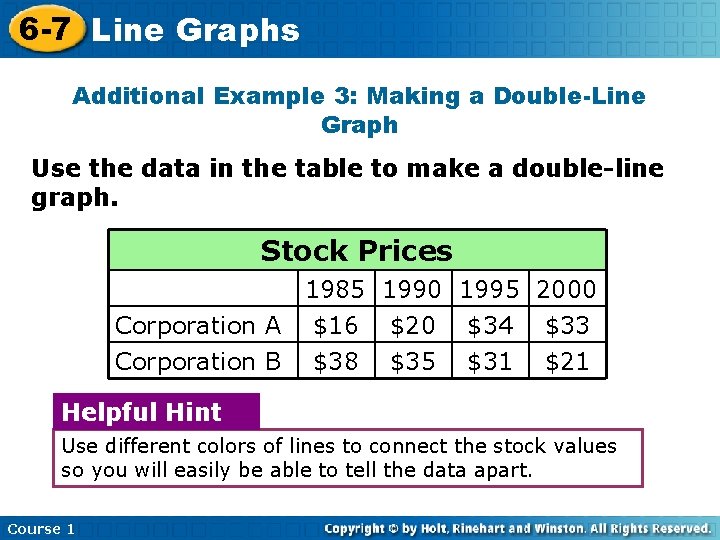
6 -7 Line Graphs Additional Example 3: Making a Double-Line Graph Use the data in the table to make a double-line graph. Stock Prices 1985 1990 1995 2000 Corporation A $16 $20 $34 $33 Corporation B $38 $35 $31 $21 Helpful Hint Use different colors of lines to connect the stock values so you will easily be able to tell the data apart. Course 1
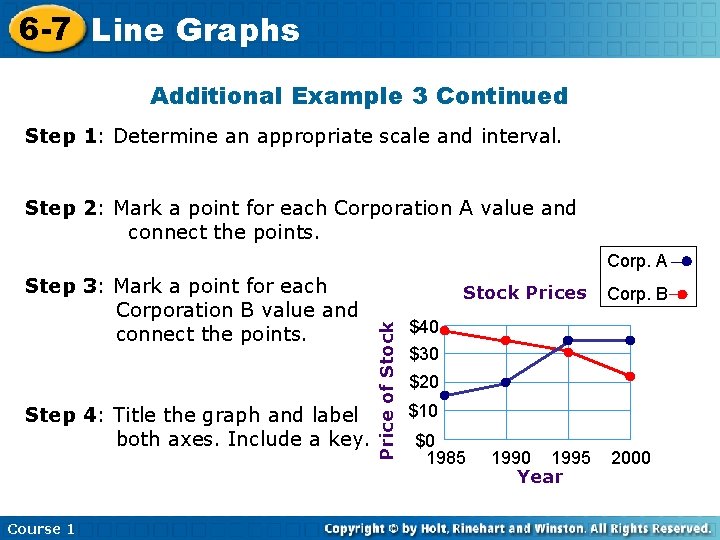
6 -7 Line Graphs Additional Example 3 Continued Step 1: Determine an appropriate scale and interval. Step 2: Mark a point for each Corporation A value and connect the points. Corp. A Step 4: Title the graph and label both axes. Include a key. Course 1 Stock Prices Price of Stock Step 3: Mark a point for each Corporation B value and connect the points. Corp. B $40 $30 $20 $10 $0 1985 1990 1995 Year 2000
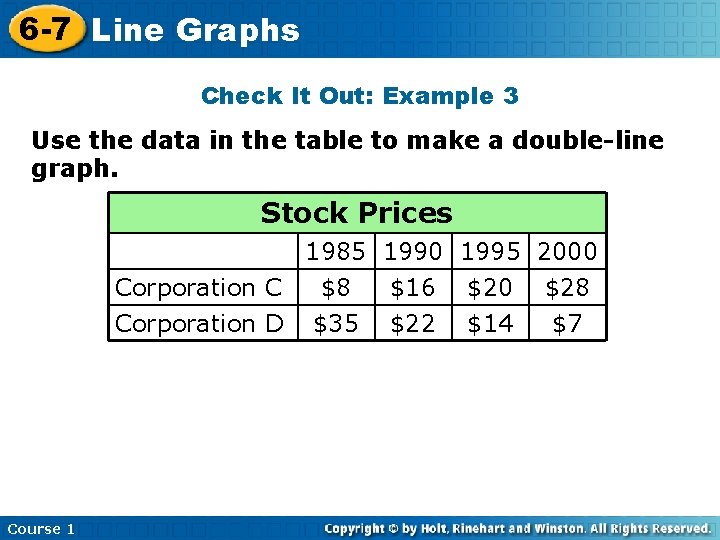
6 -7 Line Graphs Check It Out: Example 3 Use the data in the table to make a double-line graph. Stock Prices 1985 1990 1995 2000 Corporation C $8 $16 $20 $28 Corporation D $35 $22 $14 $7 Course 1
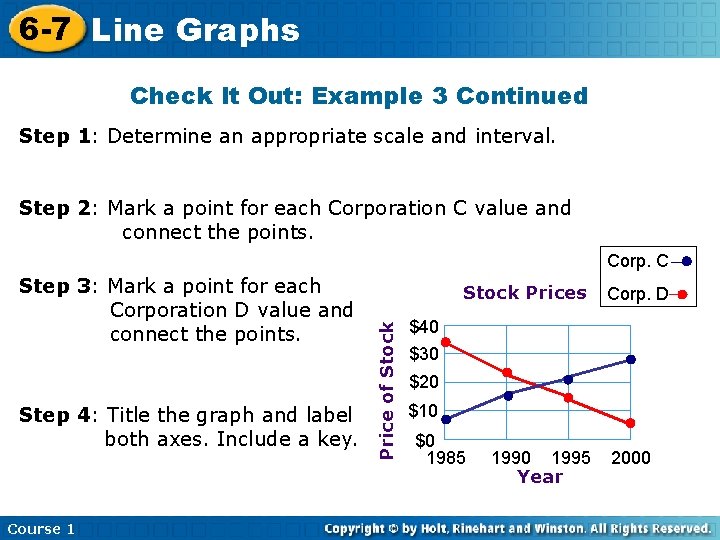
6 -7 Line Graphs Check It Out: Example 3 Continued Step 1: Determine an appropriate scale and interval. Step 2: Mark a point for each Corporation C value and connect the points. Corp. C Step 4: Title the graph and label both axes. Include a key. Course 1 Stock Prices Price of Stock Step 3: Mark a point for each Corporation D value and connect the points. Corp. D $40 $30 $20 $10 $0 1985 1990 1995 Year 2000
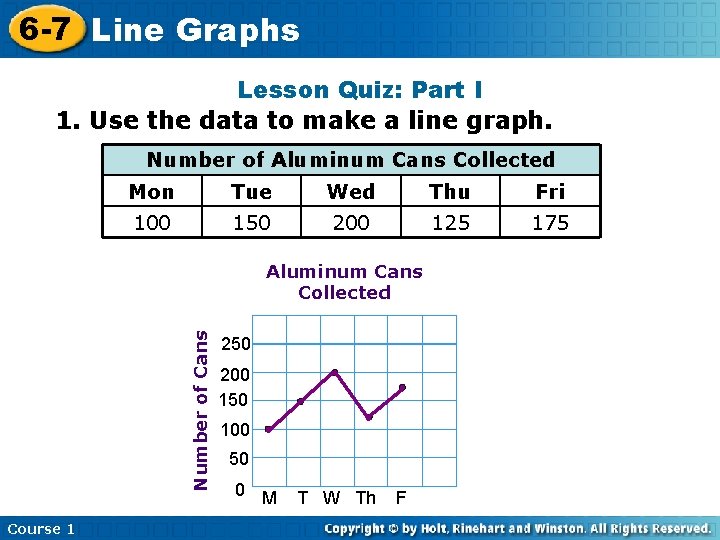
6 -7 Line Graphs Lesson Quiz: Part I 1. Use the data to make a line graph. Number of Aluminum Cans Collected Mon Tue Wed Thu Fri 100 150 200 125 175 Number of Cans Aluminum Cans Collected Course 1 250 200 150 100 50 0 M T W Th F
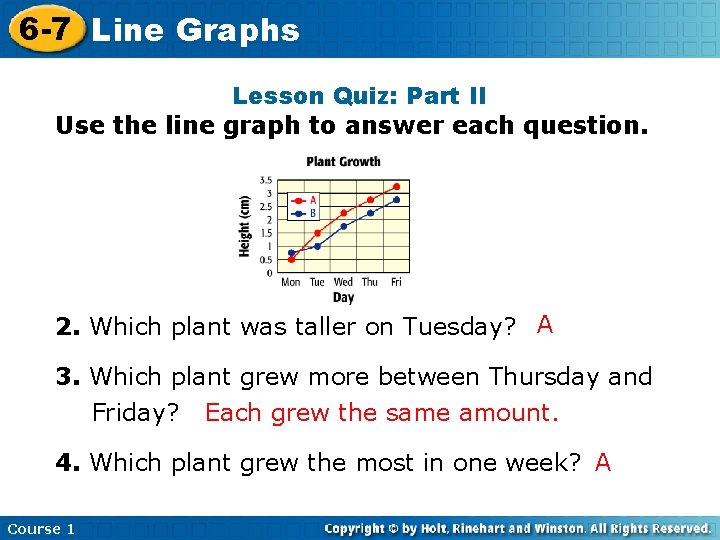
6 -7 Line Graphs Lesson Quiz: Part II Use the line graph to answer each question. 2. Which plant was taller on Tuesday? A 3. Which plant grew more between Thursday and Friday? Each grew the same amount. 4. Which plant grew the most in one week? A Course 1
- Slides: 20