
6 6 Solving Systems of Linear Inequalities Objective
6 -6 Solving Systems of Linear Inequalities Objective Graph and solve systems of linear inequalities in two variables. Vocabulary system of linear inequalities solution of a system of linear inequalities Holt Algebra 1
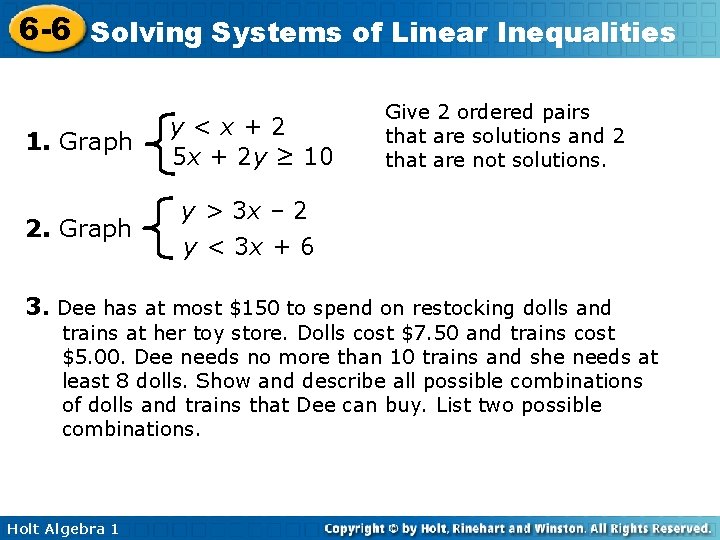
6 -6 Solving Systems of Linear Inequalities 1. Graph y<x+2 5 x + 2 y ≥ 10 2. Graph y > 3 x – 2 y < 3 x + 6 Give 2 ordered pairs that are solutions and 2 that are not solutions. 3. Dee has at most $150 to spend on restocking dolls and trains at her toy store. Dolls cost $7. 50 and trains cost $5. 00. Dee needs no more than 10 trains and she needs at least 8 dolls. Show and describe all possible combinations of dolls and trains that Dee can buy. List two possible combinations. Holt Algebra 1
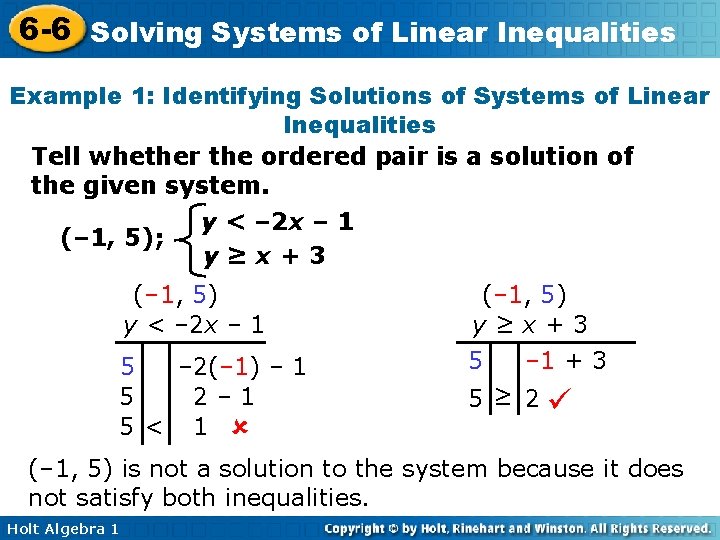
6 -6 Solving Systems of Linear Inequalities Example 1: Identifying Solutions of Systems of Linear Inequalities Tell whether the ordered pair is a solution of the given system. (– 1, 5); y < – 2 x – 1 y≥x+3 (– 1, 5) y < – 2 x – 1 5 – 2(– 1) – 1 5 2– 1 5 < 1 (– 1, 5) y≥x+3 5 – 1 + 3 5 ≥ 2 (– 1, 5) is not a solution to the system because it does not satisfy both inequalities. Holt Algebra 1
6 -6 Solving Systems of Linear Inequalities Remember! An ordered pair must be a solution of all inequalities to be a solution of the system. Holt Algebra 1
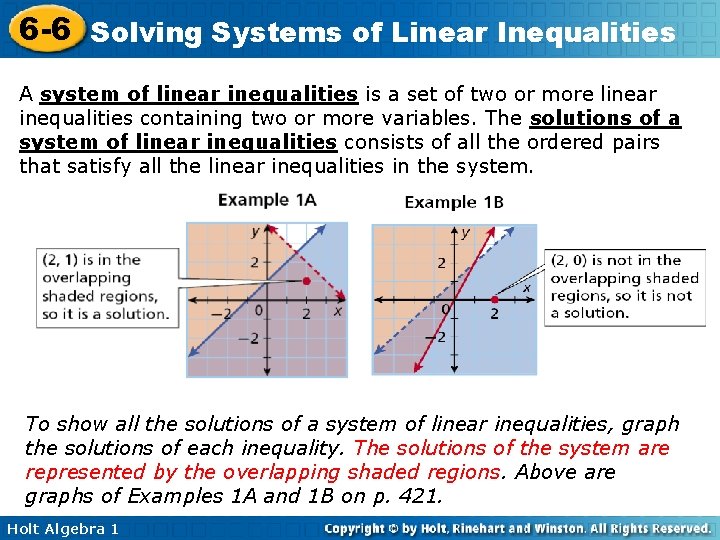
6 -6 Solving Systems of Linear Inequalities A system of linear inequalities is a set of two or more linear inequalities containing two or more variables. The solutions of a system of linear inequalities consists of all the ordered pairs that satisfy all the linear inequalities in the system. To show all the solutions of a system of linear inequalities, graph the solutions of each inequality. The solutions of the system are represented by the overlapping shaded regions. Above are graphs of Examples 1 A and 1 B on p. 421. Holt Algebra 1
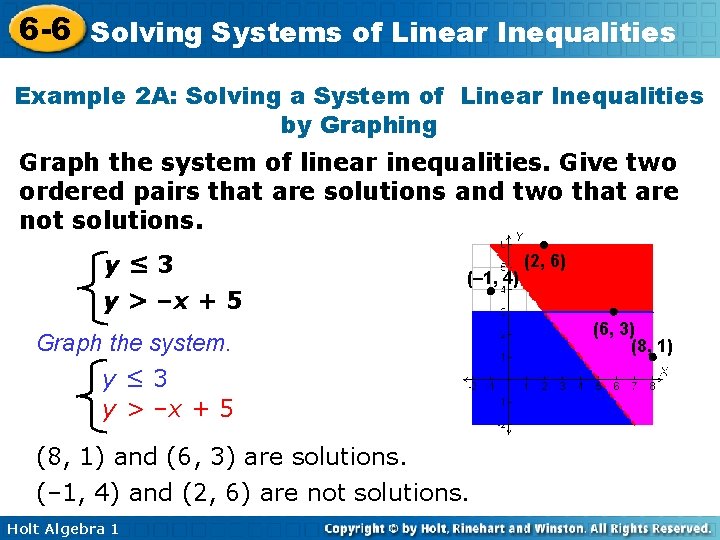
6 -6 Solving Systems of Linear Inequalities Example 2 A: Solving a System of Linear Inequalities by Graphing Graph the system of linear inequalities. Give two ordered pairs that are solutions and two that are not solutions. y≤ 3 y > –x + 5 (– 1, 4) Graph the system. y≤ 3 y > –x + 5 (8, 1) and (6, 3) are solutions. (– 1, 4) and (2, 6) are not solutions. Holt Algebra 1 (2, 6) (6, 3) (8, 1)
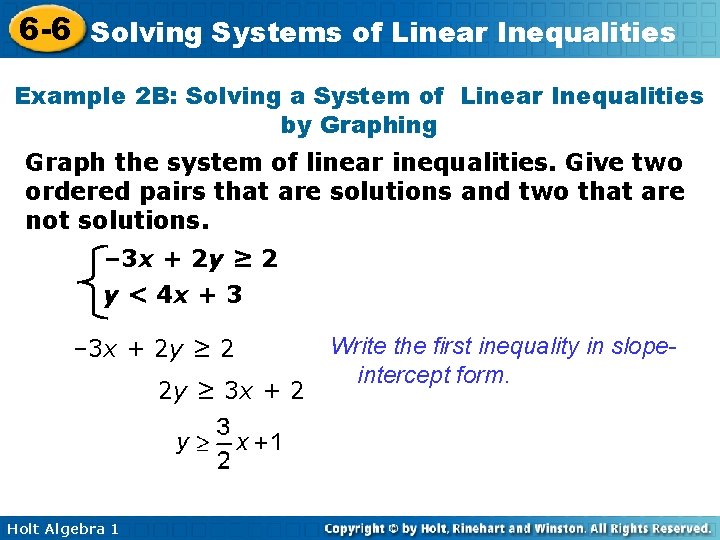
6 -6 Solving Systems of Linear Inequalities Example 2 B: Solving a System of Linear Inequalities by Graphing Graph the system of linear inequalities. Give two ordered pairs that are solutions and two that are not solutions. – 3 x + 2 y ≥ 2 y < 4 x + 3 – 3 x + 2 y ≥ 2 2 y ≥ 3 x + 2 Holt Algebra 1 Write the first inequality in slopeintercept form.
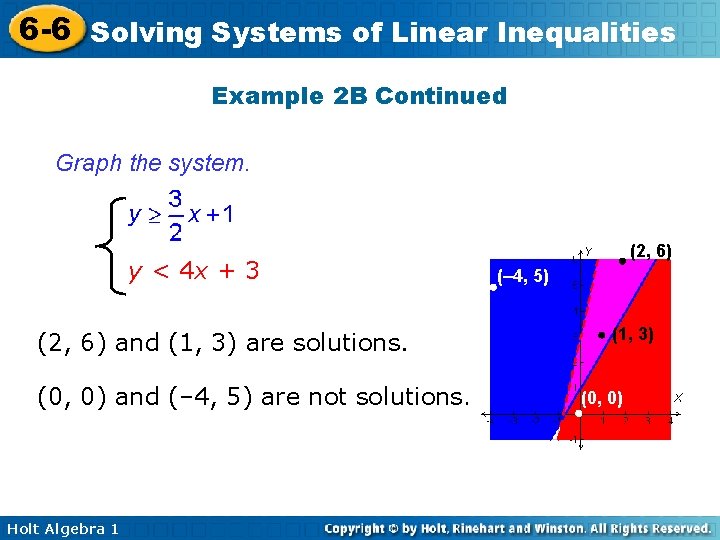
6 -6 Solving Systems of Linear Inequalities Example 2 B Continued Graph the system. y < 4 x + 3 (2, 6) and (1, 3) are solutions. (0, 0) and (– 4, 5) are not solutions. Holt Algebra 1 (– 4, 5) (2, 6) (1, 3) (0, 0)
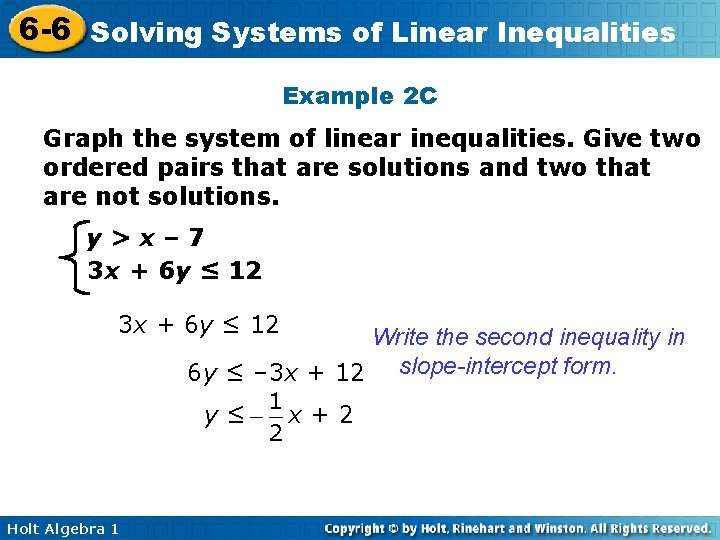
6 -6 Solving Systems of Linear Inequalities Example 2 C Graph the system of linear inequalities. Give two ordered pairs that are solutions and two that are not solutions. y>x– 7 3 x + 6 y ≤ 12 Write the second inequality in 6 y ≤ – 3 x + 12 slope-intercept form. y≤ Holt Algebra 1 x+2
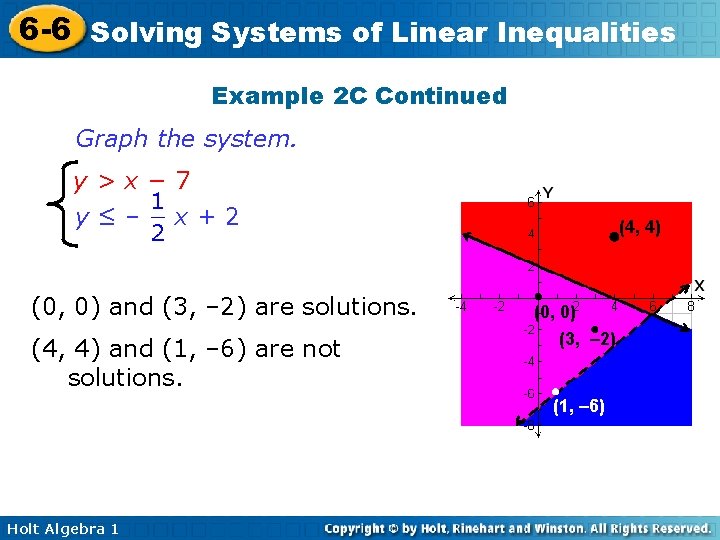
6 -6 Solving Systems of Linear Inequalities Example 2 C Continued Graph the system. y>x− 7 y≤– x+2 (0, 0) and (3, – 2) are solutions. (4, 4) and (1, – 6) are not solutions. Holt Algebra 1 (4, 4) (0, 0) (3, – 2) (1, – 6)
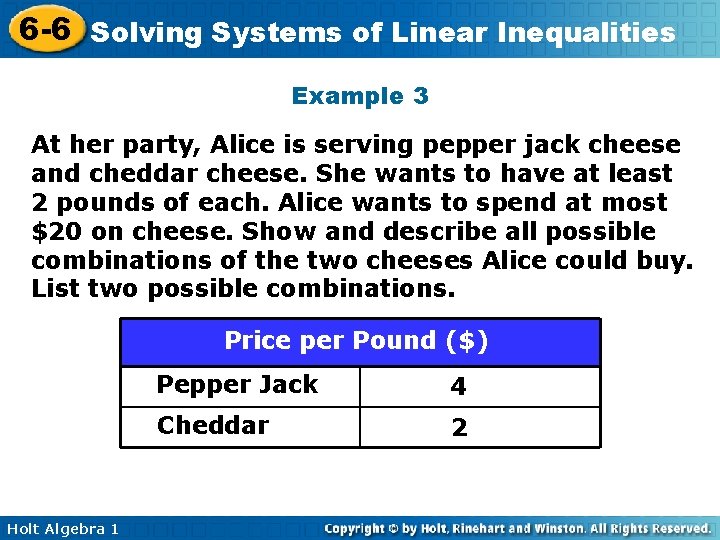
6 -6 Solving Systems of Linear Inequalities Example 3 At her party, Alice is serving pepper jack cheese and cheddar cheese. She wants to have at least 2 pounds of each. Alice wants to spend at most $20 on cheese. Show and describe all possible combinations of the two cheeses Alice could buy. List two possible combinations. Price per Pound ($) Holt Algebra 1 Pepper Jack 4 Cheddar 2
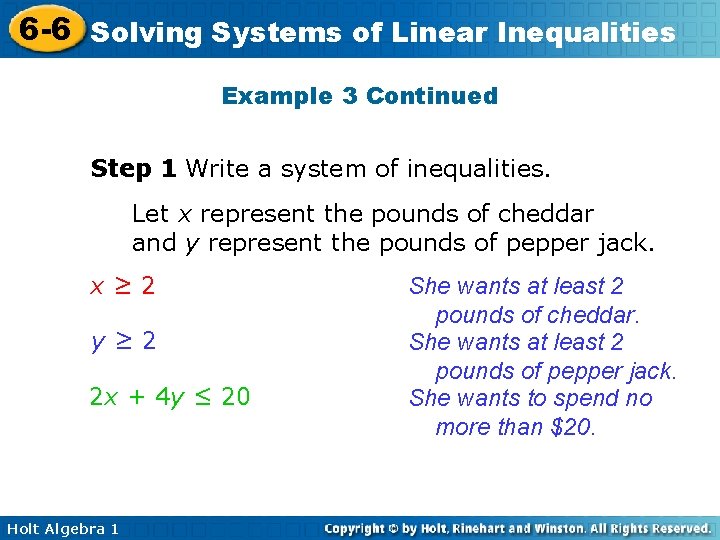
6 -6 Solving Systems of Linear Inequalities Example 3 Continued Step 1 Write a system of inequalities. Let x represent the pounds of cheddar and y represent the pounds of pepper jack. x≥ 2 y≥ 2 2 x + 4 y ≤ 20 Holt Algebra 1 She wants at least 2 pounds of cheddar. She wants at least 2 pounds of pepper jack. She wants to spend no more than $20.
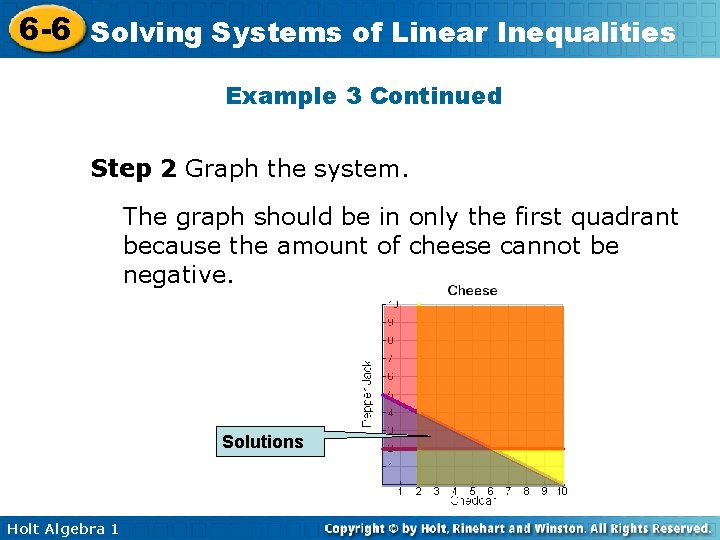
6 -6 Solving Systems of Linear Inequalities Example 3 Continued Step 2 Graph the system. The graph should be in only the first quadrant because the amount of cheese cannot be negative. Solutions Holt Algebra 1
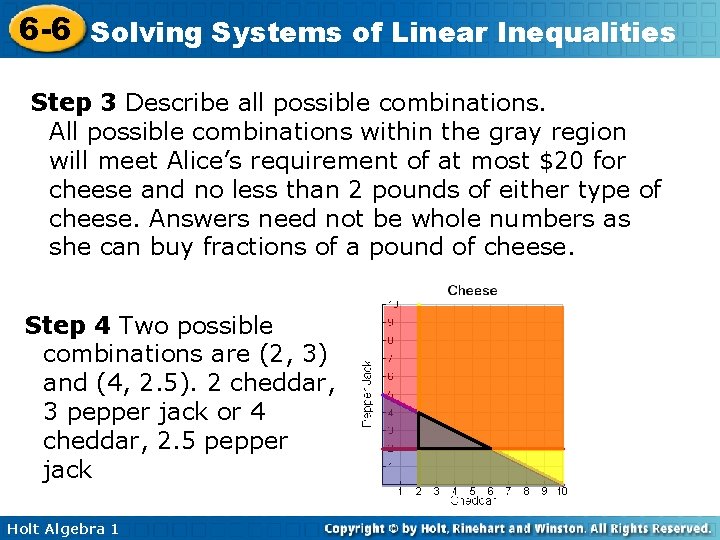
6 -6 Solving Systems of Linear Inequalities Step 3 Describe all possible combinations. All possible combinations within the gray region will meet Alice’s requirement of at most $20 for cheese and no less than 2 pounds of either type of cheese. Answers need not be whole numbers as she can buy fractions of a pound of cheese. Step 4 Two possible combinations are (2, 3) and (4, 2. 5). 2 cheddar, 3 pepper jack or 4 cheddar, 2. 5 pepper jack Holt Algebra 1
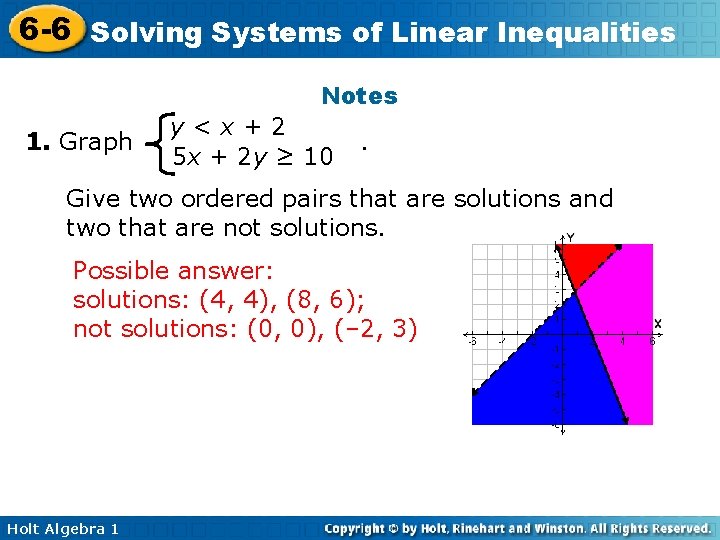
6 -6 Solving Systems of Linear Inequalities Notes 1. Graph y<x+2 5 x + 2 y ≥ 10 . Give two ordered pairs that are solutions and two that are not solutions. Possible answer: solutions: (4, 4), (8, 6); not solutions: (0, 0), (– 2, 3) Holt Algebra 1
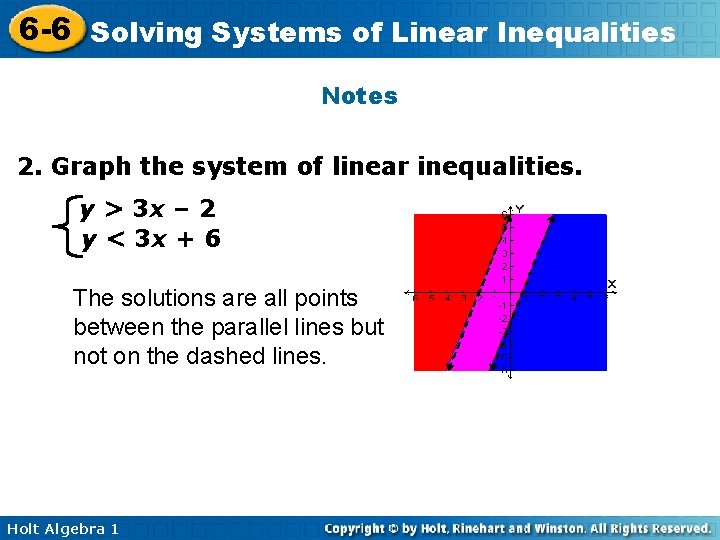
6 -6 Solving Systems of Linear Inequalities Notes 2. Graph the system of linear inequalities. y > 3 x – 2 y < 3 x + 6 The solutions are all points between the parallel lines but not on the dashed lines. Holt Algebra 1
6 -6 Solving Systems of Linear Inequalities Notes 3. Dee has at most $150 to spend on restocking dolls and trains at her toy store. Dolls cost $7. 50 and trains cost $5. 00. Dee needs no more than 10 trains and she needs at least 8 dolls. Show and describe all possible combinations of dolls and trains that Dee can buy. List two possible combinations. Holt Algebra 1
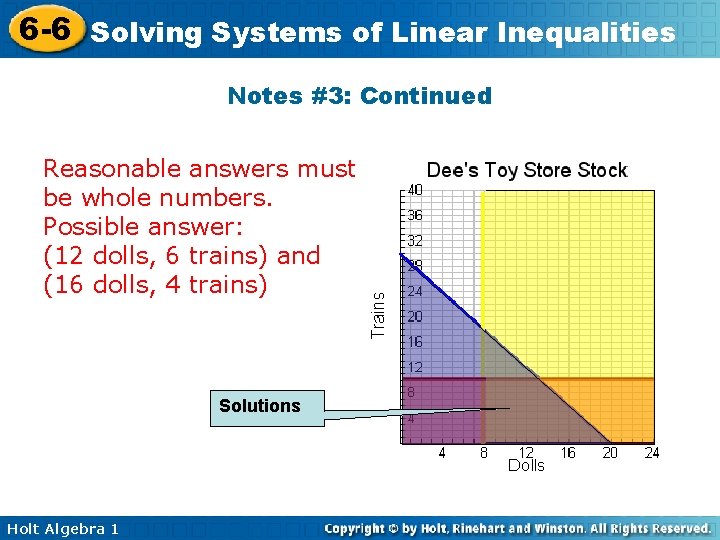
6 -6 Solving Systems of Linear Inequalities Notes #3: Continued Reasonable answers must be whole numbers. Possible answer: (12 dolls, 6 trains) and (16 dolls, 4 trains) Solutions Holt Algebra 1
- Slides: 18