
6 6 Lewis Structures for Molecules and Polyatomic



- Slides: 17
6. 6 Lewis Structures for Molecules and Polyatomic Ions A molecule is represented by a Lewis structure in which the valence electrons of all the atoms are arranged to give octets. Learning Goal Draw the Lewis structures for molecular compounds or polyatomic ions. General, Organic, and Biological Chemistry: Structures of Life, 5/e Karen C. Timberlake © 2016 Pearson Education, Inc.
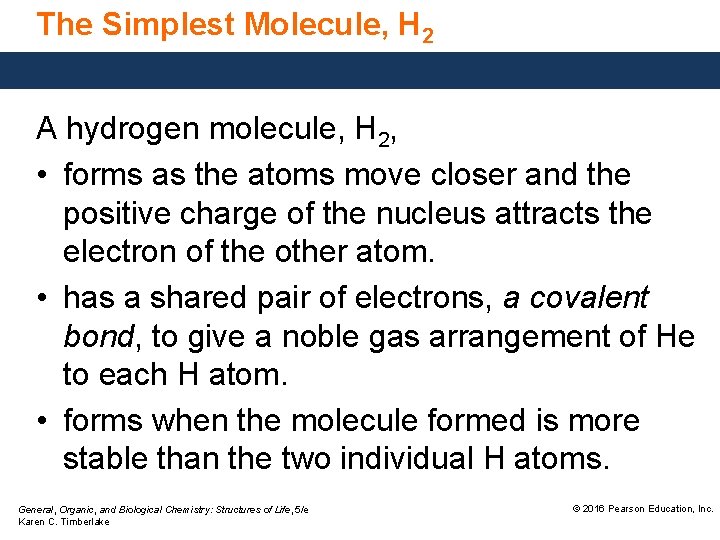
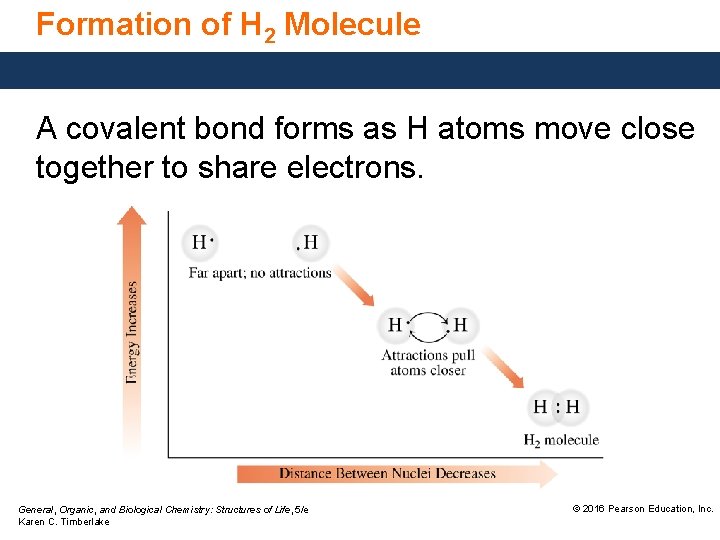
The Simplest Molecule, H 2 A hydrogen molecule, H 2, • forms as the atoms move closer and the positive charge of the nucleus attracts the electron of the other atom. • has a shared pair of electrons, a covalent bond, to give a noble gas arrangement of He to each H atom. • forms when the molecule formed is more stable than the two individual H atoms. General, Organic, and Biological Chemistry: Structures of Life, 5/e Karen C. Timberlake © 2016 Pearson Education, Inc.
Formation of H 2 Molecule A covalent bond forms as H atoms move close together to share electrons. General, Organic, and Biological Chemistry: Structures of Life, 5/e Karen C. Timberlake © 2016 Pearson Education, Inc.
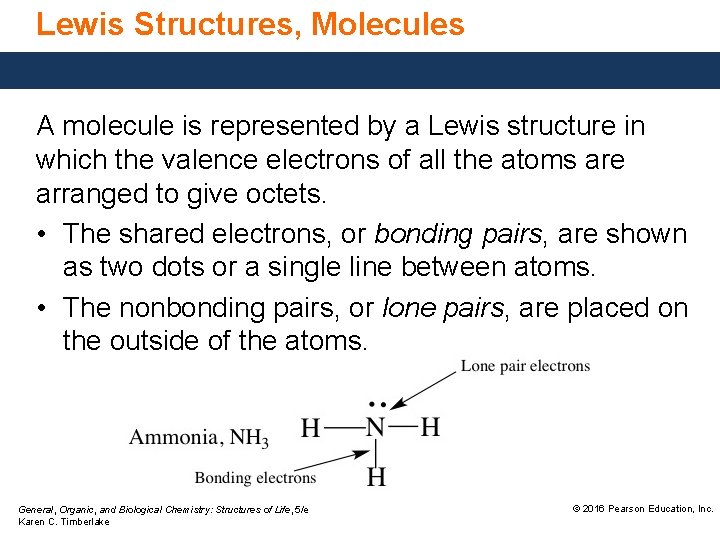
Lewis Structures, Molecules A molecule is represented by a Lewis structure in which the valence electrons of all the atoms are arranged to give octets. • The shared electrons, or bonding pairs, are shown as two dots or a single line between atoms. • The nonbonding pairs, or lone pairs, are placed on the outside of the atoms. General, Organic, and Biological Chemistry: Structures of Life, 5/e Karen C. Timberlake © 2016 Pearson Education, Inc.
Lewis Structures, Molecules A molecule is represented by a Lewis structure in which the valence electrons of all the atoms are arranged to give octets. To draw the electron-dot formula for a fluorine molecule, F 2, • we start with the electron-dot symbols for each fluorine atom. • each fluorine atom shares one electron to form a covalent bond, giving each fluorine an octet. General, Organic, and Biological Chemistry: Structures of Life, 5/e Karen C. Timberlake © 2016 Pearson Education, Inc.
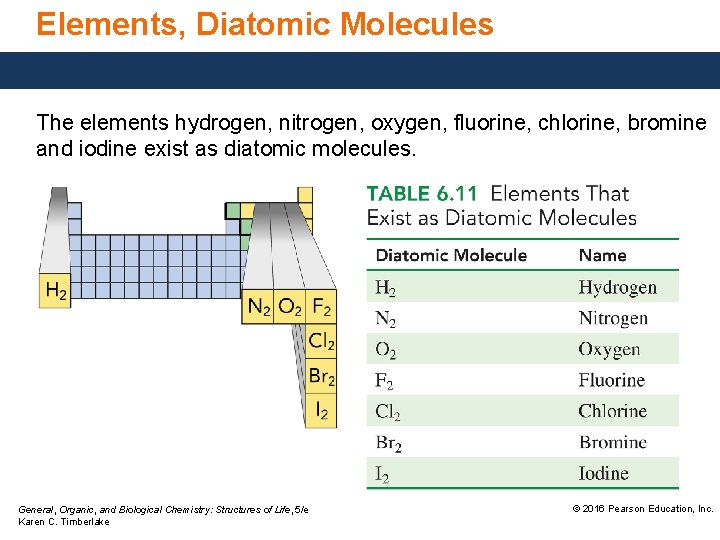
Elements, Diatomic Molecules The elements hydrogen, nitrogen, oxygen, fluorine, chlorine, bromine and iodine exist as diatomic molecules. General, Organic, and Biological Chemistry: Structures of Life, 5/e Karen C. Timberlake © 2016 Pearson Education, Inc.
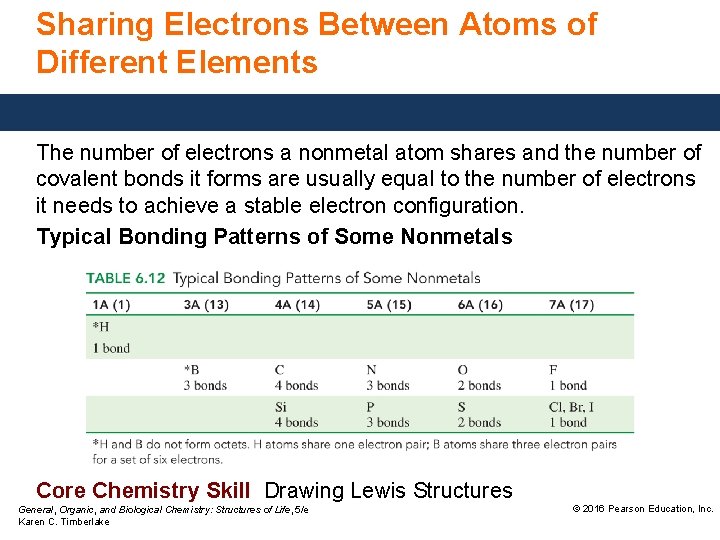
Sharing Electrons Between Atoms of Different Elements The number of electrons a nonmetal atom shares and the number of covalent bonds it forms are usually equal to the number of electrons it needs to achieve a stable electron configuration. Typical Bonding Patterns of Some Nonmetals Core Chemistry Skill Drawing Lewis Structures General, Organic, and Biological Chemistry: Structures of Life, 5/e Karen C. Timberlake © 2016 Pearson Education, Inc.
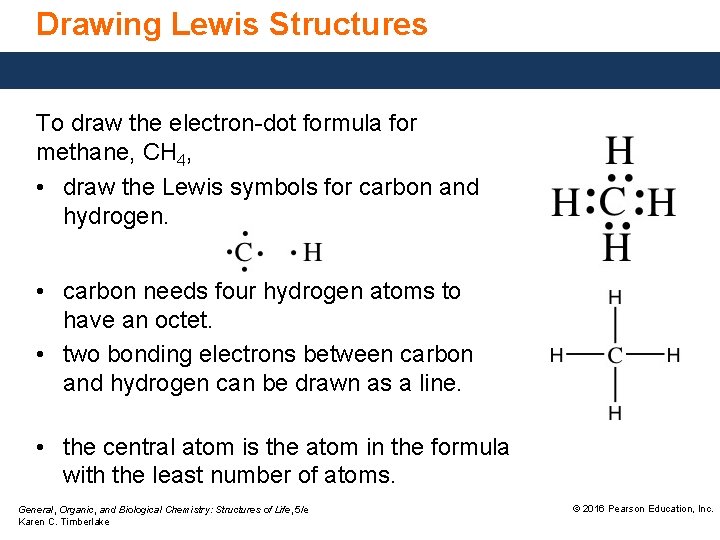
Drawing Lewis Structures To draw the electron-dot formula for methane, CH 4, • draw the Lewis symbols for carbon and hydrogen. • carbon needs four hydrogen atoms to have an octet. • two bonding electrons between carbon and hydrogen can be drawn as a line. • the central atom is the atom in the formula with the least number of atoms. General, Organic, and Biological Chemistry: Structures of Life, 5/e Karen C. Timberlake © 2016 Pearson Education, Inc.
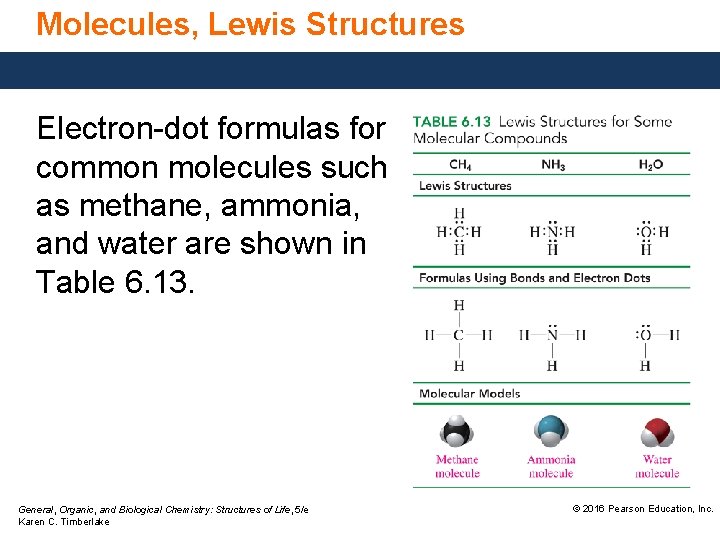
Molecules, Lewis Structures Electron-dot formulas for common molecules such as methane, ammonia, and water are shown in Table 6. 13. General, Organic, and Biological Chemistry: Structures of Life, 5/e Karen C. Timberlake © 2016 Pearson Education, Inc.
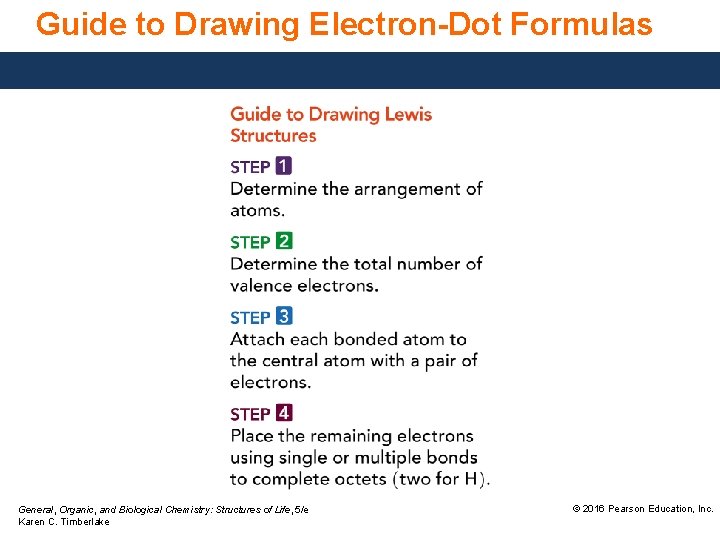
Guide to Drawing Electron-Dot Formulas General, Organic, and Biological Chemistry: Structures of Life, 5/e Karen C. Timberlake © 2016 Pearson Education, Inc.
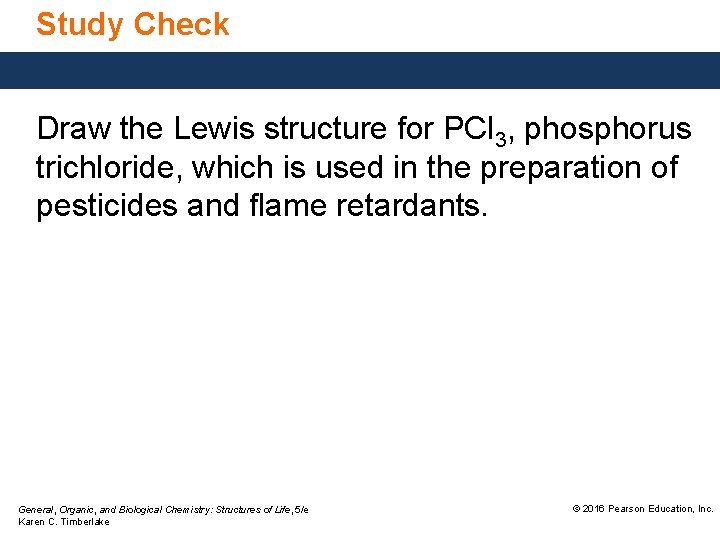
Study Check Draw the Lewis structure for PCl 3, phosphorus trichloride, which is used in the preparation of pesticides and flame retardants. General, Organic, and Biological Chemistry: Structures of Life, 5/e Karen C. Timberlake © 2016 Pearson Education, Inc.
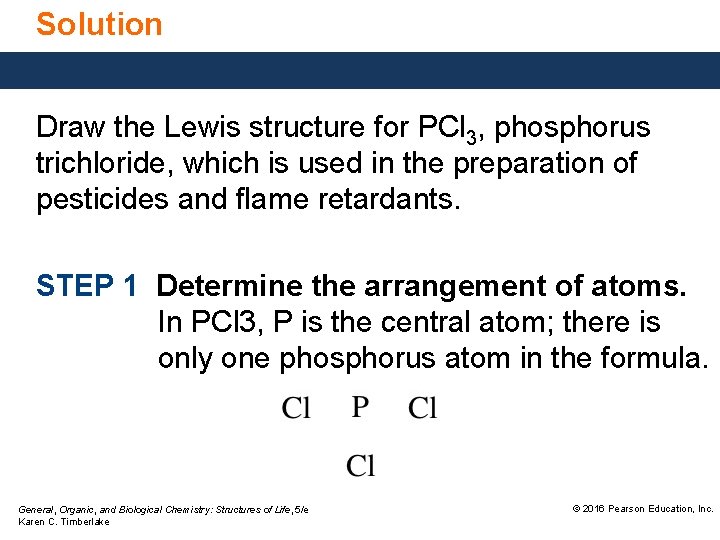
Solution Draw the Lewis structure for PCl 3, phosphorus trichloride, which is used in the preparation of pesticides and flame retardants. STEP 1 Determine the arrangement of atoms. In PCl 3, P is the central atom; there is only one phosphorus atom in the formula. General, Organic, and Biological Chemistry: Structures of Life, 5/e Karen C. Timberlake © 2016 Pearson Education, Inc.
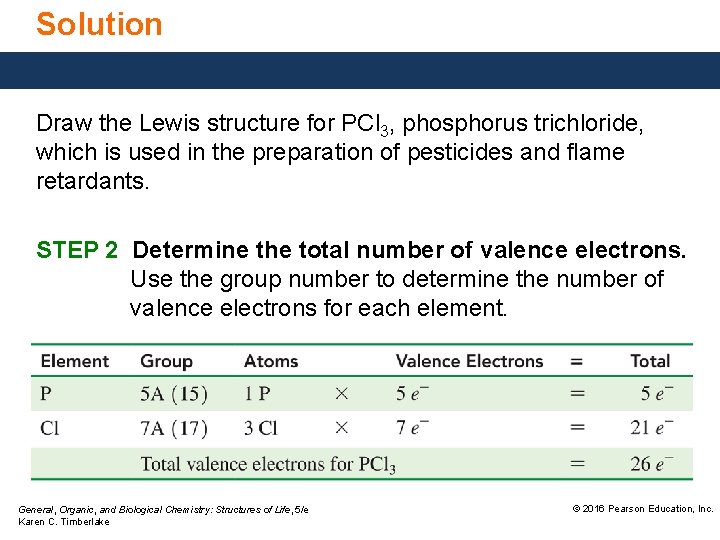
Solution Draw the Lewis structure for PCl 3, phosphorus trichloride, which is used in the preparation of pesticides and flame retardants. STEP 2 Determine the total number of valence electrons. Use the group number to determine the number of valence electrons for each element. General, Organic, and Biological Chemistry: Structures of Life, 5/e Karen C. Timberlake © 2016 Pearson Education, Inc.
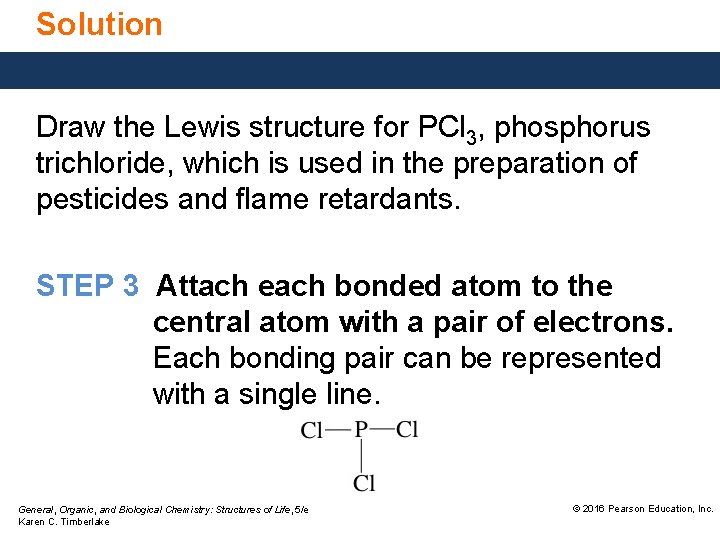
Solution Draw the Lewis structure for PCl 3, phosphorus trichloride, which is used in the preparation of pesticides and flame retardants. STEP 3 Attach each bonded atom to the central atom with a pair of electrons. Each bonding pair can be represented with a single line. General, Organic, and Biological Chemistry: Structures of Life, 5/e Karen C. Timberlake © 2016 Pearson Education, Inc.
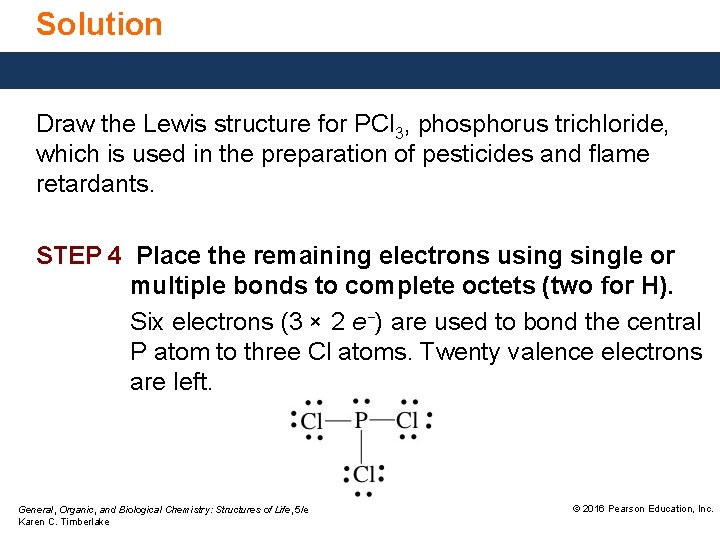
Solution Draw the Lewis structure for PCl 3, phosphorus trichloride, which is used in the preparation of pesticides and flame retardants. STEP 4 Place the remaining electrons usingle or multiple bonds to complete octets (two for H). Six electrons (3 × 2 e−) are used to bond the central P atom to three Cl atoms. Twenty valence electrons are left. General, Organic, and Biological Chemistry: Structures of Life, 5/e Karen C. Timberlake © 2016 Pearson Education, Inc.
Double and Triple Bonds A double bond • occurs when atoms share two pairs of electrons. • forms when there are not enough electrons to complete octets. A triple bond • occurs when atoms share three pairs of electrons. • forms when there are not enough electrons to complete octets. General, Organic, and Biological Chemistry: Structures of Life, 5/e Karen C. Timberlake © 2016 Pearson Education, Inc.
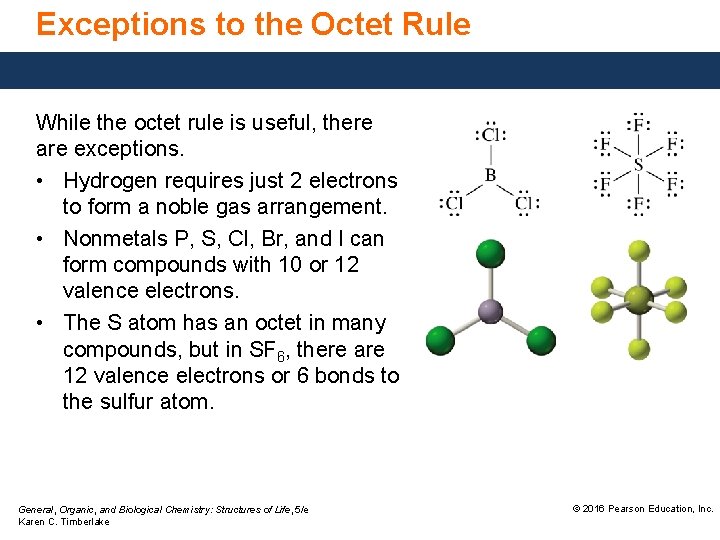
Exceptions to the Octet Rule While the octet rule is useful, there are exceptions. • Hydrogen requires just 2 electrons to form a noble gas arrangement. • Nonmetals P, S, Cl, Br, and I can form compounds with 10 or 12 valence electrons. • The S atom has an octet in many compounds, but in SF 6, there are 12 valence electrons or 6 bonds to the sulfur atom. General, Organic, and Biological Chemistry: Structures of Life, 5/e Karen C. Timberlake © 2016 Pearson Education, Inc.