
6 6 Fundamental Theorem of Algebra Warm Up
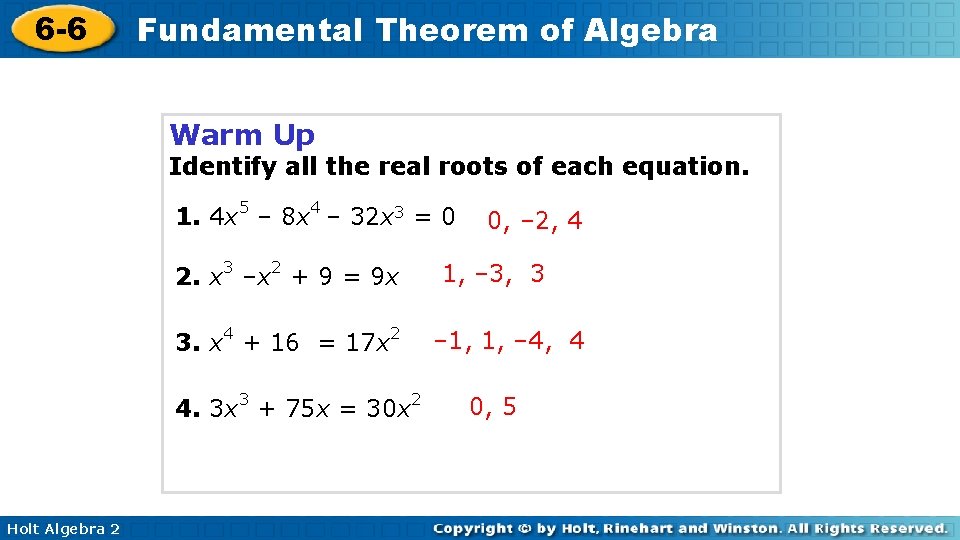
6 -6 Fundamental Theorem of Algebra Warm Up Identify all the real roots of each equation. 1. 4 x 5 – 8 x 4 – 32 x 3 = 0 2. x 3 –x 2 + 9 = 9 x 3. x 4 + 16 = 17 x 2 4. 3 x 3 + 75 x = 30 x 2 Holt Algebra 2 0, – 2, 4 1, – 3, 3 – 1, 1, – 4, 4 0, 5
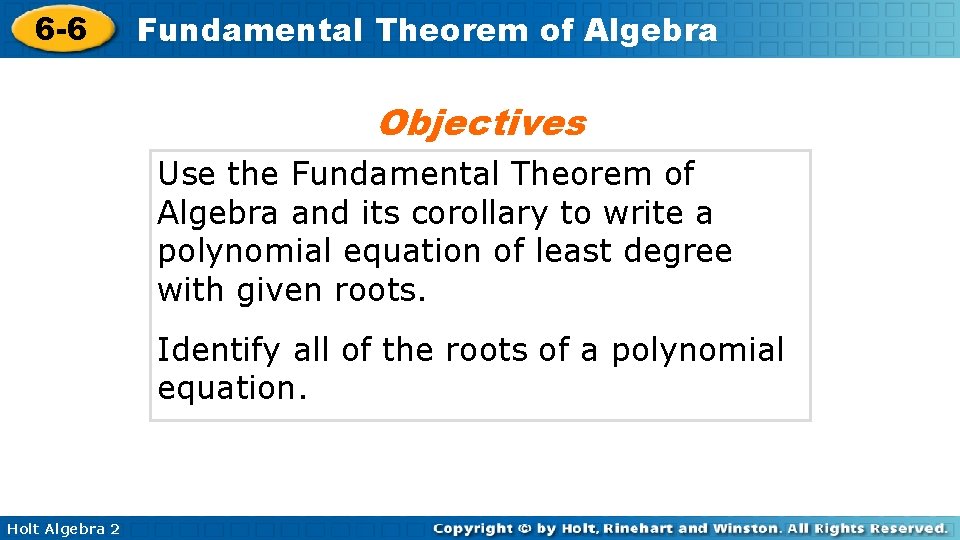
6 -6 Fundamental Theorem of Algebra Objectives Use the Fundamental Theorem of Algebra and its corollary to write a polynomial equation of least degree with given roots. Identify all of the roots of a polynomial equation. Holt Algebra 2

6 -6 Fundamental Theorem of Algebra You have learned several important properties about real roots of polynomial equations. You can use this information to write polynomial function when given in zeros. Holt Algebra 2
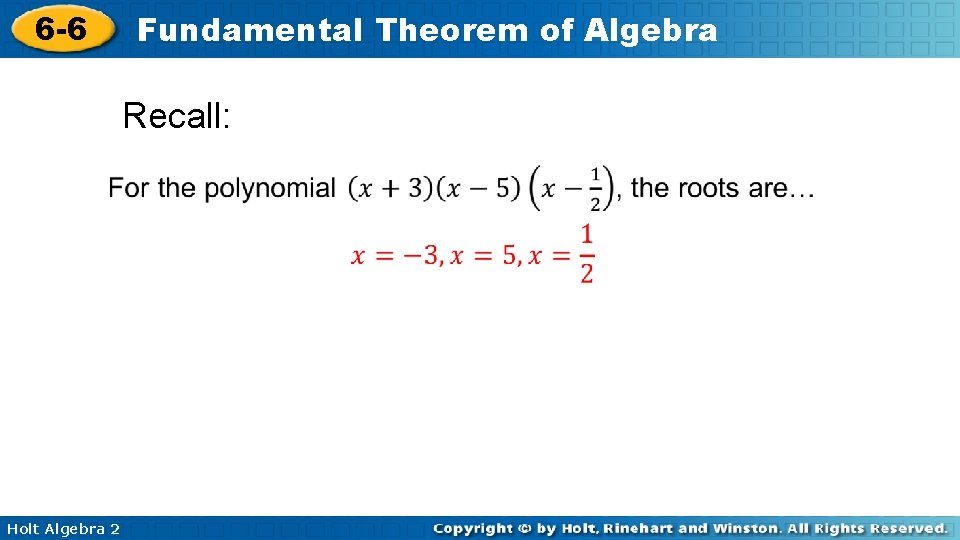
6 -6 Fundamental Theorem of Algebra Recall: Holt Algebra 2
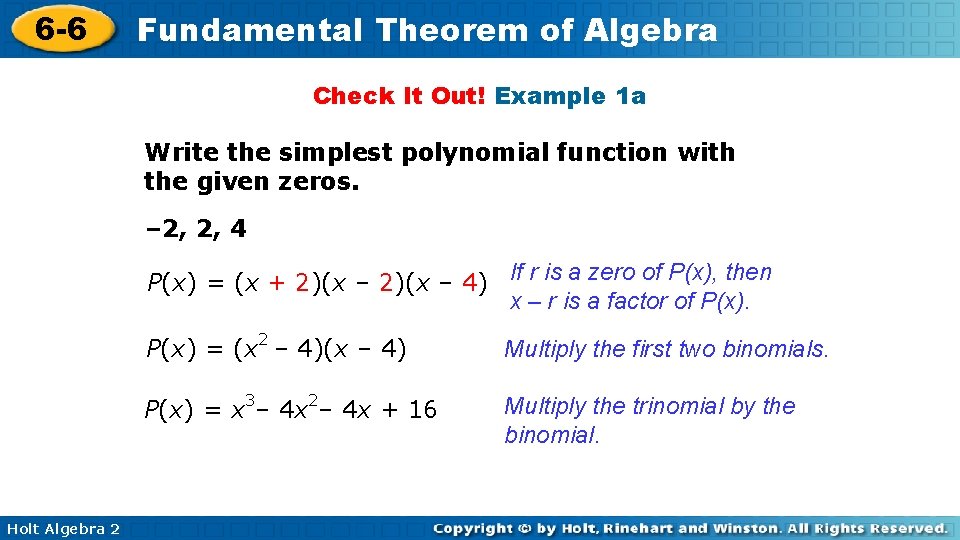
6 -6 Fundamental Theorem of Algebra Check It Out! Example 1 a Write the simplest polynomial function with the given zeros. – 2, 2, 4 P(x) = (x + 2)(x – 4) If r is a zero of P(x), then x – r is a factor of P(x). Holt Algebra 2 P(x) = (x 2 – 4)(x – 4) Multiply the first two binomials. P(x) = x 3– 4 x 2– 4 x + 16 Multiply the trinomial by the binomial.
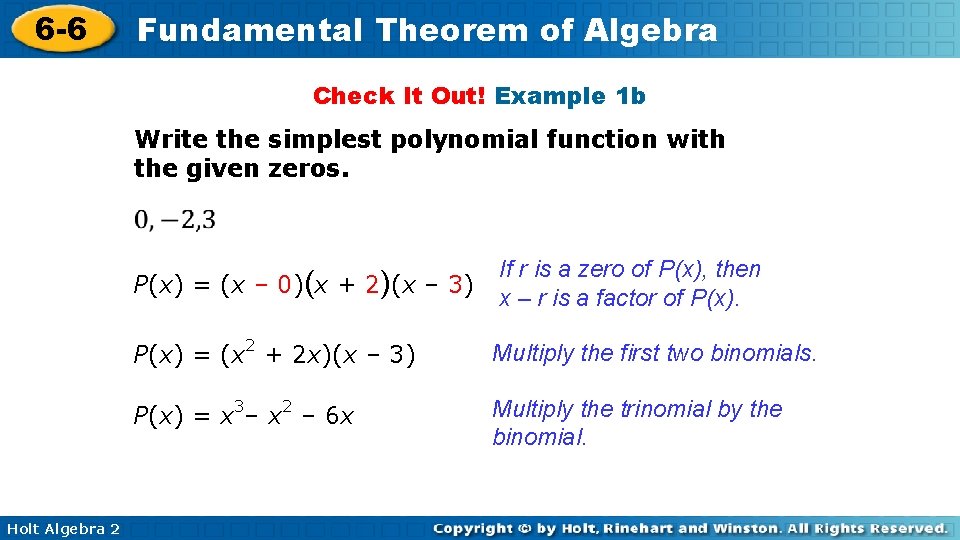
6 -6 Fundamental Theorem of Algebra Check It Out! Example 1 b Write the simplest polynomial function with the given zeros. Holt Algebra 2 P(x) = (x – 0)(x + 2)(x – 3) If r is a zero of P(x), then x – r is a factor of P(x) = (x 2 + 2 x)(x – 3) Multiply the first two binomials. P(x) = x 3– x 2 – 6 x Multiply the trinomial by the binomial.

6 -6 Fundamental Theorem of Algebra Notice that the degree of the function in Example 1 is the same as the number of zeros. This is true for all polynomial functions. However, all of the zeros are not necessarily real zeros. Polynomials functions, like quadratic functions, may have complex zeros that are not real numbers. Holt Algebra 2
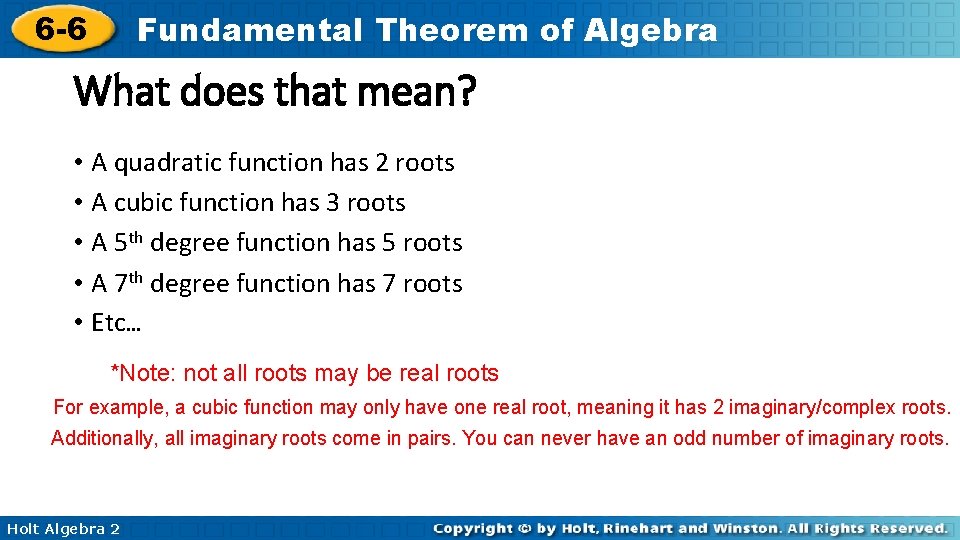
6 -6 Fundamental Theorem of Algebra What does that mean? • A quadratic function has 2 roots • A cubic function has 3 roots • A 5 th degree function has 5 roots • A 7 th degree function has 7 roots • Etc… *Note: not all roots may be real roots For example, a cubic function may only have one real root, meaning it has 2 imaginary/complex roots. Additionally, all imaginary roots come in pairs. You can never have an odd number of imaginary roots. Holt Algebra 2
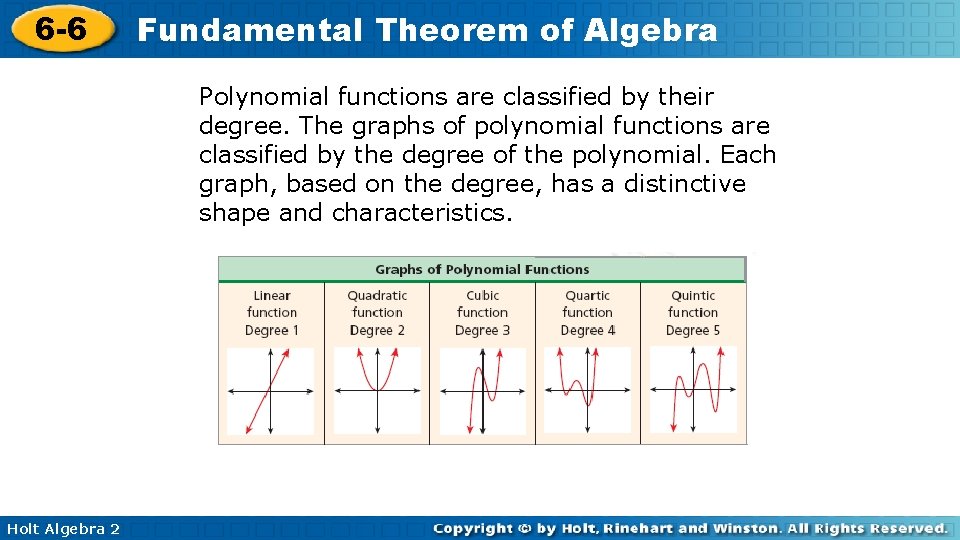
6 -6 Fundamental Theorem of Algebra Polynomial functions are classified by their degree. The graphs of polynomial functions are classified by the degree of the polynomial. Each graph, based on the degree, has a distinctive shape and characteristics. Holt Algebra 2
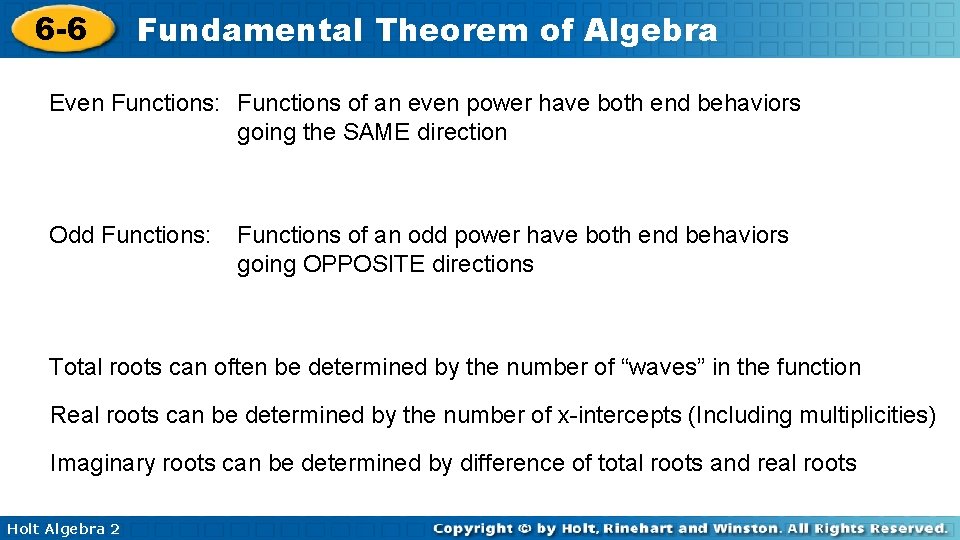
6 -6 Fundamental Theorem of Algebra Even Functions: Functions of an even power have both end behaviors going the SAME direction Odd Functions: Functions of an odd power have both end behaviors going OPPOSITE directions Total roots can often be determined by the number of “waves” in the function Real roots can be determined by the number of x-intercepts (Including multiplicities) Imaginary roots can be determined by difference of total roots and real roots Holt Algebra 2
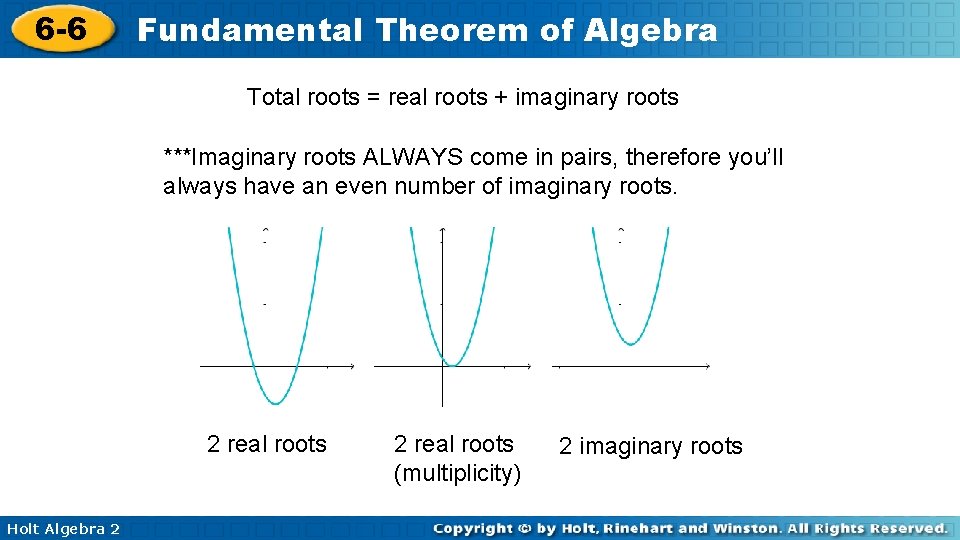
6 -6 Fundamental Theorem of Algebra Total roots = real roots + imaginary roots ***Imaginary roots ALWAYS come in pairs, therefore you’ll always have an even number of imaginary roots. 2 real roots Holt Algebra 2 2 real roots (multiplicity) 2 imaginary roots
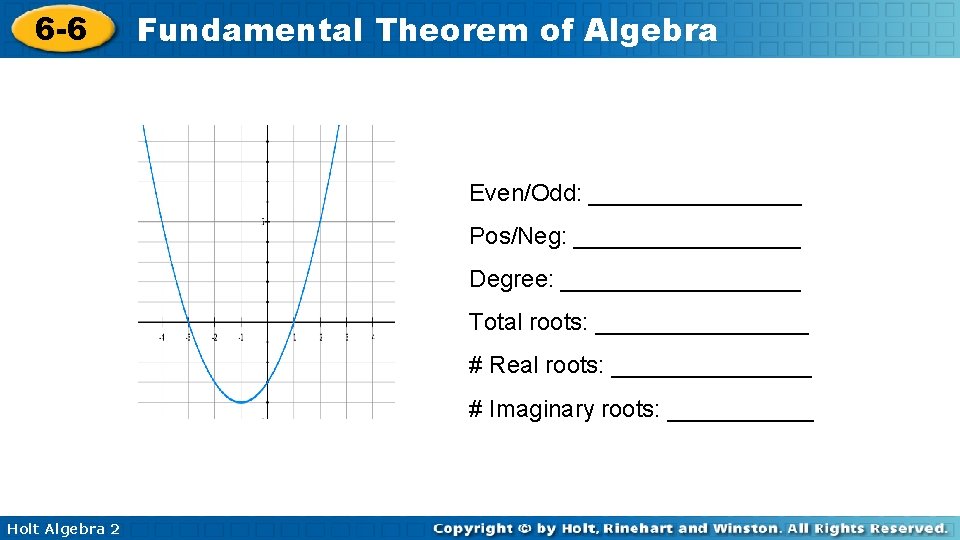
6 -6 Fundamental Theorem of Algebra Even/Odd: ________ Pos/Neg: _________ Degree: _________ Total roots: ________ # Real roots: ________ # Imaginary roots: ______ Holt Algebra 2
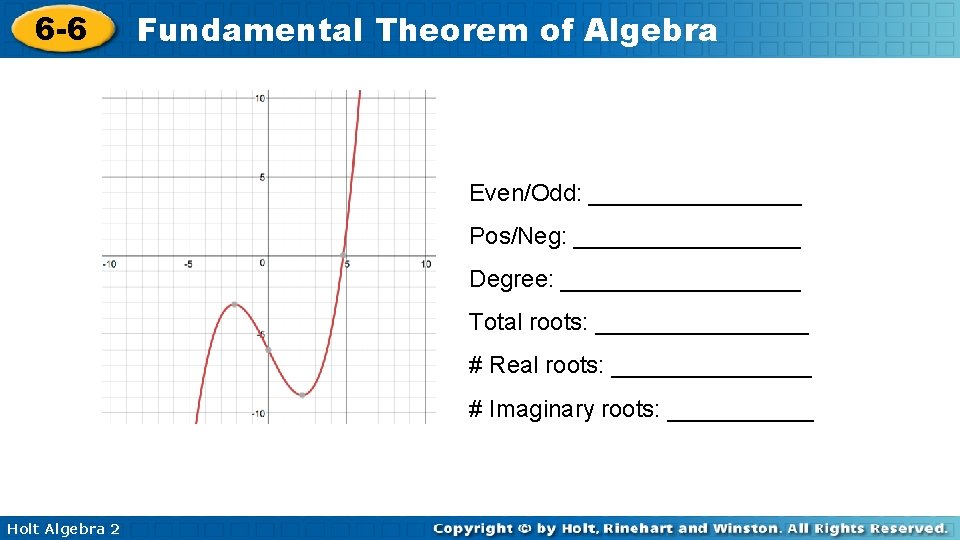
6 -6 Fundamental Theorem of Algebra Even/Odd: ________ Pos/Neg: _________ Degree: _________ Total roots: ________ # Real roots: ________ # Imaginary roots: ______ Holt Algebra 2
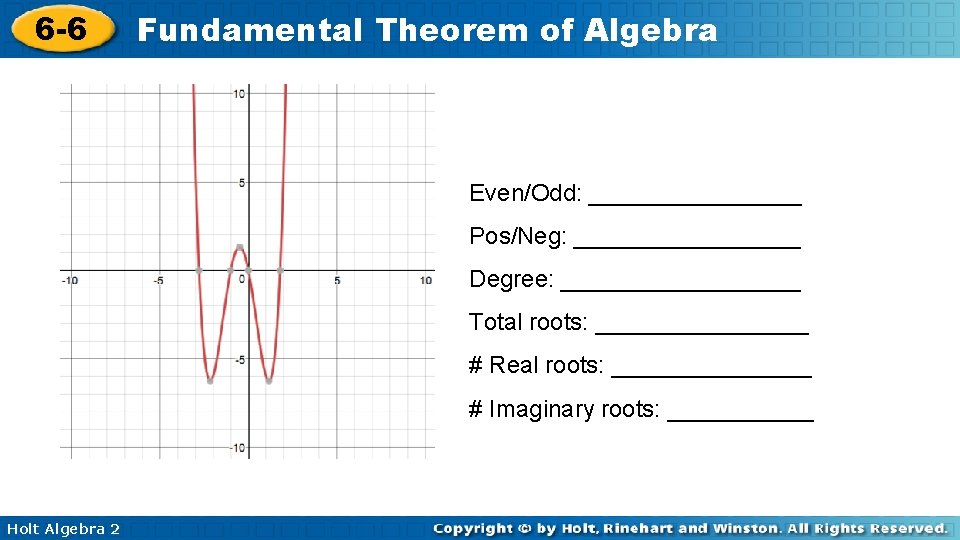
6 -6 Fundamental Theorem of Algebra Even/Odd: ________ Pos/Neg: _________ Degree: _________ Total roots: ________ # Real roots: ________ # Imaginary roots: ______ Holt Algebra 2
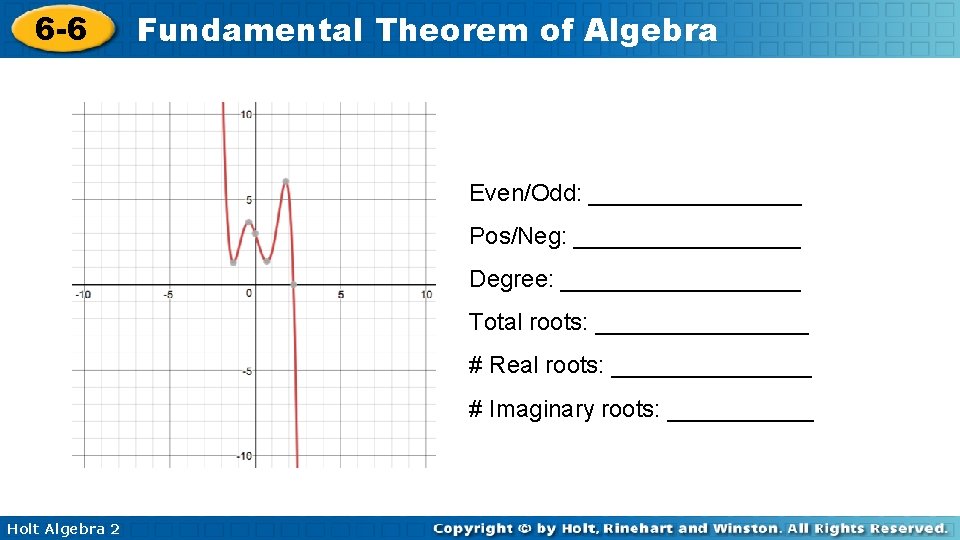
6 -6 Fundamental Theorem of Algebra Even/Odd: ________ Pos/Neg: _________ Degree: _________ Total roots: ________ # Real roots: ________ # Imaginary roots: ______ Holt Algebra 2
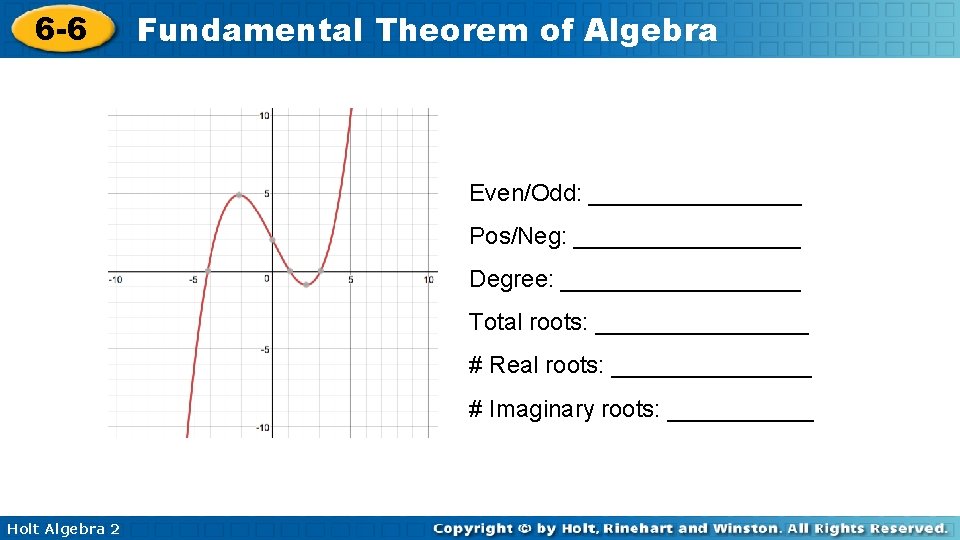
6 -6 Fundamental Theorem of Algebra Even/Odd: ________ Pos/Neg: _________ Degree: _________ Total roots: ________ # Real roots: ________ # Imaginary roots: ______ Holt Algebra 2
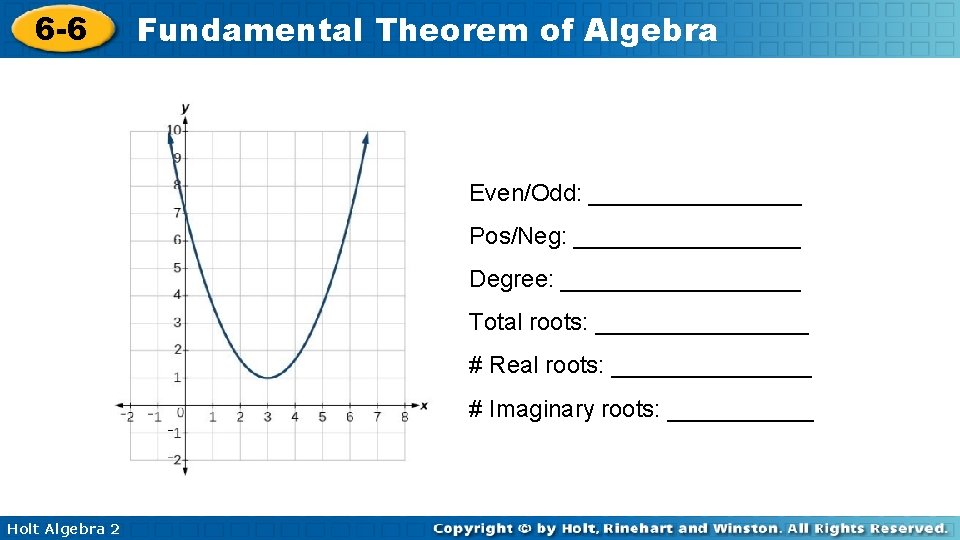
6 -6 Fundamental Theorem of Algebra Even/Odd: ________ Pos/Neg: _________ Degree: _________ Total roots: ________ # Real roots: ________ # Imaginary roots: ______ Holt Algebra 2
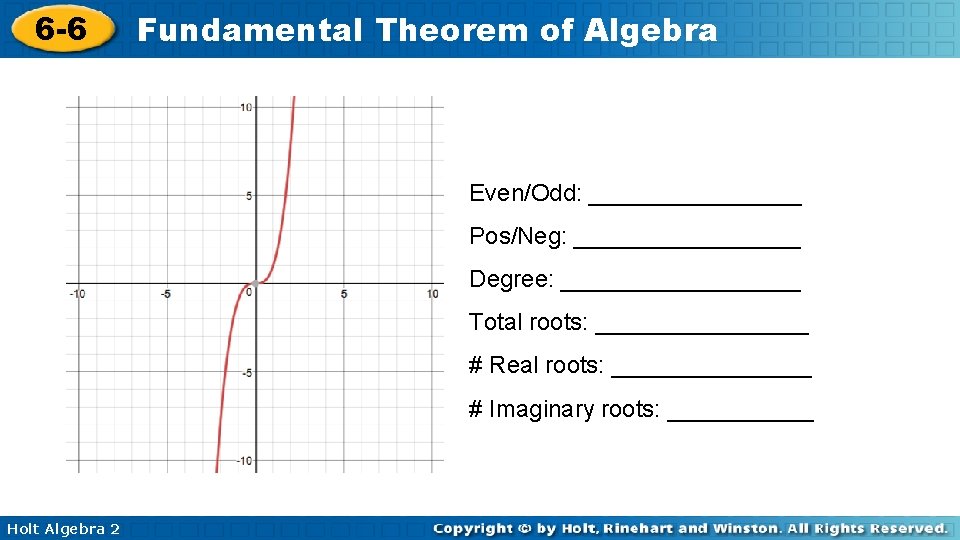
6 -6 Fundamental Theorem of Algebra Even/Odd: ________ Pos/Neg: _________ Degree: _________ Total roots: ________ # Real roots: ________ # Imaginary roots: ______ Holt Algebra 2
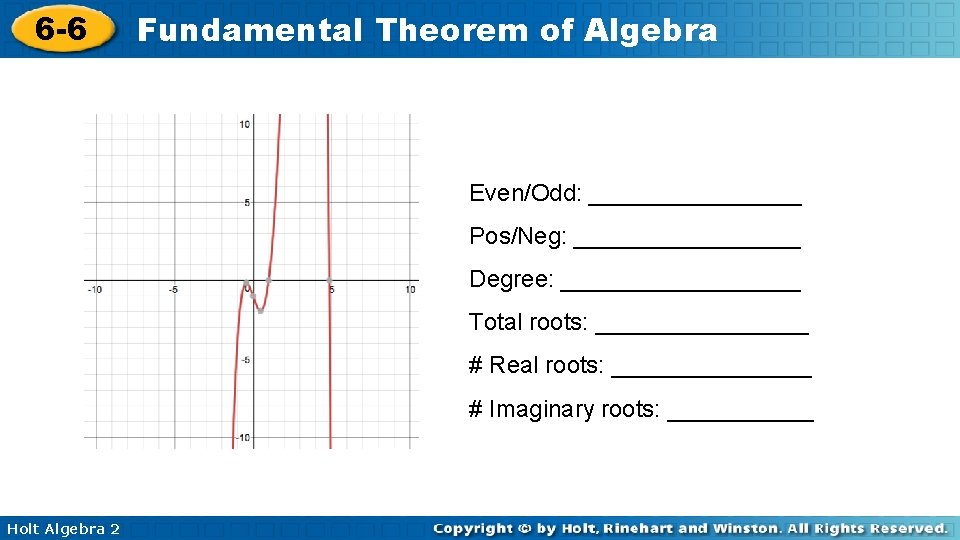
6 -6 Fundamental Theorem of Algebra Even/Odd: ________ Pos/Neg: _________ Degree: _________ Total roots: ________ # Real roots: ________ # Imaginary roots: ______ Holt Algebra 2
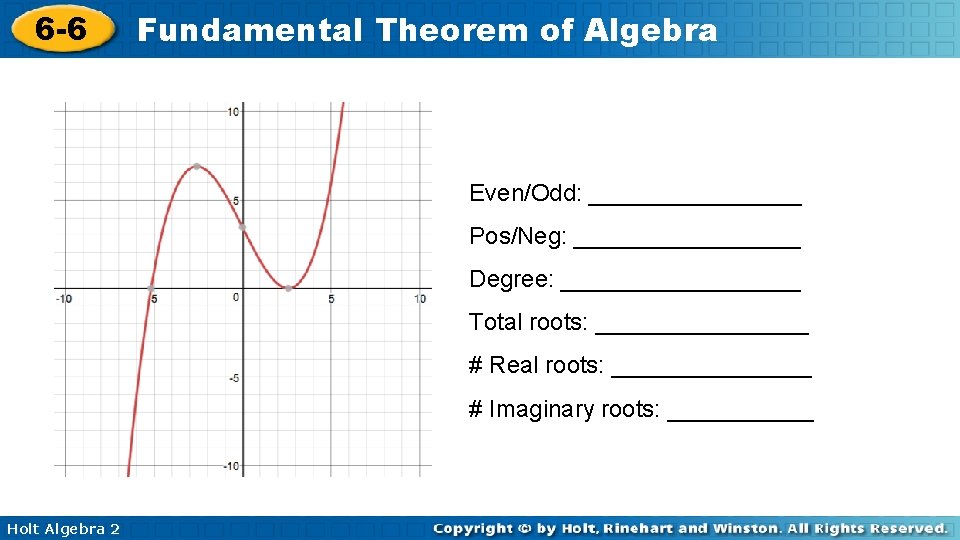
6 -6 Fundamental Theorem of Algebra Even/Odd: ________ Pos/Neg: _________ Degree: _________ Total roots: ________ # Real roots: ________ # Imaginary roots: ______ Holt Algebra 2
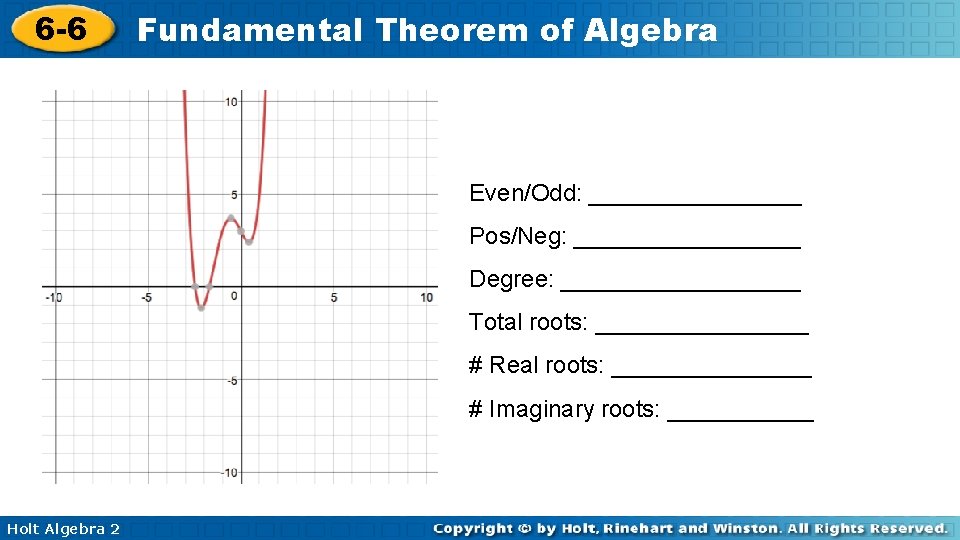
6 -6 Fundamental Theorem of Algebra Even/Odd: ________ Pos/Neg: _________ Degree: _________ Total roots: ________ # Real roots: ________ # Imaginary roots: ______ Holt Algebra 2
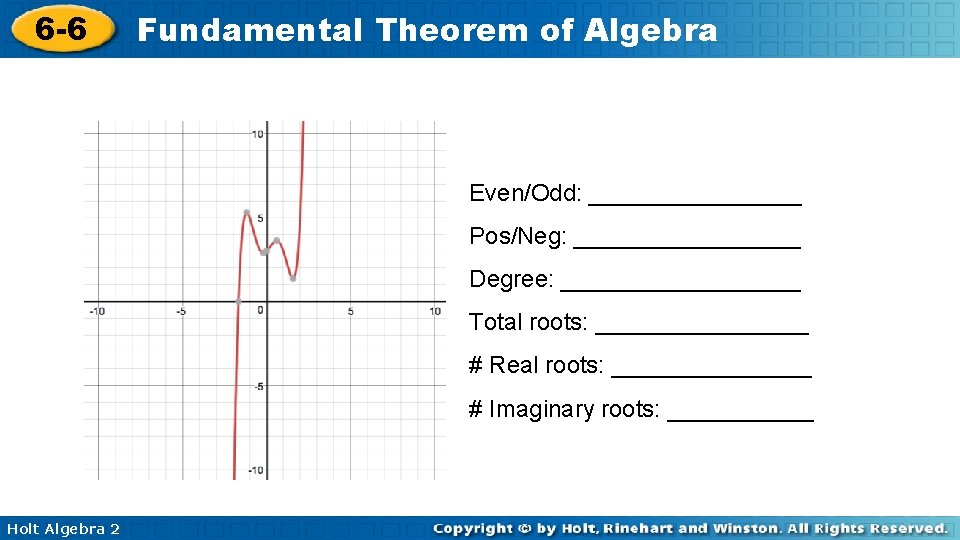
6 -6 Fundamental Theorem of Algebra Even/Odd: ________ Pos/Neg: _________ Degree: _________ Total roots: ________ # Real roots: ________ # Imaginary roots: ______ Holt Algebra 2
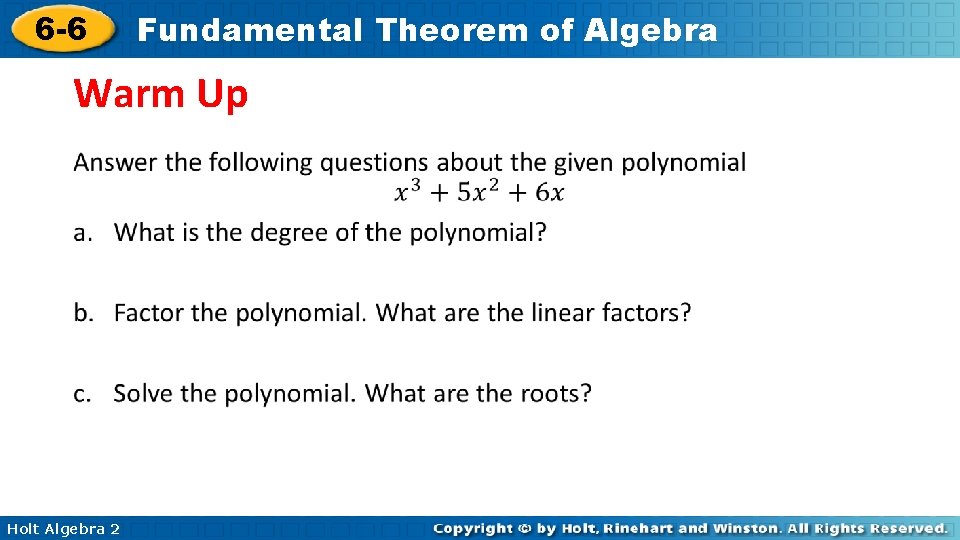
6 -6 Fundamental Theorem of Algebra Warm Up • Holt Algebra 2
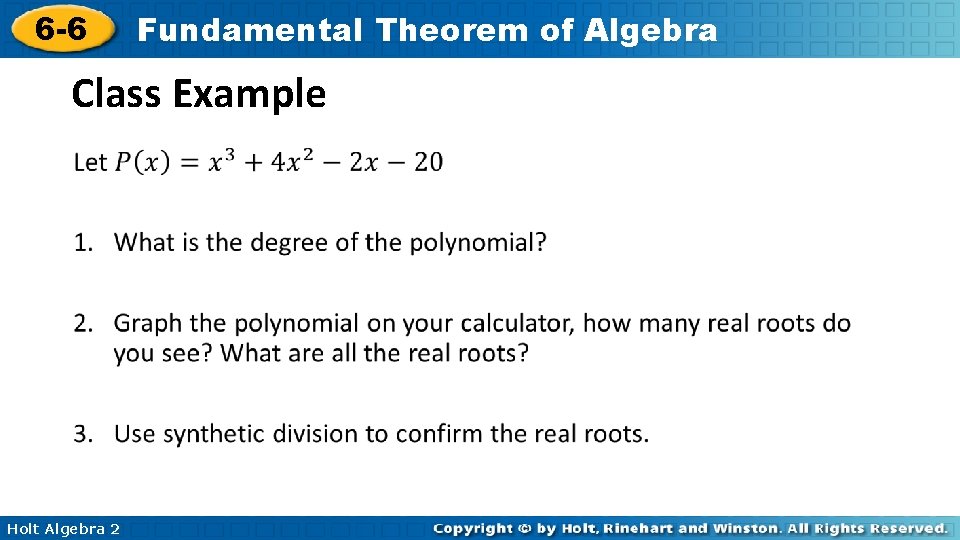
6 -6 Fundamental Theorem of Algebra Class Example • Holt Algebra 2
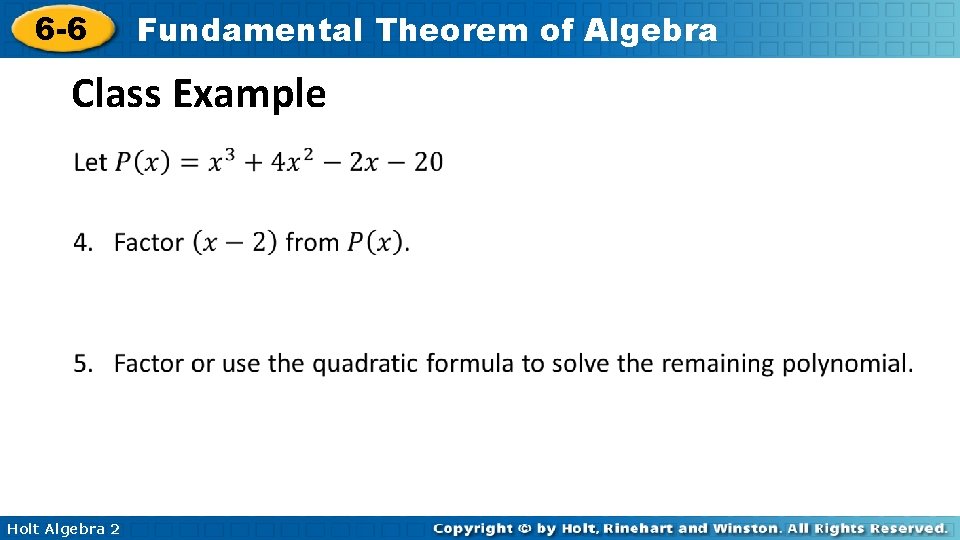
6 -6 Fundamental Theorem of Algebra Class Example • Holt Algebra 2
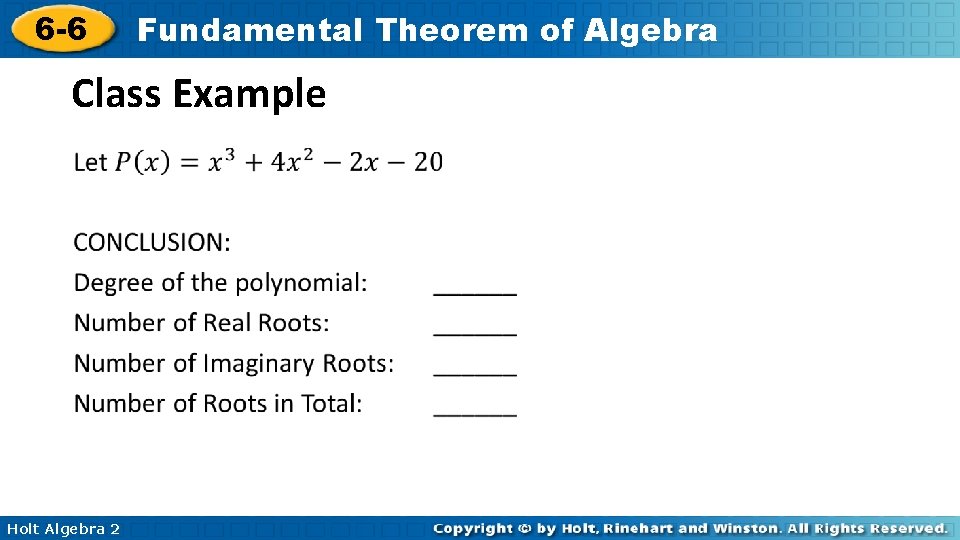
6 -6 Fundamental Theorem of Algebra Class Example • Holt Algebra 2
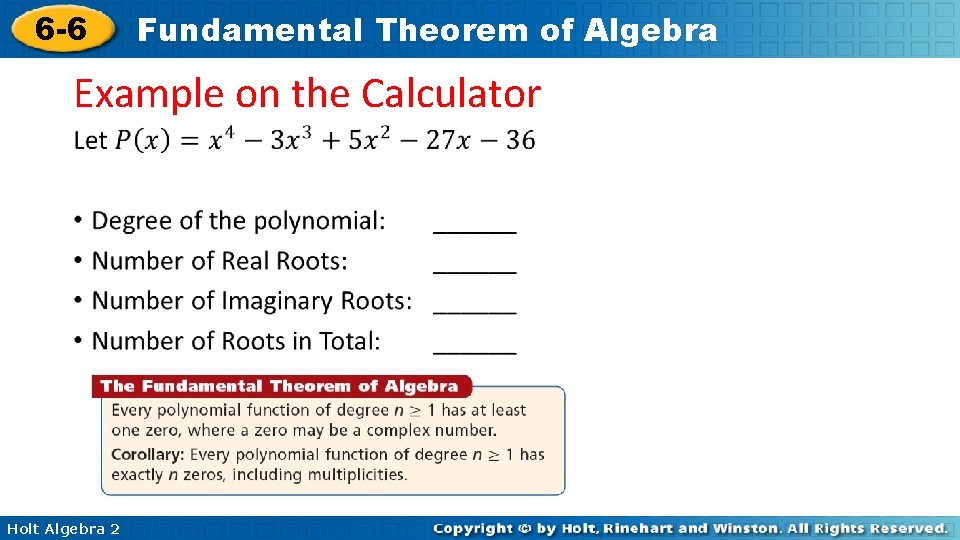
6 -6 Fundamental Theorem of Algebra Example on the Calculator • Holt Algebra 2
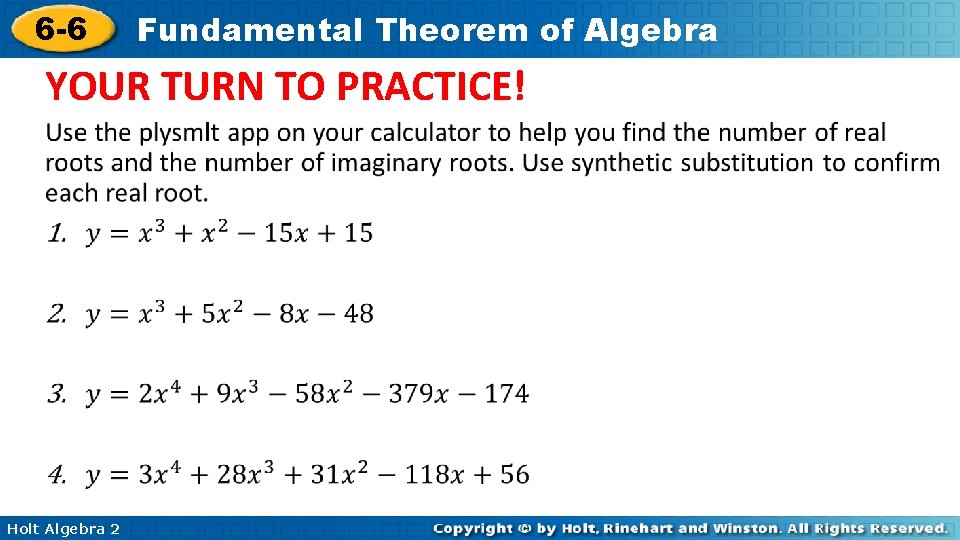
6 -6 Fundamental Theorem of Algebra YOUR TURN TO PRACTICE! • Holt Algebra 2
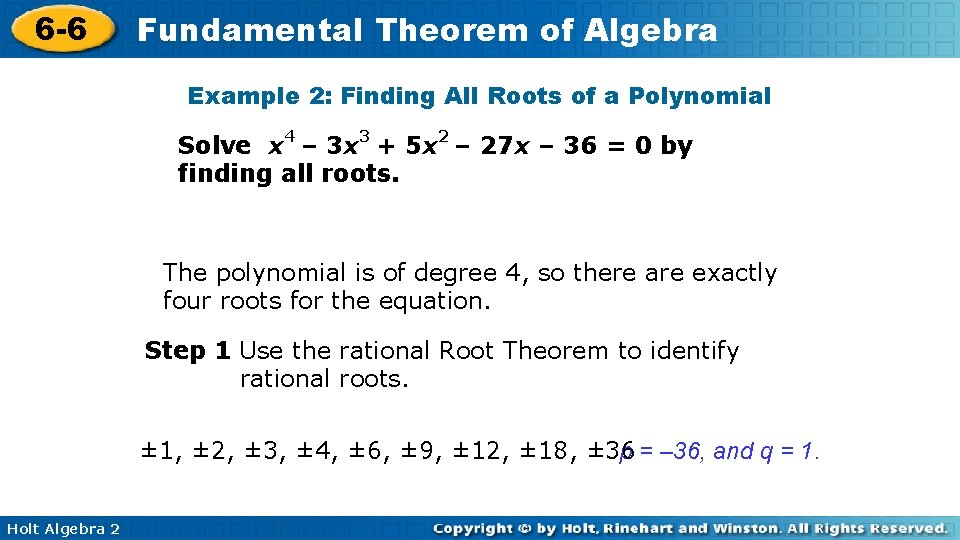
6 -6 Fundamental Theorem of Algebra Example 2: Finding All Roots of a Polynomial Solve x 4 – 3 x 3 + 5 x 2 – 27 x – 36 = 0 by finding all roots. The polynomial is of degree 4, so there are exactly four roots for the equation. Step 1 Use the rational Root Theorem to identify rational roots. p = – 36, and q = 1. ± 1, ± 2, ± 3, ± 4, ± 6, ± 9, ± 12, ± 18, ± 36 Holt Algebra 2
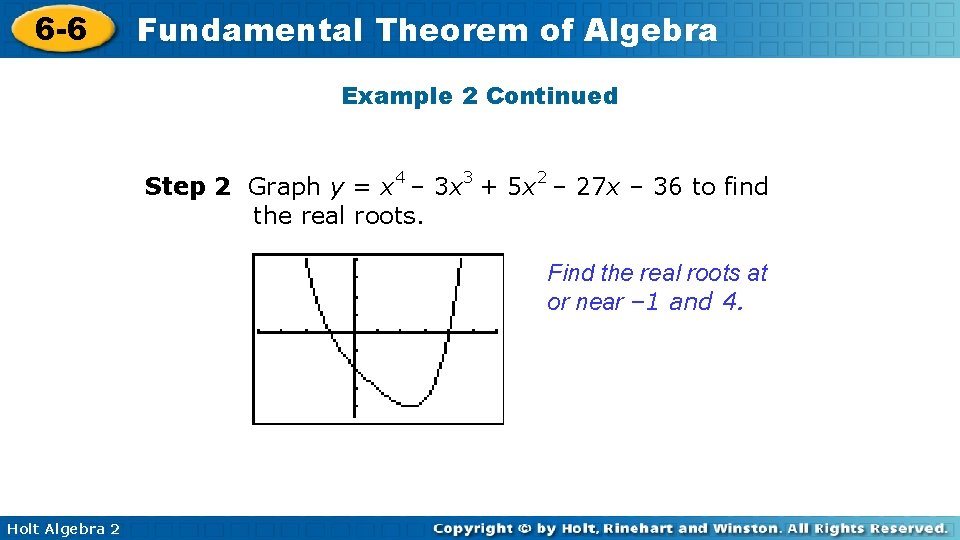
6 -6 Fundamental Theorem of Algebra Example 2 Continued Step 2 Graph y = x 4 – 3 x 3 + 5 x 2 – 27 x – 36 to find the real roots. Find the real roots at or near – 1 and 4. Holt Algebra 2
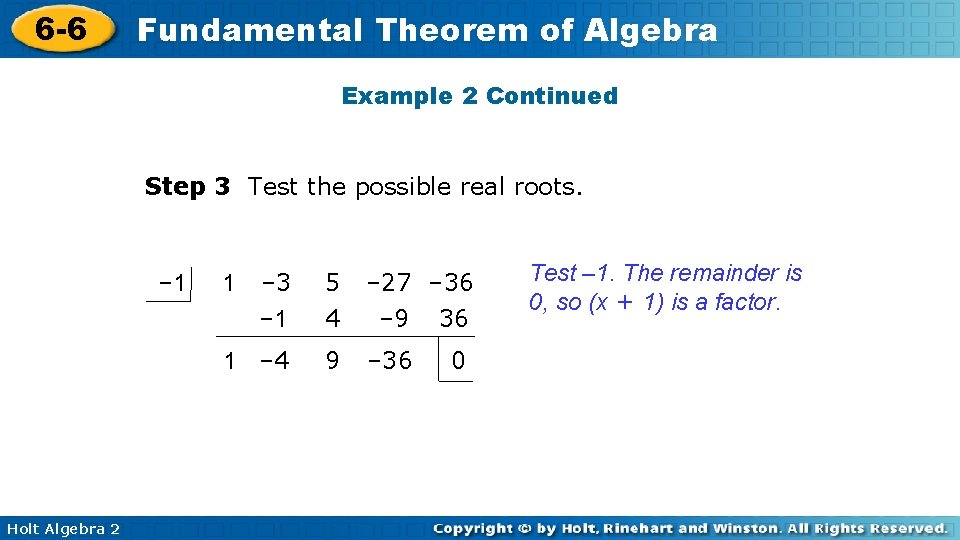
6 -6 Fundamental Theorem of Algebra Example 2 Continued Step 3 Test the possible real roots. – 1 Holt Algebra 2 – 3 – 1 5 4 – 9 36 1 – 4 9 – 36 0 1 – 27 – 36 Test – 1. The remainder is 0, so (x + 1) is a factor.
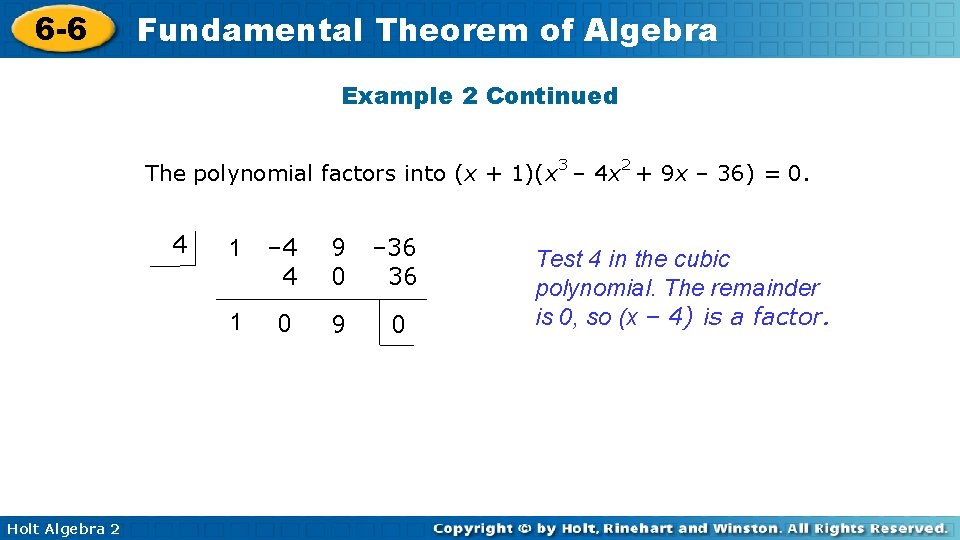
6 -6 Fundamental Theorem of Algebra Example 2 Continued The polynomial factors into (x + 1)(x 3 – 4 x 2 + 9 x – 36) = 0. 4 Holt Algebra 2 1 – 4 4 9 0 – 36 36 1 0 9 0 Test 4 in the cubic polynomial. The remainder is 0, so (x – 4) is a factor.
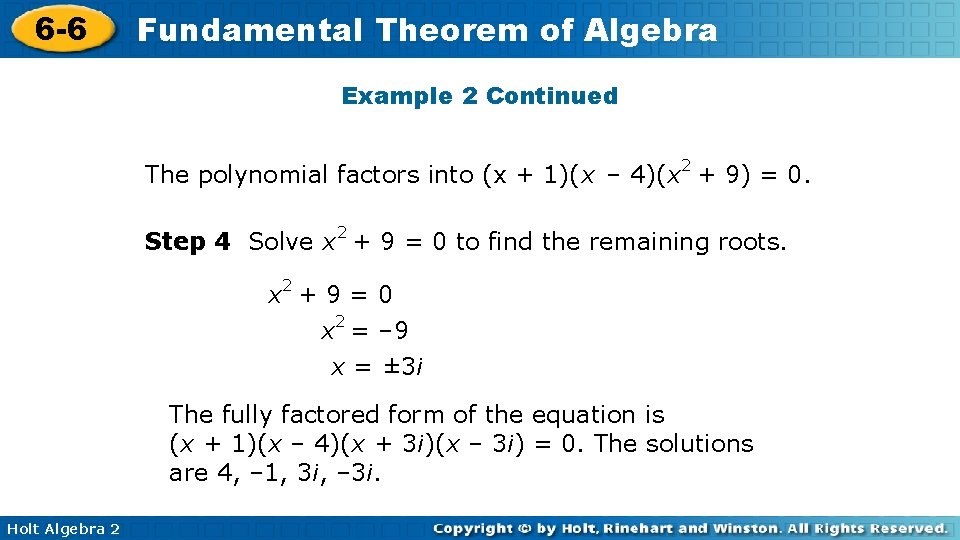
6 -6 Fundamental Theorem of Algebra Example 2 Continued The polynomial factors into (x + 1)(x – 4)(x 2 + 9) = 0. Step 4 Solve x 2 + 9 = 0 to find the remaining roots. x 2 + 9 = 0 x 2 = – 9 x = ± 3 i The fully factored form of the equation is (x + 1)(x – 4)(x + 3 i)(x – 3 i) = 0. The solutions are 4, – 1, 3 i, – 3 i. Holt Algebra 2
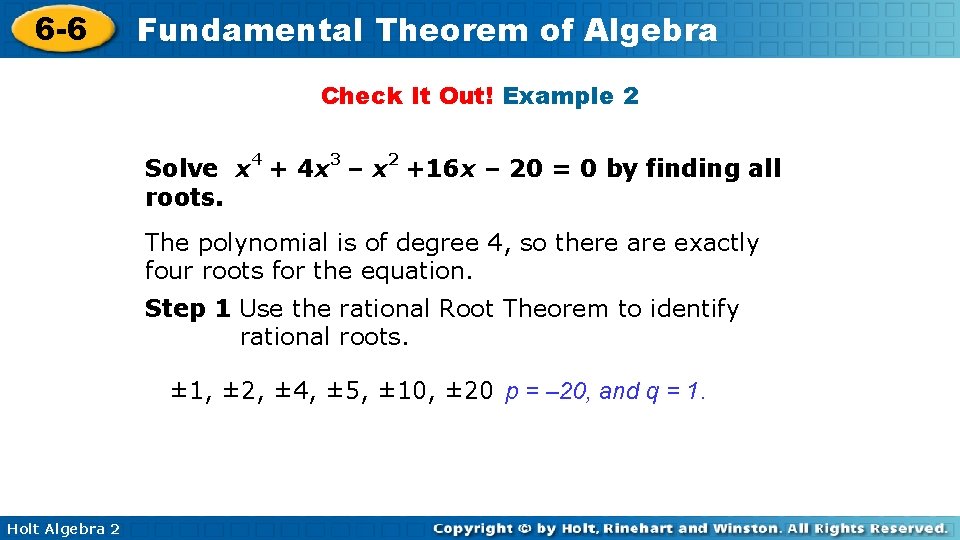
6 -6 Fundamental Theorem of Algebra Check It Out! Example 2 Solve x 4 + 4 x 3 – x 2 +16 x – 20 = 0 by finding all roots. The polynomial is of degree 4, so there are exactly four roots for the equation. Step 1 Use the rational Root Theorem to identify rational roots. ± 1, ± 2, ± 4, ± 5, ± 10, ± 20 p = – 20, and q = 1. Holt Algebra 2
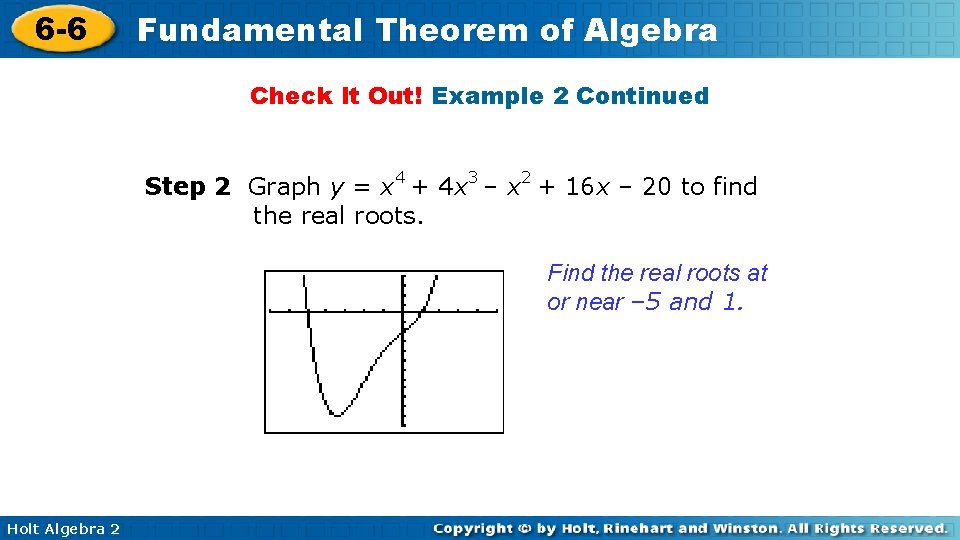
6 -6 Fundamental Theorem of Algebra Check It Out! Example 2 Continued Step 2 Graph y = x 4 + 4 x 3 – x 2 + 16 x – 20 to find the real roots. Find the real roots at or near – 5 and 1. Holt Algebra 2
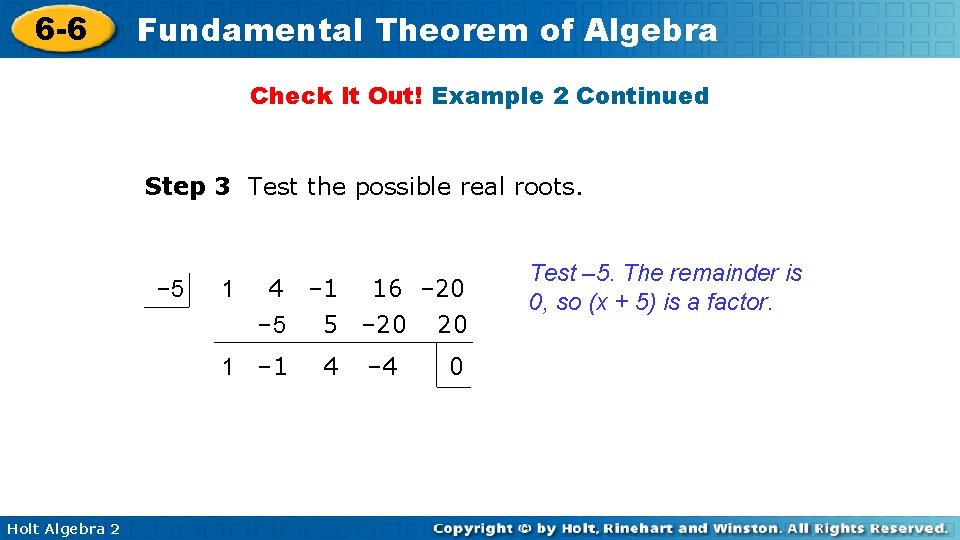
6 -6 Fundamental Theorem of Algebra Check It Out! Example 2 Continued Step 3 Test the possible real roots. – 5 1 4 – 1 16 – 20 – 5 5 – 20 20 1 – 1 Holt Algebra 2 4 – 4 0 Test – 5. The remainder is 0, so (x + 5) is a factor.
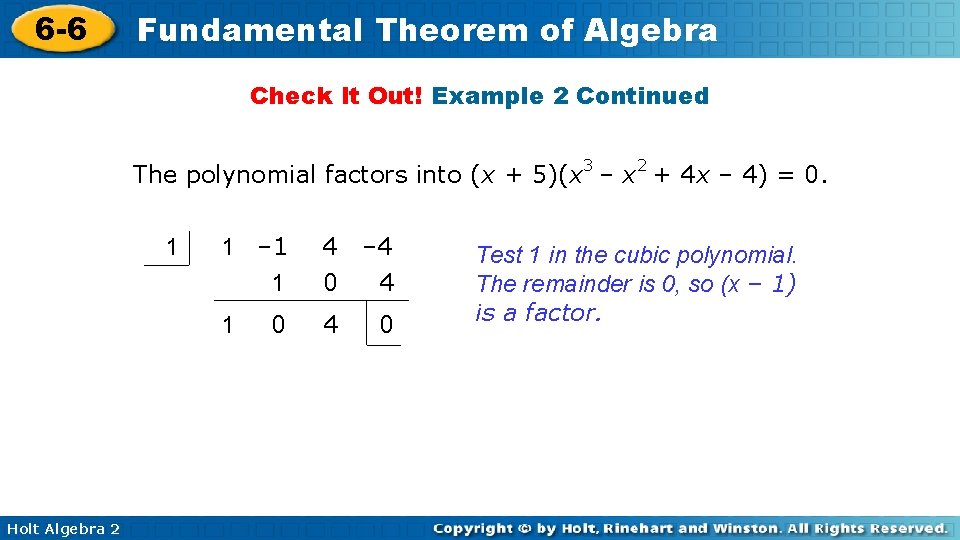
6 -6 Fundamental Theorem of Algebra Check It Out! Example 2 Continued The polynomial factors into (x + 5)(x 3 – x 2 + 4 x – 4) = 0. 1 1 – 1 1 4 – 4 0 4 0 1 Holt Algebra 2 Test 1 in the cubic polynomial. The remainder is 0, so (x – 1) is a factor.
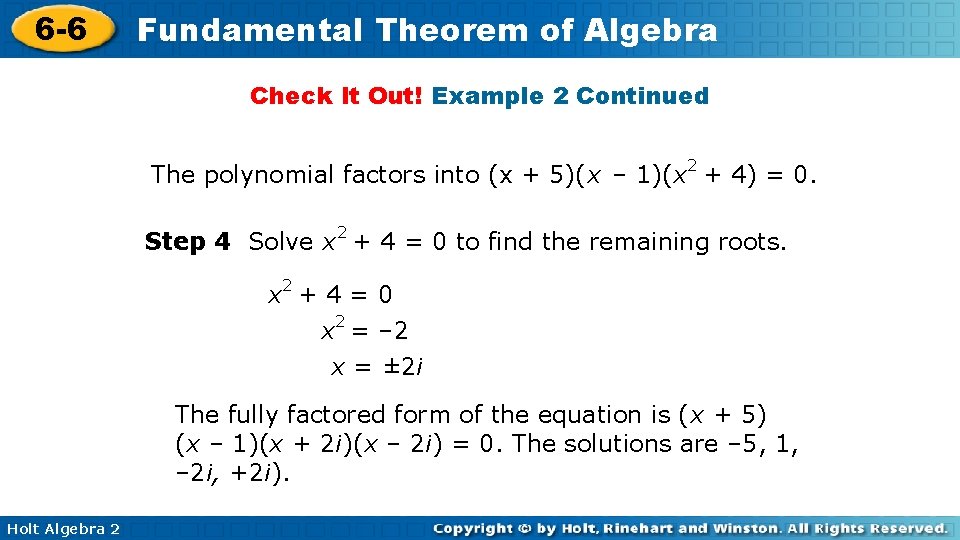
6 -6 Fundamental Theorem of Algebra Check It Out! Example 2 Continued The polynomial factors into (x + 5)(x – 1)(x 2 + 4) = 0. Step 4 Solve x 2 + 4 = 0 to find the remaining roots. x 2 + 4 = 0 x 2 = – 2 x = ± 2 i The fully factored form of the equation is (x + 5) (x – 1)(x + 2 i)(x – 2 i) = 0. The solutions are – 5, 1, – 2 i, +2 i). Holt Algebra 2
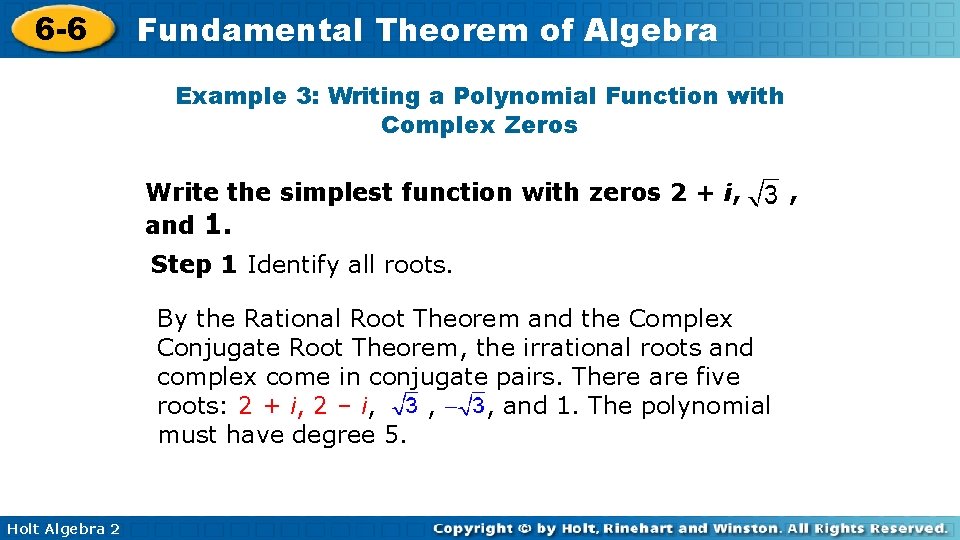
6 -6 Fundamental Theorem of Algebra Example 3: Writing a Polynomial Function with Complex Zeros Write the simplest function with zeros 2 + i, and 1. Step 1 Identify all roots. By the Rational Root Theorem and the Complex Conjugate Root Theorem, the irrational roots and complex come in conjugate pairs. There are five roots: 2 + i, 2 – i, , , and 1. The polynomial must have degree 5. Holt Algebra 2 ,
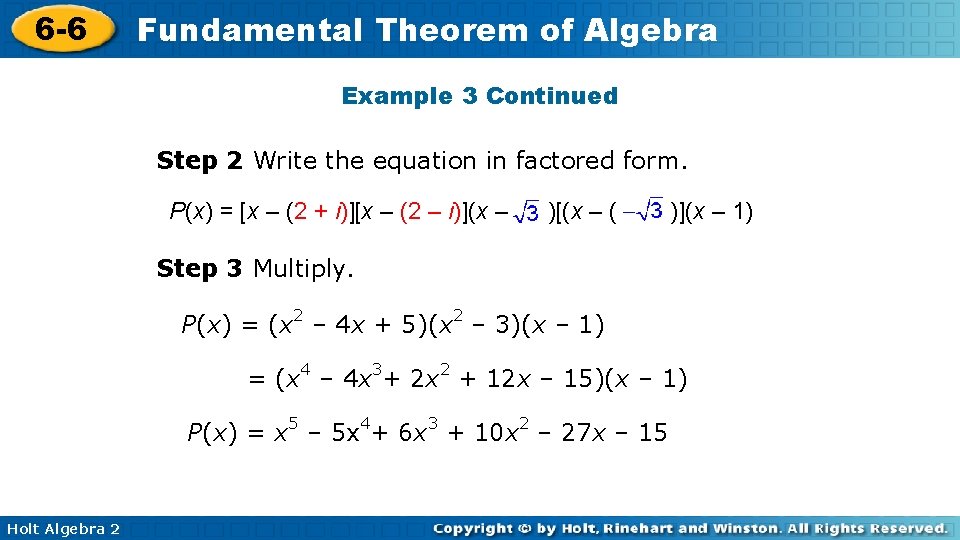
6 -6 Fundamental Theorem of Algebra Example 3 Continued Step 2 Write the equation in factored form. P(x) = [x – (2 + i)][x – (2 – i)](x – )[(x – ( )](x – 1) Step 3 Multiply. P(x) = (x 2 – 4 x + 5)(x 2 – 3)(x – 1) = (x 4 – 4 x 3+ 2 x 2 + 12 x – 15)(x – 1) P(x) = x 5 – 5 x 4+ 6 x 3 + 10 x 2 – 27 x – 15 Holt Algebra 2
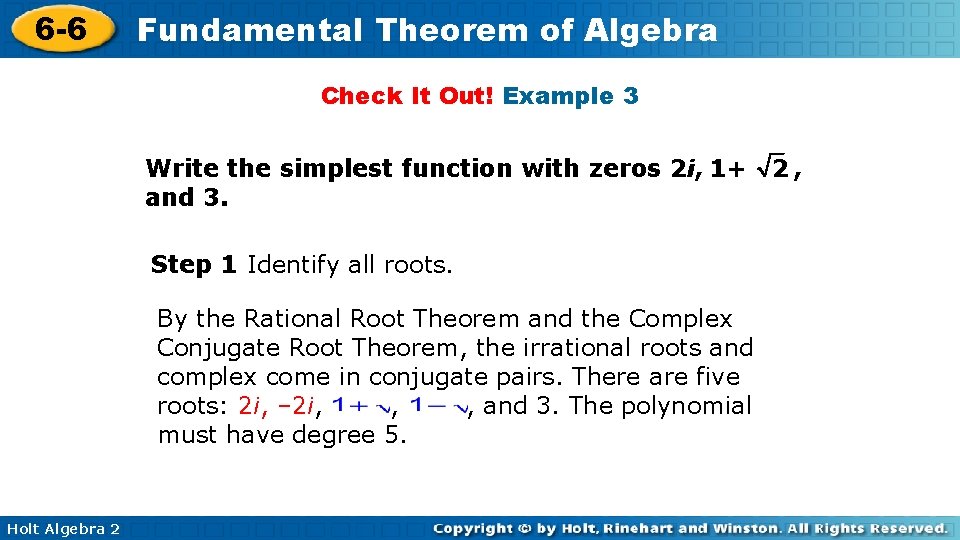
6 -6 Fundamental Theorem of Algebra Check It Out! Example 3 Write the simplest function with zeros 2 i, 1+ and 3. Step 1 Identify all roots. By the Rational Root Theorem and the Complex Conjugate Root Theorem, the irrational roots and complex come in conjugate pairs. There are five roots: 2 i, – 2 i, , , and 3. The polynomial must have degree 5. Holt Algebra 2 2,
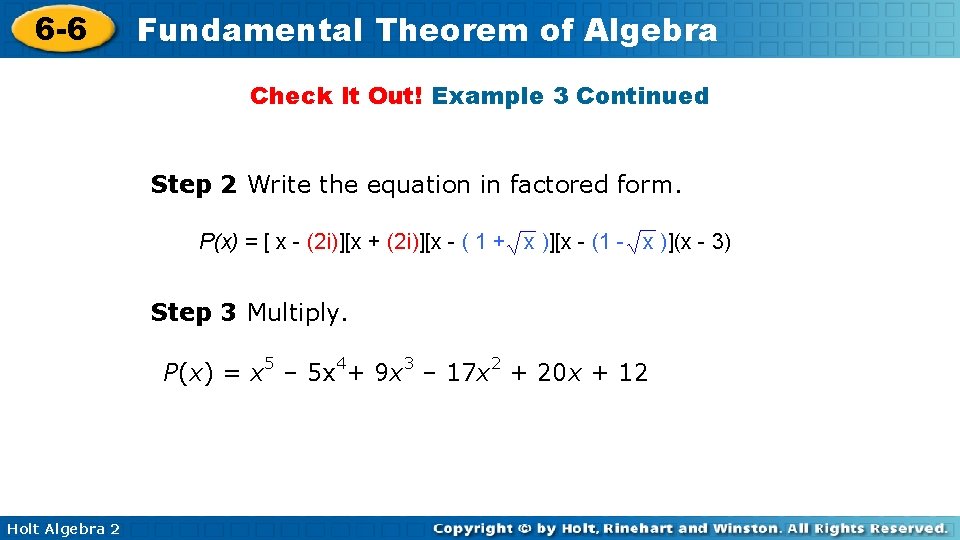
6 -6 Fundamental Theorem of Algebra Check It Out! Example 3 Continued Step 2 Write the equation in factored form. P(x) = [ x - (2 i)][x + (2 i)][x - ( 1 + x )][x - (1 - x )](x - 3) Step 3 Multiply. P(x) = x 5 – 5 x 4+ 9 x 3 – 17 x 2 + 20 x + 12 Holt Algebra 2
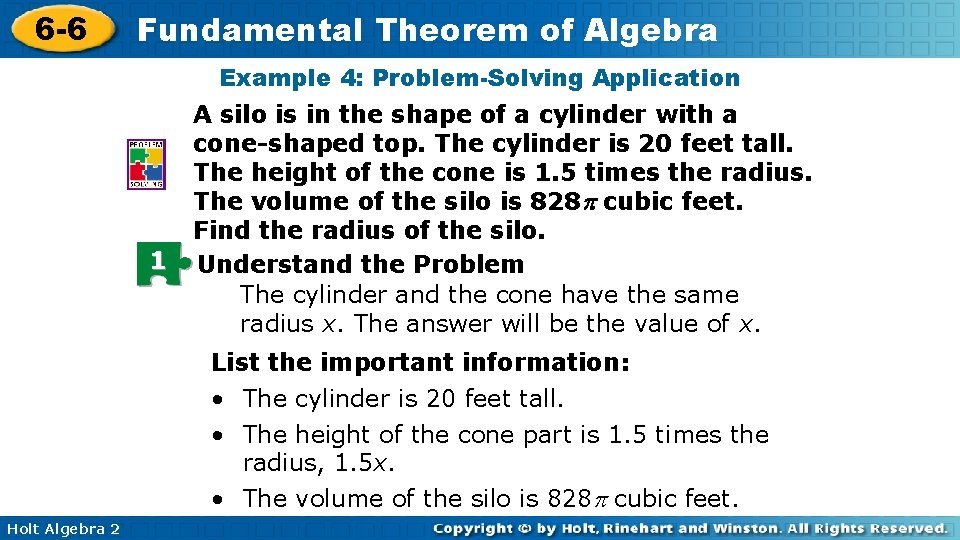
6 -6 Fundamental Theorem of Algebra Example 4: Problem-Solving Application 1 A silo is in the shape of a cylinder with a cone-shaped top. The cylinder is 20 feet tall. The height of the cone is 1. 5 times the radius. The volume of the silo is 828 cubic feet. Find the radius of the silo. Understand the Problem The cylinder and the cone have the same radius x. The answer will be the value of x. List the important information: • The cylinder is 20 feet tall. • The height of the cone part is 1. 5 times the radius, 1. 5 x. • The volume of the silo is 828 cubic feet. Holt Algebra 2
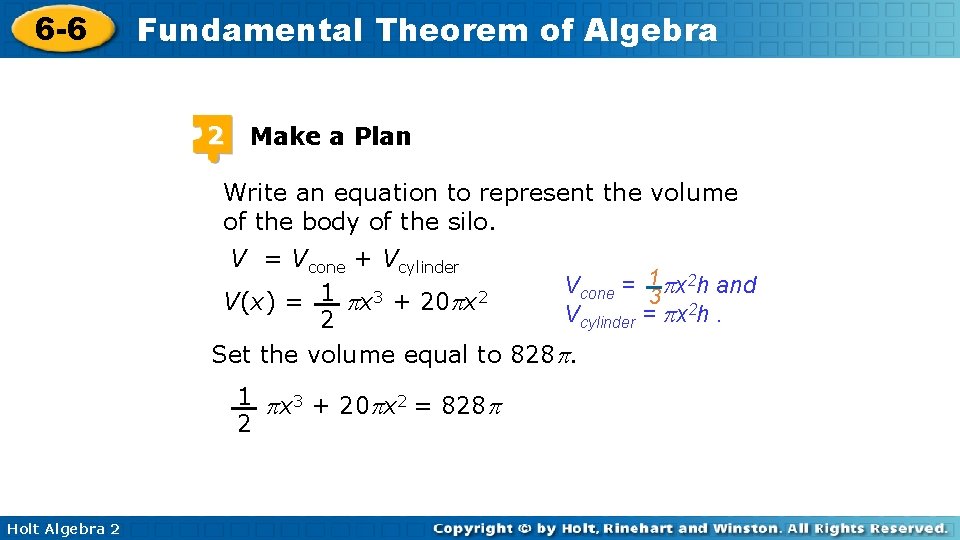
6 -6 Fundamental Theorem of Algebra 2 Make a Plan Write an equation to represent the volume of the body of the silo. V = Vcone + Vcylinder 1 x 2 h and V = cone 3 V(x) = 1 x 3 + 20 x 2 2 h. V = x cylinder 2 Set the volume equal to 828. 1 x 3 + 20 x 2 = 828 2 Holt Algebra 2
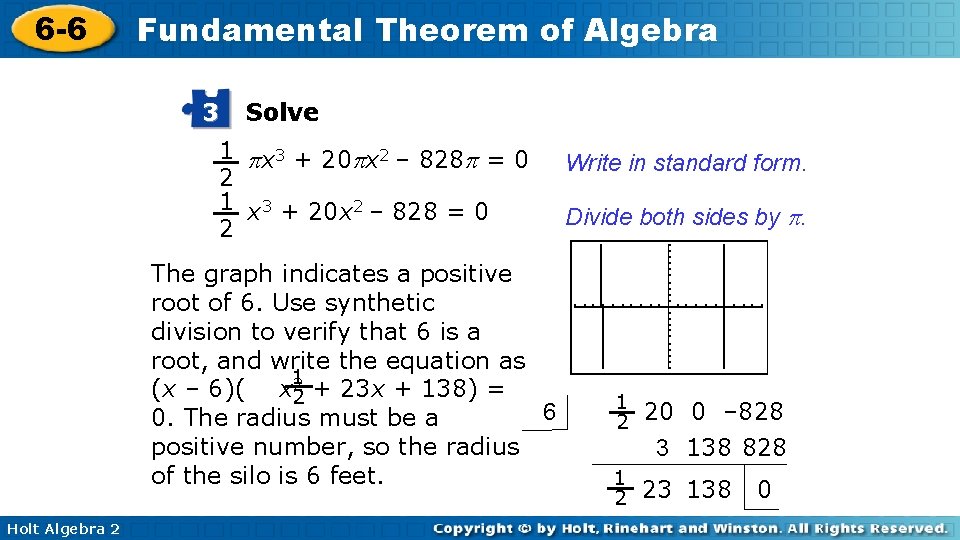
6 -6 Fundamental Theorem of Algebra 3 Solve 1 x 3 + 20 x 2 – 828 = 0 2 1 x 3 + 20 x 2 – 828 = 0 2 The graph indicates a positive root of 6. Use synthetic division to verify that 6 is a root, and write the equation as 1 (x – 6)( x 22 + 23 x + 138) = 6 0. The radius must be a positive number, so the radius of the silo is 6 feet. Holt Algebra 2 Write in standard form. Divide both sides by . 1 2 20 0 – 828 3 138 828 1 2 23 138 0
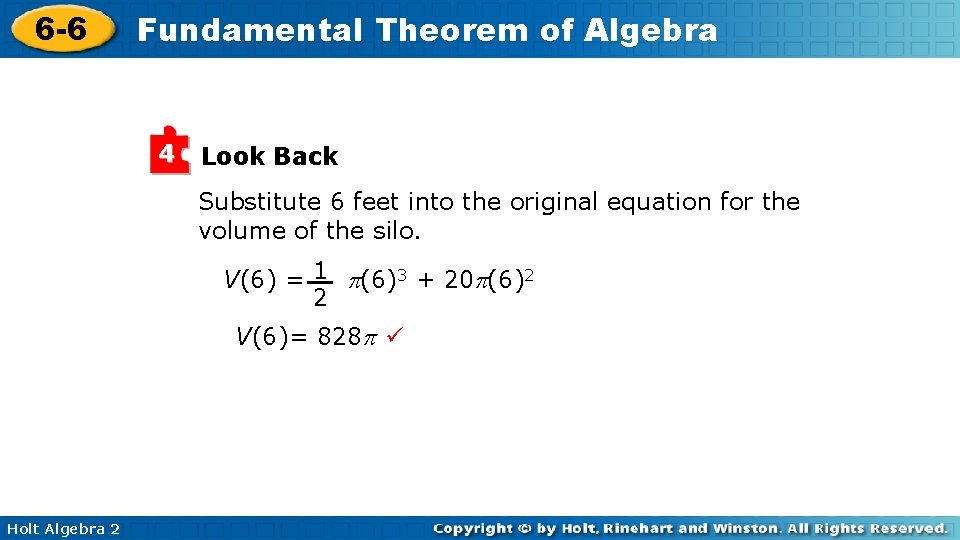
6 -6 Fundamental Theorem of Algebra 4 Look Back Substitute 6 feet into the original equation for the volume of the silo. V(6) = 1 (6)3 + 20 (6)2 2 V(6)= 828 Holt Algebra 2
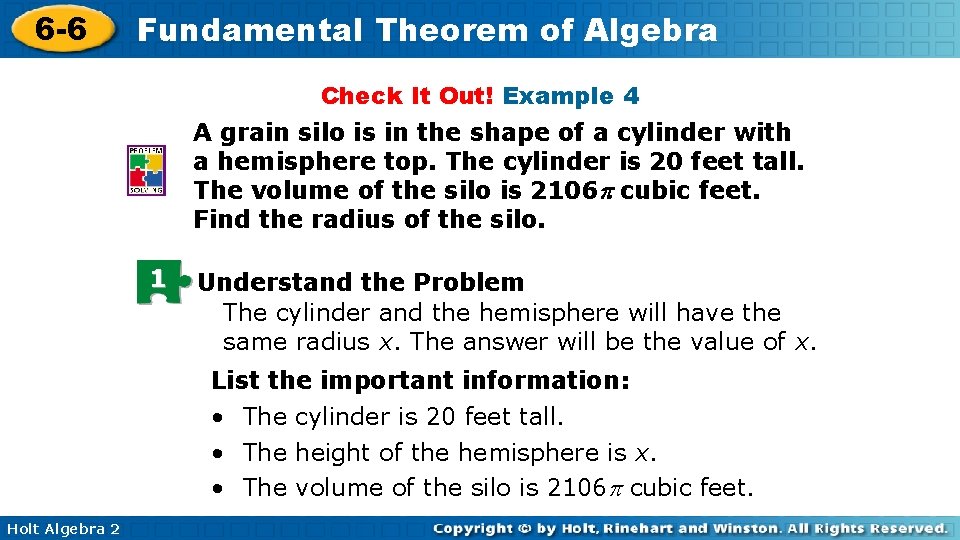
6 -6 Fundamental Theorem of Algebra Check It Out! Example 4 A grain silo is in the shape of a cylinder with a hemisphere top. The cylinder is 20 feet tall. The volume of the silo is 2106 cubic feet. Find the radius of the silo. 1 Understand the Problem The cylinder and the hemisphere will have the same radius x. The answer will be the value of x. List the important information: • The cylinder is 20 feet tall. • The height of the hemisphere is x. • The volume of the silo is 2106 cubic feet. Holt Algebra 2
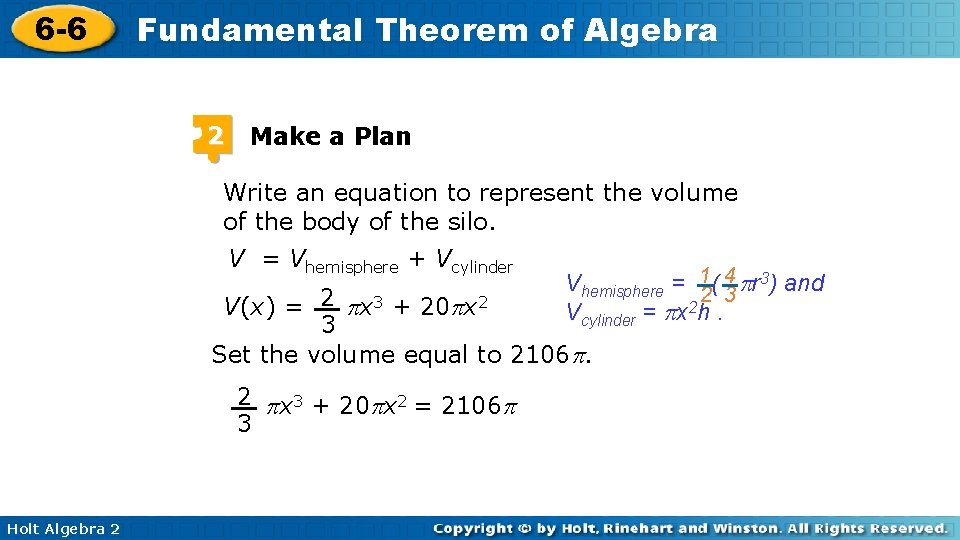
6 -6 Fundamental Theorem of Algebra 2 Make a Plan Write an equation to represent the volume of the body of the silo. V = Vhemisphere + Vcylinder Vhemisphere = 12( 43 r 3) and Vcylinder = x 2 h. V(x) = 2 x 3 + 20 x 2 3 Set the volume equal to 2106. 2 x 3 + 20 x 2 = 2106 3 Holt Algebra 2
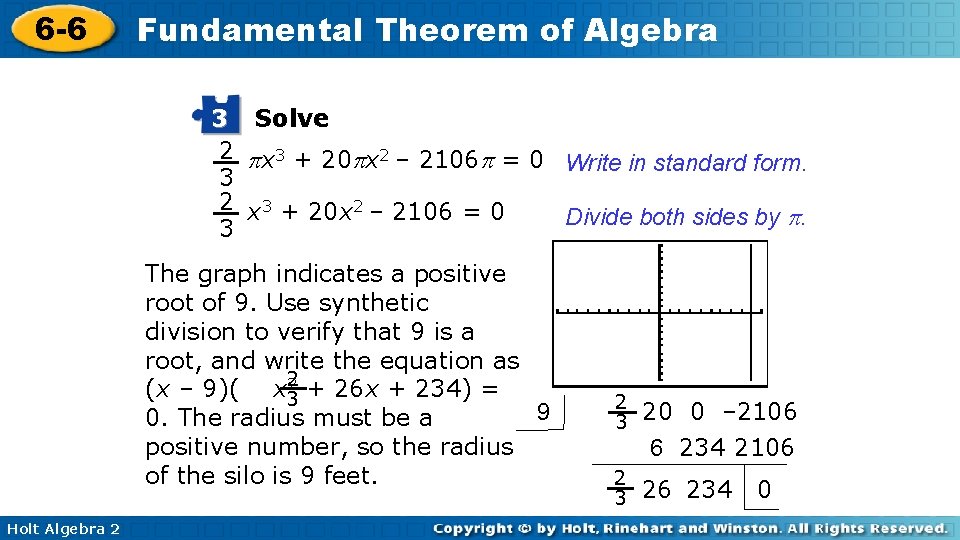
6 -6 Fundamental Theorem of Algebra 3 Solve 2 x 3 + 20 x 2 – 2106 = 0 Write in standard form. 3 2 x 3 + 20 x 2 – 2106 = 0 Divide both sides by . 3 The graph indicates a positive root of 9. Use synthetic division to verify that 9 is a root, and write the equation as 2 + 26 x + 234) = (x – 9)( x 2 3 9 0. The radius must be a positive number, so the radius of the silo is 9 feet. Holt Algebra 2 2 3 20 0 – 2106 6 234 2106 2 3 26 234 0
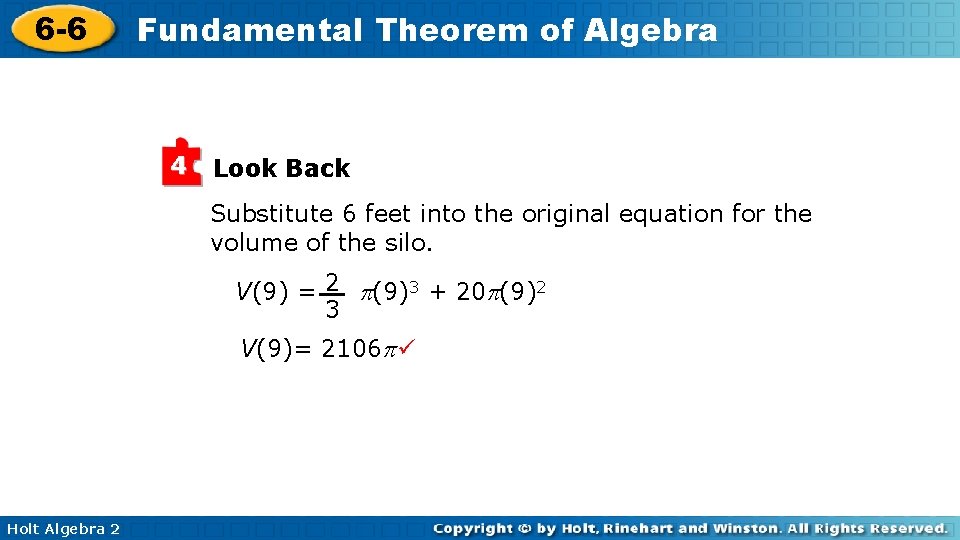
6 -6 Fundamental Theorem of Algebra 4 Look Back Substitute 6 feet into the original equation for the volume of the silo. V(9) = 2 (9)3 + 20 (9)2 3 V(9)= 2106 Holt Algebra 2
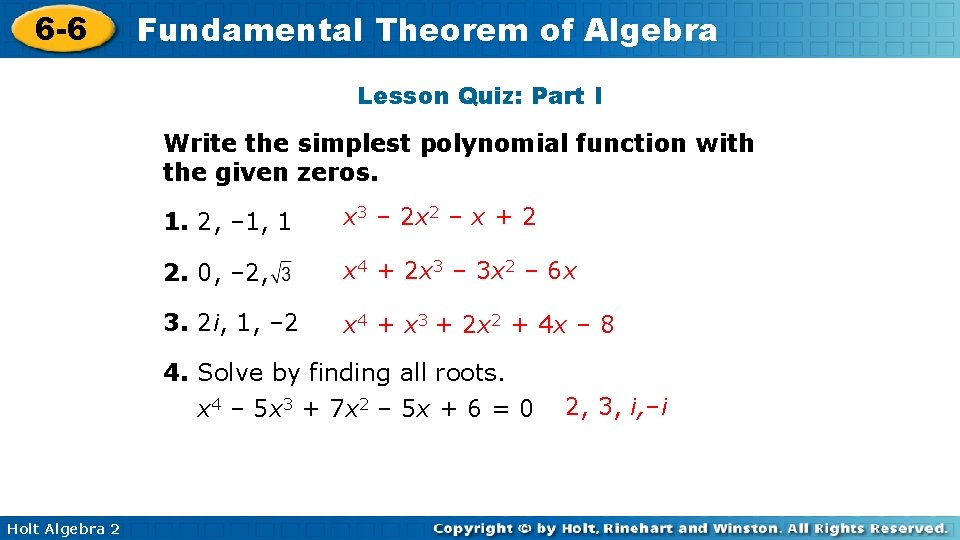
6 -6 Fundamental Theorem of Algebra Lesson Quiz: Part I Write the simplest polynomial function with the given zeros. 1. 2, – 1, 1 x 3 – 2 x 2 – x + 2 2. 0, – 2, x 4 + 2 x 3 – 3 x 2 – 6 x 3. 2 i, 1, – 2 x 4 + x 3 + 2 x 2 + 4 x – 8 4. Solve by finding all roots. x 4 – 5 x 3 + 7 x 2 – 5 x + 6 = 0 Holt Algebra 2 2, 3, i, –i
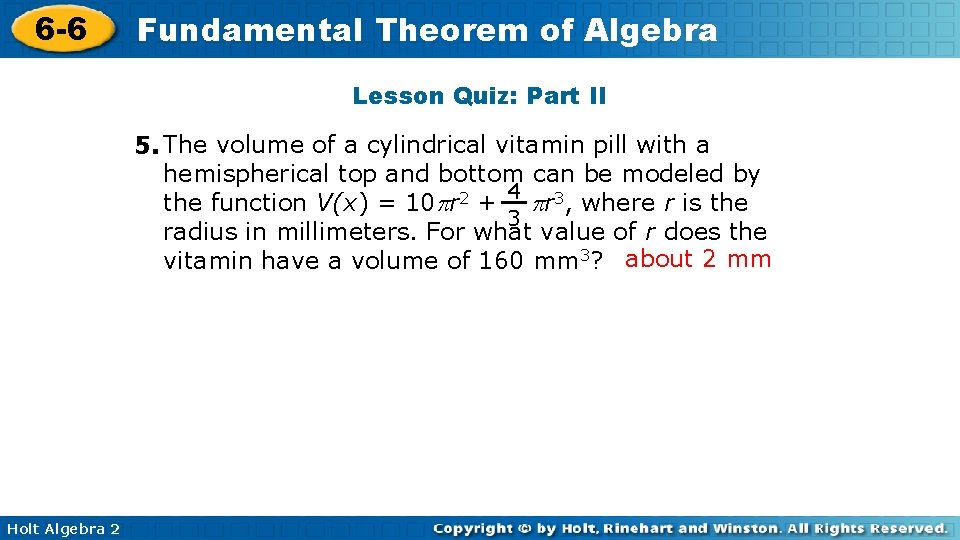
6 -6 Fundamental Theorem of Algebra Lesson Quiz: Part II 5. The volume of a cylindrical vitamin pill with a hemispherical top and bottom can be modeled by the function V(x) = 10 r 2 + 4 r 3, where r is the 3 radius in millimeters. For what value of r does the vitamin have a volume of 160 mm 3? about 2 mm Holt Algebra 2
- Slides: 52