
6 6 Division of Polynomials n Dividing by
6. 6 Division of Polynomials n Dividing by a Monomial n Dividing by a Polynomial Copyright © 2006 Pearson Education, Inc. Publishing as Pearson Addison-Wesley
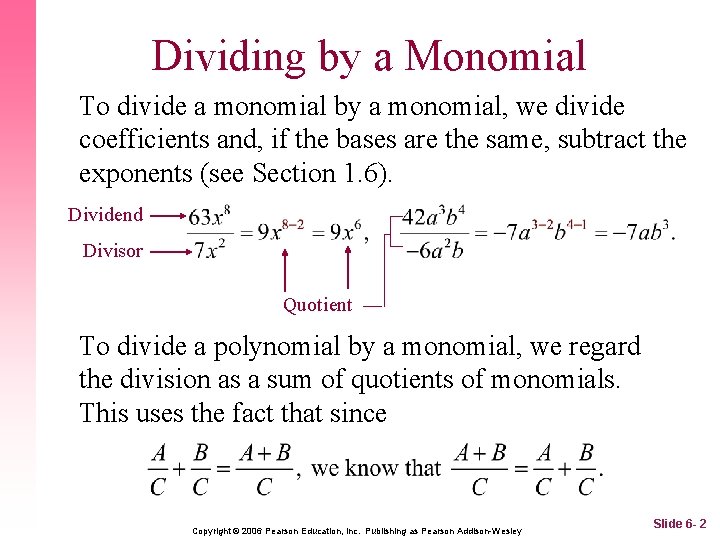
Dividing by a Monomial To divide a monomial by a monomial, we divide coefficients and, if the bases are the same, subtract the exponents (see Section 1. 6). Dividend Divisor Quotient To divide a polynomial by a monomial, we regard the division as a sum of quotients of monomials. This uses the fact that since Copyright © 2006 Pearson Education, Inc. Publishing as Pearson Addison-Wesley Slide 6 - 2
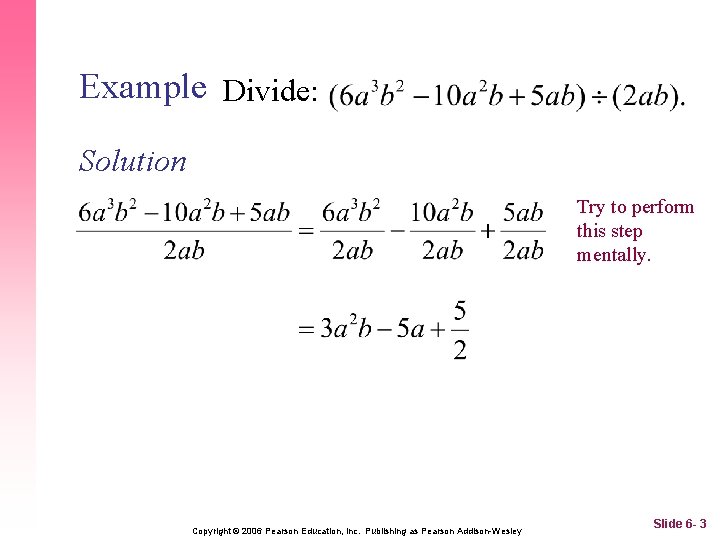
Example Divide: Solution Try to perform this step mentally. Copyright © 2006 Pearson Education, Inc. Publishing as Pearson Addison-Wesley Slide 6 - 3
Division by a Monomial To divide a polynomial by a monomial, divide each term of the polynomial by the monomial. Copyright © 2006 Pearson Education, Inc. Publishing as Pearson Addison-Wesley Slide 6 - 4
Dividing by a Polynomial When the divisor has more than one term, we use a procedure very similar to long division in arithmetic. Copyright © 2006 Pearson Education, Inc. Publishing as Pearson Addison-Wesley Slide 6 - 5
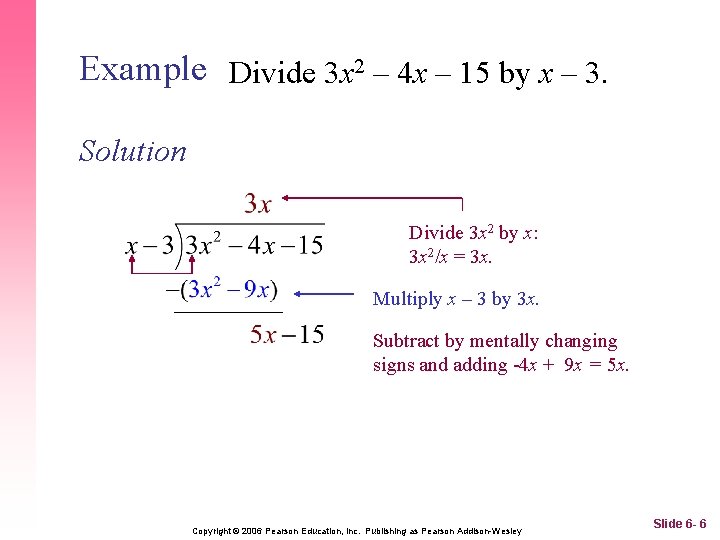
Example Divide 3 x 2 – 4 x – 15 by x – 3. Solution Divide 3 x 2 by x: 3 x 2/x = 3 x. Multiply x – 3 by 3 x. Subtract by mentally changing signs and adding -4 x + 9 x = 5 x. Copyright © 2006 Pearson Education, Inc. Publishing as Pearson Addison-Wesley Slide 6 - 6
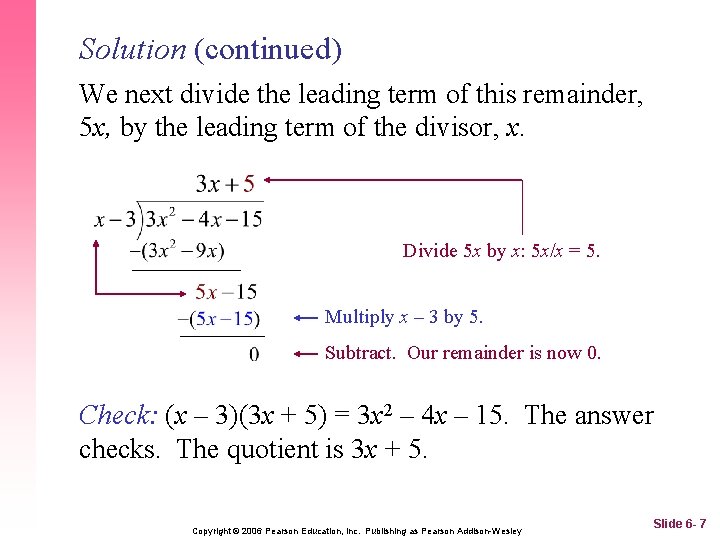
Solution (continued) We next divide the leading term of this remainder, 5 x, by the leading term of the divisor, x. Divide 5 x by x: 5 x/x = 5. Multiply x – 3 by 5. Subtract. Our remainder is now 0. Check: (x – 3)(3 x + 5) = 3 x 2 – 4 x – 15. The answer checks. The quotient is 3 x + 5. Copyright © 2006 Pearson Education, Inc. Publishing as Pearson Addison-Wesley Slide 6 - 7
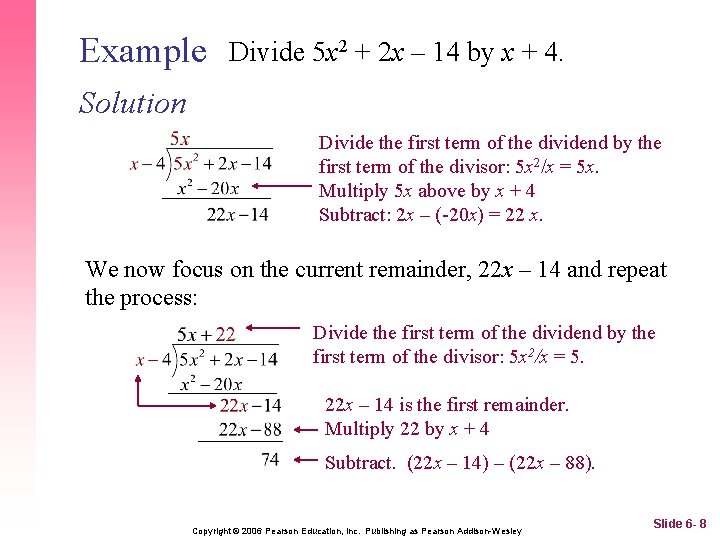
Example Divide 5 x 2 + 2 x – 14 by x + 4. Solution Divide the first term of the dividend by the first term of the divisor: 5 x 2/x = 5 x. Multiply 5 x above by x + 4 Subtract: 2 x – (-20 x) = 22 x. We now focus on the current remainder, 22 x – 14 and repeat the process: Divide the first term of the dividend by the first term of the divisor: 5 x 2/x = 5. 22 x – 14 is the first remainder. Multiply 22 by x + 4 Subtract. (22 x – 14) – (22 x – 88). Copyright © 2006 Pearson Education, Inc. Publishing as Pearson Addison-Wesley Slide 6 - 8
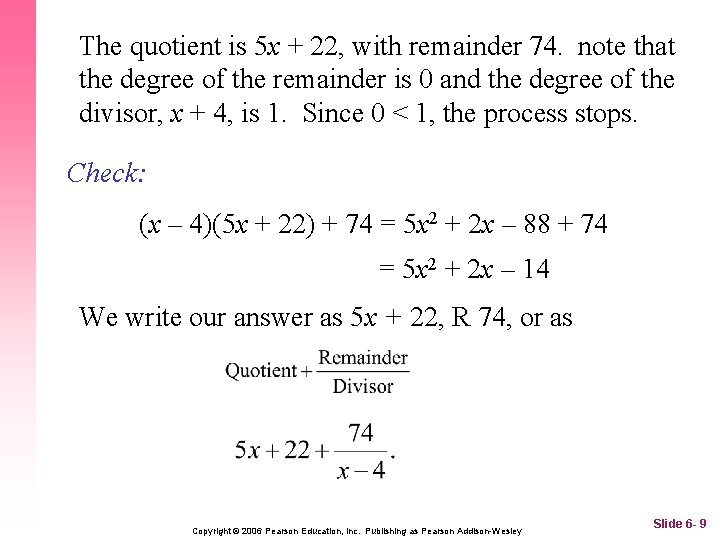
The quotient is 5 x + 22, with remainder 74. note that the degree of the remainder is 0 and the degree of the divisor, x + 4, is 1. Since 0 < 1, the process stops. Check: (x – 4)(5 x + 22) + 74 = 5 x 2 + 2 x – 88 + 74 = 5 x 2 + 2 x – 14 We write our answer as 5 x + 22, R 74, or as Copyright © 2006 Pearson Education, Inc. Publishing as Pearson Addison-Wesley Slide 6 - 9
Tips for Dividing Polynomials 1. Arrange polynomials in descending order. 2. If there are missing terms in the dividend, either write them with 0 coefficients or leave space for them. 3. Continue the long division process until the degree of the remainder is less than the degree of the divisor. Copyright © 2006 Pearson Education, Inc. Publishing as Pearson Addison-Wesley Slide 6 - 10
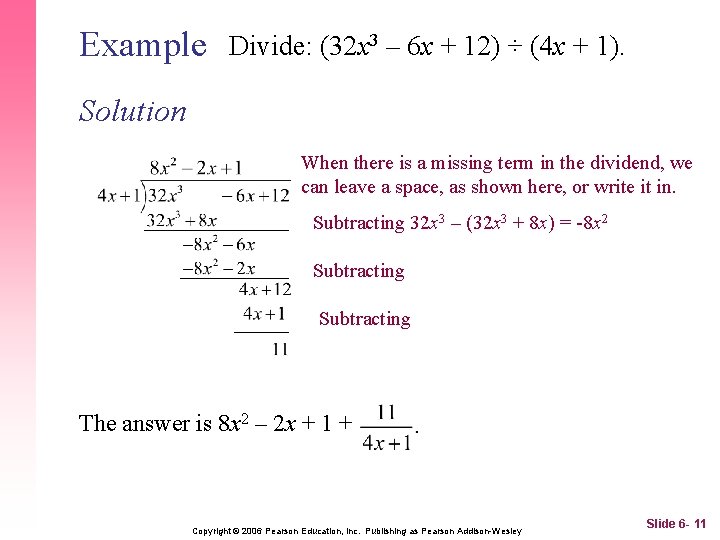
Example Divide: (32 x 3 – 6 x + 12) ÷ (4 x + 1). Solution When there is a missing term in the dividend, we can leave a space, as shown here, or write it in. Subtracting 32 x 3 – (32 x 3 + 8 x) = -8 x 2 Subtracting The answer is 8 x 2 – 2 x + 1 + Copyright © 2006 Pearson Education, Inc. Publishing as Pearson Addison-Wesley Slide 6 - 11
- Slides: 11