
6 6 De Moivres Theorem I Trigonometric Form
- Slides: 22
6. 6 De. Moivre’s Theorem
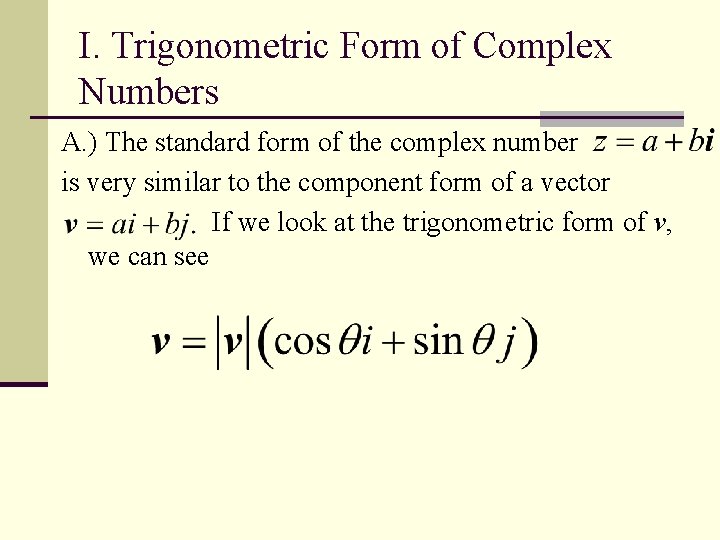
I. Trigonometric Form of Complex Numbers A. ) The standard form of the complex number is very similar to the component form of a vector If we look at the trigonometric form of v, we can see
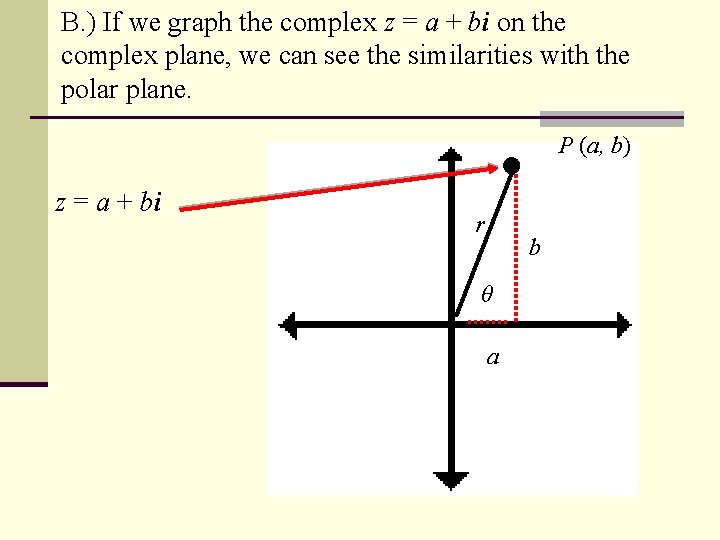
B. ) If we graph the complex z = a + bi on the complex plane, we can see the similarities with the polar plane. P (a, b) z = a + bi r b θ a
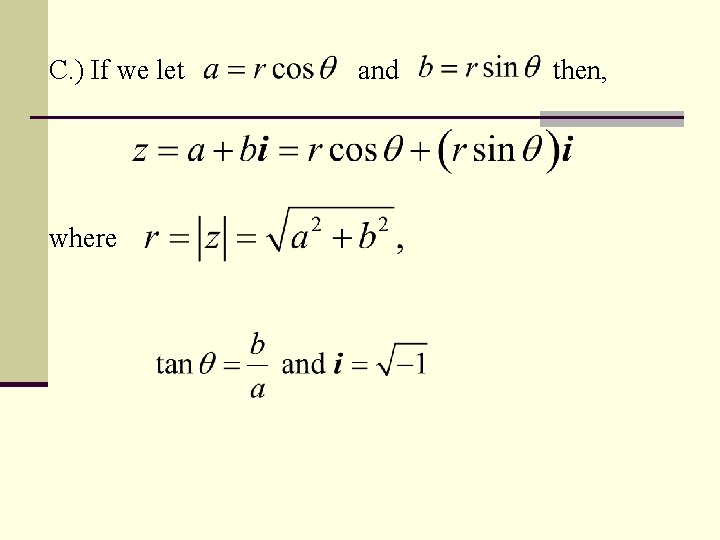
C. ) If we let where and then,
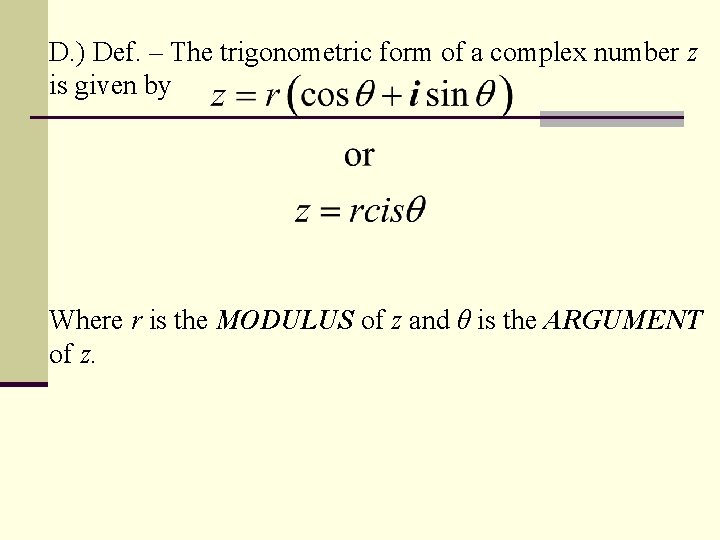
D. ) Def. – The trigonometric form of a complex number z is given by Where r is the MODULUS of z and θ is the ARGUMENT of z.
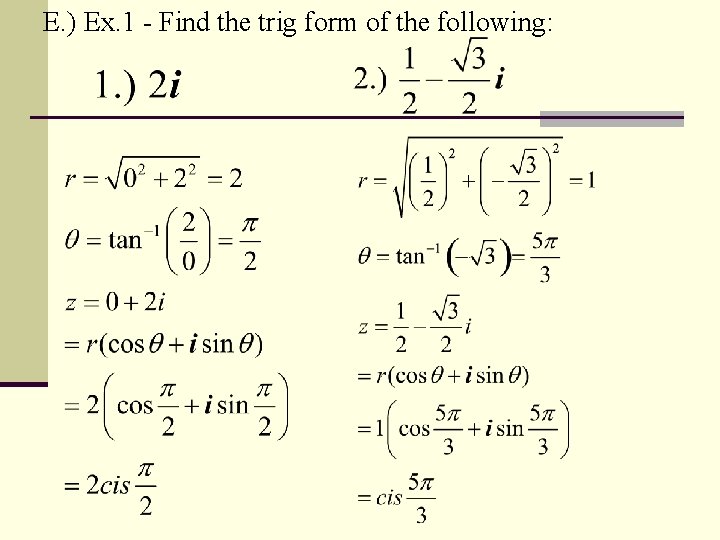
E. ) Ex. 1 - Find the trig form of the following:
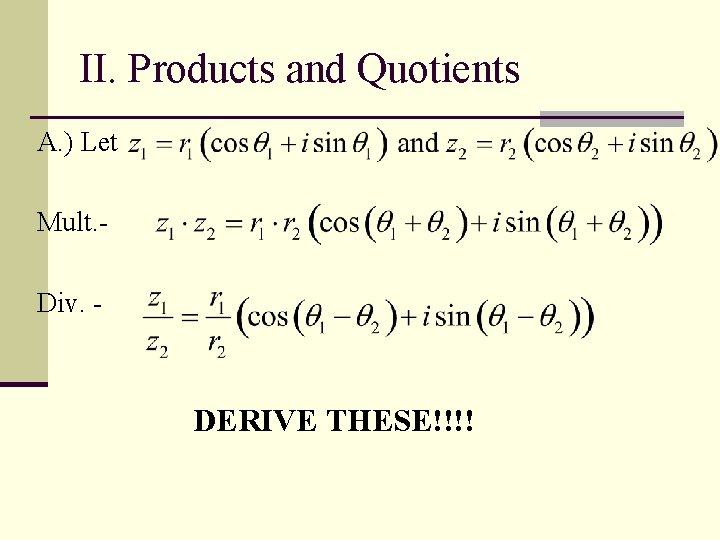
II. Products and Quotients A. ) Let . Mult. Div. - DERIVE THESE!!!!
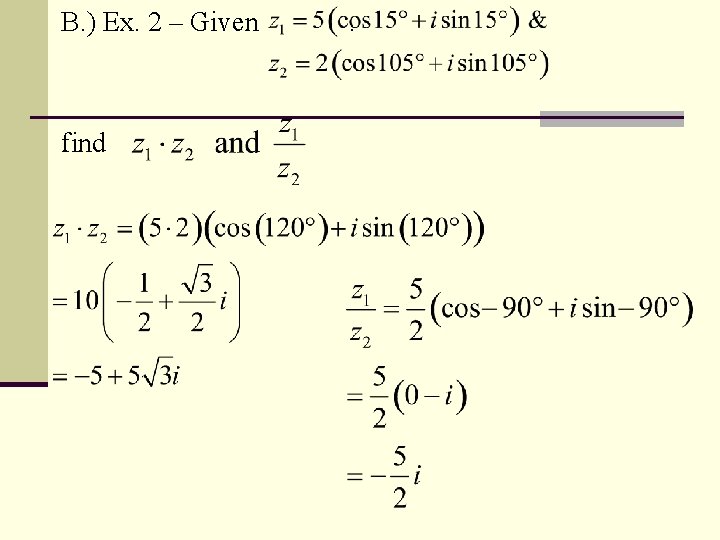
B. ) Ex. 2 – Given find .
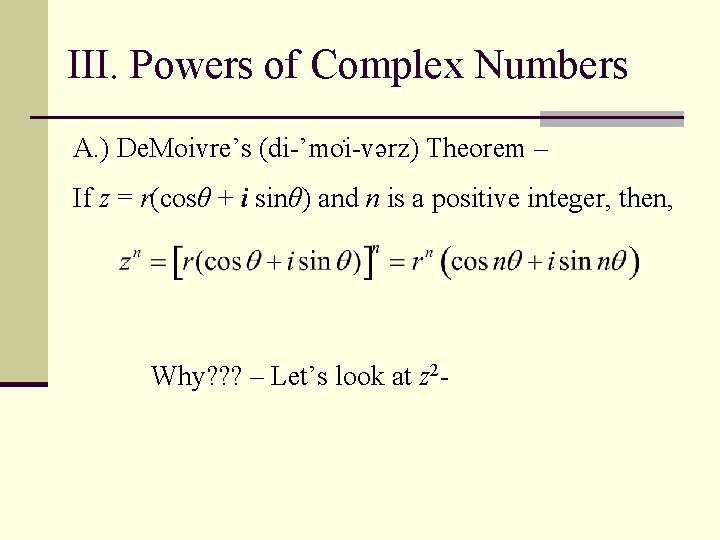
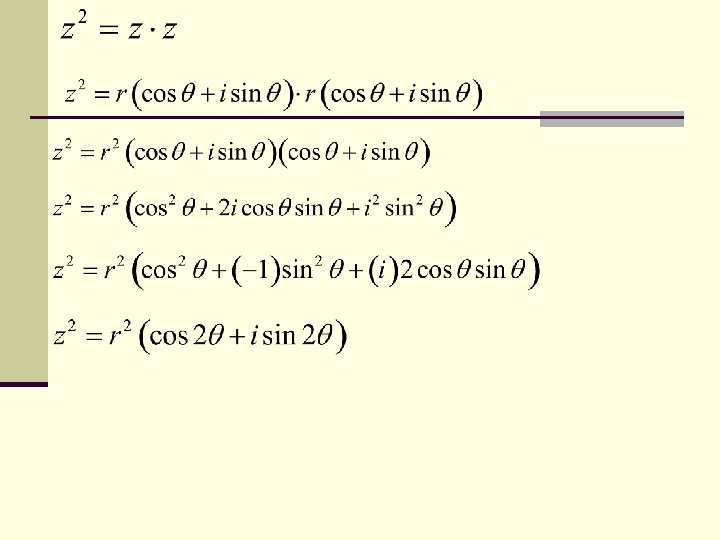
III. Powers of Complex Numbers A. ) De. Moivre’s (di-’mo i-vərz) Theorem – If z = r(cosθ + i sinθ) and n is a positive integer, then, Why? ? ? – Let’s look at z 2 -
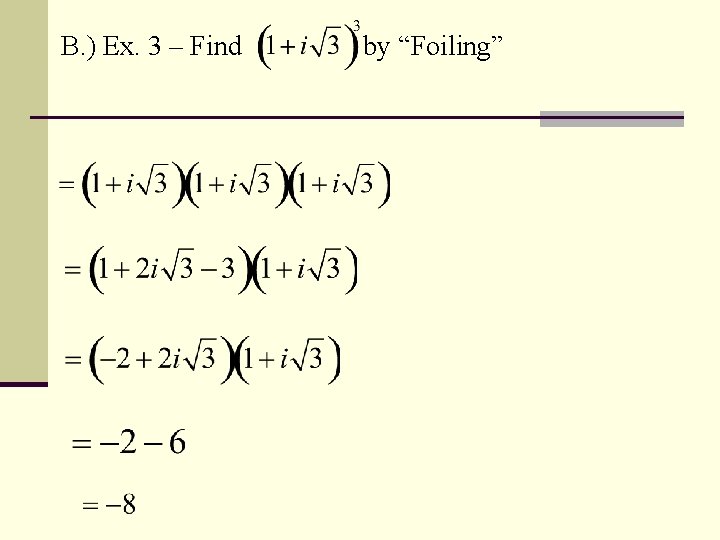
B. ) Ex. 3 – Find by “Foiling”
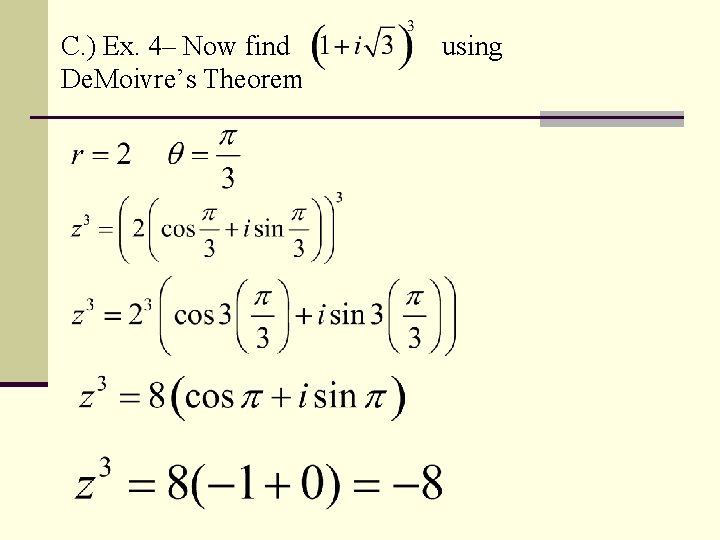
C. ) Ex. 4– Now find De. Moivre’s Theorem using
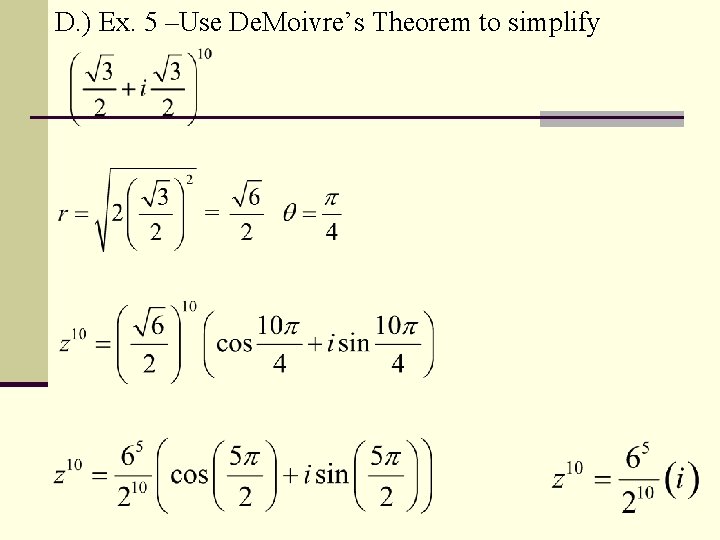
D. ) Ex. 5 –Use De. Moivre’s Theorem to simplify
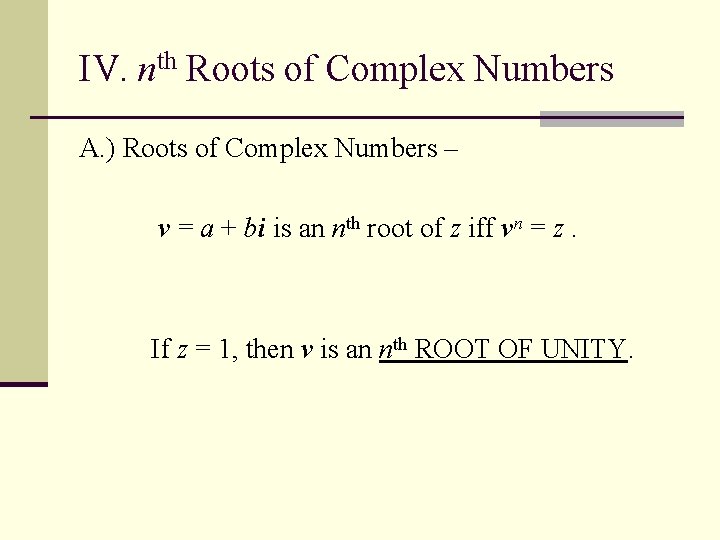
IV. nth Roots of Complex Numbers A. ) Roots of Complex Numbers – v = a + bi is an nth root of z iff vn = z. If z = 1, then v is an nth ROOT OF UNITY.
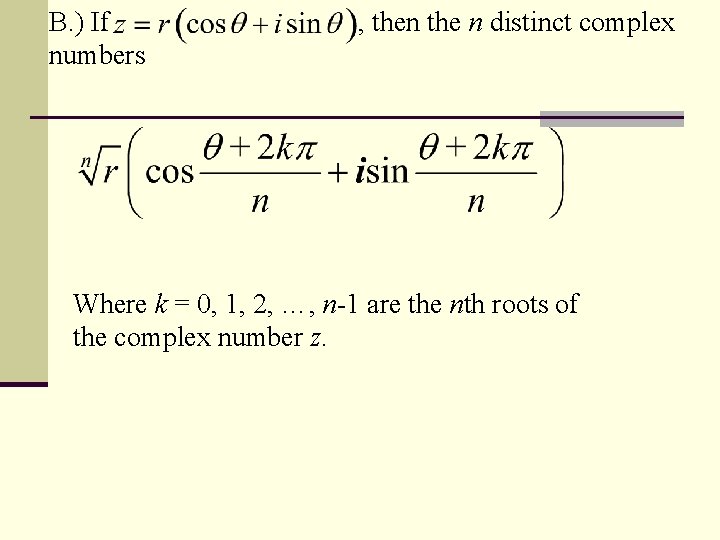
B. ) If numbers , then the n distinct complex Where k = 0, 1, 2, …, n-1 are the nth roots of the complex number z.
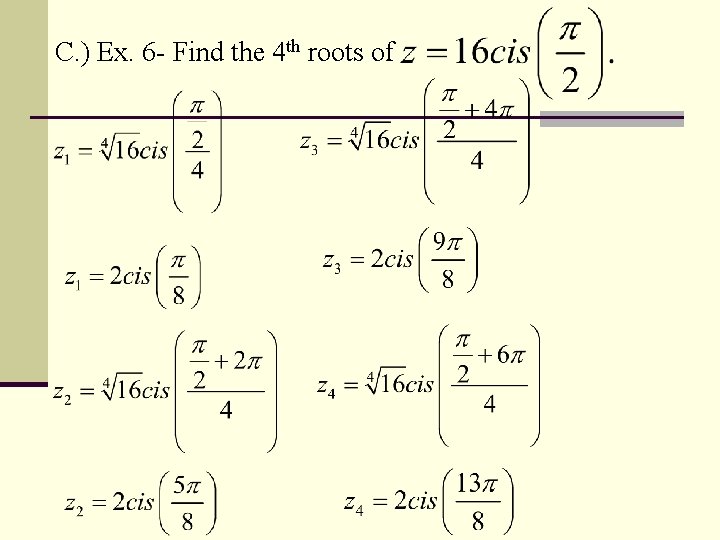
C. ) Ex. 6 - Find the 4 th roots of
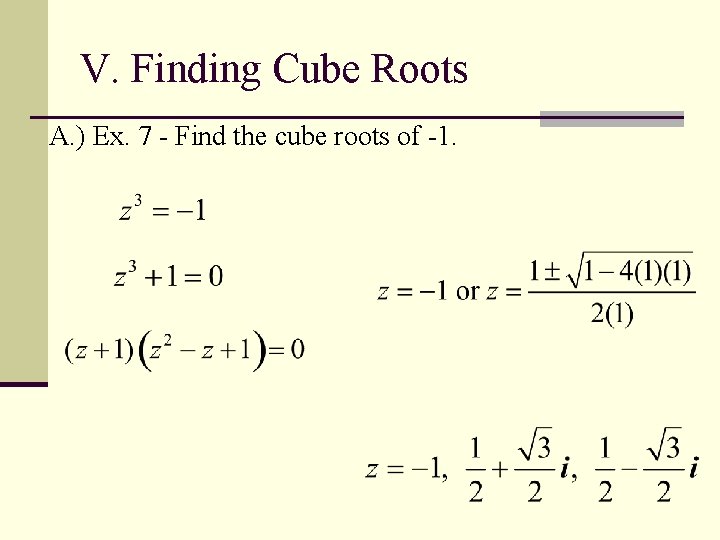
V. Finding Cube Roots A. ) Ex. 7 - Find the cube roots of -1.
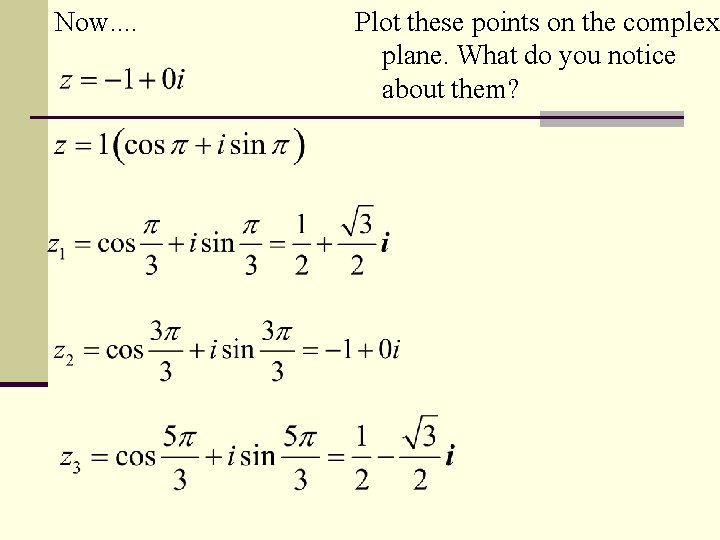
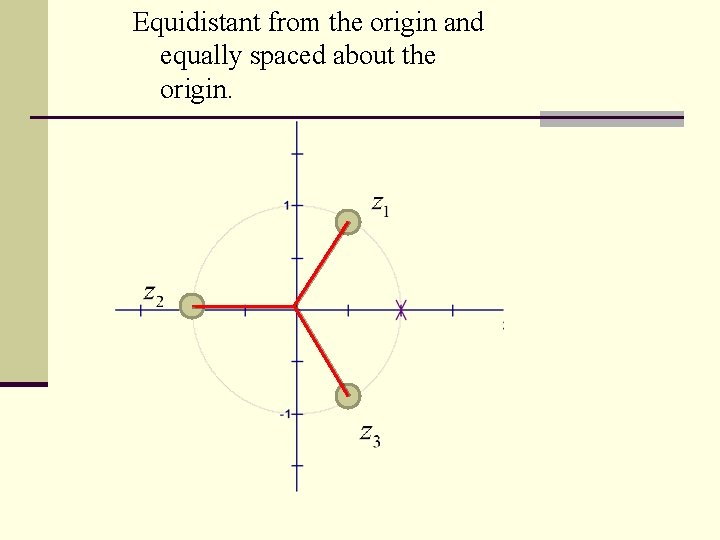
Now. . Plot these points on the complex plane. What do you notice about them?
Equidistant from the origin and equally spaced about the origin.
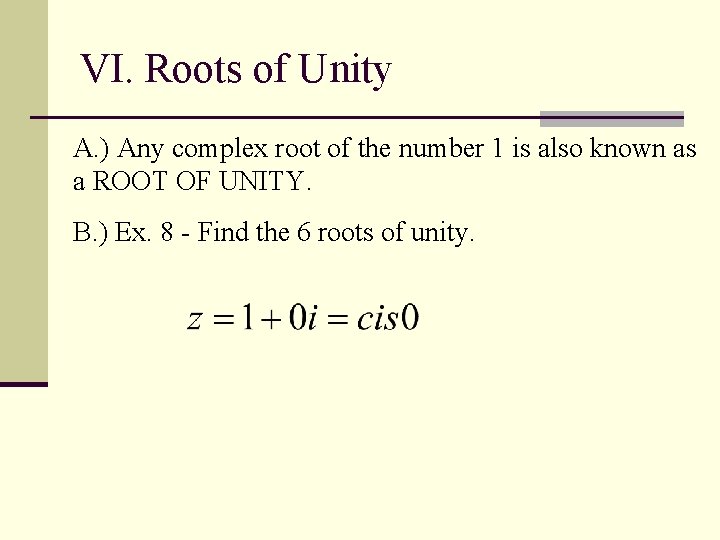
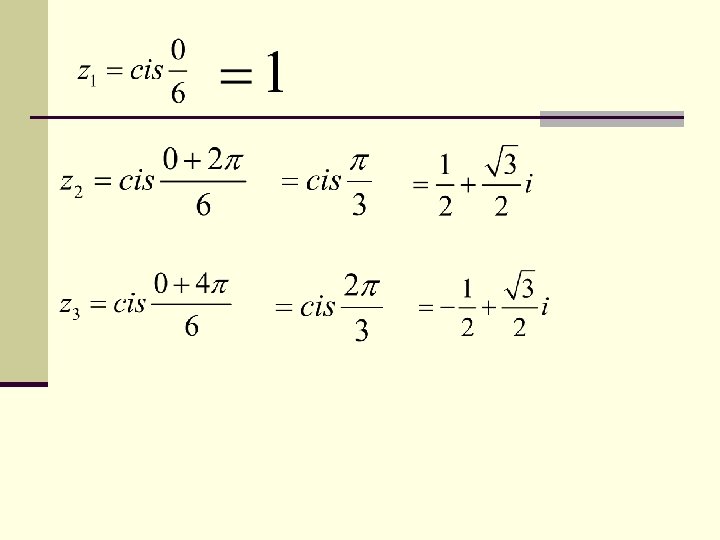
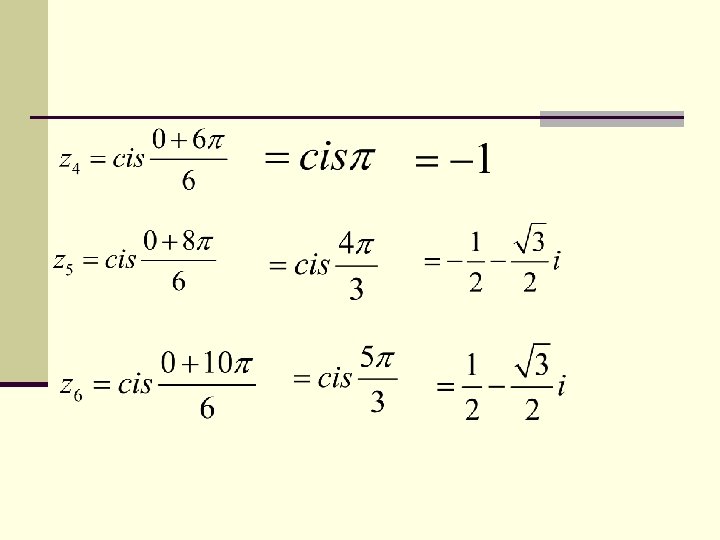
VI. Roots of Unity A. ) Any complex root of the number 1 is also known as a ROOT OF UNITY. B. ) Ex. 8 - Find the 6 roots of unity.