
6 5 Satellite system of the earth Orbital
6. 5 Satellite system of the earth • Orbital motion of satellite • Synchronous satellite and parking orbit • Energy of satellite • Weightlessness © Manhattan Press (H. K. ) Ltd. 1
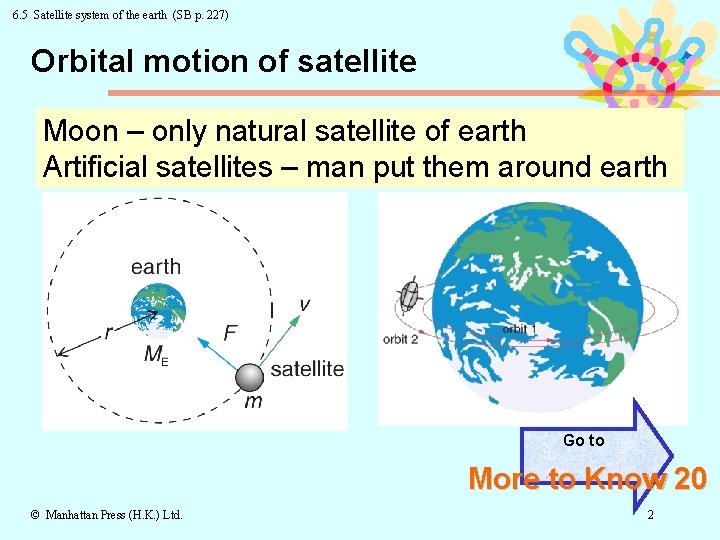
6. 5 Satellite system of the earth (SB p. 227) Orbital motion of satellite Moon – only natural satellite of earth Artificial satellites – man put them around earth Go to More to Know 20 © Manhattan Press (H. K. ) Ltd. 2
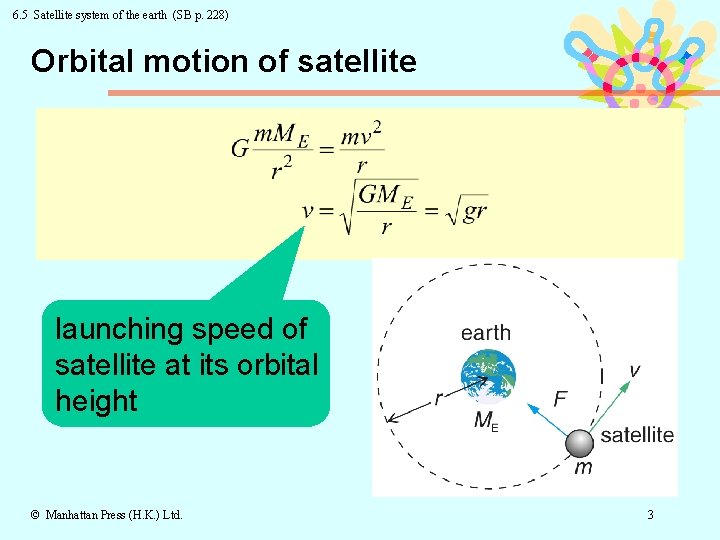
6. 5 Satellite system of the earth (SB p. 228) Orbital motion of satellite launching speed of satellite at its orbital height © Manhattan Press (H. K. ) Ltd. 3
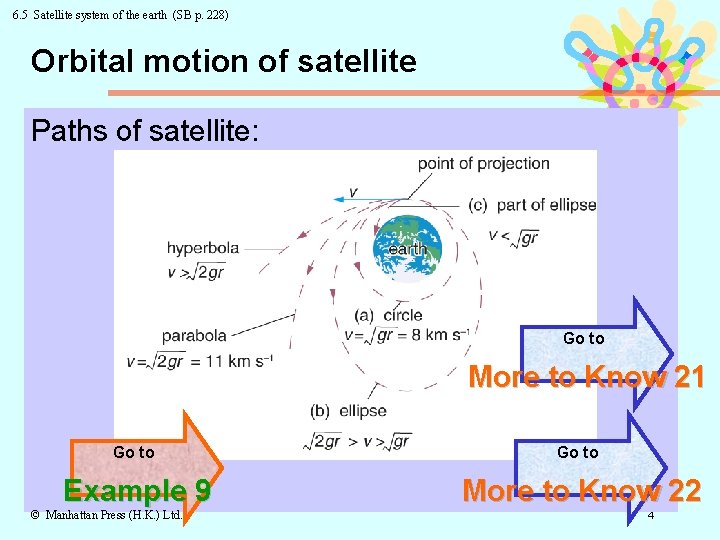
6. 5 Satellite system of the earth (SB p. 228) Orbital motion of satellite Paths of satellite: Go to More to Know 21 Go to Example 9 More to Know 22 © Manhattan Press (H. K. ) Ltd. 4
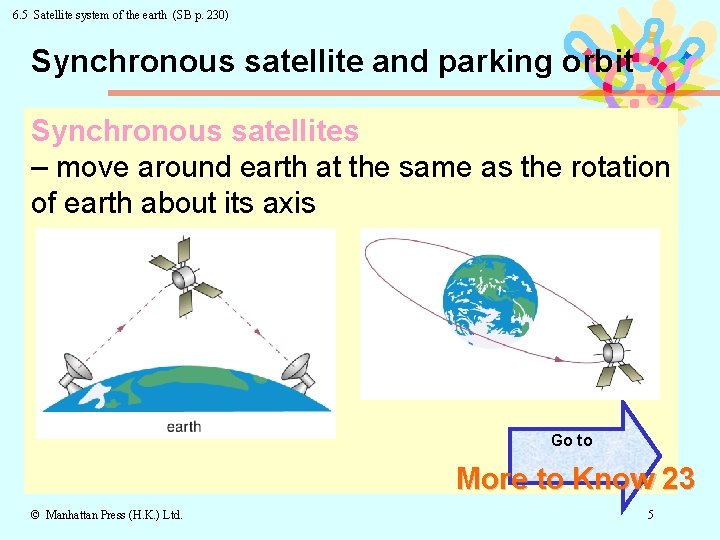
6. 5 Satellite system of the earth (SB p. 230) Synchronous satellite and parking orbit Synchronous satellites – move around earth at the same as the rotation of earth about its axis Go to More to Know 23 © Manhattan Press (H. K. ) Ltd. 5
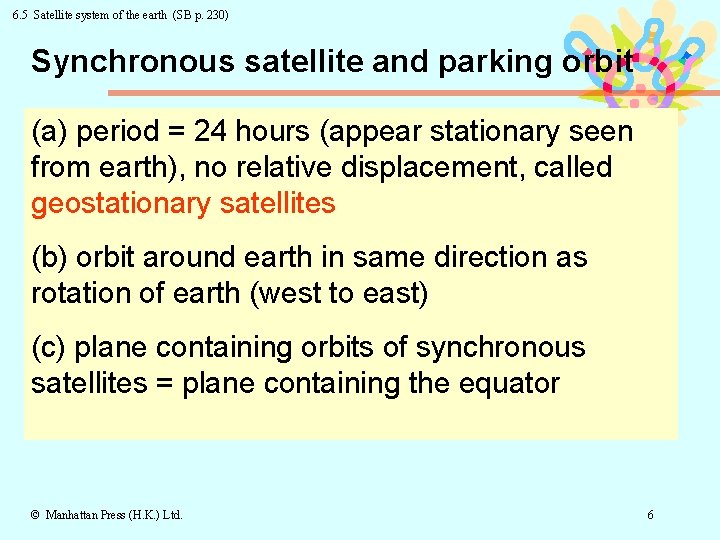
6. 5 Satellite system of the earth (SB p. 230) Synchronous satellite and parking orbit (a) period = 24 hours (appear stationary seen from earth), no relative displacement, called geostationary satellites (b) orbit around earth in same direction as rotation of earth (west to east) (c) plane containing orbits of synchronous satellites = plane containing the equator © Manhattan Press (H. K. ) Ltd. 6
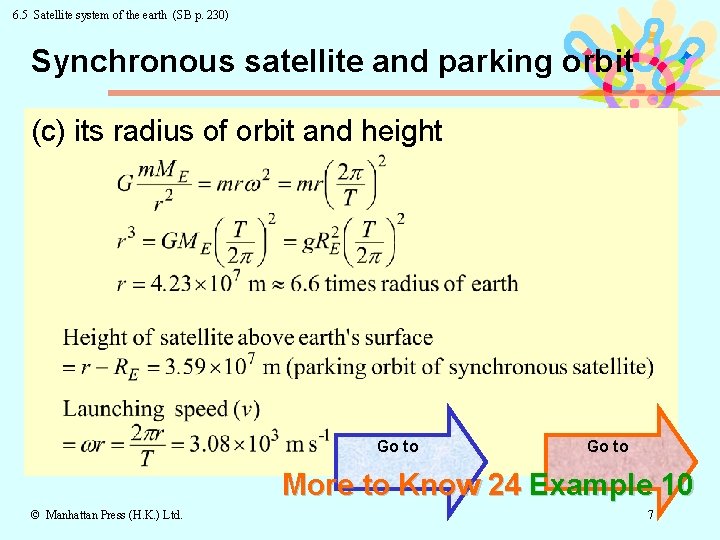
6. 5 Satellite system of the earth (SB p. 230) Synchronous satellite and parking orbit (c) its radius of orbit and height Go to More to Know 24 Example 10 © Manhattan Press (H. K. ) Ltd. 7
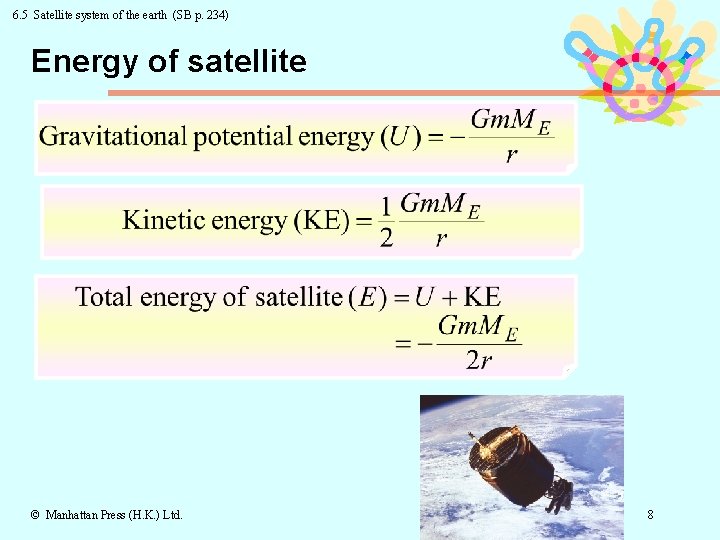
6. 5 Satellite system of the earth (SB p. 234) Energy of satellite © Manhattan Press (H. K. ) Ltd. 8
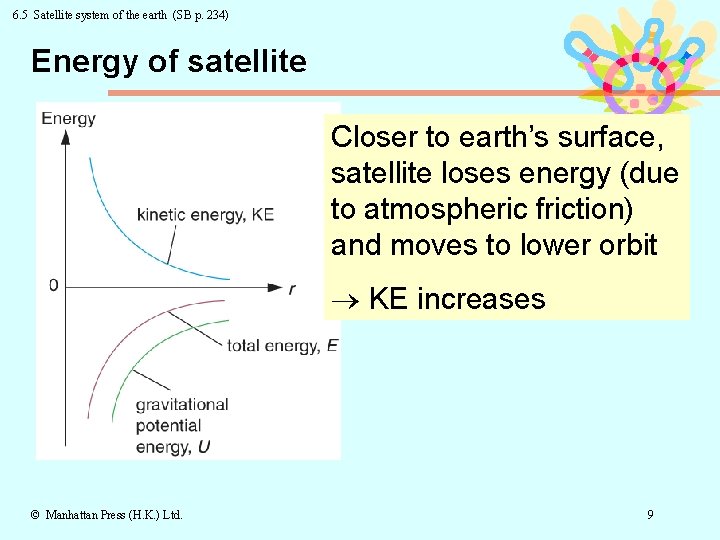
6. 5 Satellite system of the earth (SB p. 234) Energy of satellite Closer to earth’s surface, satellite loses energy (due to atmospheric friction) and moves to lower orbit KE increases © Manhattan Press (H. K. ) Ltd. 9
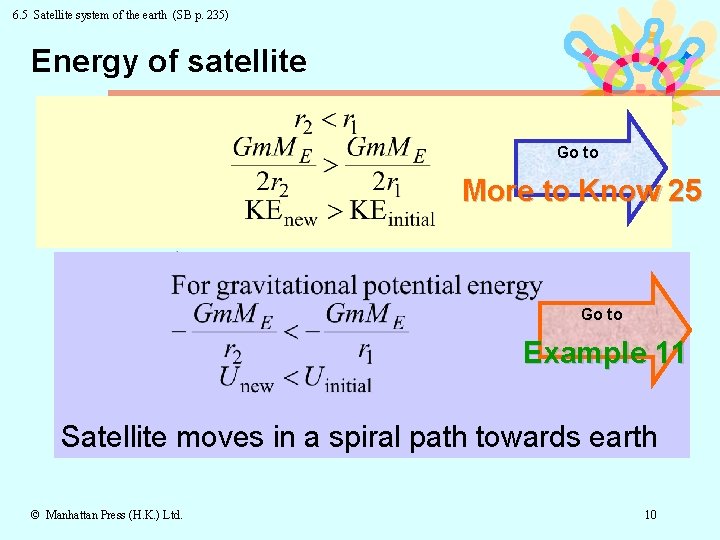
6. 5 Satellite system of the earth (SB p. 235) Energy of satellite Go to More to Know 25 Go to Example 11 Satellite moves in a spiral path towards earth © Manhattan Press (H. K. ) Ltd. 10
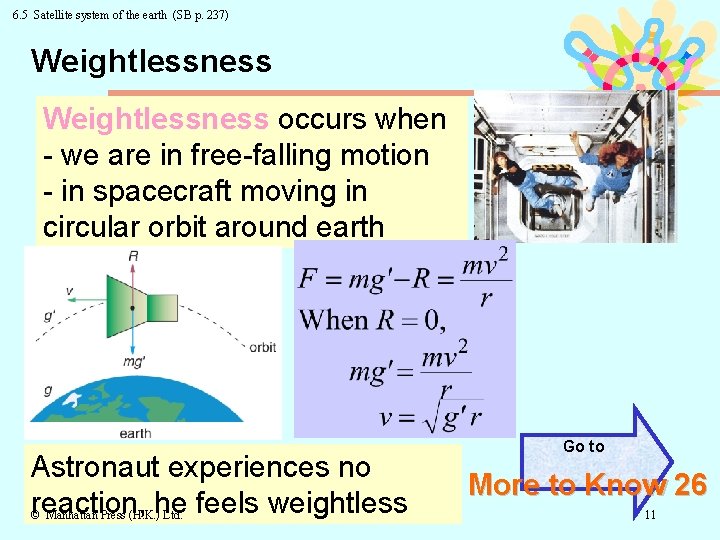
6. 5 Satellite system of the earth (SB p. 237) Weightlessness occurs when - we are in free-falling motion - in spacecraft moving in circular orbit around earth Astronaut experiences no reaction, he feels weightless © Manhattan Press (H. K. ) Ltd. Go to More to Know 26 11
End © Manhattan Press (H. K. ) Ltd. 12
6. 5 Satellite system of the earth (SB p. 227) Types of artificial satellites Communication satellites are always used for transmitting of television or telephone signals between two places. Weather satellites are used for transmitting the pictures of cloud pattern for weather forecasting. Return to © Manhattan Press (H. K. ) Ltd. Text 13
6. 5 Satellite system of the earth (SB p. 228) Paths of satellite for different speed (v) 1. A part of ellipse for v < 2. A circle for v = 3. An ellipse for >v> 4. A parabola for v = 5. A hyperbola for v > where is the launching speed required for a circular orbit near the earth and is the escape speed of the earth. Return to Text © Manhattan Press (H. K. ) Ltd. 14
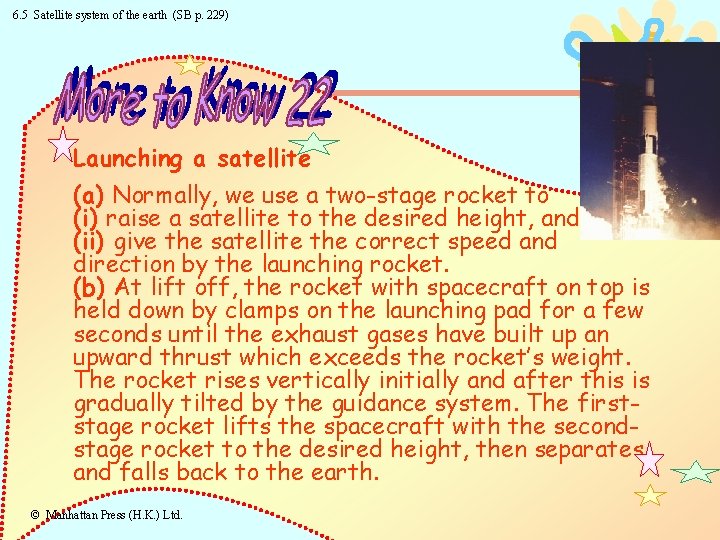
6. 5 Satellite system of the earth (SB p. 229) Launching a satellite (a) Normally, we use a two-stage rocket to (i) raise a satellite to the desired height, and (ii) give the satellite the correct speed and direction by the launching rocket. (b) At lift off, the rocket with spacecraft on top is held down by clamps on the launching pad for a few seconds until the exhaust gases have built up an upward thrust which exceeds the rocket’s weight. The rocket rises vertically initially and after this is gradually tilted by the guidance system. The firststage rocket lifts the spacecraft with the secondstage rocket to the desired height, then separates and falls back to the earth. © Manhattan Press (H. K. ) Ltd. 15
6. 5 Satellite system of the earth (SB p. 229) Launching a satellite (cont’d) (c) The spacecraft with the second-stage rocket casts in free flight to its orbital height where it is momentarily moving horizontally. The second-stage rocket then fires and increases the speed to that required for a circular orbit at the height. Then the spacecraft is separated from the second-stage rocket with the launching speed required. Return to Text © Manhattan Press (H. K. ) Ltd. 16
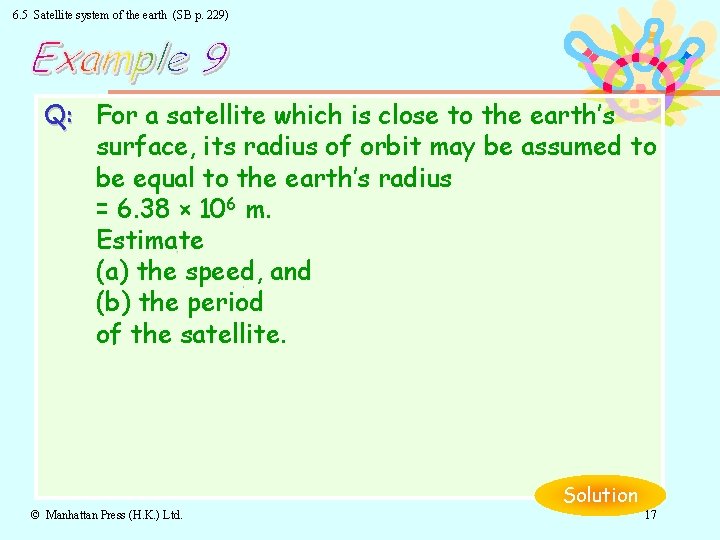
6. 5 Satellite system of the earth (SB p. 229) Q: For a satellite which is close to the earth’s surface, its radius of orbit may be assumed to be equal to the earth’s radius = 6. 38 × 106 m. Estimate (a) the speed, and (b) the period of the satellite. Solution © Manhattan Press (H. K. ) Ltd. 17
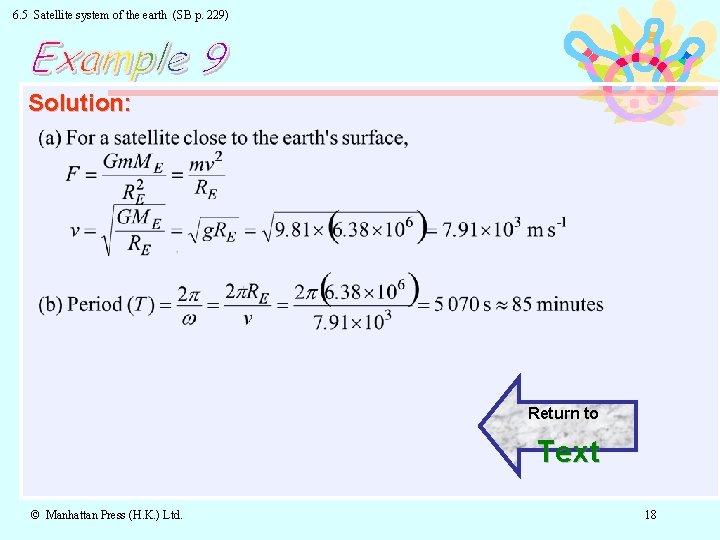
6. 5 Satellite system of the earth (SB p. 229) Solution: Return to Text © Manhattan Press (H. K. ) Ltd. 18
6. 5 Satellite system of the earth (SB p. 230) Synchronous satellite is also known as geostationary satellite or communication satellite. Return to Text © Manhattan Press (H. K. ) Ltd. 19
6. 5 Satellite system of the earth (SB p. 231) Synchronous satellites Most of communication satellites are synchronous satellites. Return to Text © Manhattan Press (H. K. ) Ltd. 20
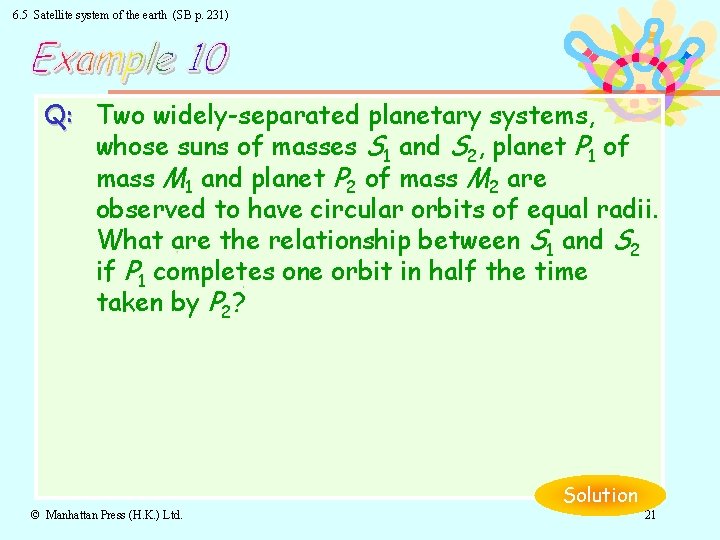
6. 5 Satellite system of the earth (SB p. 231) Q: Two widely-separated planetary systems, whose suns of masses S 1 and S 2, planet P 1 of mass M 1 and planet P 2 of mass M 2 are observed to have circular orbits of equal radii. What are the relationship between S 1 and S 2 if P 1 completes one orbit in half the time taken by P 2? Solution © Manhattan Press (H. K. ) Ltd. 21
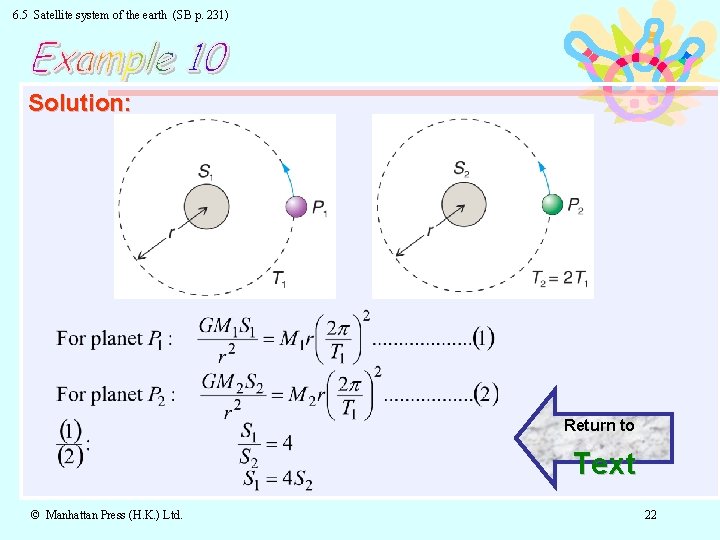
6. 5 Satellite system of the earth (SB p. 231) Solution: Return to Text © Manhattan Press (H. K. ) Ltd. 22
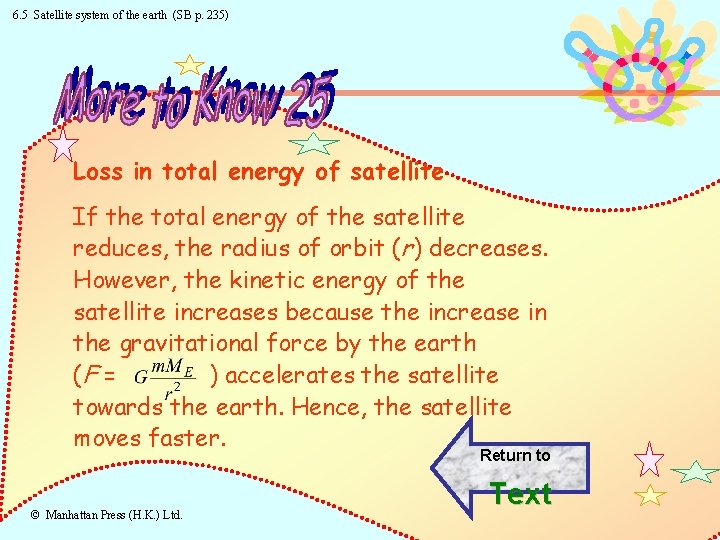
6. 5 Satellite system of the earth (SB p. 235) Loss in total energy of satellite If the total energy of the satellite reduces, the radius of orbit (r) decreases. However, the kinetic energy of the satellite increases because the increase in the gravitational force by the earth (F = ) accelerates the satellite towards the earth. Hence, the satellite moves faster. Return to © Manhattan Press (H. K. ) Ltd. Text 23
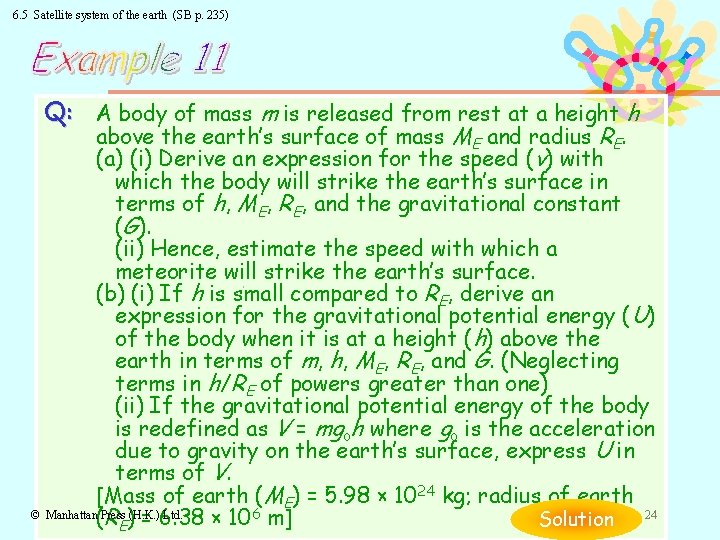
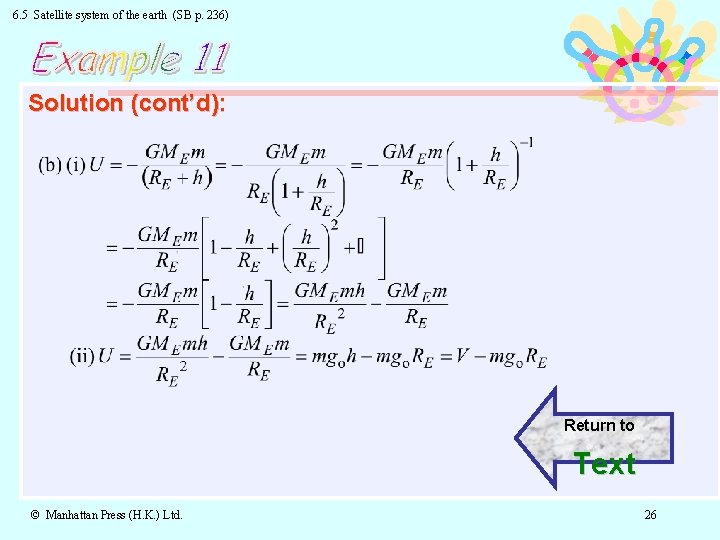
6. 5 Satellite system of the earth (SB p. 235) Q: A body of mass m is released from rest at a height h above the earth’s surface of mass ME and radius RE. (a) (i) Derive an expression for the speed (v) with which the body will strike the earth’s surface in terms of h, ME, RE, and the gravitational constant (G). (ii) Hence, estimate the speed with which a meteorite will strike the earth’s surface. (b) (i) If h is small compared to RE, derive an expression for the gravitational potential energy ( U) of the body when it is at a height (h) above the earth in terms of m, h, ME, RE, and G. (Neglecting terms in h/RE of powers greater than one) (ii) If the gravitational potential energy of the body is redefined as V = mgoh where go is the acceleration due to gravity on the earth’s surface, express U in terms of V. [Mass of earth (ME) = 5. 98 × 1024 kg; radius of earth © Manhattan Press (H. K. ) Ltd. 24 (RE) = 6. 38 × 106 m] Solution
6. 5 Satellite system of the earth (SB p. 236) Solution: © Manhattan Press (H. K. ) Ltd. 25
6. 5 Satellite system of the earth (SB p. 236) Solution (cont’d): Return to Text © Manhattan Press (H. K. ) Ltd. 26
6. 5 Satellite system of the earth (SB p. 237) Feeling of weight in space The astronaut experiences reaction when the spacecraft is launching or moving from one orbit to another orbit. Return to © Manhattan Press (H. K. ) Ltd. Text 27
- Slides: 27