
6 4 Rhombi and Squares Objectives n n
6. 4 Rhombi and Squares
Objectives: n n Use properties of sides and angles of rhombi and squares. Use properties of diagonals of rhombi and squares.
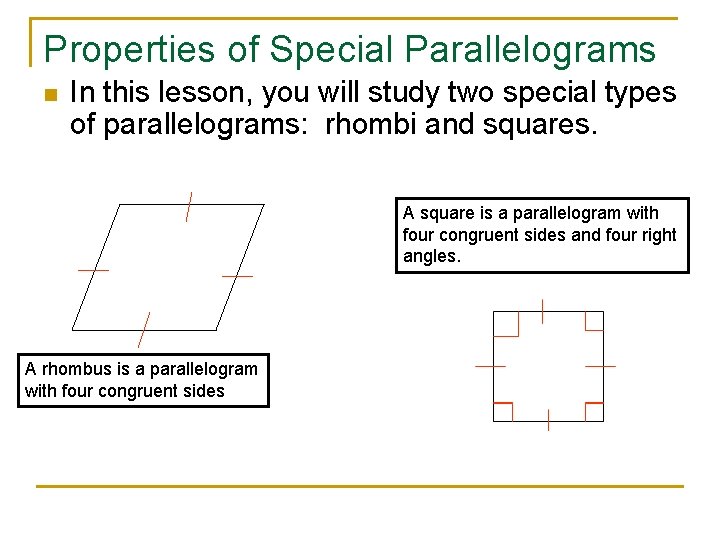
Properties of Special Parallelograms n In this lesson, you will study two special types of parallelograms: rhombi and squares. A square is a parallelogram with four congruent sides and four right angles. A rhombus is a parallelogram with four congruent sides

Venn Diagram shows relationships-- MEMORIZE n Each shape has the properties of every group that it belongs to. For instance, a square is a rectangle, a rhombus and a parallelogram; so it has all of the properties of those shapes. parallelograms rhombi rectangles squares Rhombuses Rectangles
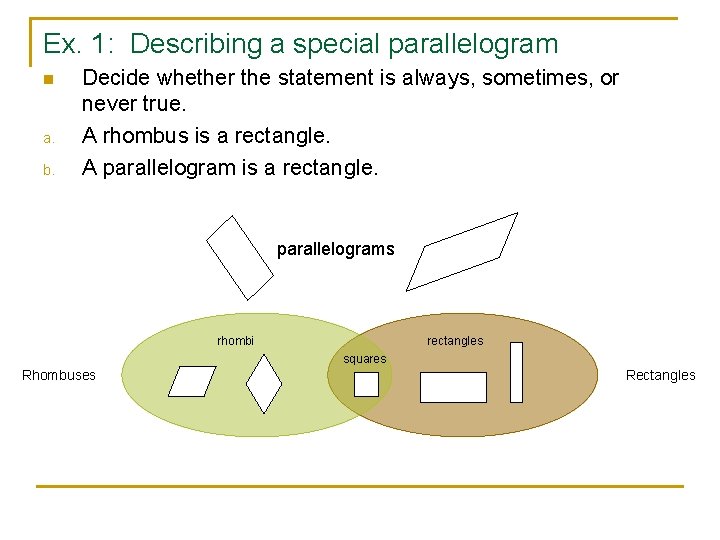
Ex. 1: Describing a special parallelogram n a. b. Decide whether the statement is always, sometimes, or never true. A rhombus is a rectangle. A parallelogram is a rectangle. parallelograms rhombi rectangles squares Rhombuses Rectangles

Ex. 1: Describing a special parallelogram Decide whether the statement is always, sometimes, or never true. a. A rhombus is a rectangle. The statement is sometimes true. In the Venn diagram, the regions for rhombi and rectangles overlap. If the rhombus is a square, it is a rectangle. n parallelograms rhombi rectangles squares Rhombuses Rectangles
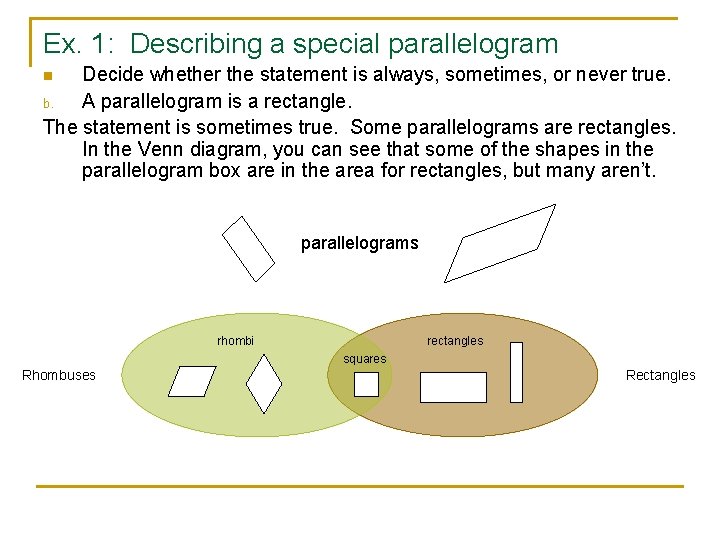
Ex. 1: Describing a special parallelogram Decide whether the statement is always, sometimes, or never true. b. A parallelogram is a rectangle. The statement is sometimes true. Some parallelograms are rectangles. In the Venn diagram, you can see that some of the shapes in the parallelogram box are in the area for rectangles, but many aren’t. n parallelograms rhombi rectangles squares Rhombuses Rectangles
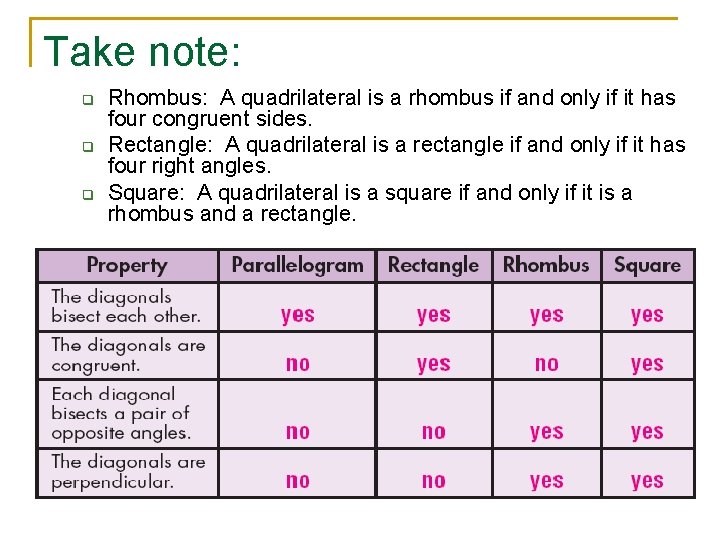
Take note: q q q Rhombus: A quadrilateral is a rhombus if and only if it has four congruent sides. Rectangle: A quadrilateral is a rectangle if and only if it has four right angles. Square: A quadrilateral is a square if and only if it is a rhombus and a rectangle.
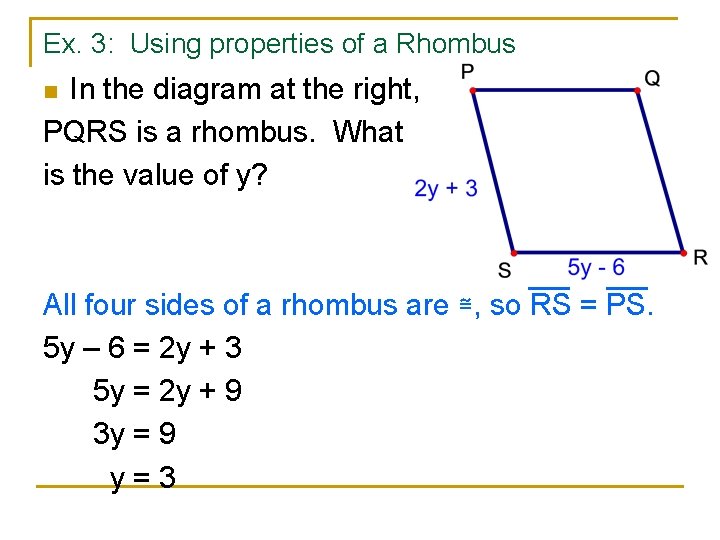
Ex. 3: Using properties of a Rhombus In the diagram at the right, PQRS is a rhombus. What is the value of y? n All four sides of a rhombus are ≅, so RS = PS. 5 y – 6 = 2 y + 3 5 y = 2 y + 9 3 y = 9 y=3
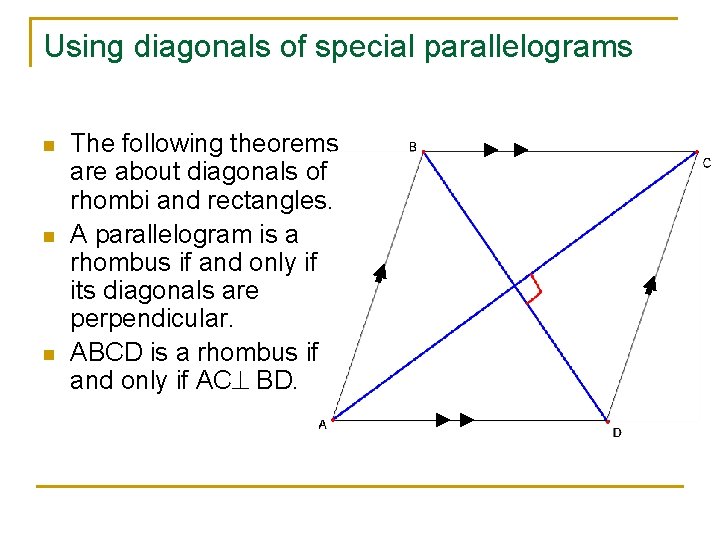
Using diagonals of special parallelograms n n n The following theorems are about diagonals of rhombi and rectangles. A parallelogram is a rhombus if and only if its diagonals are perpendicular. ABCD is a rhombus if and only if AC BD.
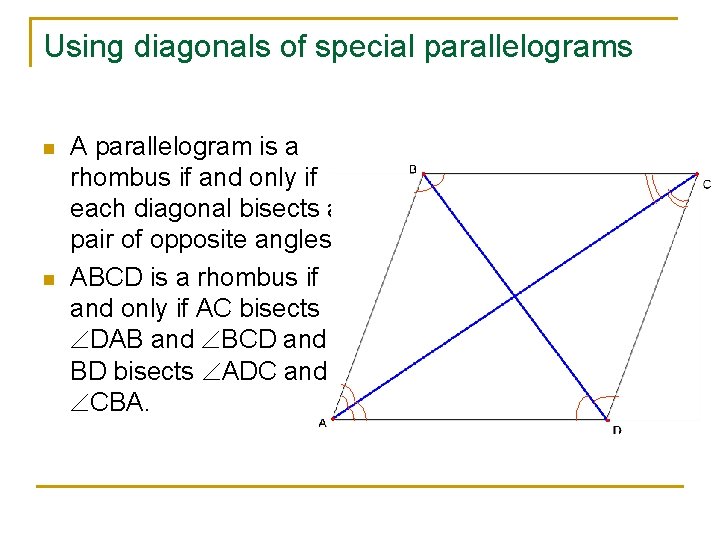
Using diagonals of special parallelograms n n A parallelogram is a rhombus if and only if each diagonal bisects a pair of opposite angles. ABCD is a rhombus if and only if AC bisects DAB and BCD and BD bisects ADC and CBA.
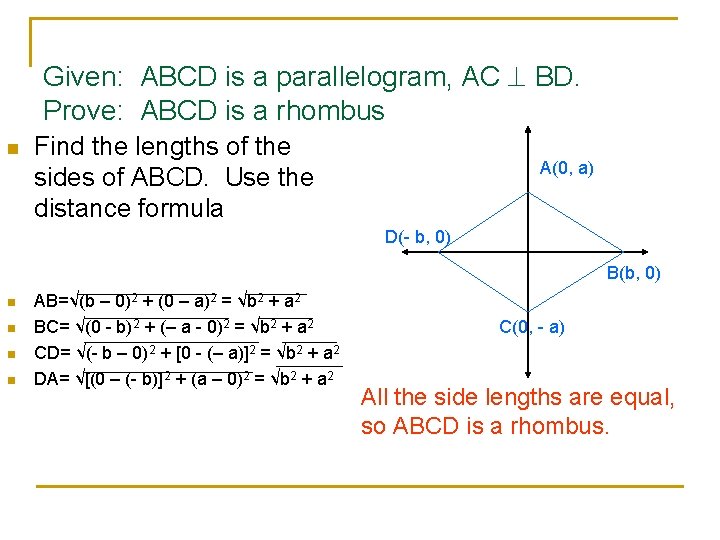
Given: ABCD is a parallelogram, AC BD. Prove: ABCD is a rhombus n n n Find the lengths of the sides of ABCD. Use the distance formula (See – you’re never going to get rid of this) AB=√(b – 0)2 + (0 – a)2 = √b 2 + a 2 BC= √(0 - b)2 + (– a - 0)2 = √b 2 + a 2 CD= √(- b – 0)2 + [0 - (– a)]2 = √b 2 + a 2 DA= √[(0 – (- b)]2 + (a – 0)2 = √b 2 + a 2 A(0, a) D(- b, 0) B(b, 0) C(0, - a) All the side lengths are equal, so ABCD is a rhombus.
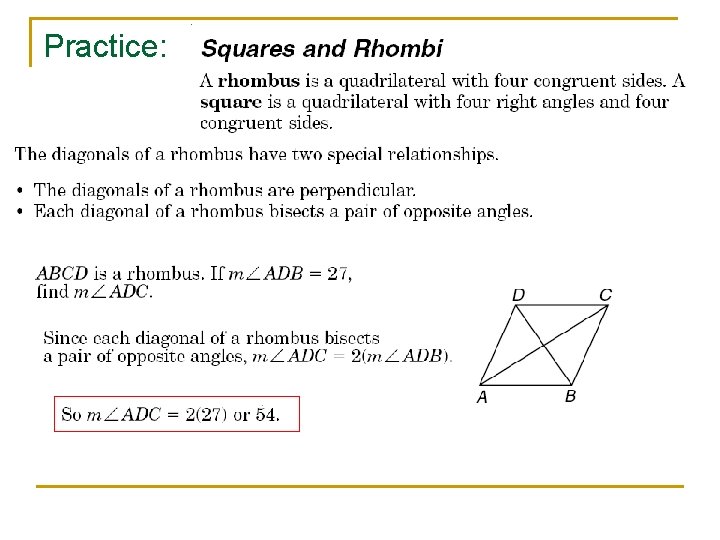
Practice:
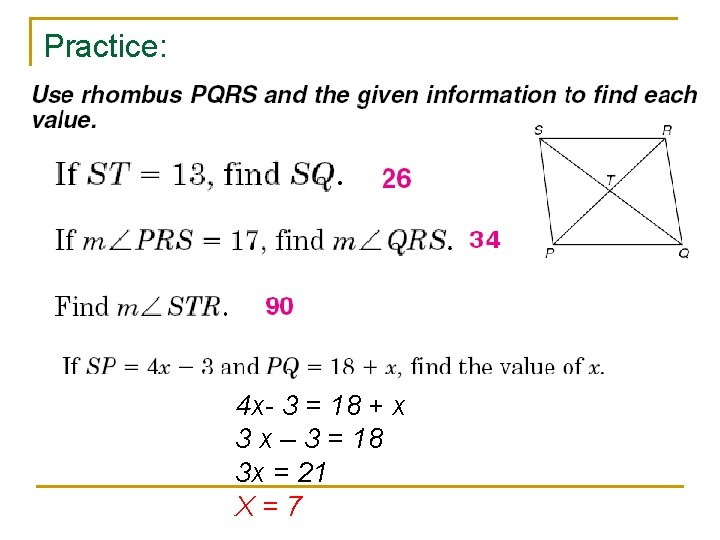
Practice: 4 x- 3 = 18 + x 3 x – 3 = 18 3 x = 21 X=7
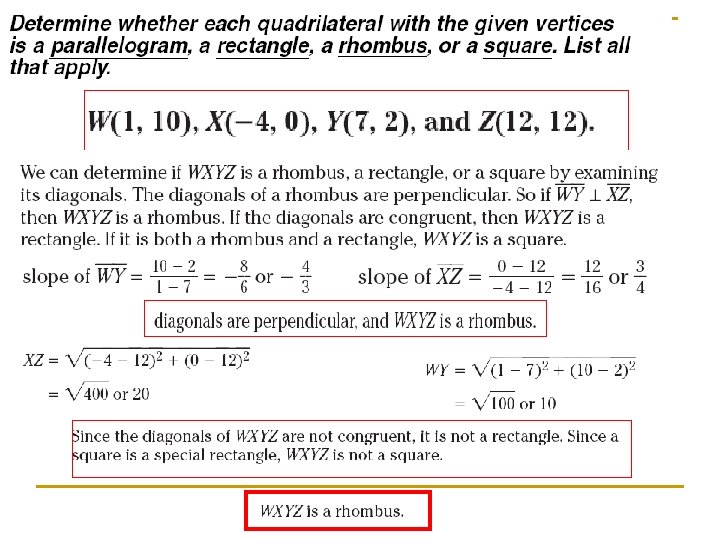
Practice:
Assignment: n Page 317 # 21 -37 all
- Slides: 16