
6 2 Notes Formation of Ionic Bonds II

6. 2 – Notes Formation of Ionic Bonds
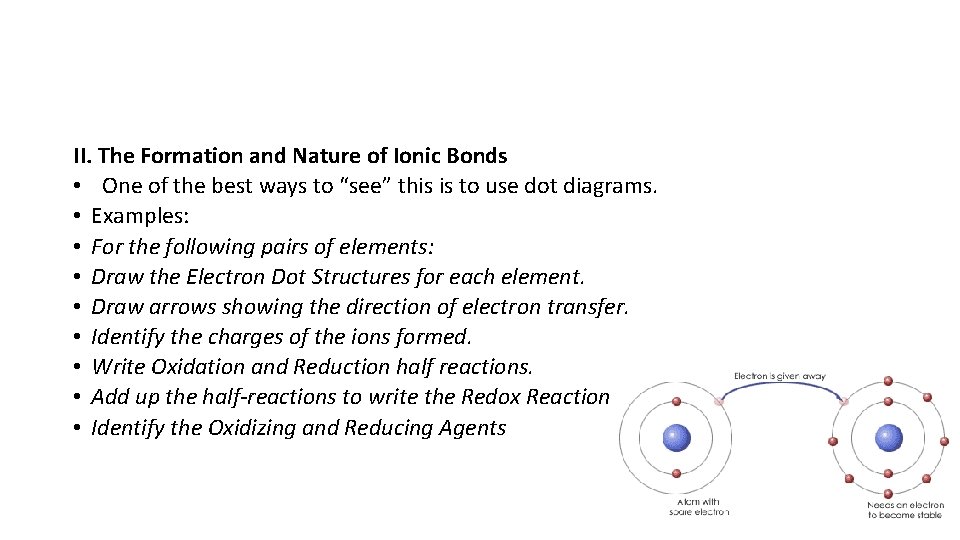
II. The Formation and Nature of Ionic Bonds • One of the best ways to “see” this is to use dot diagrams. • Examples: • For the following pairs of elements: • Draw the Electron Dot Structures for each element. • Draw arrows showing the direction of electron transfer. • Identify the charges of the ions formed. • Write Oxidation and Reduction half reactions. • Add up the half-reactions to write the Redox Reaction • Identify the Oxidizing and Reducing Agents
• Sodium and Chlorine
• Calcium and Fluorine •

• Gallium and Tellurium

• B. Properties of ionic compounds • 1. Ionic Compounds form solid, crystal lattice structures • Huge 3 -D Repetitive Grid Structures • Depending on strength of bond, properties can vary, but • All ionic compounds are crystals. • ;
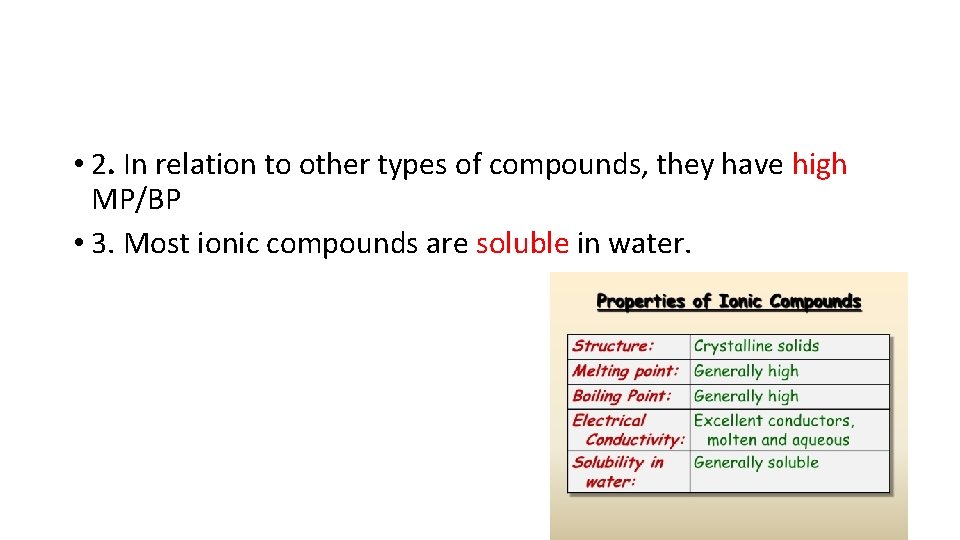
• 2. In relation to other types of compounds, they have high MP/BP • 3. Most ionic compounds are soluble in water.
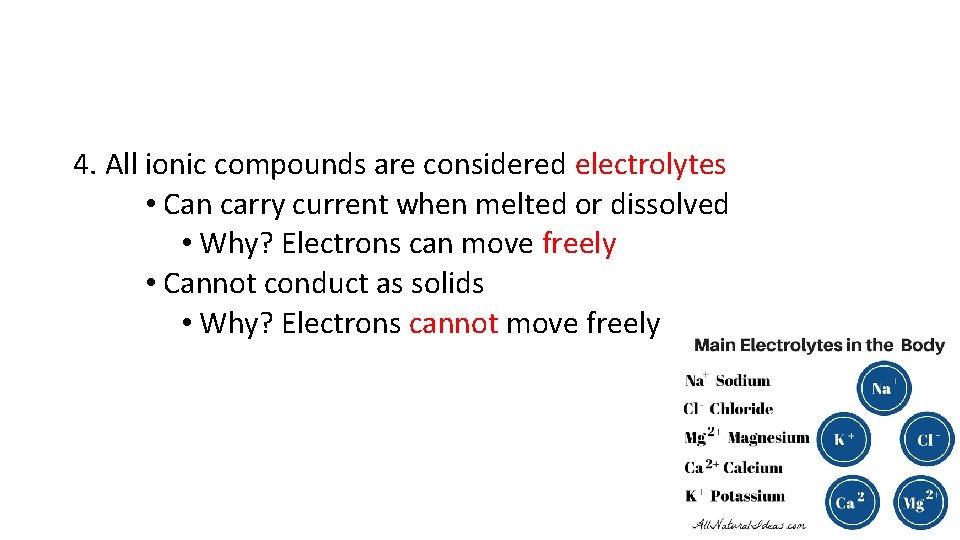
4. All ionic compounds are considered electrolytes • Can carry current when melted or dissolved • Why? Electrons can move freely • Cannot conduct as solids • Why? Electrons cannot move freely
• Lattice Energy (LE): The energy required to make an ionic bond • Measure of strength of Ionic Bonds • The higher the LE, the weaker the bond.
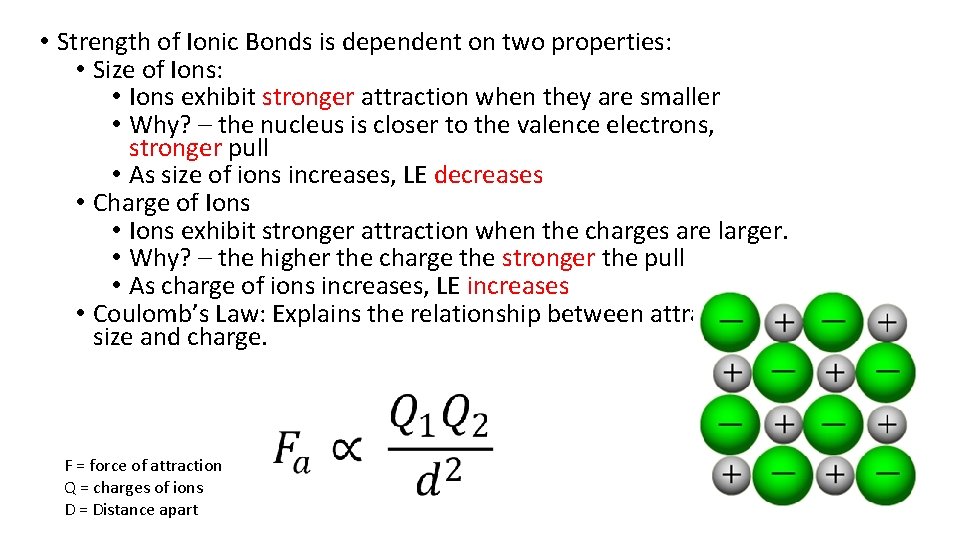
• Strength of Ionic Bonds is dependent on two properties: • Size of Ions: • Ions exhibit stronger attraction when they are smaller • Why? – the nucleus is closer to the valence electrons, stronger pull • As size of ions increases, LE decreases • Charge of Ions • Ions exhibit stronger attraction when the charges are larger. • Why? – the higher the charge the stronger the pull • As charge of ions increases, LE increases • Coulomb’s Law: Explains the relationship between attraction, size and charge. F = force of attraction Q = charges of ions D = Distance apart
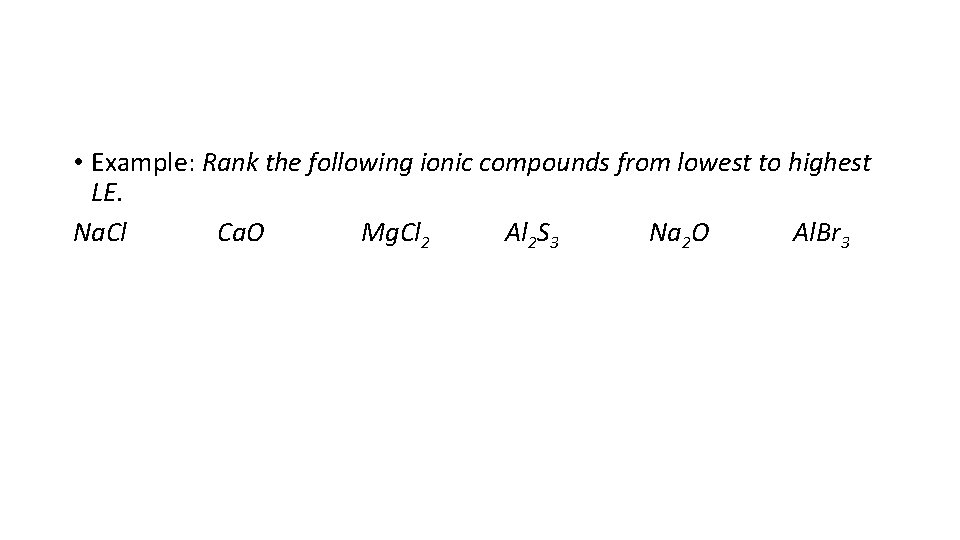
• Example: Rank the following ionic compounds from lowest to highest LE. Na. Cl Ca. O Mg. Cl 2 Al 2 S 3 Na 2 O Al. Br 3

- Slides: 12