
6 1 Percent Equivalents n Write a whole
- Slides: 43
6. 1 Percent Equivalents n Write a whole number, fraction or decimal as a percent. n Write a percent as a whole number, fraction or decimal. 1 = 100% 0. 8 = 80% = 4/5 Business Math, Eighth Edition Cleaves/Hobbs © 2009 Pearson Education, Inc. Upper Saddle River, NJ 07458 All Rights Reserved
6. 1. 1 Write a Whole Number, Fraction or Decimal as a Percent n n Percents are used to calculate markups, markdowns, discounts and many other business applications. Hundredths and percent have the same meaning: per hundred. n 100 percent is the same as 1 whole quantity, 100% = 1. n When we multiply a number by 1, the product has the same value as the original number. Business Math, Eighth Edition Cleaves/Hobbs © 2009 Pearson Education, Inc. Upper Saddle River, NJ 07458 All Rights Reserved
Change to equivalent percents n Nx 1=N n So, if 1 = 100%, then ½ x 100% = 50%. n Also, if 1 =100%, then 0. 5 x 100% = 050. % = 50% n In each case when we multiply by 1 in some form, the value of the product is equivalent to the value of the original number even though the product looks different. Business Math, Eighth Edition Cleaves/Hobbs © 2009 Pearson Education, Inc. Upper Saddle River, NJ 07458 All Rights Reserved
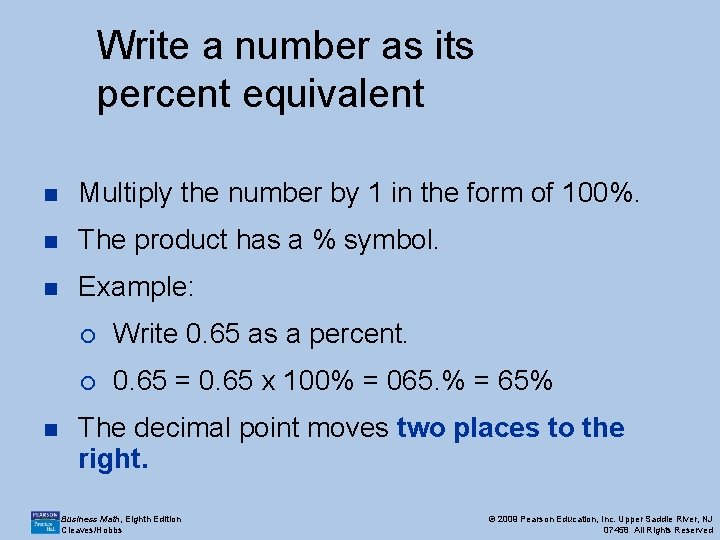
Write a number as its percent equivalent n Multiply the number by 1 in the form of 100%. n The product has a % symbol. n Example: n ¡ Write 0. 65 as a percent. ¡ 0. 65 = 0. 65 x 100% = 065. % = 65% The decimal point moves two places to the right. Business Math, Eighth Edition Cleaves/Hobbs © 2009 Pearson Education, Inc. Upper Saddle River, NJ 07458 All Rights Reserved
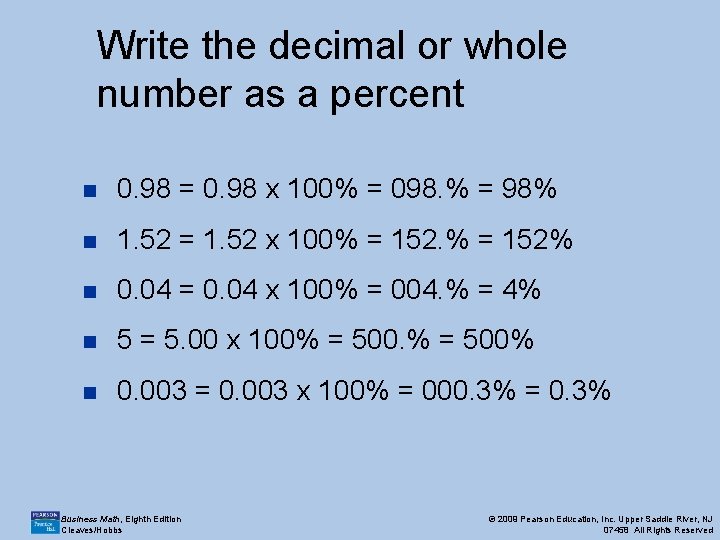
Write the decimal or whole number as a percent n 0. 98 = 0. 98 x 100% = 098. % = 98% n 1. 52 = 1. 52 x 100% = 152% n 0. 04 = 0. 04 x 100% = 004. % = 4% n 5 = 5. 00 x 100% = 500% n 0. 003 = 0. 003 x 100% = 000. 3% = 0. 3% Business Math, Eighth Edition Cleaves/Hobbs © 2009 Pearson Education, Inc. Upper Saddle River, NJ 07458 All Rights Reserved
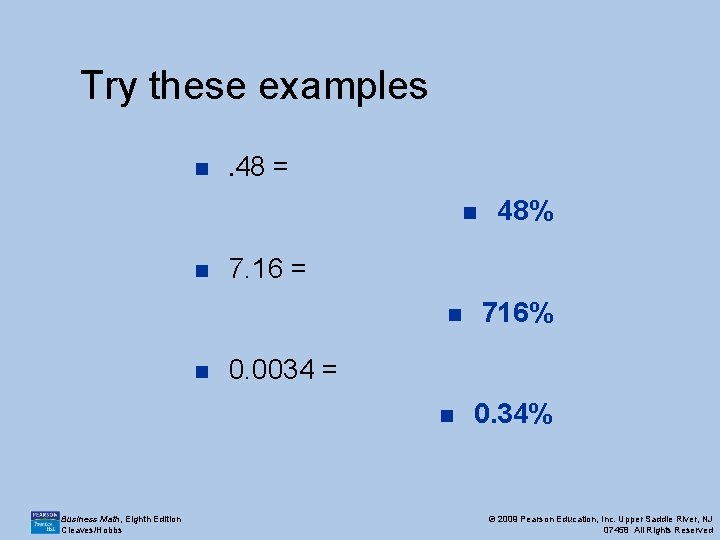
Try these examples n . 48 = n n 7. 16 = n n 716% 0. 0034 = n Business Math, Eighth Edition Cleaves/Hobbs 48% 0. 34% © 2009 Pearson Education, Inc. Upper Saddle River, NJ 07458 All Rights Reserved
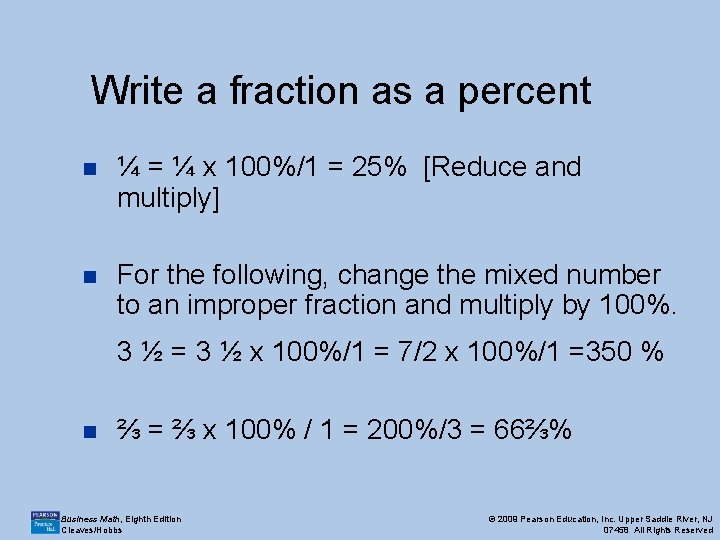
Write a fraction as a percent n ¼ = ¼ x 100%/1 = 25% [Reduce and multiply] n For the following, change the mixed number to an improper fraction and multiply by 100%. 3 ½ = 3 ½ x 100%/1 = 7/2 x 100%/1 =350 % n ⅔ = ⅔ x 100% / 1 = 200%/3 = 66⅔% Business Math, Eighth Edition Cleaves/Hobbs © 2009 Pearson Education, Inc. Upper Saddle River, NJ 07458 All Rights Reserved
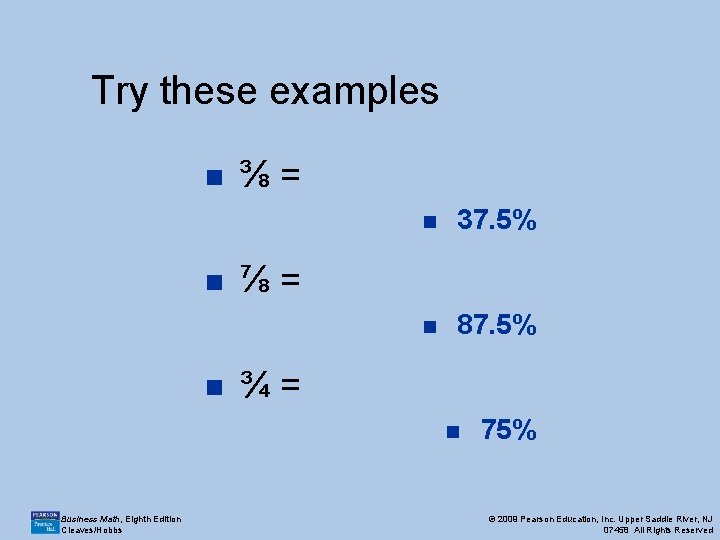
Try these examples n n n ⅜= n 37. 5% n 87. 5% ⅞= ¾= n Business Math, Eighth Edition Cleaves/Hobbs 75% © 2009 Pearson Education, Inc. Upper Saddle River, NJ 07458 All Rights Reserved
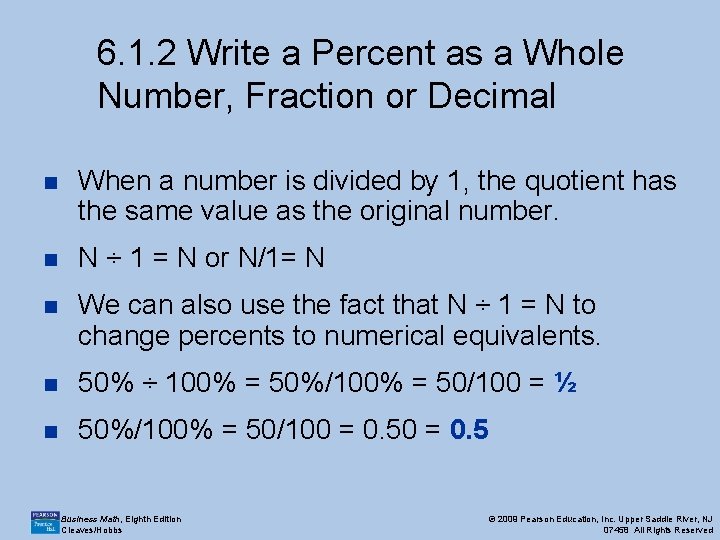
6. 1. 2 Write a Percent as a Whole Number, Fraction or Decimal n When a number is divided by 1, the quotient has the same value as the original number. n N ÷ 1 = N or N/1= N n We can also use the fact that N ÷ 1 = N to change percents to numerical equivalents. n 50% ÷ 100% = 50%/100% = 50/100 = ½ n 50%/100% = 50/100 = 0. 5 Business Math, Eighth Edition Cleaves/Hobbs © 2009 Pearson Education, Inc. Upper Saddle River, NJ 07458 All Rights Reserved
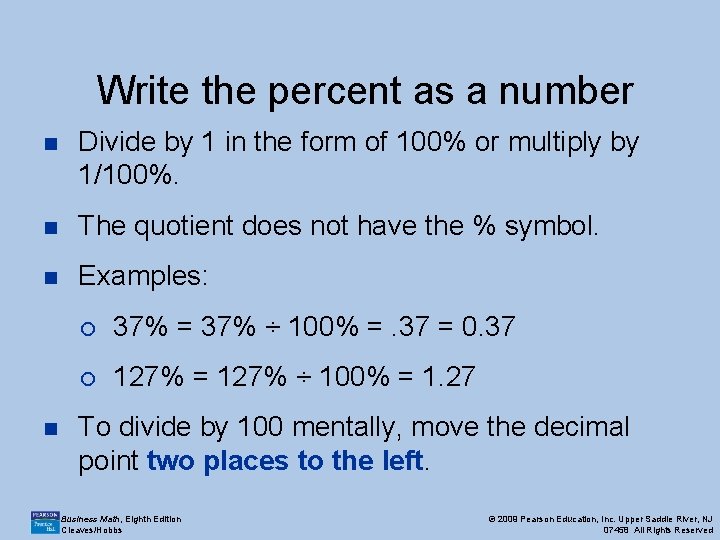
Write the percent as a number n Divide by 1 in the form of 100% or multiply by 1/100%. n The quotient does not have the % symbol. n Examples: n ¡ 37% = 37% ÷ 100% =. 37 = 0. 37 ¡ 127% = 127% ÷ 100% = 1. 27 To divide by 100 mentally, move the decimal point two places to the left. Business Math, Eighth Edition Cleaves/Hobbs © 2009 Pearson Education, Inc. Upper Saddle River, NJ 07458 All Rights Reserved
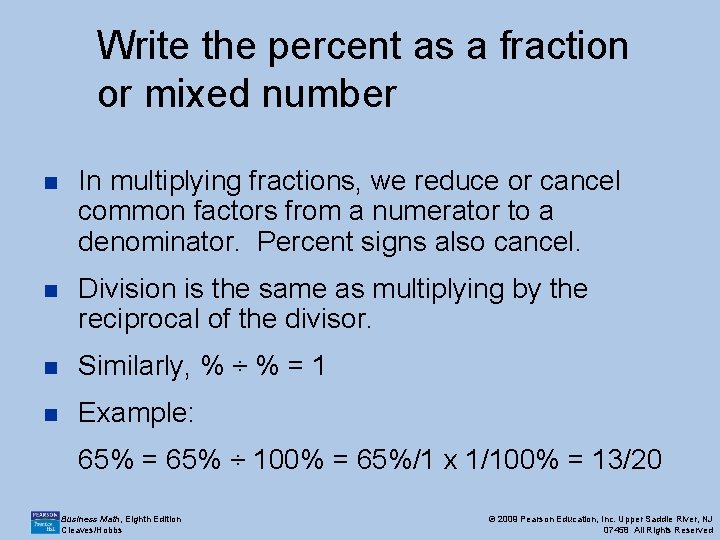
Write the percent as a fraction or mixed number n In multiplying fractions, we reduce or cancel common factors from a numerator to a denominator. Percent signs also cancel. n Division is the same as multiplying by the reciprocal of the divisor. n Similarly, % ÷ % = 1 n Example: 65% = 65% ÷ 100% = 65%/1 x 1/100% = 13/20 Business Math, Eighth Edition Cleaves/Hobbs © 2009 Pearson Education, Inc. Upper Saddle River, NJ 07458 All Rights Reserved
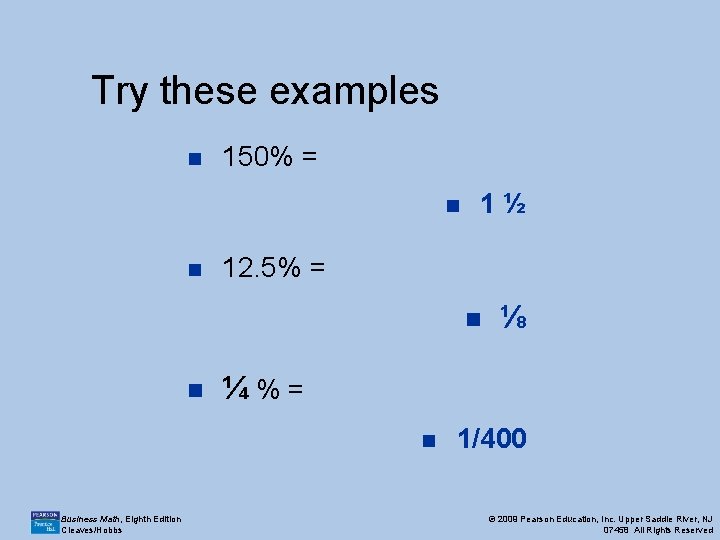
Try these examples n 150% = n n 1½ 12. 5% = n n ¼%= n Business Math, Eighth Edition Cleaves/Hobbs ⅛ 1/400 © 2009 Pearson Education, Inc. Upper Saddle River, NJ 07458 All Rights Reserved
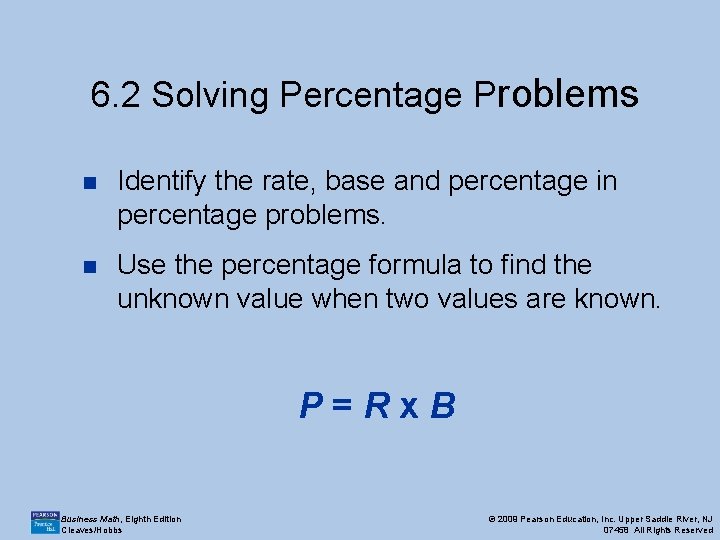
6. 2 Solving Percentage Problems n Identify the rate, base and percentage in percentage problems. n Use the percentage formula to find the unknown value when two values are known. P=Rx. B Business Math, Eighth Edition Cleaves/Hobbs © 2009 Pearson Education, Inc. Upper Saddle River, NJ 07458 All Rights Reserved
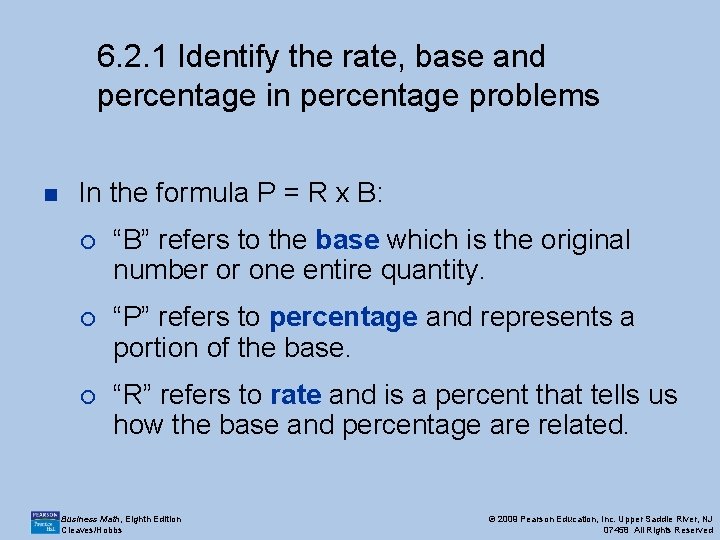
6. 2. 1 Identify the rate, base and percentage in percentage problems n In the formula P = R x B: ¡ “B” refers to the base which is the original number or one entire quantity. ¡ “P” refers to percentage and represents a portion of the base. ¡ “R” refers to rate and is a percent that tells us how the base and percentage are related. Business Math, Eighth Edition Cleaves/Hobbs © 2009 Pearson Education, Inc. Upper Saddle River, NJ 07458 All Rights Reserved
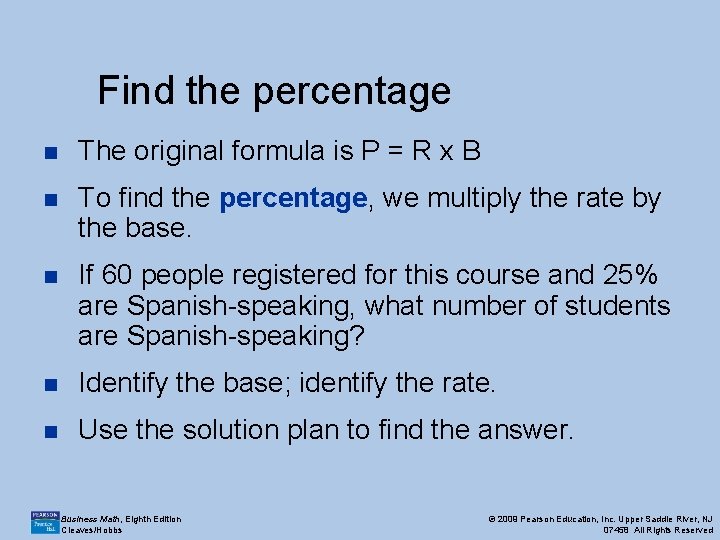
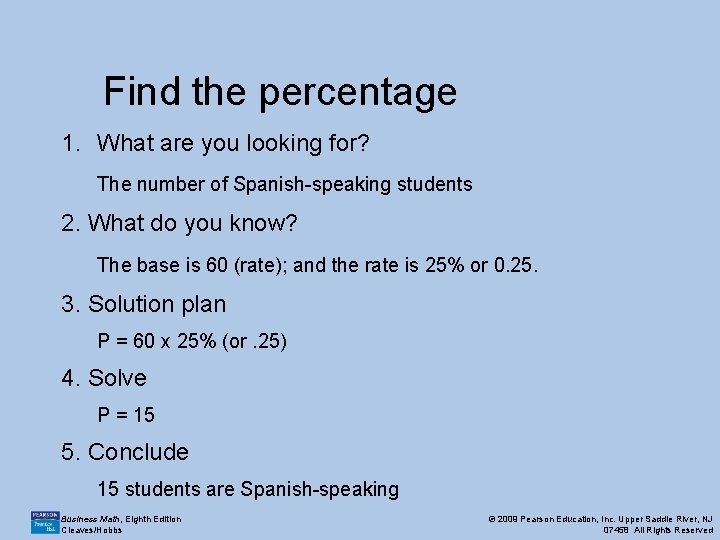
Find the percentage n The original formula is P = R x B n To find the percentage, we multiply the rate by the base. n If 60 people registered for this course and 25% are Spanish-speaking, what number of students are Spanish-speaking? n Identify the base; identify the rate. n Use the solution plan to find the answer. Business Math, Eighth Edition Cleaves/Hobbs © 2009 Pearson Education, Inc. Upper Saddle River, NJ 07458 All Rights Reserved
Find the percentage 1. What are you looking for? The number of Spanish-speaking students 2. What do you know? The base is 60 (rate); and the rate is 25% or 0. 25. 3. Solution plan P = 60 x 25% (or. 25) 4. Solve P = 15 5. Conclude 15 students are Spanish-speaking Business Math, Eighth Edition Cleaves/Hobbs © 2009 Pearson Education, Inc. Upper Saddle River, NJ 07458 All Rights Reserved
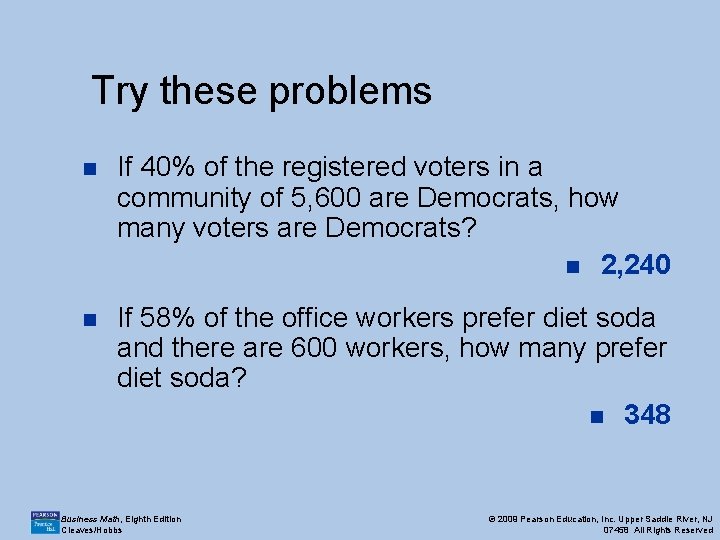
Try these problems n If 40% of the registered voters in a community of 5, 600 are Democrats, how many voters are Democrats? n 2, 240 n If 58% of the office workers prefer diet soda and there are 600 workers, how many prefer diet soda? n 348 Business Math, Eighth Edition Cleaves/Hobbs © 2009 Pearson Education, Inc. Upper Saddle River, NJ 07458 All Rights Reserved
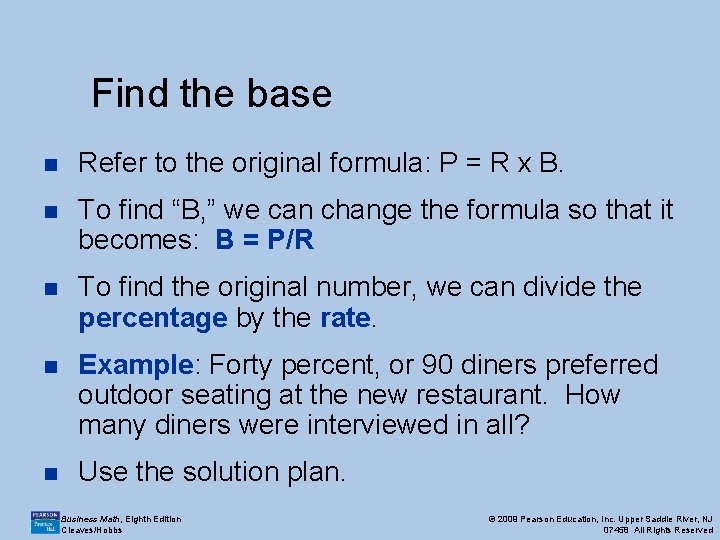
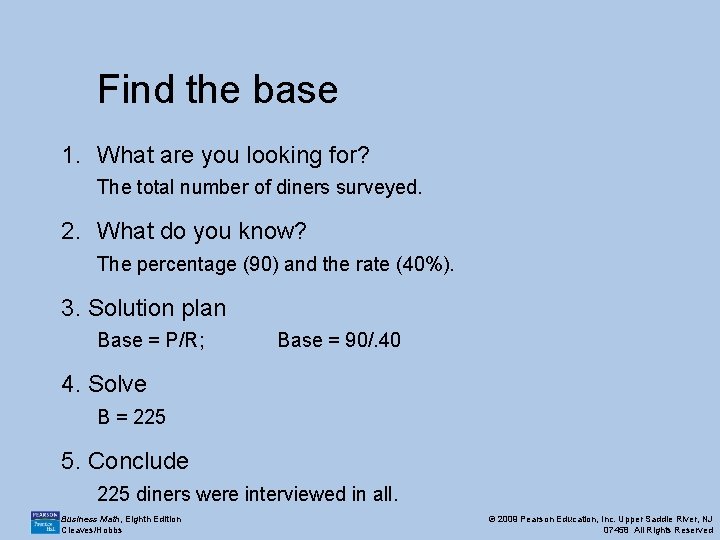
Find the base n Refer to the original formula: P = R x B. n To find “B, ” we can change the formula so that it becomes: B = P/R n To find the original number, we can divide the percentage by the rate. n Example: Forty percent, or 90 diners preferred outdoor seating at the new restaurant. How many diners were interviewed in all? n Use the solution plan. Business Math, Eighth Edition Cleaves/Hobbs © 2009 Pearson Education, Inc. Upper Saddle River, NJ 07458 All Rights Reserved
Find the base 1. What are you looking for? The total number of diners surveyed. 2. What do you know? The percentage (90) and the rate (40%). 3. Solution plan Base = P/R; Base = 90/. 40 4. Solve B = 225 5. Conclude 225 diners were interviewed in all. Business Math, Eighth Edition Cleaves/Hobbs © 2009 Pearson Education, Inc. Upper Saddle River, NJ 07458 All Rights Reserved
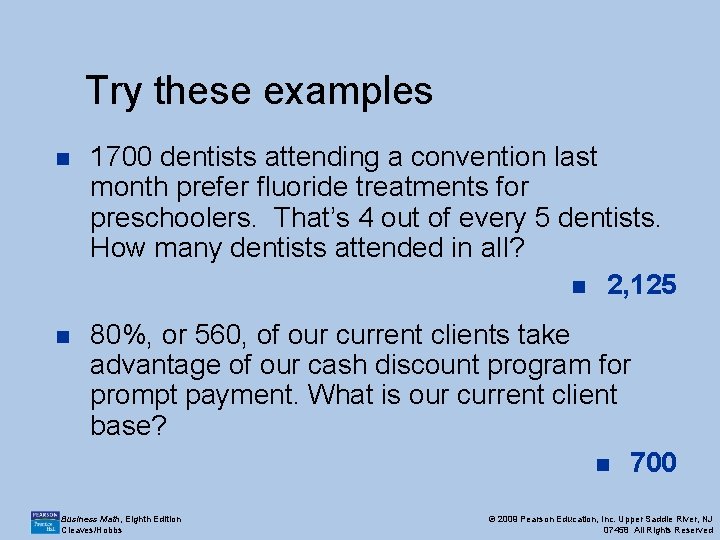
Try these examples n 1700 dentists attending a convention last month prefer fluoride treatments for preschoolers. That’s 4 out of every 5 dentists. How many dentists attended in all? n 2, 125 n 80%, or 560, of our current clients take advantage of our cash discount program for prompt payment. What is our current client base? n 700 Business Math, Eighth Edition Cleaves/Hobbs © 2009 Pearson Education, Inc. Upper Saddle River, NJ 07458 All Rights Reserved
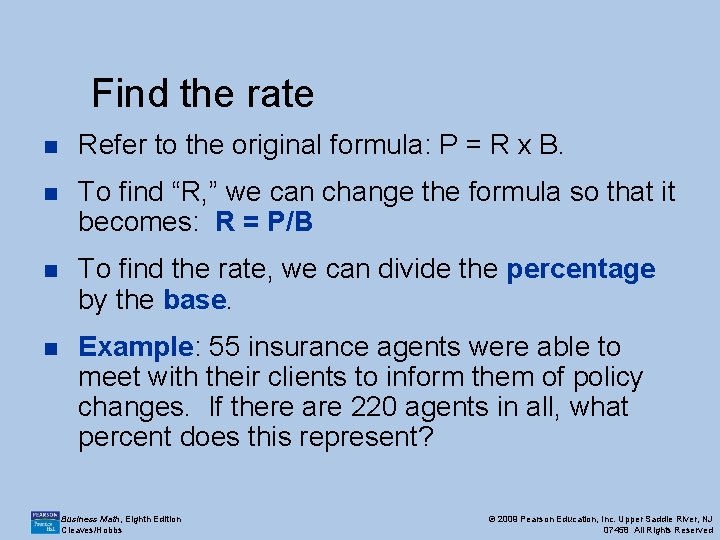
Find the rate n Refer to the original formula: P = R x B. n To find “R, ” we can change the formula so that it becomes: R = P/B n To find the rate, we can divide the percentage by the base. n Example: 55 insurance agents were able to meet with their clients to inform them of policy changes. If there are 220 agents in all, what percent does this represent? Business Math, Eighth Edition Cleaves/Hobbs © 2009 Pearson Education, Inc. Upper Saddle River, NJ 07458 All Rights Reserved
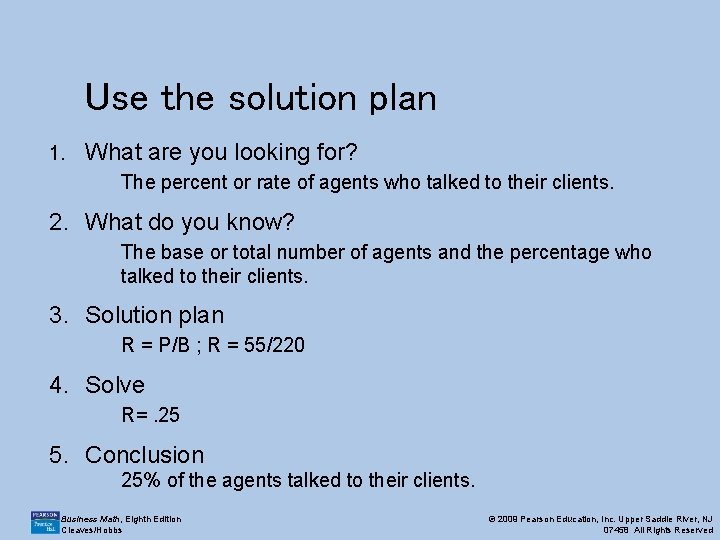
Use the solution plan 1. What are you looking for? The percent or rate of agents who talked to their clients. 2. What do you know? The base or total number of agents and the percentage who talked to their clients. 3. Solution plan R = P/B ; R = 55/220 4. Solve R=. 25 5. Conclusion 25% of the agents talked to their clients. Business Math, Eighth Edition Cleaves/Hobbs © 2009 Pearson Education, Inc. Upper Saddle River, NJ 07458 All Rights Reserved
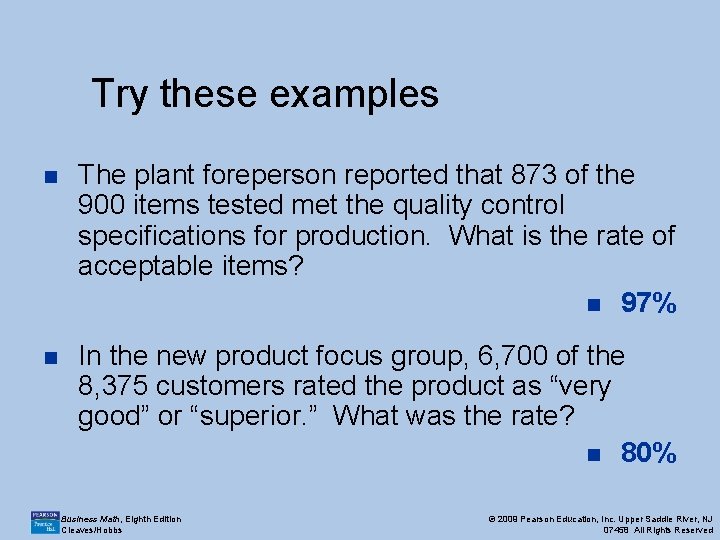
Try these examples n The plant foreperson reported that 873 of the 900 items tested met the quality control specifications for production. What is the rate of acceptable items? n 97% n In the new product focus group, 6, 700 of the 8, 375 customers rated the product as “very good” or “superior. ” What was the rate? n 80% Business Math, Eighth Edition Cleaves/Hobbs © 2009 Pearson Education, Inc. Upper Saddle River, NJ 07458 All Rights Reserved
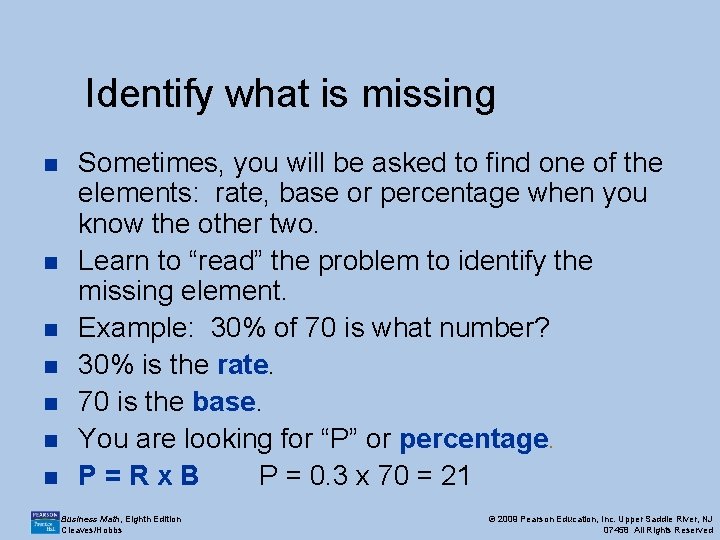
Identify what is missing n n n n Sometimes, you will be asked to find one of the elements: rate, base or percentage when you know the other two. Learn to “read” the problem to identify the missing element. Example: 30% of 70 is what number? 30% is the rate. 70 is the base. You are looking for “P” or percentage. P=Rx. B P = 0. 3 x 70 = 21 Business Math, Eighth Edition Cleaves/Hobbs © 2009 Pearson Education, Inc. Upper Saddle River, NJ 07458 All Rights Reserved
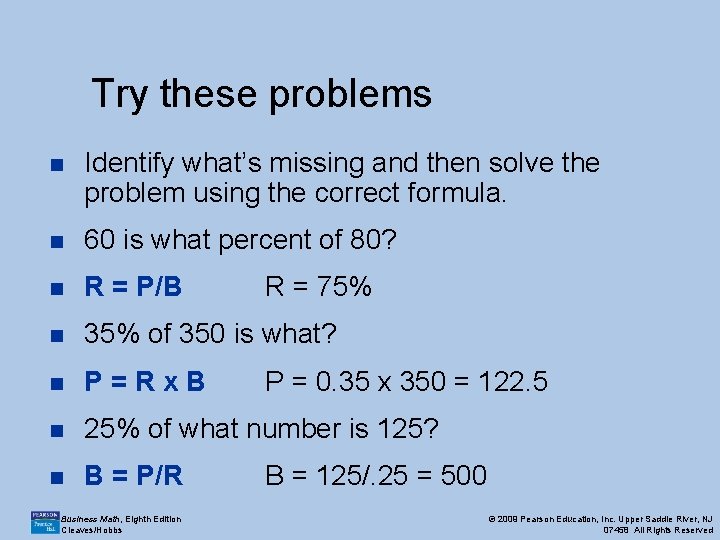
Try these problems n Identify what’s missing and then solve the problem using the correct formula. n 60 is what percent of 80? n R = P/B n 35% of 350 is what? n P=Rx. B n 25% of what number is 125? n B = P/R Business Math, Eighth Edition Cleaves/Hobbs R = 75% P = 0. 35 x 350 = 122. 5 B = 125/. 25 = 500 © 2009 Pearson Education, Inc. Upper Saddle River, NJ 07458 All Rights Reserved
6. 3 Increases and Decreases n Find the amount of increase or decrease in percent problems. n Find the new amount directly in percent problems. n Find the rate or the base in increase or decrease problems. Business Math, Eighth Edition Cleaves/Hobbs © 2009 Pearson Education, Inc. Upper Saddle River, NJ 07458 All Rights Reserved
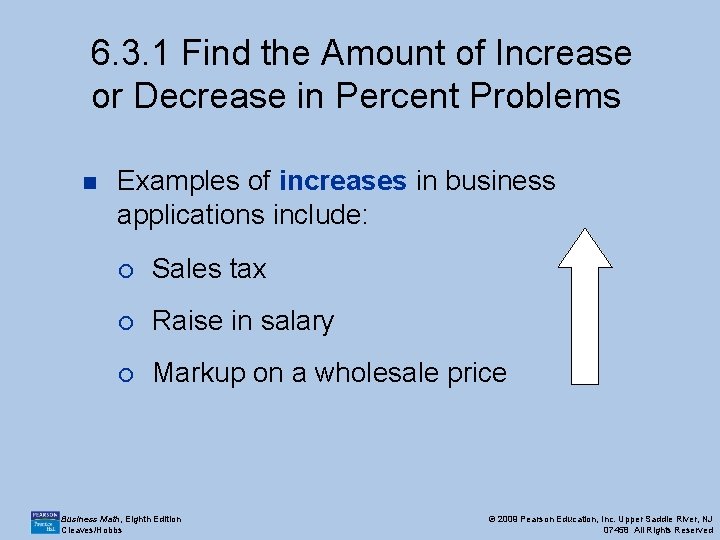
6. 3. 1 Find the Amount of Increase or Decrease in Percent Problems n Examples of increases in business applications include: ¡ Sales tax ¡ Raise in salary ¡ Markup on a wholesale price Business Math, Eighth Edition Cleaves/Hobbs © 2009 Pearson Education, Inc. Upper Saddle River, NJ 07458 All Rights Reserved
Decreases in percent problems n Some examples of decreases include: ¡ Payroll deductions ¡ Markdowns ¡ Discounts on sale items Business Math, Eighth Edition Cleaves/Hobbs © 2009 Pearson Education, Inc. Upper Saddle River, NJ 07458 All Rights Reserved
How to find the amount of increase n To find the amount of increase: amount of increase = new amt – beg. amt. Example: Joe’s salary has been $400 a week. Beginning next month, it will be $450 a week. The amount of increase is $50 a week. Business Math, Eighth Edition Cleaves/Hobbs © 2009 Pearson Education, Inc. Upper Saddle River, NJ 07458 All Rights Reserved
How to find the amount of decrease n To find the amount of decrease: Amount of decrease = beg. amt - new amt. n Example: Roxanne’s new purse originally cost $60, but it was on sale when she bought it on Saturday for $39. 99. The amount of decrease (or markdown) is $20. 01. Business Math, Eighth Edition Cleaves/Hobbs © 2009 Pearson Education, Inc. Upper Saddle River, NJ 07458 All Rights Reserved
Percent of change n The amount of change is a percent of the original or beginning amount. n Find the amount (increase or decrease) from a percent of change by: ¡ Identifying the original or beginning amount and the percent or rate of change. ¡ Multiplying the decimal equivalent of the rate of change by the original or beginning amount. Business Math, Eighth Edition Cleaves/Hobbs © 2009 Pearson Education, Inc. Upper Saddle River, NJ 07458 All Rights Reserved
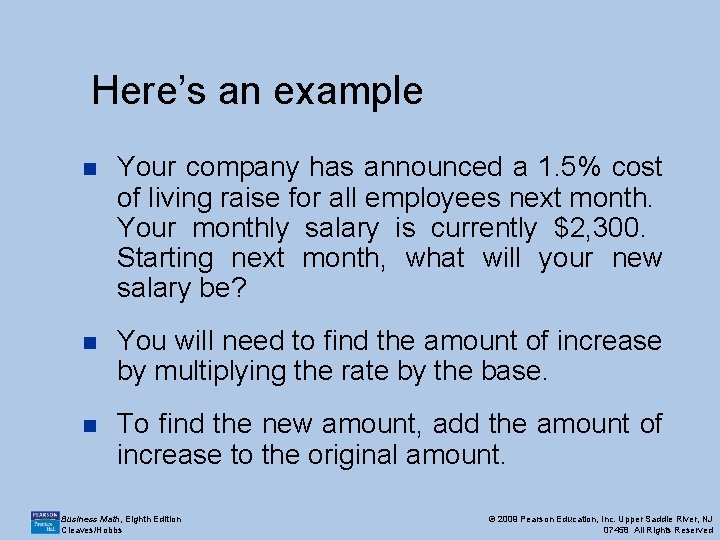
Here’s an example n Your company has announced a 1. 5% cost of living raise for all employees next month. Your monthly salary is currently $2, 300. Starting next month, what will your new salary be? n You will need to find the amount of increase by multiplying the rate by the base. n To find the new amount, add the amount of increase to the original amount. Business Math, Eighth Edition Cleaves/Hobbs © 2009 Pearson Education, Inc. Upper Saddle River, NJ 07458 All Rights Reserved
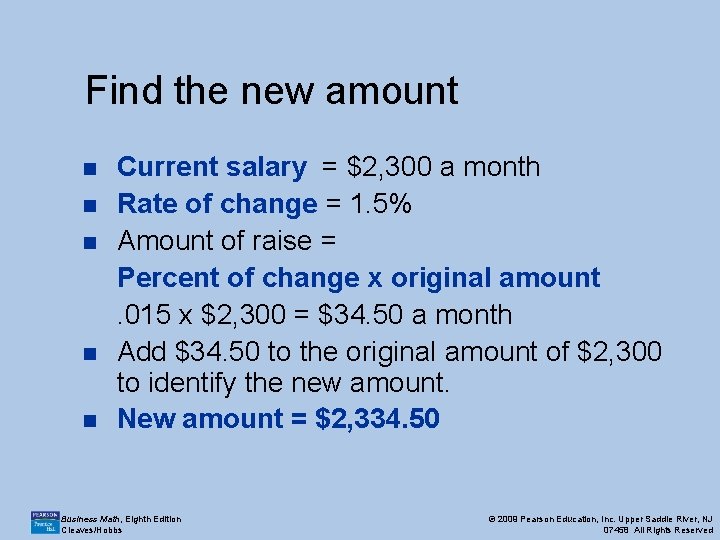
Find the new amount n n n Current salary = $2, 300 a month Rate of change = 1. 5% Amount of raise = Percent of change x original amount. 015 x $2, 300 = $34. 50 a month Add $34. 50 to the original amount of $2, 300 to identify the new amount. New amount = $2, 334. 50 Business Math, Eighth Edition Cleaves/Hobbs © 2009 Pearson Education, Inc. Upper Saddle River, NJ 07458 All Rights Reserved
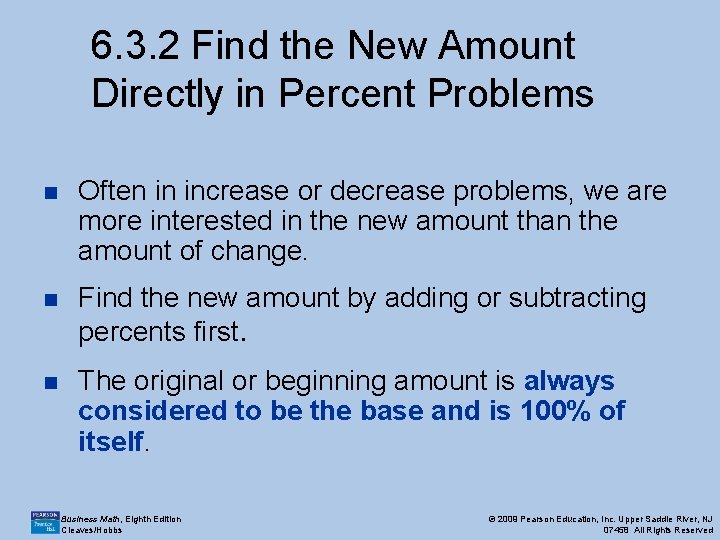
6. 3. 2 Find the New Amount Directly in Percent Problems n Often in increase or decrease problems, we are more interested in the new amount than the amount of change. n Find the new amount by adding or subtracting percents first. n The original or beginning amount is always considered to be the base and is 100% of itself. Business Math, Eighth Edition Cleaves/Hobbs © 2009 Pearson Education, Inc. Upper Saddle River, NJ 07458 All Rights Reserved
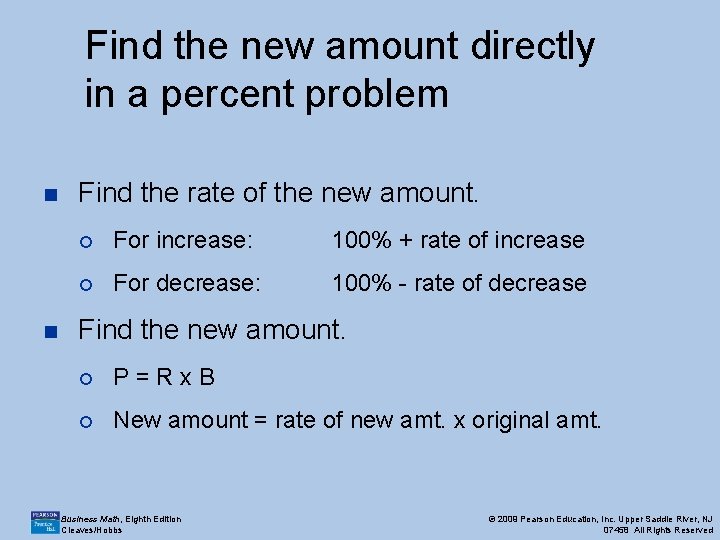
Find the new amount directly in a percent problem n n Find the rate of the new amount. ¡ For increase: 100% + rate of increase ¡ For decrease: 100% - rate of decrease Find the new amount. ¡ P=Rx. B ¡ New amount = rate of new amt. x original amt. Business Math, Eighth Edition Cleaves/Hobbs © 2009 Pearson Education, Inc. Upper Saddle River, NJ 07458 All Rights Reserved
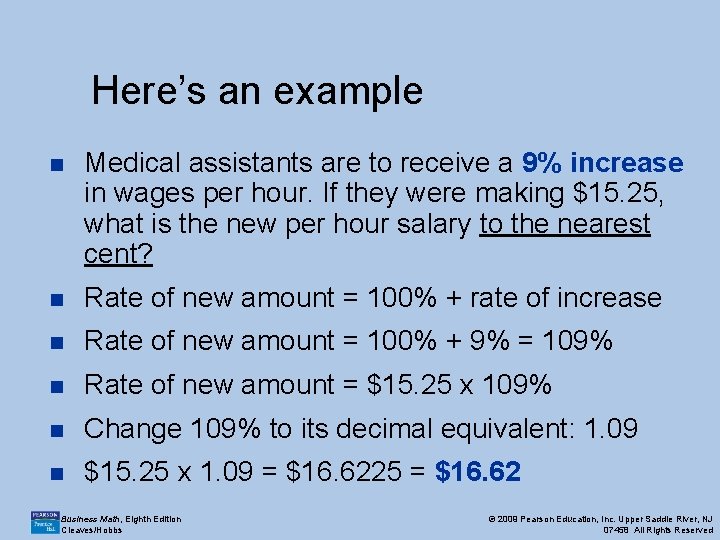
Here’s an example n Medical assistants are to receive a 9% increase in wages per hour. If they were making $15. 25, what is the new per hour salary to the nearest cent? n Rate of new amount = 100% + rate of increase n Rate of new amount = 100% + 9% = 109% n Rate of new amount = $15. 25 x 109% n Change 109% to its decimal equivalent: 1. 09 n $15. 25 x 1. 09 = $16. 6225 = $16. 62 Business Math, Eighth Edition Cleaves/Hobbs © 2009 Pearson Education, Inc. Upper Saddle River, NJ 07458 All Rights Reserved
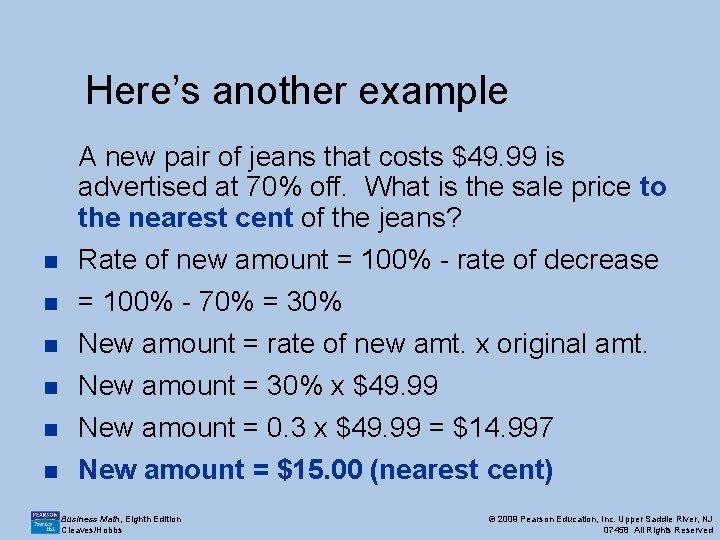
Here’s another example A new pair of jeans that costs $49. 99 is advertised at 70% off. What is the sale price to the nearest cent of the jeans? n n n Rate of new amount = 100% - rate of decrease = 100% - 70% = 30% New amount = rate of new amt. x original amt. New amount = 30% x $49. 99 New amount = 0. 3 x $49. 99 = $14. 997 New amount = $15. 00 (nearest cent) Business Math, Eighth Edition Cleaves/Hobbs © 2009 Pearson Education, Inc. Upper Saddle River, NJ 07458 All Rights Reserved
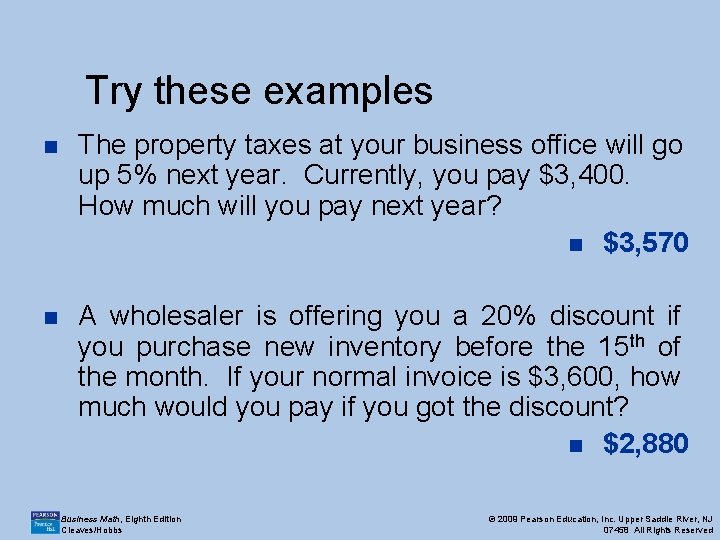
Try these examples n The property taxes at your business office will go up 5% next year. Currently, you pay $3, 400. How much will you pay next year? n $3, 570 n A wholesaler is offering you a 20% discount if you purchase new inventory before the 15 th of the month. If your normal invoice is $3, 600, how much would you pay if you got the discount? n $2, 880 Business Math, Eighth Edition Cleaves/Hobbs © 2009 Pearson Education, Inc. Upper Saddle River, NJ 07458 All Rights Reserved
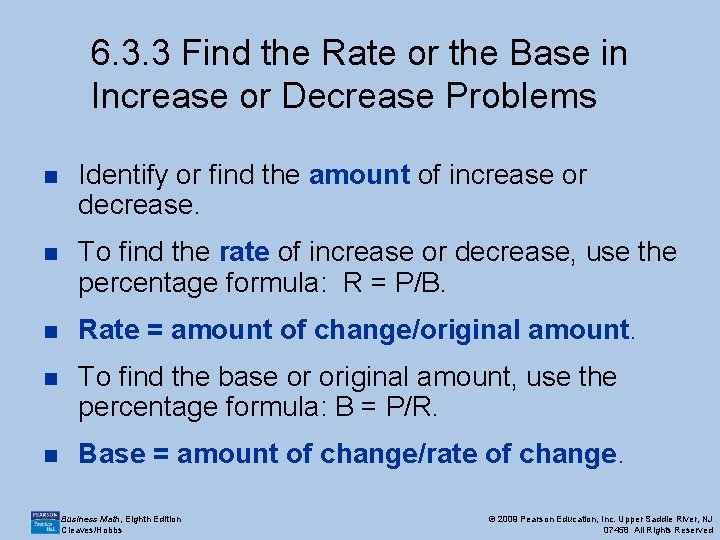
6. 3. 3 Find the Rate or the Base in Increase or Decrease Problems n Identify or find the amount of increase or decrease. n To find the rate of increase or decrease, use the percentage formula: R = P/B. n Rate = amount of change/original amount. n To find the base or original amount, use the percentage formula: B = P/R. n Base = amount of change/rate of change. Business Math, Eighth Edition Cleaves/Hobbs © 2009 Pearson Education, Inc. Upper Saddle River, NJ 07458 All Rights Reserved
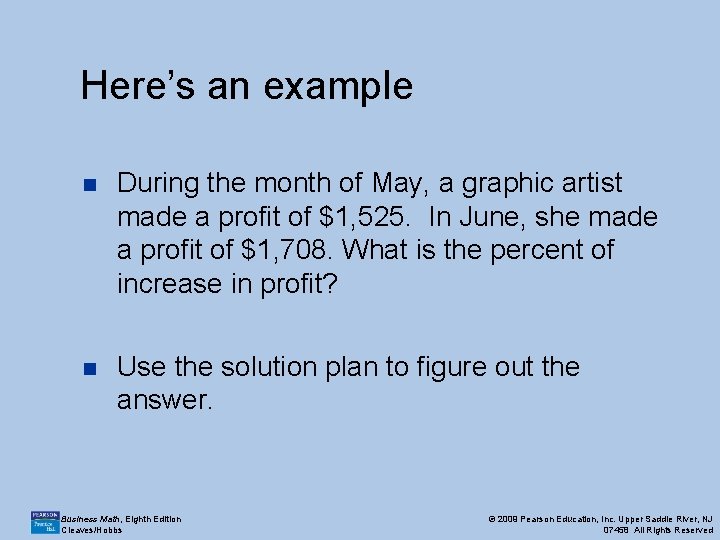
Here’s an example n During the month of May, a graphic artist made a profit of $1, 525. In June, she made a profit of $1, 708. What is the percent of increase in profit? n Use the solution plan to figure out the answer. Business Math, Eighth Edition Cleaves/Hobbs © 2009 Pearson Education, Inc. Upper Saddle River, NJ 07458 All Rights Reserved
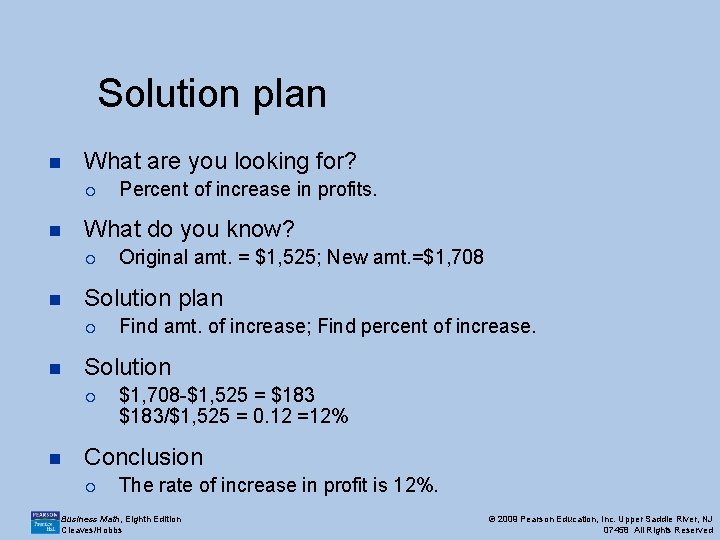
Solution plan n What are you looking for? ¡ n What do you know? ¡ n Find amt. of increase; Find percent of increase. Solution ¡ n Original amt. = $1, 525; New amt. =$1, 708 Solution plan ¡ n Percent of increase in profits. $1, 708 -$1, 525 = $183/$1, 525 = 0. 12 =12% Conclusion ¡ The rate of increase in profit is 12%. Business Math, Eighth Edition Cleaves/Hobbs © 2009 Pearson Education, Inc. Upper Saddle River, NJ 07458 All Rights Reserved
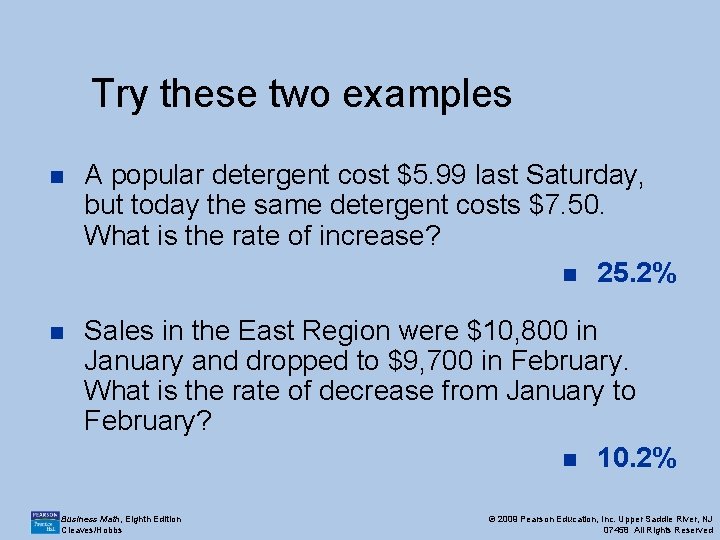
Try these two examples n A popular detergent cost $5. 99 last Saturday, but today the same detergent costs $7. 50. What is the rate of increase? n 25. 2% n Sales in the East Region were $10, 800 in January and dropped to $9, 700 in February. What is the rate of decrease from January to February? n 10. 2% Business Math, Eighth Edition Cleaves/Hobbs © 2009 Pearson Education, Inc. Upper Saddle River, NJ 07458 All Rights Reserved