
6 1 Pearce Robinson 10 th ed Chapter
6 -1 Pearce & Robinson, 10 th ed.
Chapter 6 • Internal Analysis Mc. Graw-Hill/Irwin Strategic Management, 10/e Copyright © 2007 The Mc. Graw-Hill Companies, Inc. All rights reserved.
6 -3 Learning Objectives 1. Understand how to conduct a SWOT analysis 2. Understand value chain analysis and how to use it to disaggregate a firm’s activities 3. Understand the resource-based view of a firm 4. Apply four different perspectives for making meaningful comparisons to assess a firm’s internal strengths and weaknesses 5. Refamiliarize yourself with ratio analysis and basic techniques of financial analysis to assist in doing internal analysis
6 -4 SWOT Analysis A traditional approach to internal analysis: SWOT is an acronym for the internal Strengths and Weaknesses of a firm and the environmental Opportunities and Threats facing that firm. • SWOT analysis is a historically popular technique through which managers create a quick overview of a company’s strategic situation.
6 -5 SWOT Components • • An opportunity is a major unfavorable situation in a firm’s environment A threat is a major unfavorable situation in a firm’s environment A strength is a resource or capability controlled by or available to a firm that gives it an advantage relative to its competitors in meeting the needs of the customers it serves A weakness is a limitation or deficiency in one or more of a firm’s resources or capabilities relative to its competitors that create a disadvantage in effectively meeting customer needs
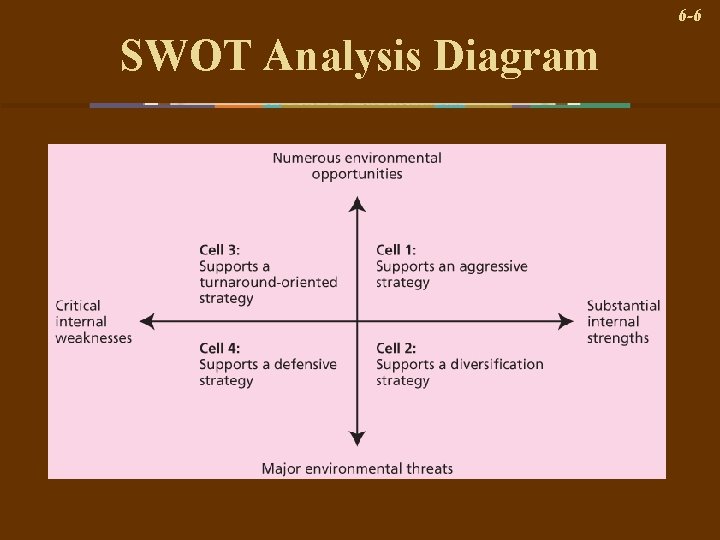
6 -6 SWOT Analysis Diagram
6 -7 Limitations of SWOT Analysis • • A SWOT analysis can overemphasize internal strengths and downplay external threats A SWOT analysis can be static and can risk ignoring changing circumstances A SWOT analysis can overemphasize a single strength or element of strategy A strength is not necessarily a source of competitive advantage
6 -8 Value Chain Analysis (VCA) • • • The term value chain describes a way of looking at a business as a chain of activities that transform inputs into outputs that customers value Value chain analysis (VCA) attempts to understand how a business creates customer value by examining the contributions of different activities within the business to that value VCA takes a process point of view
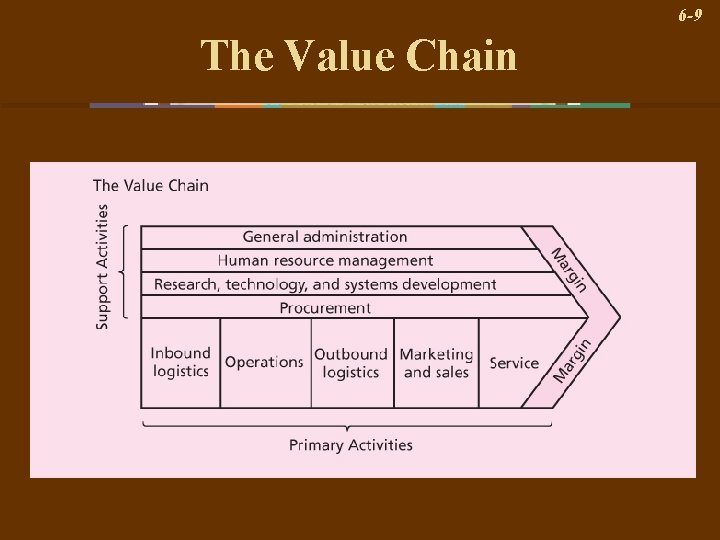
6 -9 The Value Chain
6 -10 Conducting a VCA 1. Identify activities 2. Allocate costs • VCA proponents hold that the activity-based VCA approach would provide a more meaningful analysis of the procurement function’s costs and consequent value added than the traditional cost accounting approach
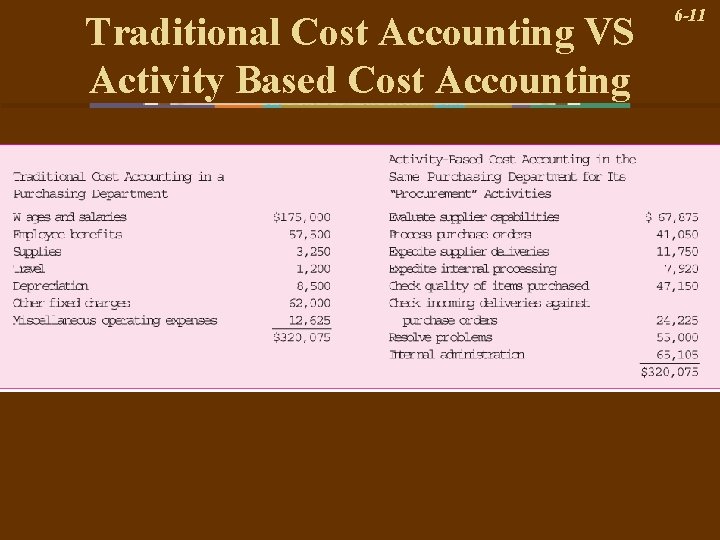
Traditional Cost Accounting VS Activity Based Cost Accounting 6 -11
Difficulty in Activity-Based Cost Accounting • • • 6 -12 It is important to note that existing financial management and accounting systems in many firms are not set up to easily provide activity-based cost breakdowns Identify the activities that differentiate the firm Examine the value chain
6 -13 Resource-Based View (RBV) 1. RBV is a method of analyzing and identifying a firm’s strategic advantages based on examining its distinct combination of assets, skills, capabilities, and intangibles 2. The RBV’s underlying premise is that firms differ in fundamental ways because each firm possesses a unique “bundle” of resources 3. Each firm develops competencies from these resources, and these become the source of the firm’s competitive advantages
6 -14 Three Basic Resources 1. Tangible assets are the easiest “resources” to identify and are often found on a firm’s balance sheet 2. Intangible assets are “resources” such as brand names, company reputation, organizational morale, technical knowledge, patents and trademarks, and accumulated experience 3. Organizational capabilities are not specific “inputs. ” They are the skills that a company uses to transform inputs into outputs
6 -15 What makes a resource valuable? 4 Guidelines: 1. Is the resource or skill critical to fulfilling a customer’s need better than that of the firm’s competitors? Resurgence of Environmentalism 2. Is the resource scarce? Is it in short supply or not easily substituted for or imitated? 3. Appropriability: Who actually gets the profit created by a resource? 4. Durability: How rapidly will the resource depreciate?
6 -16 Elements of Scarcity • • Short Supply Availability of Substitutes Imitation Isolating Mechanisms: – – Physically Unique Resources “Path-Dependent” Resources Casual Ambiguity Economic Deterrence
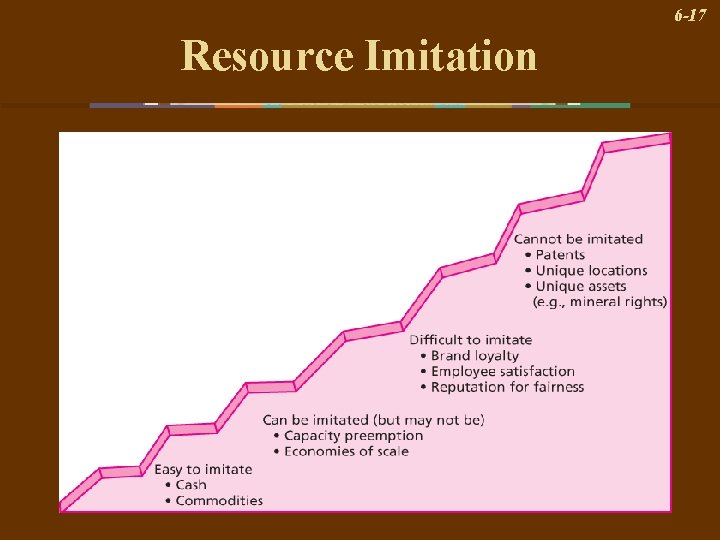
6 -17 Resource Imitation
6 -18 Using RBV in Internal Analysis It is helpful to: • Disaggregate resources • Utilize a functional perspective • Look at organizational processes • Use the value chain approach
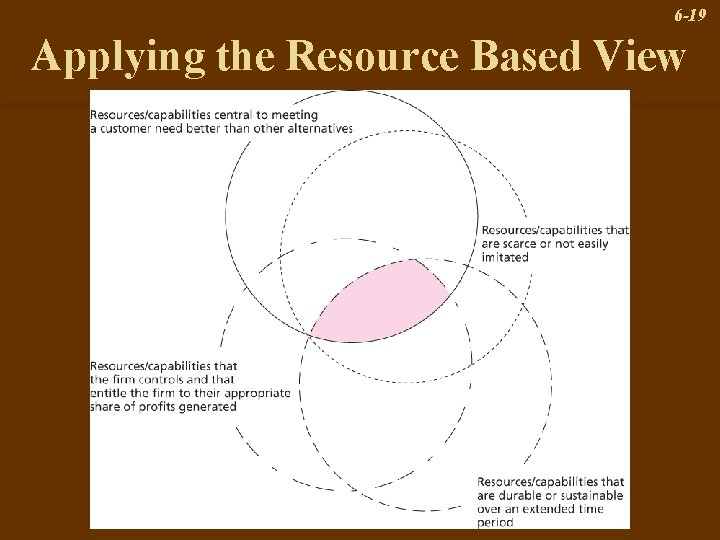
6 -19 Applying the Resource Based View
6 -20 Making Meaningful Comparisons • • • Managers need objective standards to use when examining internal resources and value-building activities Strategists use the firm’s historical experience as a basis for evaluating internal factors Benchmarking, or comparing the way “our” company performs a specific activity with a competitor or other company doing the same thing, has become a central concern of managers in quality commitment companies worldwide
Comparison with Success Factors in the Industry 6 -21 • The key determinants of success in an industry may be used to identify a firm’s internal strengths and weaknesses • A strategist seeks to determine whether a firm’s current internal capabilities represent strengths or weaknesses in new competitive arenas
- Slides: 21