
6 1 DIGESTION AND ABSORPTION OF CARBOHYDRATES INTRODUCTION
6. 1 DIGESTION AND ABSORPTION OF CARBOHYDRATES
INTRODUCTION The most abundant carbohydrates ingested by human beings are they polysaccharides, starch and cellulose, furnished by plant foods and glycogen, provided by foods of animal origin.
2. Digestion- Starch • Starch and glycogen are completely hydrolyzed by enzyme action in the gastrointestinal tract to yield free D-glucose. • This process begins in the mouth during chewing, through the action of amylase secreted by the salivary glands. • Salivary amylase hydrolyzes many of the α (1 4) glycosidic linkages of starch and glycogen Salivary amylase Starch and glycogen → a mixture of maltose, glucose and oligosaccharides.

The digestion of digestible polysaccharides to yield Dglucose is continued and completed in the small intestine 1. Pancreatic amylase -made by the pancreas and secreted via the pancreatic duct into the upper protein of the small intestine duodenum 2. Intestinal amylase secreted by small intestine continue and complete the digestion of starch Pancreatic amylase & intestinal amylase Starch → a mixture of maltose, glucose and oligosaccharides
Disaccharides are hydrolyzed by enzymes located in the outer border of the epithelial cells lining the small intestine. sucrase or invertase Surcose → D-glucose and D-fructose , Lactose lactase → D-glucose and D-galactose Maltose maltase → two molecules of D-glucose. The liver stores the glucose as glycogen and releases glucose as and when needed to maintain blood glucose level.
Cellulose • Cellulose cannot be enzymatically digested and used by most mammals for lack of enzymes capable of hydrolyzing the β(1 4) linkages between successive D-glucose residues of cellulose. • Nevertheless undigested cellulose residues of plant foods provide bulk or fiber (also called “roughage”) in the diet and are desirable for proper motility of materials in the intestine. • Cellulose can be digested by ruminant animals, but only indirectly. The rumen bacteria hydrolyze cellulose to yield Dglucose, which they ferment to yield lactate, acetate, and propionate, absorbed into the blood. • Lactate and propionate are converted by the liver into glucose sugar in ruminants.

Digestion of carbohydrates
Absorption • In the epithelial cells lining the small intestine, D-fructose, D-galactose and D-mannose are converted into Dglucose. • The resulting mixture of simple hexoses is absorbed into the epithelial cells lining the small intestine and brought via the blood to the liver.
Metabolisms involving glucose • The absorbed free glucose is phosphorylated to glucose 6 phosphate by hexokinase using ATP. • The fructose, galactose and mannose absorbed are also converted into glucose 6 phosphate. • This compound is metabolized by five major metabolic path ways.
i. Conversion into blood glucose • The absorbed free glucose is phosphorylated to glucose 6 phosphate by hexokinase using ATP. • The fructose, galactose and mannose absorbed are also converted into glucose 6 phosphate. • This compound is then metabolized by major metabolic path ways. • Glucose 6 -phosphate is dephosphorylated by glucose 6 phosphate to yield free-D-glucose, which passes into the systemic blood to be transported to other tissues. Glucose 6 phosphatase Glucose 6 -phosphate → Glucose + Pi •
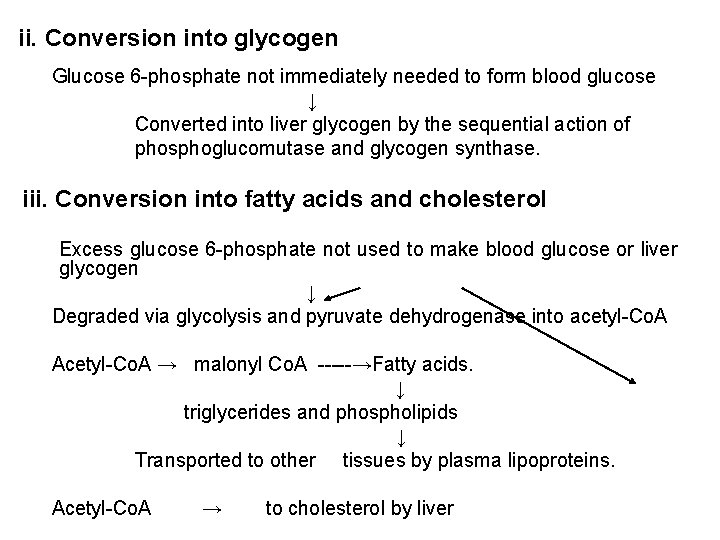
ii. Conversion into glycogen Glucose 6 -phosphate not immediately needed to form blood glucose ↓ Converted into liver glycogen by the sequential action of phosphoglucomutase and glycogen synthase. iii. Conversion into fatty acids and cholesterol Excess glucose 6 -phosphate not used to make blood glucose or liver glycogen ↓ Degraded via glycolysis and pyruvate dehydrogenase into acetyl-Co. A Acetyl-Co. A → malonyl Co. A -----→Fatty acids. ↓ triglycerides and phospholipids ↓ Transported to other tissues by plasma lipoproteins. Acetyl-Co. A → to cholesterol by liver
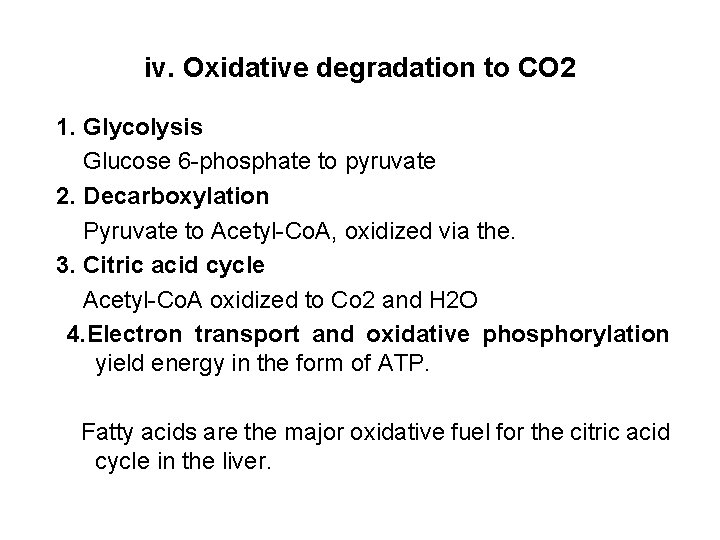
iv. Oxidative degradation to CO 2 1. Glycolysis Glucose 6 -phosphate to pyruvate 2. Decarboxylation Pyruvate to Acetyl-Co. A, oxidized via the. 3. Citric acid cycle Acetyl-Co. A oxidized to Co 2 and H 2 O 4. Electron transport and oxidative phosphorylation yield energy in the form of ATP. Fatty acids are the major oxidative fuel for the citric acid cycle in the liver.
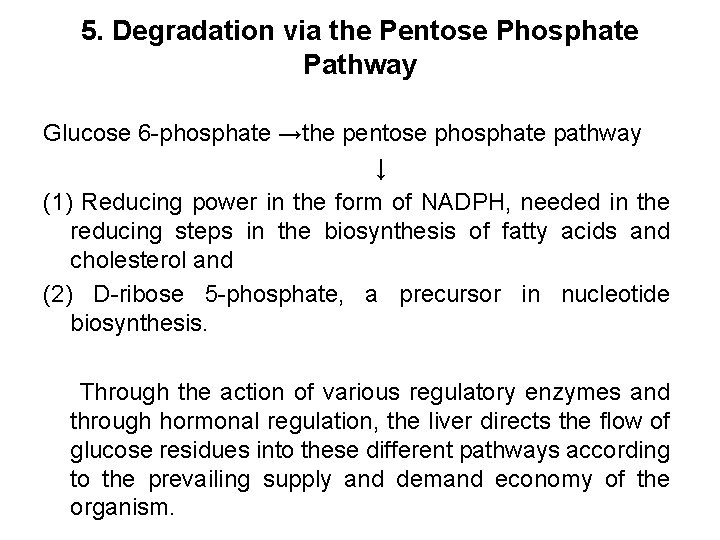
5. Degradation via the Pentose Phosphate Pathway Glucose 6 -phosphate →the pentose phosphate pathway ↓ (1) Reducing power in the form of NADPH, needed in the reducing steps in the biosynthesis of fatty acids and cholesterol and (2) D-ribose 5 -phosphate, a precursor in nucleotide biosynthesis. Through the action of various regulatory enzymes and through hormonal regulation, the liver directs the flow of glucose residues into these different pathways according to the prevailing supply and demand economy of the organism.
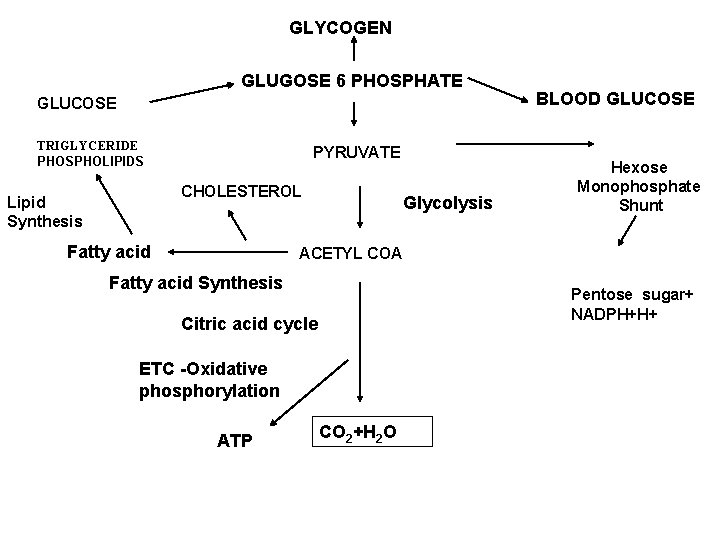
GLYCOGEN GLUGOSE 6 PHOSPHATE GLUCOSE TRIGLYCERIDE PHOSPHOLIPIDS PYRUVATE CHOLESTEROL Lipid Synthesis Fatty acid Glycolysis BLOOD GLUCOSE Hexose Monophosphate Shunt ACETYL COA Fatty acid Synthesis Pentose sugar+ NADPH+H+ Citric acid cycle ETC -Oxidative phosphorylation ATP CO 2+H 2 O
- Slides: 14