
6 1 Chromosomes and Meiosis Bellwork Complete Plant
6. 1 Chromosomes and Meiosis • • Bellwork: Complete Plant Processes Review worksheet! Word bank is on the back of your worksheet! Goes on pg. 82 of your journal!!!! • ANSWERS TO TRANSPIRATION AND GROWTH BELLWORK: • 1. 1. Absorption of water, 2. transport of water, 3. gas exchange • 2. a. Active transport b. high • 3. a. root cap and bud; apical meristem b. stem; axillary meristem • 4. WILL BE CHECKED FOR CORRECTNESS! MAKE SURE TO USE AMPLE DETAILS!!!!!!!
6. 1 Chromosomes and Meiosis Think about it!: How are sexual reproduction and asexual reproduction different from each other? A. sexual reproduction requires two parents and asexual reproduction requires only one parent B. asexual reproduction requires two parents and sexual reproduction requires only one parent C. mutation rates are lower in sexual reproduction than in asexual reproduction D. asexual reproduction occurs only in multicellular organisms
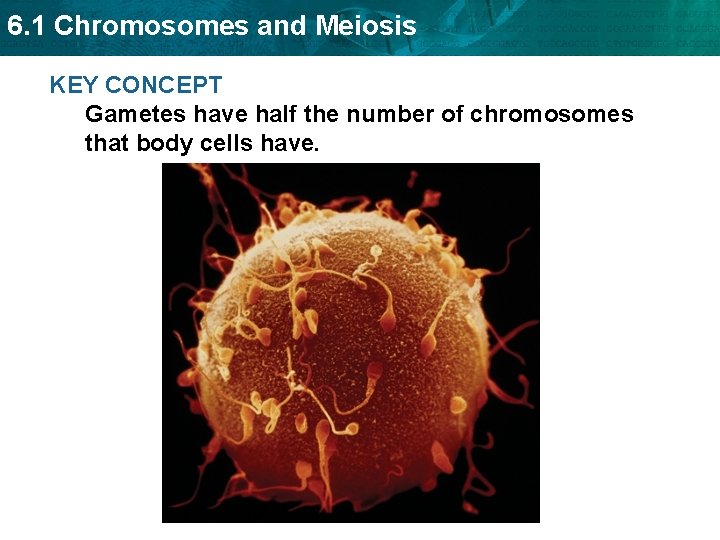
6. 1 Chromosomes and Meiosis KEY CONCEPT Gametes have half the number of chromosomes that body cells have.
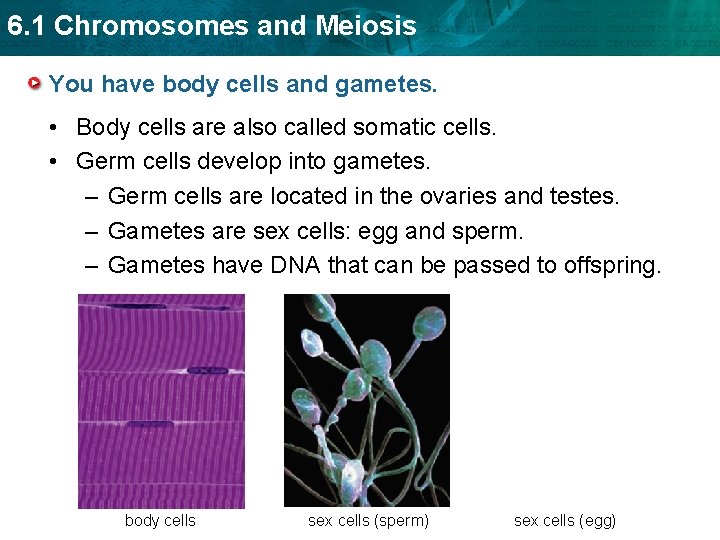
6. 1 Chromosomes and Meiosis You have body cells and gametes. • Body cells are also called somatic cells. • Germ cells develop into gametes. – Germ cells are located in the ovaries and testes. – Gametes are sex cells: egg and sperm. – Gametes have DNA that can be passed to offspring. body cells sex cells (sperm) sex cells (egg)
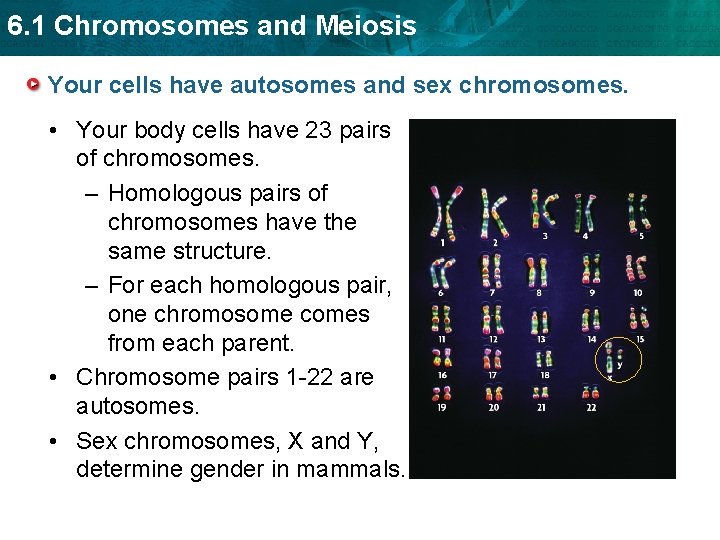
6. 1 Chromosomes and Meiosis Your cells have autosomes and sex chromosomes. • Your body cells have 23 pairs of chromosomes. – Homologous pairs of chromosomes have the same structure. – For each homologous pair, one chromosome comes from each parent. • Chromosome pairs 1 -22 are autosomes. • Sex chromosomes, X and Y, determine gender in mammals.
6. 1 Chromosomes and Meiosis Higher order thinking #1 • How does cellular information pass from one generation to another?
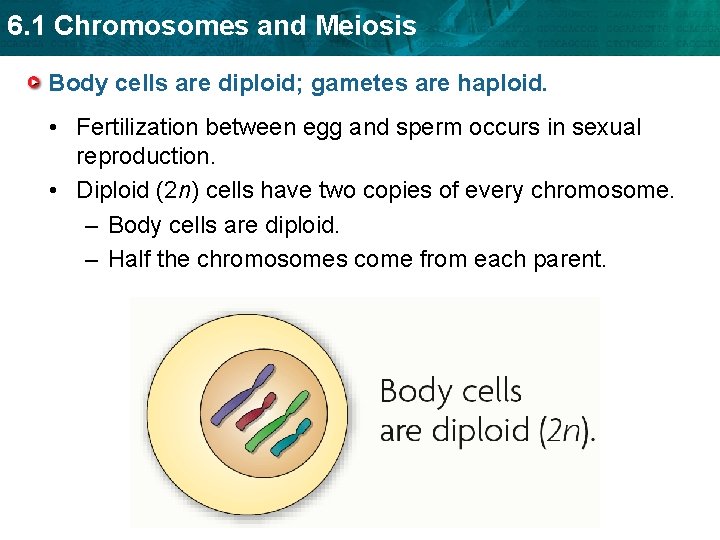
6. 1 Chromosomes and Meiosis Body cells are diploid; gametes are haploid. • Fertilization between egg and sperm occurs in sexual reproduction. • Diploid (2 n) cells have two copies of every chromosome. – Body cells are diploid. – Half the chromosomes come from each parent.
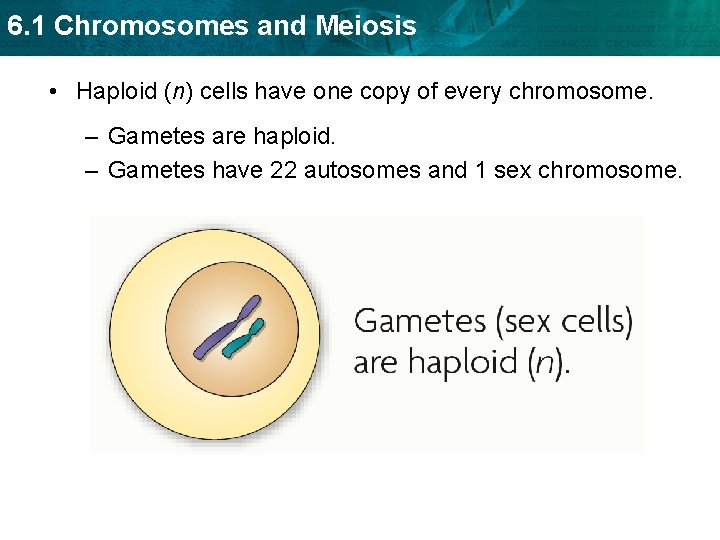
6. 1 Chromosomes and Meiosis • Haploid (n) cells have one copy of every chromosome. – Gametes are haploid. – Gametes have 22 autosomes and 1 sex chromosome.
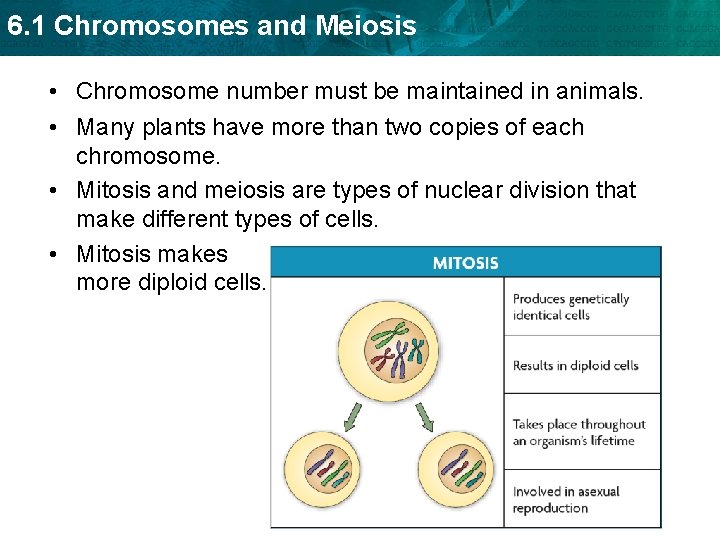
6. 1 Chromosomes and Meiosis • Chromosome number must be maintained in animals. • Many plants have more than two copies of each chromosome. • Mitosis and meiosis are types of nuclear division that make different types of cells. • Mitosis makes more diploid cells.
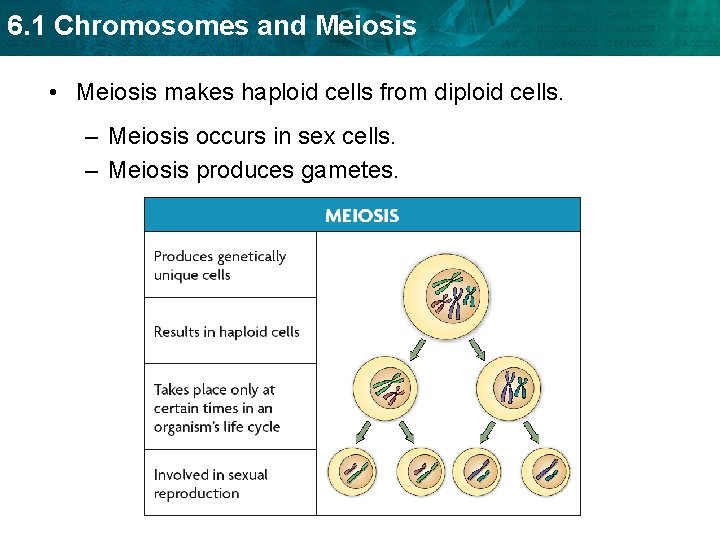
6. 1 Chromosomes and Meiosis • Meiosis makes haploid cells from diploid cells. – Meiosis occurs in sex cells. – Meiosis produces gametes.
6. 1 Chromosomes and Meiosis Higher order thinking #2 • Explain why chromosomes, not genes, independently assort.
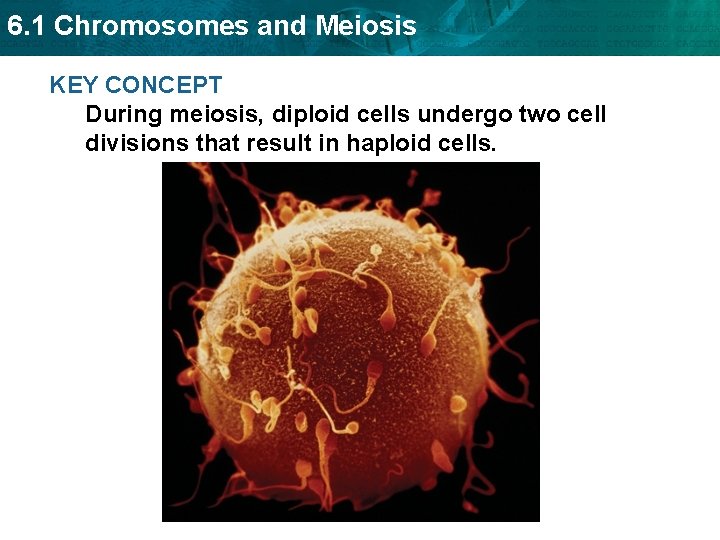
6. 1 Chromosomes and Meiosis KEY CONCEPT During meiosis, diploid cells undergo two cell divisions that result in haploid cells.
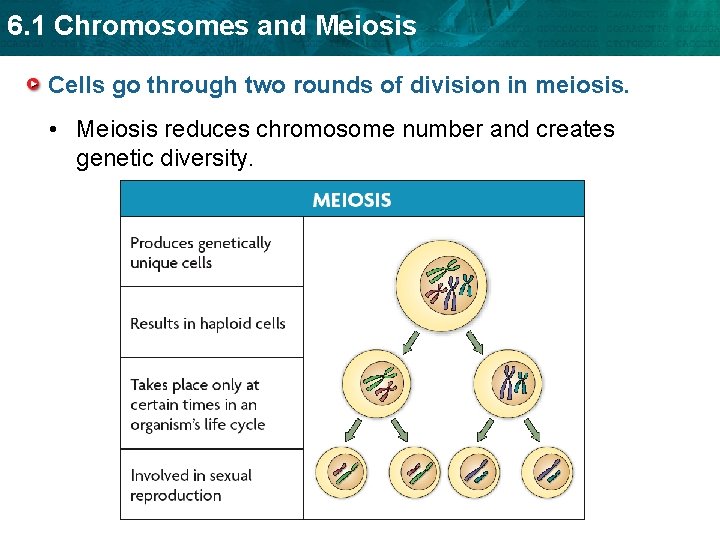
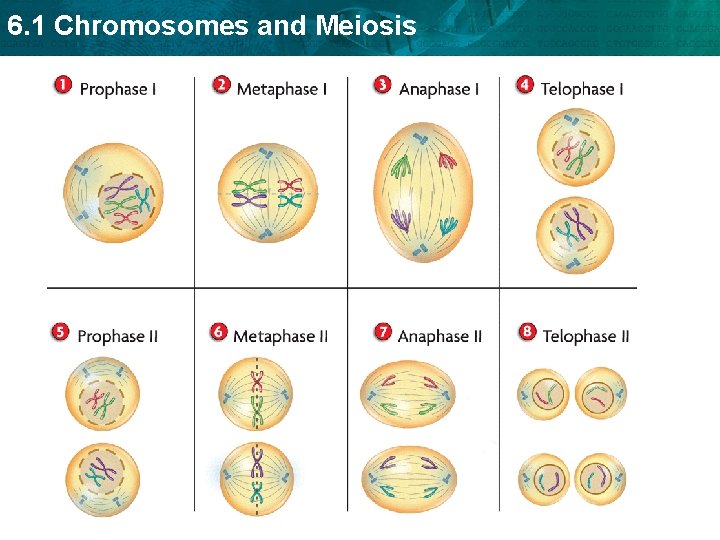
6. 1 Chromosomes and Meiosis Cells go through two rounds of division in meiosis. • Meiosis reduces chromosome number and creates genetic diversity.
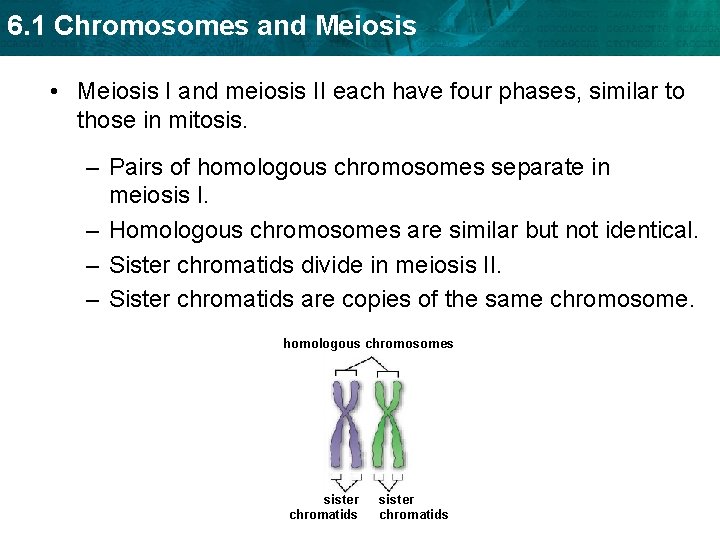
6. 1 Chromosomes and Meiosis • Meiosis I and meiosis II each have four phases, similar to those in mitosis. – Pairs of homologous chromosomes separate in meiosis I. – Homologous chromosomes are similar but not identical. – Sister chromatids divide in meiosis II. – Sister chromatids are copies of the same chromosome. homologous chromosomes sister chromatids
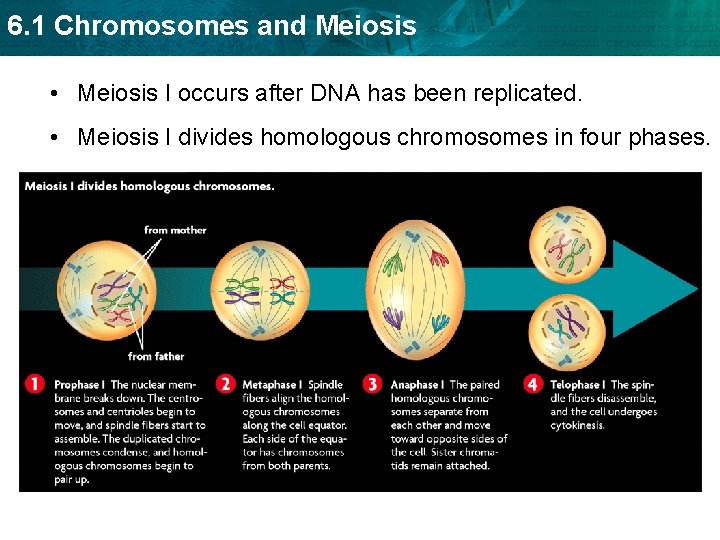
6. 1 Chromosomes and Meiosis • Meiosis I occurs after DNA has been replicated. • Meiosis I divides homologous chromosomes in four phases.
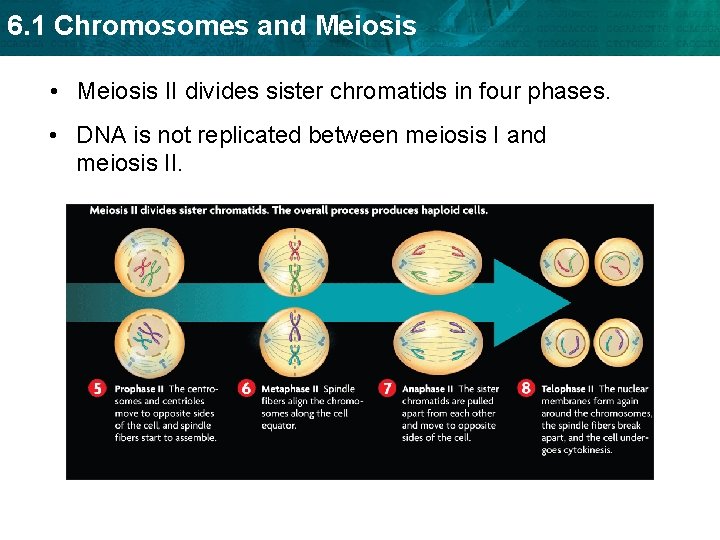
6. 1 Chromosomes and Meiosis • Meiosis II divides sister chromatids in four phases. • DNA is not replicated between meiosis I and meiosis II.
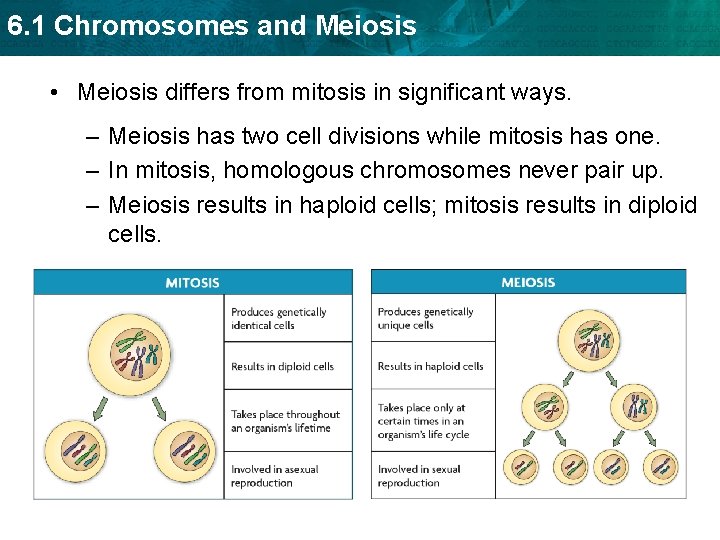
6. 1 Chromosomes and Meiosis • Meiosis differs from mitosis in significant ways. – Meiosis has two cell divisions while mitosis has one. – In mitosis, homologous chromosomes never pair up. – Meiosis results in haploid cells; mitosis results in diploid cells.
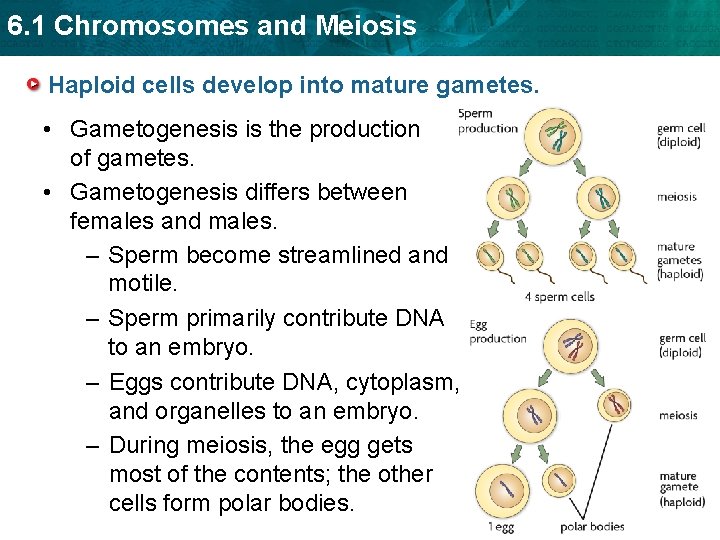
6. 1 Chromosomes and Meiosis Haploid cells develop into mature gametes. • Gametogenesis is the production of gametes. • Gametogenesis differs between females and males. – Sperm become streamlined and motile. – Sperm primarily contribute DNA to an embryo. – Eggs contribute DNA, cytoplasm, and organelles to an embryo. – During meiosis, the egg gets most of the contents; the other cells form polar bodies.
6. 1 Chromosomes and Meiosis Higher order thinking #3 • How can we use genetics to study human inheritance?
6. 1 Chromosomes and Meiosis Amoeba Sisters! • Complete the worksheets as we view the video! It is back and front, so don’t forget to flip it over!
6. 1 Chromosomes and Meiosis Flip Chart it! • Cut out each square • Draw each stage of meiosis in the “cells” • Staple the pages together to create a flipchart of meiosis
6. 1 Chromosomes and Meiosis
6. 1 Chromosomes and Meiosis Essential Question/Exit Ticket • How does the sorting and recombination of genes in sexual reproduction result in a great variety of possible gene combinations?
6. 1 Chromosomes and Meiosis Home Learning • SCIENCE FAIR due 11/22 • Penda Learning 3 assignments per week! • Any make up work due 11/22 • Mitosis, Meiosis, and Human Reproduction QUIZ 11/30 and 12/1
6. 1 Chromosomes and Meiosis Day two on Meiosis
6. 1 Chromosomes and Meiosis Copy and answer the following question on page 86 of your journal: • How are mitosis and meiosis different from each other? • Use your notes to help you! Make a table or venn diagram!
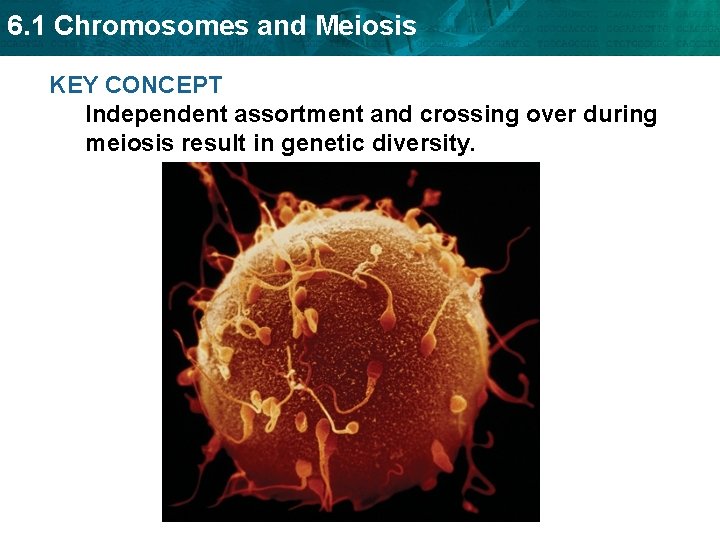
6. 1 Chromosomes and Meiosis KEY CONCEPT Independent assortment and crossing over during meiosis result in genetic diversity.
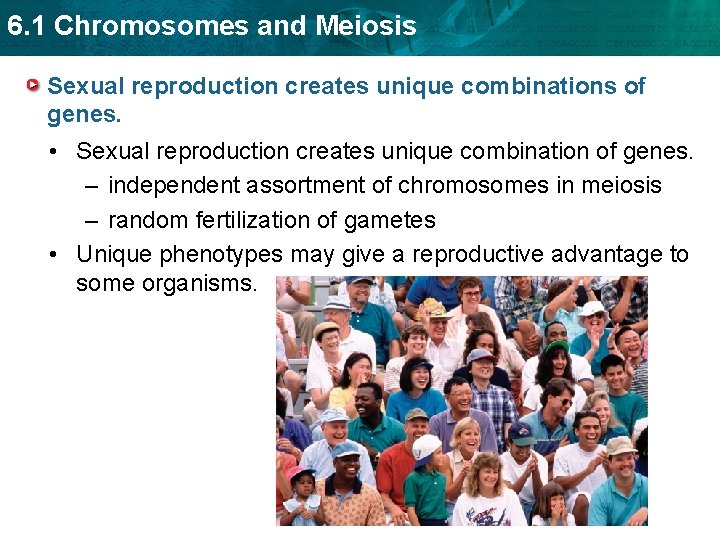
6. 1 Chromosomes and Meiosis Sexual reproduction creates unique combinations of genes. • Sexual reproduction creates unique combination of genes. – independent assortment of chromosomes in meiosis – random fertilization of gametes • Unique phenotypes may give a reproductive advantage to some organisms.
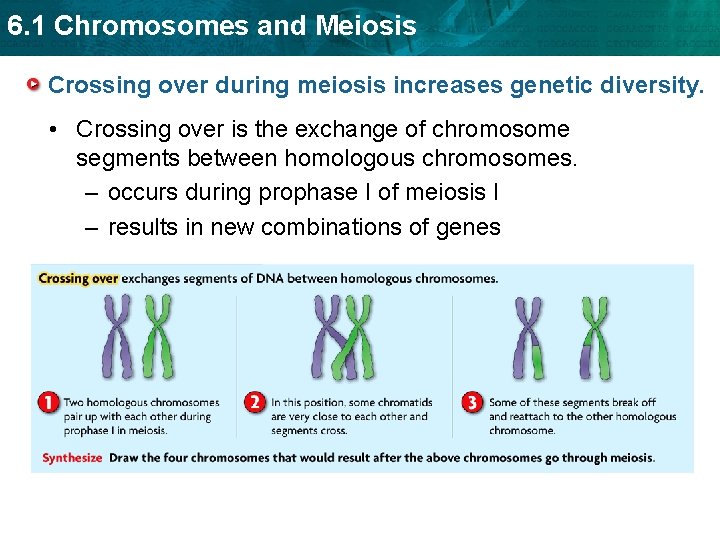
6. 1 Chromosomes and Meiosis Crossing over during meiosis increases genetic diversity. • Crossing over is the exchange of chromosome segments between homologous chromosomes. – occurs during prophase I of meiosis I – results in new combinations of genes
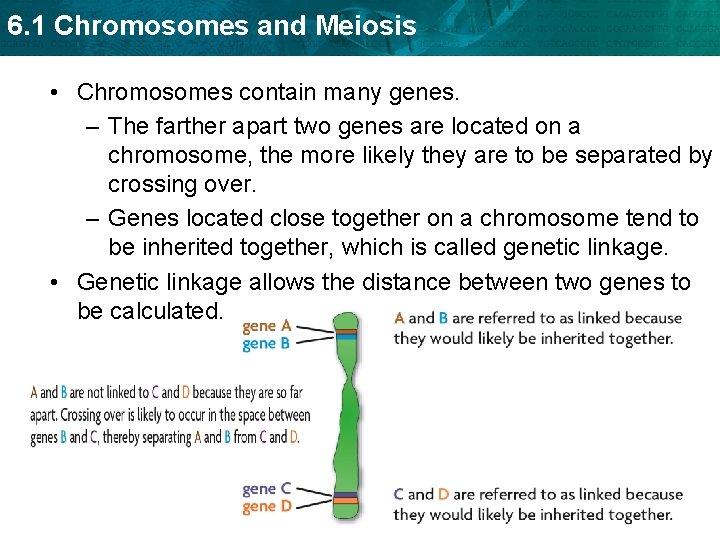
6. 1 Chromosomes and Meiosis • Chromosomes contain many genes. – The farther apart two genes are located on a chromosome, the more likely they are to be separated by crossing over. – Genes located close together on a chromosome tend to be inherited together, which is called genetic linkage. • Genetic linkage allows the distance between two genes to be calculated.
6. 1 Chromosomes and Meiosis • Higher order thinking #4: • What is the relationship between meiosis and genetic disorders such as Down’s Syndrome and Turner’s Syndrome?
6. 1 Chromosomes and Meiosis Home Learning • STUDY for meiosis and mitosis quiz next class • Penda Learning 3 assignments • Scrimmage Dec. 13/14 • Finish web quest for your trimester. Completed webquest will be due Dec. 1!!!!
- Slides: 32