
59 291 Section 1 Lecture 8 Receptor Classification
- Slides: 9
59 -291 Section 1, Lecture 8 Receptor Classification according to: -which drugs they interact with ( -adrenergic –binds norepinphine with high affinity ; - adrenergic binds epinephrine with high affinity) -tissue location -molecular structure (protein sequence) 1
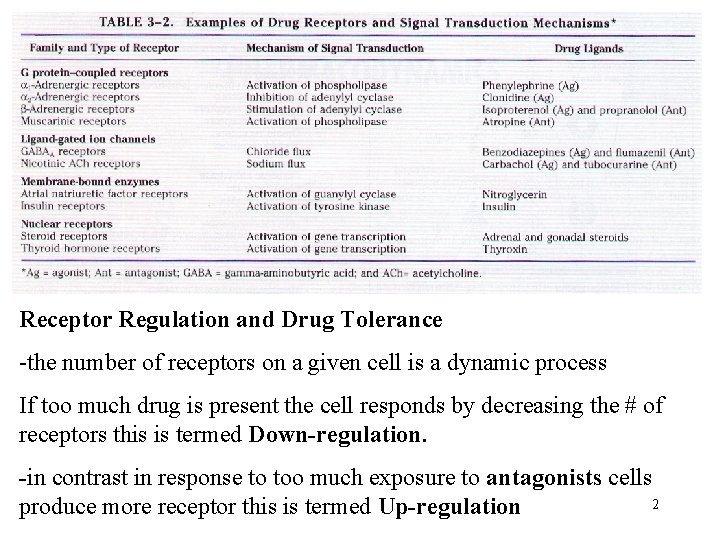
Receptor Regulation and Drug Tolerance -the number of receptors on a given cell is a dynamic process If too much drug is present the cell responds by decreasing the # of receptors this is termed Down-regulation. -in contrast in response to too much exposure to antagonists cells 2 produce more receptor this is termed Up-regulation
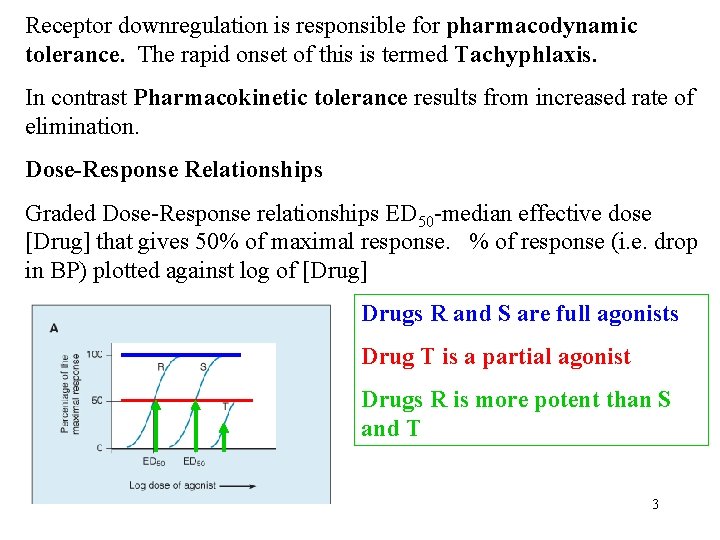
Receptor downregulation is responsible for pharmacodynamic tolerance. The rapid onset of this is termed Tachyphlaxis. In contrast Pharmacokinetic tolerance results from increased rate of elimination. Dose-Response Relationships Graded Dose-Response relationships ED 50 -median effective dose [Drug] that gives 50% of maximal response. % of response (i. e. drop in BP) plotted against log of [Drug] Drugs R and S are full agonists Drug T is a partial agonist Drugs R is more potent than S and T 3
• Efficacy: the maximal response produced by a drug – Full agonist >> maximal efficacy – Partial agonist >> sub maximal efficacy • Antagonist has no efficacy – Can be an effective medication? – Adrenergic receptor antagonist ( blocker) 4
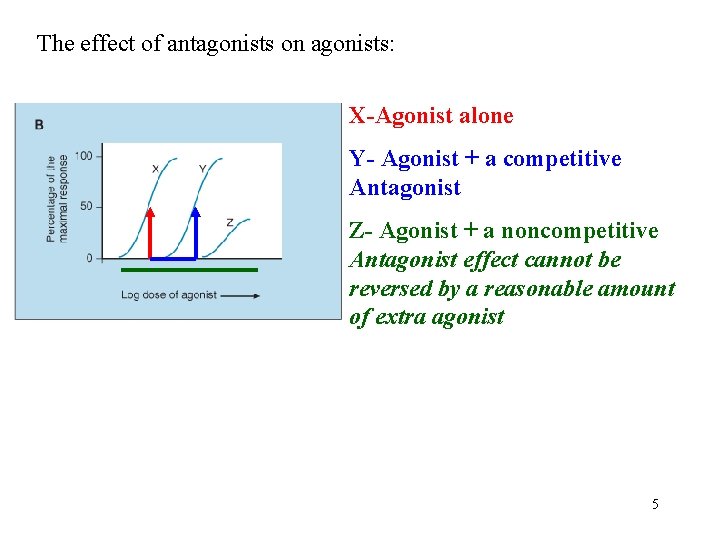
The effect of antagonists on agonists: X-Agonist alone Y- Agonist + a competitive Antagonist Z- Agonist + a noncompetitive Antagonist effect cannot be reversed by a reasonable amount of extra agonist 5
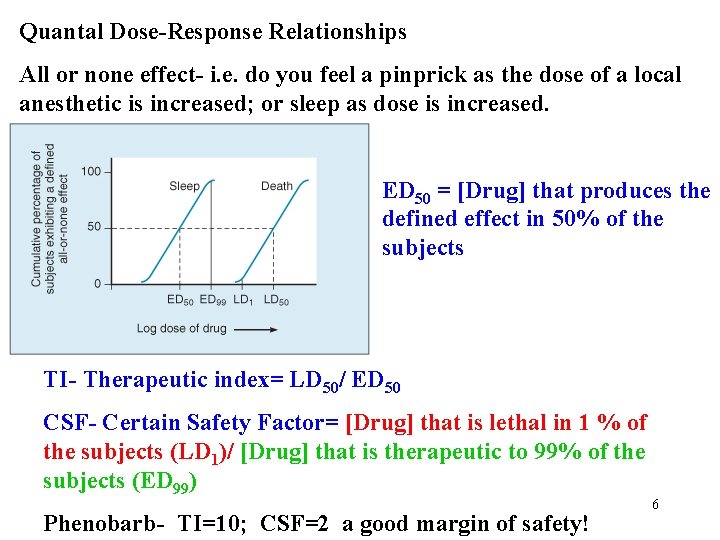
Quantal Dose-Response Relationships All or none effect- i. e. do you feel a pinprick as the dose of a local anesthetic is increased; or sleep as dose is increased. ED 50 = [Drug] that produces the defined effect in 50% of the subjects TI- Therapeutic index= LD 50/ ED 50 CSF- Certain Safety Factor= [Drug] that is lethal in 1 % of the subjects (LD 1)/ [Drug] that is therapeutic to 99% of the subjects (ED 99) Phenobarb- TI=10; CSF=2 a good margin of safety! 6
Practice Questions • What are orphan receptors? • Receptor-like proteins that no endogenous ligand has found for them • The structure is predicted from gene sequencing 7
• What is not the consequence of Ser/Thr phosphorylation of receptors • • • Desensitization Tachyphylaxis Internalization Supersensitivity down-regulation 8
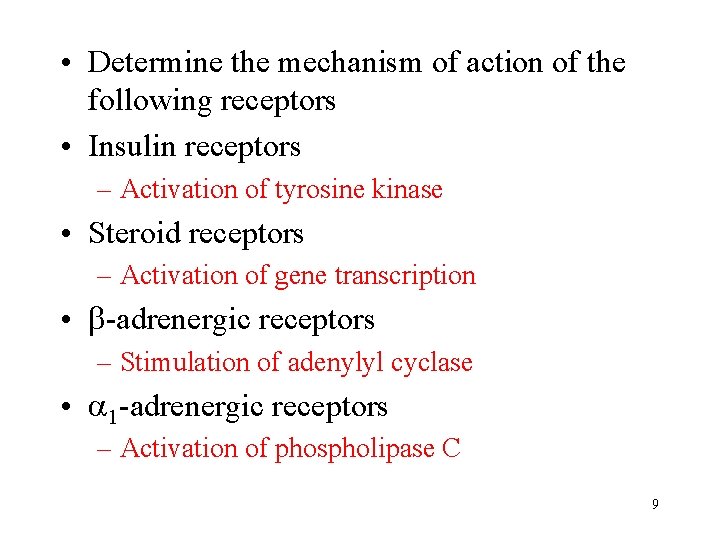
• Determine the mechanism of action of the following receptors • Insulin receptors – Activation of tyrosine kinase • Steroid receptors – Activation of gene transcription • -adrenergic receptors – Stimulation of adenylyl cyclase • 1 -adrenergic receptors – Activation of phospholipase C 9