
59 291 Section 1 Lecture 6 Singledose kinetics
![59 -291 Section 1, Lecture 6 Single-dose kinetics Plasma [Drug] curve Upon administration [drug]plasma](https://slidetodoc.com/presentation_image_h/b375f9ffdcc33797d79c0654ff20e2ca/image-1.jpg "59 -291 Section 1, Lecture 6 Single-dose kinetics Plasma [Drug] curve Upon administration [drug]plasma")
![Continuous and multiple dose kinetics Steady-State Principle: for drugs exhibiting first-order pharmacokinetics [Drug] Rate](https://slidetodoc.com/presentation_image_h/b375f9ffdcc33797d79c0654ff20e2ca/image-3.jpg "Continuous and multiple dose kinetics Steady-State Principle: for drugs exhibiting first-order pharmacokinetics [Drug] Rate")
![Dosage Calculations; Loading dose- dose to establish a rapid therapeutic [drug]plasma = Vd x](https://slidetodoc.com/presentation_image_h/b375f9ffdcc33797d79c0654ff20e2ca/image-8.jpg "Dosage Calculations; Loading dose- dose to establish a rapid therapeutic [drug]plasma = Vd x")
![Example for Gentamicin: [Gentamicin]steady-state plasma= 2 mg/L Clgentamicin=100 m. L/min rate of elimination =](https://slidetodoc.com/presentation_image_h/b375f9ffdcc33797d79c0654ff20e2ca/image-9.jpg "Example for Gentamicin: [Gentamicin]steady-state plasma= 2 mg/L Clgentamicin=100 m. L/min rate of elimination =")
- Slides: 11
59 -291 Section 1, Lecture 6 Single-dose kinetics Plasma [Drug] curve Upon administration [drug]plasma reaches a max Then begins to decline as the Drug is eliminated Cpmax =max plasma [drug] tmax = time to reach Cpmax AUC= area under the curve= These measures are useful for comparing the bioavailability of 1 different pharmaceutical formulation
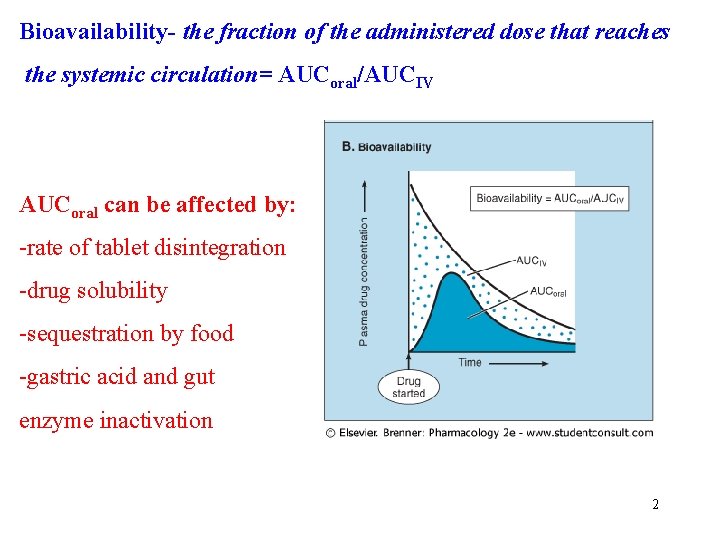
Bioavailability- the fraction of the administered dose that reaches the systemic circulation= AUCoral/AUCIV AUCoral can be affected by: -rate of tablet disintegration -drug solubility -sequestration by food -gastric acid and gut enzyme inactivation 2
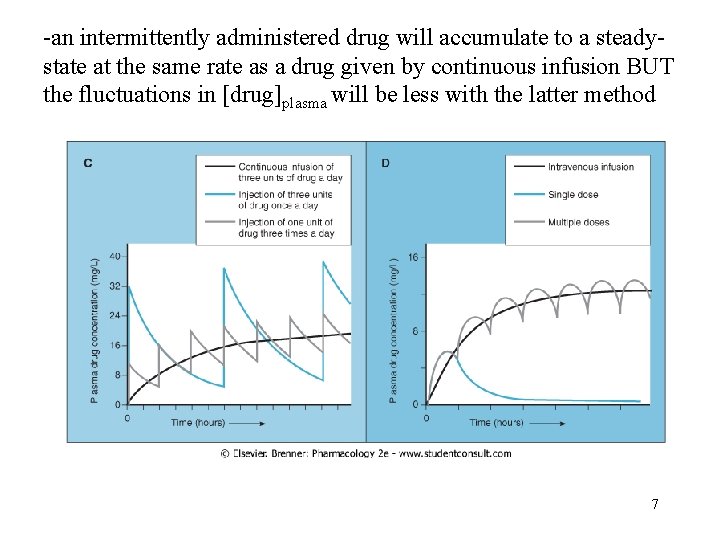
Continuous and multiple dose kinetics Steady-State Principle: for drugs exhibiting first-order pharmacokinetics [Drug] Rate of administration or absorption [Drug]plasma rate= [Drug] x kabs Rate of elimination [Drug]urine, rate= [Drug]plasma x ke Initially rate of admin. or absorption greater than rate of elimination because initially [Drug]plasma is low -rate of elimination gradually increases as [Drug]plasma increases and reaches a plateau. This is termed the steady-state concentration. 3
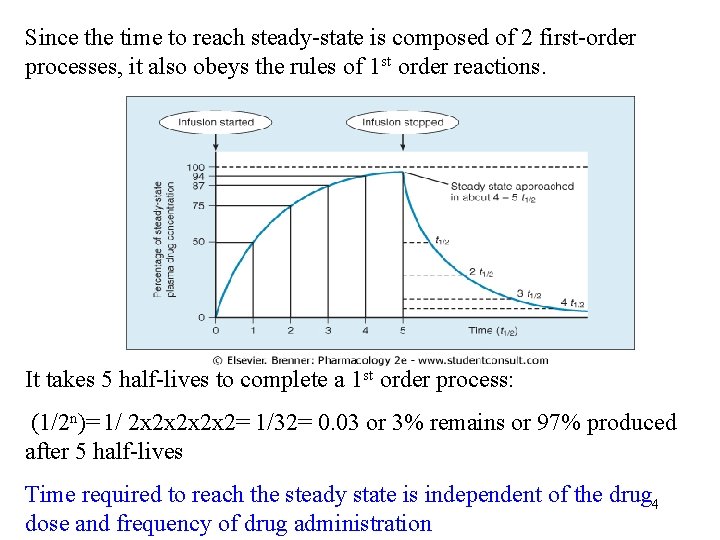
Since the time to reach steady-state is composed of 2 first-order processes, it also obeys the rules of 1 st order reactions. It takes 5 half-lives to complete a 1 st order process: (1/2 n)= 1/ 2 x 2 x 2= 1/32= 0. 03 or 3% remains or 97% produced after 5 half-lives Time required to reach the steady state is independent of the drug 4 dose and frequency of drug administration
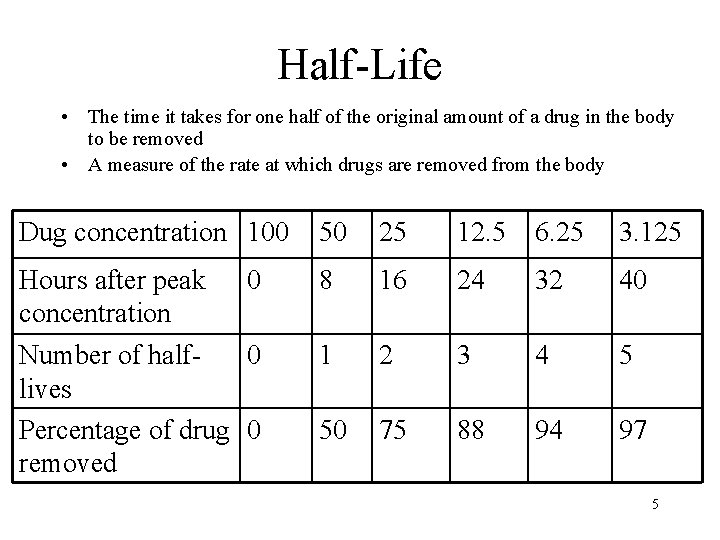
Half-Life • The time it takes for one half of the original amount of a drug in the body to be removed • A measure of the rate at which drugs are removed from the body Dug concentration 100 50 25 12. 5 6. 25 3. 125 Hours after peak concentration 0 8 16 24 32 40 Number of half 0 lives Percentage of drug 0 removed 1 2 3 4 5 50 75 88 94 97 5
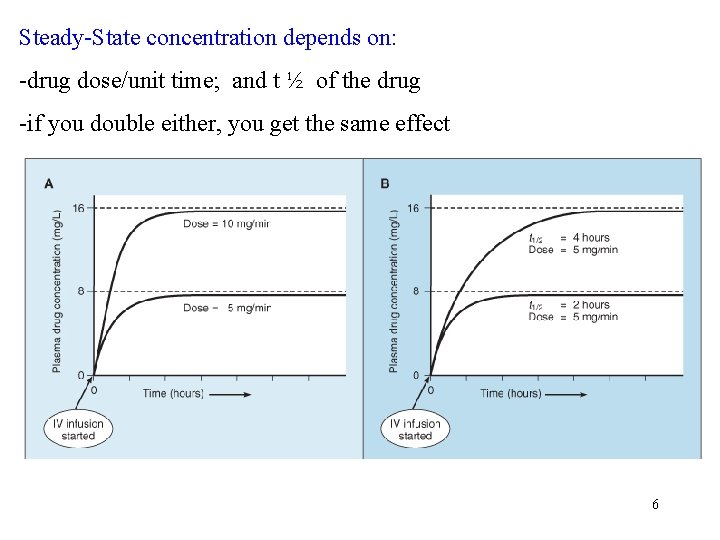
Steady-State concentration depends on: -drug dose/unit time; and t ½ of the drug -if you double either, you get the same effect 6
-an intermittently administered drug will accumulate to a steadystate at the same rate as a drug given by continuous infusion BUT the fluctuations in [drug]plasma will be less with the latter method 7
Dosage Calculations; Loading dose- dose to establish a rapid therapeutic [drug]plasma = Vd x desired [drug]plasma dose/Cp 0 In the case of toxic drugs (digitalis) Loading dose is divided into several portions and given over a long time Maintenance dose= dose required to maintain a desired steady-state Rate of elimination (in hours) x dosage interval in hours At steady state: rate of elimination=rate of administration (absorption) rate of elimination = Cl x avg [Drug]steady-state plasma 8
Example for Gentamicin: [Gentamicin]steady-state plasma= 2 mg/L Clgentamicin=100 m. L/min rate of elimination = Cl x avg [Drug]steady-state plasma = 0. 1 L/min x 2 mg/L = 0. 2 mg/min What is the maintenance dose for administration once every 8 h? Maintenance dose = Rate of elimination (in hours) x dosage interval in hours = 0. 2 mg/min x 60 min/h x 8 h = 96 mg 9
Practice questions • Define bioavailability and list the parameters that are useful for comparing different formulations – the fraction of the administered dose that reaches the systemic circulation= AUCoral/AUCIV – CPmax – Tmax – AUCoral 10
• List the parameters that affect bioavailability of orally administered drugs – rate of tablet disintegration – drug solubility – sequestration by food – gastric acid and gut enzyme inactivation 11