
55 BC The First Raid The Romans had
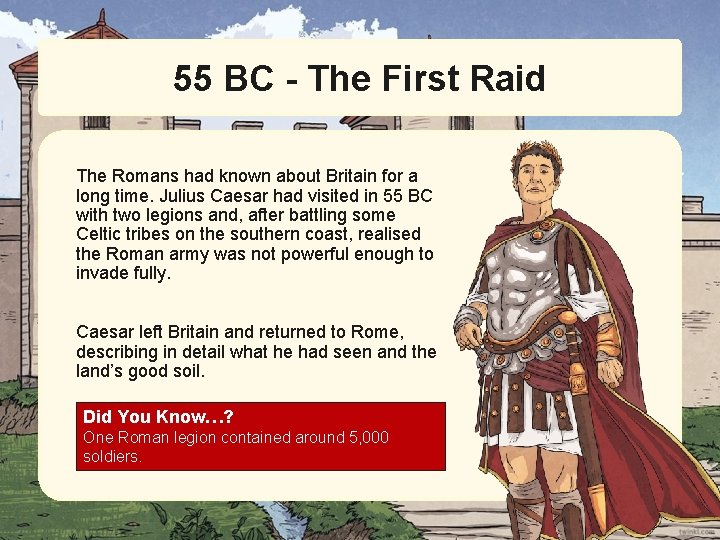
55 BC - The First Raid The Romans had known about Britain for a long time. Julius Caesar had visited in 55 BC with two legions and, after battling some Celtic tribes on the southern coast, realised the Roman army was not powerful enough to invade fully. Caesar left Britain and returned to Rome, describing in detail what he had seen and the land’s good soil. Did You Know…? One Roman legion contained around 5, 000 soldiers.
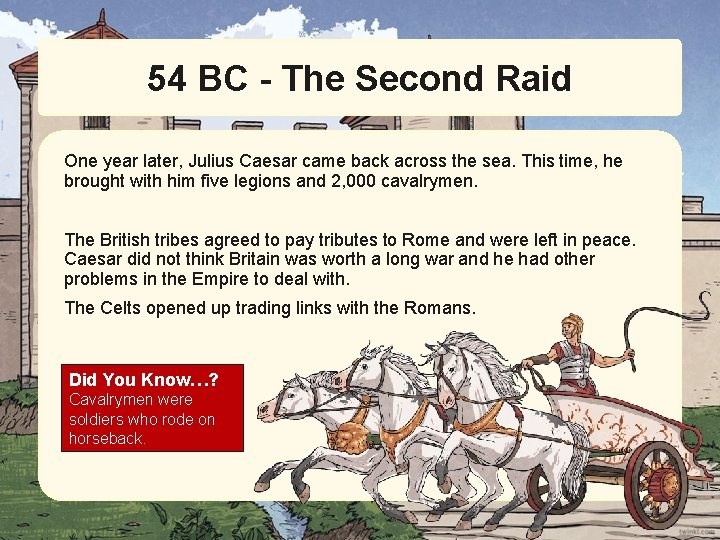
54 BC - The Second Raid One year later, Julius Caesar came back across the sea. This time, he brought with him five legions and 2, 000 cavalrymen. The British tribes agreed to pay tributes to Rome and were left in peace. Caesar did not think Britain was worth a long war and he had other problems in the Empire to deal with. The Celts opened up trading links with the Romans. Did You Know…? Cavalrymen were soldiers who rode on horseback.

AD 43 – The Claudian Invasion The Roman Emperor, Claudius, had ordered the creation of a new warship to help his army safely cross the sea between Gaul (modernday France), which they already controlled, and Britain. The army sent to Britain was made up of 20, 000 soldiers in four legions as well as auxiliaries. In AD 43, Claudius’ fleet sail and landed on the south coast of Britain. Did You Know…? Vespasian, who would later become Roman Emperor, commanded one of the invading legions.

AD 43 – The Claudian Invasion Upon landing, Claudius’ army attacked Celtic tribes in the south-east of Britain and quickly took control of the lands. Many Celtic tribes realised how strong this Roman army was and made deals to keep the peace. They agreed to obey Roman laws and pay taxes. In return they were allowed to keep their kingdoms. In total, eleven British kings surrendered to the Romans and another king, Caratacus, was defeated and fled only to be later captured in AD 51 and sent to Rome. Did You Know…? Auxiliary soldiers were recruited from non-Roman tribes to reinforce the army or provide a specific skill.
AD 60 -61 – The Iceni Rebellion After Claudius left Britain, he left a governor in charge. Over the next decade, each governor in command managed to increase the amount of Britain under Roman control. In AD 60, the Romans experienced uprisings from native tribes such as the Iceni. The Iceni, commanded by Queen Boudicca, were angry that the Romans had seized their lands and how they were being treated. Boudicca led the Iceni to many victories against the Romans, leaving many towns in ruins and over 80, 000 Roman citizens dead. Boudicca was eventually defeated in AD 61, poisoning herself so she wouldn’t be captured by her enemies. Did You Know…? The story of Boudicca was largely forgotten until Queen Victoria made her famous again. She wanted to be associated with a fierce female warrior.
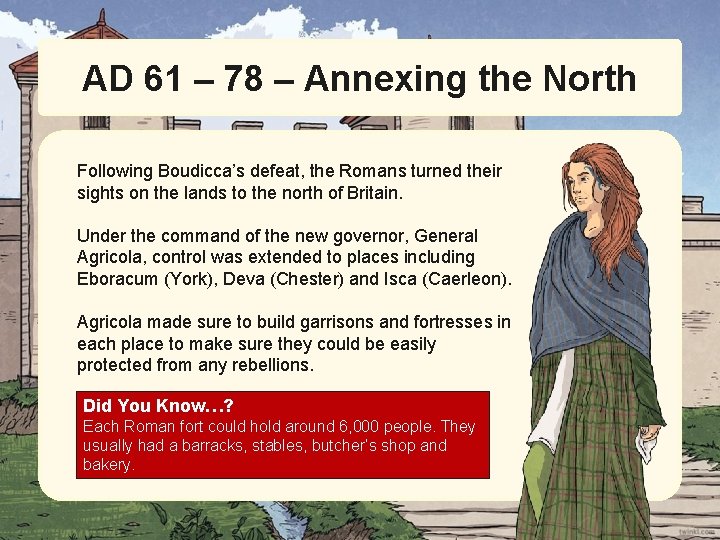
AD 61 – 78 – Annexing the North Following Boudicca’s defeat, the Romans turned their sights on the lands to the north of Britain. Under the command of the new governor, General Agricola, control was extended to places including Eboracum (York), Deva (Chester) and Isca (Caerleon). Agricola made sure to build garrisons and fortresses in each place to make sure they could be easily protected from any rebellions. Did You Know…? Each Roman fort could hold around 6, 000 people. They usually had a barracks, stables, butcher’s shop and bakery.
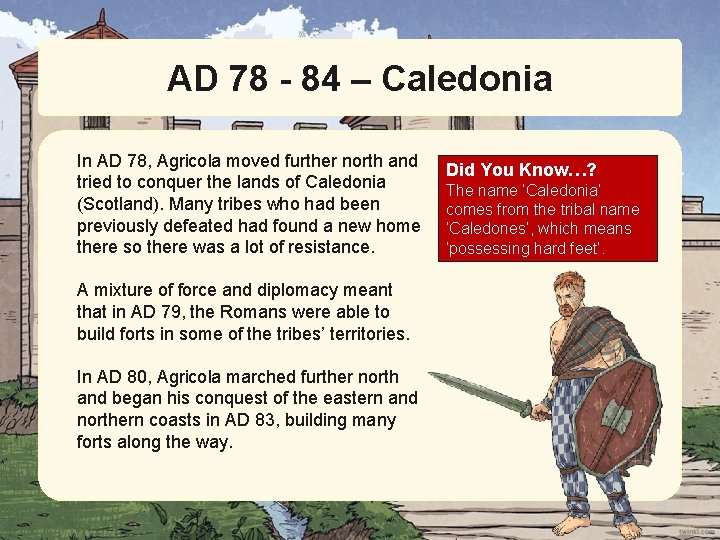
AD 78 - 84 – Caledonia In AD 78, Agricola moved further north and tried to conquer the lands of Caledonia (Scotland). Many tribes who had been previously defeated had found a new home there so there was a lot of resistance. A mixture of force and diplomacy meant that in AD 79, the Romans were able to build forts in some of the tribes’ territories. In AD 80, Agricola marched further north and began his conquest of the eastern and northern coasts in AD 83, building many forts along the way. Did You Know…? The name ‘Caledonia’ comes from the tribal name ‘Caledones’, which means ‘possessing hard feet’.
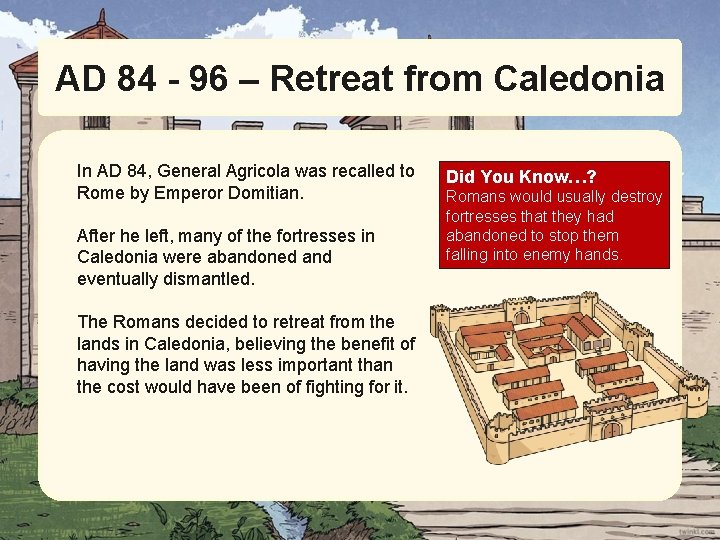
AD 84 - 96 – Retreat from Caledonia In AD 84, General Agricola was recalled to Rome by Emperor Domitian. After he left, many of the fortresses in Caledonia were abandoned and eventually dismantled. The Romans decided to retreat from the lands in Caledonia, believing the benefit of having the land was less important than the cost would have been of fighting for it. Did You Know…? Romans would usually destroy fortresses that they had abandoned to stop them falling into enemy hands.
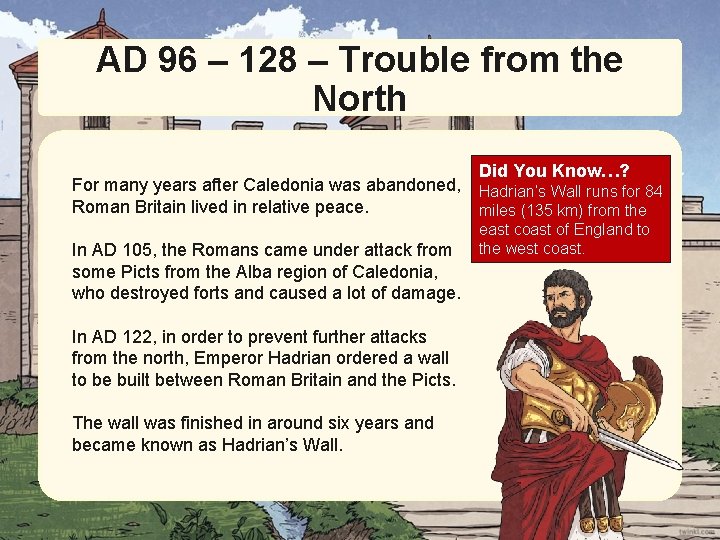
AD 96 – 128 – Trouble from the North For many years after Caledonia was abandoned, Roman Britain lived in relative peace. In AD 105, the Romans came under attack from some Picts from the Alba region of Caledonia, who destroyed forts and caused a lot of damage. In AD 122, in order to prevent further attacks from the north, Emperor Hadrian ordered a wall to be built between Roman Britain and the Picts. The wall was finished in around six years and became known as Hadrian’s Wall. Did You Know…? Hadrian’s Wall runs for 84 miles (135 km) from the east coast of England to the west coast.
Later Years Roman Britain was now largely established, however, many other Emperors and governors attempted to invade the lands above Hadrian’s Wall and failed. Over the next few centuries, Britain prospered under Roman rule. However, there were attacks from other tribes, barbarians and other nations that were successfully defeated. In the late 4 th century, Roman troops began to be withdrawn from Britain under order from Rome and by AD 410, the last Romans left and the people of Britain were told they now had to defend themselves. Did You Know…? The Romans introduced many things to Britain, including a legal system, the calendar, straight roads and even central heating!
- Slides: 12