
5110 Maryland Way Suite 200 Brentwood TN 615

5110 Maryland Way, Suite 200, Brentwood, TN 615. 309. 6053 www. healthtechs 3. com 2745 North Dallas Pkwy, Suite 100, Dallas, TX 800. 228. 0647 www. gaffeythealthcare. com Swing Bed 101 September 6, 2019 1
2 Nationwide Client Base Currently provides hospital management, consulting services and technology to: • • • Preferred vendor to: • Serving community, district, non-profit • and critical access hospitals Example managed hospital client includes • Barrett Hospital and Healthcare in Dillon, MT. Ranked as a Top 100 Critical Access • Hospital for 8 years in a row Example technology and AR services client includes two-hospital NFP system in southeast GA with numerous associated physician practices California Critical Access Hospital Network Western Healthcare Alliance Partner with Illinois Critical Access Hospital Network Vizient Group Purchasing Organization
3 Areas of Expertise Strategy – Solutions - Support Governance & Strategy Finance • • • Executive management & leadership development Community health needs assessment Lean culture Performance optimization & margin improvement Revenue cycle & business office improvement AR outsourcing Recruitment Clinical Care & Operations • • • Executive and interim recruitment CEOs, CFOs, CNOs VP and Department Directors Continuous survey readiness Care coordination Swing bed consulting
4 PRESENTER Carolyn began her healthcareer as a staff nurse in Intensive Care. She has worked in a variety of staff, administrative and consulting roles and has been in her current position as Regional Chief Clinical Officer with Health. Tech. S 3 for the last fifteen years. Carolyn St. Charles Regional Chief Clinical Officer In her role as Regional Chief Clinical Officer, Carolyn St. Charles conducts mock surveys for Critical Access Hospitals, Acute Care Hospitals, Long Term Care, Rural Health Clinics, Home Health and Hospice. Carolyn also provides assistance in developing strategies for continuous survey readiness and developing plans of correction. Carolyn has extensive experience in working with rural hospitals to both develop and strengthen Swing Bed programs. carolyn. stcharles@healthtechs 3. com 360 -584 -9868

5 INSTRUCTIONS FOR TODAY’S WEBINAR You may type a question in the text box if you have a question during the presentation We will try to cover all of your questions – but if we don’t get to them during the webinar we will follow-up with you by e-mail You may also send questions after the webinar to our team (contact information is included at the end of the presentation) The webinar will be recorded and the recording will be available on the Health. Tech. S 3 web site: www. healthtechs 3. com Health. Tech. S 3 hopes that the information contained herein will be informative and helpful on industry topics. However, please note that this information is not intended to be definitive. Health. Tech. S 3 and its affiliates expressly disclaim any and all liability, whatsoever, for any such information and for any use made thereof. Health. Tech. S 3 does not and shall not have any authority to develop substantive billing or coding policies for any hospital, clinic or their respective personnel, and any such final responsibility remains exclusively with the hospital, clinic or their respective personnel. Health. Tech. S 3 recommends that hospitals, clinics, their respective personnel, and all other third party recipients of this information consult original source materials and qualified healthcare regulatory counsel for specific guidance in healthcare reimbursement and regulatory matters.
rd 3 QUARTER 2019 WEBINARS 6 ALL WEBINARS ARE RECORDED Understanding the ROI on Advanced Wellness Visits and Advanced Care Planning: Preparing the Right Person for the Job Host: Faith M Jones, MSN, RN, NEA-BC – Director of Care Coordination and Lean Consulting, Health. Tech. S 3 July 11, 2019 at 12: 00 pm CT https: //bit. ly/2 Xs 2 YUN Improve your CCM Program Revenue: Incorporate Technology and Resources for Additional Reimbursement Host: Faith M Jones, MSN, RN, NEA-BC – Director of Care Coordination and Lean Consulting, Health. Tech. S 3 August 15, 2019 at 12: 00 pm CT https: //bit. ly/2 S 08 g. AC Using the Concepts of Lean to Improve Swing Bed Documentation Host: Carolyn St. Charles, RN, BSN, MBA – Chief Regional Clinical Officer, Health. Tech. S 3 July 12, 2019 at 12: 00 pm CT https: //bit. ly/2 Ju 7 Jm. U Swing Bed 101 Host: Carolyn St. Charles, RN, BSN, MBA – Chief Regional Clinical Officer, Health. Tech. S 3 September 6, 2019 at 12: 00 pm CT https: //bit. ly/2 x. Ht 8 Dj Community Health Needs Assessment – The Implementation Plan Host: Carolyn St. Charles, RN, BSN, MBA – Chief Regional Clinical Officer, Health. Tech. S 3 August 2, 2019 at 12: 00 pm CT https: //bit. ly/2 xzek 9 U Trends Facing Rural Healthcare Boards Host: Michael Lieb – Regional Vice President & Director, Practice Management, Health. Tech. S 3 September 13, 2019 at 12: 00 pm CT https: //bit. ly/2 YJVSa. A
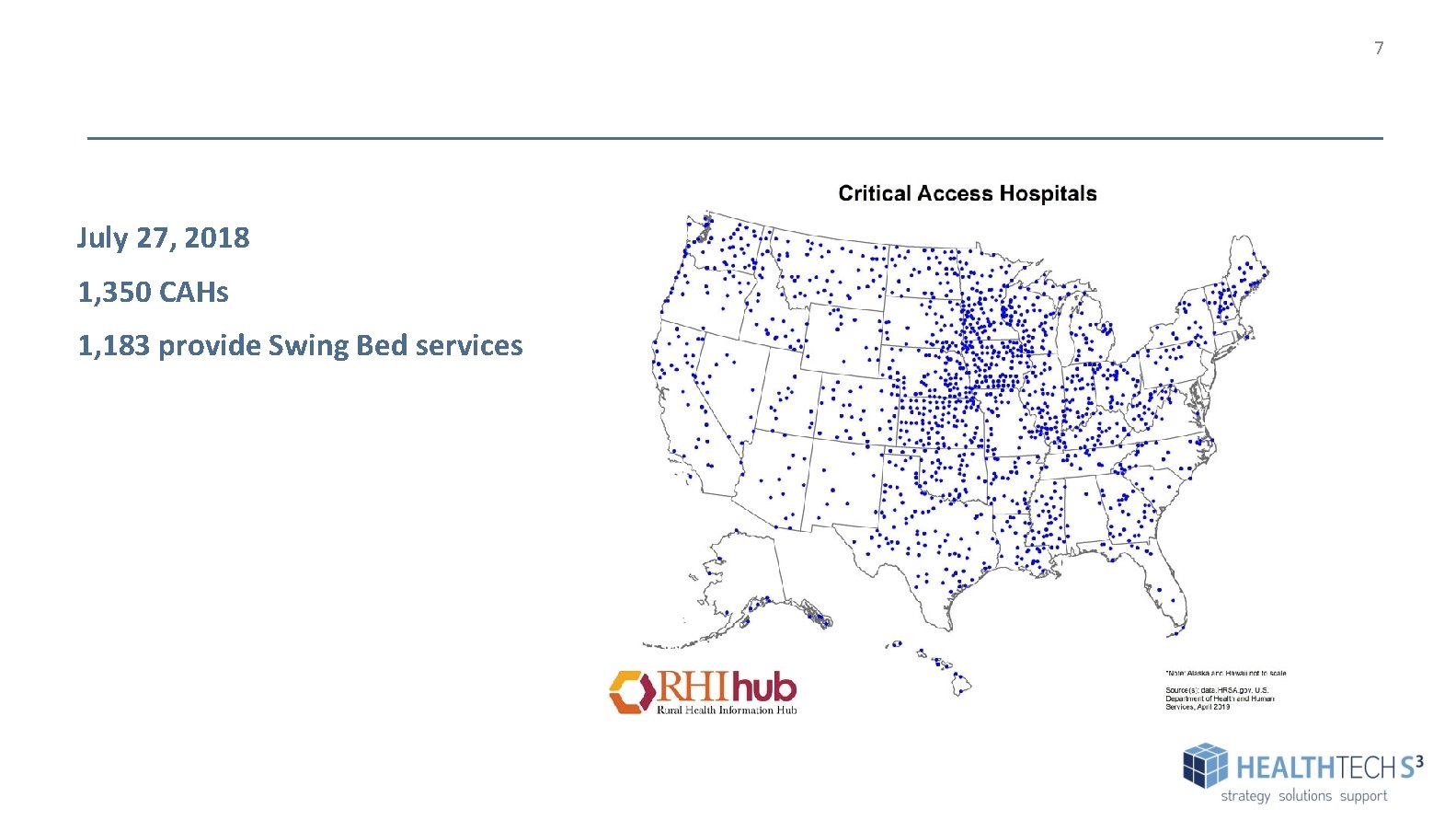
7 July 27, 2018 1, 350 CAHs 1, 183 provide Swing Bed services
8 Use of Swing Beds IS NOT restricted to Medicare and Medicaid patients – just like admission to acute care is not restricted to only Medicare or Medicaid (Reimbursement may be different – of course)
9 REGULATORY RESOURCES • State Operations Manual – Appendix A (Rev. 183, 10 -12 -18) • State Operations Manual - Appendix W (Rev. 183, 10 -12 -18) • State Operations Manual - Appendix PP (Rev. 173, 11 -22 -17) Medicare Claims Processing Manuals – Updated in 2019 • Medicare Claims Processing Manual, Chapter 4 (Rev. 4295, 5 -03 -19) • Medicare Claims Processing Manual, Chapter 6 (Rev. 4247, 03 -01 -19) • Medicare Benefit Policy Manual Chapter 8 (Rev. 4202, 01 -18 -19)
10 What is a Swing Bed? The Social Security Act (the Act) permits certain small, rural hospitals to enter into a swing bed agreement, under which the hospital can use its beds, as needed, to provide either acute or SNF care. As defined in the regulations, a swing bed hospital is a hospital or critical access hospital (CAH) participating in Medicare that has CMS approval to provide post-hospital SNF care and meets certain requirements. Medicare Part A (the hospital insurance program) covers post-hospital extended care services furnished in a swing bed hospital. https: //www. cms. gov/Medicare-Fee-for-Service-Payment/SNFPPS/Swing. Bed. html
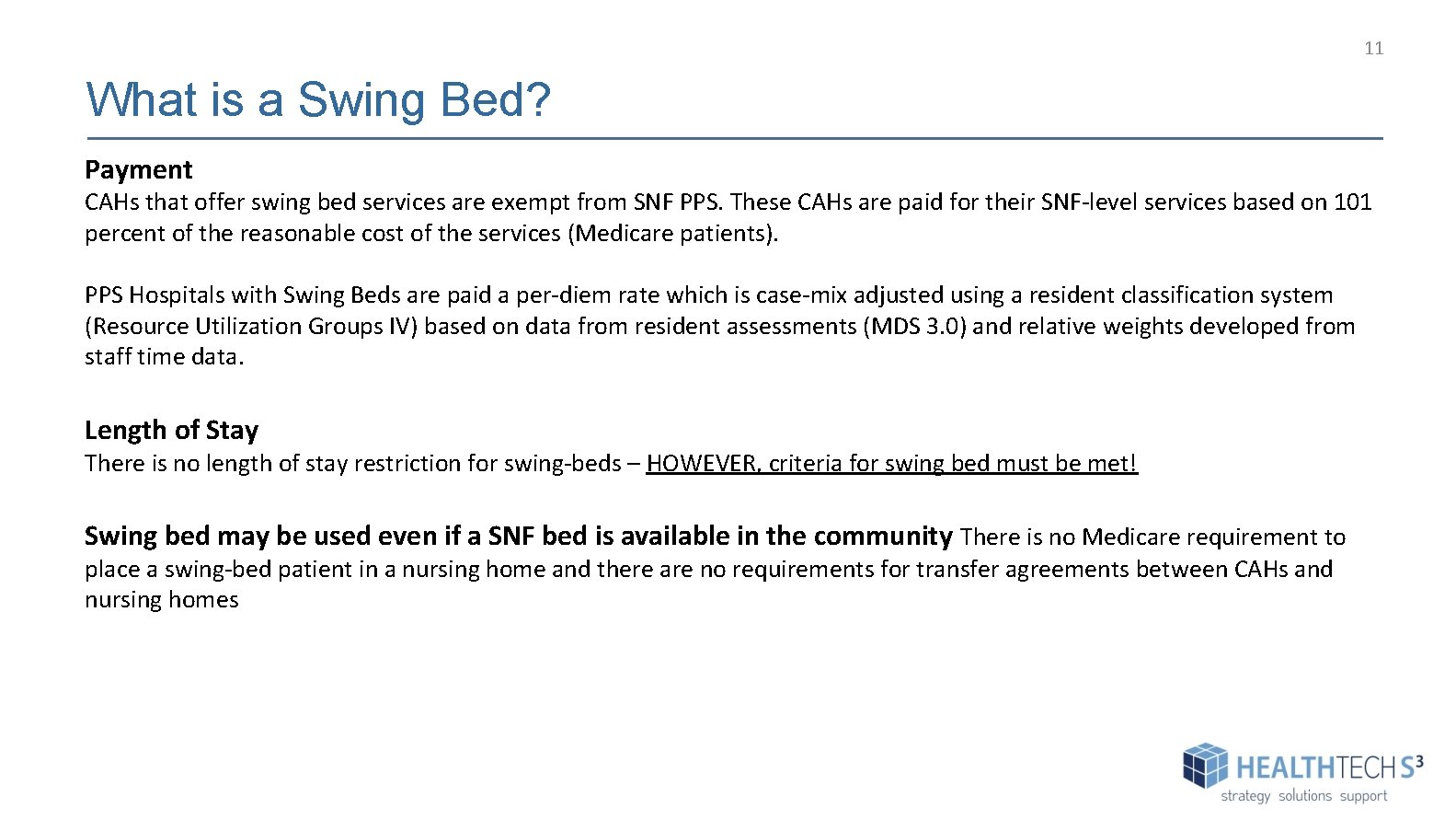
11 What is a Swing Bed? Payment CAHs that offer swing bed services are exempt from SNF PPS. These CAHs are paid for their SNF-level services based on 101 percent of the reasonable cost of the services (Medicare patients). PPS Hospitals with Swing Beds are paid a per-diem rate which is case-mix adjusted using a resident classification system (Resource Utilization Groups IV) based on data from resident assessments (MDS 3. 0) and relative weights developed from staff time data. Length of Stay There is no length of stay restriction for swing-beds – HOWEVER, criteria for swing bed must be met! Swing bed may be used even if a SNF bed is available in the community There is no Medicare requirement to place a swing-bed patient in a nursing home and there are no requirements for transfer agreements between CAHs and nursing homes
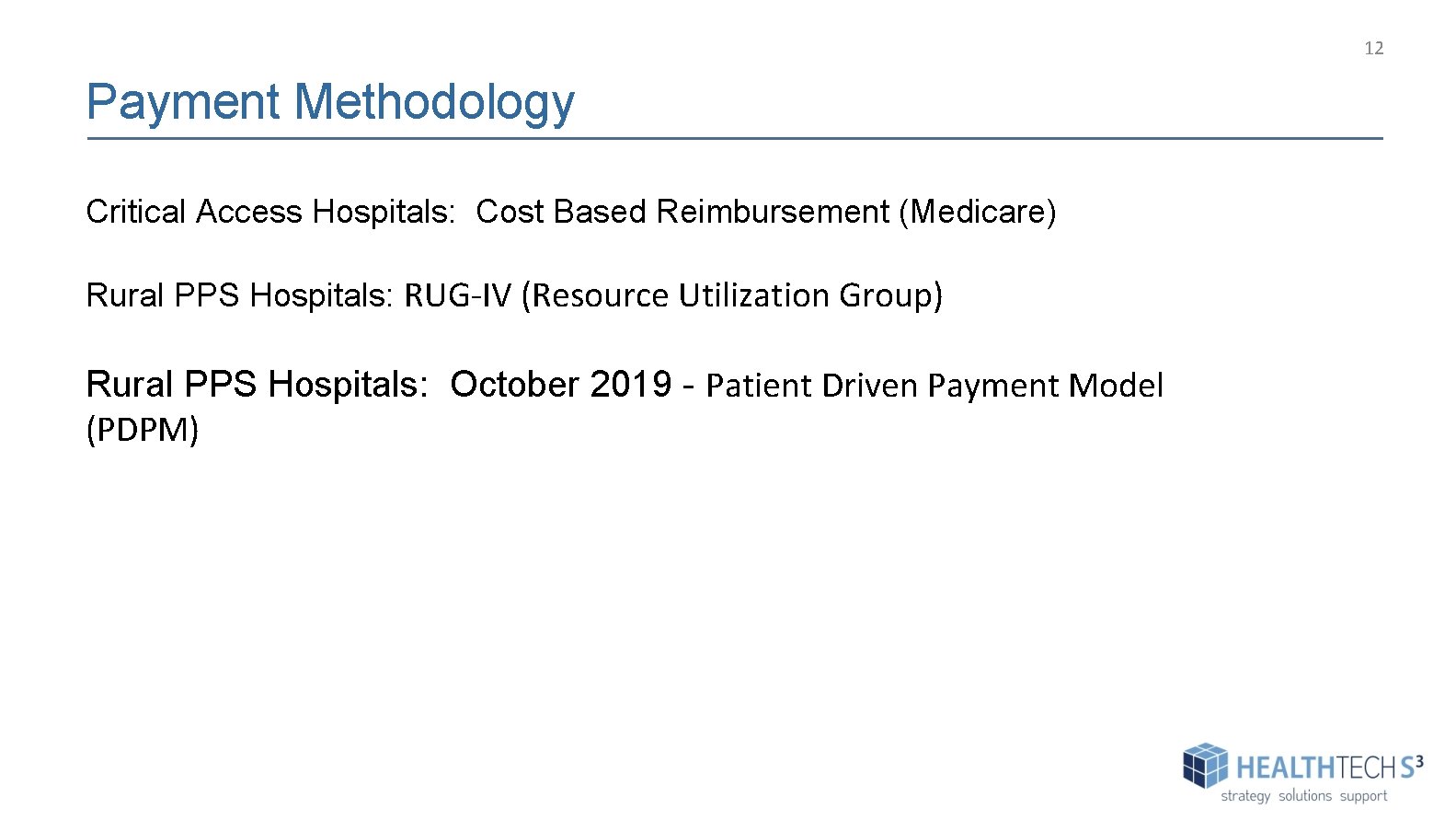
12 Payment Methodology Critical Access Hospitals: Cost Based Reimbursement (Medicare) Rural PPS Hospitals: RUG-IV (Resource Utilization Group) Rural PPS Hospitals: October 2019 - Patient Driven Payment Model (PDPM)
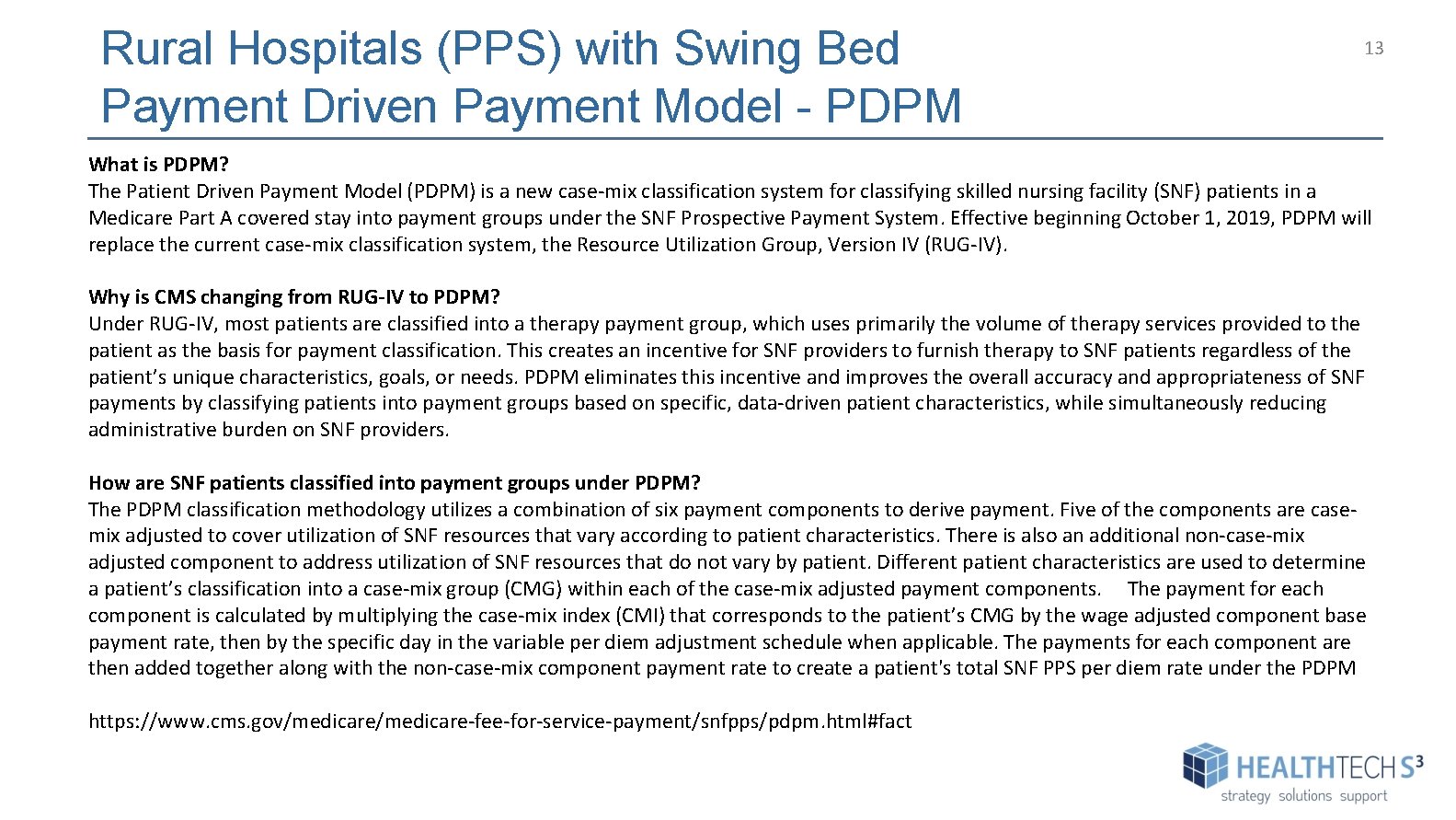
Rural Hospitals (PPS) with Swing Bed Payment Driven Payment Model - PDPM 13 What is PDPM? The Patient Driven Payment Model (PDPM) is a new case-mix classification system for classifying skilled nursing facility (SNF) patients in a Medicare Part A covered stay into payment groups under the SNF Prospective Payment System. Effective beginning October 1, 2019, PDPM will replace the current case-mix classification system, the Resource Utilization Group, Version IV (RUG-IV). Why is CMS changing from RUG-IV to PDPM? Under RUG-IV, most patients are classified into a therapy payment group, which uses primarily the volume of therapy services provided to the patient as the basis for payment classification. This creates an incentive for SNF providers to furnish therapy to SNF patients regardless of the patient’s unique characteristics, goals, or needs. PDPM eliminates this incentive and improves the overall accuracy and appropriateness of SNF payments by classifying patients into payment groups based on specific, data-driven patient characteristics, while simultaneously reducing administrative burden on SNF providers. How are SNF patients classified into payment groups under PDPM? The PDPM classification methodology utilizes a combination of six payment components to derive payment. Five of the components are casemix adjusted to cover utilization of SNF resources that vary according to patient characteristics. There is also an additional non-case-mix adjusted component to address utilization of SNF resources that do not vary by patient. Different patient characteristics are used to determine a patient’s classification into a case-mix group (CMG) within each of the case-mix adjusted payment components. The payment for each component is calculated by multiplying the case-mix index (CMI) that corresponds to the patient’s CMG by the wage adjusted component base payment rate, then by the specific day in the variable per diem adjustment schedule when applicable. The payments for each component are then added together along with the non-case-mix component payment rate to create a patient's total SNF PPS per diem rate under the PDPM https: //www. cms. gov/medicare-fee-for-service-payment/snfpps/pdpm. html#fact
14 Critical Access Hospitals ---- Important Information Too! What is PDPM? The Patient Driven Payment Model (PDPM) is a new case-mix classification system for classifying skilled nursing facility (SNF) patients in a Medicare Part A covered stay into payment groups under the SNF Prospective Payment System. Effective beginning October 1, 2019, PDPM will replace the current case-mix classification system, the Resource Utilization Group, Version IV (RUG-IV). Why is CMS changing from RUG-IV to PDPM? Under RUG-IV, most patients are classified into a therapy payment group, which uses primarily the volume of therapy services provided to the patient as the basis for payment classification. This creates an incentive for SNF providers to furnish therapy to SNF patients regardless of the patient’s unique characteristics, goals, or needs. PDPM eliminates this incentive and improves the overall accuracy and appropriateness of SNF payments by classifying patients into payment groups based on specific, data-driven patient characteristics, while simultaneously reducing administrative burden on SNF providers. How are SNF patients classified into payment groups under PDPM? The PDPM classification methodology utilizes a combination of six payment components to derive payment. Five of the components are casemix adjusted to cover utilization of SNF resources that vary according to patient characteristics. There is also an additional non-case-mix adjusted component to address utilization of SNF resources that do not vary by patient. Different patient characteristics are used to determine a patient’s classification into a case-mix group (CMG) within each of the case-mix adjusted payment components. The payment for each component is calculated by multiplying the case-mix index (CMI) that corresponds to the patient’s CMG by the wage adjusted component base payment rate, then by the specific day in the variable per diem adjustment schedule when applicable. The payments for each component are then added together along with the non-case-mix component payment rate to create a patient's total SNF PPS per diem rate under the PDPM https: //www. cms. gov/medicare-fee-for-service-payment/snfpps/pdpm. html#fact
15 Swing Bed Program Benefits Critical Access Hospitals • Cost based reimbursement for Medicare • No delays in providing skilled level of care (no transfers Rural PPS Hospitals • No delays in providing skilled level of care (no transfers) • May reduce acute care length of stay Patients • Care close to home • Usually same provider(s), nursing staff, rehab staff • Usually a shorter length of stay than in a SNF
16 Swing Bed Program Challenges Paperwork • Discharge from Acute • Admission to Swing Bed • Assessment (MDS for Rural PPS Hospitals) • Multidisciplinary Plan of Care • Discharge SNF Level Care • Staff and Provider understanding of how and why swing bed is different than acute care – and providing SNF level care Activities • Providing sufficient type and frequency of activities Volume • Too many swing bed patients and concern about capacity for acute patients • Too few swing bed patients to ensure consistent and reliable processes
17 Medicare Swing Bed Criteria Private Insurance – Their Rules Medicaid – Different by State – Their Rules 1. Medicare The patient has Medicare Part A and has benefit days available 2. Medicare age or disability/disease eligibility requirements must be met 3. There must be a three‐day qualifying stay (observation doesn’t count) 4. Swing Bed admission condition is the same as the qualifying stay condition 5. Patient must be admitted to Swing Bed within thirty days of discharge from acute care 6. The patient’s condition meets criteria to necessitate inpatient skilled nursing services Medicare Benefit Policy Manual Chapter 8 (Rev. 4202, 01 -18 -19) Coverage of Extended Care (SNF) Services Under Hospital Insurance
18 Medicare 3 -day Qualifying Stay The 3 consecutive calendar day stay requirement can be met by stays totaling 3 consecutive days in one or more hospitals. In determining whether the requirement has been met, the day of admission, but not the day of discharge, is counted as a hospital inpatient day. Time spent in observation status or in the emergency room prior to (or in lieu of) an inpatient admission to the hospital does not count toward the 3 -day qualifying inpatient hospital stay, as a person who appears at a hospital’s emergency room seeking examination or treatment or is placed on observation has not been admitted to the hospital as an inpatient; instead, the person receives outpatient services. Medicare Benefit Policy Manual Chapter 8 – 20. 1
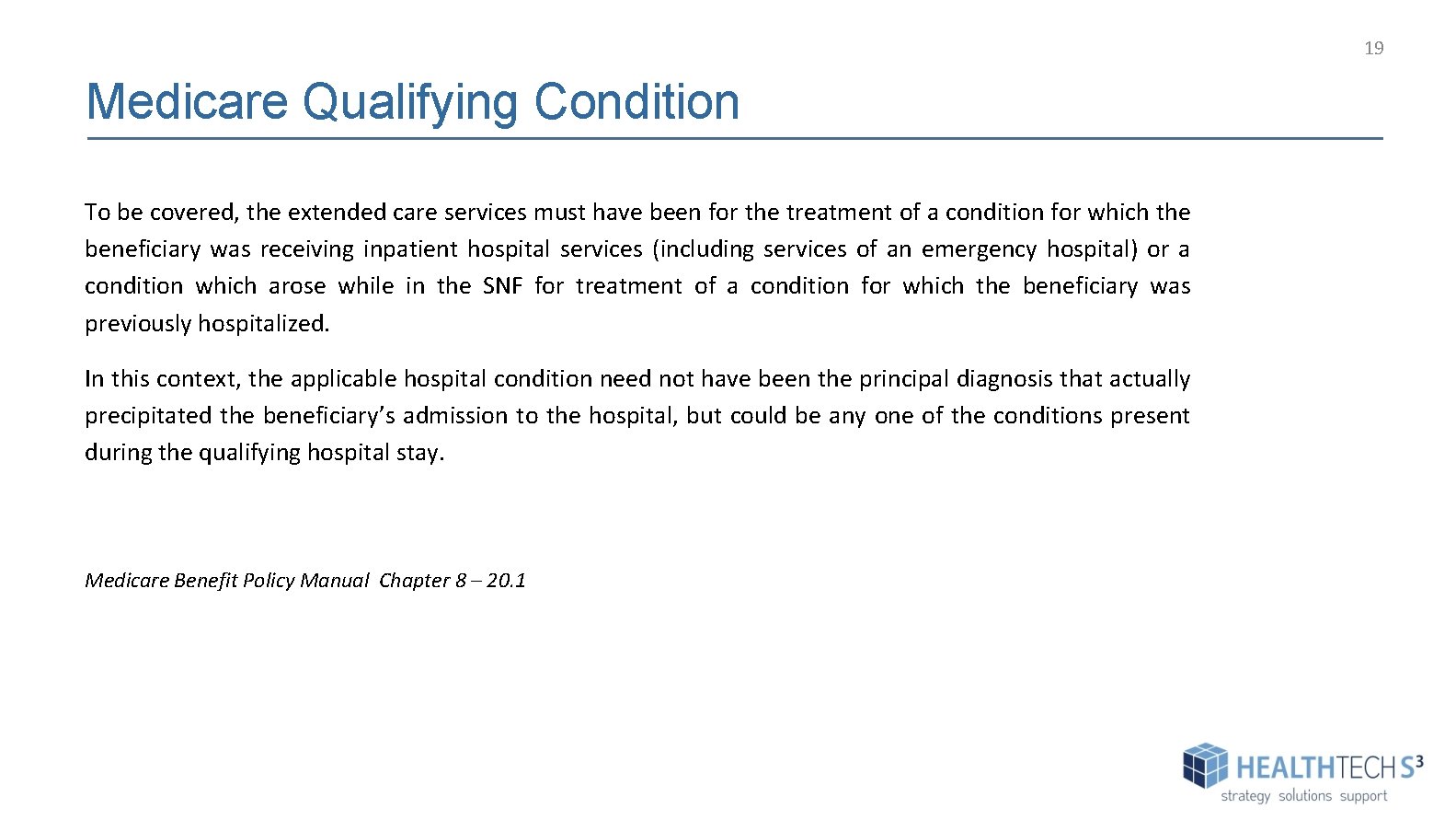
19 Medicare Qualifying Condition To be covered, the extended care services must have been for the treatment of a condition for which the beneficiary was receiving inpatient hospital services (including services of an emergency hospital) or a condition which arose while in the SNF for treatment of a condition for which the beneficiary was previously hospitalized. In this context, the applicable hospital condition need not have been the principal diagnosis that actually precipitated the beneficiary’s admission to the hospital, but could be any one of the conditions present during the qualifying hospital stay. Medicare Benefit Policy Manual Chapter 8 – 20. 1
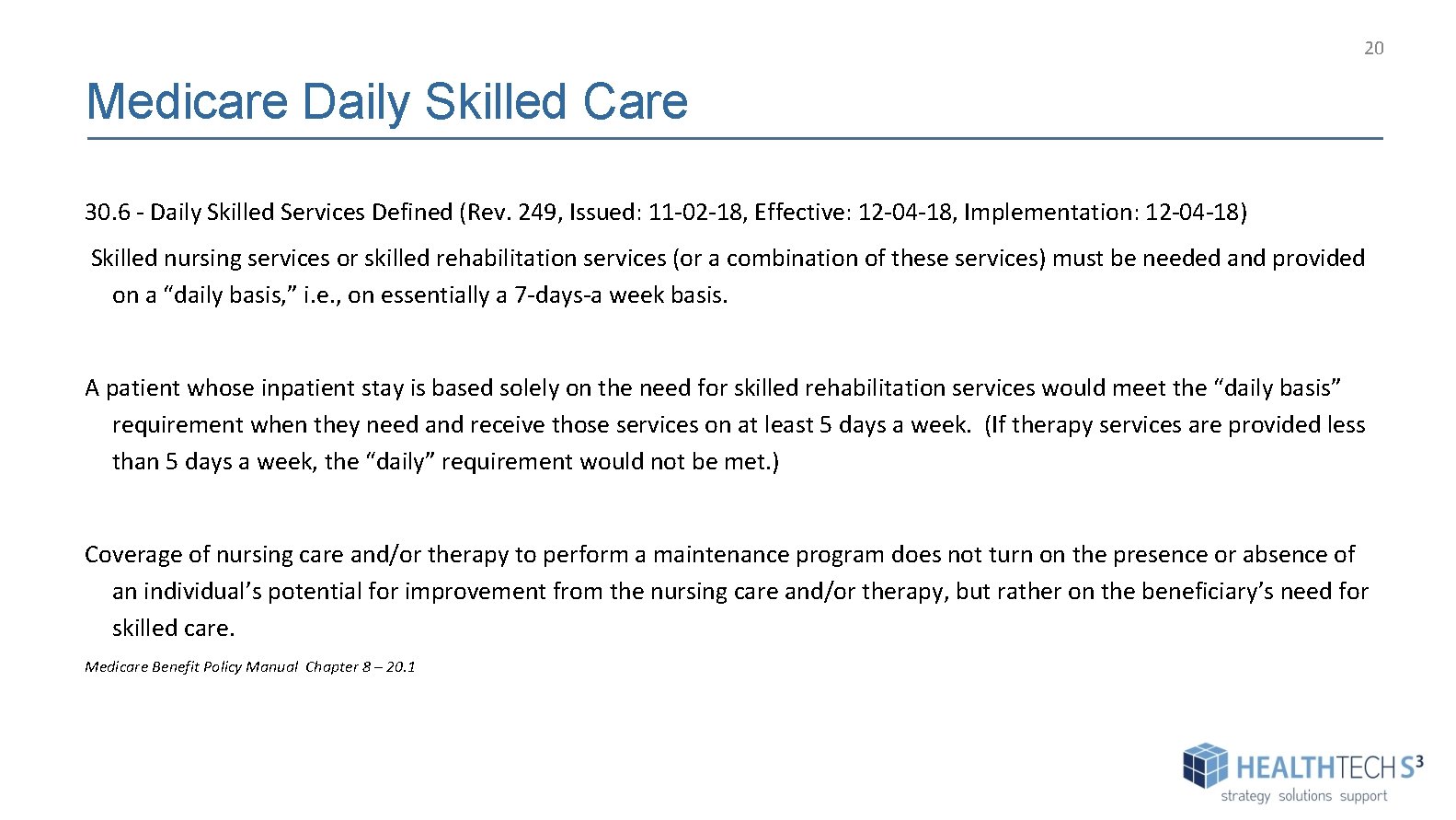
20 Medicare Daily Skilled Care 30. 6 - Daily Skilled Services Defined (Rev. 249, Issued: 11 -02 -18, Effective: 12 -04 -18, Implementation: 12 -04 -18) Skilled nursing services or skilled rehabilitation services (or a combination of these services) must be needed and provided on a “daily basis, ” i. e. , on essentially a 7 -days-a week basis. A patient whose inpatient stay is based solely on the need for skilled rehabilitation services would meet the “daily basis” requirement when they need and receive those services on at least 5 days a week. (If therapy services are provided less than 5 days a week, the “daily” requirement would not be met. ) Coverage of nursing care and/or therapy to perform a maintenance program does not turn on the presence or absence of an individual’s potential for improvement from the nursing care and/or therapy, but rather on the beneficiary’s need for skilled care. Medicare Benefit Policy Manual Chapter 8 – 20. 1
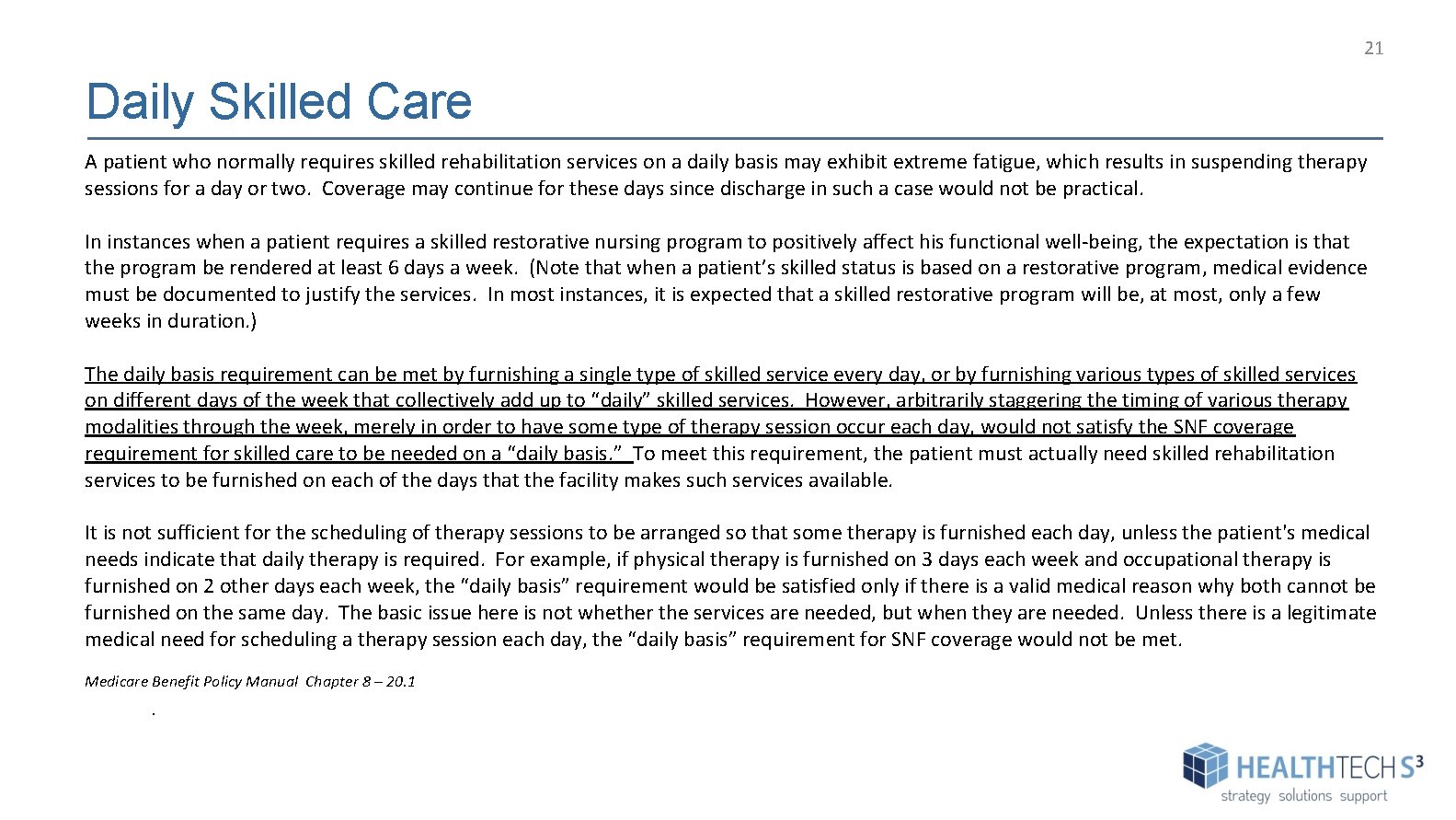
21 Daily Skilled Care A patient who normally requires skilled rehabilitation services on a daily basis may exhibit extreme fatigue, which results in suspending therapy sessions for a day or two. Coverage may continue for these days since discharge in such a case would not be practical. In instances when a patient requires a skilled restorative nursing program to positively affect his functional well-being, the expectation is that the program be rendered at least 6 days a week. (Note that when a patient’s skilled status is based on a restorative program, medical evidence must be documented to justify the services. In most instances, it is expected that a skilled restorative program will be, at most, only a few weeks in duration. ) The daily basis requirement can be met by furnishing a single type of skilled service every day, or by furnishing various types of skilled services on different days of the week that collectively add up to “daily” skilled services. However, arbitrarily staggering the timing of various therapy modalities through the week, merely in order to have some type of therapy session occur each day, would not satisfy the SNF coverage requirement for skilled care to be needed on a “daily basis. ” To meet this requirement, the patient must actually need skilled rehabilitation services to be furnished on each of the days that the facility makes such services available. It is not sufficient for the scheduling of therapy sessions to be arranged so that some therapy is furnished each day, unless the patient's medical needs indicate that daily therapy is required. For example, if physical therapy is furnished on 3 days each week and occupational therapy is furnished on 2 other days each week, the “daily basis” requirement would be satisfied only if there is a valid medical reason why both cannot be furnished on the same day. The basic issue here is not whether the services are needed, but when they are needed. Unless there is a legitimate medical need for scheduling a therapy session each day, the “daily basis” requirement for SNF coverage would not be met. Medicare Benefit Policy Manual Chapter 8 – 20. 1 .
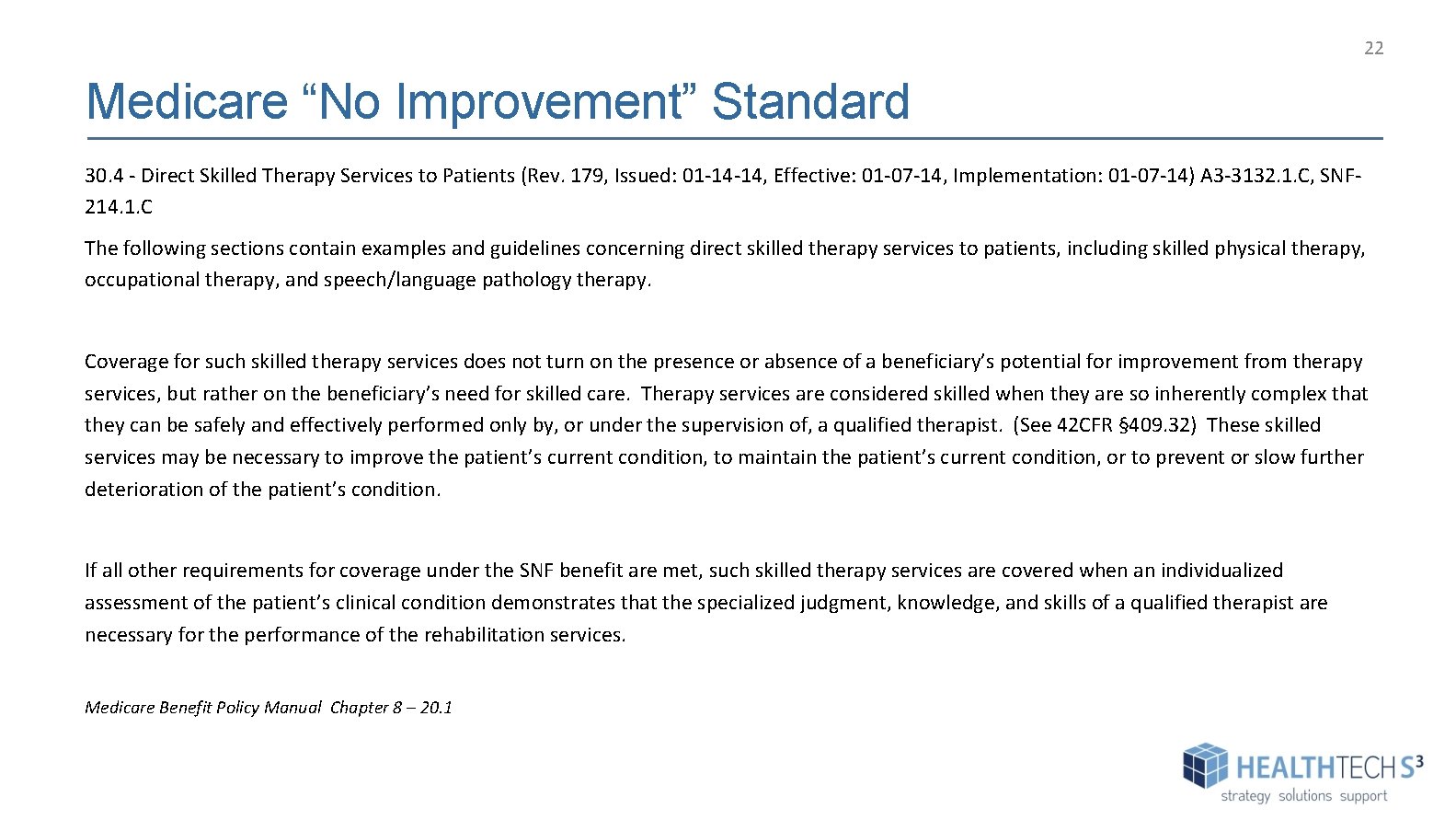
22 Medicare “No Improvement” Standard 30. 4 - Direct Skilled Therapy Services to Patients (Rev. 179, Issued: 01 -14 -14, Effective: 01 -07 -14, Implementation: 01 -07 -14) A 3 -3132. 1. C, SNF 214. 1. C The following sections contain examples and guidelines concerning direct skilled therapy services to patients, including skilled physical therapy, occupational therapy, and speech/language pathology therapy. Coverage for such skilled therapy services does not turn on the presence or absence of a beneficiary’s potential for improvement from therapy services, but rather on the beneficiary’s need for skilled care. Therapy services are considered skilled when they are so inherently complex that they can be safely and effectively performed only by, or under the supervision of, a qualified therapist. (See 42 CFR § 409. 32) These skilled services may be necessary to improve the patient’s current condition, to maintain the patient’s current condition, or to prevent or slow further deterioration of the patient’s condition. If all other requirements for coverage under the SNF benefit are met, such skilled therapy services are covered when an individualized assessment of the patient’s clinical condition demonstrates that the specialized judgment, knowledge, and skills of a qualified therapist are necessary for the performance of the rehabilitation services. Medicare Benefit Policy Manual Chapter 8 – 20. 1
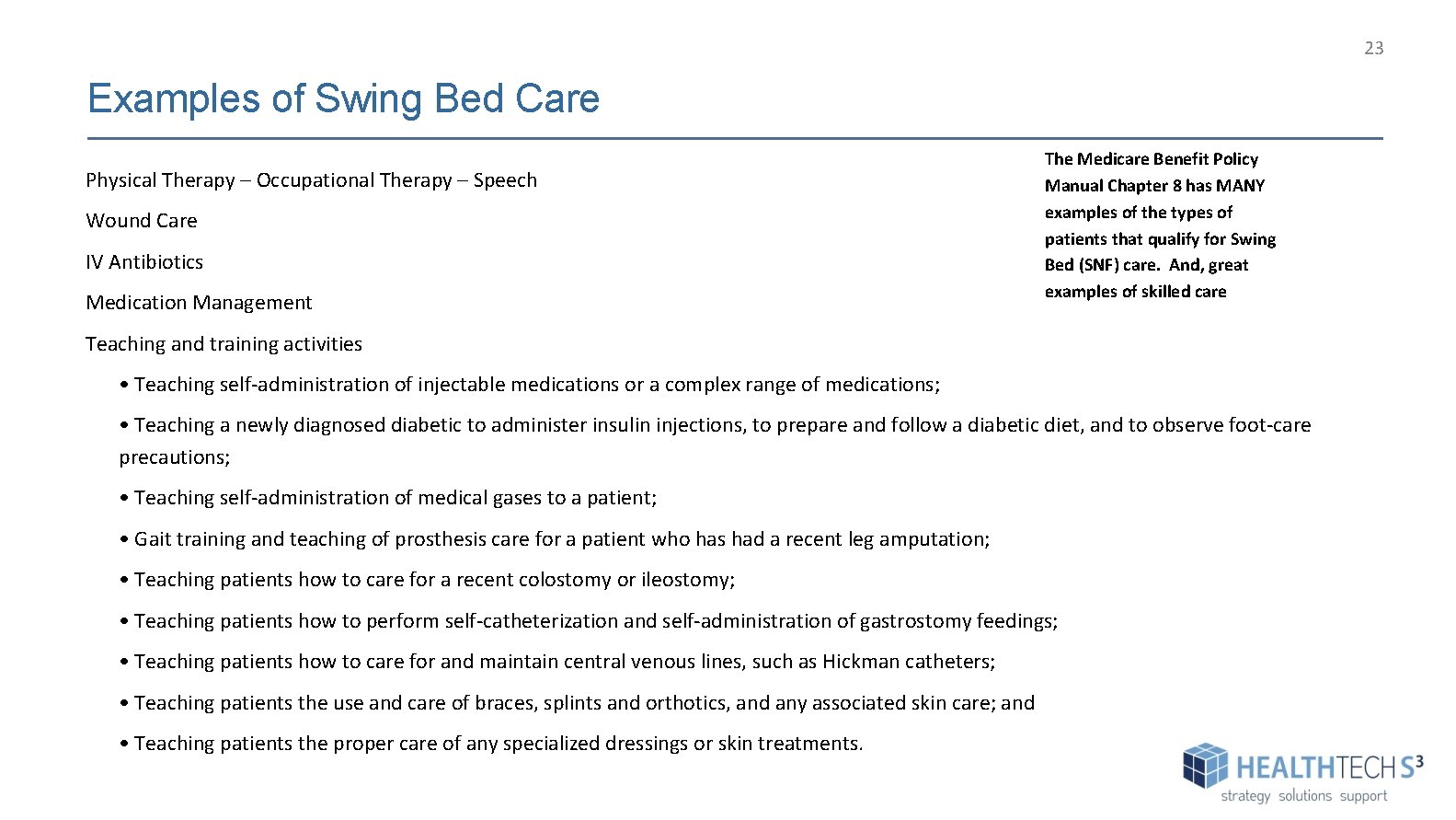
23 Examples of Swing Bed Care Physical Therapy – Occupational Therapy – Speech Wound Care IV Antibiotics Medication Management The Medicare Benefit Policy Manual Chapter 8 has MANY examples of the types of patients that qualify for Swing Bed (SNF) care. And, great examples of skilled care Teaching and training activities • Teaching self-administration of injectable medications or a complex range of medications; • Teaching a newly diagnosed diabetic to administer insulin injections, to prepare and follow a diabetic diet, and to observe foot-care precautions; • Teaching self-administration of medical gases to a patient; • Gait training and teaching of prosthesis care for a patient who has had a recent leg amputation; • Teaching patients how to care for a recent colostomy or ileostomy; • Teaching patients how to perform self-catheterization and self-administration of gastrostomy feedings; • Teaching patients how to care for and maintain central venous lines, such as Hickman catheters; • Teaching patients the use and care of braces, splints and orthotics, and any associated skin care; and • Teaching patients the proper care of any specialized dressings or skin treatments.
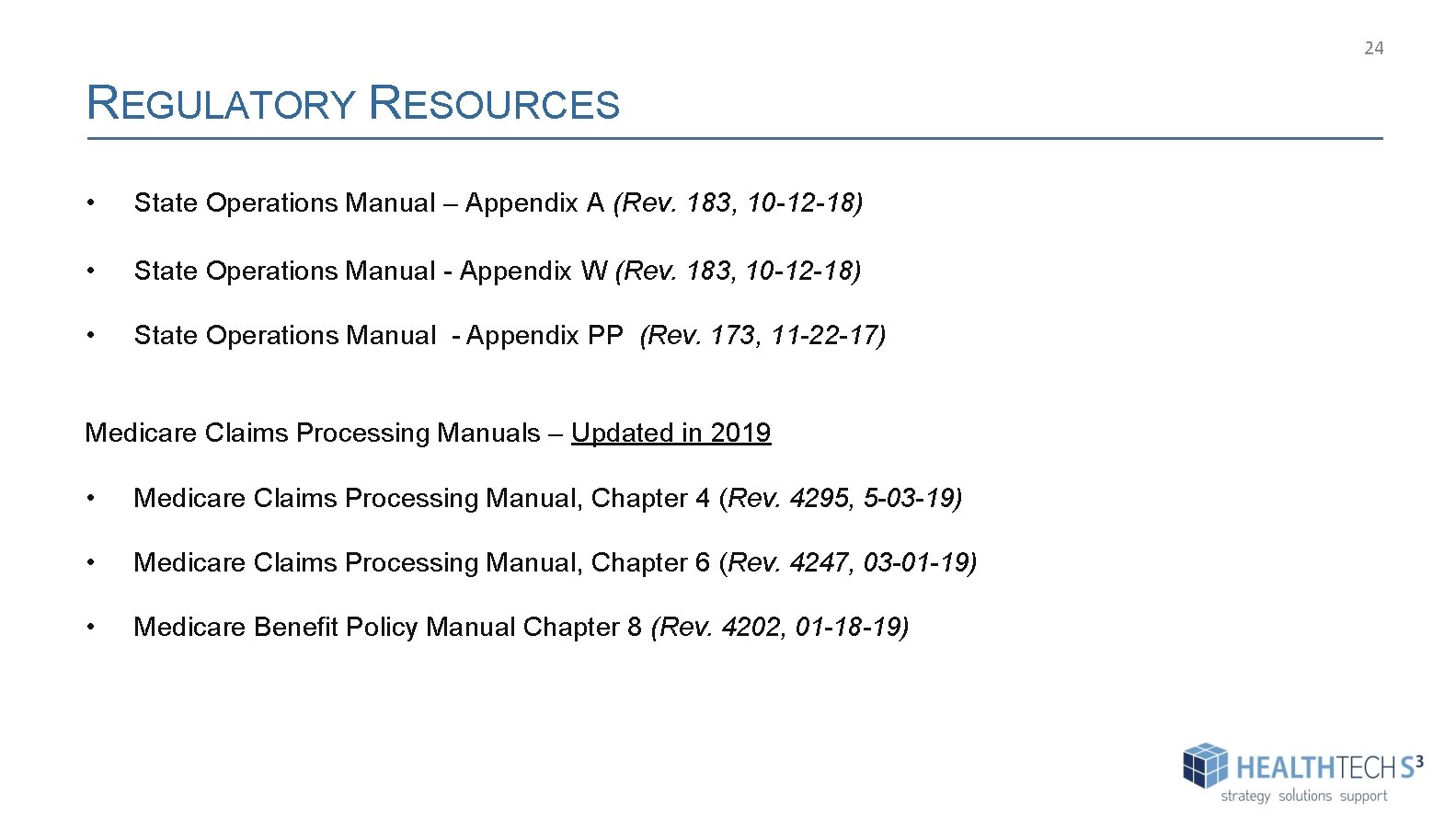
24 REGULATORY RESOURCES • State Operations Manual – Appendix A (Rev. 183, 10 -12 -18) • State Operations Manual - Appendix W (Rev. 183, 10 -12 -18) • State Operations Manual - Appendix PP (Rev. 173, 11 -22 -17) Medicare Claims Processing Manuals – Updated in 2019 • Medicare Claims Processing Manual, Chapter 4 (Rev. 4295, 5 -03 -19) • Medicare Claims Processing Manual, Chapter 6 (Rev. 4247, 03 -01 -19) • Medicare Benefit Policy Manual Chapter 8 (Rev. 4202, 01 -18 -19)
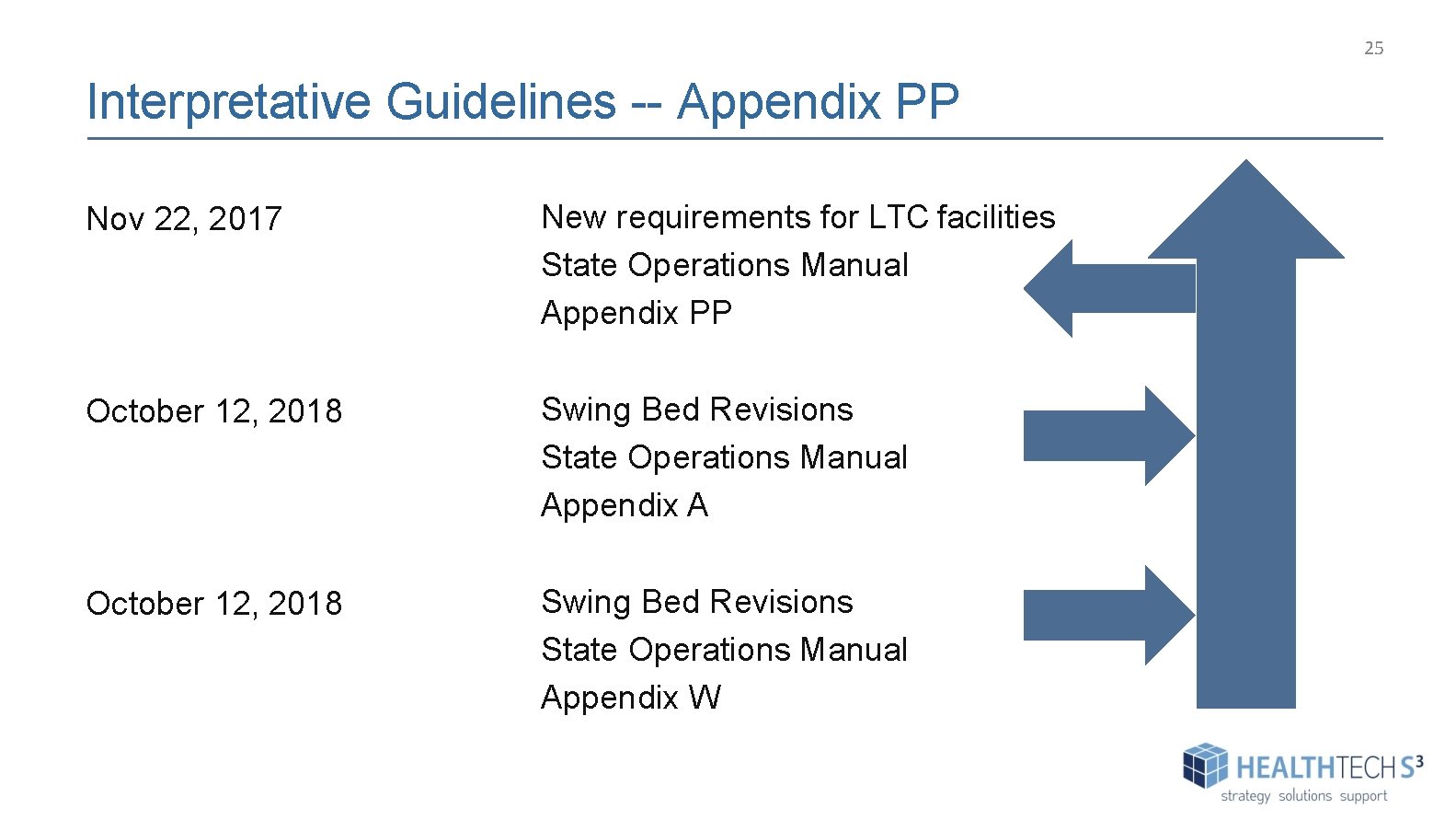
25 Interpretative Guidelines -- Appendix PP Nov 22, 2017 New requirements for LTC facilities State Operations Manual Appendix PP October 12, 2018 Swing Bed Revisions State Operations Manual Appendix A October 12, 2018 Swing Bed Revisions State Operations Manual Appendix W
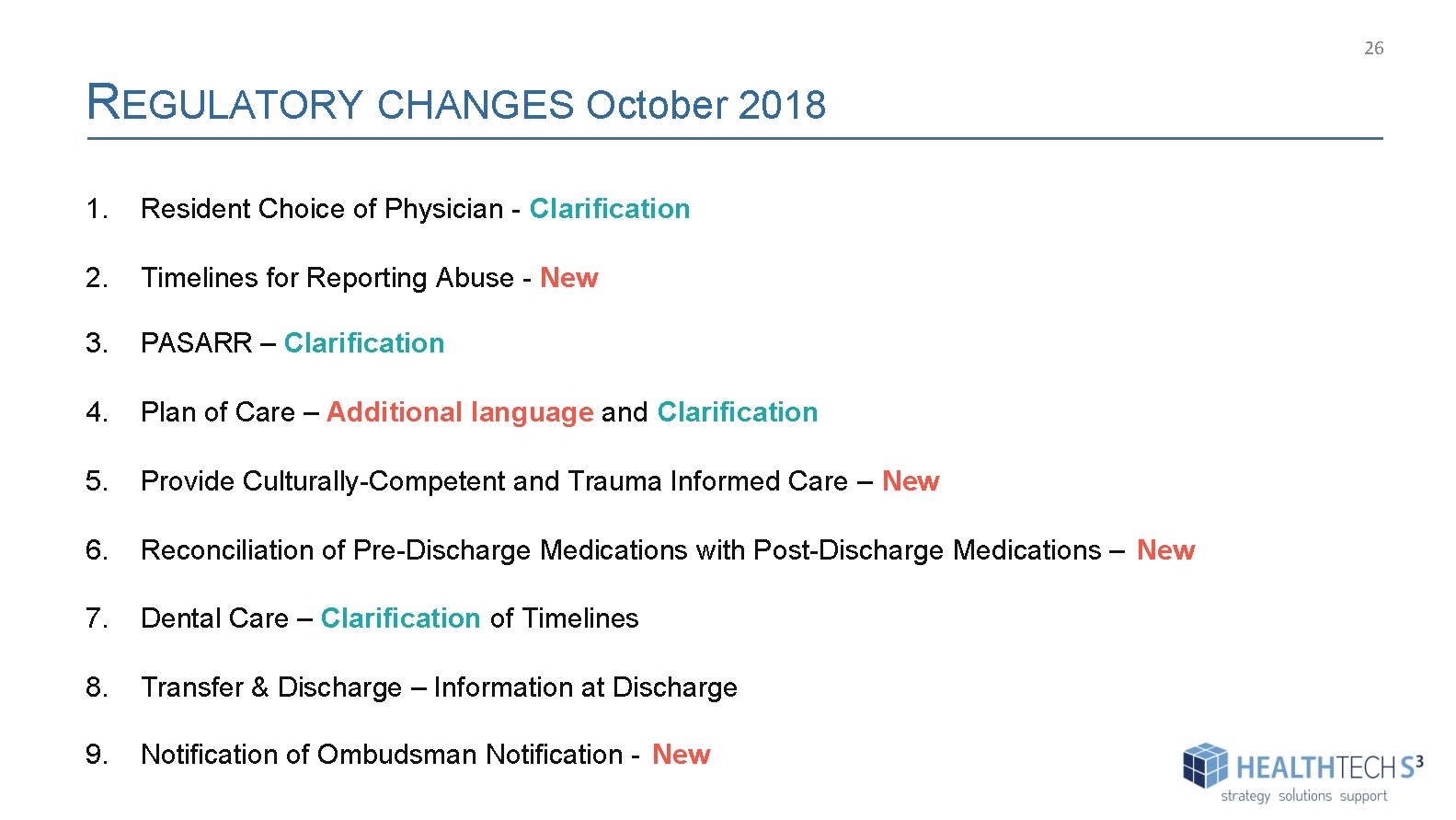
26 REGULATORY CHANGES October 2018 1. Resident Choice of Physician - Clarification 2. Timelines for Reporting Abuse - New 3. PASARR – Clarification 4. Plan of Care – Additional language and Clarification 5. Provide Culturally-Competent and Trauma Informed Care – New 6. Reconciliation of Pre-Discharge Medications with Post-Discharge Medications – New 7. Dental Care – Clarification of Timelines 8. Transfer & Discharge – Information at Discharge 9. Notification of Ombudsman Notification - New
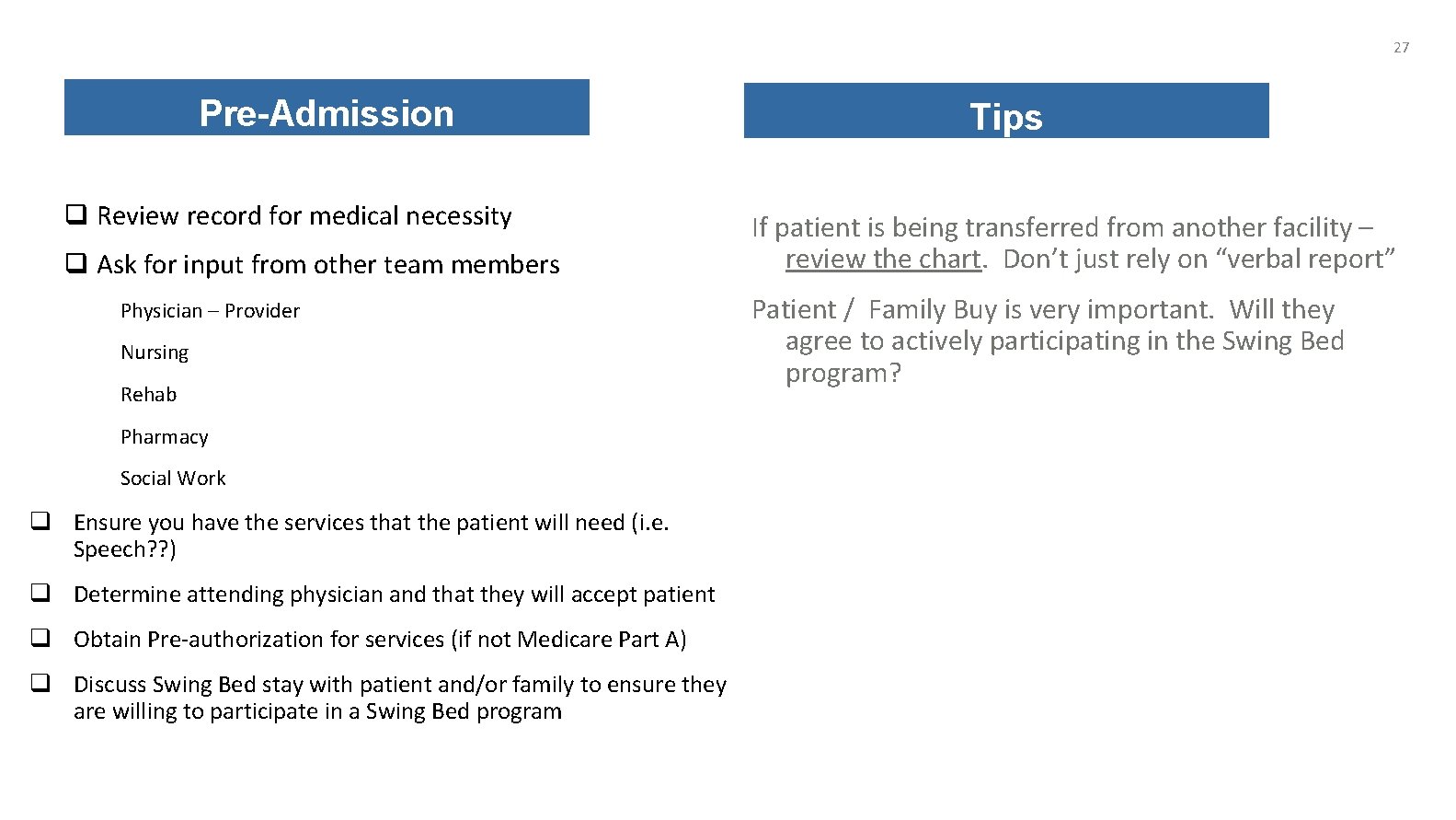
27 Pre-Admission Review record for medical necessity Ask for input from other team members Physician – Provider Nursing Rehab Pharmacy Social Work Ensure you have the services that the patient will need (i. e. Speech? ? ) Determine attending physician and that they will accept patient Obtain Pre-authorization for services (if not Medicare Part A) Discuss Swing Bed stay with patient and/or family to ensure they are willing to participate in a Swing Bed program Tips If patient is being transferred from another facility – review the chart. Don’t just rely on “verbal report” Patient / Family Buy is very important. Will they agree to actively participating in the Swing Bed program?
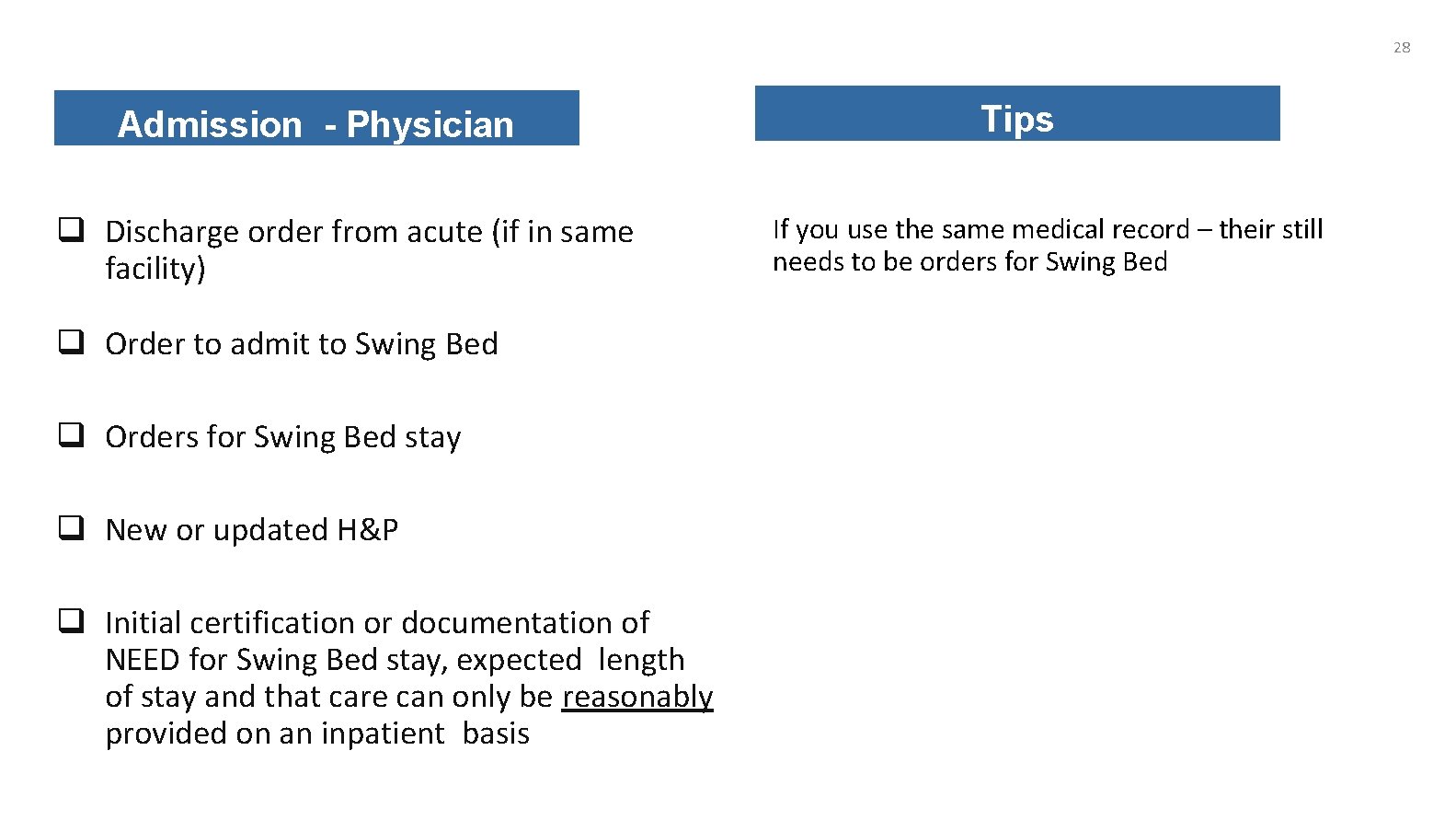
28 Admission - Physician Discharge order from acute (if in same facility) Order to admit to Swing Bed Orders for Swing Bed stay New or updated H&P Initial certification or documentation of NEED for Swing Bed stay, expected length of stay and that care can only be reasonably provided on an inpatient basis Tips If you use the same medical record – their still needs to be orders for Swing Bed
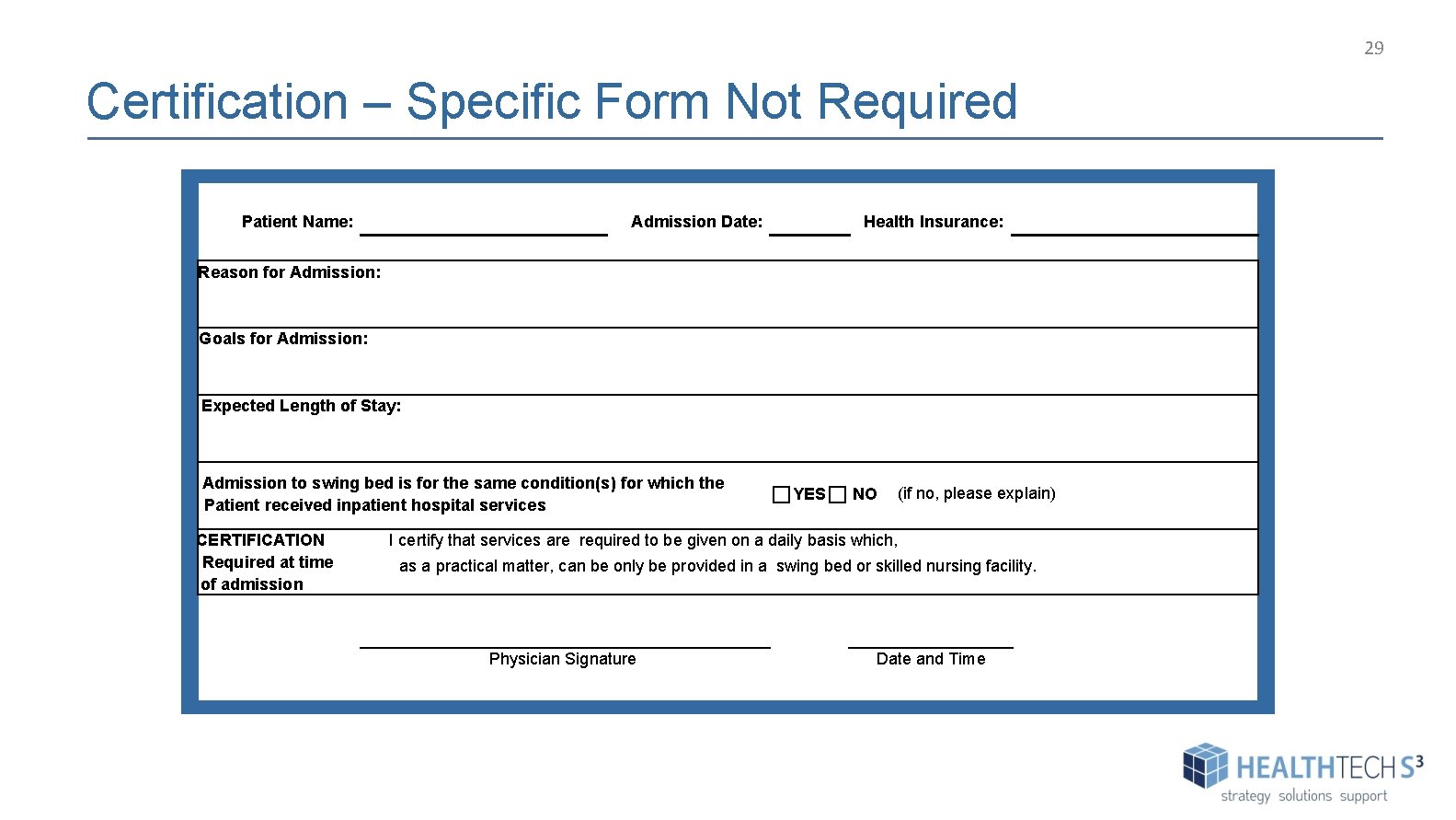
29 Certification – Specific Form Not Required Patient Name: Admission Date: Health Insurance: Reason for Admission: Goals for Admission: Expected Length of Stay: Admission to swing bed is for the same condition(s) for which the Patient received inpatient hospital services CERTIFICATION Required at time of admission c YES c NO (if no, please explain) I certify that services are required to be given on a daily basis which, as a practical matter, can be only be provided in a swing bed or skilled nursing facility. Physician Signature Date and Time
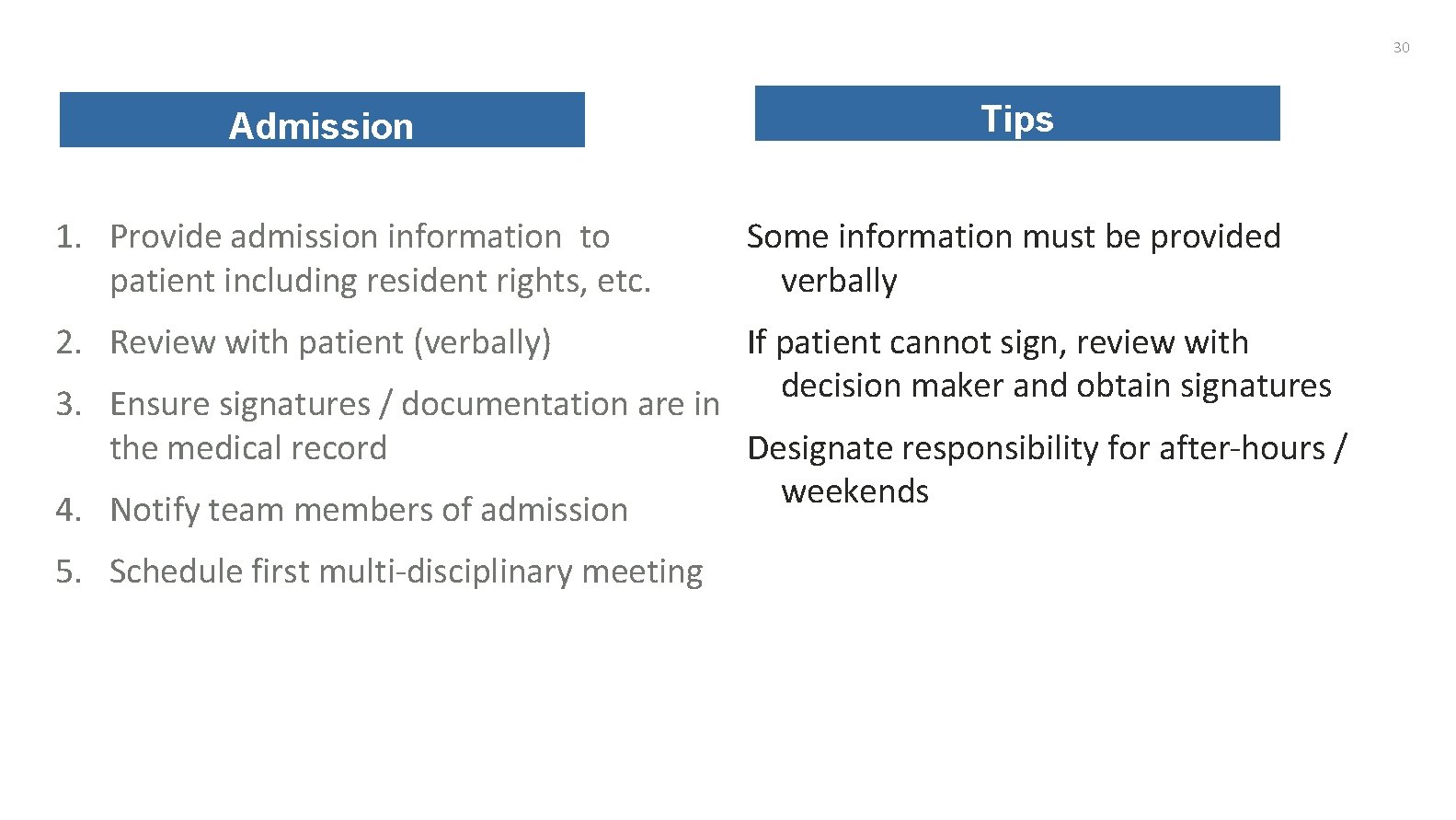
30 Admission Tips 1. Provide admission information to patient including resident rights, etc. Some information must be provided verbally 2. Review with patient (verbally) If patient cannot sign, review with decision maker and obtain signatures 3. Ensure signatures / documentation are in Designate responsibility for after-hours / the medical record weekends 4. Notify team members of admission 5. Schedule first multi-disciplinary meeting
Patient Required Notices Information provided both orally and in writing in a language that the resident understands of his or her rights and all rules and regulations governing resident conduct and responsibilities during the stay in the facility. The facility must also provide the resident with the notice (if any) of the State developed under section 1919(e)(6) of the Act. Such notification must be made prior to or upon admission and during the resident’s stay. Receipt of such information, and any amendments to it, must be acknowledged in writing A facility must promote the exercise of rights for all residents, including those who face barriers such as communication problems, hearing problems and cognition limits. 31 Description of Swing Bed Resident Rights and Responsibilities A description of Hospital’s policies regarding advance directives A list of attending physicians who treat patients Resident Choice of physicians Information on how to contact providers (ALL) Financial Obligations Transfer and Discharge policies Notice of privacy practices How to file grievance or complaint Hospital responsibility for preventing patient abuse Information for reporting Abuse and Neglect Contact information for Hospital and State Agencies including State Ombudsman
32 Resident (Patient) Rights 1. You have the right to a dignified existence, self-determination, and communication with and access to persons and services inside and outside the facility. 2. You have the right to be free of interference, coercion, discrimination, and reprisal from the facility in exercising your rights. You have the right to be supported by the facility in the exercise of your rights. 3. You have the right to be informed of, and participate in, your treatment, including the right to be fully informed in a language that you can understand of your total health status, including but not limited to, your medical condition. 4. You have the right to be informed, in advance, of changes to your plan of care. 5. You have the right to request, refuse, and/or discontinue treatment. 6. You have the right to participate in or refuse to participate in experimental research 7. You have the right to formulate an advance directive. 8. You have the right to choose an attending physician. You have the right to be informed if the physician you have chosen is unable or unwilling to be your attending physician, and to have alternative physicians discussed with you, and to honor your preferences, if any, in identifying options. 9. You have the right to be informed of the name, specialty, and way of contacting your physician and other primary care professionals responsible for your care. 10. You have the right to retain and use personal possessions, including furnishings, and clothing, as space permits, unless to do so would infringe upon the rights of health and safety or other residents
33 Resident (Patient) Rights 11. You have the right to share a room with your spouse when your spouse is in the same facility, and both you and your spouse consent to the arrangement. 12. You have the right to immediate access by immediate family and other relatives, subject to your right to deny or withdraw consent at any time 13. You have the right to immediate access by others who are visiting with your consent, subject to reasonable clinical and safety restrictions and your right to deny or withdraw consent at any time. 14. You have the right to choose to or refuse to perform services for the facility, and the facility must not require you to perform services for the facility. You may choose to perform services for the facility, when: • The facility has documented your need or desire to work in the plan of care; • Your plan of care specifies the nature of the services performed and whether the services are voluntary or paid • You receive compensation for paid services at or above prevailing rates; and • You agree to the work arrangement described in the plan of care. 15. You have the right to be informed in writing, if you have Medicaid insurance, at the time of admission or when you become eligible for Medicaid of: • The items and services that are included in nursing facility services under the State plan and for which you may not be charged • Those other items and services that the Hospital offers and for which you may be charged, and the amount of charges for those services • Be informed when changes are made to items and services 16. You have the right to be informed before, or at the time of admission, and periodically during your stay, of services available in the facility and of charges for those services, including any charges for services not covered under Medicare/Medicaid or by the facility’s per-diem rate. 17. You have the right to privacy in your accommodations. 18. You have the right to privacy for any medical treatment or personal care. 19. You have the right to privacy for visits and meetings with family and resident groups. This does not require the facility to provide you with a private room.
34 Resident (Patient) Rights 20. You have the right to privacy in your oral (spoken), written, and electronic communications, including the right to send and promptly receive unopened mail and other letters, packages and other materials delivered to the facility for you, including those delivered through a means other than a postal service. 21. You have the right to access to stationery, postage, and writing implements at your own expense. 22. You have the right to secure and confidential personal and medical records. You have the right to refuse the release of personal and medical records except as required or provided by federal or state laws. The facility must allow representatives of the Office of the State Long-Term Care Ombudsman to examine your medical, social, and administrative records in accordance with State law. 23. You have the right to remain in the facility, and not be transferred or discharged unless: • The transfer or discharge is necessary for your welfare, and your needs cannot be met in the facility • The transfer or discharge is appropriate because your health has improved sufficiently so that you no longer need the services provided by the facility • The safety of individuals in the facility are endangered due to your clinical or behavioral status • The health of individuals in the facility would be endangered • You have failed, after reasonable and appropriate notice, to pay for (or to have paid under Medicare or Medicaid) a stay at the facility. Non-payment applies if you do not submit the necessary paperwork for third-party payment or after the third party, including Medicare or Medicaid, denies the claims and you refuse to pay for your stay. • The facility ceases to operate The facility may not transfer or discharge you while an appeal is pending, unless the failure to discharge or transfer would endanger the health or safety of you or other individuals in the facility. 24. You have the right to be free from abuse, neglect, misappropriation of property, and exploitation. This includes but is not limited to freedom from corporal punishment, involuntary seclusion, and any physical or chemical restraint not required to treat your medical symptoms.
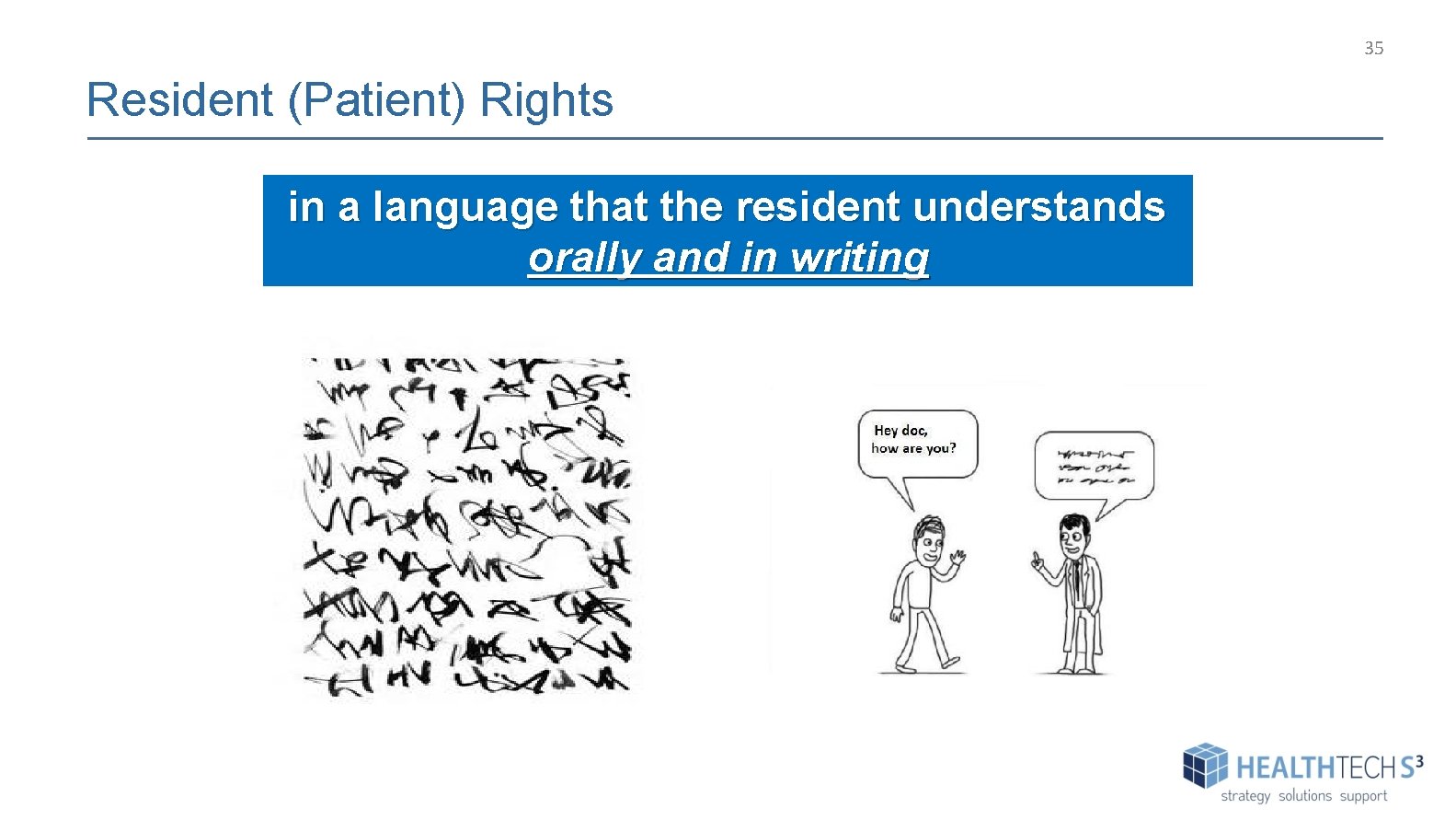
35 Resident (Patient) Rights in a language that the resident understands orally and in writing
36 FINANCIAL OBLIGATIONS 1 (i) Inform each resident who is entitled to Medicaid benefits, in writing, at the time of admission to the nursing facility or, when the resident becomes eligible for Medicaid of-(A) The items and services that are included in nursing facility services under the State plan and for which the resident may not be charged; (B)Those other items and services that the facility offers and for which the resident may be charged, and the amount of charges for those services; and (ii) Inform each resident when changes are made to the items and services specified in paragraphs (5)(i)(A) and (B) of this section. (6) The facility must inform each resident before, or at the time of admission, and periodically during the resident’s stay, of services available in the facility and of charges for those services, including any charges for services not covered under Medicare or by the facility’s per diem rate. Medicare • $0 for the first 20 days of each benefit period • $170. 50 per day for days 21– 100 of each benefit period (2019) • All costs for each day 101 and beyond ASSIGN SOMEONE TO UPDATE EACH YEAR!
37 Choice of Physicians & Info on Contacting Providers C-0361 § 483. 10(d): Choice of attending physician. The resident has the right to choose his or her attending physician. The physician must be licensed to practice, and (2) If the physician chosen by the resident refuses to or does not meet requirements specified in this part, the facility may seek alternate physician participation as specified in paragraphs (d)(4) and (5) of this section to assure provision of appropriate and adequate care and treatment. (3) The facility must ensure that each resident remains informed of the name, specialty, and way of contacting the physician and other primary care professionals responsible for his or her care. (4) The facility must inform the resident if the facility determines that the physician chosen by the resident is unable or unwilling to meet requirements specified in this part and the facility seeks alternate physician participation to assure provision of appropriate and adequate care and treatment. The facility must discuss the alternative physician participation with the resident and honor the resident's preferences, if any, among options. (5) If the resident subsequently selects another attending physician who meets the requirements specified in this part, the facility must honor that choice.
38 After Admission Tips 1. Complete comprehensive assessment (each discipline) per facility timelines Assign responsibility for each assessment component. 2. Include assessment of trauma Timelines need to be congruent with your length of stay 3. Develop multi-disciplinary care plan of care Don’t forget assessment of trauma • • • attending physician registered nurse with responsibility for the resident nurse aide with responsibility for the resident member of food and nutrition services staff patient Don’t forget review of PASRR (if patient has one completed in another facility)
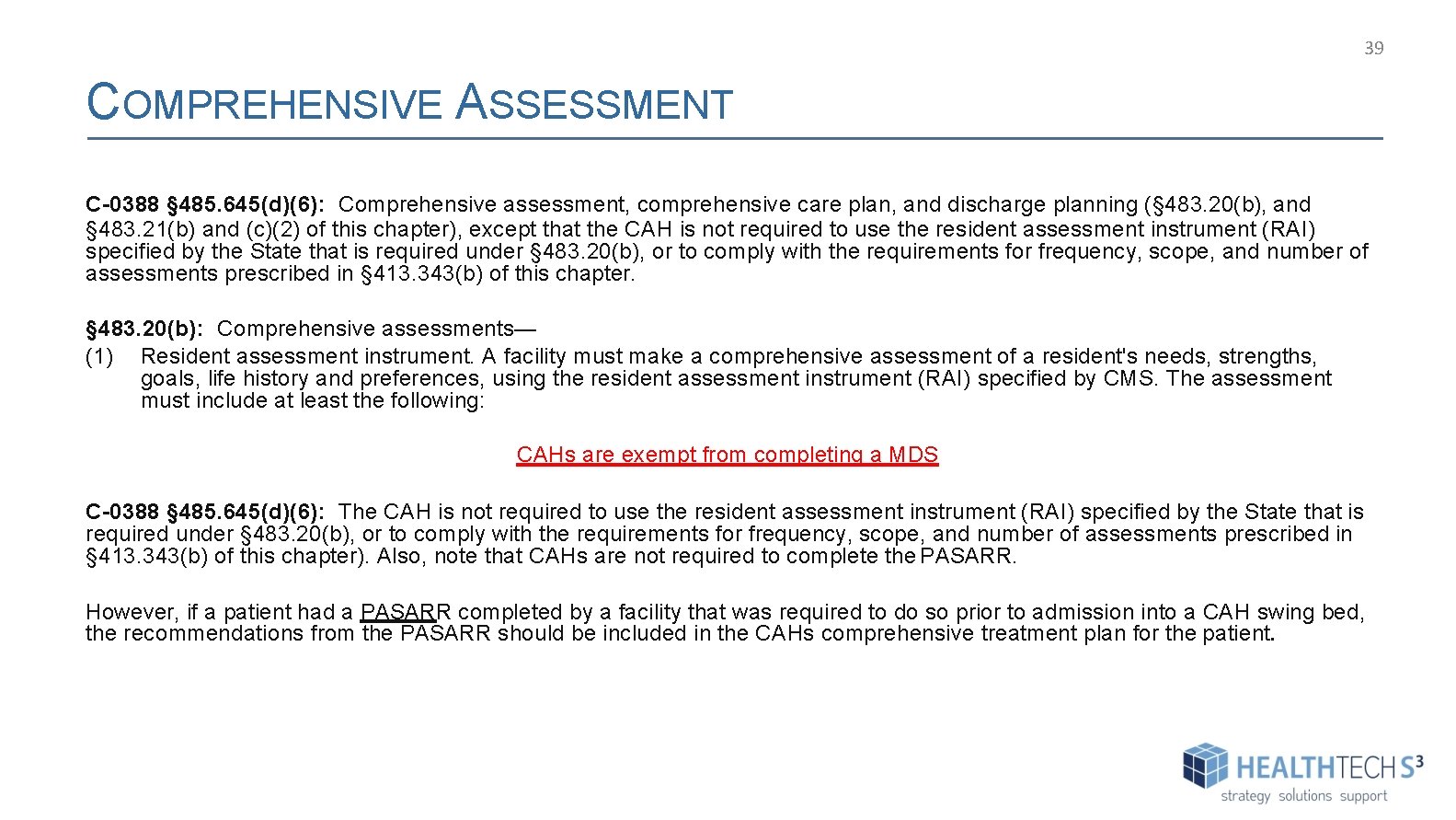
39 COMPREHENSIVE ASSESSMENT C-0388 § 485. 645(d)(6): Comprehensive assessment, comprehensive care plan, and discharge planning (§ 483. 20(b), and § 483. 21(b) and (c)(2) of this chapter), except that the CAH is not required to use the resident assessment instrument (RAI) specified by the State that is required under § 483. 20(b), or to comply with the requirements for frequency, scope, and number of assessments prescribed in § 413. 343(b) of this chapter. § 483. 20(b): Comprehensive assessments— (1) Resident assessment instrument. A facility must make a comprehensive assessment of a resident's needs, strengths, goals, life history and preferences, using the resident assessment instrument (RAI) specified by CMS. The assessment must include at least the following: CAHs are exempt from completing a MDS C-0388 § 485. 645(d)(6): The CAH is not required to use the resident assessment instrument (RAI) specified by the State that is required under § 483. 20(b), or to comply with the requirements for frequency, scope, and number of assessments prescribed in § 413. 343(b) of this chapter). Also, note that CAHs are not required to complete the PASARR. However, if a patient had a PASARR completed by a facility that was required to do so prior to admission into a CAH swing bed, the recommendations from the PASARR should be included in the CAHs comprehensive treatment plan for the patient.
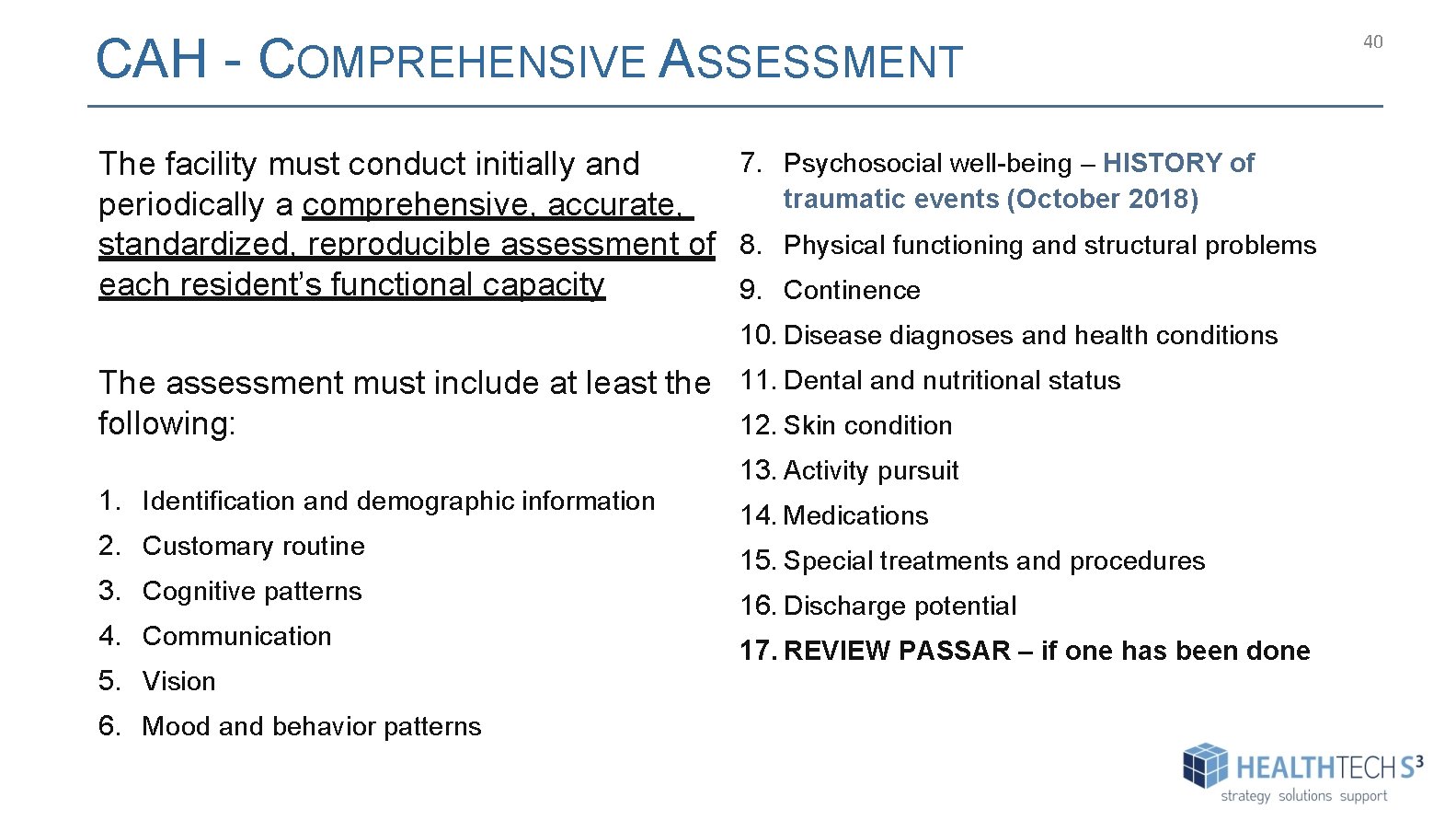
CAH - COMPREHENSIVE ASSESSMENT 7. Psychosocial well-being – HISTORY of The facility must conduct initially and traumatic events (October 2018) periodically a comprehensive, accurate, standardized, reproducible assessment of 8. Physical functioning and structural problems each resident’s functional capacity 9. Continence 10. Disease diagnoses and health conditions The assessment must include at least the 11. Dental and nutritional status following: 12. Skin condition 1. Identification and demographic information 2. Customary routine 3. Cognitive patterns 4. Communication 5. Vision 6. Mood and behavior patterns 13. Activity pursuit 14. Medications 15. Special treatments and procedures 16. Discharge potential 17. REVIEW PASSAR – if one has been done 40
41 Rural Hospitals PPS - ASSESSMENT Hospitals with swing beds paid under PPS must utilize and submit the Swing Bed MDS to CMS There are 9 different item subsets for nursing homes and 5 for swing bed providers: Source: Long-Term Care Facility Resident Assessment Instrument 3. 0 User’s Manual Version 1. 17, October 2019
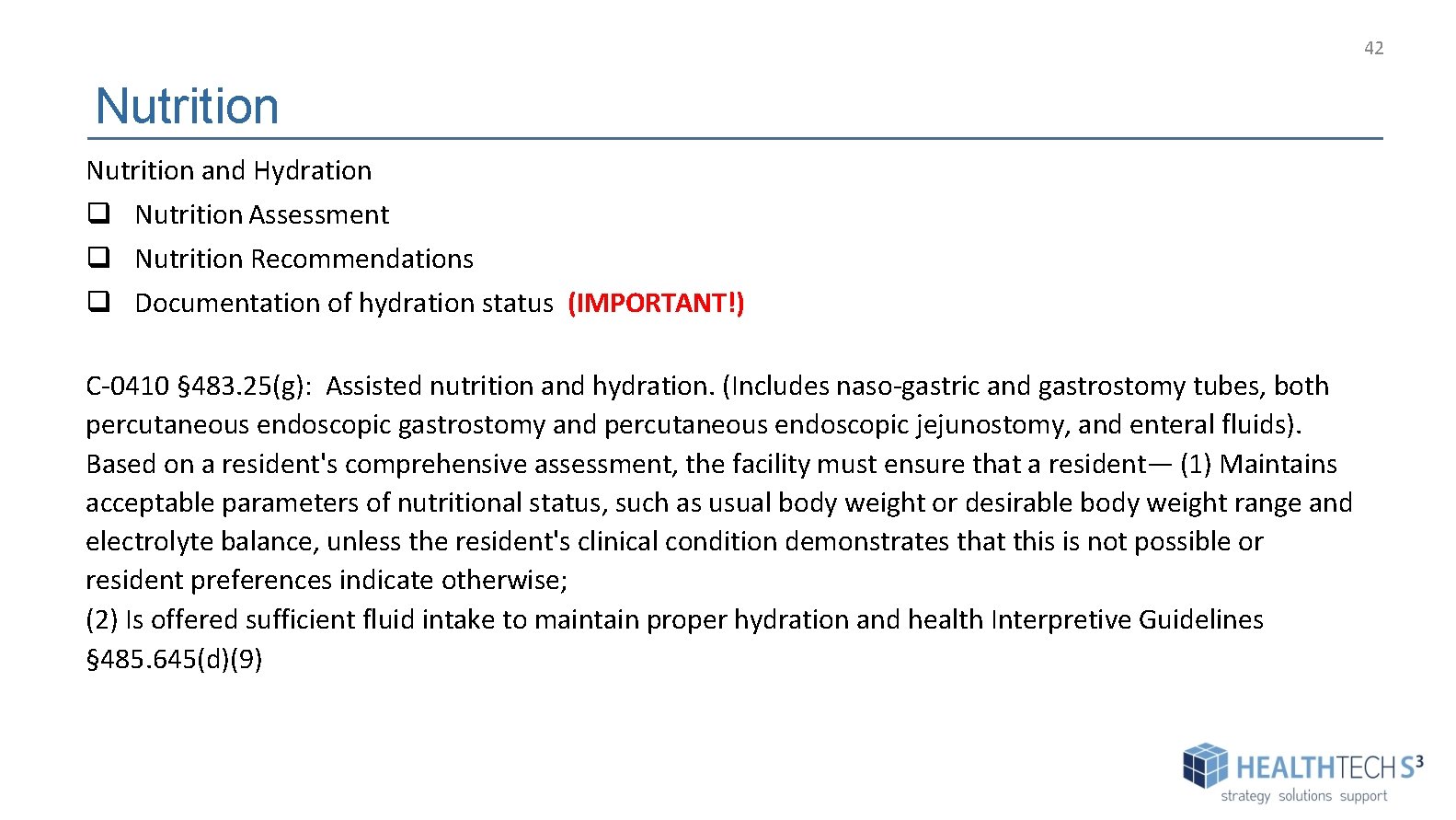
42 Nutrition and Hydration Nutrition Assessment Nutrition Recommendations Documentation of hydration status (IMPORTANT!) C-0410 § 483. 25(g): Assisted nutrition and hydration. (Includes naso-gastric and gastrostomy tubes, both percutaneous endoscopic gastrostomy and percutaneous endoscopic jejunostomy, and enteral fluids). Based on a resident's comprehensive assessment, the facility must ensure that a resident— (1) Maintains acceptable parameters of nutritional status, such as usual body weight or desirable body weight range and electrolyte balance, unless the resident's clinical condition demonstrates that this is not possible or resident preferences indicate otherwise; (2) Is offered sufficient fluid intake to maintain proper hydration and health Interpretive Guidelines § 485. 645(d)(9)
43 Activities Assessment Activities Plan Documentation of Activities status (IMPORTANT!) C-0385 (Rev. 183, Issued: 10 -12 -18, Effective: 10 -12 -18, Implementation: 10 -12 -18) § 483. 24(c) Activities. (1) The facility must provide, based on the comprehensive assessment and care plan and the preferences of each resident, an ongoing program to support residents in their choice of activities, both facilitysponsored group and individual activities and independent activities, designed to meet the interests of and support the physical, mental, and psychosocial well-being of each resident, encouraging both independence and interaction in the community.
44 Activities C-0385(Rev. 183, Issued: 10 -12 -18, Effective: 10 -12 -18, Implementation: 10 -12 -18) § 485. 645(d)(4) Patient Activities (§ 483. 24(c) of this chapter), except that the services may be directed either by a qualified professional meeting the requirements of § 483. 24(c)(2), or by an individual on the facility staff who is designated as the activities director and who serves in consultation with a therapeutic recreation specialist, occupational therapist, or other professional with experience or education in recreational therapy. (2) The activities program must be directed by a qualified professional who is a qualified therapeutic recreation specialist or an activities professional who— (i) Is licensed or registered, if applicable, by the State in which practicing; and (ii) Is: (A) Eligible for certification as a therapeutic recreation specialist or as an activities professional by a recognized accrediting body on or after October 1, 1990; or (B) Has 2 years of experience in a social or recreational program within the last 5 years, one of which was full-time in a therapeutic activities program; or (C) Is a qualified occupational therapist or occupational therapy assistant; or (D) Has completed a training course approved by the State.
45 CAH - Comprehensive ASSESSMENT TIMELINE The new Co. Ps eliminate the requirement for specific timelines for Swing Beds in a CAH (7 day and 14 day timelines are not applicable). However, timelines must be congruent with your Length of Stay. For example: Nursing within 24 hours Rehab within 48 hours Dietary within 48 hours Activities within 48 hours Social Services / Discharge Planning within 48 hours Pharmacy, if appropriate, within 48 hours
46 REASSESSMENT AFTER SIGNIFICANT CHANGE A “significant change” may include, but is not limited to, any of the following, or may be determined by a MD/DO’s decision if uncertainty exists. • Deterioration in two of more activities of daily living (ADLs), or any combination of deterioration in two or more areas of ADLs, communication, or cognitive abilities that appear permanent. For example, pronounced deterioration in function and communication following a stroke. • Loss of ability to ambulate freely or to use hands to grasp small objects to feed or groom oneself, such as spoon, toothbrush, or comb. Temporary loss of ability, such as during an acute illness, is not included. • Deterioration in behavior or mood, to the point where daily problems arise or relationships have become problematic and staff conclude that these changes in the resident’s psychosocial status are not likely to improve without staff intervention. • Deterioration in a resident’s health status, where this change places the resident’s life in danger (e. g. , stroke, heart disease, metastatic cancer); where the change is associated with a serious clinical complication (e. g. , initial development of a stage III pressure sore, prolonged delirious state, or recurrent decline in level of consciousness); or change that is associated with an initial diagnosis of a condition that is likely to affect the resident’s physical, mental, or psychosocial well-being over a prolonged period of time (e. g. , Alzheimer’s disease or diabetes); or the onset of significant, unplanned weight loss (5% in the last 30 days, 10% in the last 180 days).
47 TRAUMA INFORMED CARE Trauma Informed Care is an organizational structure and treatment framework that involves understanding, recognizing, and responding to the effects of all types of trauma. Trauma Informed Care also emphasizes physical, psychological and emotional safety for both consumers and providers, and helps survivors rebuild a sense of control and empowerment. http: //traumainformedcareproject. org/index. php
48 TRAUMA INFORMED CARE 1. Has there been anything within the last six months to a year that has caused you to be upset or very worried? 2. Have you experienced the loss of a close friend, relative or a pet that you loved recently? 3. Have you had any past trauma in your life that we should know about so we can better care for you? 4. If you have experienced some kind of trauma is there something that helps you feel better? 5. Is there anything we can do to help while you are in the (Hospital/Nursing Home) DON’T PROBE – NO IS NO
49 Important Note The assessment is not JUST A NURSING ASSESSMENT – It’s Multidisciplinary Important Note This is not AN ACUTE CARE ASSESSMENT Important Note Assessment must include direct OBSERVATION and COMMUNICATION with the patient Important Note Assessment must include communication / input with licensed and non-licensed DIRECT CARE STAFF MEMBERS ON ALL SHIFTS
50 COMPREHENSIVE CARE PLAN C-0388 § 485. 645(d)(6) Timelines must be congruent with your Length of Stay. (ii) Prepared by an interdisciplinary team, that includes but is not limited to— For example: IDT meeting within 48 – 72 (A) The attending physician. hours of admission to develop (B) A registered nurse with responsibility for the resident. comprehensive plan of care. (C) A nurse aide with responsibility for the resident. (D) A member of food and nutrition services staff. (E)To the extent practicable, the participation of the resident and the resident's representative(s). An explanation must be included in a resident's medical record if the participation of the resident and their resident representative is determined not practicable for the development of the resident's care plan. (F) Other appropriate staff or professionals in disciplines as determined by the resident's needs or as requested by the resident. (iii) Reviewed and revised by the interdisciplinary team after each assessment, including both the comprehensive and quarterly review assessments. (3) The services provided or arranged by the facility, as outlined by the comprehensive care plan, must— (i) Meet professional standards of quality. (ii) Be provided by qualified persons in accordance with each resident's written plan of care. (iii) Be culturally-competent and trauma-informed
51 COMPREHENSIVE CARE PLAN C-0388 § 483. 21(b) Comprehensive care plans (1) The facility must develop and implement a comprehensive person-centered care plan for each resident, consistent with the resident rights set forth at § 483. 10(c)(2) and § 483. 10(c)(3), that includes measurable objectives and timeframes to meet a resident's medical, nursing, and mental and psychosocial needs that are identified in the comprehensive assessment. The comprehensive care plan must describe the following: (i)The services that are to be furnished to attain or maintain the resident's highest practicable physical, mental, and psychosocial well-being as required under § 483. 24, § 483. 25, or § 483. 40; and (ii)Any services that would otherwise be required under § 483. 24, § 483. 25, or § 483. 40 but are not provided due to the resident's exercise of rights under § 483. 10, including the right to refuse treatment under § 483. 10(c)(6). (i)Any specialized services or specialized rehabilitative services the nursing facility will provide as a result of PASARR recommendations. If a facility disagrees with the findings of the PASARR, it must indicate its rationale in the resident's medical record. (ii) In consultation with the resident and the resident's representative(s)— (A) The resident's goals for admission and desired outcomes. (B)The resident's preference and potential for future discharge. Facilities must document whether the resident's desire to return to the community was assessed any referrals to local contact agencies and/or other appropriate entities, for this purpose. (C) Discharge plans in the comprehensive care plan, as appropriate, in accordance with the requirements set forth in paragraph (c) of this section.
52 PASARR C-0388 § 483. 21(b) Comprehensive care plans. (i) Any specialized services or specialized rehabilitative services the nursing facility will provide as a result of PASARR recommendations. If a facility disagrees with the findings of the PASARR, it must indicate its rationale in the resident's medical record. PASARR is a screening tool to identify residents with serious mental illness (SMI), mental retardation (MR), or a related condition (RC) Federal regulations do not require that a PASRR is completed for Swing Bed Patients. However, new regulatory requirements require that you review and incorporate the PASRR in the plan of care if appropriate – if one has been done. Some states require completion of a PASARR for all SNF and Swing bed patients http: //www. pasrrassist. org
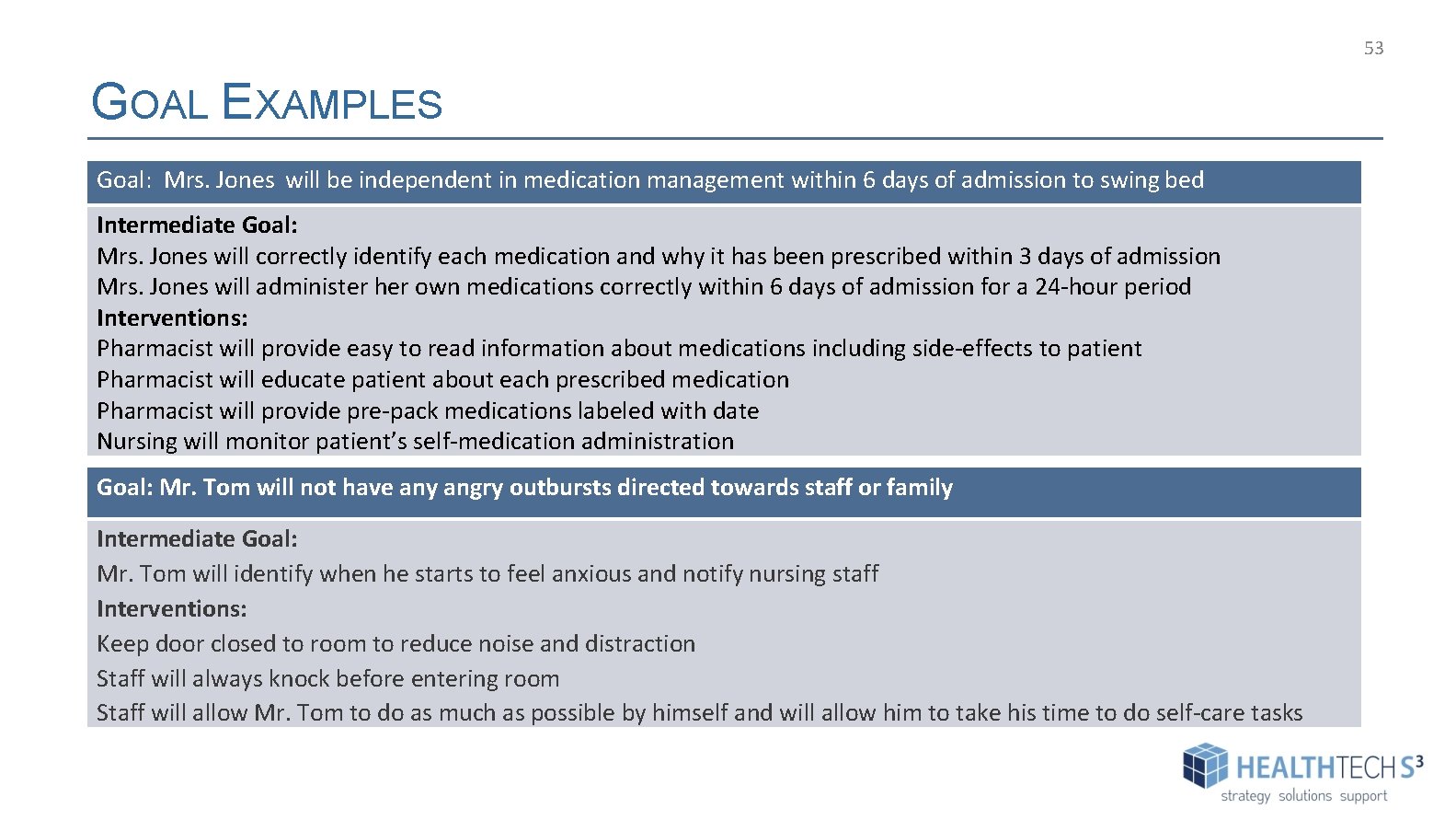
53 GOAL EXAMPLES Goal: Mrs. Jones will be independent in medication management within 6 days of admission to swing bed Intermediate Goal: Mrs. Jones will correctly identify each medication and why it has been prescribed within 3 days of admission Mrs. Jones will administer her own medications correctly within 6 days of admission for a 24 -hour period Interventions: Pharmacist will provide easy to read information about medications including side-effects to patient Pharmacist will educate patient about each prescribed medication Pharmacist will provide pre-pack medications labeled with date Nursing will monitor patient’s self-medication administration Goal: Mr. Tom will not have any angry outbursts directed towards staff or family Intermediate Goal: Mr. Tom will identify when he starts to feel anxious and notify nursing staff Interventions: Keep door closed to room to reduce noise and distraction Staff will always knock before entering room Staff will allow Mr. Tom to do as much as possible by himself and will allow him to take his time to do self-care tasks
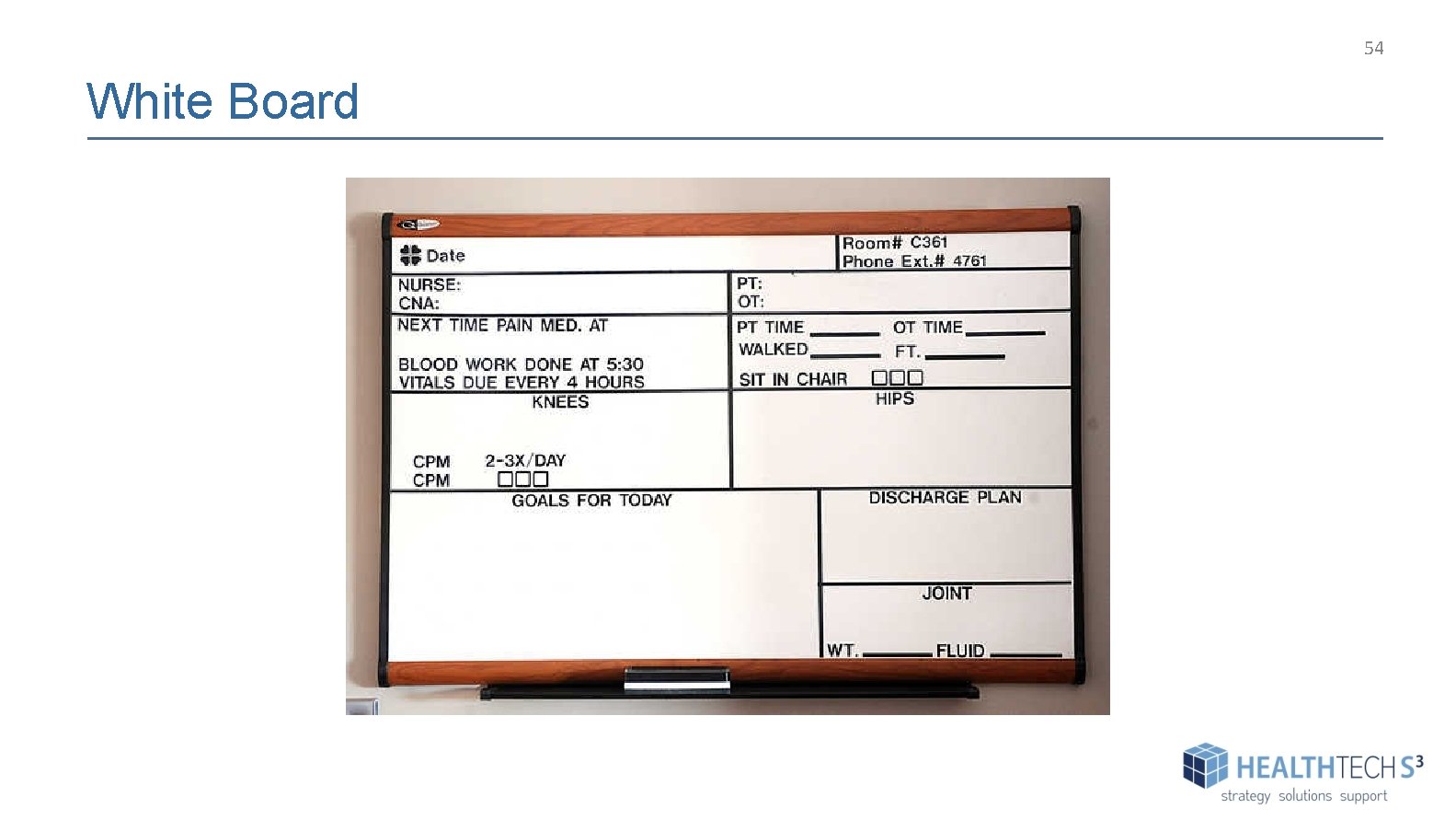
54 White Board
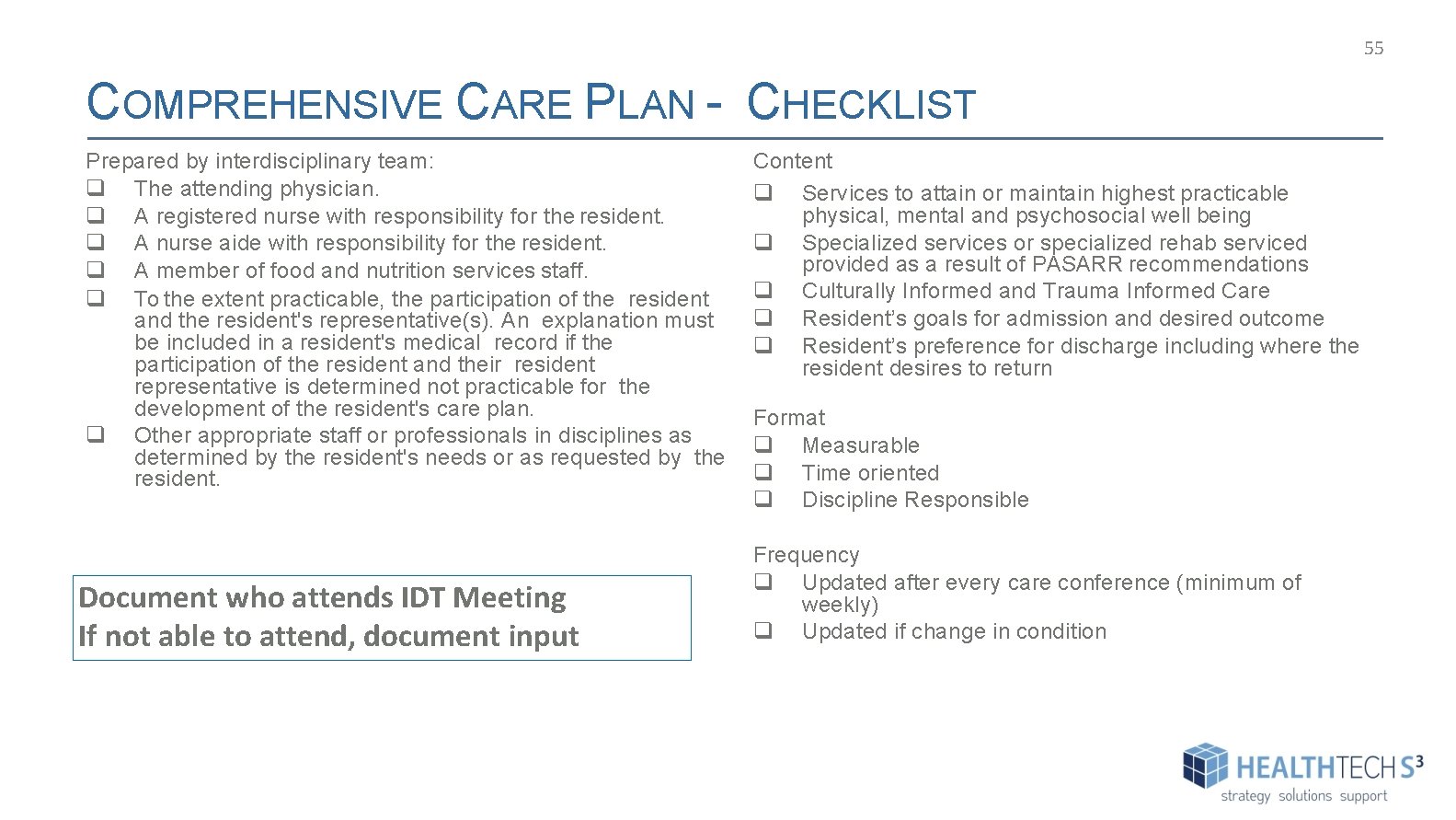
55 COMPREHENSIVE CARE PLAN - CHECKLIST Prepared by interdisciplinary team: The attending physician. A registered nurse with responsibility for the resident. A nurse aide with responsibility for the resident. A member of food and nutrition services staff. To the extent practicable, the participation of the resident and the resident's representative(s). An explanation must be included in a resident's medical record if the participation of the resident and their resident representative is determined not practicable for the development of the resident's care plan. Other appropriate staff or professionals in disciplines as determined by the resident's needs or as requested by the resident. Document who attends IDT Meeting If not able to attend, document input Content Services to attain or maintain highest practicable physical, mental and psychosocial well being Specialized services or specialized rehab serviced provided as a result of PASARR recommendations Culturally Informed and Trauma Informed Care Resident’s goals for admission and desired outcome Resident’s preference for discharge including where the resident desires to return Format Measurable Time oriented Discipline Responsible Frequency Updated after every care conference (minimum of weekly) Updated if change in condition
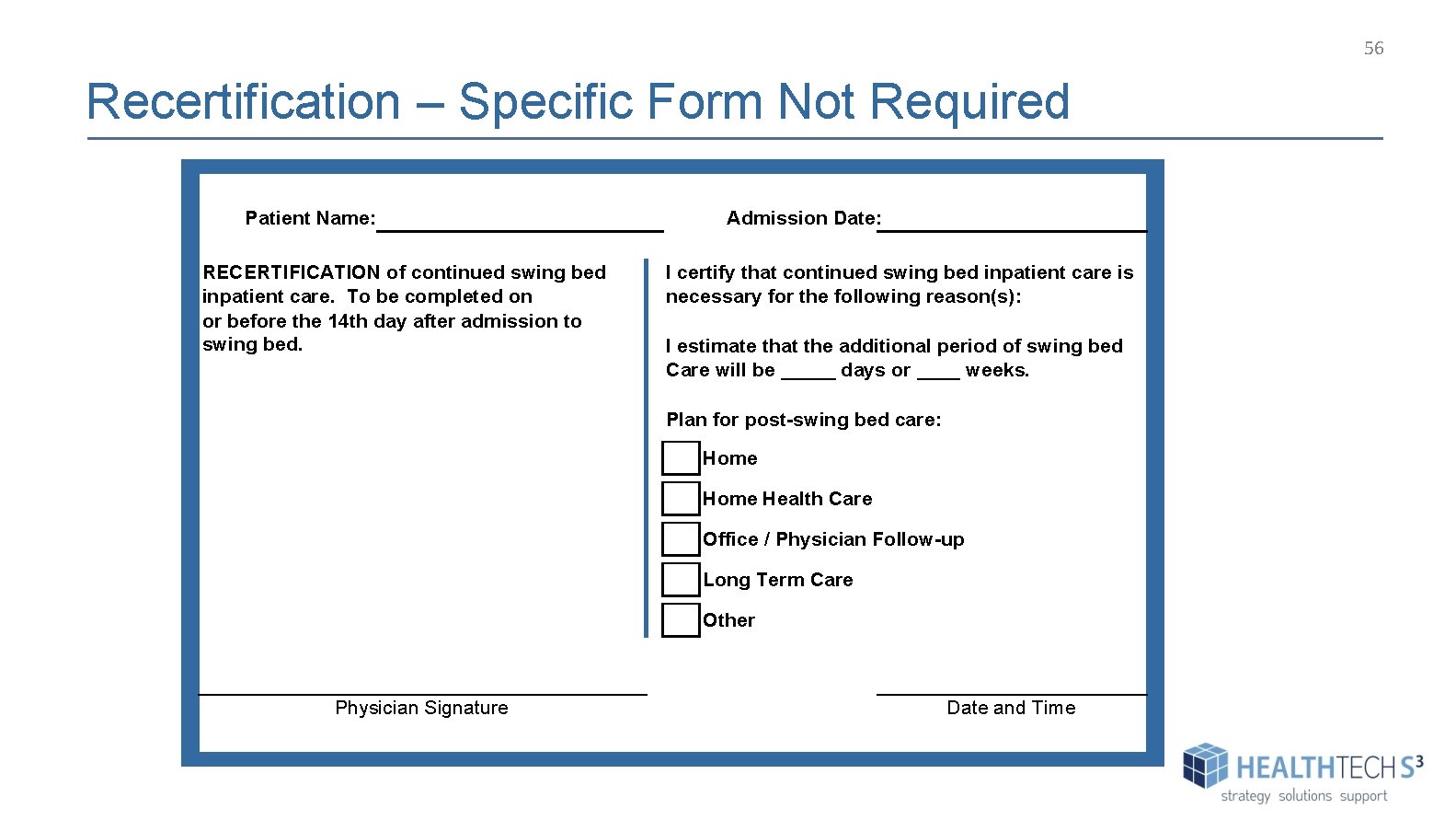
56 Recertification – Specific Form Not Required Patient Name: RECERTIFICATION of continued swing bed inpatient care. To be completed on or before the 14 th day after admission to swing bed. Admission Date: I certify that continued swing bed inpatient care is necessary for the following reason(s): I estimate that the additional period of swing bed Care will be _____ days or ____ weeks. Plan for post-swing bed care: Home Health Care Office / Physician Follow-up Long Term Care Other Physician Signature Date and Time
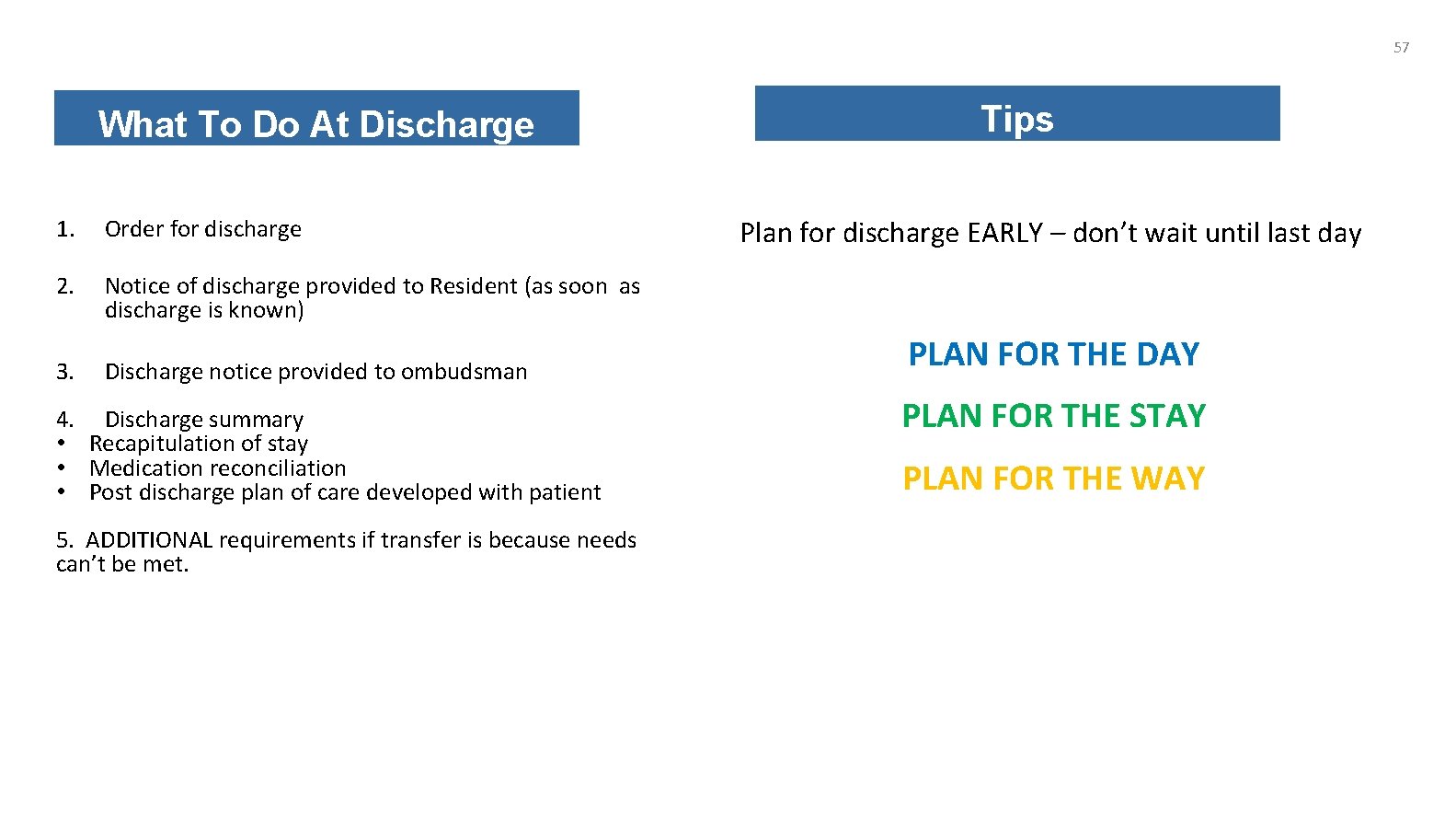
57 What To Do At Discharge 1. Order for discharge 2. Notice of discharge provided to Resident (as soon as discharge is known) 3. Discharge notice provided to ombudsman 4. Discharge summary • Recapitulation of stay • Medication reconciliation • Post discharge plan of care developed with patient 5. ADDITIONAL requirements if transfer is because needs can’t be met. Tips Plan for discharge EARLY – don’t wait until last day PLAN FOR THE DAY PLAN FOR THE STAY PLAN FOR THE WAY
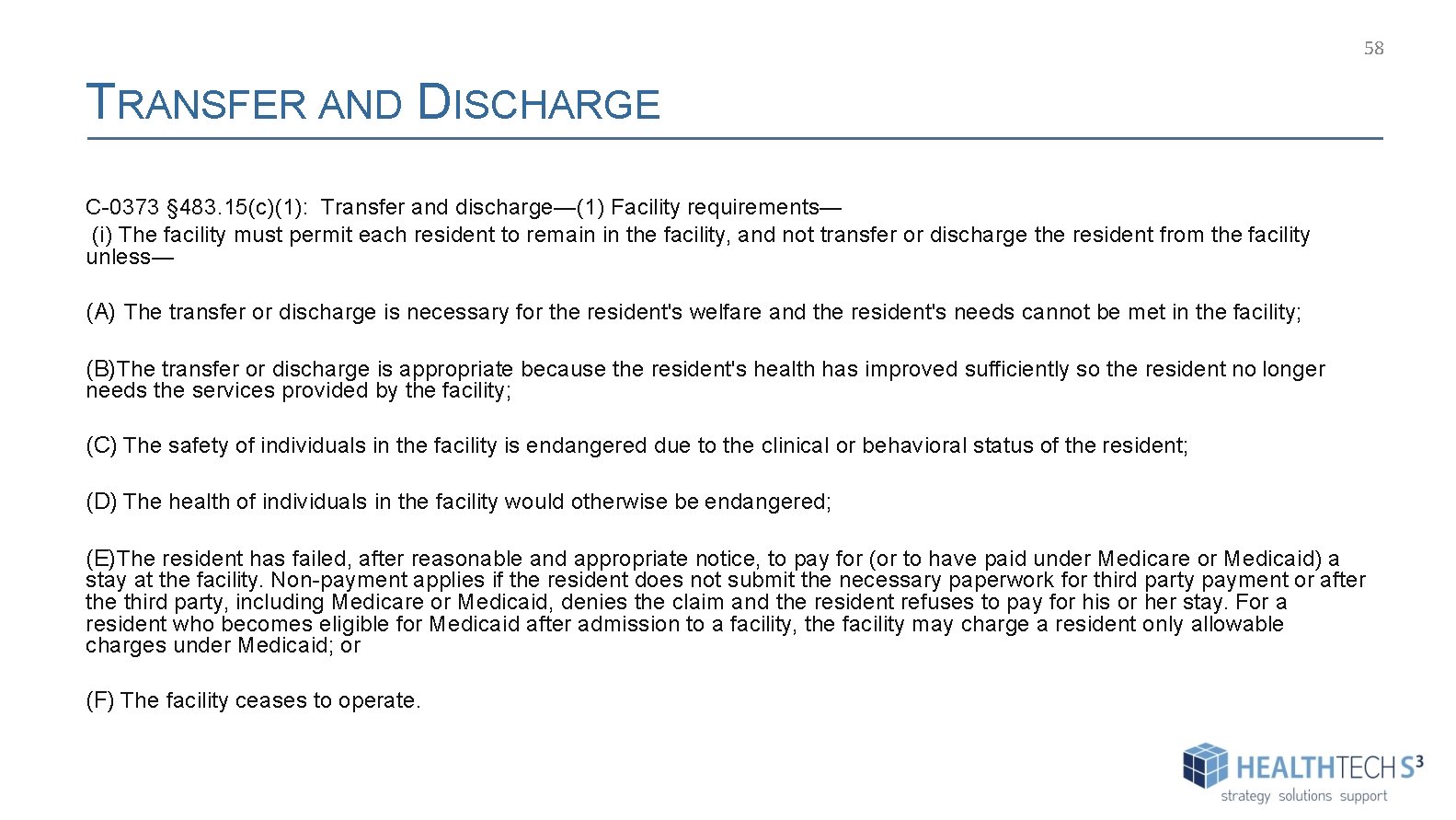
58 TRANSFER AND DISCHARGE C-0373 § 483. 15(c)(1): Transfer and discharge—(1) Facility requirements— (i) The facility must permit each resident to remain in the facility, and not transfer or discharge the resident from the facility unless— (A) The transfer or discharge is necessary for the resident's welfare and the resident's needs cannot be met in the facility; (B)The transfer or discharge is appropriate because the resident's health has improved sufficiently so the resident no longer needs the services provided by the facility; (C) The safety of individuals in the facility is endangered due to the clinical or behavioral status of the resident; (D) The health of individuals in the facility would otherwise be endangered; (E)The resident has failed, after reasonable and appropriate notice, to pay for (or to have paid under Medicare or Medicaid) a stay at the facility. Non-payment applies if the resident does not submit the necessary paperwork for third party payment or after the third party, including Medicare or Medicaid, denies the claim and the resident refuses to pay for his or her stay. For a resident who becomes eligible for Medicaid after admission to a facility, the facility may charge a resident only allowable charges under Medicaid; or (F) The facility ceases to operate.
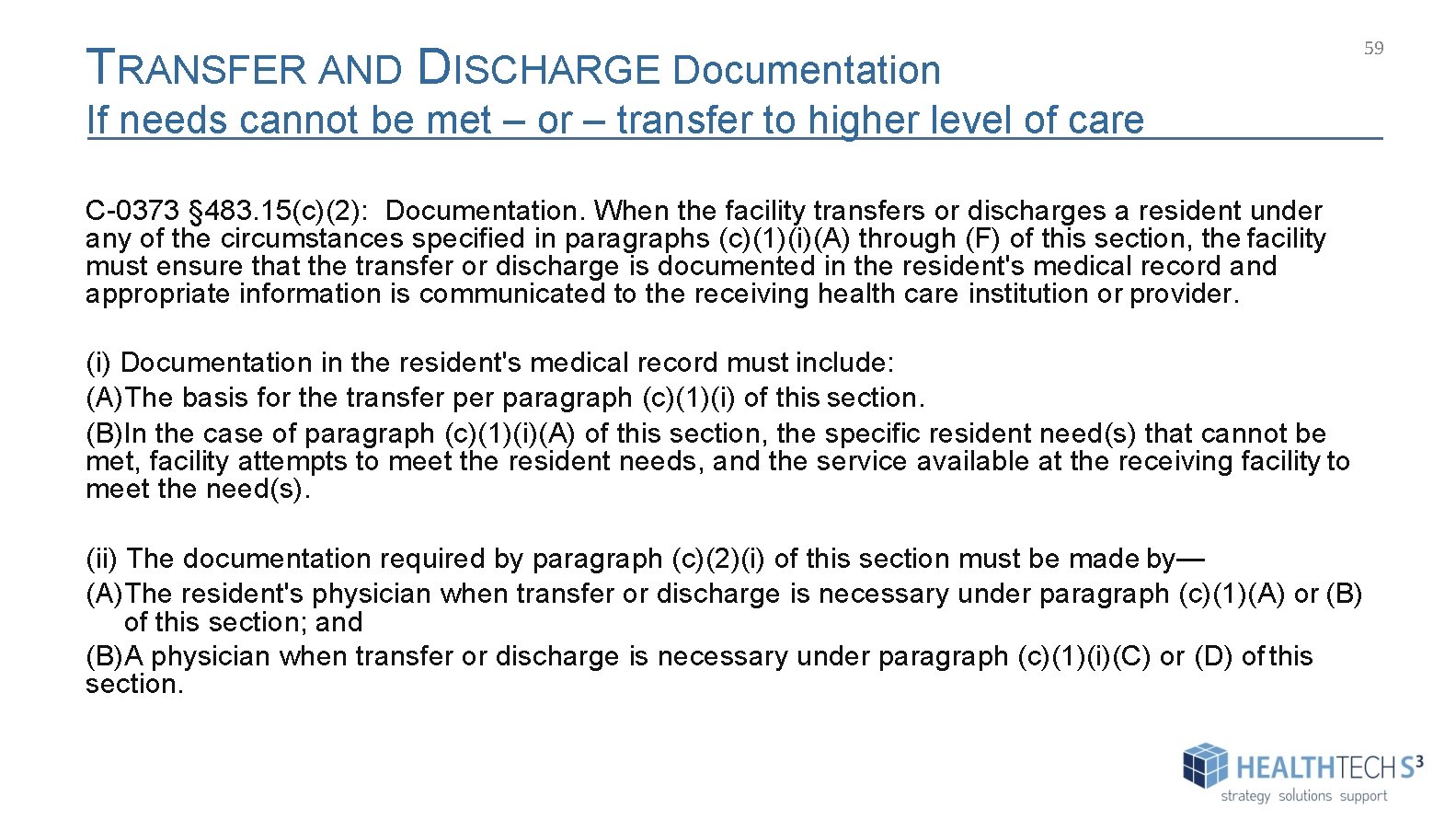
TRANSFER AND DISCHARGE Documentation 59 If needs cannot be met – or – transfer to higher level of care C-0373 § 483. 15(c)(2): Documentation. When the facility transfers or discharges a resident under any of the circumstances specified in paragraphs (c)(1)(i)(A) through (F) of this section, the facility must ensure that the transfer or discharge is documented in the resident's medical record and appropriate information is communicated to the receiving health care institution or provider. (i) Documentation in the resident's medical record must include: (A)The basis for the transfer paragraph (c)(1)(i) of this section. (B)In the case of paragraph (c)(1)(i)(A) of this section, the specific resident need(s) that cannot be met, facility attempts to meet the resident needs, and the service available at the receiving facility to meet the need(s). (ii) The documentation required by paragraph (c)(2)(i) of this section must be made by— (A)The resident's physician when transfer or discharge is necessary under paragraph (c)(1)(A) or (B) of this section; and (B)A physician when transfer or discharge is necessary under paragraph (c)(1)(i)(C) or (D) of this section.
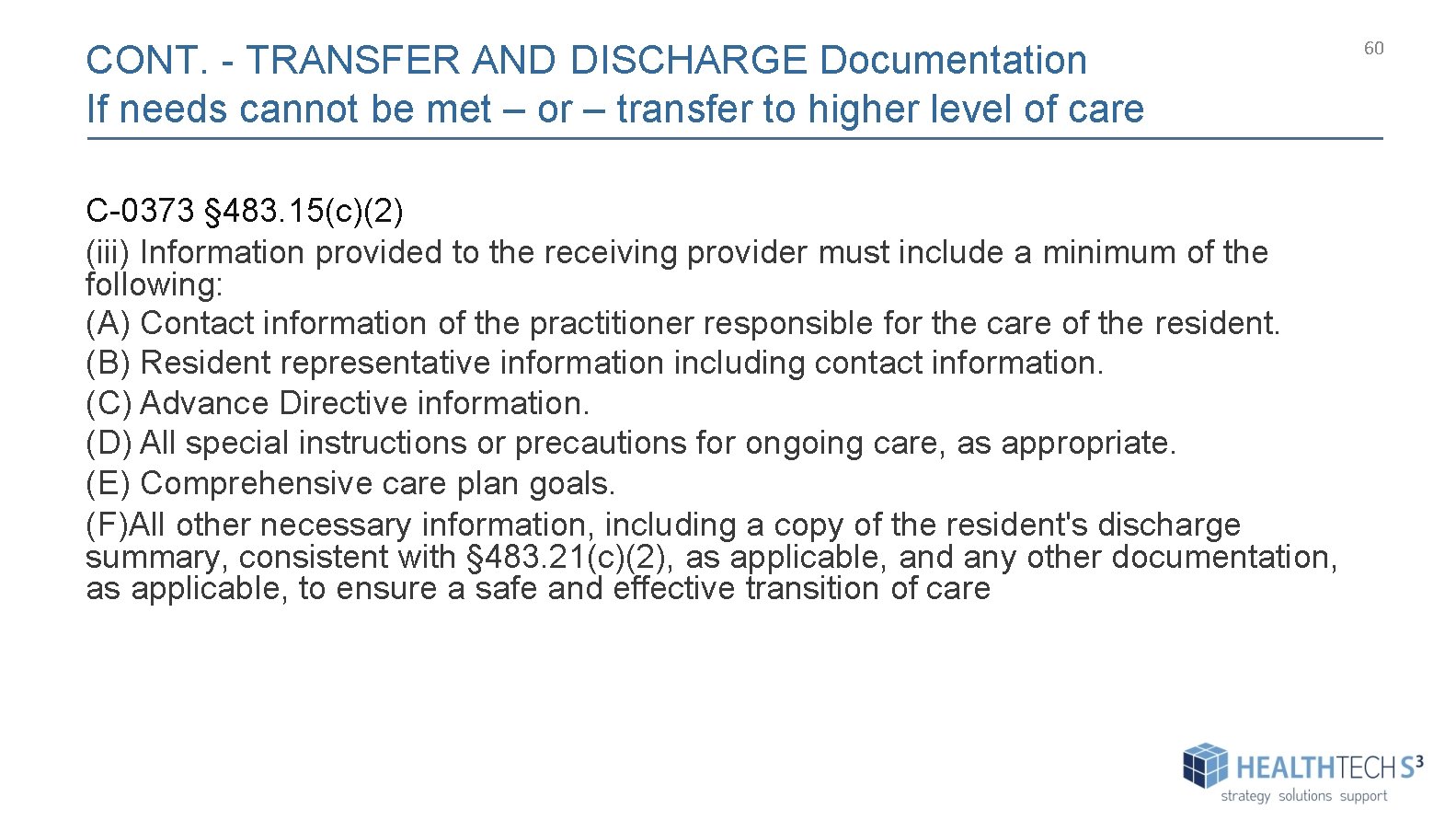
CONT. - TRANSFER AND DISCHARGE Documentation If needs cannot be met – or – transfer to higher level of care C-0373 § 483. 15(c)(2) (iii) Information provided to the receiving provider must include a minimum of the following: (A) Contact information of the practitioner responsible for the care of the resident. (B) Resident representative information including contact information. (C) Advance Directive information. (D) All special instructions or precautions for ongoing care, as appropriate. (E) Comprehensive care plan goals. (F)All other necessary information, including a copy of the resident's discharge summary, consistent with § 483. 21(c)(2), as applicable, and any other documentation, as applicable, to ensure a safe and effective transition of care 60
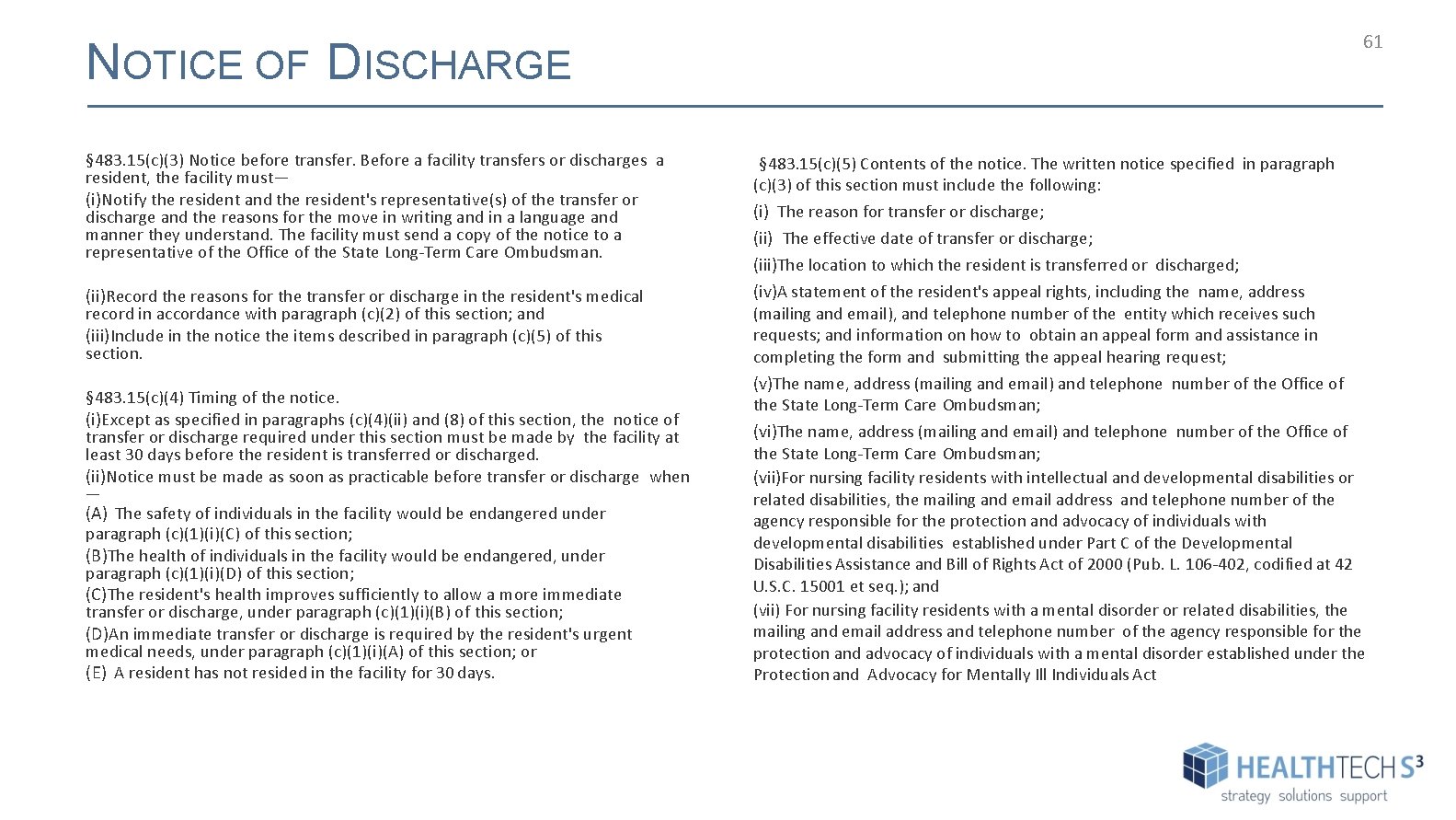
NOTICE OF DISCHARGE § 483. 15(c)(3) Notice before transfer. Before a facility transfers or discharges a resident, the facility must— (i)Notify the resident and the resident's representative(s) of the transfer or discharge and the reasons for the move in writing and in a language and manner they understand. The facility must send a copy of the notice to a representative of the Office of the State Long-Term Care Ombudsman. (ii)Record the reasons for the transfer or discharge in the resident's medical record in accordance with paragraph (c)(2) of this section; and (iii)Include in the notice the items described in paragraph (c)(5) of this section. § 483. 15(c)(4) Timing of the notice. (i)Except as specified in paragraphs (c)(4)(ii) and (8) of this section, the notice of transfer or discharge required under this section must be made by the facility at least 30 days before the resident is transferred or discharged. (ii)Notice must be made as soon as practicable before transfer or discharge when — (A) The safety of individuals in the facility would be endangered under paragraph (c)(1)(i)(C) of this section; (B)The health of individuals in the facility would be endangered, under paragraph (c)(1)(i)(D) of this section; (C)The resident's health improves sufficiently to allow a more immediate transfer or discharge, under paragraph (c)(1)(i)(B) of this section; (D)An immediate transfer or discharge is required by the resident's urgent medical needs, under paragraph (c)(1)(i)(A) of this section; or (E) A resident has not resided in the facility for 30 days. . 61 § 483. 15(c)(5) Contents of the notice. The written notice specified in paragraph (c)(3) of this section must include the following: (i) The reason for transfer or discharge; (ii) The effective date of transfer or discharge; (iii)The location to which the resident is transferred or discharged; (iv)A statement of the resident's appeal rights, including the name, address (mailing and email), and telephone number of the entity which receives such requests; and information on how to obtain an appeal form and assistance in completing the form and submitting the appeal hearing request; (v)The name, address (mailing and email) and telephone number of the Office of the State Long-Term Care Ombudsman; (vii)For nursing facility residents with intellectual and developmental disabilities or related disabilities, the mailing and email address and telephone number of the agency responsible for the protection and advocacy of individuals with developmental disabilities established under Part C of the Developmental Disabilities Assistance and Bill of Rights Act of 2000 (Pub. L. 106 -402, codified at 42 U. S. C. 15001 et seq. ); and (vii) For nursing facility residents with a mental disorder or related disabilities, the mailing and email address and telephone number of the agency responsible for the protection and advocacy of individuals with a mental disorder established under the Protection and Advocacy for Mentally Ill Individuals Act
62 Discharge Notification 35
63 OMBUDSMAN C-0373 § 483. 15(c)(3): Notice before transfer. Before a facility transfers or discharges a resident, the facility must— (i) Notify the resident and the resident's representative(s) of the transfer or discharge and the reasons for the move in writing and in a language and manner they understand. The facility must send a copy of the notice to a representative of the Office of the State Long-Term Care Ombudsman. (ii)Record the reasons for the transfer or discharge in the resident's medical record in accordance with paragraph (c)(2) of this section; and (iii)Include in the notice the items described in paragraph (c)(5) of this section. Appendix PP § 483. 15(c)(3)-(6) Guidance - Notice of Transfer or Discharge and Ombudsman Notification For facility-initiated transfer or discharge of a resident, the facility must notify the resident and the resident’s representative(s) of the transfer or discharge and the reasons for the move in writing and in a language and manner they understand. Additionally, the facility must send a copy of the notice of transfer or discharge to the representative of the Office of the State Long-Term Care (LTC) Ombudsman. The intent of sending copies of the notice to a representative of the Office of the State LTC Ombudsman is to provide added protection to residents from being inappropriately discharged, provide residents with access to an advocate who can inform them of their options and rights, and to ensure that the Office of the State LTC Ombudsman is aware of facility practices and activities related to transfers and discharges. Notice to the Office of the State LTC Ombudsman must occur before or as close as possible to the actual time of a facility-initiated transfer or discharge. The medical record must contain evidence that the notice was sent to the Ombudsman. While Ombudsman Programs vary from state to state, facilities must know the process for ombudsman notification in their state
64 DISCHARGE SUMMARY C-0388 § 483. 21(c)(2): Discharge summary. When the facility anticipates discharge a resident must have a discharge summary that includes, but is not limited to, the following: (i) A recapitulation of the resident's stay that includes, but is not limited to, diagnoses, course of illness/treatment or therapy, and pertinent lab, radiology, and consultation results. (ii) A final summary of the resident's status to include items in paragraph (b)(1) of § 483. 20, at the time of the discharge that is available for release to authorized persons and agencies, with the consent of the resident or resident's representative. (iii) Reconciliation of all pre-discharge medications with the resident's post-discharge medications (both prescribed and over-the-counter). (iv) A post-discharge plan of care that is developed with the participation of the resident and, with the resident's consent, the resident representative(s), which will assist the resident to adjust to his or her new living environment. The post- discharge plan of care must indicate where the individual plans to reside, any arrangements that have been made for the resident's follow up care and any post-discharge medical and non-medical services.
65 Other Info: Abuse – New Timelines C-0381 § 483. 12(c): In response to allegations of abuse, neglect, exploitation, or mistreatment, the facility must: (1) Ensure that alleged violations involving abuse, neglect, exploitation or mistreatment, including injuries of unknown source and misappropriation of resident property, are reported immediately, but not later than 2 hours after the allegation is made, if the events that cause the allegation involve abuse or result in serious bodily injury, or not later than 24 hours if the events that cause the allegation do not involve abuse and do not result in serious bodily injury, to the administrator of the facility and to other officials (including to the State Survey Agency and adult protective services where state law provides for jurisdiction in long-term care facilities) in accordance with State law through established procedures. (2) Have evidence that alleged violations are thoroughly investigated. (3) Prevent further potential abuse, neglect, exploitation, or mistreatment while the investigation is in progress. (4) Report the results of all investigations to the administrator or his or her designated representative and to other officials in accordance with State law, including to the State Survey Agency, within 5 working days of the incident, and if the alleged violation is verified appropriate corrective action must be taken.
66 Other Info: Dental – New Timelines C-0404 § 483. 55: Dental services. The facility must assist residents in obtaining routine and 24 -hour emergency dental care. (a) Skilled nursing facilities. A facility (1) Must provide or obtain from an outside resource, in accordance with § 483. 70(g), routine and emergency dental services to meet the needs of each resident; (2) May charge a Medicare resident an additional amount for routine and emergency dental services; (3) Must have a policy identifying those circumstances when the loss or damage of dentures is the facility's responsibility and may not charge a resident for the loss or damage of dentures determined in accordance with facility policy to be the facility's responsibility; (4) Must if necessary or if requested, assist the resident— (i) In making appointments; and (ii) By arranging for transportation to and from the dental services location; and (5) Must promptly, within 3 days, refer residents with lost or damaged dentures for dental services. If a referral does not occur within 3 days, the facility must provide documentation of what they did to ensure the resident could still eat and drink adequately while awaiting dental services and the extenuating circumstances that led to the delay

THANK YOU I hope this information has been helpful Please contact me if you would like to schedule a review of your Swing Bed Program or have questions about the presentation Stay Tune for a New Swing Bed Collaborative Opportunity Coming Soon! Carolyn St. Charles carolyn. stcharles@healthtech. S 3. com Office: 360 -584 -9868 Cell: 206 -605 -3748 68
- Slides: 68