
51 st CIRP General Assembly Presentation STC O
51 st CIRP General Assembly Presentation STC "O" Classification of Logistical System Behavior A precondition for control-theoretic approaches in manufacturing Hans-Hermann Wiendahl Engelbert Westkämper (1) Fraunhofer-Institute for Manufacturing and Engineering and Automation (IPA) Stuttgart Institute of Industrial Manufacturing and Management (IFF), University Stuttgart Nancy, France 19. - 25. August 2001 2/10/2022 Vortrag_CIRP_Nancy. ppt slide 1 Universität Fraunhofer Institute Manufacturing Engineering and Automation Stuttgart
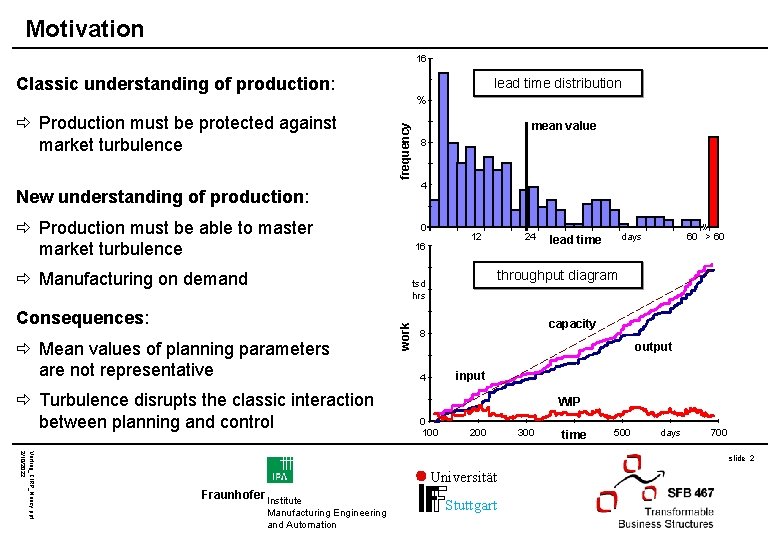
Motivation 16 Classic understanding of production: lead time distribution ð Production must be protected against market turbulence frequency % 8 4 New understanding of production: ð Production must be able to master market turbulence ð Manufacturing on demand mean value 0 12 16 ð Turbulence disrupts the classic interaction between planning and control work ð Mean values of planning parameters are not representative days lead time 60 > 60 throughput diagram tsd hrs Consequences: 24 capacity 8 output input 4 WIP 0 100 200 300 time 500 days 700 2/10/2022 Vortrag_CIRP_Nancy. ppt slide 2 Universität Fraunhofer Institute Manufacturing Engineering and Automation Stuttgart
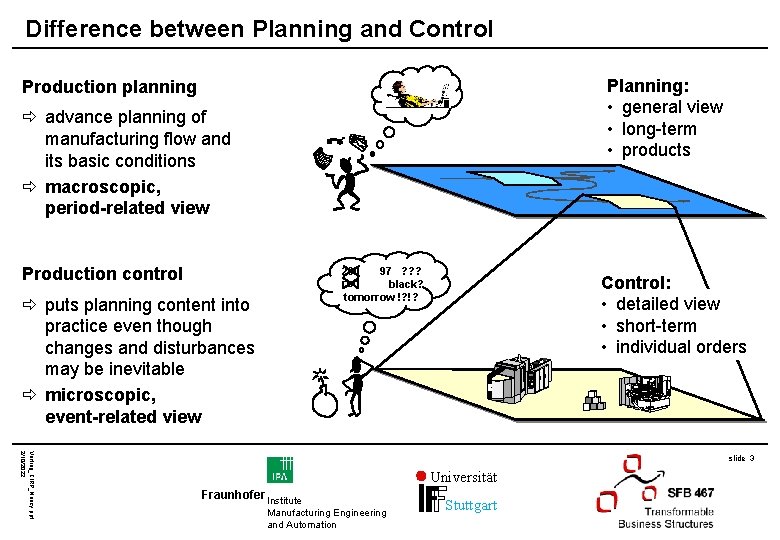
Difference between Planning and Control Planning: • general view • long-term • products Production planning ð advance planning of manufacturing flow and its basic conditions ð macroscopic, period-related view Production control 97 ? ? ? 200 red black? tomorrow !? !? ð puts planning content into practice even though changes and disturbances may be inevitable ð microscopic, event-related view Control: • detailed view • short-term • individual orders 2/10/2022 Vortrag_CIRP_Nancy. ppt slide 3 Universität Fraunhofer Institute Manufacturing Engineering and Automation Stuttgart
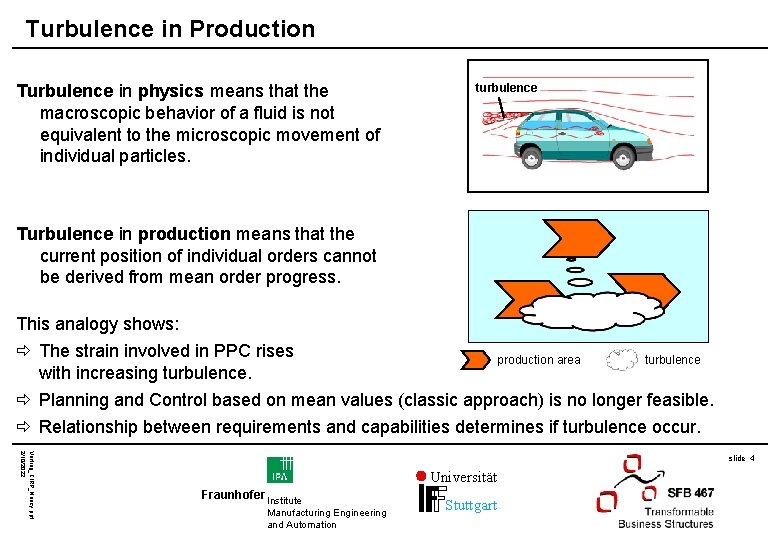
Turbulence in Production Turbulence in physics means that the macroscopic behavior of a fluid is not equivalent to the microscopic movement of individual particles. turbulence Turbulence in production means that the current position of individual orders cannot be derived from mean order progress. This analogy shows: ð The strain involved in PPC rises production area turbulence with increasing turbulence. ð Planning and Control based on mean values (classic approach) is no longer feasible. ð Relationship between requirements and capabilities determines if turbulence occur. 2/10/2022 Vortrag_CIRP_Nancy. ppt slide 4 Universität Fraunhofer Institute Manufacturing Engineering and Automation Stuttgart
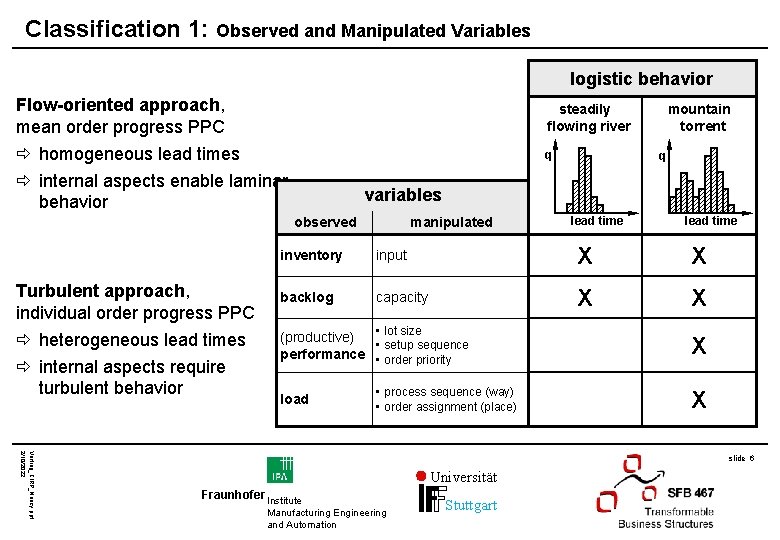
Classification 1: Observed and Manipulated Variables logistic behavior Flow-oriented approach, mean order progress PPC ð homogeneous lead times steadily flowing river q ð internal aspects enable laminar behavior ð internal aspects require turbulent behavior q variables observed Turbulent approach, individual order progress PPC ð heterogeneous lead times mountain torrent manipulated lead time inventory input X X backlog capacity X X • lot size (productive) • setup sequence performance • order priority load • process sequence (way) • order assignment (place) X X 2/10/2022 Vortrag_CIRP_Nancy. ppt slide 6 Universität Fraunhofer Institute Manufacturing Engineering and Automation Stuttgart
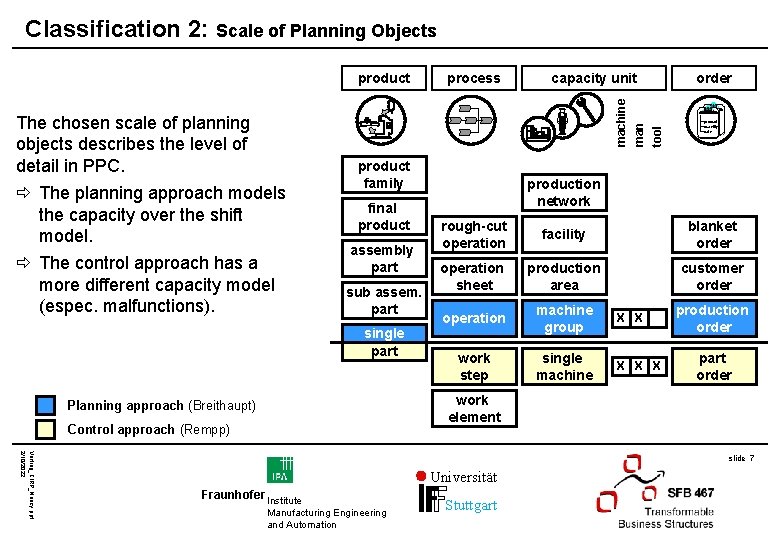
Classification 2: Scale of Planning Objects process capacity unit machine man tool product The chosen scale of planning objects describes the level of detail in PPC. ð The planning approach models the capacity over the shift model. ð The control approach has a more different capacity model (espec. malfunctions). product family final product assembly part sub assem. part single part order product quantity date production network rough-cut operation facility blanket order operation sheet production area customer order operation machine group X X work step single machine X X X production order part order work element Planning approach (Breithaupt) Control approach (Rempp) 2/10/2022 Vortrag_CIRP_Nancy. ppt slide 7 Universität Fraunhofer Institute Manufacturing Engineering and Automation Stuttgart
- Slides: 6