
50 Using a Punnett Square Vocabulary 1 2
#50 Using a Punnett Square
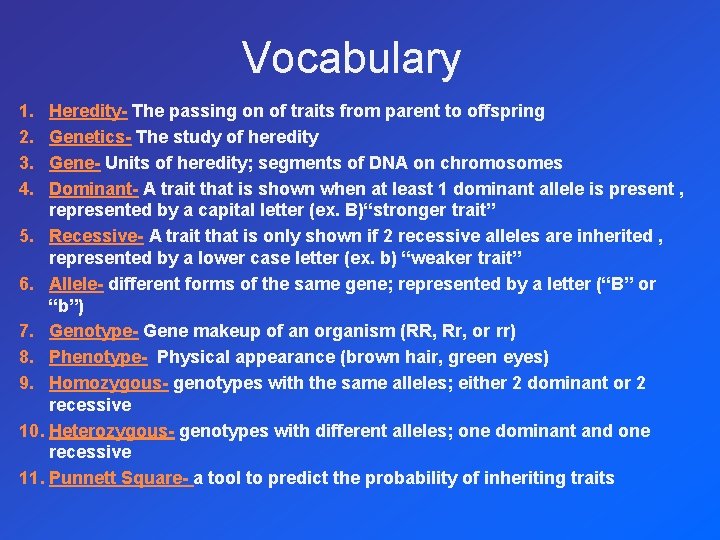
Vocabulary 1. 2. 3. 4. Heredity- The passing on of traits from parent to offspring Genetics- The study of heredity Gene- Units of heredity; segments of DNA on chromosomes Dominant- A trait that is shown when at least 1 dominant allele is present , represented by a capital letter (ex. B)“stronger trait” 5. Recessive- A trait that is only shown if 2 recessive alleles are inherited , represented by a lower case letter (ex. b) “weaker trait” 6. Allele- different forms of the same gene; represented by a letter (“B” or “b”) 7. Genotype- Gene makeup of an organism (RR, Rr, or rr) 8. Phenotype- Physical appearance (brown hair, green eyes) 9. Homozygous- genotypes with the same alleles; either 2 dominant or 2 recessive 10. Heterozygous- genotypes with different alleles; one dominant and one recessive 11. Punnett Square- a tool to predict the probability of inheriting traits
What is a PUNNETT SQUARE? • A tool to predict the probability of certain traits in offspring that shows the different ways the alleles of each genotype can combine • A way to show possible phenotypes & genotypes
What is a PUNNETT SQUARE? • Letters stand for dominant and recessive alleles – An uppercase letter stands for a dominant allele – Lowercase letters stand for recessive alleles
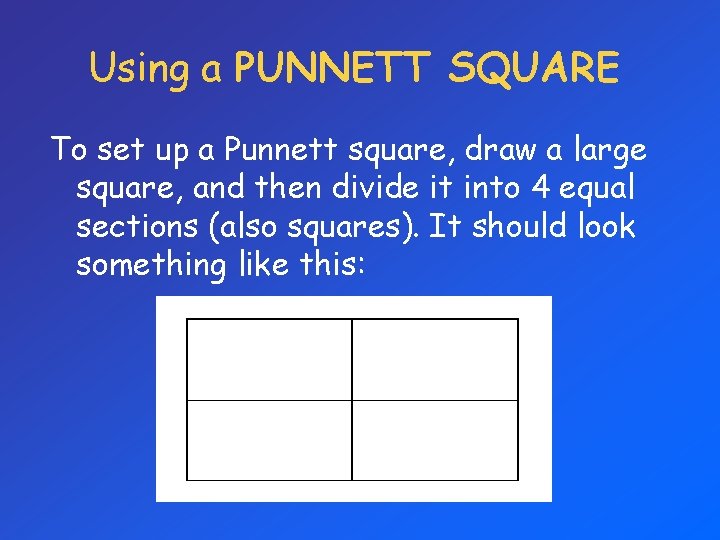
Using a PUNNETT SQUARE To set up a Punnett square, draw a large square, and then divide it into 4 equal sections (also squares). It should look something like this:
Using a PUNNETT SQUARE Now you need two parents to mate, ones with a known genotype For example, a red flower (genotype Rr) and a white flower (genotype rr). Rr x rr
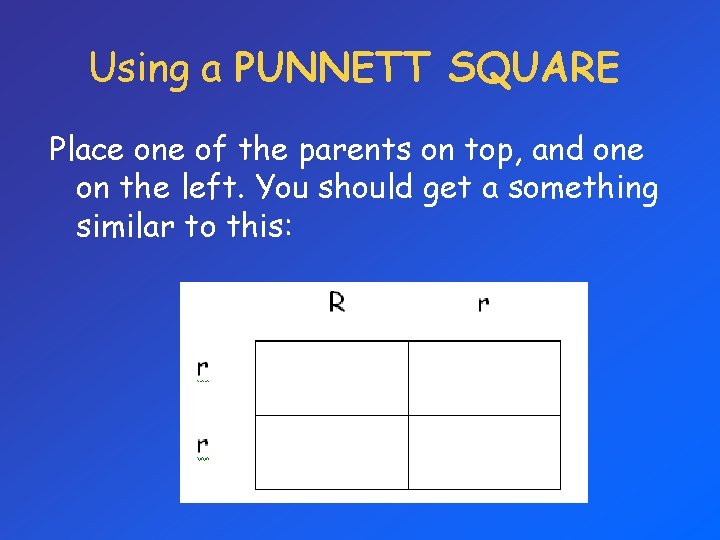
Using a PUNNETT SQUARE Place one of the parents on top, and one on the left. You should get a something similar to this:
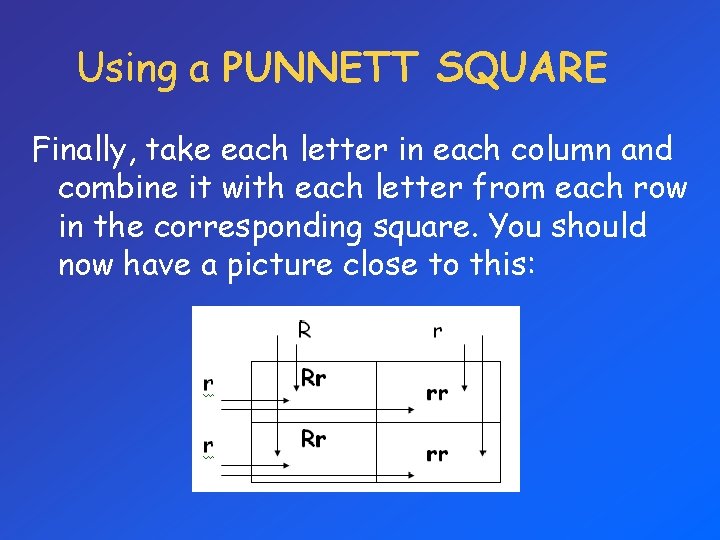
Using a PUNNETT SQUARE Finally, take each letter in each column and combine it with each letter from each row in the corresponding square. You should now have a picture close to this:
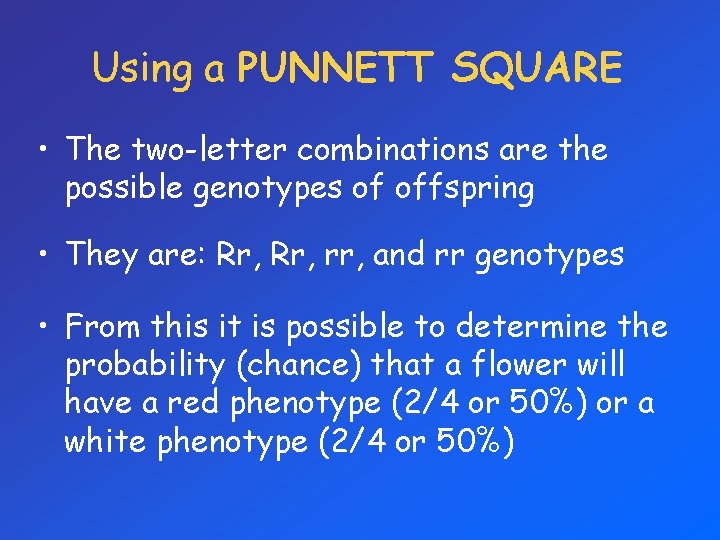
Using a PUNNETT SQUARE • The two-letter combinations are the possible genotypes of offspring • They are: Rr, rr, and rr genotypes • From this it is possible to determine the probability (chance) that a flower will have a red phenotype (2/4 or 50%) or a white phenotype (2/4 or 50%)
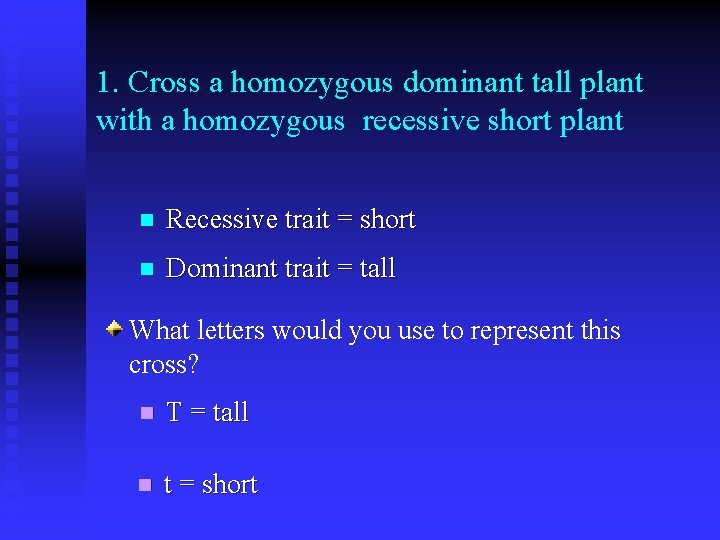
1. Cross a homozygous dominant tall plant with a homozygous recessive short plant n Recessive trait = short n Dominant trait = tall What letters would you use to represent this cross? n T = tall n t = short
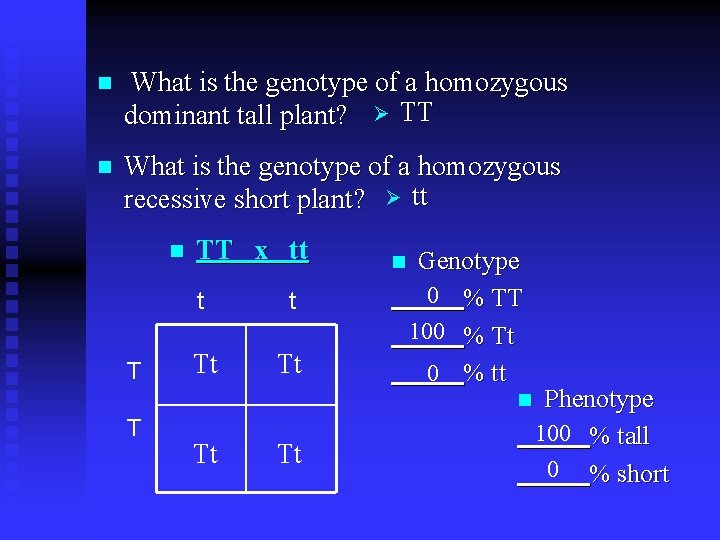
n What is the genotype of a homozygous dominant tall plant? Ø TT n What is the genotype of a homozygous recessive short plant? Ø tt n T TT x tt t t Tt Tt n Genotype 0 % TT 100 % Tt 0 % tt n T Tt Tt Phenotype 100 % tall 0 % short

#2. Cross a heterozygous brown haired rabbit with a homozygous recessive white haired rabbit. n Dominant trait = brown hair n Recessive trait = white hair o What letters would you use to represent this cross? n B = brown n b = white
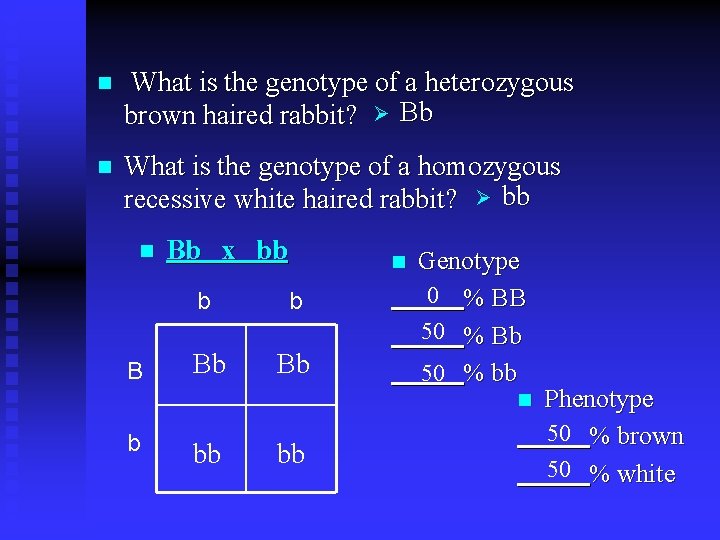
n What is the genotype of a heterozygous brown haired rabbit? Ø Bb n What is the genotype of a homozygous recessive white haired rabbit? Ø bb n B Bb x bb n b b Bb Bb Genotype 0 % BB 50 % Bb 50 % bb n b bb bb Phenotype 50 % brown 50 % white
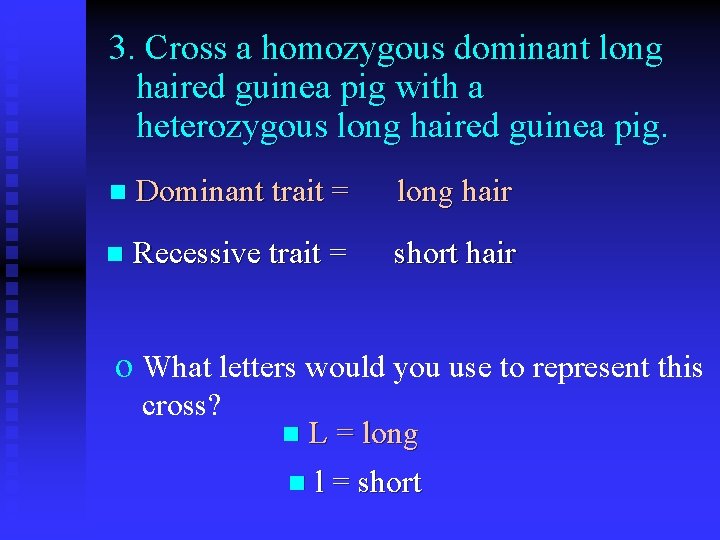
3. Cross a homozygous dominant long haired guinea pig with a heterozygous long haired guinea pig. n Dominant trait = long hair n Recessive trait = short hair o What letters would you use to represent this cross? L = long n l = short n
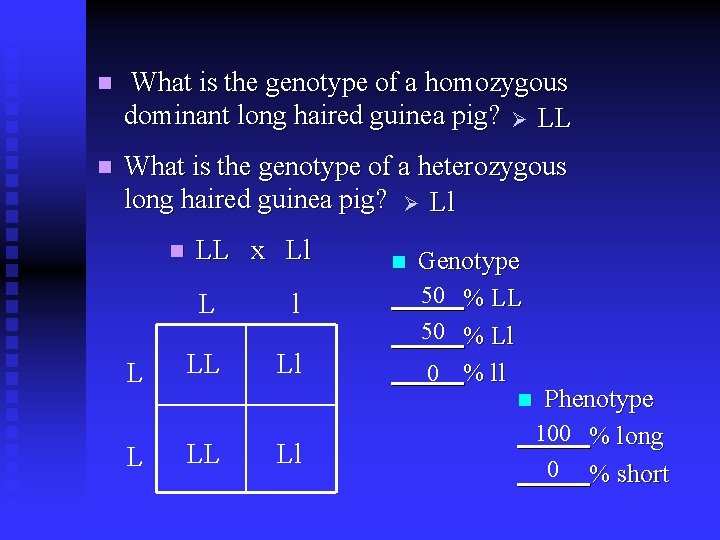
n What is the genotype of a homozygous dominant long haired guinea pig? Ø LL n What is the genotype of a heterozygous long haired guinea pig? Ø Ll n L LL x Ll L l LL Ll n Genotype 50 % LL 50 % Ll 0 % ll n L LL Ll Phenotype 100 % long 0 % short
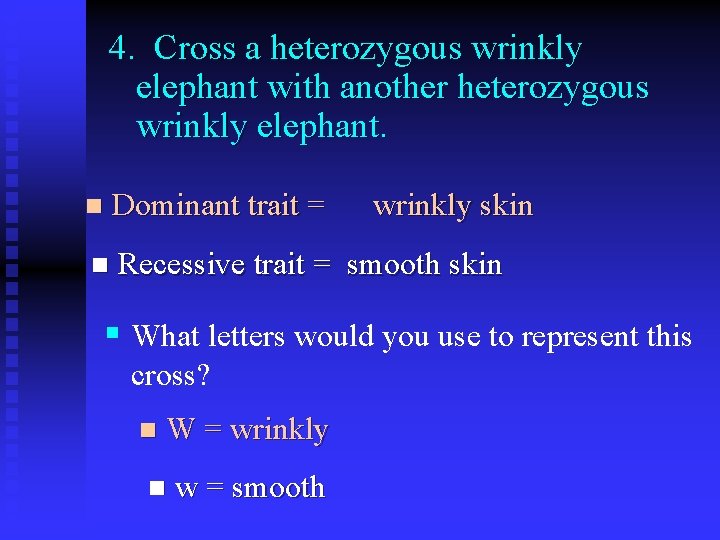
4. Cross a heterozygous wrinkly elephant with another heterozygous wrinkly elephant. n Dominant trait = wrinkly skin n Recessive trait = smooth skin § What letters would you use to represent this cross? n W = wrinkly n w = smooth
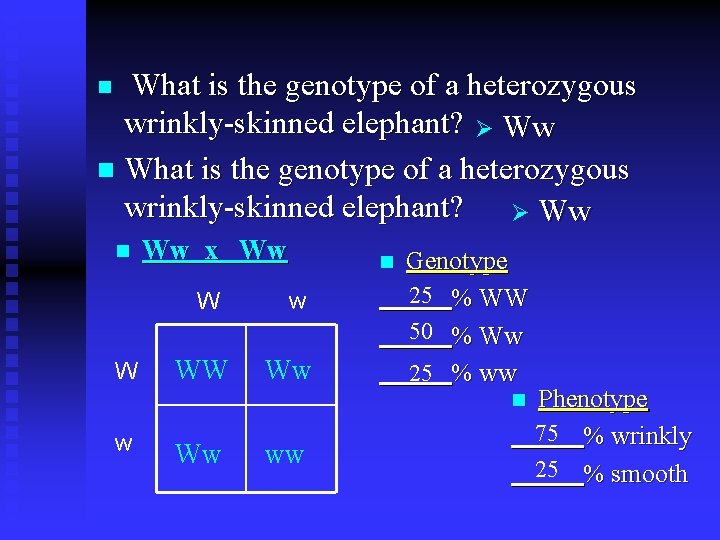
What is the genotype of a heterozygous wrinkly-skinned elephant? Ø Ww n n Ww x Ww W W WW n w Ww Genotype 25 % WW 50 % Ww 25 % ww n w Ww ww Phenotype 75 % wrinkly 25 % smooth
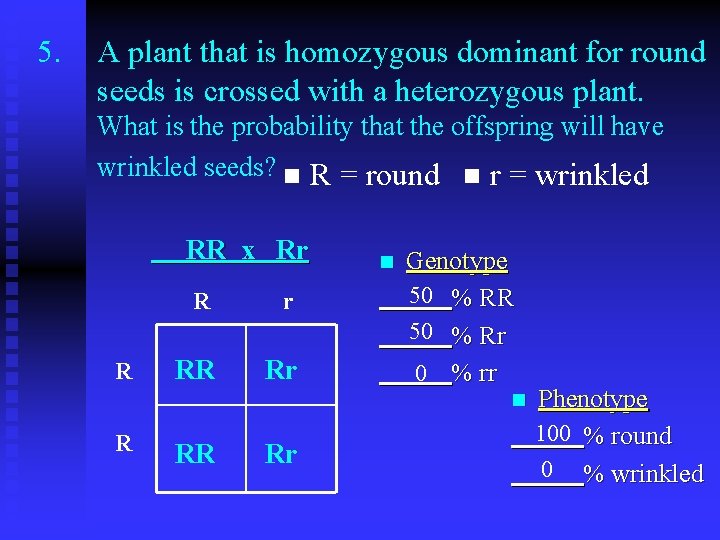
5. A plant that is homozygous dominant for round seeds is crossed with a heterozygous plant. What is the probability that the offspring will have wrinkled seeds? n R = round n r = wrinkled RR x Rr R R r RR Rr n Genotype 50 % RR 50 % Rr 0 % rr n R RR Rr Phenotype 100 % round 0 % wrinkled
- Slides: 18