
5 Things Time does to your Data Using

- Slides: 31
5 Things Time does to your Data. Using Data Governance to Avoid Truth Decay
The Data • • • What is time? Time is a dimension. We know the past exists (we have shared memories and records) We assume based on past experiences that there is a future We know based on observation that for some their future “ceased” Everything is subject to the effects of time. 1. Data Decay (Data rots and contaminates good data) 2. Latency (Data can arrive too late causing issues) 3. Data in the minds of people (blocking new ways of Data Management) 4. Data Management Maturity (evolving with ageing data & systems) 5. Truth and Changing Meta-data 2
Data Decay • All Data has a decay rate, each data asset decays due to forces beyond our view. • Assess the forces changing the truth of your data as it relates to the real world around you (but do not change history, rather process a contra entry. ) • Test and quality-spot-check to find decayed data quickly, because decayed data corrupts good data – you lose trust, even in the good data around it • Takeaways from the Analogy of A Supermarket. • (Data Decay is a constant threat) • All the items are different data assets • All the people are data stewards of the data • The customers are the users • https: //www. youtube. com/watch? v=Bx 0 ok. Llca. C 4 3
Key Take-Aways (Business-Guys) • Show every person in your company that they change the real world when they change the virtual world • Get Data Stewards to work with data, identify it, catalogue it, organize it and set “Use-by” and “Sell-by” Dates for your Internal and external customers • Create a culture of hygiene and effective management of quality, taking decaying data out of circulation 4
Experiences: Latency https: //www. youtube. com/watch? v=Nma 5 Of. NREx. E 5
Latency • Latency: Who should have the better response time? • You / Your Customer? • https: //www. youtube. com/watch? v=Nma 5 Of. NREx. E • Use a cloud that is based closer to those who need the best response times. • Use friendly Customers: Ask them to do a spot test of your latency: Click> Start Button > Run > “CMD” > “Tracert <<Your website>>” • Add Up all the milliseconds through all the hops it took to get there. • The ideal is less than 200 ms “Blazing Fast” = a total of 10 ms. 6
Key Take-Aways (Tech-Guys) • Don’t make it fast – get the timing and hand-offs right to reduce overflow and lost records • Get a Cloud (physical installation) close to your clients to minimise Network Latency • Have your friendly clients run Trace Route from time to time 7
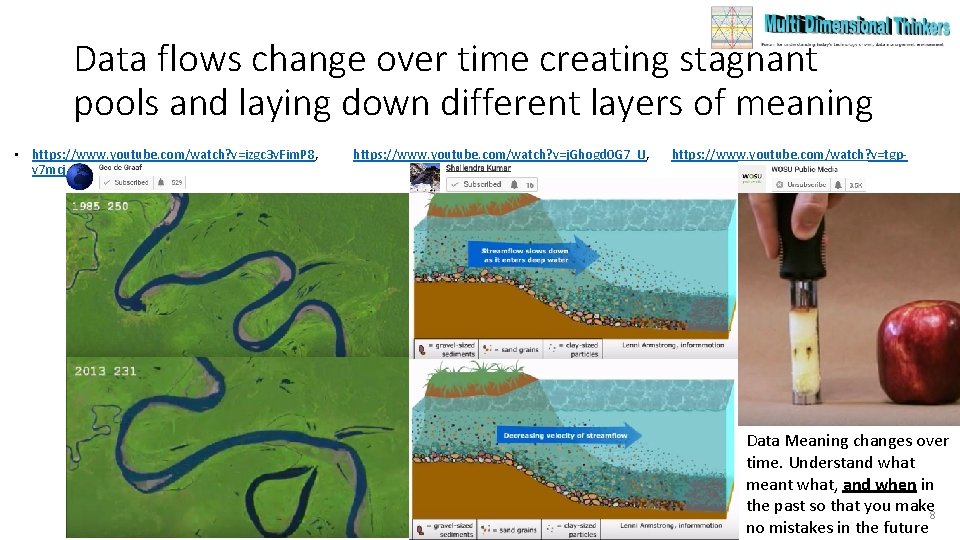
Data flows change over time creating stagnant pools and laying down different layers of meaning • https: //www. youtube. com/watch? v=izgc 3 v. Fim. P 8, v 7 mcj. FM https: //www. youtube. com/watch? v=j. Ghogd 0 G 7_U, https: //www. youtube. com/watch? v=tgp- Data Meaning changes over time. Understand what meant what, and when in the past so that you make 8 no mistakes in the future
Key Take-Aways (Data-Guys) • Data Meaning changes over time, Document the history of the Business and the history of your Data flows. • Data can settle in your database after ingestion and contaminate your good data that flows, archive based on significant historical events • Ensure Data Queries draw data based on times when meanings are consistent to the data-request intention 9
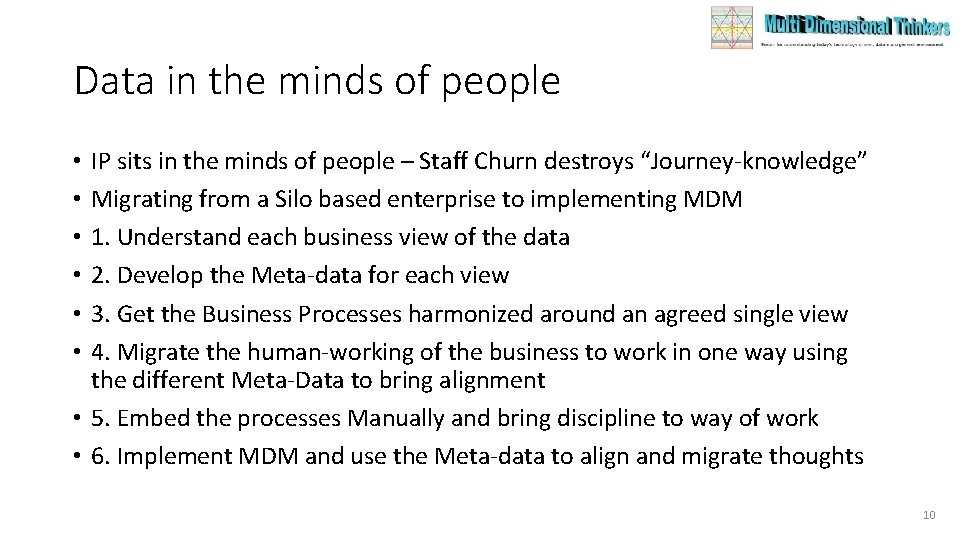
Data in the minds of people IP sits in the minds of people – Staff Churn destroys “Journey-knowledge” Migrating from a Silo based enterprise to implementing MDM 1. Understand each business view of the data 2. Develop the Meta-data for each view 3. Get the Business Processes harmonized around an agreed single view 4. Migrate the human-working of the business to work in one way using the different Meta-Data to bring alignment • 5. Embed the processes Manually and bring discipline to way of work • 6. Implement MDM and use the Meta-data to align and migrate thoughts • • • 10
Acquisitions and mergers (and Backwards Compatibility) • The Data restored has different formats to what the system has been changed to now. • • • Different/Changed meanings of terms and definitions Different/Changed standards and protocols Decisions made based on previously existing policies, legislation, procedures Procedures that catered for data quality anomalies Field length, Special character use, permitted file sizes, readable file types. • Insist on a full historical explanation of the IT Estate, and what was bought and used and integrated into what at what time. • Understand the history of the changing data flows … because all that data is “living” in time-layers in your Data-Stores 11
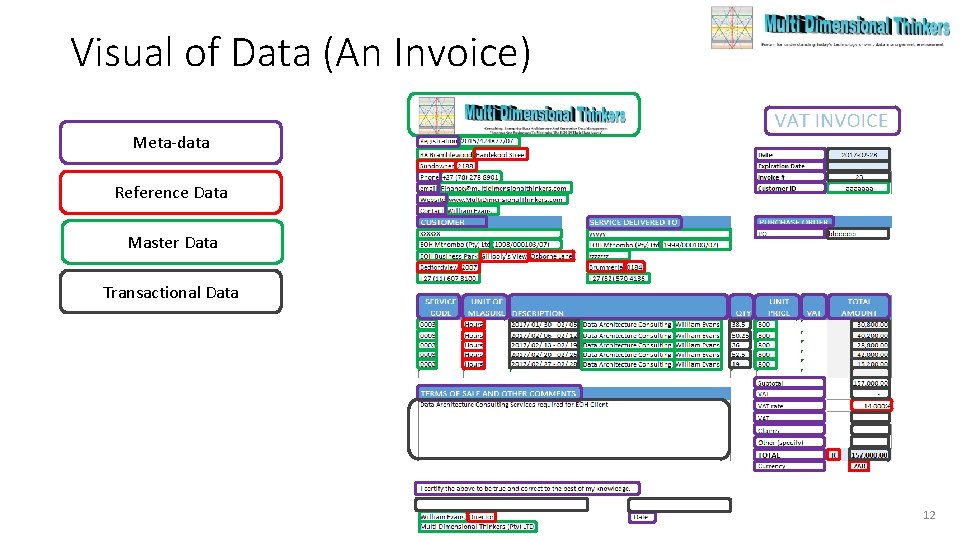
Visual of Data (An Invoice) Meta-data Reference Data Master Data Transactional Data 12
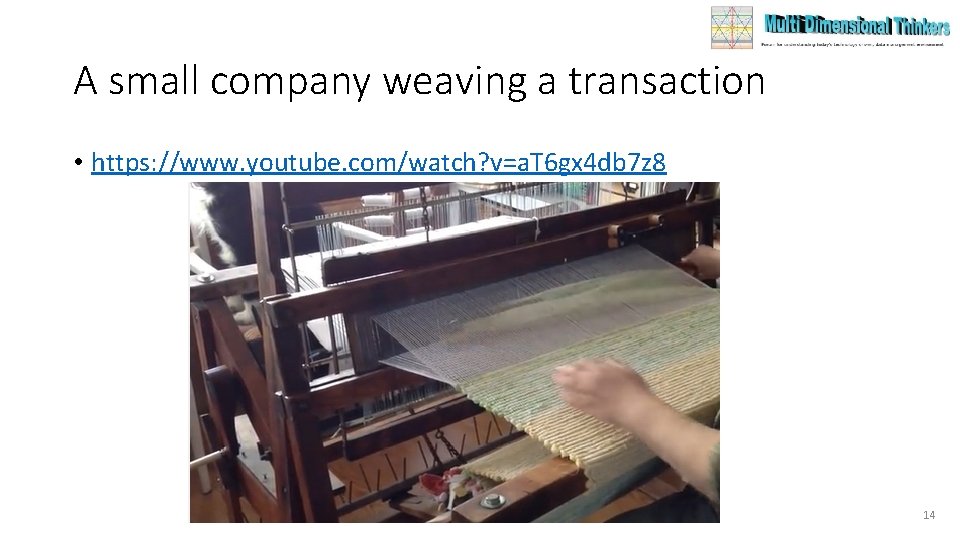
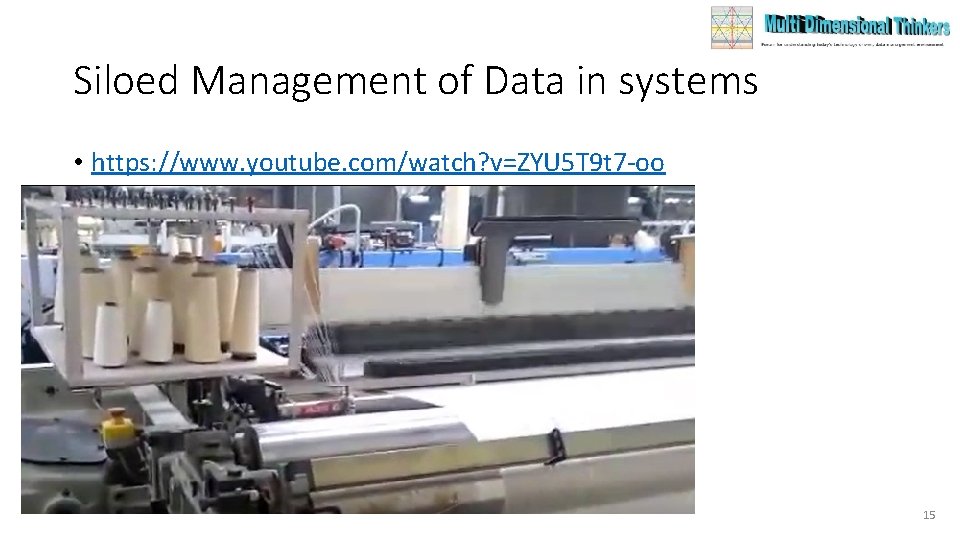
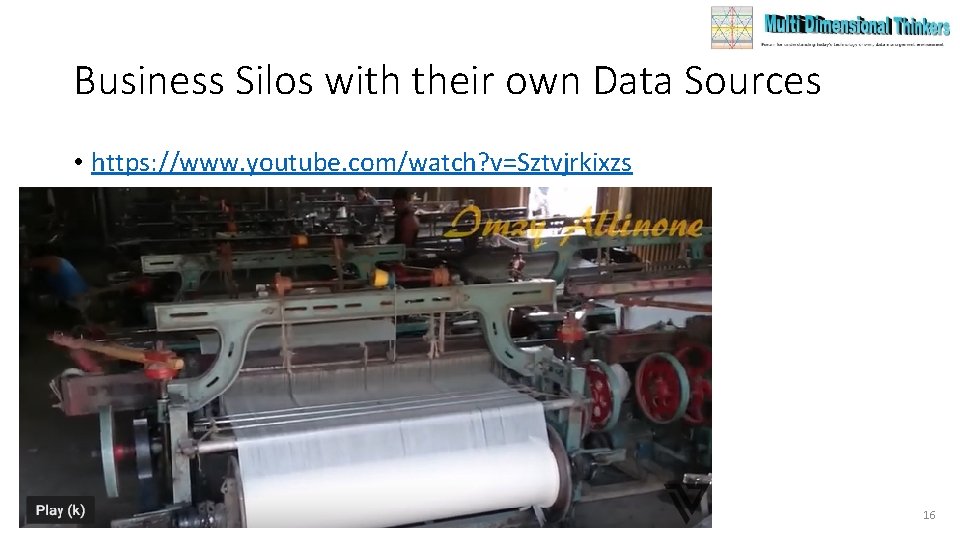
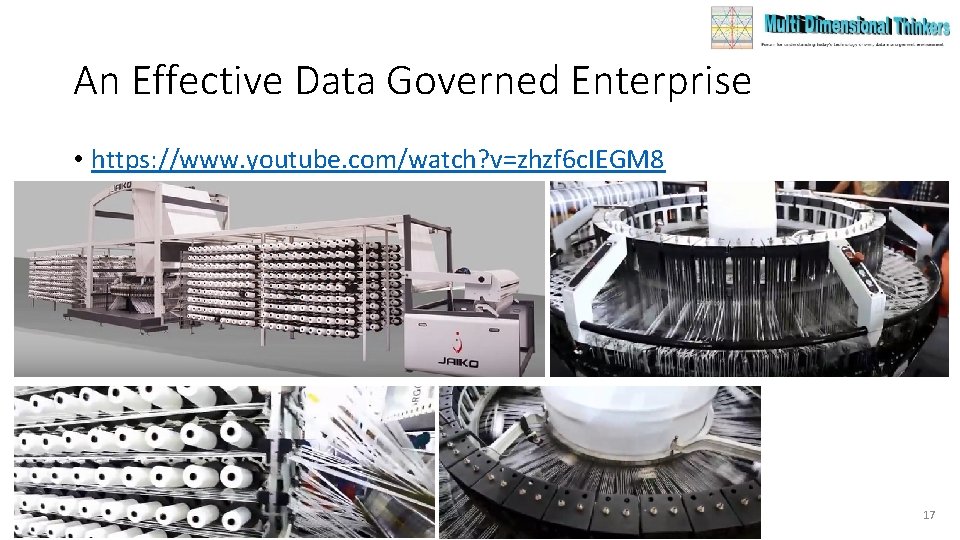
Analogy: When weaving a carpet, there are 3 different threads. Each thread is a data attribute. Each millimetre of thread is instantiated data of the attribute of that thread. • Here is a simple explanation of Data Functioning in an Enterprise • Discuss The analogy and the types of Data 13
A small company weaving a transaction • https: //www. youtube. com/watch? v=a. T 6 gx 4 db 7 z 8 14
Siloed Management of Data in systems • https: //www. youtube. com/watch? v=ZYU 5 T 9 t 7 -oo 15
Business Silos with their own Data Sources • https: //www. youtube. com/watch? v=Sztvjrkixzs 16
An Effective Data Governed Enterprise • https: //www. youtube. com/watch? v=zhzf 6 c. IEGM 8 17
Key Take-Aways (Exec-Guys) • You have to change your Business Structure to leverage effective Data Management • You have to educate your staff to be able to work with one structure of a data object (ideally through one process) when implementing a single, simplified Technology Solution • CFO : CEO : CDO Discussion: • CEO - Q: Which is more important, my money or my data? • CFO - A: Your Money! – It is like water, without it the Business will die. • CDO - A: Your Data! – It tells you if you have money and where it is. (amongst other things) • Data is like air: • Today, Business dies a lot faster if you don’t have data than if you don’t have money. 18
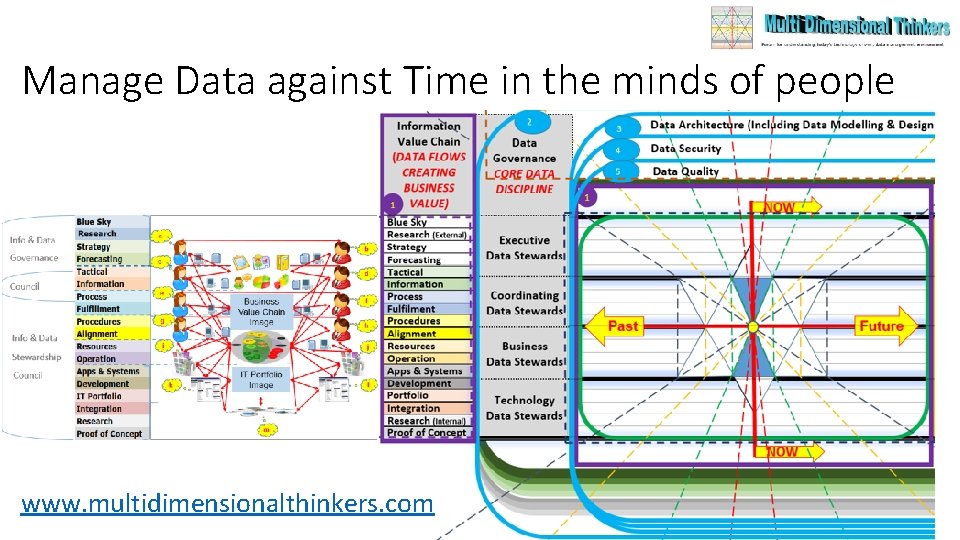
Traditional Thinking vs Time Centered Thinking • Traditional Thinking: • - We add a date attribute to something we are doing … sometimes • • Time Centered Thinking: - We determine Assets of the Enterprise based on Time Cycles - We use the Information Value Chain (IVC) to align the Enterprise to time - We add Attributes to the time line, instead of time to the attributes - We document the history of our assets against the same time line - We map the Data flows and show historical data flows - We map all these against the two triangles of: • Enterprise Architecture (traditional apex-up-triangle mapped against IVC) and • Service Oriented Architecture (apex-down mapped against IVC) 19
Manage Data against Time in the minds of people www. multidimensionalthinkers. com 20
The best Data Manager, will be the person who is … a good Gardener. https: //www. youtube. com/watch? v=1 e 0 NDruy. U 0 U Time impact and cycles and windows of opportunity in a Garden must be paid attention to. The Gold Analogy does not really work anymore, because gold does not decay, However, all data is fluid and subject to time, much like a garden. You can only pick and use the roses in a certain window of opportunity. 21
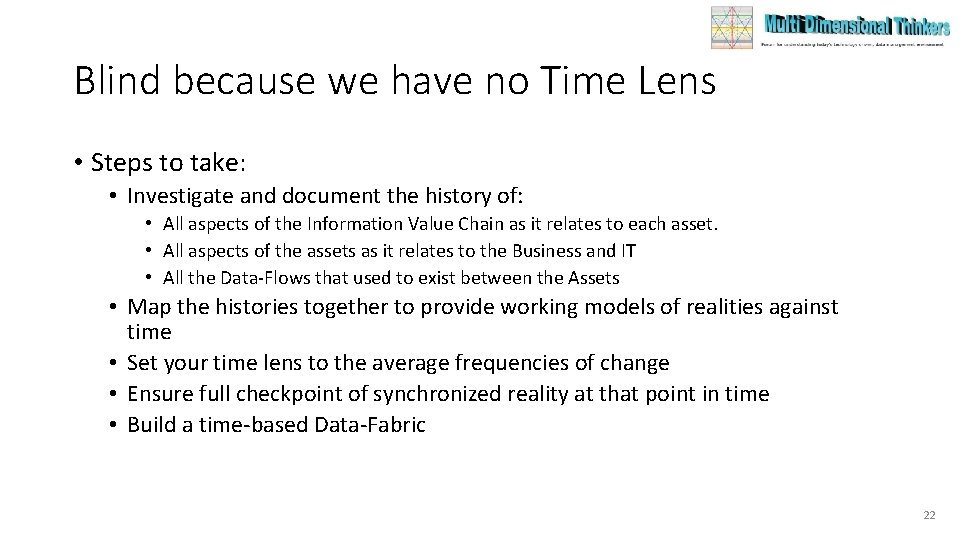
Blind because we have no Time Lens • Steps to take: • Investigate and document the history of: • All aspects of the Information Value Chain as it relates to each asset. • All aspects of the assets as it relates to the Business and IT • All the Data-Flows that used to exist between the Assets • Map the histories together to provide working models of realities against time • Set your time lens to the average frequencies of change • Ensure full checkpoint of synchronized reality at that point in time • Build a time-based Data-Fabric 22
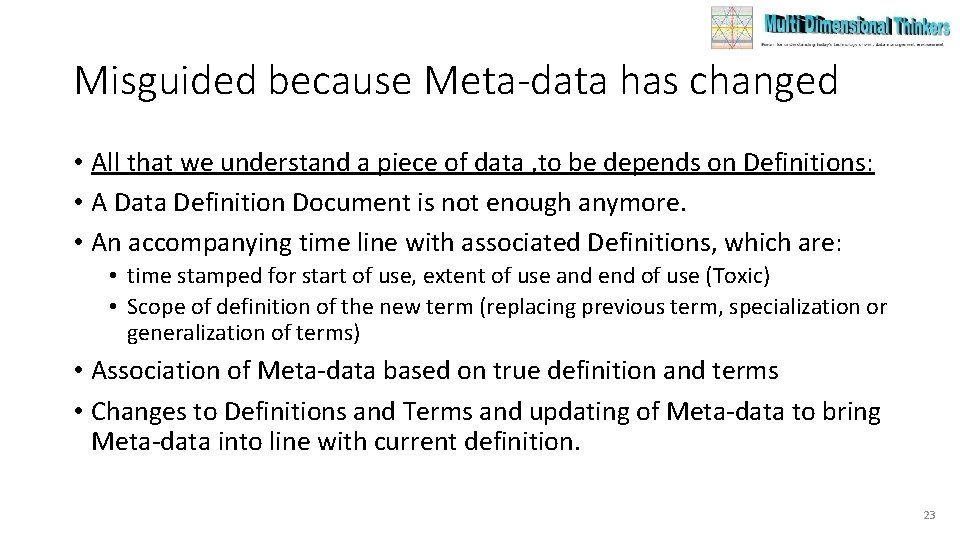
Misguided because Meta-data has changed • All that we understand a piece of data , to be depends on Definitions: • A Data Definition Document is not enough anymore. • An accompanying time line with associated Definitions, which are: • time stamped for start of use, extent of use and end of use (Toxic) • Scope of definition of the new term (replacing previous term, specialization or generalization of terms) • Association of Meta-data based on true definition and terms • Changes to Definitions and Terms and updating of Meta-data to bring Meta-data into line with current definition. 23
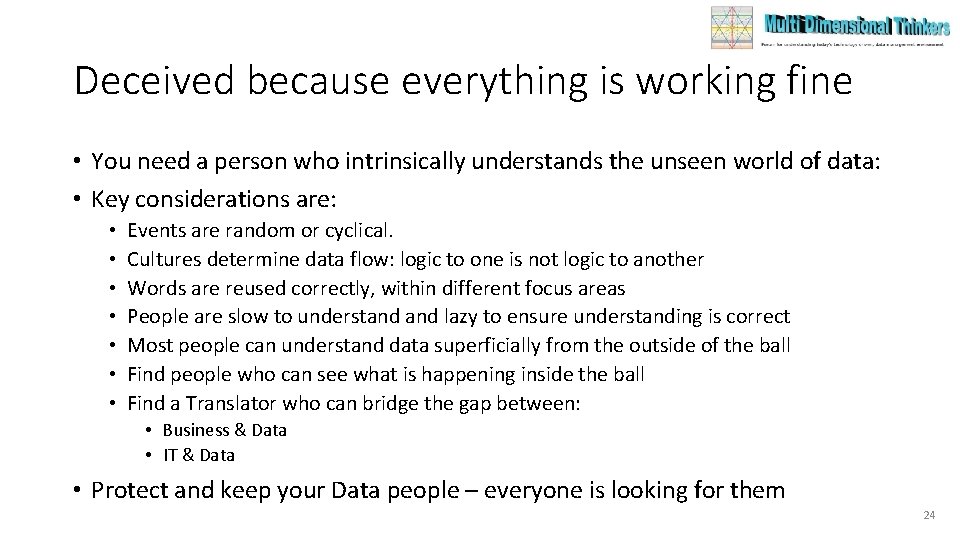
Deceived because everything is working fine • You need a person who intrinsically understands the unseen world of data: • Key considerations are: • • Events are random or cyclical. Cultures determine data flow: logic to one is not logic to another Words are reused correctly, within different focus areas People are slow to understand lazy to ensure understanding is correct Most people can understand data superficially from the outside of the ball Find people who can see what is happening inside the ball Find a Translator who can bridge the gap between: • Business & Data • IT & Data • Protect and keep your Data people – everyone is looking for them 24
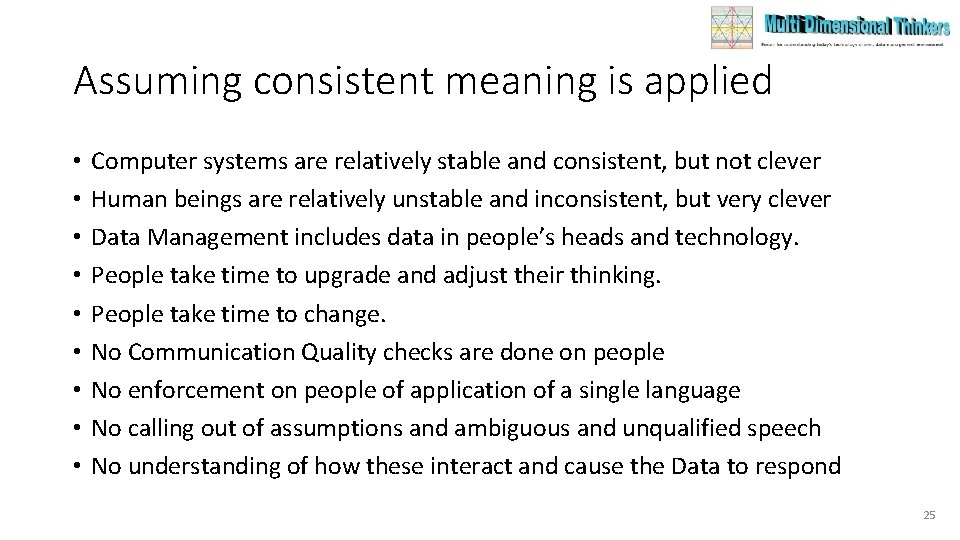
Assuming consistent meaning is applied • • • Computer systems are relatively stable and consistent, but not clever Human beings are relatively unstable and inconsistent, but very clever Data Management includes data in people’s heads and technology. People take time to upgrade and adjust their thinking. People take time to change. No Communication Quality checks are done on people No enforcement on people of application of a single language No calling out of assumptions and ambiguous and unqualified speech No understanding of how these interact and cause the Data to respond 25
Incorrect Identification due to seasonal effect • • • At different times we interact with others with different definitions We have events which happen once but their effect is cyclical We receive data from other sources with different sanitization dates We issue data to recipients where we must change terms for their use We have to merge data from different sources which have different cycle times The Volume of the data may increase/decrease data quality Some data only appears at certain moments in a cycle Some data may appear once off, never to appear again All Data must be used and provided ensuring Truth decay is provided. 26
Unintended Consequences due to no insight • Removing data, causes data to move from high pressure areas to low • Changing data causes data to take add or lose properties • Data flow levels are seasonal, overuse can cause a loss of data in peak • People can behave irrationally reduced care = communication errors • Cause and effect should b documented and modelled and used • Whatever you do to the data will change something somewhere • Data is what we use to change our world. Data causes disruption • Stagnant data (not flowing) becomes toxic over time & deadly if used 27
Fatigue in Data Management Discipline • The KPIs and KPAs can create a poor data hygiene behavior • Seasonal, sickness and week-start/week-end proximity affect data • System age, overuse, & spaghetti programming cause data complexity • Managers with no insight into personnel triggers can cause fatigue • Poor understanding of how data works, and ebbs & flows around us • Insufficient agenda time discussing data related discipline • Expectation of additional role instead of effectiveness of current role • Data is always going out of date. Constant cleaning is mandatory 28
Assuming All Data is Accurate and Up-to-Date • When we provide data for a report we are complicit in the decision • All Data must be assured before providing it to Artificial Intelligence • Assure Data is correct with Data Quality metrics, measures and limits • Learn how to judge truth in your output before you give it to AI • All truth in your output must be measured against all forces of time • Understand how you respond to data, so that you can understand AI • Remember that to AI, you are just cold, hard data it can manipulate 29
Keep proof over time of Data Quality • You need to be able to manage your data over time and trend quality • You need to be able to motivate trust in your input quality • AI will blame you for poor Data Quality that it uses to make decisions • People are relatively slow. It is quite easy to catch an error • AI is very fast. Great damage can be done before you catch it • Get one AI to monitor the output of anther (segregation of duties) • Give yourself the job of Data Manager over the AI. • Use your gut instinct to stop a process. Instinct is faster than AI. • Figure out why you feel what you do then proceed 30
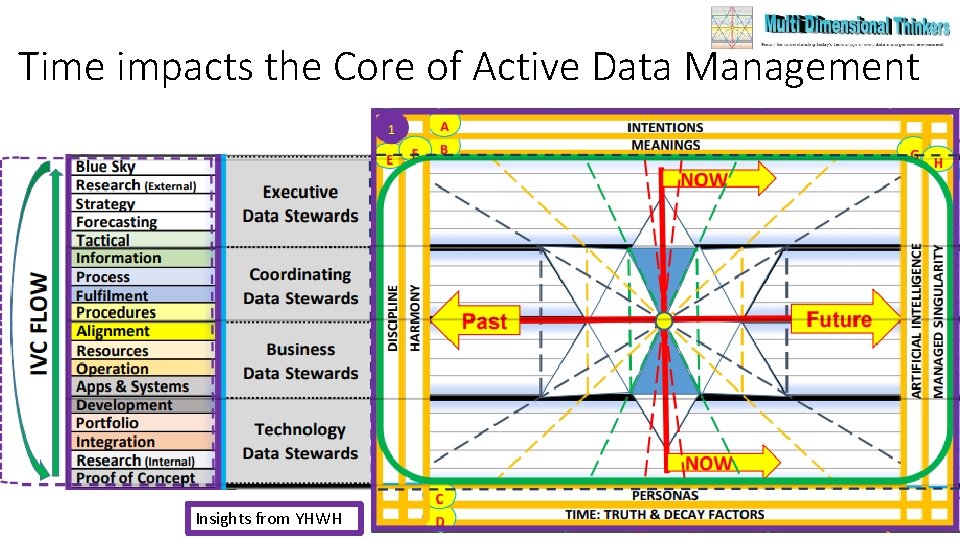
Time impacts the Core of Active Data Management Insights from YHWH 31