
5 The Cell Membrane A look at a
#5 The Cell Membrane A look at a critical regulating structure of all cells 12/27/2021

Movement Through A Membrane Foldable 1. Draw the cells shown here. 2. Indicate Plant or Animal Cell Predict the mass for your Carrot, potato, celery, or raisins 3. Draw 4 arrows ~ Water going in or ~ Water going out 4. Identify by name: ~ Hypertonic ~ Hypotonic ~ Isotonic 12/27/2021
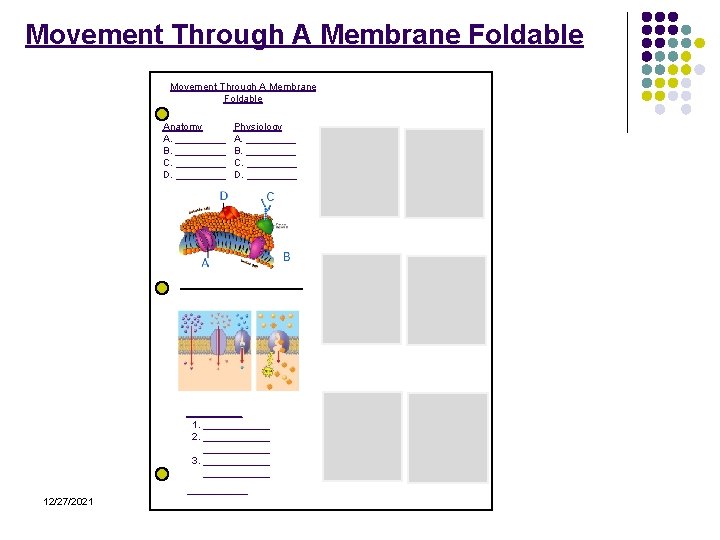
Movement Through A Membrane Foldable Anatomy A. _____ B. _____ C. _____ D. _____ Physiology A. _____ B. _____ C. _____ D. __________ 1. ______ 2. ____________ 3. ____________ 12/27/2021


Anatomy and Physiology A - Protein channel/pump B - Phospholipid Bilayer C - Carbohydrate chain D - Proteins 12/27/2021 A - move larger molecules thru B - structure, support, protect C - cell recognition D - structure, channel/pump
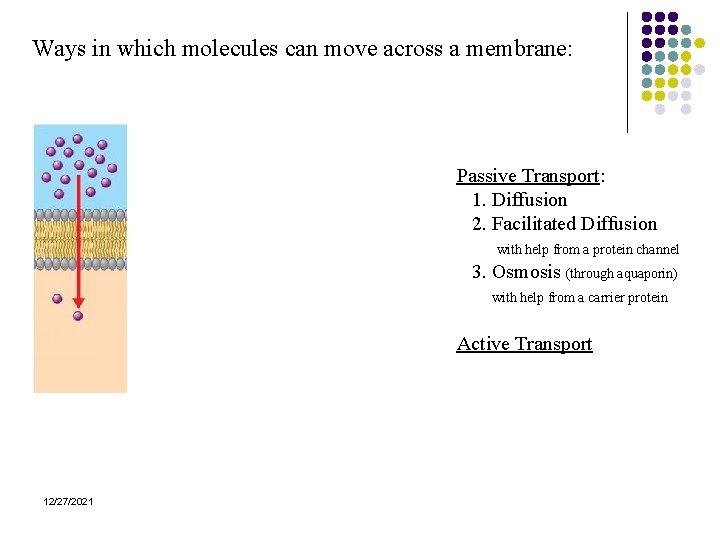
Ways in which molecules can move across a membrane: Passive Transport: 1. Diffusion 2. Facilitated Diffusion with help from a protein channel 3. Osmosis (through aquaporin) with help from a carrier protein Active Transport 12/27/2021
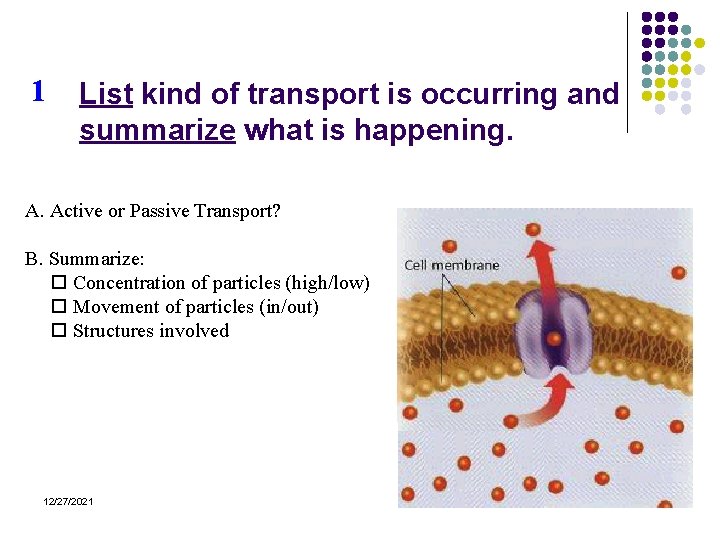
1 List kind of transport is occurring and summarize what is happening. A. Active or Passive Transport? B. Summarize: Concentration of particles (high/low) Movement of particles (in/out) Structures involved 12/27/2021
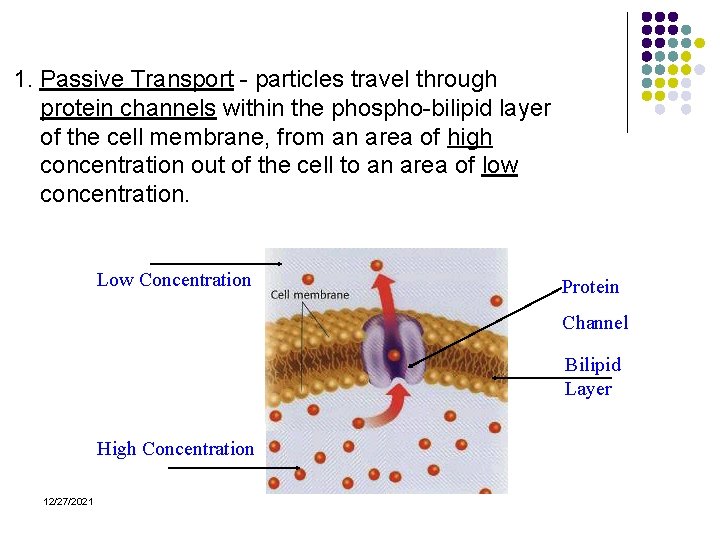
1. Passive Transport - particles travel through protein channels within the phospho-bilipid layer of the cell membrane, from an area of high concentration out of the cell to an area of low concentration. Low Concentration Protein Channel Bilipid Layer High Concentration 12/27/2021
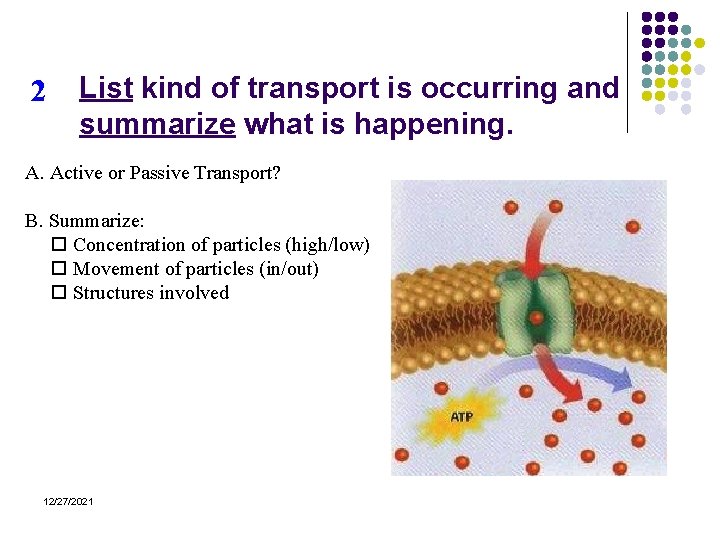
2 List kind of transport is occurring and summarize what is happening. A. Active or Passive Transport? B. Summarize: Concentration of particles (high/low) Movement of particles (in/out) Structures involved 12/27/2021
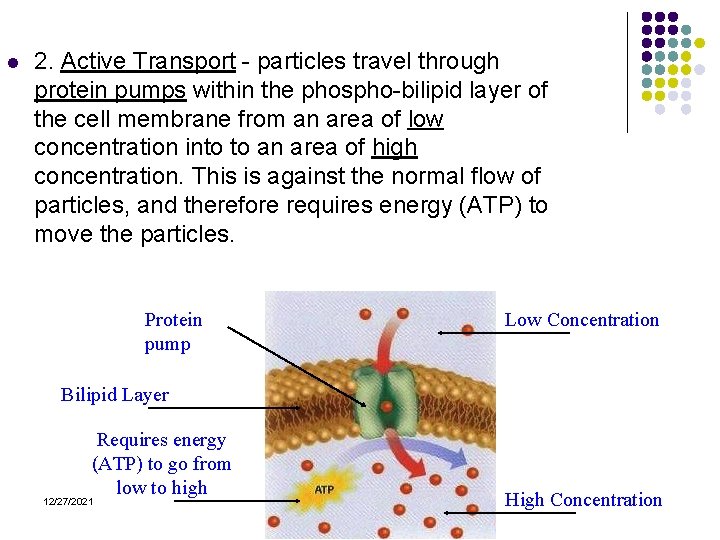
l 2. Active Transport - particles travel through protein pumps within the phospho-bilipid layer of the cell membrane from an area of low concentration into to an area of high concentration. This is against the normal flow of particles, and therefore requires energy (ATP) to move the particles. Protein pump Low Concentration Bilipid Layer Requires energy (ATP) to go from low to high 12/27/2021 High Concentration
1. Passive Transport A. What does passive mean here? B. What part of the cell membrane do the particles travel through? C. What direction do they move? From an area of ? To ? D. What are three types of passive transport? 2. Active Transport A. What does active mean here? B. What direction do the particles move with active transport? C. Is this the normal flow of particles? D. What is required for this to happen? (2) E. What is that called? 12/27/2021
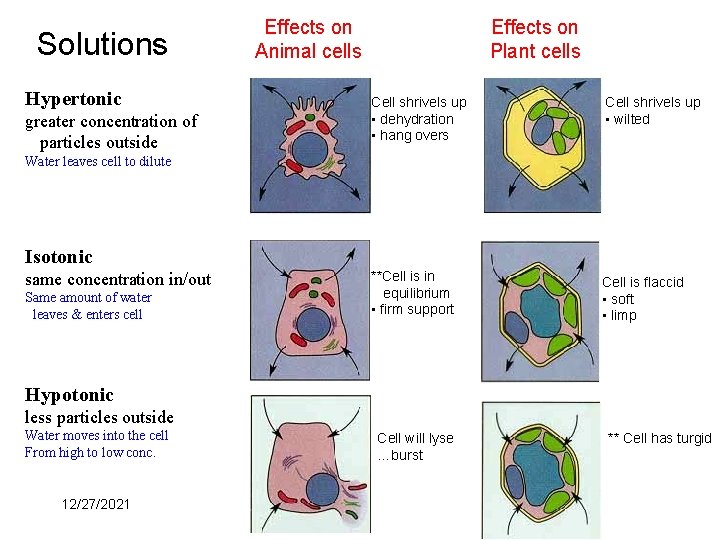
Solutions Hypertonic greater concentration of particles outside Effects on Animal cells Effects on Plant cells Cell shrivels up • dehydration • hang overs Cell shrivels up • wilted **Cell is in equilibrium • firm support Cell is flaccid • soft • limp Water leaves cell to dilute Isotonic same concentration in/out Same amount of water leaves & enters cell Hypotonic less particles outside Water moves into the cell From high to low conc. 12/27/2021 Cell will lyse …burst ** Cell has turgid
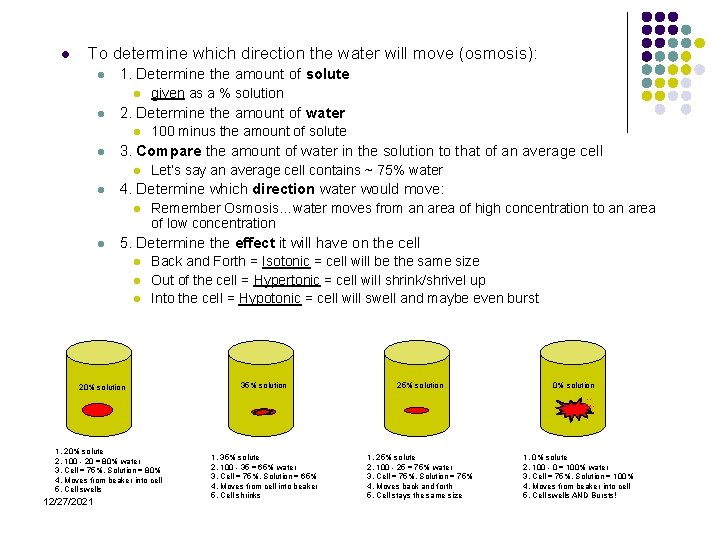
l To determine which direction the water will move (osmosis): l 1. Determine the amount of solute l l 2. Determine the amount of water l l Let’s say an average cell contains ~ 75% water 4. Determine which direction water would move: l l 100 minus the amount of solute 3. Compare the amount of water in the solution to that of an average cell l l given as a % solution Remember Osmosis…water moves from an area of high concentration to an area of low concentration 5. Determine the effect it will have on the cell l Back and Forth = Isotonic = cell will be the same size Out of the cell = Hypertonic = cell will shrink/shrivel up Into the cell = Hypotonic = cell will swell and maybe even burst 20% solution 1. 20% solute 2. 100 - 20 = 80% water 3. Cell = 75%, Solution = 80% 4. Moves from beaker into cell 5. Cell swells 12/27/2021 35% solution 25% solution 1. 35% solute 2. 100 - 35 = 65% water 3. Cell = 75%, Solution = 65% 4. Moves from cell into beaker 5. Cell shrinks 1. 25% solute 2. 100 - 25 = 75% water 3. Cell = 75%, Solution = 75% 4. Moves back and forth 5. Cell stays the same size 0% solution 1. 0% solute 2. 100 - 0 = 100% water 3. Cell = 75%, Solution = 100% 4. Moves from beaker into cell 5. Cell swells AND Bursts!
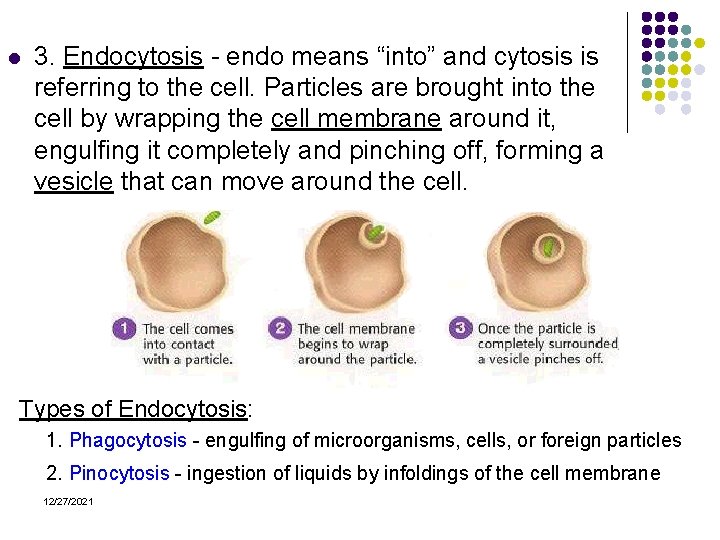
l 3. Endocytosis - endo means “into” and cytosis is referring to the cell. Particles are brought into the cell by wrapping the cell membrane around it, engulfing it completely and pinching off, forming a vesicle that can move around the cell. Types of Endocytosis: 1. Phagocytosis - engulfing of microorganisms, cells, or foreign particles 2. Pinocytosis - ingestion of liquids by infoldings of the cell membrane 12/27/2021
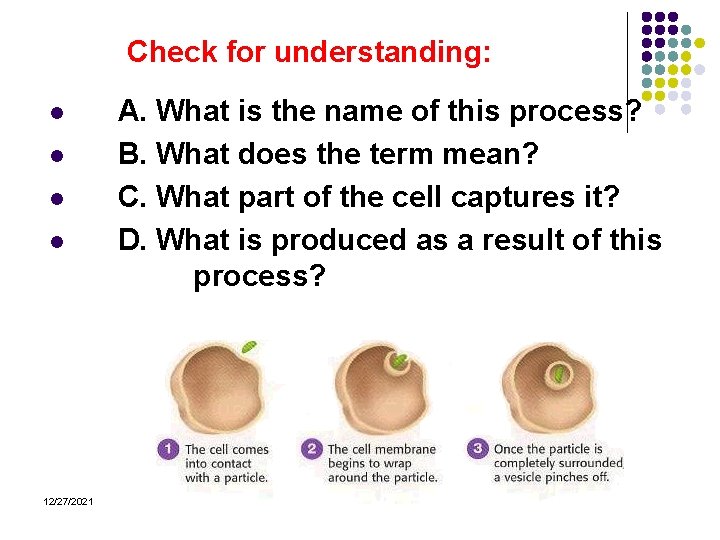
Check for understanding: l l 12/27/2021 A. What is the name of this process? B. What does the term mean? C. What part of the cell captures it? D. What is produced as a result of this process?
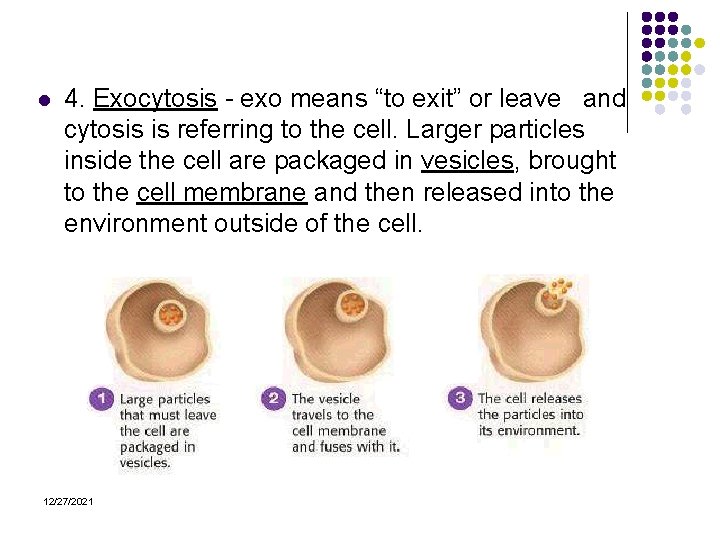
l 4. Exocytosis - exo means “to exit” or leave and cytosis is referring to the cell. Larger particles inside the cell are packaged in vesicles, brought to the cell membrane and then released into the environment outside of the cell. 12/27/2021
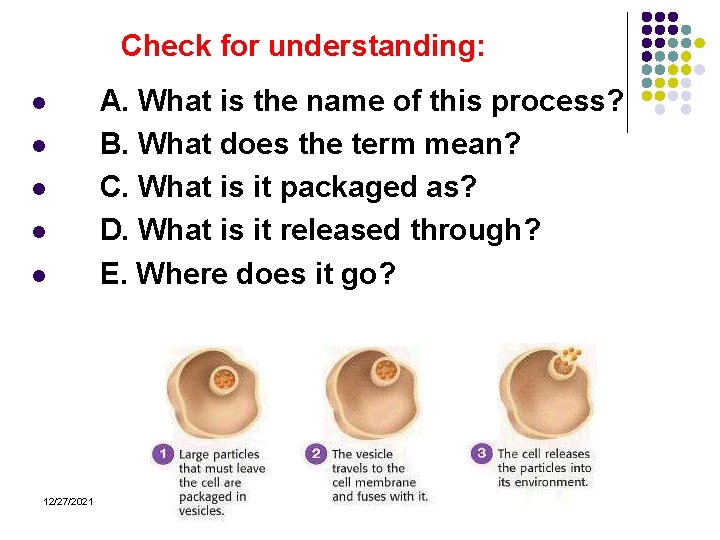
Check for understanding: l l l 12/27/2021 A. What is the name of this process? B. What does the term mean? C. What is it packaged as? D. What is it released through? E. Where does it go?
Relate and Apply 1. Why do people get a headache when they’re dehydrated or hung over? 2. What happened to the woman on the radio contest? Why? 3. Why do plants look wilted? 4. Why do restaurants/bars put out salty foods like chips, pretzels, salted nuts? 12/27/2021
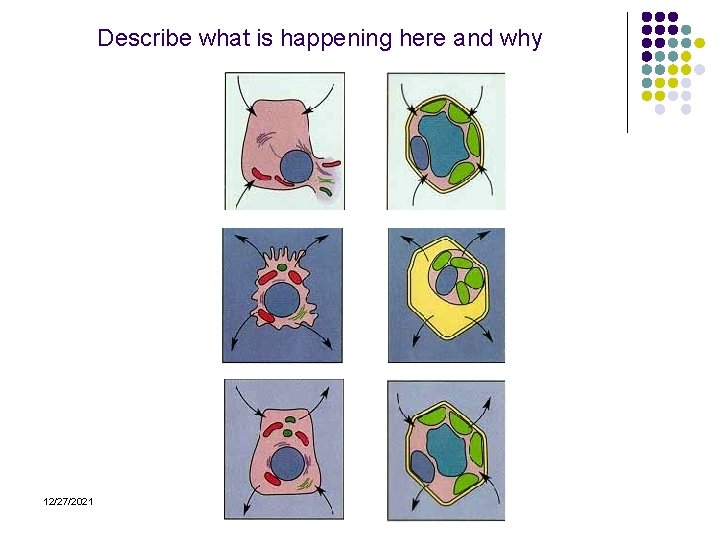
Describe what is happening here and why 12/27/2021
- Slides: 19