
5 Slides about Photoinduced Electron Transfer What is
5 Slides about: Photoinduced Electron Transfer What is PET How to calculate driving forces for PET Created Robert Holbrook and posted on VIPEr on July 17, 2014, Copyright 2014. This work is licensed under the Creative Commons Attribution-Non. Commercial-Share Alike License. To view a copy of this license visit http: //creativecommons. org/about/license/

Electronic excitation • When a photon excites a molecule, an electron in a ground state can be excited to a higher energy state • A Jablonski diagram illustrates the electronic states of a molecule and the transitions between them • Excited states of a molecule can undergo nonradiative and radiative transitions S 1 Intersystem crossing (ISC) T 1 Absorption hν S 0 Fluorescence hν Phosphorescence hν 2
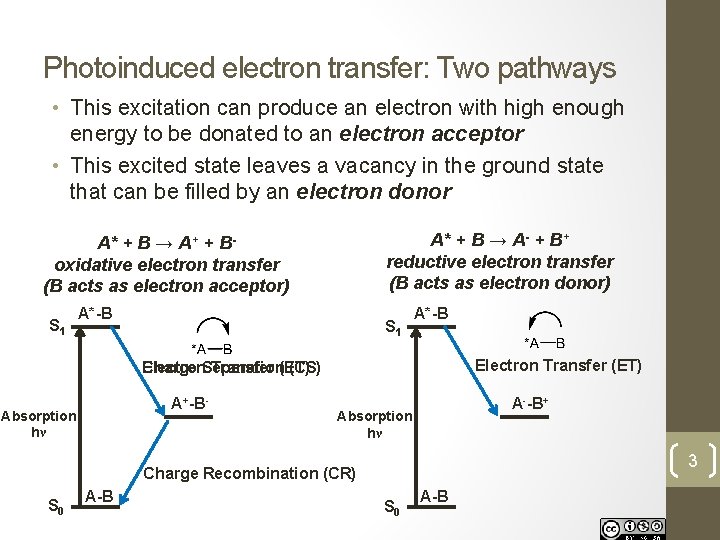
Photoinduced electron transfer: Two pathways • This excitation can produce an electron with high enough energy to be donated to an electron acceptor • This excited state leaves a vacancy in the ground state that can be filled by an electron donor A* + B → A- + B+ reductive electron transfer (B acts as electron donor) A* + B → A+ + Boxidative electron transfer (B acts as electron acceptor) S 1 A*-B Electron Transfer (ET) Electron Charge Separation Transfer (ET) (CS) A+-B- Absorption hν A--B+ Absorption hν 3 Charge Recombination (CR) S 0 A-B
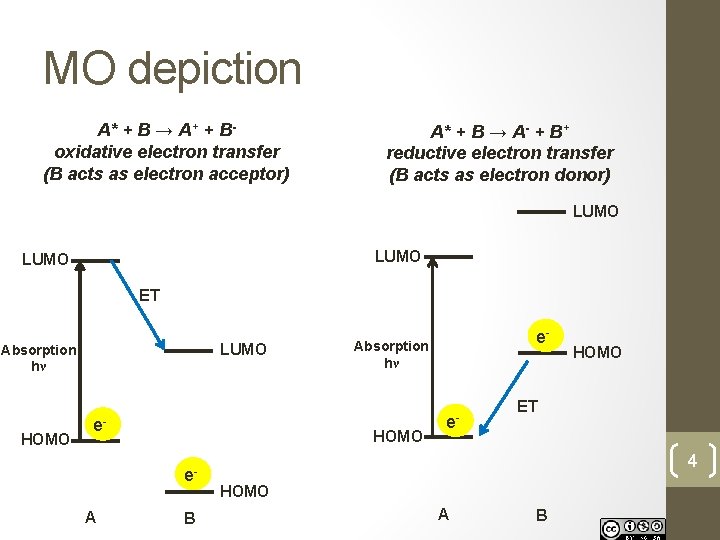
MO depiction A* + B → A+ + Boxidative electron transfer (B acts as electron acceptor) A* + B → A- + B+ reductive electron transfer (B acts as electron donor) LUMO ET LUMO Absorption hν HOMO e- HOMO e. A B e- Absorption hν e- HOMO ET 4 HOMO A B
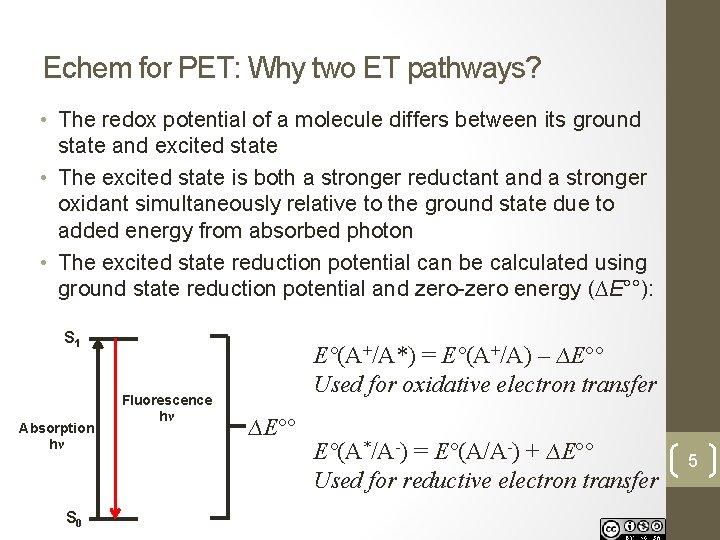
Echem for PET: Why two ET pathways? • The redox potential of a molecule differs between its ground state and excited state • The excited state is both a stronger reductant and a stronger oxidant simultaneously relative to the ground state due to added energy from absorbed photon • The excited state reduction potential can be calculated using ground state reduction potential and zero-zero energy (∆E°°): S 1 Absorption hν S 0 Fluorescence hν E°(A+/A*) = E°(A+/A) – ∆E°° Used for oxidative electron transfer ∆E°° E°(A*/A-) = E°(A/A-) + ∆E°° Used for reductive electron transfer 5
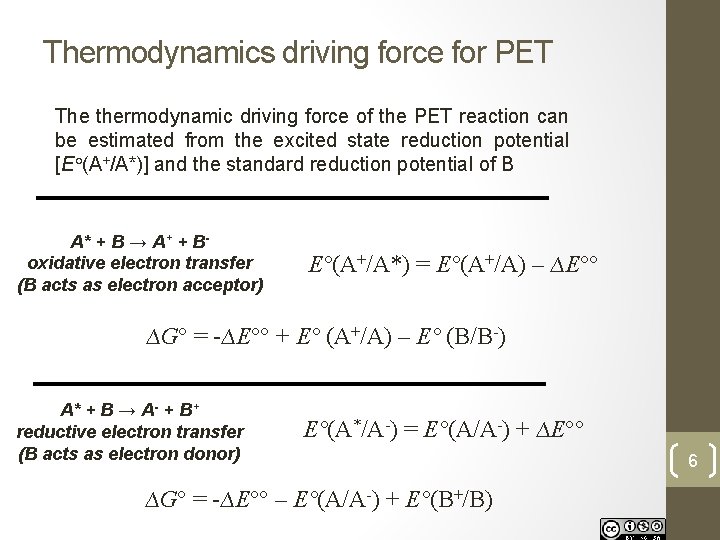
Thermodynamics driving force for PET The thermodynamic driving force of the PET reaction can be estimated from the excited state reduction potential [E°(A+/A*)] and the standard reduction potential of B A* + B → A+ + Boxidative electron transfer (B acts as electron acceptor) E°(A+/A*) = E°(A+/A) – ∆E°° ∆G° = -∆E°° + E° (A+/A) – E° (B/B-) A* + B → A- + B+ reductive electron transfer (B acts as electron donor) E°(A*/A-) = E°(A/A-) + ∆E°° ∆G° = -∆E°° – E°(A/A-) + E°(B+/B) 6
![For example, Ru(bpy)32+ [Ru(III)/Ru(II)] = 1. 26 V vs SHE E°° = 2. 12](http://slidetodoc.com/presentation_image_h/94cb3ded8a86cca4d76f1c9b7dbd1e24/image-7.jpg "For example, Ru(bpy)32+ [Ru(III)/Ru(II)] = 1. 26 V vs SHE E°° = 2. 12")
For example, Ru(bpy)32+ [Ru(III)/Ru(II)] = 1. 26 V vs SHE E°° = 2. 12 e. V [Ru(III)/*Ru(II)] = -0. 86 V [Ru(II)/Ru(I)] = -1. 35 V vs SHE E°° = 2. 12 e. V [*Ru(II)/Ru(I)] = 0. 77 V S 1 (ISC) T 1 Absorption hν Phos. hν E°° = 2. 12 e. V -0. 86 V Ru(bpy)33+ 1. 26 V S 0 *Ru(bpy)32+ Ru(bpy)3+ 2. 12 e. V Ru(bpy)32+ Oxidative cycle 0. 77 V -1. 35 V Reductive cycle 7
- Slides: 7