
5 Simple Steps To finding the Solution Solve
- Slides: 9
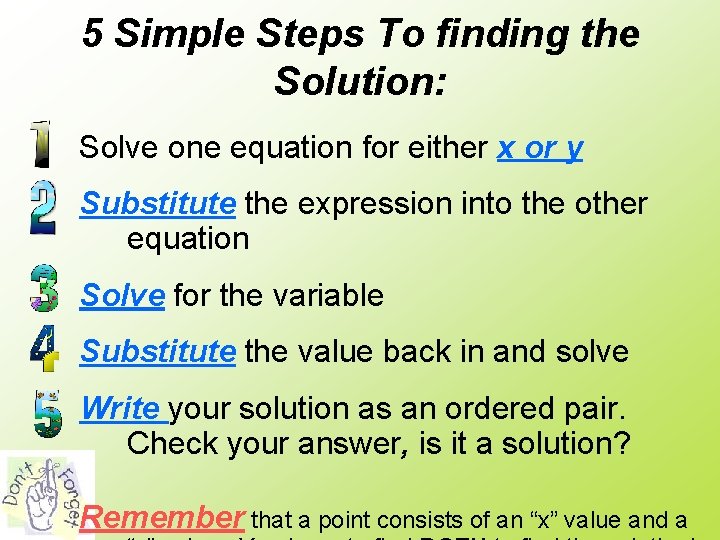
5 Simple Steps To finding the Solution: Solve one equation for either x or y Substitute the expression into the other equation Solve for the variable Substitute the value back in and solve Write your solution as an ordered pair. Check your answer, is it a solution? Remember that a point consists of an “x” value and a
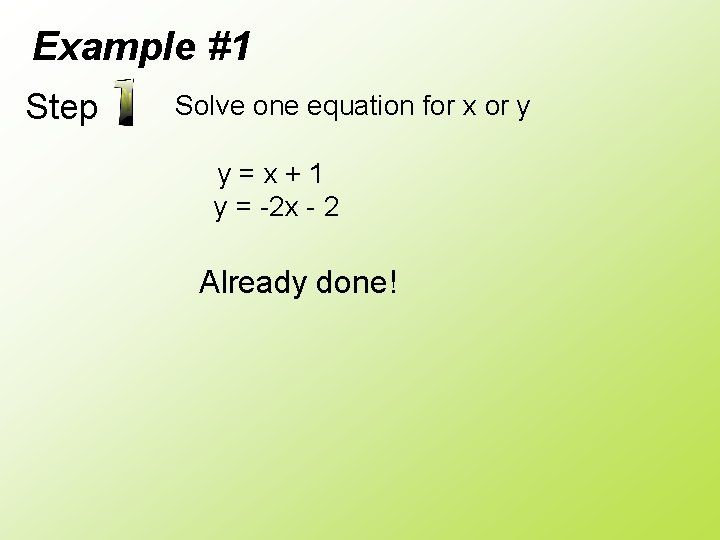
Example #1 Step Solve one equation for x or y y=x+1 y = -2 x - 2 Already done!
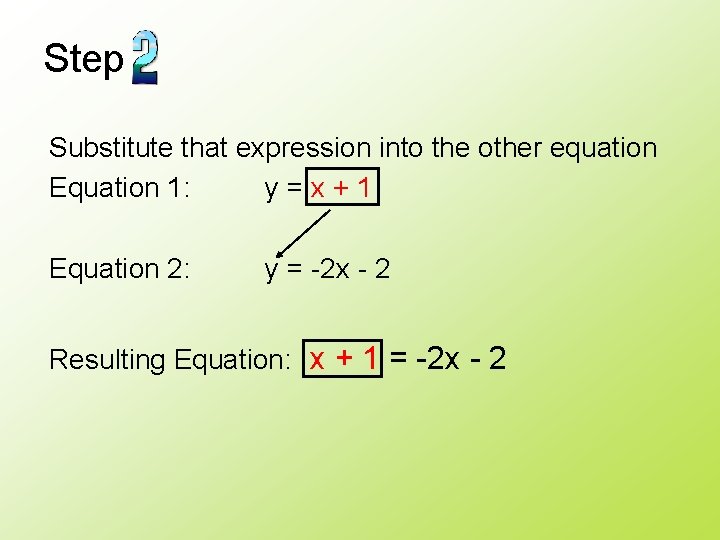
Step Substitute that expression into the other equation Equation 1: y=x+1 Equation 2: y = -2 x - 2 Resulting Equation: x + 1 = -2 x - 2
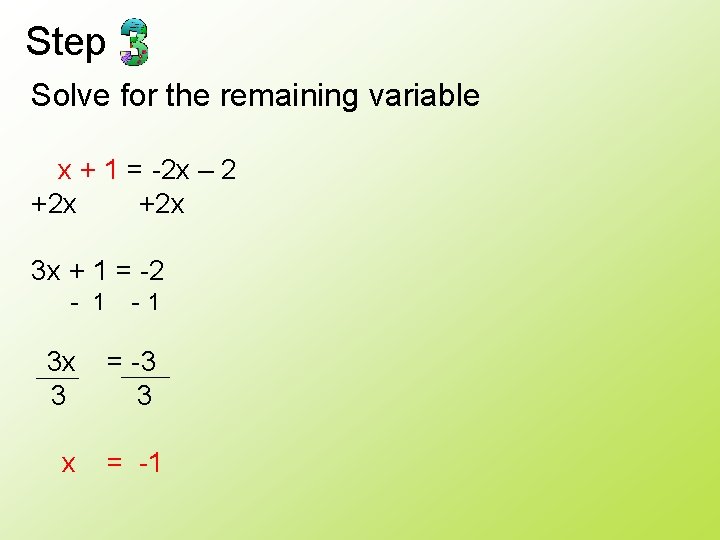
Step Solve for the remaining variable x + 1 = -2 x – 2 +2 x 3 x + 1 = -2 - 1 -1 3 x 3 = -3 3 x = -1
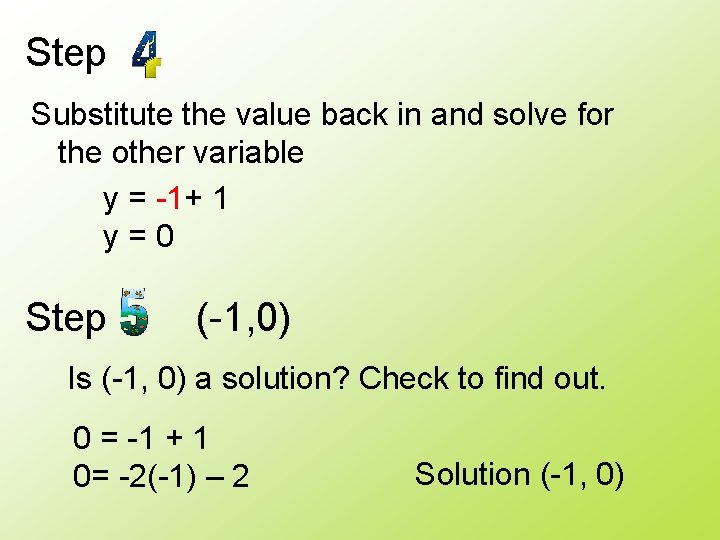
Step Substitute the value back in and solve for the other variable y = -1+ 1 y=0 Step (-1, 0) Is (-1, 0) a solution? Check to find out. 0 = -1 + 1 0= -2(-1) – 2 Solution (-1, 0)
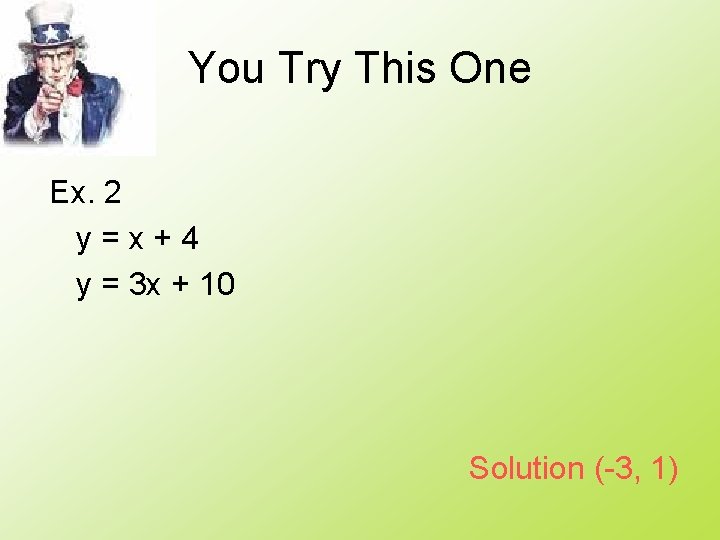
You Try This One Ex. 2 y=x+4 y = 3 x + 10 Solution (-3, 1)
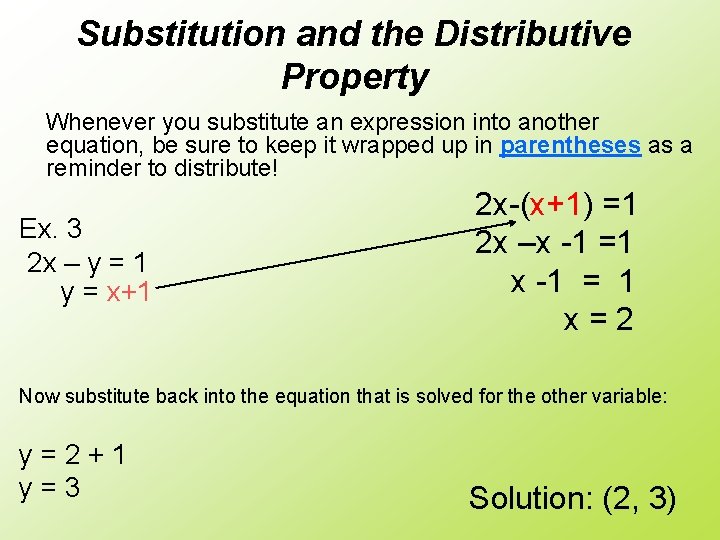
Substitution and the Distributive Property Whenever you substitute an expression into another equation, be sure to keep it wrapped up in parentheses as a reminder to distribute! Ex. 3 2 x – y = 1 y = x+1 2 x-(x+1) =1 2 x –x -1 =1 x -1 = 1 x=2 Now substitute back into the equation that is solved for the other variable: y=2+1 y=3 Solution: (2, 3)
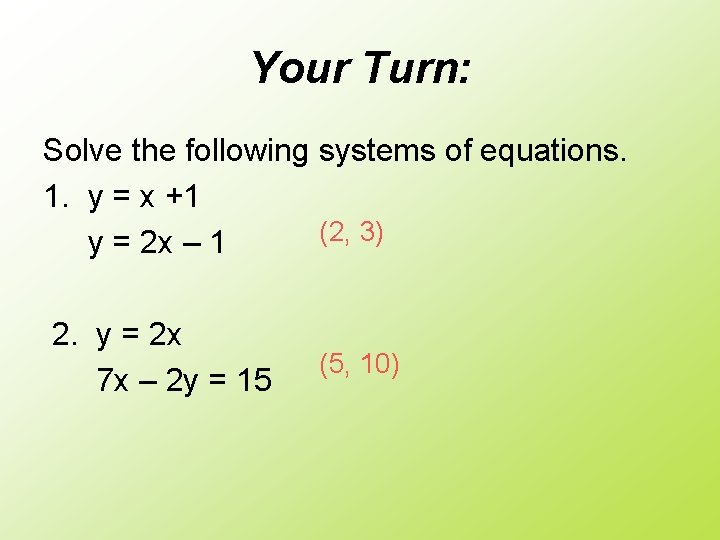
Your Turn: Solve the following systems of equations. 1. y = x +1 (2, 3) y = 2 x – 1 2. y = 2 x 7 x – 2 y = 15 (5, 10)
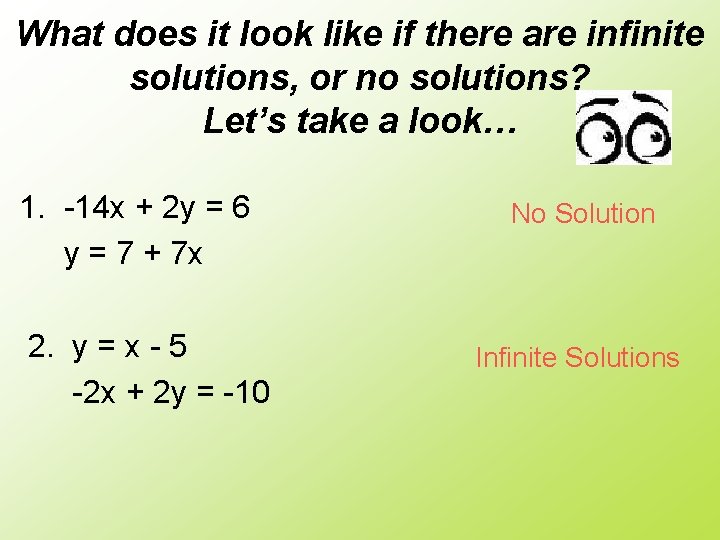
What does it look like if there are infinite solutions, or no solutions? Let’s take a look… 1. -14 x + 2 y = 6 y = 7 + 7 x 2. y = x - 5 -2 x + 2 y = -10 No Solution Infinite Solutions