
5 Series Laurent Expansion Taylor Expansion Suppose we
- Slides: 9
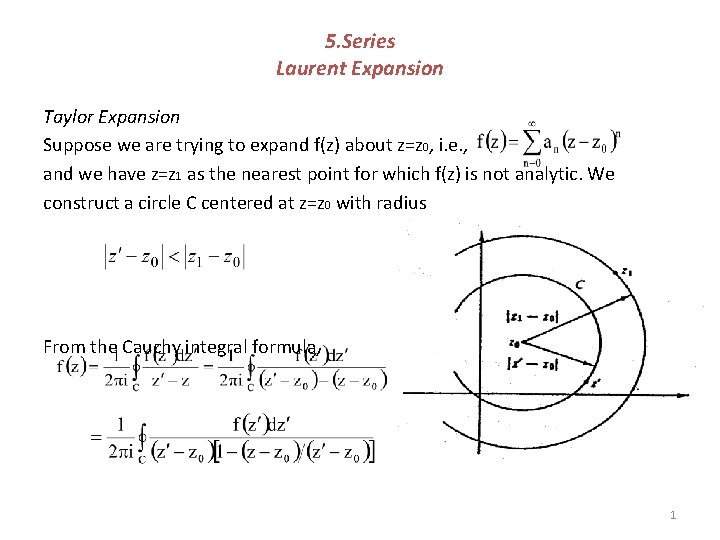
5. Series Laurent Expansion Taylor Expansion Suppose we are trying to expand f(z) about z=z 0, i. e. , and we have z=z 1 as the nearest point for which f(z) is not analytic. We construct a circle C centered at z=z 0 with radius From the Cauchy integral formula, 1
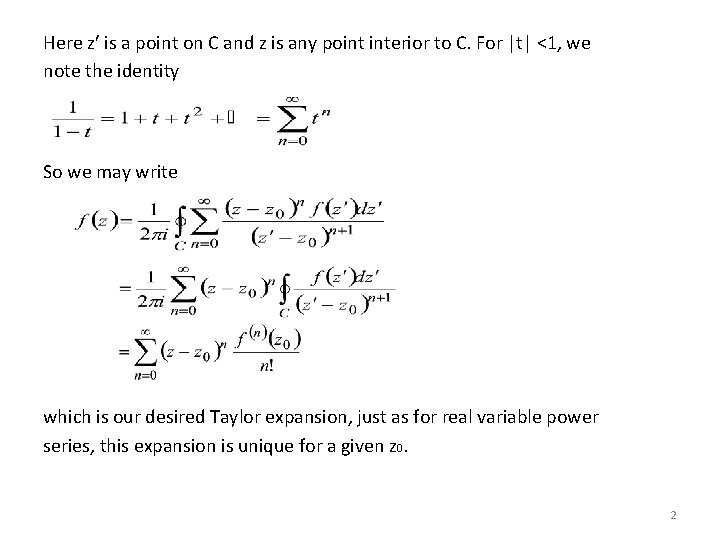
Here z is a point on C and z is any point interior to C. For |t| <1, we note the identity So we may write which is our desired Taylor expansion, just as for real variable power series, this expansion is unique for a given z 0. 2
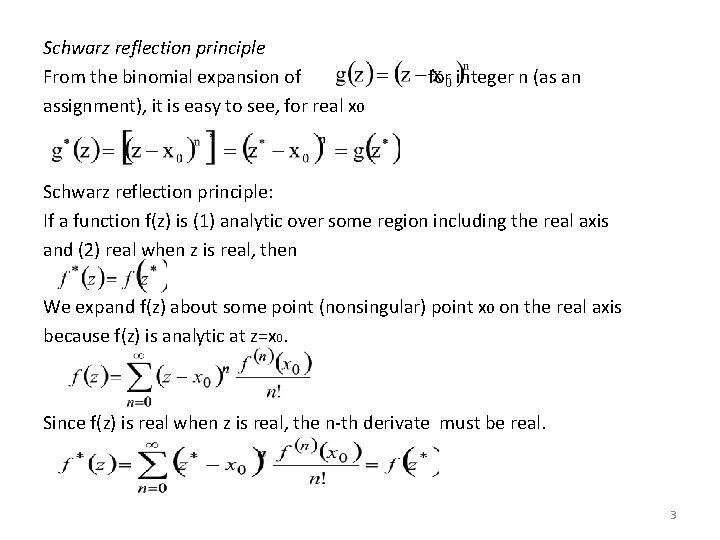
Schwarz reflection principle From the binomial expansion of assignment), it is easy to see, for real x 0 for integer n (as an Schwarz reflection principle: If a function f(z) is (1) analytic over some region including the real axis and (2) real when z is real, then We expand f(z) about some point (nonsingular) point x 0 on the real axis because f(z) is analytic at z=x 0. Since f(z) is real when z is real, the n-th derivate must be real. 3
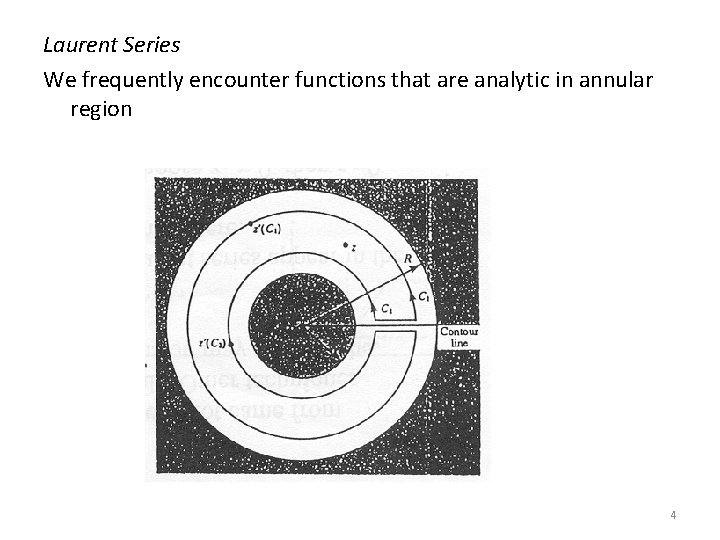
Laurent Series We frequently encounter functions that are analytic in annular region 4
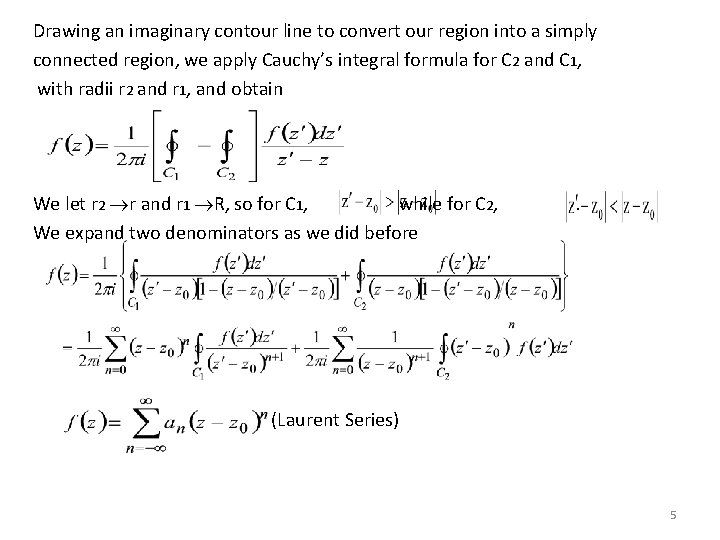
Drawing an imaginary contour line to convert our region into a simply connected region, we apply Cauchy’s integral formula for C 2 and C 1, with radii r 2 and r 1, and obtain We let r 2 r and r 1 R, so for C 1, while for C 2, We expand two denominators as we did before . (Laurent Series) 5
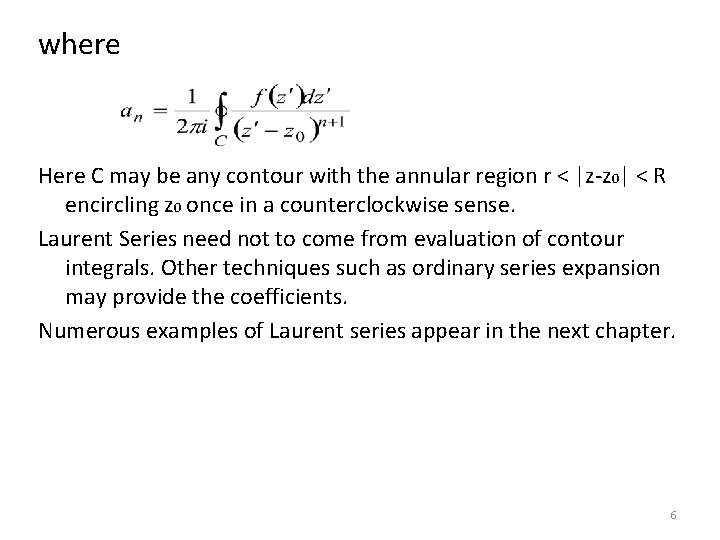
where Here C may be any contour with the annular region r < |z-z 0| < R encircling z 0 once in a counterclockwise sense. Laurent Series need not to come from evaluation of contour integrals. Other techniques such as ordinary series expansion may provide the coefficients. Numerous examples of Laurent series appear in the next chapter. 6
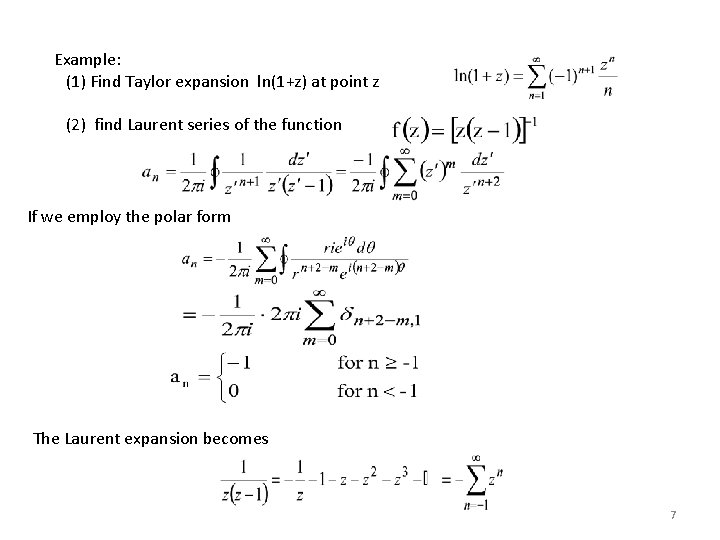
Example: (1) Find Taylor expansion ln(1+z) at point z (2) find Laurent series of the function If we employ the polar form The Laurent expansion becomes 7
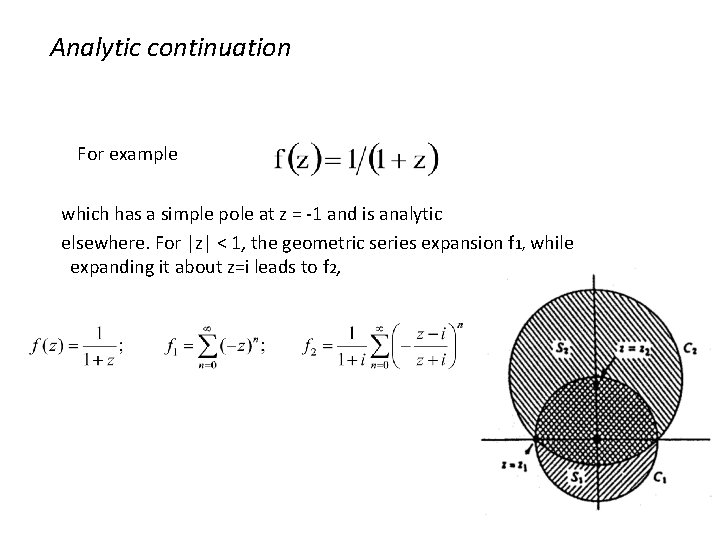
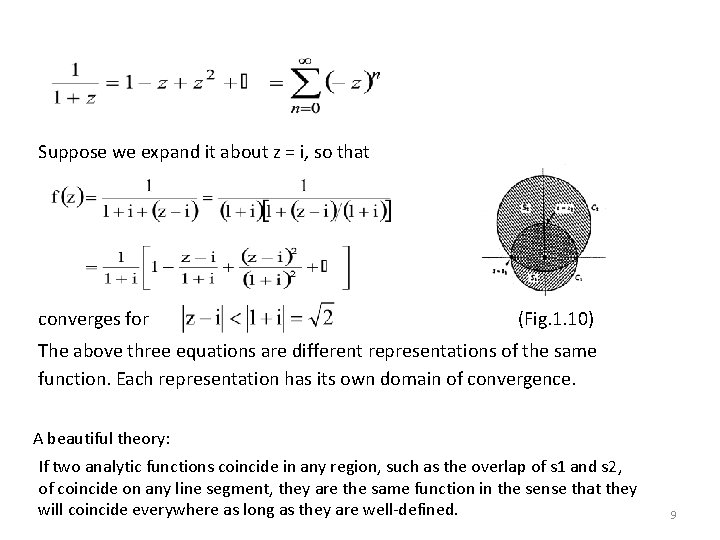
Analytic continuation For example which has a simple pole at z = -1 and is analytic elsewhere. For |z| < 1, the geometric series expansion f 1, while expanding it about z=i leads to f 2, 8
Suppose we expand it about z = i, so that converges for (Fig. 1. 10) The above three equations are different representations of the same function. Each representation has its own domain of convergence. A beautiful theory: If two analytic functions coincide in any region, such as the overlap of s 1 and s 2, of coincide on any line segment, they are the same function in the sense that they will coincide everywhere as long as they are well-defined. 9