
5 Semantics Reference Semantic units Equivalence The term
- Slides: 13
5. Semantics Reference Semantic units Equivalence
“The term ‘semantics’ does not simply refer to the meaning of words; it is the entire system of meanings of a language, expressed by grammar as well as vocabulary. The text is a semantic unit […] meanings are realised through wordings. ” (M. A. K. Halliday, cited by Taylor p. 68). Phonetic features also contribute to meaning. In Italian we can add a diminutive suffix to the end of a noun to suggest smallness or lightness. In fact there are two diminutives in Italian. English has a diminutive suffix but it is used less frequently than the Italian forms. However, in English we have the colloquial expressions teeny-weeny and itsy-bitsy to suggest that something is very small or of no importance at all. From a 1960 hit single by Brian Hyland: “It was an itsy-bitsy, teeny-weeny yellow polka-dot bikini…” http: //testi-di-canzoni. com/canzone/mostrare/243594/brian-hyland/testo-etraduzione-itsy-bitsy-teeny-weeny-yellow-polka-dot/ And what is the Italian augmentative suffix to indicate largeness or heaviness?
Function words have no semantic value, only a grammatical function. What does the mean? Or by or in? Content words or lexical items refer to something that exists in the world, whether concrete (house, Cagliari, coffee) or abstract (curiosity, philosophy, idea). The thing referred to is the referent; the word/words that indicate it is/are the referring expression.
Reference is not always straightforward. The English words bough /baʊ/ and branch are both translated into Italian by ramo but native speakers of English know that they do not refer to exactly the same thing. Branch is polysemous: it can also be translated as filiale, succursale or sportello. Bough is monosemous but in spoken English there could be ambiguity because it is a homophone of bow, which means inchinarsi. Do paura and spavento refer to exactly the same emotion? If you live at the Equator, what does autumn refer to?
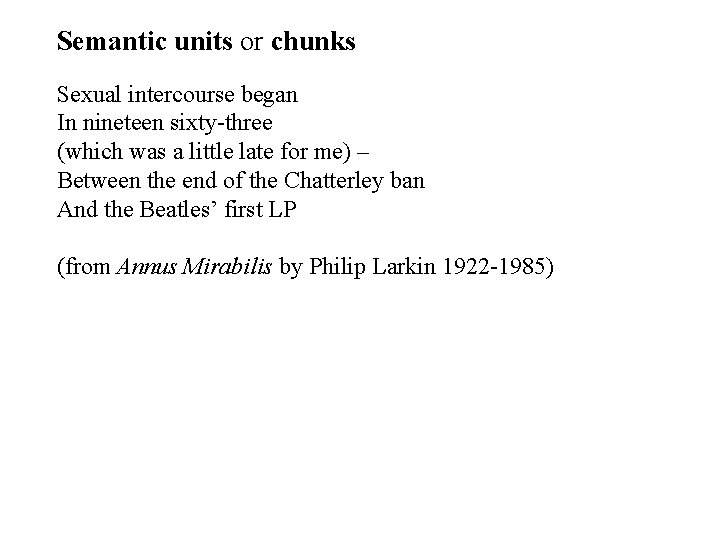
Semantic units or chunks Sexual intercourse began In nineteen sixty-three (which was a little late for me) – Between the end of the Chatterley ban And the Beatles’ first LP (from Annus Mirabilis by Philip Larkin 1922 -1985)
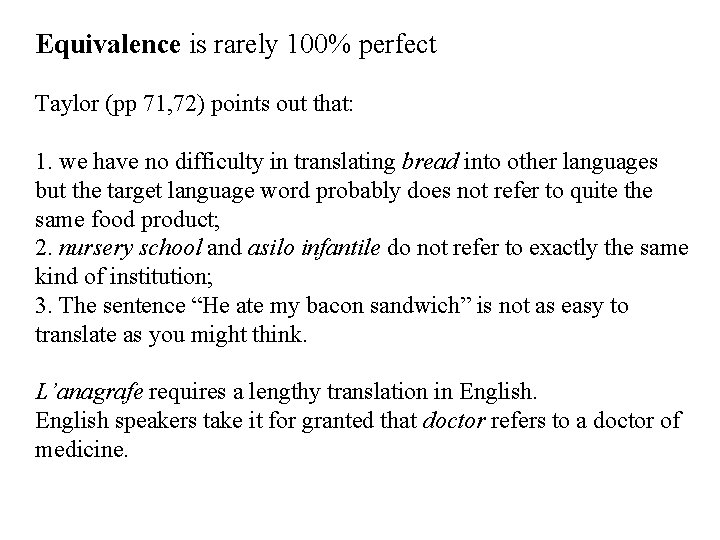
Equivalence is rarely 100% perfect Taylor (pp 71, 72) points out that: 1. we have no difficulty in translating bread into other languages but the target language word probably does not refer to quite the same food product; 2. nursery school and asilo infantile do not refer to exactly the same kind of institution; 3. The sentence “He ate my bacon sandwich” is not as easy to translate as you might think. L’anagrafe requires a lengthy translation in English speakers take it for granted that doctor refers to a doctor of medicine.
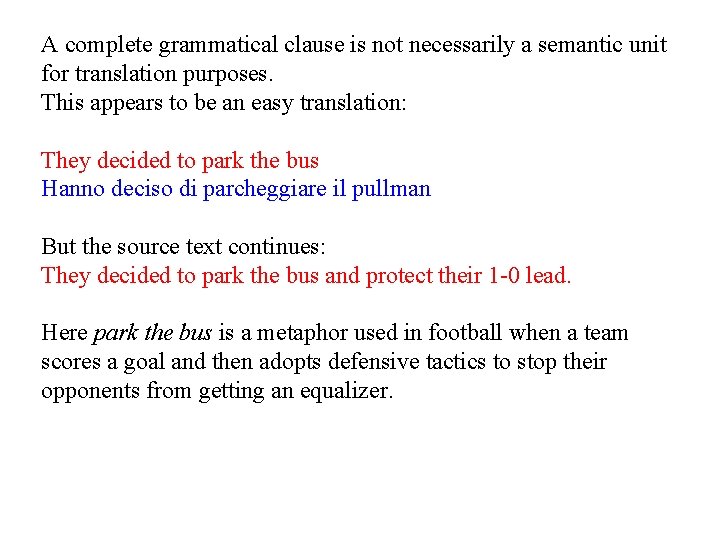
A complete grammatical clause is not necessarily a semantic unit for translation purposes. This appears to be an easy translation: They decided to park the bus Hanno deciso di parcheggiare il pullman But the source text continues: They decided to park the bus and protect their 1 -0 lead. Here park the bus is a metaphor used in football when a team scores a goal and then adopts defensive tactics to stop their opponents from getting an equalizer.
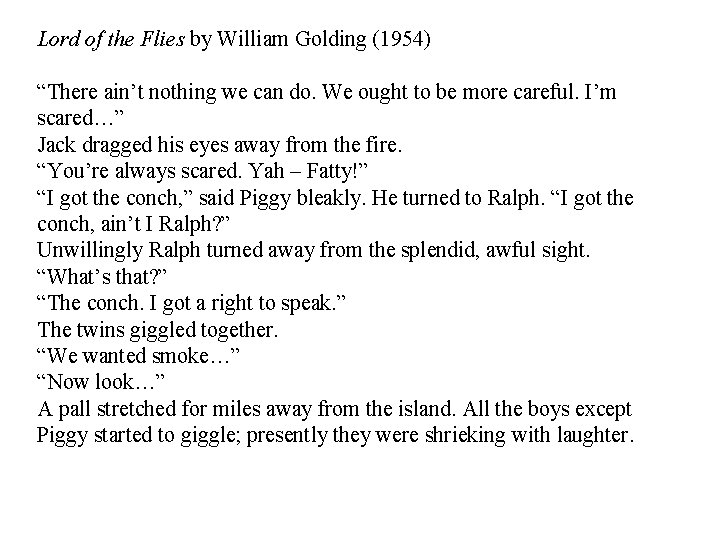
Lord of the Flies by William Golding (1954) “There ain’t nothing we can do. We ought to be more careful. I’m scared…” Jack dragged his eyes away from the fire. “You’re always scared. Yah – Fatty!” “I got the conch, ” said Piggy bleakly. He turned to Ralph. “I got the conch, ain’t I Ralph? ” Unwillingly Ralph turned away from the splendid, awful sight. “What’s that? ” “The conch. I got a right to speak. ” The twins giggled together. “We wanted smoke…” “Now look…” A pall stretched for miles away from the island. All the boys except Piggy started to giggle; presently they were shrieking with laughter.
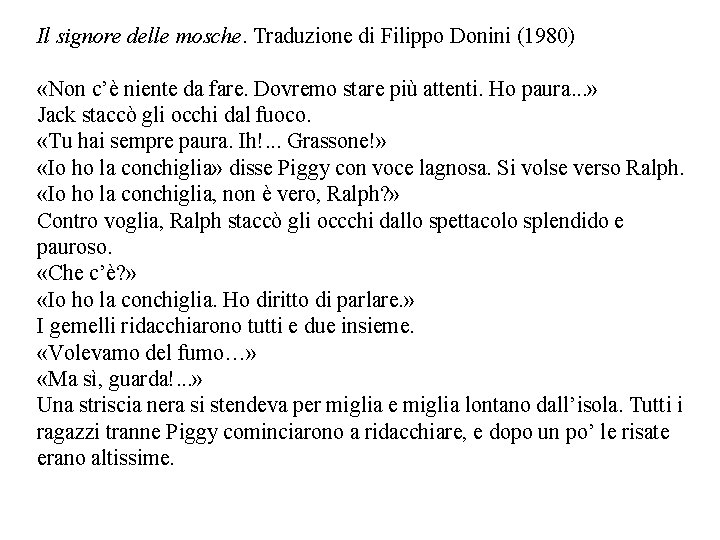
Il signore delle mosche. Traduzione di Filippo Donini (1980) «Non c’è niente da fare. Dovremo stare più attenti. Ho paura. . . » Jack staccò gli occhi dal fuoco. «Tu hai sempre paura. Ih!. . . Grassone!» «Io ho la conchiglia» disse Piggy con voce lagnosa. Si volse verso Ralph. «Io ho la conchiglia, non è vero, Ralph? » Contro voglia, Ralph staccò gli occchi dallo spettacolo splendido e pauroso. «Che c’è? » «Io ho la conchiglia. Ho diritto di parlare. » I gemelli ridacchiarono tutti e due insieme. «Volevamo del fumo…» «Ma sì, guarda!. . . » Una striscia nera si stendeva per miglia e miglia lontano dall’isola. Tutti i ragazzi tranne Piggy cominciarono a ridacchiare, e dopo un po’ le risate erano altissime.
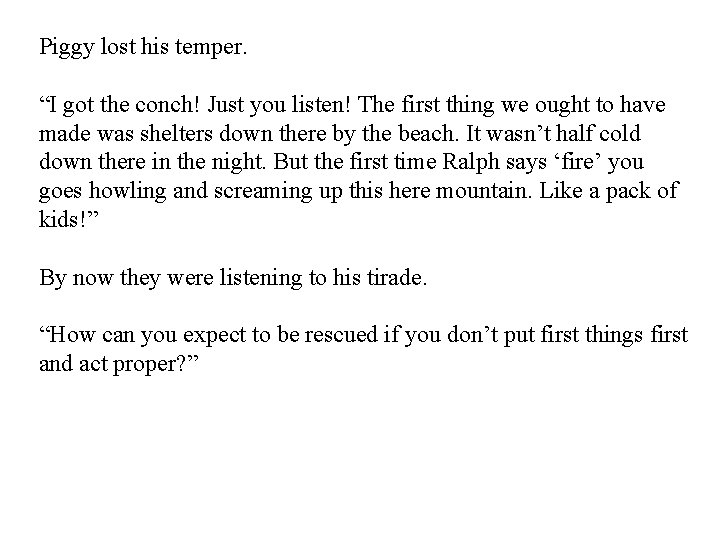
Piggy lost his temper. “I got the conch! Just you listen! The first thing we ought to have made was shelters down there by the beach. It wasn’t half cold down there in the night. But the first time Ralph says ‘fire’ you goes howling and screaming up this here mountain. Like a pack of kids!” By now they were listening to his tirade. “How can you expect to be rescued if you don’t put first things first and act proper? ”
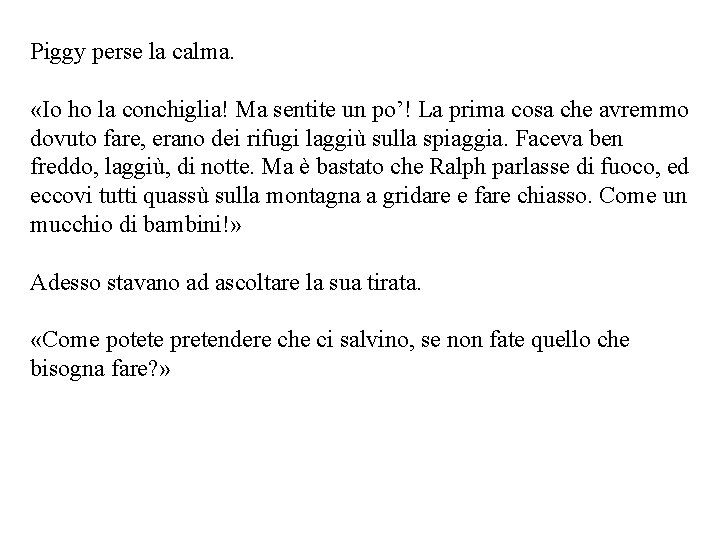
Piggy perse la calma. «Io ho la conchiglia! Ma sentite un po’! La prima cosa che avremmo dovuto fare, erano dei rifugi laggiù sulla spiaggia. Faceva ben freddo, laggiù, di notte. Ma è bastato che Ralph parlasse di fuoco, ed eccovi tutti quassù sulla montagna a gridare e fare chiasso. Come un mucchio di bambini!» Adesso stavano ad ascoltare la sua tirata. «Come potete pretendere che ci salvino, se non fate quello che bisogna fare? »
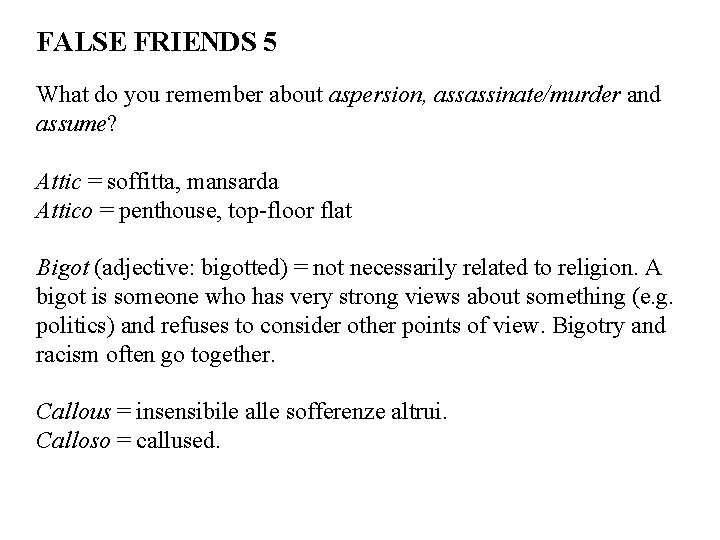
FALSE FRIENDS 5 What do you remember about aspersion, assassinate/murder and assume? Attic = soffitta, mansarda Attico = penthouse, top-floor flat Bigot (adjective: bigotted) = not necessarily related to religion. A bigot is someone who has very strong views about something (e. g. politics) and refuses to consider other points of view. Bigotry and racism often go together. Callous = insensibile alle sofferenze altrui. Calloso = callused.
THE DIARY OF A BRAVE TRANSLATOR VERILY IN LEG – PART 5 Don’t believe everything you see on the internet. The other day I read that it’s very dangerous to use your phone while the battery is recharging, but I later discovered that it was just a cow buffalo. There are often stories about certain foods that have miraculous qualities, but I didn’t fall with the last rain, so I don’t believe them. But these stories persist because there are plenty of naive people about and it’s easy to take them by the bottom.