
5 S Strategies for Passage Analysis 1 Discover
- Slides: 6
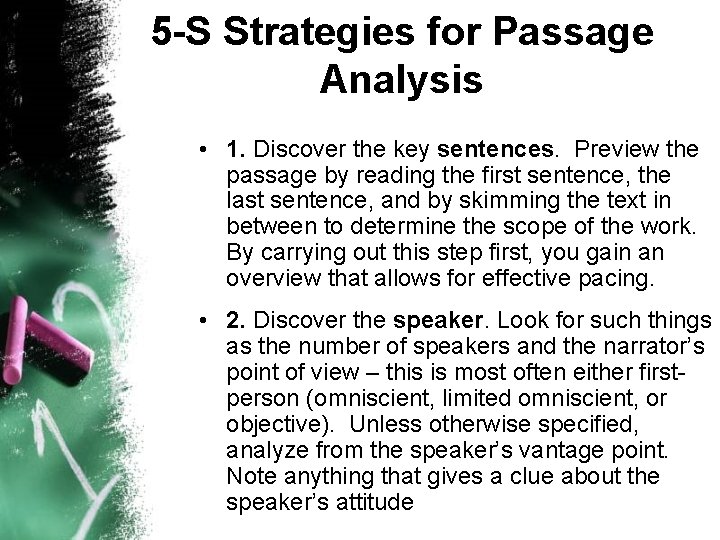
5 -S Strategies for Passage Analysis • 1. Discover the key sentences. Preview the passage by reading the first sentence, the last sentence, and by skimming the text in between to determine the scope of the work. By carrying out this step first, you gain an overview that allows for effective pacing. • 2. Discover the speaker. Look for such things as the number of speakers and the narrator’s point of view – this is most often either firstperson (omniscient, limited omniscient, or objective). Unless otherwise specified, analyze from the speaker’s vantage point. Note anything that gives a clue about the speaker’s attitude
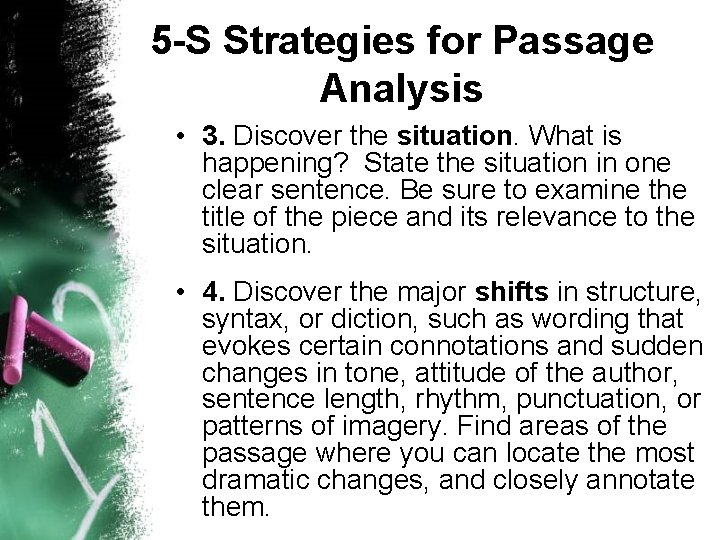
5 -S Strategies for Passage Analysis • 3. Discover the situation. What is happening? State the situation in one clear sentence. Be sure to examine the title of the piece and its relevance to the situation. • 4. Discover the major shifts in structure, syntax, or diction, such as wording that evokes certain connotations and sudden changes in tone, attitude of the author, sentence length, rhythm, punctuation, or patterns of imagery. Find areas of the passage where you can locate the most dramatic changes, and closely annotate them.
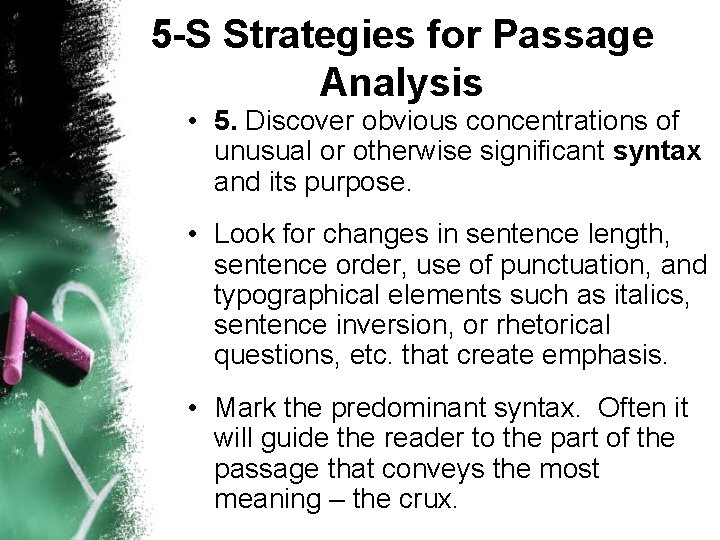
5 -S Strategies for Passage Analysis • 5. Discover obvious concentrations of unusual or otherwise significant syntax and its purpose. • Look for changes in sentence length, sentence order, use of punctuation, and typographical elements such as italics, sentence inversion, or rhetorical questions, etc. that create emphasis. • Mark the predominant syntax. Often it will guide the reader to the part of the passage that conveys the most meaning – the crux.
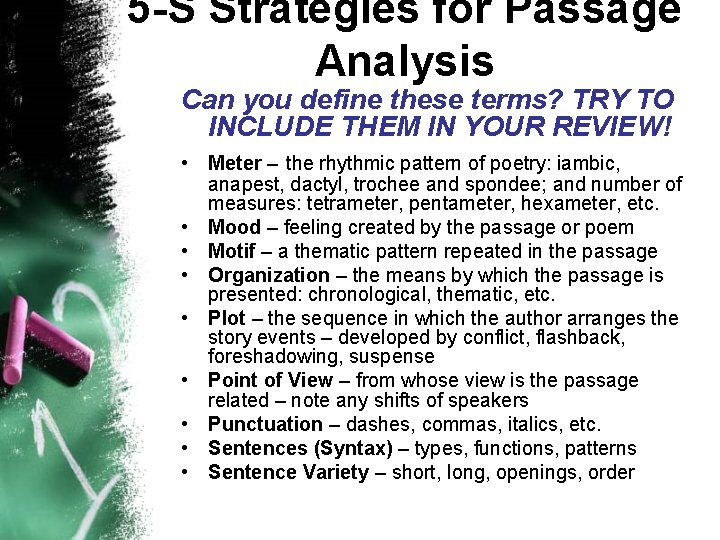
5 -S Strategies for Passage Analysis Can you define these terms? TRY TO INCLUDE THEM IN YOUR REVIEW! • Meter – the rhythmic pattern of poetry: iambic, anapest, dactyl, trochee and spondee; and number of measures: tetrameter, pentameter, hexameter, etc. • Mood – feeling created by the passage or poem • Motif – a thematic pattern repeated in the passage • Organization – the means by which the passage is presented: chronological, thematic, etc. • Plot – the sequence in which the author arranges the story events – developed by conflict, flashback, foreshadowing, suspense • Point of View – from whose view is the passage related – note any shifts of speakers • Punctuation – dashes, commas, italics, etc. • Sentences (Syntax) – types, functions, patterns • Sentence Variety – short, long, openings, order
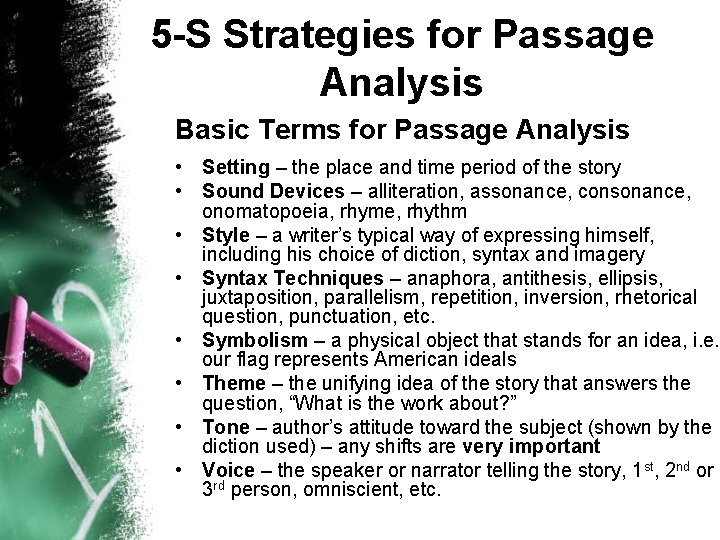
5 -S Strategies for Passage Analysis Basic Terms for Passage Analysis • Setting – the place and time period of the story • Sound Devices – alliteration, assonance, consonance, onomatopoeia, rhyme, rhythm • Style – a writer’s typical way of expressing himself, including his choice of diction, syntax and imagery • Syntax Techniques – anaphora, antithesis, ellipsis, juxtaposition, parallelism, repetition, inversion, rhetorical question, punctuation, etc. • Symbolism – a physical object that stands for an idea, i. e. our flag represents American ideals • Theme – the unifying idea of the story that answers the question, “What is the work about? ” • Tone – author’s attitude toward the subject (shown by the diction used) – any shifts are very important • Voice – the speaker or narrator telling the story, 1 st, 2 nd or 3 rd person, omniscient, etc.
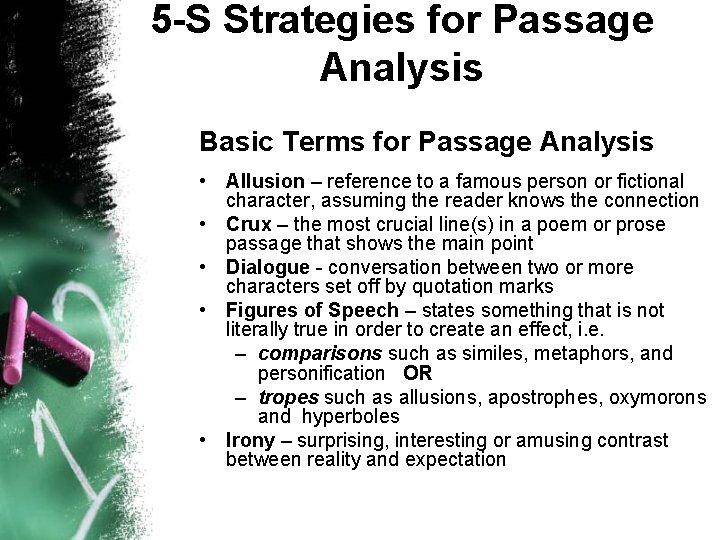
5 -S Strategies for Passage Analysis Basic Terms for Passage Analysis • Allusion – reference to a famous person or fictional character, assuming the reader knows the connection • Crux – the most crucial line(s) in a poem or prose passage that shows the main point • Dialogue - conversation between two or more characters set off by quotation marks • Figures of Speech – states something that is not literally true in order to create an effect, i. e. – comparisons such as similes, metaphors, and personification OR – tropes such as allusions, apostrophes, oxymorons and hyperboles • Irony – surprising, interesting or amusing contrast between reality and expectation