
5 Risk Title and Insurace 1 2 3
- Slides: 13
5. Risk, Title and Insurace 1. 2. 3. 4. What are risks in foreign trade? How to face with risks ? How do people arrange the insurance ? What types of insurance cover are there?
What are risks in foreign trade? • Risks are the accidents, disasters or troubles that might appear suddenly during the delivery of goods. This can lead to the damages or financial loss for the insured objects. Ph. D Hoang Van Chau( 2006), The insurance in business.
There are 2 popular risks involved in the sales of good : ü Risk of the goods injuring a third party. ü Risk of loss or damage of goods. => Once happened, risks charge the title a lot of money and related responsibilities.
How to face with risks ? • The title must arrange the insurance to protect himself from risks. • The title are : ü Ownership of goods after delivery. ü Ownership of goods after payment totally.
How do people arrange the insurance ? • By endorsing the insurance, the exporter can assign the full rights to the buyer. • A set of insurance include: i. Certificate of insurance ( C/I) : C/I cover an individual shipment in a period of time. ii. Letter of insurance( L/I) : L/I state with the buyer that the purchased goods are insured.
What types of insurance cover are there? 1. Group 1 : Floating policy and Open Cover. 2. Group 2: Valued and Undervalued insurance.
Floating policy and Open Cover • When an exporter have many similar contracts that shipped in unusual ways to unfamiliar destinations, he shall buy a floating policy or an open cover insurance. • These types of insurance cover on all shipments over a period of time and are set a ceiling on the overall figure.
Floating policy and Open Cover • How different are they ? ü The floating policy is expired automatically unless renewed while the open cover does not => The open cover is more convinient compared with the floating policy. ü The floating policy is a policy but an open cover is an agreement between the insured and the insurance company.
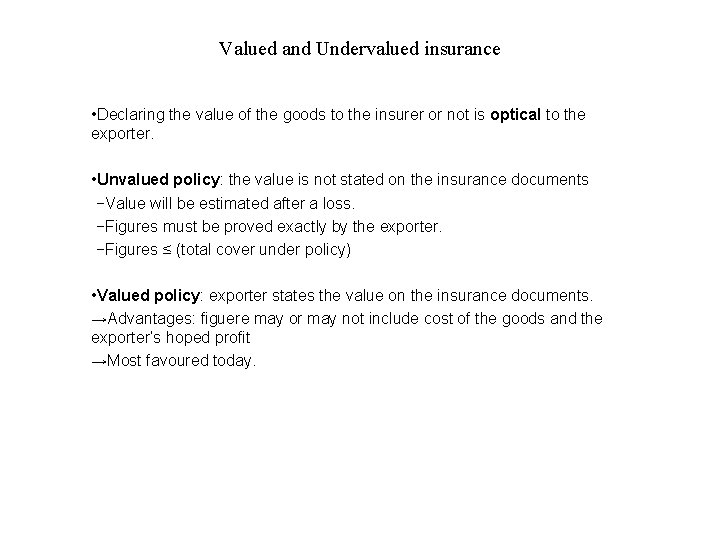
Valued and Undervalued insurance • Declaring the value of the goods to the insurer or not is optical to the exporter. • Unvalued policy: the value is not stated on the insurance documents −Value will be estimated after a loss. −Figures must be proved exactly by the exporter. −Figures ≤ (total cover under policy) • Valued policy: exporter states the value on the insurance documents. →Advantages: figuere may or may not include cost of the goods and the exporter’s hoped profit →Most favoured today.
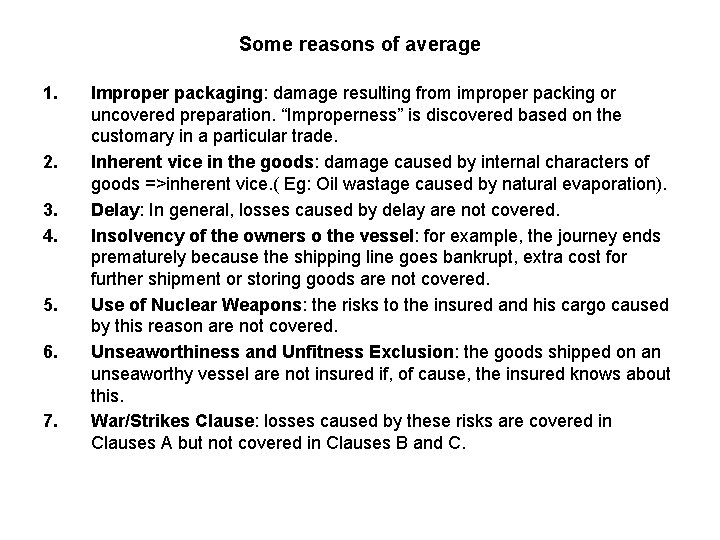
Some reasons of average 1. 2. 3. 4. 5. 6. 7. Improper packaging: damage resulting from improper packing or uncovered preparation. “Improperness” is discovered based on the customary in a particular trade. Inherent vice in the goods: damage caused by internal characters of goods =>inherent vice. ( Eg: Oil wastage caused by natural evaporation). Delay: In general, losses caused by delay are not covered. Insolvency of the owners o the vessel: for example, the journey ends prematurely because the shipping line goes bankrupt, extra cost for further shipment or storing goods are not covered. Use of Nuclear Weapons: the risks to the insured and his cargo caused by this reason are not covered. Unseaworthiness and Unfitness Exclusion: the goods shipped on an unseaworthy vessel are not insured if, of cause, the insured knows about this. War/Strikes Clause: losses caused by these risks are covered in Clauses A but not covered in Clauses B and C.
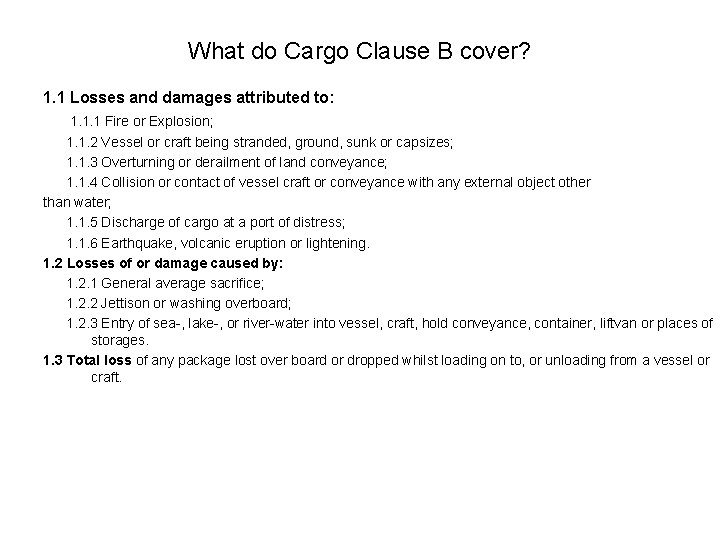
What do Cargo Clause B cover? 1. 1 Losses and damages attributed to: 1. 1. 1 Fire or Explosion; 1. 1. 2 Vessel or craft being stranded, ground, sunk or capsizes; 1. 1. 3 Overturning or derailment of land conveyance; 1. 1. 4 Collision or contact of vessel craft or conveyance with any external object other than water; 1. 1. 5 Discharge of cargo at a port of distress; 1. 1. 6 Earthquake, volcanic eruption or lightening. 1. 2 Losses of or damage caused by: 1. 2. 1 General average sacrifice; 1. 2. 2 Jettison or washing overboard; 1. 2. 3 Entry of sea-, lake-, or river-water into vessel, craft, hold conveyance, container, liftvan or places of storages. 1. 3 Total loss of any package lost over board or dropped whilst loading on to, or unloading from a vessel or craft.
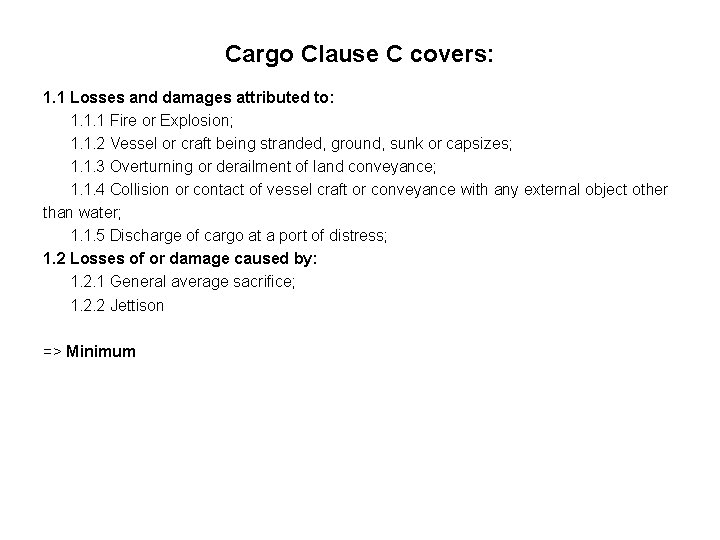
Cargo Clause C covers: 1. 1 Losses and damages attributed to: 1. 1. 1 Fire or Explosion; 1. 1. 2 Vessel or craft being stranded, ground, sunk or capsizes; 1. 1. 3 Overturning or derailment of land conveyance; 1. 1. 4 Collision or contact of vessel craft or conveyance with any external object other than water; 1. 1. 5 Discharge of cargo at a port of distress; 1. 2 Losses of or damage caused by: 1. 2. 1 General average sacrifice; 1. 2. 2 Jettison => Minimum
Note when paying claime 1. Insurers must study the circumstance fully to make sure that the lost and damaged goods were correctly described. Incorrectness means no payment. 2. Innocent misdescription: sometimes supported by “held covered” clause - “held covered at premium to be arranged” => insures have to pay extra premium to get payment. CARDINAL PRINCIPAL: A contract of marine insurance must be based on the utmost good faith, and, if the utmost good faith be not observed by either party, the contract may avoided by the other party.