
5 Random Variables Lesson 5 2 Analyzing Discrete
5 Random Variables Lesson 5. 2 Analyzing Discrete Random Variables Statistics and Probability with Applications, 3 rd Edition Starnes & Tabor Bedford Freeman Worth Publishers
Analyzing Discrete Random Variables Learning Targets After this lesson, you should be able to: ü Make a histogram to display the probability distribution of a discrete random variable and describe its shape. ü Calculate and interpret the mean (expected value) of a discrete random variable. ü Calculate and interpret the standard deviation of a discrete random variable. Statistics and Probability with Applications, 3 rd Edition 2
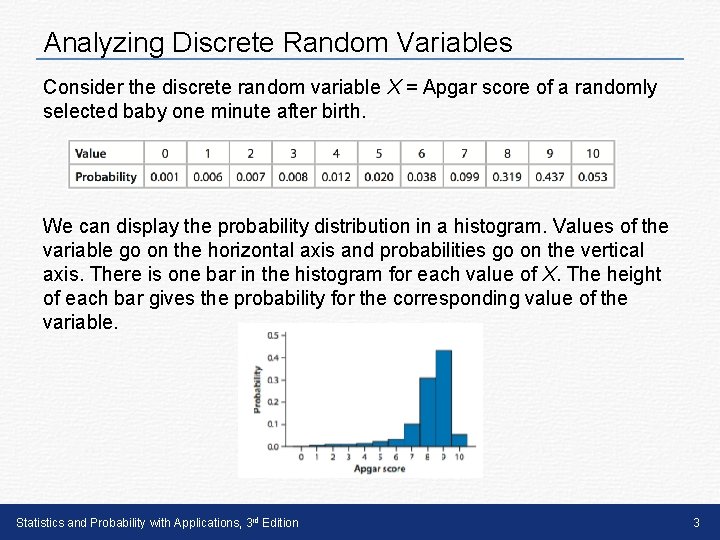
Analyzing Discrete Random Variables Consider the discrete random variable X = Apgar score of a randomly selected baby one minute after birth. We can display the probability distribution in a histogram. Values of the variable go on the horizontal axis and probabilities go on the vertical axis. There is one bar in the histogram for each value of X. The height of each bar gives the probability for the corresponding value of the variable. Statistics and Probability with Applications, 3 rd Edition 3
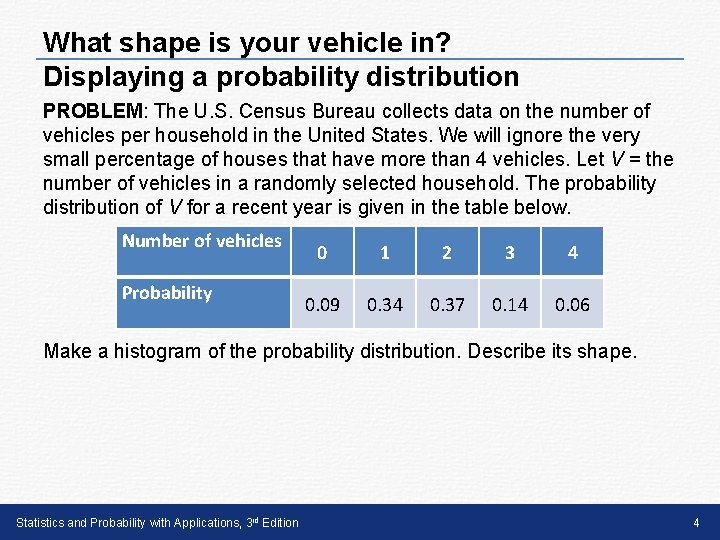
What shape is your vehicle in? Displaying a probability distribution PROBLEM: The U. S. Census Bureau collects data on the number of vehicles per household in the United States. We will ignore the very small percentage of houses that have more than 4 vehicles. Let V = the number of vehicles in a randomly selected household. The probability distribution of V for a recent year is given in the table below. Number of vehicles Probability 0 1 2 3 4 0. 09 0. 34 0. 37 0. 14 0. 06 Make a histogram of the probability distribution. Describe its shape. Statistics and Probability with Applications, 3 rd Edition 4
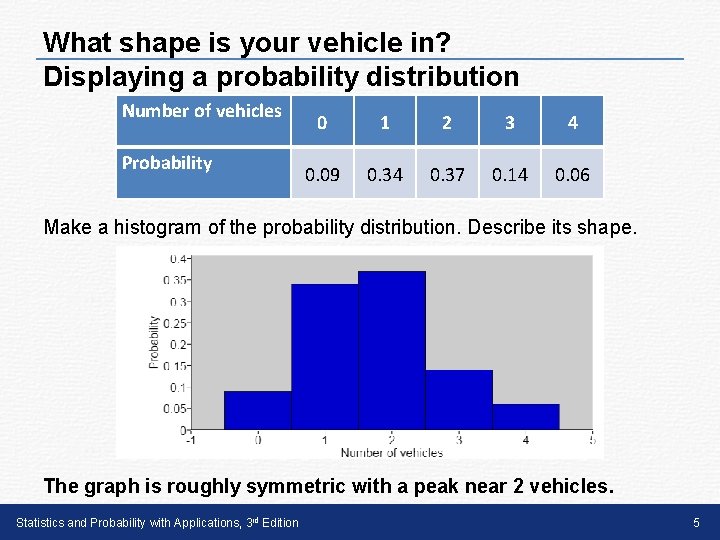
What shape is your vehicle in? Displaying a probability distribution Number of vehicles Probability 0 1 2 3 4 0. 09 0. 34 0. 37 0. 14 0. 06 Make a histogram of the probability distribution. Describe its shape. The graph is roughly symmetric with a peak near 2 vehicles. Statistics and Probability with Applications, 3 rd Edition 5
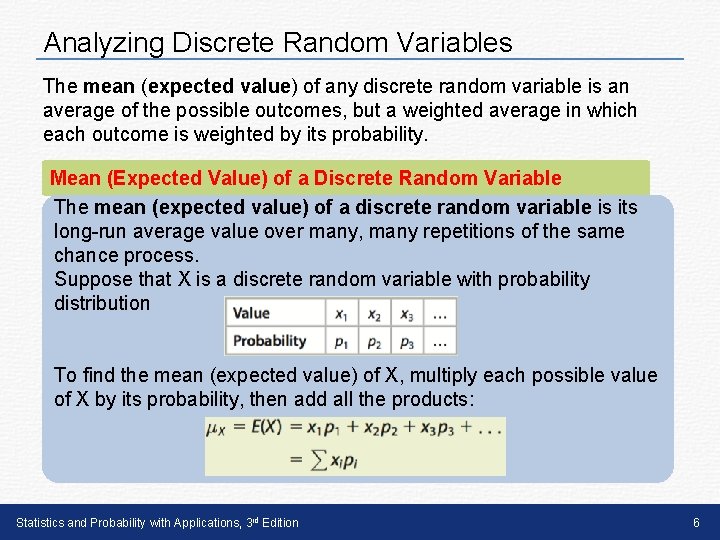
Analyzing Discrete Random Variables The mean (expected value) of any discrete random variable is an average of the possible outcomes, but a weighted average in which each outcome is weighted by its probability. Mean (Expected Value) of a Discrete Random Variable The mean (expected value) of a discrete random variable is its long-run average value over many, many repetitions of the same chance process. Suppose that X is a discrete random variable with probability distribution To find the mean (expected value) of X, multiply each possible value of X by its probability, then add all the products: Statistics and Probability with Applications, 3 rd Edition 6
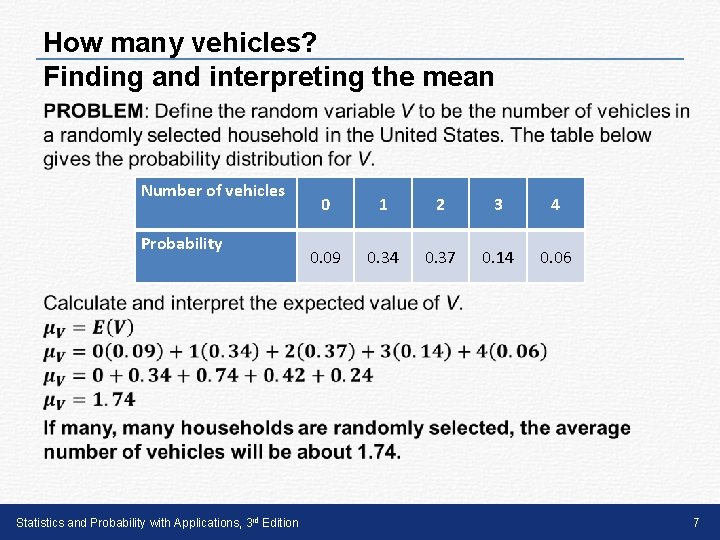
How many vehicles? Finding and interpreting the mean • Number of vehicles Probability Statistics and Probability with Applications, 3 rd Edition 0 1 2 3 4 0. 09 0. 34 0. 37 0. 14 0. 06 7
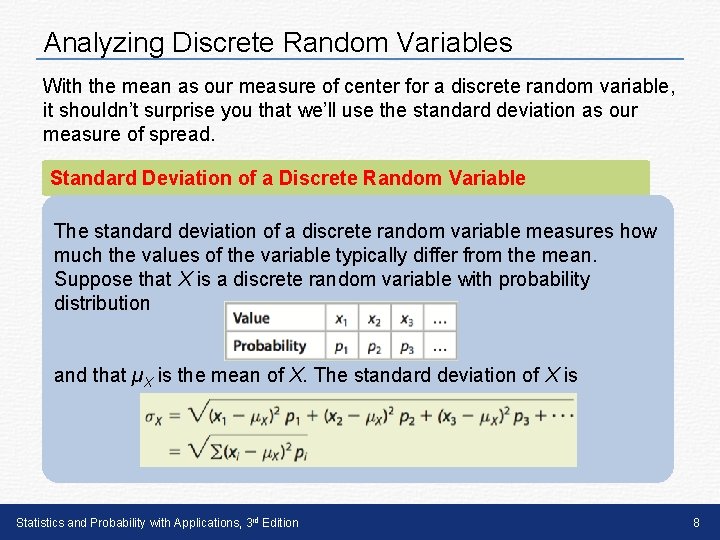
Analyzing Discrete Random Variables With the mean as our measure of center for a discrete random variable, it shouldn’t surprise you that we’ll use the standard deviation as our measure of spread. Standard Deviation of a Discrete Random Variable The standard deviation of a discrete random variable measures how much the values of the variable typically differ from the mean. Suppose that X is a discrete random variable with probability distribution and that µX is the mean of X. The standard deviation of X is Statistics and Probability with Applications, 3 rd Edition 8
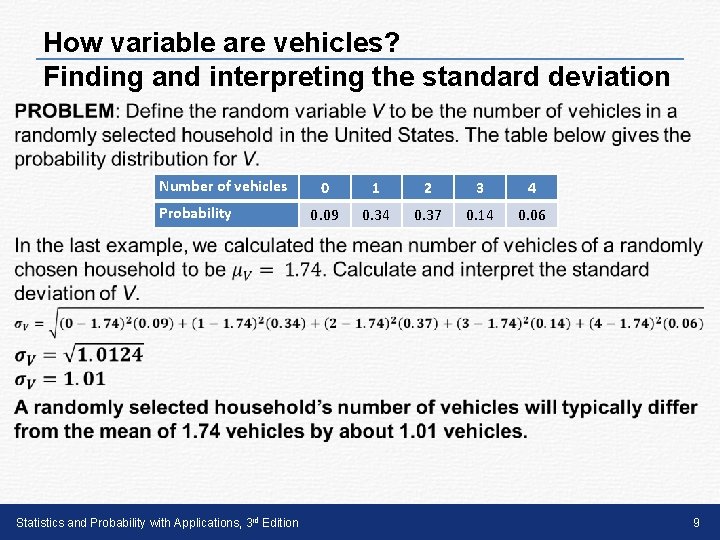
How variable are vehicles? Finding and interpreting the standard deviation • Number of vehicles Probability Statistics and Probability with Applications, 3 rd Edition 0 1 2 3 4 0. 09 0. 34 0. 37 0. 14 0. 06 9
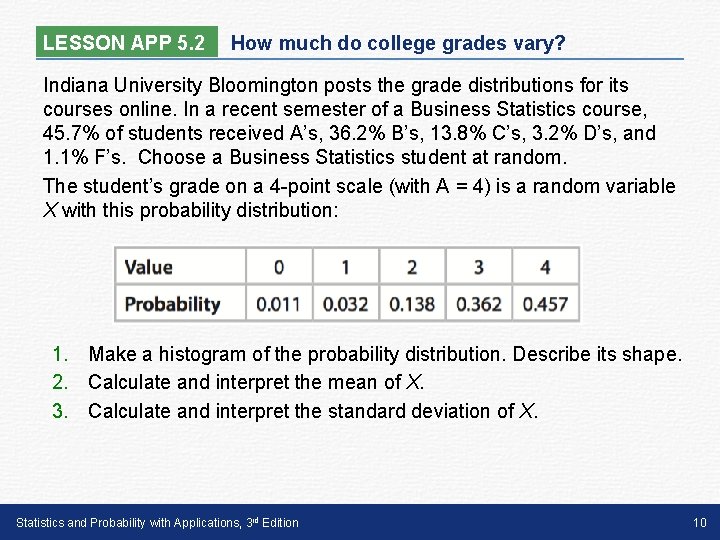
LESSON APP 5. 2 How much do college grades vary? Indiana University Bloomington posts the grade distributions for its courses online. In a recent semester of a Business Statistics course, 45. 7% of students received A’s, 36. 2% B’s, 13. 8% C’s, 3. 2% D’s, and 1. 1% F’s. Choose a Business Statistics student at random. The student’s grade on a 4 -point scale (with A = 4) is a random variable X with this probability distribution: 1. Make a histogram of the probability distribution. Describe its shape. 2. Calculate and interpret the mean of X. 3. Calculate and interpret the standard deviation of X. Statistics and Probability with Applications, 3 rd Edition 10
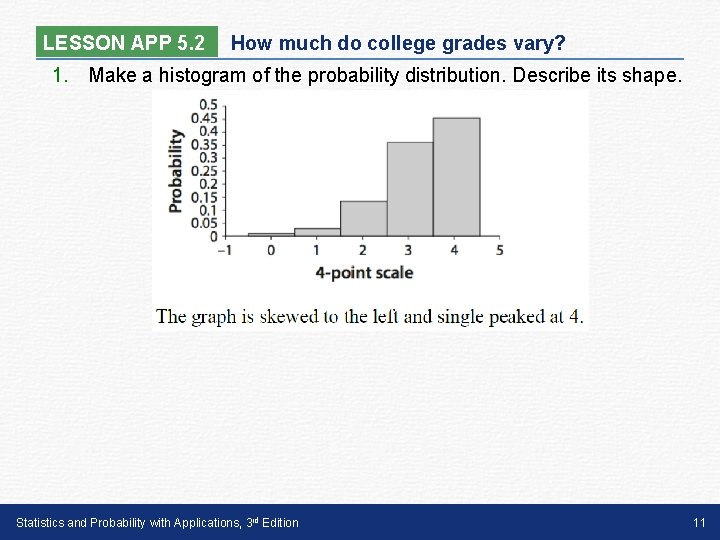
LESSON APP 5. 2 How much do college grades vary? 1. Make a histogram of the probability distribution. Describe its shape. Statistics and Probability with Applications, 3 rd Edition 11
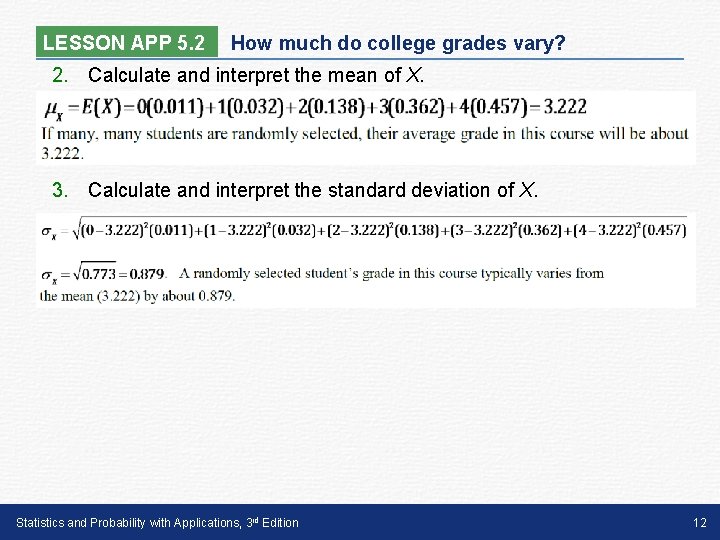
LESSON APP 5. 2 How much do college grades vary? 2. Calculate and interpret the mean of X. 3. Calculate and interpret the standard deviation of X. Statistics and Probability with Applications, 3 rd Edition 12
Analyzing Discrete Random Variables Learning Targets After this lesson, you should be able to: ü Make a histogram to display the probability distribution of a discrete random variable and describe its shape. ü Calculate and interpret the mean (expected value) of a discrete random variable. ü Calculate and interpret the standard deviation of a discrete random variable. Statistics and Probability with Applications, 3 rd Edition 13
- Slides: 13