5 Points of a Good Conclusion A good
- Slides: 3
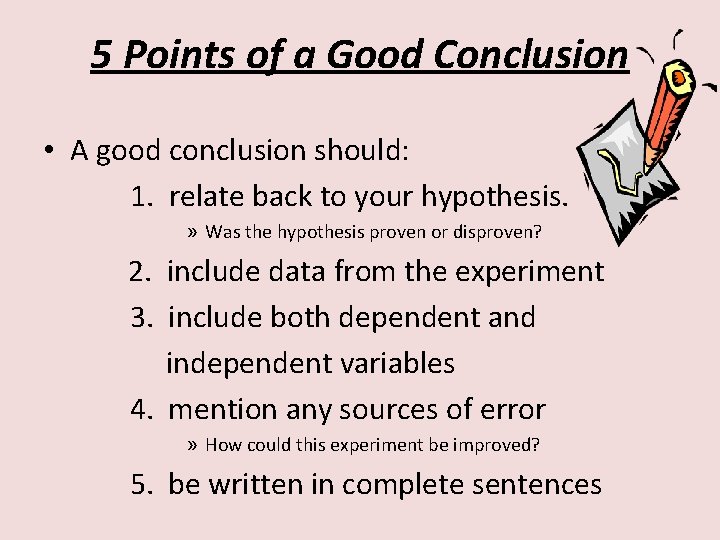
5 Points of a Good Conclusion • A good conclusion should: 1. relate back to your hypothesis. » Was the hypothesis proven or disproven? 2. include data from the experiment 3. include both dependent and independent variables 4. mention any sources of error » How could this experiment be improved? 5. be written in complete sentences
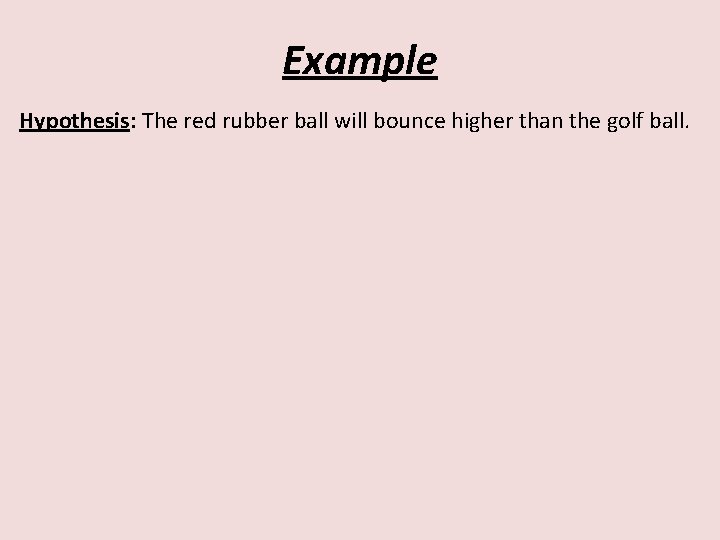
Example Hypothesis: The red rubber ball will bounce higher than the golf ball. Graph Data Table Golf Ball 14 Red Rubber Ball 12 12 cm Height of Golf Ball's Bounce 10 Trial 1 12 cm 1 cm Trial 2 13 cm 6 cm Trial 3 12 cm 1 cm 6 Trial 4 12 cm 1 cm 4 Trial 5 11 cm 2 Avg. 2. 2 cm 0 12 cm The Height Different Types of Balls Bounced 8 Height of Rubber Ball's Bounce 2. 2 cm Golf Ball Red Rubber Ball
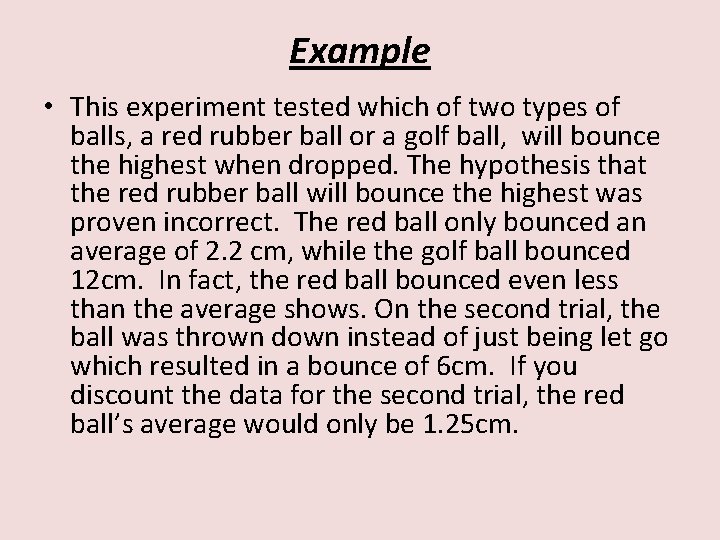
Example • This experiment tested which of two types of balls, a red rubber ball or a golf ball, will bounce the highest when dropped. The hypothesis that the red rubber ball will bounce the highest was proven incorrect. The red ball only bounced an average of 2. 2 cm, while the golf ball bounced 12 cm. In fact, the red ball bounced even less than the average shows. On the second trial, the ball was thrown down instead of just being let go which resulted in a bounce of 6 cm. If you discount the data for the second trial, the red ball’s average would only be 1. 25 cm.