
5 Nucleic acids Dr Ayat B AlGhafari Biochemistry
5. Nucleic acids Dr. Ayat B. Al-Ghafari Biochemistry
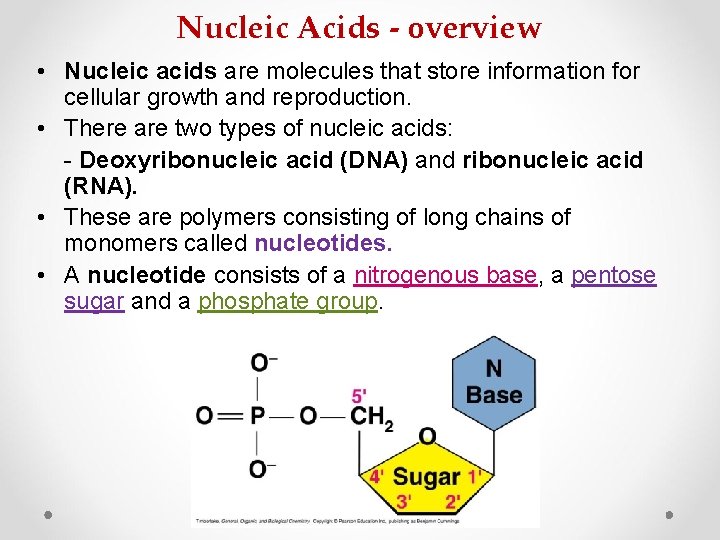
Nucleic Acids - overview • Nucleic acids are molecules that store information for cellular growth and reproduction. • There are two types of nucleic acids: - Deoxyribonucleic acid (DNA) and ribonucleic acid (RNA). • These are polymers consisting of long chains of monomers called nucleotides. • A nucleotide consists of a nitrogenous base, a pentose sugar and a phosphate group.

Nitrogen Bases • The nitrogen bases in nucleotides consist of two general types: - purines: adenine (A) and guanine (G) - pyrimidines: cytosine (C), thymine (T) and Uracil (U)
• The purines are the same in both DNA and RNA. • The pyrimidines are different in DNA than RNA: • In DNA: the pyrimidines are cytosine (C) and Thymine (T). • In RNA: the pyrimidines are cytosine (C) and Uracil (U).
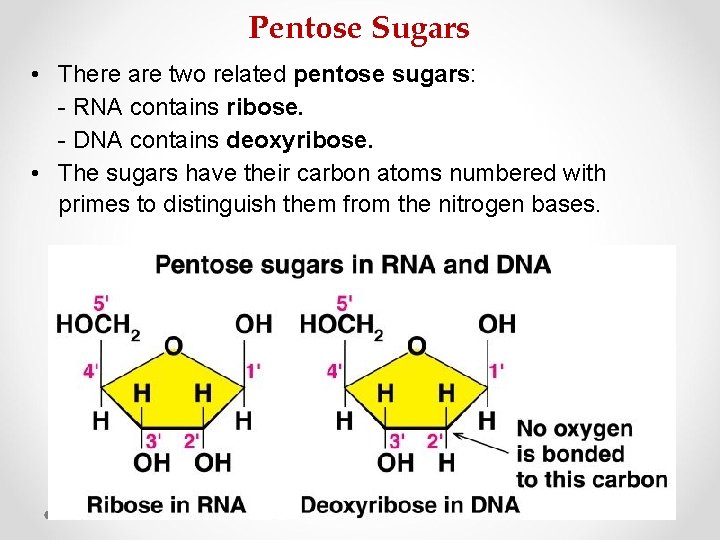
Pentose Sugars • There are two related pentose sugars: - RNA contains ribose. - DNA contains deoxyribose. • The sugars have their carbon atoms numbered with primes to distinguish them from the nitrogen bases.
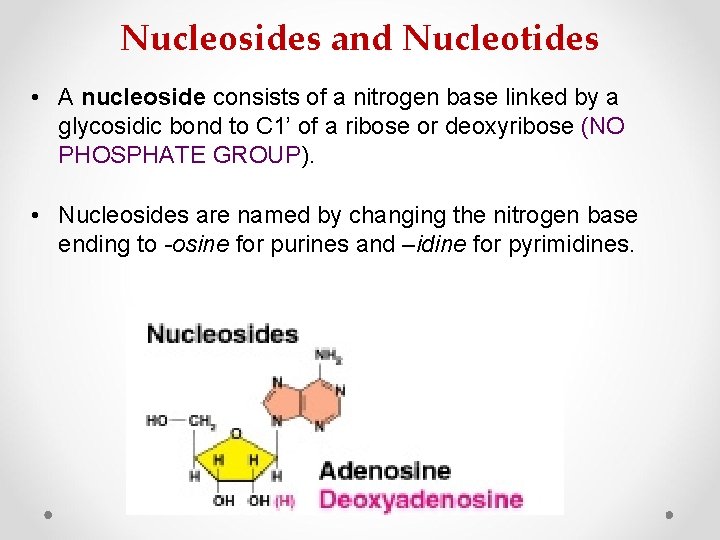
Nucleosides and Nucleotides • A nucleoside consists of a nitrogen base linked by a glycosidic bond to C 1’ of a ribose or deoxyribose (NO PHOSPHATE GROUP). • Nucleosides are named by changing the nitrogen base ending to -osine for purines and –idine for pyrimidines.
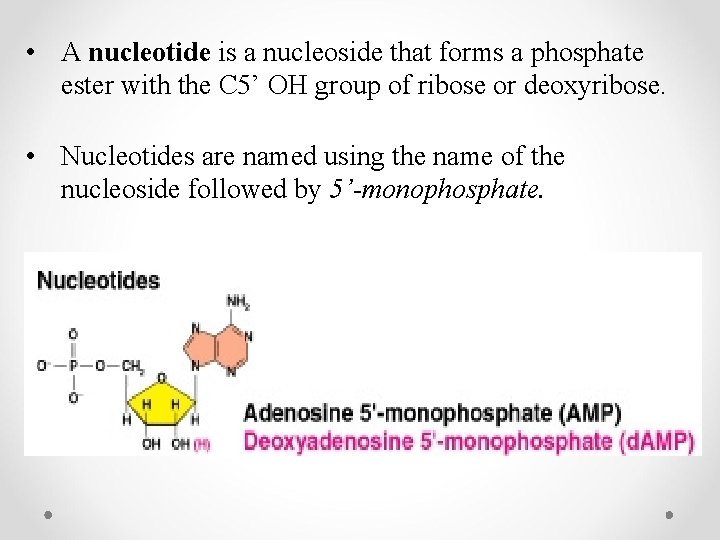
• A nucleotide is a nucleoside that forms a phosphate ester with the C 5’ OH group of ribose or deoxyribose. • Nucleotides are named using the name of the nucleoside followed by 5’-monophosphate.
DNA Structure
Nucleic Acids Structure • The primary structure of a nucleic acid is the nucleotide sequence. • The nucleotides in nucleic acids are joined by phosphodiester bonds. • The 3’-OH group of the sugar in one nucleotide forms an ester bond to the phosphate group on the 5’-carbon of the sugar of the next nucleotide.
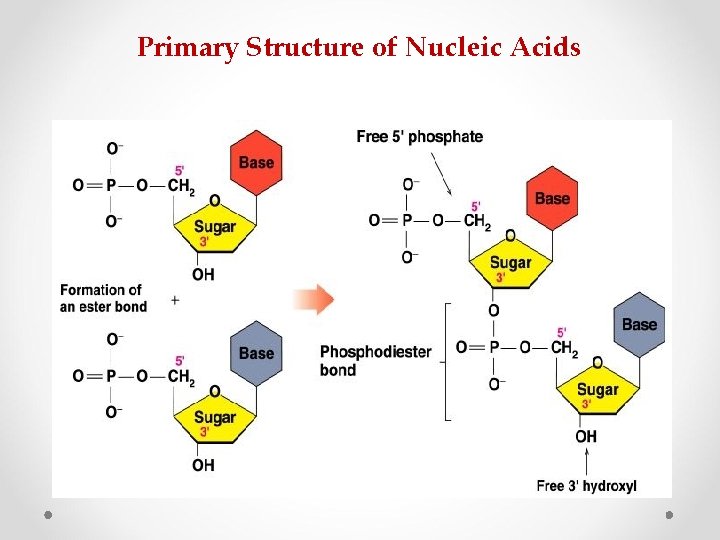
Primary Structure of Nucleic Acids
Secondary Structure: DNA Double Helix • In DNA there are two strands of nucleotides that wind together in a double helix. - the strands run in opposite directions. - the bases are arranged in step-like pairs. - the base pairs are held together by hydrogen bonding. • The pairing of the bases from the two strands is very specific (Chargaaff’s rules). • The complimentary base pairs are A-T and G-C - two hydrogen bonds form between A and T - three hydrogen bonds form between G and C • Each pair consists of a purine and a pyrimidine, so they are the same width, keeping the two strands at equal distances from each other.
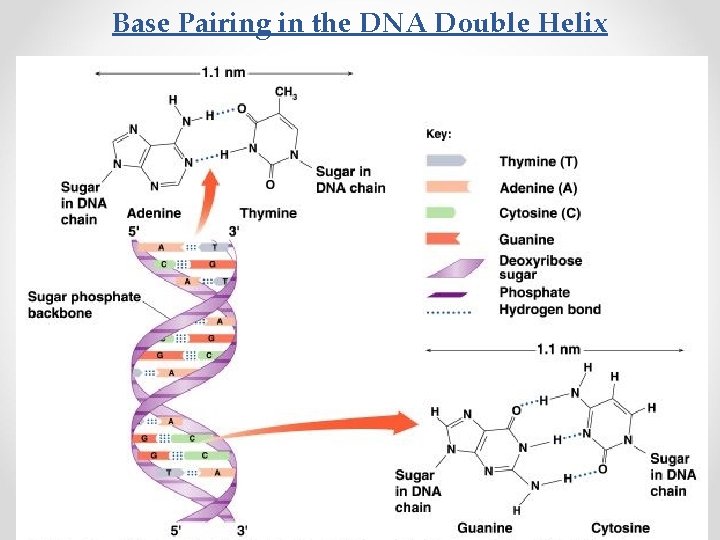
Base Pairing in the DNA Double Helix
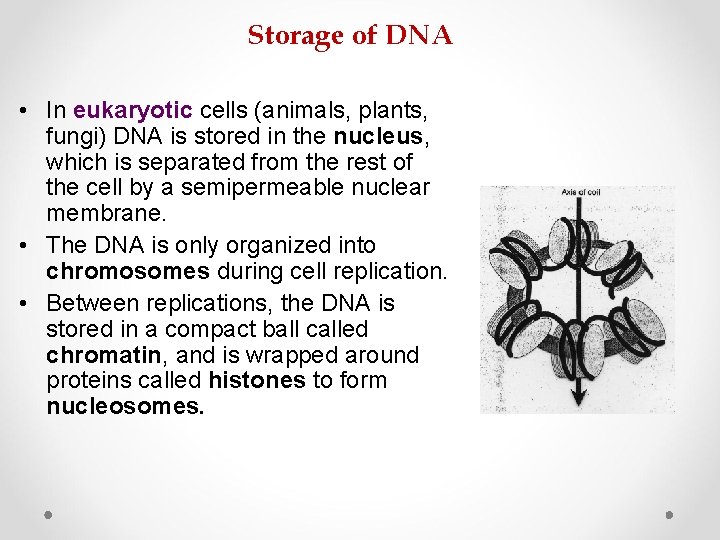
Storage of DNA • In eukaryotic cells (animals, plants, fungi) DNA is stored in the nucleus, which is separated from the rest of the cell by a semipermeable nuclear membrane. • The DNA is only organized into chromosomes during cell replication. • Between replications, the DNA is stored in a compact ball called chromatin, and is wrapped around proteins called histones to form nucleosomes.
DNA Replication
DNA Replication • When a eukaryotic cell divides, the process is called mitosis - the cell splits into two identical daughter cells. - the DNA must be replicated so that each daughter cell has a copy. • DNA replication involves several processes: 1. first, the DNA must be unwound, separating the two strands. 2. the single strands then act as templates for synthesis of the new strands, which are complimentary in sequence. 3. bases are added one at a time until two new DNA strands that exactly duplicate the original DNA are produced. • The process is called semi-conservative replication because one strand of each daughter DNA comes from the parent DNA and one strand is new.
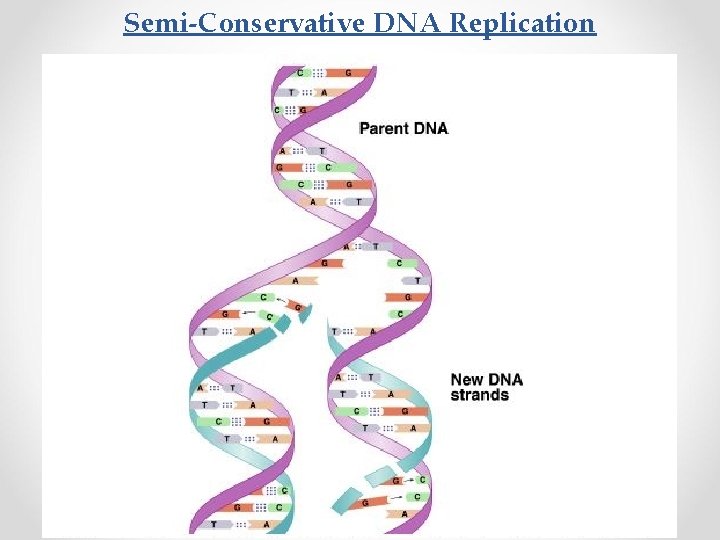
Semi-Conservative DNA Replication
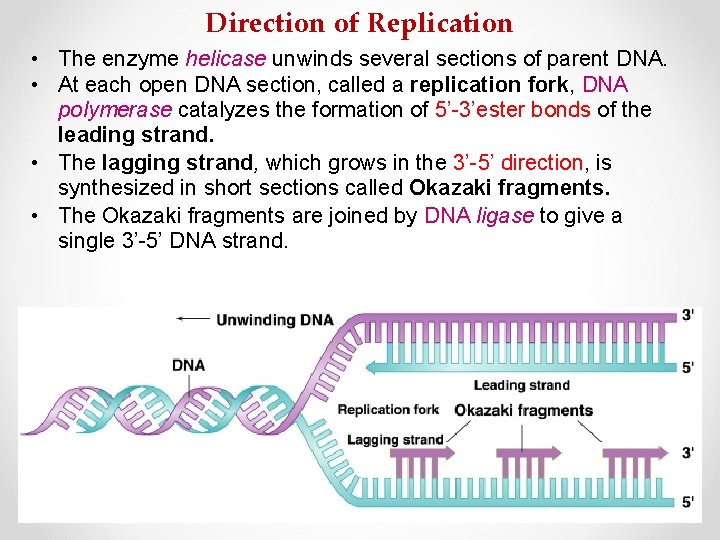
Direction of Replication • The enzyme helicase unwinds several sections of parent DNA. • At each open DNA section, called a replication fork, DNA polymerase catalyzes the formation of 5’-3’ester bonds of the leading strand. • The lagging strand, which grows in the 3’-5’ direction, is synthesized in short sections called Okazaki fragments. • The Okazaki fragments are joined by DNA ligase to give a single 3’-5’ DNA strand.
RNA
Ribonucleic Acid (RNA) • There are several important differences between RNA and DNA: 1. The pentose sugar in RNA is ribose, in DNA it’s deoxyribose. 2. In RNA, uracil replaces the base thymine (U pairs with A). 3. RNA is single stranded while DNA is double stranded. 4. RNA molecules are much smaller but more abundant than DNA molecules.
REFERENCES 1. Murray, R. , Bender, D. , Botham, K. , Kennelly, P. , Rodwell, V. , Weil. , P. (2012) Harper’s illustrated biochemistry, 29 th edition. Publisher: Mc. Graw Hill Lange. 2. Nelson, D. and Cox, M. (2008) Lehninger principles of biochemistry, 5 th edition. Publisher: W. H. Freeman and company, New York. 3. Harvey, R. and Ferrier, D. (2011) Lippincott’s illustrated reviews: biochemistry, 5 th edition. Publisher: Lippincott Williams & Wilkins. 20
- Slides: 20