
5 Notes on the Least Squares Estimate 1


- Slides: 15
(5) Notes on the Least Squares Estimate 1
Introduction • The quality of an estimate can be judged using the expected value and the covariance matrix of the estimated parameters. • The following theorem is an important tool to determine the quality of the least squares estimate. 2
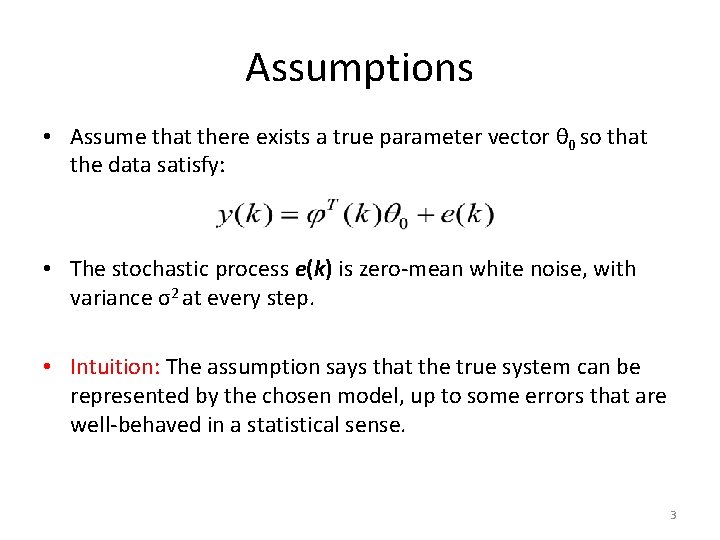
Assumptions • Assume that there exists a true parameter vector θ 0 so that the data satisfy: • The stochastic process e(k) is zero-mean white noise, with variance σ2 at every step. • Intuition: The assumption says that the true system can be represented by the chosen model, up to some errors that are well-behaved in a statistical sense. 3
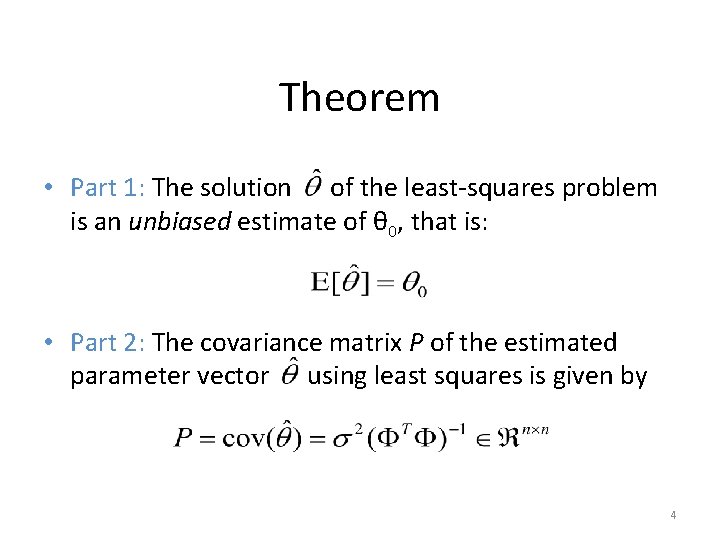
Theorem • Part 1: The solution of the least-squares problem is an unbiased estimate of θ 0, that is: • Part 2: The covariance matrix P of the estimated parameter vector using least squares is given by 4
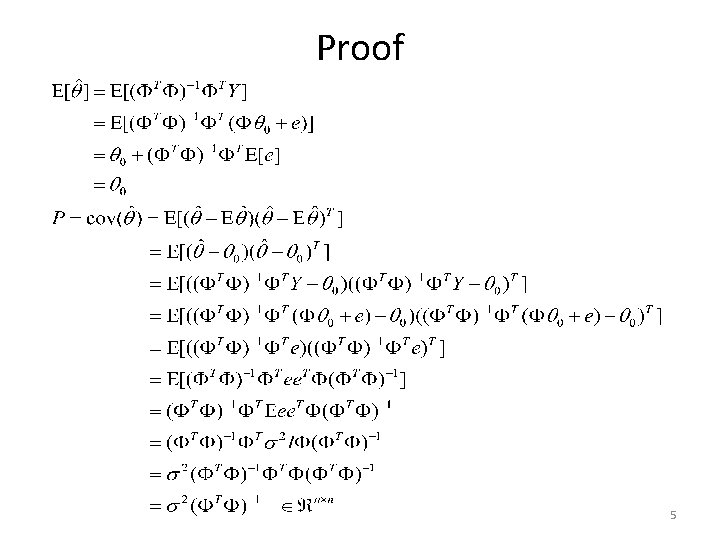
Proof 5
Remarks • Part 1 of theorem says that the solution makes (statistical) sense on average. • The ith diagonal element in the covariance matrix P is the variance of the ith parameter. The low is the variance of the estimated parameter, the higher is the confidence that it is close to its true value. • It can be seen that smaller errors e(k) (i. e. smaller variance σ2) yield smaller parameter covariance. 6
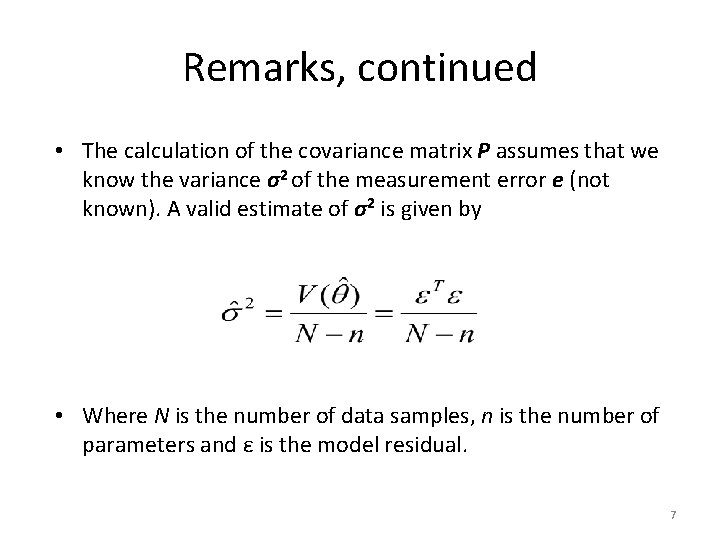
Remarks, continued • The calculation of the covariance matrix P assumes that we know the variance σ2 of the measurement error e (not known). A valid estimate of σ2 is given by • Where N is the number of data samples, n is the number of parameters and ε is the model residual. 7
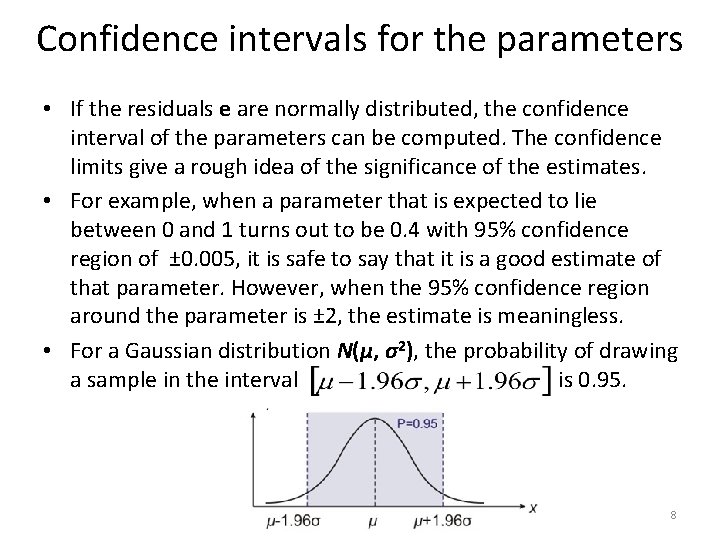
Confidence intervals for the parameters • If the residuals e are normally distributed, the confidence interval of the parameters can be computed. The confidence limits give a rough idea of the significance of the estimates. • For example, when a parameter that is expected to lie between 0 and 1 turns out to be 0. 4 with 95% confidence region of ± 0. 005, it is safe to say that it is a good estimate of that parameter. However, when the 95% confidence region around the parameter is ± 2, the estimate is meaningless. • For a Gaussian distribution N(µ, σ2), the probability of drawing a sample in the interval is 0. 95. 8
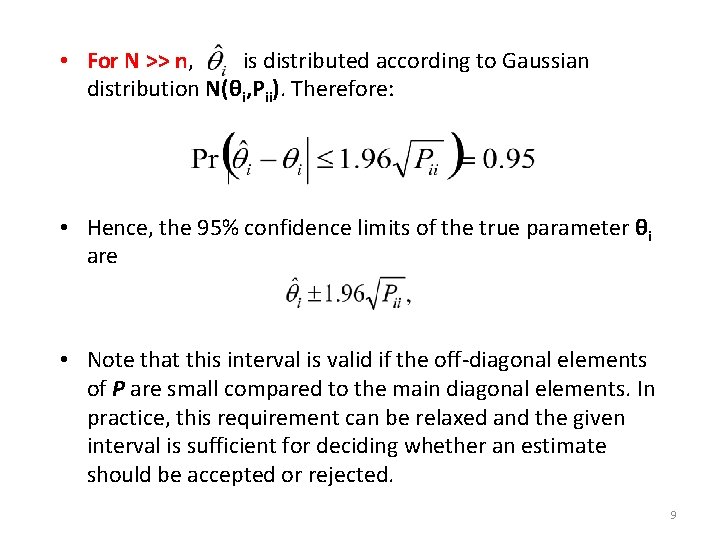
• For N >> n, is distributed according to Gaussian distribution N(θi, Pii). Therefore: • Hence, the 95% confidence limits of the true parameter θi are • Note that this interval is valid if the off-diagonal elements of P are small compared to the main diagonal elements. In practice, this requirement can be relaxed and the given interval is sufficient for deciding whether an estimate should be accepted or rejected. 9
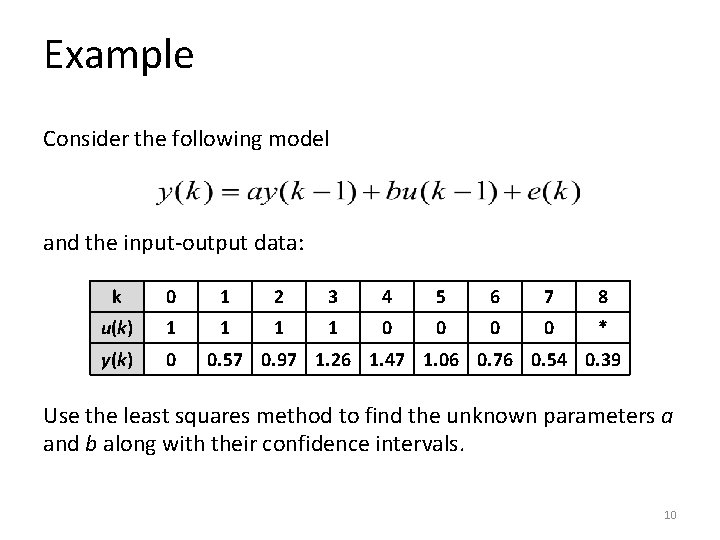
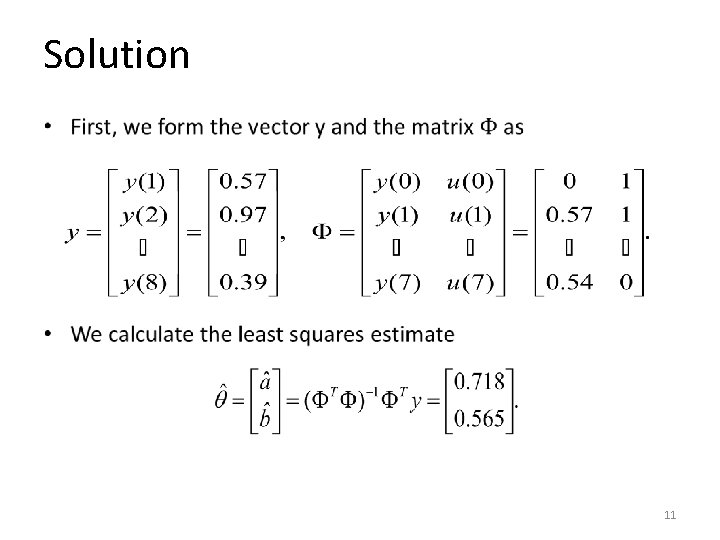
Example Consider the following model and the input-output data: k 0 1 2 3 4 5 6 7 8 u(k) 1 1 0 0 * y(k) 0 0. 57 0. 97 1. 26 1. 47 1. 06 0. 76 0. 54 0. 39 Use the least squares method to find the unknown parameters a and b along with their confidence intervals. 10
Solution • 11
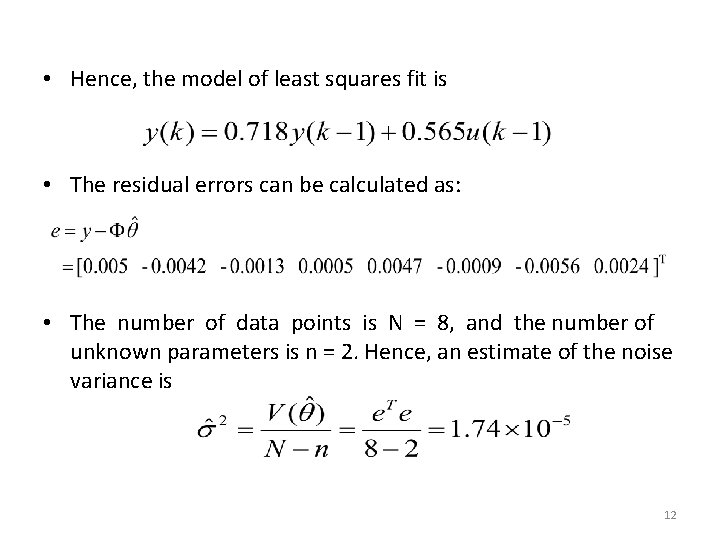
• Hence, the model of least squares fit is • The residual errors can be calculated as: • The number of data points is N = 8, and the number of unknown parameters is n = 2. Hence, an estimate of the noise variance is 12
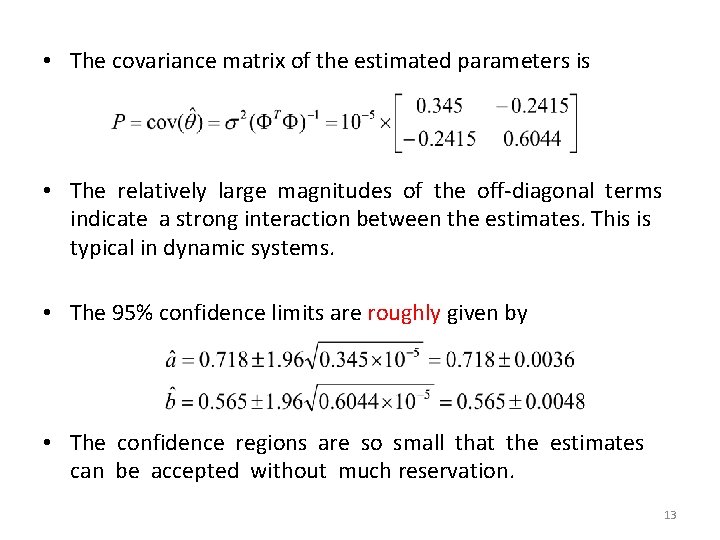
• The covariance matrix of the estimated parameters is • The relatively large magnitudes of the off-diagonal terms indicate a strong interaction between the estimates. This is typical in dynamic systems. • The 95% confidence limits are roughly given by • The confidence regions are so small that the estimates can be accepted without much reservation. 13
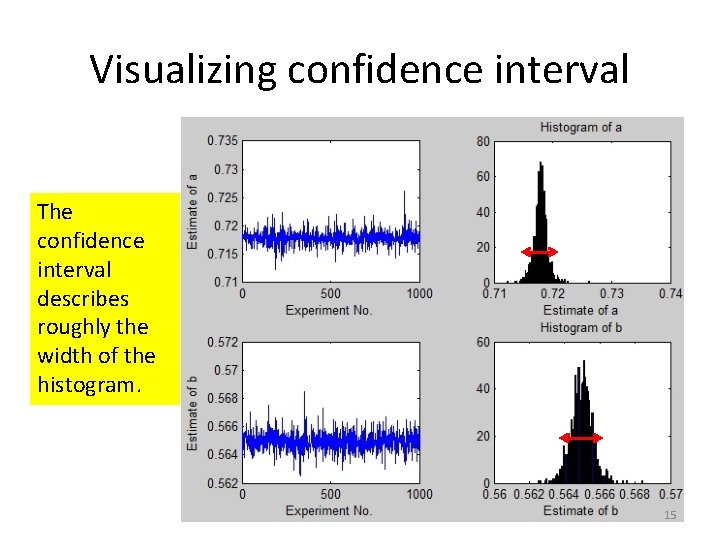
Visualization of the confidence interval • To visualize the confidence intervals, imagine that we repeat the previous experiment 1000 times. • In each experiment, we use 8 input-output data points and the least squares to find an estimate of the parameters. • The empirical distribution (histogram) of the estimated parameters are shown in the next slide. 14
Visualizing confidence interval The confidence interval describes roughly the width of the histogram. 15